
the Creative Commons Attribution 4.0 License.
the Creative Commons Attribution 4.0 License.
 | 20 Sep 2024
Revisiting the Sunspot Number as EUV proxy for ionospheric F2 critical frequency
Abstract. This study reconsiders the Sunspot Number (Sn) as a solar extreme ultraviolet (EUV) proxy for modeling the ionospheric F2 layer's critical frequency (foF2) over the period 1960–2023. We compare the performance of Sn with F10.7 and F30 solar radio fluxes, focusing on their ability to model the Global Ionospheric index (IG). Our results reveal that while F30 has shown a better correlation in recent solar cycles, the Sn is the most stable and reliable over the entire dataset, obtaining the highest correlation. In addition, if we remove the saturation effects from the considering a maximum value of Sn, the correlation increases, outperforming all other proxies, and predicting correctly the long-term trend estimated by general circulation models.
Competing interests: At least one of the (co-)authors is a member of the editorial board of Annales Geophysicae. The peer-review pro- cess was guided by an independent editor, and the authors also have no other competing interests to declare.
Publisher's note: Copernicus Publications remains neutral with regard to jurisdictional claims made in the text, published maps, institutional affiliations, or any other geographical representation in this paper. While Copernicus Publications makes every effort to include appropriate place names, the final responsibility lies with the authors. Views expressed in the text are those of the authors and do not necessarily reflect the views of the publisher.-
Notice on discussion status
The requested preprint has a corresponding peer-reviewed final revised paper. You are encouraged to refer to the final revised version.
-
Preprint
(1773 KB)
-
The requested preprint has a corresponding peer-reviewed final revised paper. You are encouraged to refer to the final revised version.
- Preprint
(1773 KB) - Metadata XML
- BibTeX
- EndNote
- Final revised paper


Journal article(s) based on this preprint
Interactive discussion
Status: closed
-
RC1: 'Comment on egusphere-2024-2828', Anonymous Referee #1, 05 Oct 2024
-
AC1: 'Reply on RC1', Bruno S. Zossi, 10 Oct 2024
Thank you for your comments.
We would greatly appreciate it if you could elaborate on any specific points or aspects of our approach or conclusions that you may not fully agree with. To be honest, we were also surprised by this result, since we claimed F30 and MgII as the best solar proxies in previous works. However, as we mentioned, the use of a reduced period in those analysis could be the reason.About your critical comments:
- The statement in line 143-144 is: “Among them, the more reliable were always the oldest, the sunspot number, and the solar fluxes at radio wavelengths…” It is hardly correct, because in many publications of the authors, as well as in the papers by Lastovicka and Russian group, the sunspot number was behind the F30, MgII and even Ly-a proxies.
You are right. We were referring to the historical context. We will clarify this in the revised version.
- The authors state that the trend in foF2 they show at the end of the paper is close to theoretical estimates. However, it is worth mentioning that -0.79% per decade is much lower than the estimates based in the experimental data in many publications, including the authors recent papers. A value of -0.079% per year means (if we conventionally take average foF2 as 10 MHz) –0.0079 MHz per year. In the majority of recent papers, the trends are obtained of the order of –(0.02-0.05) MHz/year. I think that it is worth mentioning it in the paper.
You are correct. Using only data during minimum solar activity level, we obtain a trend which matches modeled foF2 trends forced by the increase in greenhouse gas concentration. We will include your comment in the revised version of our work. Specially, that in the majority of recent papers, the experimental trends are obtained of the order of –(0.02-0.05) MHz/year, that is an order of magnitude greater than the theoretical value, while our trend estimation, based on considering minimum epochs, has a closer agreement.
Citation: https://doi.org/10.5194/egusphere-2024-2828-AC1 -
RC2: 'Reply on AC1', Anonymous Referee #1, 10 Oct 2024
I am completely satisfied by the authors responses to my comments in the previous reveiw. As for my
disagreement to some points, it should not prevail the paper form publications.
Citation: https://doi.org/10.5194/egusphere-2024-2828-RC2 -
AC3: 'Reply on RC2', Bruno S. Zossi, 06 Nov 2024
OK, thank you.
Citation: https://doi.org/10.5194/egusphere-2024-2828-AC3
-
AC3: 'Reply on RC2', Bruno S. Zossi, 06 Nov 2024
-
AC1: 'Reply on RC1', Bruno S. Zossi, 10 Oct 2024
-
RC3: 'Comment on egusphere-2024-2828', Anonymous Referee #2, 18 Oct 2024
Review comments on the paper ’ Revisiting the Sunspot Number as EUV proxy for ionospheric F2 critical frequency’ by Bruno S. Zossi, Franco D. Medina, Trinidad Duran, Blas F. de Haro Barbas and Ana G.
The paper examines the Sunspot Number (Sn) as a solar extreme ultraviolet (EUV) proxy for modeling the critical frequency of the ionospheric F2 layer (foF2) over the period 1960-2023. The authors compared Sn with solar radio fluxes F10.7 and F30 in relation to the ionospheric index IG. They found that for recent solar cycles, F30 provides a better correlation, while for earlier solar cycles, Sn shows a stronger correlation. Furthermore, by removing the saturation effect from the Sn dataset, the correlation with the Global Ionospheric Index (IG) is improved, enhancing the accuracy of long-term trend predictions.
General Comments
While this issue has been discussed extensively in previous studies, and the results vary across different papers, as the authors have noted, the choice of solar index is crucial for long-term trend studies where the dependence of foF2 on the solar cycle must be removed through regression with a solar index (such as Sunspot Numbers, F10.7, etc.).
Mikhailov et al. (2017) [doi:10.1002/2017JA023909] found a strong relationship between foE and R12, while for long-term foF2 studies, many researchers use F10.7.
For this reason, the study is noteworthy, and it may encourage other researchers to compare their results using different solar indices. The paper is suitable for acceptance in its current form.
Citation: https://doi.org/10.5194/egusphere-2024-2828-RC3 -
AC2: 'Reply on RC3', Bruno S. Zossi, 31 Oct 2024
Thank you very much for your positive comments.
We will add Mikhailov et al. (2017) discussions about the use of Rz in the E layer and its possible similarities in F2.Citation: https://doi.org/10.5194/egusphere-2024-2828-AC2
-
AC2: 'Reply on RC3', Bruno S. Zossi, 31 Oct 2024
Peer review completion


Interactive discussion
Status: closed
-
RC1: 'Comment on egusphere-2024-2828', Anonymous Referee #1, 05 Oct 2024
Reviewer comments to the paper by Zossi et al. “Revising the sunspot number…”
The problem of long-term changes in the ionospheric F2 region is widely known and numerously considered in literature. A choice of proper solar proxy to reject the solar activity (SA) effects in the initial data is a very important point of all such considerations.
The authors have numerously discussed that point deriving trends in the critical frequency foF2 and height hmF2 of the ionospheric F2 layer. Their conclusions were that the best SA proxies for deriving ionospheric trends are F30 and MgII.
In the Introduction, the authors briefly describe the problem and emphasize the need in selection of the best SA proxies for describing F2-layer parameters behavior and looking for their trends.
In the paper under review, the solar proxies Rz, F30 and F10.7 and considered. Their ability to model foF2 for the period 1960-2023 is analyzed. To do that, the well-known ionospheric index
IG is considered.
The foF2 monthly medians obtained at 10 ionospheric stations (both in the Northern and Southern Hemispheres) are used as initial data. Some “cleaning” of the initial data is briefly described.
The mean values of foF2 at 10 stations are compared to the IG index over the 1960-2023 period. Fig.1 demonstrates that the agreement is excellent (R2 =0.996).
The authors are using several approaches to the comparison of foF2 description by the three SA proxies. The results of the firs approach are shown in Fig. 2. It shows the 11-year moving squared linear correlation between IG and solar proxies and demonstrates that the F10.7 proxy provides in some periods a relatively low correlation (R2 below 0.96) as compared to F30 and Rz. I think that is a good explanation of the fact that F10.7 is found the worst in many publications dealing with ionospheric trends.
In the second approach, the authors perform a linear modeling of IG with F30 and RZ and compare the results with the observed IG. Their point here is that around 2020 the real IGs go slightly lower than the modeled IGs and that could be a cause of negative trends in foF2 obtained by many authors within the recent decade. That conclusion is in a slightly different way supported by Fig. 4 (left).
In the third approach, the authors show (Fig. 5) the linear and quadratic regression between proxies and IG separately for periods 1960-1997 and 1985-2023. Again, they see different results in different periods. Rz and F30 are the best in the first and second periods, respectively.
Then the authors try to get rid of the saturation effect in the foF2 dependence on Rz. They state that the “de-saturating” improves substantially the correlation between Rz and IG.
The results of application of the linear regression with different SA proxies to the observations at all 10 aforementioned stations are shown in Table 1. The authors claim that “…quadratic regression using Sn is, on average, the most effective to predict the ionospheric foF2, followed by Sn de-saturated and quadratic F10.7”.
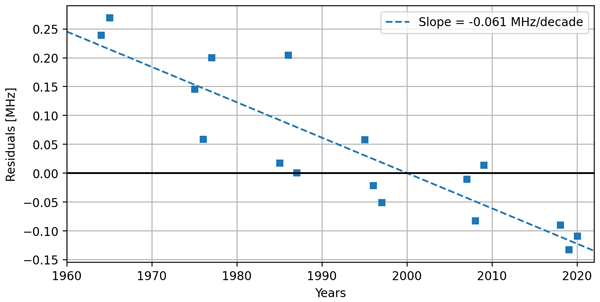
The authors estimate briefly the foF2 trends with using Rz as an SA proxy. Analyzing only the years of solar minima, they obtain a trend of -0.79% per decade. They clime that it is in a good agreement with the results of trend modeling.
I have to confess that I agree not to all approaches and conclusions of the authors. However, I think that there are some interesting and unexpected results which would make over researchers in the field to consider in their trend studies. I recommend the paper for publication with minor revision.
Me critical comments are as follows.
- The statement in line 143-144 is: “Among them, the more reliable were always the oldest, the sunspot number, and the solar fluxes at radio wavelengths…” It is hardly correct, because in many publications of the authors, as well as in the papers by Lastovocka and Russian group, the sunspot number was behind the F30, MgII and even Ly-a proxies.
- The authors state that the trend in foF2 they show at the end of the paper is close to theoretical estimates. However, it is worth mentioning that -0.79% per decade is much lower than the estimates based in the experimental data in many publications, including the authors recent papers. A value of -0.079% per year means (if we conventionally take average foF2 as 10 MHz) –0.0079 MHz per year. In the majority of recent papers, the trends are obtained of the order of –(0.02-0.05) MHz/year. I think that it is worth mentioning it in the paper.
-
AC1: 'Reply on RC1', Bruno S. Zossi, 10 Oct 2024
Thank you for your comments.
We would greatly appreciate it if you could elaborate on any specific points or aspects of our approach or conclusions that you may not fully agree with. To be honest, we were also surprised by this result, since we claimed F30 and MgII as the best solar proxies in previous works. However, as we mentioned, the use of a reduced period in those analysis could be the reason.About your critical comments:
- The statement in line 143-144 is: “Among them, the more reliable were always the oldest, the sunspot number, and the solar fluxes at radio wavelengths…” It is hardly correct, because in many publications of the authors, as well as in the papers by Lastovicka and Russian group, the sunspot number was behind the F30, MgII and even Ly-a proxies.
You are right. We were referring to the historical context. We will clarify this in the revised version.
- The authors state that the trend in foF2 they show at the end of the paper is close to theoretical estimates. However, it is worth mentioning that -0.79% per decade is much lower than the estimates based in the experimental data in many publications, including the authors recent papers. A value of -0.079% per year means (if we conventionally take average foF2 as 10 MHz) –0.0079 MHz per year. In the majority of recent papers, the trends are obtained of the order of –(0.02-0.05) MHz/year. I think that it is worth mentioning it in the paper.
You are correct. Using only data during minimum solar activity level, we obtain a trend which matches modeled foF2 trends forced by the increase in greenhouse gas concentration. We will include your comment in the revised version of our work. Specially, that in the majority of recent papers, the experimental trends are obtained of the order of –(0.02-0.05) MHz/year, that is an order of magnitude greater than the theoretical value, while our trend estimation, based on considering minimum epochs, has a closer agreement.
Citation: https://doi.org/10.5194/egusphere-2024-2828-AC1 -
RC2: 'Reply on AC1', Anonymous Referee #1, 10 Oct 2024
I am completely satisfied by the authors responses to my comments in the previous reveiw. As for my
disagreement to some points, it should not prevail the paper form publications.
Citation: https://doi.org/10.5194/egusphere-2024-2828-RC2 -
AC3: 'Reply on RC2', Bruno S. Zossi, 06 Nov 2024
OK, thank you.
Citation: https://doi.org/10.5194/egusphere-2024-2828-AC3
-
AC3: 'Reply on RC2', Bruno S. Zossi, 06 Nov 2024
-
RC3: 'Comment on egusphere-2024-2828', Anonymous Referee #2, 18 Oct 2024
Review comments on the paper ’ Revisiting the Sunspot Number as EUV proxy for ionospheric F2 critical frequency’ by Bruno S. Zossi, Franco D. Medina, Trinidad Duran, Blas F. de Haro Barbas and Ana G.
The paper examines the Sunspot Number (Sn) as a solar extreme ultraviolet (EUV) proxy for modeling the critical frequency of the ionospheric F2 layer (foF2) over the period 1960-2023. The authors compared Sn with solar radio fluxes F10.7 and F30 in relation to the ionospheric index IG. They found that for recent solar cycles, F30 provides a better correlation, while for earlier solar cycles, Sn shows a stronger correlation. Furthermore, by removing the saturation effect from the Sn dataset, the correlation with the Global Ionospheric Index (IG) is improved, enhancing the accuracy of long-term trend predictions.
General Comments
While this issue has been discussed extensively in previous studies, and the results vary across different papers, as the authors have noted, the choice of solar index is crucial for long-term trend studies where the dependence of foF2 on the solar cycle must be removed through regression with a solar index (such as Sunspot Numbers, F10.7, etc.).
Mikhailov et al. (2017) [doi:10.1002/2017JA023909] found a strong relationship between foE and R12, while for long-term foF2 studies, many researchers use F10.7.
For this reason, the study is noteworthy, and it may encourage other researchers to compare their results using different solar indices. The paper is suitable for acceptance in its current form.
Citation: https://doi.org/10.5194/egusphere-2024-2828-RC3 -
AC2: 'Reply on RC3', Bruno S. Zossi, 31 Oct 2024
Thank you very much for your positive comments.
We will add Mikhailov et al. (2017) discussions about the use of Rz in the E layer and its possible similarities in F2.Citation: https://doi.org/10.5194/egusphere-2024-2828-AC2
-
AC2: 'Reply on RC3', Bruno S. Zossi, 31 Oct 2024
Peer review completion
Journal article(s) based on this preprint
Viewed
| HTML | XML | Total | BibTeX | EndNote | |
|---|---|---|---|---|---|
| 1,195 | 653 | 1,852 | 3,700 | 107 | 163 |
- HTML: 1,195
- PDF: 653
- XML: 1,852
- Total: 3,700
- BibTeX: 107
- EndNote: 163
Viewed (geographical distribution)
| Country | # | Views | % |
|---|
| Total: | 0 |
| HTML: | 0 |
| PDF: | 0 |
| XML: | 0 |
- 1

Franco D. Medina
Trinidad Duran
Blas F. de Haro Barbas
Ana G. Elias
The requested preprint has a corresponding peer-reviewed final revised paper. You are encouraged to refer to the final revised version.
- Preprint
(1773 KB) - Metadata XML
Reviewer comments to the paper by Zossi et al. “Revising the sunspot number…”
The problem of long-term changes in the ionospheric F2 region is widely known and numerously considered in literature. A choice of proper solar proxy to reject the solar activity (SA) effects in the initial data is a very important point of all such considerations.
The authors have numerously discussed that point deriving trends in the critical frequency foF2 and height hmF2 of the ionospheric F2 layer. Their conclusions were that the best SA proxies for deriving ionospheric trends are F30 and MgII.
In the Introduction, the authors briefly describe the problem and emphasize the need in selection of the best SA proxies for describing F2-layer parameters behavior and looking for their trends.
In the paper under review, the solar proxies Rz, F30 and F10.7 and considered. Their ability to model foF2 for the period 1960-2023 is analyzed. To do that, the well-known ionospheric index
IG is considered.
The foF2 monthly medians obtained at 10 ionospheric stations (both in the Northern and Southern Hemispheres) are used as initial data. Some “cleaning” of the initial data is briefly described.
The mean values of foF2 at 10 stations are compared to the IG index over the 1960-2023 period. Fig.1 demonstrates that the agreement is excellent (R2 =0.996).
The authors are using several approaches to the comparison of foF2 description by the three SA proxies. The results of the firs approach are shown in Fig. 2. It shows the 11-year moving squared linear correlation between IG and solar proxies and demonstrates that the F10.7 proxy provides in some periods a relatively low correlation (R2 below 0.96) as compared to F30 and Rz. I think that is a good explanation of the fact that F10.7 is found the worst in many publications dealing with ionospheric trends.
In the second approach, the authors perform a linear modeling of IG with F30 and RZ and compare the results with the observed IG. Their point here is that around 2020 the real IGs go slightly lower than the modeled IGs and that could be a cause of negative trends in foF2 obtained by many authors within the recent decade. That conclusion is in a slightly different way supported by Fig. 4 (left).
In the third approach, the authors show (Fig. 5) the linear and quadratic regression between proxies and IG separately for periods 1960-1997 and 1985-2023. Again, they see different results in different periods. Rz and F30 are the best in the first and second periods, respectively.
Then the authors try to get rid of the saturation effect in the foF2 dependence on Rz. They state that the “de-saturating” improves substantially the correlation between Rz and IG.
The results of application of the linear regression with different SA proxies to the observations at all 10 aforementioned stations are shown in Table 1. The authors claim that “…quadratic regression using Sn is, on average, the most effective to predict the ionospheric foF2, followed by Sn de-saturated and quadratic F10.7”.
The authors estimate briefly the foF2 trends with using Rz as an SA proxy. Analyzing only the years of solar minima, they obtain a trend of -0.79% per decade. They clime that it is in a good agreement with the results of trend modeling.
I have to confess that I agree not to all approaches and conclusions of the authors. However, I think that there are some interesting and unexpected results which would make over researchers in the field to consider in their trend studies. I recommend the paper for publication with minor revision.
Me critical comments are as follows.