
the Creative Commons Attribution 4.0 License.
the Creative Commons Attribution 4.0 License.
 | 09 Mar 2026
Probabilistic avalanche runout modelling for daily risk management of traffic routes
Abstract. In alpine regions, snow avalanches endanger infrastructure such as roads, ski slopes and buildings. While permanent protection measures minimize avalanche impact, local experts must implement additional safety measures such as road or ski slope closures during critical situations. To support this demanding decision-making process, we propose a framework that can be used on a daily basis to calculate avalanche probability indication maps of potential avalanche runout extents and intensities. The probability indication maps are generated by running multiple avalanche simulations, based on an ensemble of estimations of input parameters derived from weather station measurements and weather forecasts, to assess a range of possible scenarios, e.g. for fracture depth, maximum erosion depth and snow temperature. We aim to identify the minimum number of input parameters needed to meaningfully represent daily snowpack conditions. In this project, we focus on cold snow conditions that produce powder snow avalanches. To evaluate the quality of the proposed probability indication maps, we conduct a hindcast for four well-documented avalanche events around Davos, Switzerland, using meteorological station data from the day before the avalanches released, weather forecast and SNOWPACK simulations. For validation we compare the resulting predictions to the measured outlines of the avalanche cores. This study demonstrates how real-time weather and snowpack data can be utilized effectively to provide practitioners with an overview of the current avalanche situation to support their decision-making process. In the future, such approaches could be implemented into more data-based decision-making processes to better protect traffic infrastructure in high-risk avalanche hazard areas.
-
Notice on discussion status
The requested preprint has a corresponding peer-reviewed final revised paper. You are encouraged to refer to the final revised version.
-
Preprint
(44674 KB)
-
The requested preprint has a corresponding peer-reviewed final revised paper. You are encouraged to refer to the final revised version.
- Preprint
(44674 KB) - Metadata XML
- BibTeX
- EndNote
- Final revised paper


Journal article(s) based on this preprint
Interactive discussion
Status: closed
-
RC1: 'Comment on egusphere-2026-999', Andrea Bruckmeier & Erich Peitzsch (co-review team), 22 May 2026
-
AC1: 'Reply on RC1', Julia Glaus, 16 Jun 2026
Dear Editor and Referees,
We greatly appreciate your detailed and constructive feedback. This has been invaluable for further enhancing the quality of our manuscript. We have listed your comments into the blue boxes and enumerated them so that we can address each part separately below. We have marked the comments from the co-author team, Andrea Bruckmeier and Erich Peitzsch as R1, and we have added our potential changes and insights. The provided lines numbers refer to the original manuscript.
Sincerely, Julia Glaus & Co-Authors
-
AC1: 'Reply on RC1', Julia Glaus, 16 Jun 2026
-
RC2: 'Comment on egusphere-2026-999', Andrea Bruckmeier & Erich Peitzsch (co-review team), 22 May 2026
Dear authors and editors,
The manuscript introduces an innovative framework to support operational decision making for avalanche forecasting and road closures combining probabilistic avalanche runout modeling with meteorological input and snow cover simulations. Specifically, combining weather station data and snow cover simulation outputs to better assess potential fracture depths, snowpack characteristics and snow conditions within the avalanche path displayed in a probability indication map provide a huge potential for daily avalanche forecasting.
The maps present a hit probability for the avalanche path and runout that is calculated mainly based on the frequency approach. Only one scenario is additionally calculated based on the stability approach. The frequency approach considers the probability for a certain snow loading and weak-layer interaction to define fracture depth classes to calculate the hit probability. This approach does weigh the probabilities of new snow and buried weak layer equally and is less complex on necessary input variables as compared to the stability approach. The results for the 2019 event show that the higher probability values match the observed avalanche paths well using the frequency approach. In 2025, the probability indication maps differ from the real avalanche runout mainly due to differences in weak layer characteristics influenced by the slope exposure. This shows us how sensitive the framework is to the quality and availability of input variables.
The authors describe the background and the objectives well in the Introduction. The Methods are very detailed describing the used approaches. However, this section would benefit from additional clarification, particularly regarding the definition of the validation events (see comments). The Results are comprehensive, and the Discussion provides a reasonable interpretation of the findings and limitations. Additional detail on the study design, results, and broader context could further strengthen the overall manuscript (see comments).
I am very grateful for the opportunity to review this manuscript. Overall, I think this is a promising manuscript that provides a framework combining daily snowpack conditions and terrain with runout probability that can potentially be used in avalanche operations. The authors’ approach to identifying the least amount of input parameter necessary for the most representative daily snowpack conditions makes this paper particularly meaningful and potentially applicable in different regions. After minor revisions, this paper is a valuable contribution and relevant advancement for operational decision-making processes for avalanche risk management along infrastructure corridors.
This is a co-review with my supervisor, Dr. Erich Peitzsch.General Comments
- Validation dataset
Considering the complexity, data availability, time requirements, and resources necessary to analyze each event in the level of detail presented in this manuscript, the reduced number of analyzed events appears justified. Nevertheless, it may be beneficial to acknowledge this more explicitly as a potential limitation within the discussion section, rather than only briefly mentioning it in the conclusion. While the arguments for the selective approach are logical, clarifying this point earlier in the manuscript could strengthen the transparency of the study.
- Dataset description
As a reader, I found the description of the analyzed dataset somewhat difficult to follow. In the Test Site and Data section (Section 2), four avalanche events for validation are introduced, although only three of these are described in greater detail. It is not entirely clear whether these refer to the same avalanches, whether each avalanche event contains multiple avalanches, or whether each case study includes several individual events, as implied later in the manuscript (L255).
In Figure 5, I can only identify three events. The dashed and dotted lines may indicate additional avalanches occurring on specific days; if so, this could be clarified in the figure caption. Furthermore, Section 4.3 introduces additional historical avalanche events. Although this is briefly mentioned in the final paragraph of Section 2, Figure 3 gives the impression that more avalanches were analyzed, rather than only four additional years.
To improve clarity, it may be helpful to display only the avalanches included in the analyses and to distinguish more clearly between validation data and additional datasets. In addition, displaying all events in a table including event, location, trigger and runout location and consistently referring to each event throughout the manuscript using a standardized naming code could greatly improve readability and help the reader follow the analysis.
- MAE for data-sparse areas
Many data-sparse forecasting regions often rely on only one or two weather stations. Therefore, rather than emphasizing the reduction from seven to six or five weather stations, a more detailed comparison using only one or two stations may provide a more practically relevant assessment.
- Frequency and stability approach
It would be helpful to include a brief explanation around L256 regarding the decision to use the frequency approach instead of the stability approach. Although both methods are described in detail in the methods section, the stability approach is only applied in one specific scenario. Expanding the discussion of the two approaches (L336-L342), particularly emphasizing the advantages and applicability of the frequency approach, would strengthen the manuscript.
- Meteorological input data
I would suggest including an overview of the parameters and variables derived from the weather stations that were used to force SNOWPACK, as well as the parameters applied for forecasting daily conditions.
In addition to weather station density, the availability of specific meteorological variables may represent a critical limitation for implementing this approach in other regions. Discussing this aspect could improve the broader applicability of the study.
- Artificial Triggering vs. Natural Avalanches
It appears that the three avalanches as described in Section 2 were all artificially triggered. How does using artificially triggered avalanches to validate the probability maps whether using frequency or stability approach factor into the results? In other words, are the release probability and subsequent runout independent of triggering mechanism (natural vs. explosive/artificial)? When using the historical data (Section 4.3) for evaluating the workflow/model chain, were these avalanches naturally occurring or artificially triggered? Additionally, the authors mention that “the release zones are derived using a return-period-based algorithm” (Line 360). Is this return period based on natural or artificial triggering. I think this topic deserves some explanation given the validation avalanches are all artificially triggered.
Specific Comments
- Figure 2a: Without reading the accompanying text, it is not immediately clear what the values 0, 1, 2, and 3 represent, or why the distances of 1 km, 2 km, and 3 km are important in this context.
Additionally, from the map alone it is difficult to identify the terrain flattening where most avalanches stop. Including a slope profile may help illustrate this more clearly.
- Figure 2b: It is unclear what the blue line represents. Does it indicate dependencies of the avalanches? For example, from 3.4 to 4.0 km the line remains at one avalanche: does this indicate that one single avalanche reached this road section, and it was the same avalanche for this entire section? Maybe you could include a short explanation in the figure description?
- L136: “on January 28” please use the standard English date format consistently throughout the manuscript (Month Day, Year). This comment applies generally across the manuscript.
- Figure 3: The distinction between “Road closures” and “Days with road closures” is not immediately clear and could be clarified further.
Additionally, consider replacing “November till May” with “November to May” for more formal language.
- Figure 4: I think this conceptual diagram of the workflow could use some improvement. I think including the specific input data for ‘Meteorological Data & Forecast’ that is used in SNOWPACK is important. Additionally, include where the frequency and stability approaches are used in the workflow. Finally, include which data (historical and 2019 and 2025 events) are used for validation and how that is incorporated to tune the workflow.
- Figure 5: Please clarify the meaning of the dashed versus dotted lines in the caption. Additionally, the x-axis may not need to be labeled as “Date.”
- Figure 7: Consider labeling each panel as a, b, c, etc. The graphs at the bottom may benefit from including y-axis scales. Additionally, the legend order of weather stations should begin with seven stations and decrease sequentially, as placing seven at the end is somewhat counterintuitive. Including a one-weather-station scenario may also be informative. In the final graph, the lines are very close together, making differences between scenarios difficult to distinguish.
- L301: Instead of stating “stronger influence on the result,” could this effect be described more specifically? For example, does it reduce the hit probability in the avalanche runout, and if so, by approximately how much?
- L313: What was the reason for including the 2017 event that evolved into a wet-snow avalanche? This is very interesting: is RAMMS::EXTENDED capable of simulating the transition in avalanche type?
- L366–L369: Consider including supporting citations in this section.
- L373: A citation may also be appropriate here.
- L401: It may be worth considering an assessment of data sparsity in a climate more comparable to Davos, rather than addressing the additional caveats associated with high-altitude or Arctic climates.
Many thanks and best regards,
Andrea Bruckmeier
Citation: https://doi.org/10.5194/egusphere-2026-999-RC2 -
AC1: 'Reply on RC1', Julia Glaus, 16 Jun 2026
Dear Editor and Referees,
We greatly appreciate your detailed and constructive feedback. This has been invaluable for further enhancing the quality of our manuscript. We have listed your comments into the blue boxes and enumerated them so that we can address each part separately below. We have marked the comments from the co-author team, Andrea Bruckmeier and Erich Peitzsch as R1, and we have added our potential changes and insights. The provided lines numbers refer to the original manuscript.
Sincerely, Julia Glaus & Co-Authors
- Validation dataset
-
RC3: 'Comment on egusphere-2026-999', Anonymous Referee #2, 29 May 2026
Comments on the paper:
Probabilistic avalanche runout modelling for daily risk management of traffic routes
By Julia Glaus, Jan Kleinn, Lukas Stoffel, Pia Ruttner, Katreen Wikstrom Jones, Johan Gaume, and Yves Bühler
The paper introduces an automated modelling framework to help local safety experts manage avalanche risk along alpine transport routes. Traditional hazard maps are too static for daily decisions such as road closures or avalanche control
A real-time probabilistic framework for cold powder snow conditions is porposed. It combines weather observations, SNOWPACK snow-cover simulations, and the RAMMS::Extended avalanche model. Running multiple simulations for different release scenarios, it produces probability indication maps showing the likely extent and intensity of avalanche runout during a given forecast period.
General comments
This paper is well written and interesting but suffers a major drawback that needs more explanations. Its overall structure is unclear and hard to follow. The study site, avalanche locations, and meteorological installations should be presented fully earlier, with the relevant figures. The methodology section should clearly explain both the probabilistic approach and its validation, separating methods from results. More detail is also needed to make the study reproducible, especially on simulations and parameters.
The “probability” term in the title is not relevant, if it is not demonstrated that you reach a resolution of at least 1/1000 probability to reach the road, because you must give the argument about the threshold used. In the example it is mandatory to provide the total number of simulations used.
If the probability resolution is above 1/1000 it means that this is not a probability analysis but a worst-case scenario type of analysis. This must be mandatorily demonstrated. If the probabilistic approach is relevant, a clearer discussion and comparison of the probabilistic results with the observed data is needed. For example, the authors could report on the probability of reaching the observed runout and discuss those values.
Artificially triggered avalanches help validate runout modelling, including fracture depth, entrainment, stopping distance, and road impact. However, they cannot by themselves validate the probabilistic release component, because triggering alters the failure process and fixes the timing, location, and loading. Validation should therefore separate runout validation given release from full probabilistic validation of natural avalanche impact. This needs to be discussed, or site clear study about this issue. Is it conservative or the inverse?
Specific comments
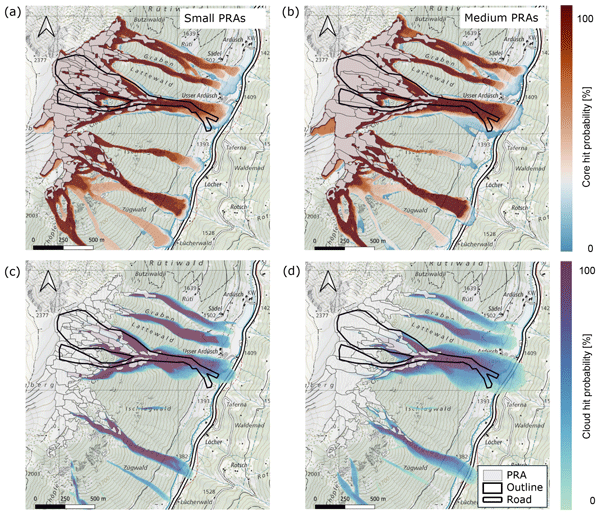
A clear definition of core hit and cloud hit would be helpful.
The figure captions could be improved to clearly indicate the study site (with a reference to the figure showing its location) and the method used (frequency or stability).
Suggestion: include a sensitivity analysis of the DEM spatial resolution and/or the temporal resolution of the meteorological stations.
Line 8: “in this project” is not really relevant, is it research or research project, etc.?
Lines 32-37: as RAMMS is commercial software, it would be fairer to give a more complete list of software open source, the name of avaflow is r.avaflow, and if would be also avaframe, etc. Omitting opensource software can be an ethical issue in science if only presenting commercial ones…
Line 122: give the total number here!
Line 131: mor information about the levels!
Lines 156-158: unclear!
Maybe the paper of
Fischer J-T, Kofler A, Huber A, Fellin W, Mergili M, Oberguggenberger M. Bayesian Inference in Snow Avalanche Simulation with r.avaflow. Geosciences. 2020; 10(5):191. https://doi.org/10.3390/geosciences10050191
can be cited
Citation: https://doi.org/10.5194/egusphere-2026-999-RC3 -
AC2: 'Reply on RC3', Julia Glaus, 16 Jun 2026
Dear Editor and Referee,
We greatly appreciate your detailed and constructive feedback. This has been invaluable for further enhancing the quality of our manuscript. We have listed your comments into the blue boxes and enumerated them so that we can address each part separately below. We have marked the comments from the reviewer as R2, and we have added our potential changes and insights. The provided lines numbers refer to the original manuscript.
Sincerely, Julia Glaus & Co-Authors
-
AC2: 'Reply on RC3', Julia Glaus, 16 Jun 2026
-
AC1: 'Reply on RC1', Julia Glaus, 16 Jun 2026
Dear Editor and Referees,
We greatly appreciate your detailed and constructive feedback. This has been invaluable for further enhancing the quality of our manuscript. We have listed your comments into the blue boxes and enumerated them so that we can address each part separately below. We have marked the comments from the co-author team, Andrea Bruckmeier and Erich Peitzsch as R1, and we have added our potential changes and insights. The provided lines numbers refer to the original manuscript.
Sincerely, Julia Glaus & Co-Authors
Peer review completion


Interactive discussion
Status: closed
-
RC1: 'Comment on egusphere-2026-999', Andrea Bruckmeier & Erich Peitzsch (co-review team), 22 May 2026
Dear authors and editors,
The manuscript introduces an innovative framework to support operational decision making for avalanche forecasting and road closures combining probabilistic avalanche runout modeling with meteorological input and snow cover simulations. Specifically, combining weather station data and snow cover simulation outputs to better assess potential fracture depths, snowpack characteristics and snow conditions within the avalanche path displayed in a probability indication map provide a huge potential for daily avalanche forecasting.
The maps present a hit probability for the avalanche path and runout that is calculated mainly based on the frequency approach. Only one scenario is additionally calculated based on the stability approach. The frequency approach considers the probability for a certain snow loading and weak-layer interaction to define fracture depth classes to calculate the hit probability. This approach does weigh the probabilities of new snow and buried weak layer equally and is less complex on necessary input variables as compared to the stability approach. The results for the 2019 event show that the higher probability values match the observed avalanche paths well using the frequency approach. In 2025, the probability indication maps differ from the real avalanche runout mainly due to differences in weak layer characteristics influenced by the slope exposure. This shows us how sensitive the framework is to the quality and availability of input variables.
The authors describe the background and the objectives well in the Introduction. The Methods are very detailed describing the used approaches. However, this section would benefit from additional clarification, particularly regarding the definition of the validation events (see comments). The Results are comprehensive, and the Discussion provides a reasonable interpretation of the findings and limitations. Additional detail on the study design, results, and broader context could further strengthen the overall manuscript (see comments).
I am very grateful for the opportunity to review this manuscript. Overall, I think this is a promising manuscript that provides a framework combining daily snowpack conditions and terrain with runout probability that can potentially be used in avalanche operations. The authors’ approach to identifying the least amount of input parameter necessary for the most representative daily snowpack conditions makes this paper particularly meaningful and potentially applicable in different regions. After minor revisions, this paper is a valuable contribution and relevant advancement for operational decision-making processes for avalanche risk management along infrastructure corridors.
This is a co-review with my supervisor, Dr. Erich Peitzsch.General Comments
- Validation dataset
Considering the complexity, data availability, time requirements, and resources necessary to analyze each event in the level of detail presented in this manuscript, the reduced number of analyzed events appears justified. Nevertheless, it may be beneficial to acknowledge this more explicitly as a potential limitation within the discussion section, rather than only briefly mentioning it in the conclusion. While the arguments for the selective approach are logical, clarifying this point earlier in the manuscript could strengthen the transparency of the study.
- Dataset description
As a reader, I found the description of the analyzed dataset somewhat difficult to follow. In the Test Site and Data section (Section 2), four avalanche events for validation are introduced, although only three of these are described in greater detail. It is not entirely clear whether these refer to the same avalanches, whether each avalanche event contains multiple avalanches, or whether each case study includes several individual events, as implied later in the manuscript (L255).
In Figure 5, I can only identify three events. The dashed and dotted lines may indicate additional avalanches occurring on specific days; if so, this could be clarified in the figure caption. Furthermore, Section 4.3 introduces additional historical avalanche events. Although this is briefly mentioned in the final paragraph of Section 2, Figure 3 gives the impression that more avalanches were analyzed, rather than only four additional years.
To improve clarity, it may be helpful to display only the avalanches included in the analyses and to distinguish more clearly between validation data and additional datasets. In addition, displaying all events in a table including event, location, trigger and runout location and consistently referring to each event throughout the manuscript using a standardized naming code could greatly improve readability and help the reader follow the analysis.
- MAE for data-sparse areas
Many data-sparse forecasting regions often rely on only one or two weather stations. Therefore, rather than emphasizing the reduction from seven to six or five weather stations, a more detailed comparison using only one or two stations may provide a more practically relevant assessment.
- Frequency and stability approach
It would be helpful to include a brief explanation around L256 regarding the decision to use the frequency approach instead of the stability approach. Although both methods are described in detail in the methods section, the stability approach is only applied in one specific scenario. Expanding the discussion of the two approaches (L336-L342), particularly emphasizing the advantages and applicability of the frequency approach, would strengthen the manuscript.
- Meteorological input data
I would suggest including an overview of the parameters and variables derived from the weather stations that were used to force SNOWPACK, as well as the parameters applied for forecasting daily conditions.
In addition to weather station density, the availability of specific meteorological variables may represent a critical limitation for implementing this approach in other regions. Discussing this aspect could improve the broader applicability of the study.
- Artificial Triggering vs. Natural Avalanches
It appears that the three avalanches as described in Section 2 were all artificially triggered. How does using artificially triggered avalanches to validate the probability maps whether using frequency or stability approach factor into the results? In other words, are the release probability and subsequent runout independent of triggering mechanism (natural vs. explosive/artificial)? When using the historical data (Section 4.3) for evaluating the workflow/model chain, were these avalanches naturally occurring or artificially triggered? Additionally, the authors mention that “the release zones are derived using a return-period-based algorithm” (Line 360). Is this return period based on natural or artificial triggering. I think this topic deserves some explanation given the validation avalanches are all artificially triggered.
Specific Comments
- Figure 2a: Without reading the accompanying text, it is not immediately clear what the values 0, 1, 2, and 3 represent, or why the distances of 1 km, 2 km, and 3 km are important in this context.
Additionally, from the map alone it is difficult to identify the terrain flattening where most avalanches stop. Including a slope profile may help illustrate this more clearly.
- Figure 2b: It is unclear what the blue line represents. Does it indicate dependencies of the avalanches? For example, from 3.4 to 4.0 km the line remains at one avalanche: does this indicate that one single avalanche reached this road section, and it was the same avalanche for this entire section? Maybe you could include a short explanation in the figure description?
- L136: “on January 28” please use the standard English date format consistently throughout the manuscript (Month Day, Year). This comment applies generally across the manuscript.
- Figure 3: The distinction between “Road closures” and “Days with road closures” is not immediately clear and could be clarified further.
Additionally, consider replacing “November till May” with “November to May” for more formal language.
- Figure 4: I think this conceptual diagram of the workflow could use some improvement. I think including the specific input data for ‘Meteorological Data & Forecast’ that is used in SNOWPACK is important. Additionally, include where the frequency and stability approaches are used in the workflow. Finally, include which data (historical and 2019 and 2025 events) are used for validation and how that is incorporated to tune the workflow.
- Figure 5: Please clarify the meaning of the dashed versus dotted lines in the caption. Additionally, the x-axis may not need to be labeled as “Date.”
- Figure 7: Consider labeling each panel as a, b, c, etc. The graphs at the bottom may benefit from including y-axis scales. Additionally, the legend order of weather stations should begin with seven stations and decrease sequentially, as placing seven at the end is somewhat counterintuitive. Including a one-weather-station scenario may also be informative. In the final graph, the lines are very close together, making differences between scenarios difficult to distinguish.
- L301: Instead of stating “stronger influence on the result,” could this effect be described more specifically? For example, does it reduce the hit probability in the avalanche runout, and if so, by approximately how much?
- L313: What was the reason for including the 2017 event that evolved into a wet-snow avalanche? This is very interesting: is RAMMS::EXTENDED capable of simulating the transition in avalanche type?
- L366–L369: Consider including supporting citations in this section.
- L373: A citation may also be appropriate here.
- L401: It may be worth considering an assessment of data sparsity in a climate more comparable to Davos, rather than addressing the additional caveats associated with high-altitude or Arctic climates.
Many thanks and best regards,
Andrea Bruckmeier
Citation: https://doi.org/10.5194/egusphere-2026-999-RC1 -
AC1: 'Reply on RC1', Julia Glaus, 16 Jun 2026
Dear Editor and Referees,
We greatly appreciate your detailed and constructive feedback. This has been invaluable for further enhancing the quality of our manuscript. We have listed your comments into the blue boxes and enumerated them so that we can address each part separately below. We have marked the comments from the co-author team, Andrea Bruckmeier and Erich Peitzsch as R1, and we have added our potential changes and insights. The provided lines numbers refer to the original manuscript.
Sincerely, Julia Glaus & Co-Authors
- Validation dataset
-
RC2: 'Comment on egusphere-2026-999', Andrea Bruckmeier & Erich Peitzsch (co-review team), 22 May 2026
Dear authors and editors,
The manuscript introduces an innovative framework to support operational decision making for avalanche forecasting and road closures combining probabilistic avalanche runout modeling with meteorological input and snow cover simulations. Specifically, combining weather station data and snow cover simulation outputs to better assess potential fracture depths, snowpack characteristics and snow conditions within the avalanche path displayed in a probability indication map provide a huge potential for daily avalanche forecasting.
The maps present a hit probability for the avalanche path and runout that is calculated mainly based on the frequency approach. Only one scenario is additionally calculated based on the stability approach. The frequency approach considers the probability for a certain snow loading and weak-layer interaction to define fracture depth classes to calculate the hit probability. This approach does weigh the probabilities of new snow and buried weak layer equally and is less complex on necessary input variables as compared to the stability approach. The results for the 2019 event show that the higher probability values match the observed avalanche paths well using the frequency approach. In 2025, the probability indication maps differ from the real avalanche runout mainly due to differences in weak layer characteristics influenced by the slope exposure. This shows us how sensitive the framework is to the quality and availability of input variables.
The authors describe the background and the objectives well in the Introduction. The Methods are very detailed describing the used approaches. However, this section would benefit from additional clarification, particularly regarding the definition of the validation events (see comments). The Results are comprehensive, and the Discussion provides a reasonable interpretation of the findings and limitations. Additional detail on the study design, results, and broader context could further strengthen the overall manuscript (see comments).
I am very grateful for the opportunity to review this manuscript. Overall, I think this is a promising manuscript that provides a framework combining daily snowpack conditions and terrain with runout probability that can potentially be used in avalanche operations. The authors’ approach to identifying the least amount of input parameter necessary for the most representative daily snowpack conditions makes this paper particularly meaningful and potentially applicable in different regions. After minor revisions, this paper is a valuable contribution and relevant advancement for operational decision-making processes for avalanche risk management along infrastructure corridors.
This is a co-review with my supervisor, Dr. Erich Peitzsch.General Comments
- Validation dataset
Considering the complexity, data availability, time requirements, and resources necessary to analyze each event in the level of detail presented in this manuscript, the reduced number of analyzed events appears justified. Nevertheless, it may be beneficial to acknowledge this more explicitly as a potential limitation within the discussion section, rather than only briefly mentioning it in the conclusion. While the arguments for the selective approach are logical, clarifying this point earlier in the manuscript could strengthen the transparency of the study.
- Dataset description
As a reader, I found the description of the analyzed dataset somewhat difficult to follow. In the Test Site and Data section (Section 2), four avalanche events for validation are introduced, although only three of these are described in greater detail. It is not entirely clear whether these refer to the same avalanches, whether each avalanche event contains multiple avalanches, or whether each case study includes several individual events, as implied later in the manuscript (L255).
In Figure 5, I can only identify three events. The dashed and dotted lines may indicate additional avalanches occurring on specific days; if so, this could be clarified in the figure caption. Furthermore, Section 4.3 introduces additional historical avalanche events. Although this is briefly mentioned in the final paragraph of Section 2, Figure 3 gives the impression that more avalanches were analyzed, rather than only four additional years.
To improve clarity, it may be helpful to display only the avalanches included in the analyses and to distinguish more clearly between validation data and additional datasets. In addition, displaying all events in a table including event, location, trigger and runout location and consistently referring to each event throughout the manuscript using a standardized naming code could greatly improve readability and help the reader follow the analysis.
- MAE for data-sparse areas
Many data-sparse forecasting regions often rely on only one or two weather stations. Therefore, rather than emphasizing the reduction from seven to six or five weather stations, a more detailed comparison using only one or two stations may provide a more practically relevant assessment.
- Frequency and stability approach
It would be helpful to include a brief explanation around L256 regarding the decision to use the frequency approach instead of the stability approach. Although both methods are described in detail in the methods section, the stability approach is only applied in one specific scenario. Expanding the discussion of the two approaches (L336-L342), particularly emphasizing the advantages and applicability of the frequency approach, would strengthen the manuscript.
- Meteorological input data
I would suggest including an overview of the parameters and variables derived from the weather stations that were used to force SNOWPACK, as well as the parameters applied for forecasting daily conditions.
In addition to weather station density, the availability of specific meteorological variables may represent a critical limitation for implementing this approach in other regions. Discussing this aspect could improve the broader applicability of the study.
- Artificial Triggering vs. Natural Avalanches
It appears that the three avalanches as described in Section 2 were all artificially triggered. How does using artificially triggered avalanches to validate the probability maps whether using frequency or stability approach factor into the results? In other words, are the release probability and subsequent runout independent of triggering mechanism (natural vs. explosive/artificial)? When using the historical data (Section 4.3) for evaluating the workflow/model chain, were these avalanches naturally occurring or artificially triggered? Additionally, the authors mention that “the release zones are derived using a return-period-based algorithm” (Line 360). Is this return period based on natural or artificial triggering. I think this topic deserves some explanation given the validation avalanches are all artificially triggered.
Specific Comments
- Figure 2a: Without reading the accompanying text, it is not immediately clear what the values 0, 1, 2, and 3 represent, or why the distances of 1 km, 2 km, and 3 km are important in this context.
Additionally, from the map alone it is difficult to identify the terrain flattening where most avalanches stop. Including a slope profile may help illustrate this more clearly.
- Figure 2b: It is unclear what the blue line represents. Does it indicate dependencies of the avalanches? For example, from 3.4 to 4.0 km the line remains at one avalanche: does this indicate that one single avalanche reached this road section, and it was the same avalanche for this entire section? Maybe you could include a short explanation in the figure description?
- L136: “on January 28” please use the standard English date format consistently throughout the manuscript (Month Day, Year). This comment applies generally across the manuscript.
- Figure 3: The distinction between “Road closures” and “Days with road closures” is not immediately clear and could be clarified further.
Additionally, consider replacing “November till May” with “November to May” for more formal language.
- Figure 4: I think this conceptual diagram of the workflow could use some improvement. I think including the specific input data for ‘Meteorological Data & Forecast’ that is used in SNOWPACK is important. Additionally, include where the frequency and stability approaches are used in the workflow. Finally, include which data (historical and 2019 and 2025 events) are used for validation and how that is incorporated to tune the workflow.
- Figure 5: Please clarify the meaning of the dashed versus dotted lines in the caption. Additionally, the x-axis may not need to be labeled as “Date.”
- Figure 7: Consider labeling each panel as a, b, c, etc. The graphs at the bottom may benefit from including y-axis scales. Additionally, the legend order of weather stations should begin with seven stations and decrease sequentially, as placing seven at the end is somewhat counterintuitive. Including a one-weather-station scenario may also be informative. In the final graph, the lines are very close together, making differences between scenarios difficult to distinguish.
- L301: Instead of stating “stronger influence on the result,” could this effect be described more specifically? For example, does it reduce the hit probability in the avalanche runout, and if so, by approximately how much?
- L313: What was the reason for including the 2017 event that evolved into a wet-snow avalanche? This is very interesting: is RAMMS::EXTENDED capable of simulating the transition in avalanche type?
- L366–L369: Consider including supporting citations in this section.
- L373: A citation may also be appropriate here.
- L401: It may be worth considering an assessment of data sparsity in a climate more comparable to Davos, rather than addressing the additional caveats associated with high-altitude or Arctic climates.
Many thanks and best regards,
Andrea Bruckmeier
Citation: https://doi.org/10.5194/egusphere-2026-999-RC2 -
AC1: 'Reply on RC1', Julia Glaus, 16 Jun 2026
Dear Editor and Referees,
We greatly appreciate your detailed and constructive feedback. This has been invaluable for further enhancing the quality of our manuscript. We have listed your comments into the blue boxes and enumerated them so that we can address each part separately below. We have marked the comments from the co-author team, Andrea Bruckmeier and Erich Peitzsch as R1, and we have added our potential changes and insights. The provided lines numbers refer to the original manuscript.
Sincerely, Julia Glaus & Co-Authors
- Validation dataset
-
RC3: 'Comment on egusphere-2026-999', Anonymous Referee #2, 29 May 2026
Comments on the paper:
Probabilistic avalanche runout modelling for daily risk management of traffic routes
By Julia Glaus, Jan Kleinn, Lukas Stoffel, Pia Ruttner, Katreen Wikstrom Jones, Johan Gaume, and Yves Bühler
The paper introduces an automated modelling framework to help local safety experts manage avalanche risk along alpine transport routes. Traditional hazard maps are too static for daily decisions such as road closures or avalanche control
A real-time probabilistic framework for cold powder snow conditions is porposed. It combines weather observations, SNOWPACK snow-cover simulations, and the RAMMS::Extended avalanche model. Running multiple simulations for different release scenarios, it produces probability indication maps showing the likely extent and intensity of avalanche runout during a given forecast period.
General comments
This paper is well written and interesting but suffers a major drawback that needs more explanations. Its overall structure is unclear and hard to follow. The study site, avalanche locations, and meteorological installations should be presented fully earlier, with the relevant figures. The methodology section should clearly explain both the probabilistic approach and its validation, separating methods from results. More detail is also needed to make the study reproducible, especially on simulations and parameters.
The “probability” term in the title is not relevant, if it is not demonstrated that you reach a resolution of at least 1/1000 probability to reach the road, because you must give the argument about the threshold used. In the example it is mandatory to provide the total number of simulations used.
If the probability resolution is above 1/1000 it means that this is not a probability analysis but a worst-case scenario type of analysis. This must be mandatorily demonstrated. If the probabilistic approach is relevant, a clearer discussion and comparison of the probabilistic results with the observed data is needed. For example, the authors could report on the probability of reaching the observed runout and discuss those values.
Artificially triggered avalanches help validate runout modelling, including fracture depth, entrainment, stopping distance, and road impact. However, they cannot by themselves validate the probabilistic release component, because triggering alters the failure process and fixes the timing, location, and loading. Validation should therefore separate runout validation given release from full probabilistic validation of natural avalanche impact. This needs to be discussed, or site clear study about this issue. Is it conservative or the inverse?
Specific comments
A clear definition of core hit and cloud hit would be helpful.
The figure captions could be improved to clearly indicate the study site (with a reference to the figure showing its location) and the method used (frequency or stability).
Suggestion: include a sensitivity analysis of the DEM spatial resolution and/or the temporal resolution of the meteorological stations.
Line 8: “in this project” is not really relevant, is it research or research project, etc.?
Lines 32-37: as RAMMS is commercial software, it would be fairer to give a more complete list of software open source, the name of avaflow is r.avaflow, and if would be also avaframe, etc. Omitting opensource software can be an ethical issue in science if only presenting commercial ones…
Line 122: give the total number here!
Line 131: mor information about the levels!
Lines 156-158: unclear!
Maybe the paper of
Fischer J-T, Kofler A, Huber A, Fellin W, Mergili M, Oberguggenberger M. Bayesian Inference in Snow Avalanche Simulation with r.avaflow. Geosciences. 2020; 10(5):191. https://doi.org/10.3390/geosciences10050191
can be cited
Citation: https://doi.org/10.5194/egusphere-2026-999-RC3 -
AC2: 'Reply on RC3', Julia Glaus, 16 Jun 2026
Dear Editor and Referee,
We greatly appreciate your detailed and constructive feedback. This has been invaluable for further enhancing the quality of our manuscript. We have listed your comments into the blue boxes and enumerated them so that we can address each part separately below. We have marked the comments from the reviewer as R2, and we have added our potential changes and insights. The provided lines numbers refer to the original manuscript.
Sincerely, Julia Glaus & Co-Authors
-
AC2: 'Reply on RC3', Julia Glaus, 16 Jun 2026
-
AC1: 'Reply on RC1', Julia Glaus, 16 Jun 2026
Dear Editor and Referees,
We greatly appreciate your detailed and constructive feedback. This has been invaluable for further enhancing the quality of our manuscript. We have listed your comments into the blue boxes and enumerated them so that we can address each part separately below. We have marked the comments from the co-author team, Andrea Bruckmeier and Erich Peitzsch as R1, and we have added our potential changes and insights. The provided lines numbers refer to the original manuscript.
Sincerely, Julia Glaus & Co-Authors
Peer review completion
Journal article(s) based on this preprint
Viewed
| HTML | XML | Total | BibTeX | EndNote | |
|---|---|---|---|---|---|
| 1,019 | 749 | 107 | 1,875 | 104 | 112 |
- HTML: 1,019
- PDF: 749
- XML: 107
- Total: 1,875
- BibTeX: 104
- EndNote: 112
Viewed (geographical distribution)
| Country | # | Views | % |
|---|
| Total: | 0 |
| HTML: | 0 |
| PDF: | 0 |
| XML: | 0 |
- 1
Julia Glaus

Jan Kleinn
Lukas Stoffel
Pia Ruttner
Katreen Wikstrom Jones
Johan Gaume
Yves Bühler
The requested preprint has a corresponding peer-reviewed final revised paper. You are encouraged to refer to the final revised version.
- Preprint
(44674 KB) - Metadata XML
Dear authors and editors,
The manuscript introduces an innovative framework to support operational decision making for avalanche forecasting and road closures combining probabilistic avalanche runout modeling with meteorological input and snow cover simulations. Specifically, combining weather station data and snow cover simulation outputs to better assess potential fracture depths, snowpack characteristics and snow conditions within the avalanche path displayed in a probability indication map provide a huge potential for daily avalanche forecasting.
The maps present a hit probability for the avalanche path and runout that is calculated mainly based on the frequency approach. Only one scenario is additionally calculated based on the stability approach. The frequency approach considers the probability for a certain snow loading and weak-layer interaction to define fracture depth classes to calculate the hit probability. This approach does weigh the probabilities of new snow and buried weak layer equally and is less complex on necessary input variables as compared to the stability approach. The results for the 2019 event show that the higher probability values match the observed avalanche paths well using the frequency approach. In 2025, the probability indication maps differ from the real avalanche runout mainly due to differences in weak layer characteristics influenced by the slope exposure. This shows us how sensitive the framework is to the quality and availability of input variables.
The authors describe the background and the objectives well in the Introduction. The Methods are very detailed describing the used approaches. However, this section would benefit from additional clarification, particularly regarding the definition of the validation events (see comments). The Results are comprehensive, and the Discussion provides a reasonable interpretation of the findings and limitations. Additional detail on the study design, results, and broader context could further strengthen the overall manuscript (see comments).
I am very grateful for the opportunity to review this manuscript. Overall, I think this is a promising manuscript that provides a framework combining daily snowpack conditions and terrain with runout probability that can potentially be used in avalanche operations. The authors’ approach to identifying the least amount of input parameter necessary for the most representative daily snowpack conditions makes this paper particularly meaningful and potentially applicable in different regions. After minor revisions, this paper is a valuable contribution and relevant advancement for operational decision-making processes for avalanche risk management along infrastructure corridors.
This is a co-review with my supervisor, Dr. Erich Peitzsch.
General Comments
Considering the complexity, data availability, time requirements, and resources necessary to analyze each event in the level of detail presented in this manuscript, the reduced number of analyzed events appears justified. Nevertheless, it may be beneficial to acknowledge this more explicitly as a potential limitation within the discussion section, rather than only briefly mentioning it in the conclusion. While the arguments for the selective approach are logical, clarifying this point earlier in the manuscript could strengthen the transparency of the study.
As a reader, I found the description of the analyzed dataset somewhat difficult to follow. In the Test Site and Data section (Section 2), four avalanche events for validation are introduced, although only three of these are described in greater detail. It is not entirely clear whether these refer to the same avalanches, whether each avalanche event contains multiple avalanches, or whether each case study includes several individual events, as implied later in the manuscript (L255).
In Figure 5, I can only identify three events. The dashed and dotted lines may indicate additional avalanches occurring on specific days; if so, this could be clarified in the figure caption. Furthermore, Section 4.3 introduces additional historical avalanche events. Although this is briefly mentioned in the final paragraph of Section 2, Figure 3 gives the impression that more avalanches were analyzed, rather than only four additional years.
To improve clarity, it may be helpful to display only the avalanches included in the analyses and to distinguish more clearly between validation data and additional datasets. In addition, displaying all events in a table including event, location, trigger and runout location and consistently referring to each event throughout the manuscript using a standardized naming code could greatly improve readability and help the reader follow the analysis.
Many data-sparse forecasting regions often rely on only one or two weather stations. Therefore, rather than emphasizing the reduction from seven to six or five weather stations, a more detailed comparison using only one or two stations may provide a more practically relevant assessment.
It would be helpful to include a brief explanation around L256 regarding the decision to use the frequency approach instead of the stability approach. Although both methods are described in detail in the methods section, the stability approach is only applied in one specific scenario. Expanding the discussion of the two approaches (L336-L342), particularly emphasizing the advantages and applicability of the frequency approach, would strengthen the manuscript.
I would suggest including an overview of the parameters and variables derived from the weather stations that were used to force SNOWPACK, as well as the parameters applied for forecasting daily conditions.
In addition to weather station density, the availability of specific meteorological variables may represent a critical limitation for implementing this approach in other regions. Discussing this aspect could improve the broader applicability of the study.
It appears that the three avalanches as described in Section 2 were all artificially triggered. How does using artificially triggered avalanches to validate the probability maps whether using frequency or stability approach factor into the results? In other words, are the release probability and subsequent runout independent of triggering mechanism (natural vs. explosive/artificial)? When using the historical data (Section 4.3) for evaluating the workflow/model chain, were these avalanches naturally occurring or artificially triggered? Additionally, the authors mention that “the release zones are derived using a return-period-based algorithm” (Line 360). Is this return period based on natural or artificial triggering. I think this topic deserves some explanation given the validation avalanches are all artificially triggered.
Specific Comments
Additionally, from the map alone it is difficult to identify the terrain flattening where most avalanches stop. Including a slope profile may help illustrate this more clearly.
Additionally, consider replacing “November till May” with “November to May” for more formal language.
Many thanks and best regards,
Andrea Bruckmeier