
the Creative Commons Attribution 4.0 License.
the Creative Commons Attribution 4.0 License.
 | 19 Mar 2026
Enhancement of ammonium nitrate aerosol in the Northern Hemisphere lower stratosphere linked to Asian summer monsoon outflow
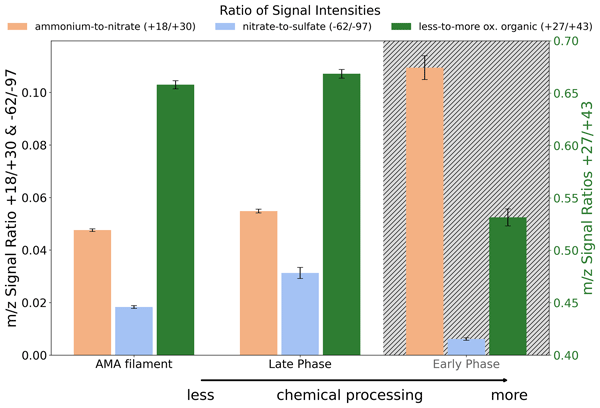
Abstract. This study examines how Asian Summer Monsoon (ASM) outflow perturbs the chemical composition of background aerosol in the extratropical lower stratosphere (ExLS). We analyze the summer-to-autumn transition in aerosol chemical composition using in-situ measurements from the ERICA instrument acquired during the PHILEAS aircraft campaign in August–September 2023 over the North Pacific, Alaska, northern Canada, and northern Europe. We observe an enrichment of ammonium and nitrate aerosol in the ExLS background air masses from summer to autumn, particularly at potential temperatures above 370 K (~13 km). Concurrently, the fraction of NO+-rich particles in the ExLS increases from August to September 2023. The corresponding mass spectra indicate internally mixed particles containing nitrate, sulfate, ammonium, and organic matter. Simulations with the Chemical Lagrangian Model of the Stratosphere (CLaMS) show this seasonal transition is associated with the intrusion of relatively young air masses (<3.5 months old) originating from South Asia and the western Pacific into the ExLS, especially in autumn. These particles persist in the lower stratosphere for weeks up to months and undergo chemical aging. This aging is reflected by an observed increasing oxidative degree of organic matter, a decreasing nitrate-to-sulfate ratio, and an increasing ammonium-to-nitrate ratio, suggesting progressive sulfate incorporation and particle nitrate depletion. Overall, our results demonstrate that the ASM outflow can substantially shape ExLS background aerosol composition through the convective uplift, subsequent transport, and aging of ammonium- and nitrate-rich air masses from polluted surface regions, with important implications for stratospheric heterogeneous chemistry and aerosol-climate interactions.
-
Notice on discussion status
The requested preprint has a corresponding peer-reviewed final revised paper. You are encouraged to refer to the final revised version.
-
Preprint
(7447 KB)
-
Supplement
(3936 KB)
-
The requested preprint has a corresponding peer-reviewed final revised paper. You are encouraged to refer to the final revised version.
- Preprint
(7447 KB) - Metadata XML
-
Supplement
(3936 KB) - BibTeX
- EndNote
- Final revised paper


Journal article(s) based on this preprint
Interactive discussion
Status: closed
-
RC1: 'Comment on egusphere-2026-998', Anonymous Referee #1, 06 Apr 2026
-
AC1: 'Reply on RC1', Fatih Ekinci, 30 May 2026
We would like to thank the reviewer sincerely for the detailed comments and thoughtful questions. The comments offered valuable insights and helped us to improve the clarity and quality of the manuscript. We also appreciate the positive assessment of the topic's suitability for the publication. Our point-by-point responses and the corresponding changes made to the manuscript in response to RC1 are attached.
-
AC1: 'Reply on RC1', Fatih Ekinci, 30 May 2026
-
RC2: 'Comment on egusphere-2026-998', Anonymous Referee #2, 21 Apr 2026
Ekinci et al. describe in their manuscript the change of ExLS background air particle chemical composition from summer to fall season, and connect these changes with outflow from the Asian Monsoon. Their findings are based on in-situ measurements with the ERICA instrument during the PHILEAS aircraft campaign in 2023. For their analyses they used the CLaMS atmospheric model.
The paper is well written and structured and has high quality figures. I appreciate the detailed description of the methods and that the authors moved it to the supplementary part of the manuscript. The subject of the paper is well within the scope of ACP and deserves publication after minor revision (points listed below).
Disclaimer: I am not an expert for the instruments described in this paper and cannot judge the sections describing the details of the measurement technique.
General points:
- The analysis of this paper is based on 6 research flights (3 for the early and late phase each). I am missing a discussion how representative this data base is for the conclusions drawn in this paper. Figure 4 indicates that there are data gaps for certain potential temperature and equivalent latitude ranges, but I think this should be discussed how this affects the conclusions.
- For the analyses, particle fractions were plotted and discussed. I wonder if the increase or decrease of these PFs are also reflected in an increase or decrease of absolute particle numbers. Or is the PF even the fraction of those particles, which can be detected by ERICA? Then absolute numbers would be even more interesting.
- The description of the backward trajectories should be in a precise language (see also specific comments below).
- The discussion of the influence of biomass burning and the measurements of organic aerosols are interesting but are in my opinion a bit away from the focus of this paper. The authors could reconsider if they really want to keep this part in the manuscript or if they want to present these findings in a different framework (it is just a suggestion from my side, both options would be okay for me).
- Section 3.2 seems to be apart from the earlier part of the manuscript and introduces a new selection of data (also including more PHILEAS flights than mentioned in section 2.1, where only 6 flights were introduced, now also other flight data is used). Further, it is not shown how it is possible to compare air masses from 2017 with those measured in 2023. Is it known that those years are comparable? Are the air masses sampled during these campaigns comparable? Again, I suggest to consider if this section could be presented in a different framework than this manuscript. Further, the relationship if this section to the preprint by Koellner et al. (2026) is not very clear to me for this section.Specific points:
- very minor point: The numbering in the list of affiliations is not according to the appearance in the authors list. At the moment, numbers are counting: 1,2,5,3,10,8,7,9,4,6
- L113: Please define HASI
- L233: Why is only a degraded ERA5 resolution used for the PV analysis?
- Figure 4 d-f: Are the profiles shown in the right column the sum or an average of all equivalent latitudes? Same for Figure 5.
- Figure 8: I do not understand the "relative frequency" shown in this figure. Relative with respect to what? And are the values normalized with respect to a surface area? And what is meant by "backward trajectory end point"? The point where the trajectory ends (at the position of the aircraft), or the point where the backward trajectory ends (at the surface)? And the "relative frequency" shown in the figures - is it of backward trajectories ending at the lowest model level or what criterion was used here that a trajectory is shown? Further, 0.03% of all trajectories is a very, very low fraction of trajectories being the top of the color bar. I cannot integrate over the area to get the total fraction of trajectories which were (probably?) reaching the ground, but it seems like most of the backward trajectories did not reach the ground during the maximum time period?
- L309: What is meant by: "backward trajectory statistics were also examined for potential temperatures below 320 K and above 380 K"? Backward trajectories being released at measurement locations of this potential temperature range? I think the formulation of the description of the trajectories could be more precise throughout the manuscript.
- L323: I would argue that the peak of CO PDF is only marginally shifted towards higher mixing ratios, while also lower mixing ratios appear in the PDF. "The CO distributions (Fig. 9b) show a similar pattern." is not quite precise here.
- L347: "This trend suggests a decreasing influence of BB emissions on the ExLS aerosol composition": Is this also supported by the trajectories shown in Fig. 8? For me it looks like there is more signal from Canada in the early phase compared to the late phase.
- L360: "Second, we analyzed NO+-rich particles abundant in CH4-rich stratospheric regimes in the extratropics measured during PHILEAS (defined as ’AMA filament in the ExLS’).": Is there also a potential temperature threshold applied to this selection of air masses?
- L407: Make a new paragraph at "Third"
- L409: "The size distribution of the Early Phase peaks at larger diameters": I would argue that all three distributions peak at the same particle diameter (of ~340 nm) in Fig. 11!
- Figure 10: This is a busy plot and I think it should be mentioned why the "Early Phase" has a grey background, and why there are no green bars for the "Filament" and "Late" columns, and why there is no blue bar for the "Early Phase".
- L446: "We thus hypothesize that the particles may remnants from the previous monsoon season.": Please rephrase, I do not understand this sentence.
- L450 & Fig. 12: It is not appropriate to introduce new figures in the section called "conclusions". Please introduce this figure in the main part of the manuscript.
- L454: Here, year-to-year variability is mentioned, but this manuscript directly compares measurements from 2017 to those from 2023. Why is that a valid comparison?
- L455: The authors recommend further campaigns to answer open questions, but are there options for long-term observations from operational monitoring programs like from satellites or regular aircraft missions?
- L461: I would appreciate if the authors would make their data available to the referees. There are options to publish the data password protected during review if they prefer not to make their data publicly available during the review process. In my opinion, it is also part of the referee's job to assess the quality of the published data, which belongs to this paper, and I cannot do so at the moment.Citation: https://doi.org/10.5194/egusphere-2026-998-RC2 -
AC2: 'Reply on RC2', Fatih Ekinci, 30 May 2026
We would like to thank the reviewer sincerely for the detailed comments and thoughtful questions. The comments offered valuable insights and helped us to improve the clarity and quality of the manuscript. We also appreciate the positive assessment of the topic's suitability for the publication. Our point-by-point responses and the corresponding changes made to the manuscript in response to RC2 are attached.
-
AC2: 'Reply on RC2', Fatih Ekinci, 30 May 2026
Peer review completion


Interactive discussion
Status: closed
-
RC1: 'Comment on egusphere-2026-998', Anonymous Referee #1, 06 Apr 2026
This is an important paper that reveals the global impact of ATAL after the ASM season. The paper is very well rewritten and I only has a few minor comments. Once they are addressed, I support the publication of the paper. I don't need to review it again.
General: One important conclusion of this paper is regarding the transport of ATAL materials to ExLS that NO3 is higher in Sep than other time. I wander if you could add more insight in the paper regarding following questions I am curious about: Is the peaking of NO3 in ExLS just because the cumulation of NO3 takes time? Or is it because in August, there're more shedding events that "leaks" more materials out of the ASM anticyclone compared to previous months? When ASM anticyclone breaks, more ATAL materials gets to transport to ExLS or ATAL materials has no chance to enter the stratosphere?
Section 3.1.2: As you mentioned before, ATAL composition is dominant by sulfate, nitrate, ammonium and organics. Why does the organic decrease in Sep if ATAL materials still transport into ExLS region? Is it because the SOA from ASM is not high in k+?
Line 173: What causes the detection change between different flights?
Line 180: What's the NOAA standards?
Figure 4: Figure right panel, add "Aug" and "Sep" after Early phase and Late phase. Caption second line "the Late and Early Phases (August and September)": Switch Sep and Aug to be consistent with Late and Early phases.
Line 382-383: This sentence is a little vague. I am not sure if you are talking about one mechanism or two here. The first sentence reads like a physical process that increase the H2SO4 percentage through coagulating NO+-rich particle with Sulfur-rich particle or condensing H2SO4 gas. Maybe adding "through chemical process" at the end of line 383 after "the depletion of nitrate".
Line 448: I don't understand this "significant chemical processing"
Citation: https://doi.org/10.5194/egusphere-2026-998-RC1 -
AC1: 'Reply on RC1', Fatih Ekinci, 30 May 2026
We would like to thank the reviewer sincerely for the detailed comments and thoughtful questions. The comments offered valuable insights and helped us to improve the clarity and quality of the manuscript. We also appreciate the positive assessment of the topic's suitability for the publication. Our point-by-point responses and the corresponding changes made to the manuscript in response to RC1 are attached.
-
AC1: 'Reply on RC1', Fatih Ekinci, 30 May 2026
-
RC2: 'Comment on egusphere-2026-998', Anonymous Referee #2, 21 Apr 2026
Ekinci et al. describe in their manuscript the change of ExLS background air particle chemical composition from summer to fall season, and connect these changes with outflow from the Asian Monsoon. Their findings are based on in-situ measurements with the ERICA instrument during the PHILEAS aircraft campaign in 2023. For their analyses they used the CLaMS atmospheric model.
The paper is well written and structured and has high quality figures. I appreciate the detailed description of the methods and that the authors moved it to the supplementary part of the manuscript. The subject of the paper is well within the scope of ACP and deserves publication after minor revision (points listed below).
Disclaimer: I am not an expert for the instruments described in this paper and cannot judge the sections describing the details of the measurement technique.
General points:
- The analysis of this paper is based on 6 research flights (3 for the early and late phase each). I am missing a discussion how representative this data base is for the conclusions drawn in this paper. Figure 4 indicates that there are data gaps for certain potential temperature and equivalent latitude ranges, but I think this should be discussed how this affects the conclusions.
- For the analyses, particle fractions were plotted and discussed. I wonder if the increase or decrease of these PFs are also reflected in an increase or decrease of absolute particle numbers. Or is the PF even the fraction of those particles, which can be detected by ERICA? Then absolute numbers would be even more interesting.
- The description of the backward trajectories should be in a precise language (see also specific comments below).
- The discussion of the influence of biomass burning and the measurements of organic aerosols are interesting but are in my opinion a bit away from the focus of this paper. The authors could reconsider if they really want to keep this part in the manuscript or if they want to present these findings in a different framework (it is just a suggestion from my side, both options would be okay for me).
- Section 3.2 seems to be apart from the earlier part of the manuscript and introduces a new selection of data (also including more PHILEAS flights than mentioned in section 2.1, where only 6 flights were introduced, now also other flight data is used). Further, it is not shown how it is possible to compare air masses from 2017 with those measured in 2023. Is it known that those years are comparable? Are the air masses sampled during these campaigns comparable? Again, I suggest to consider if this section could be presented in a different framework than this manuscript. Further, the relationship if this section to the preprint by Koellner et al. (2026) is not very clear to me for this section.Specific points:
- very minor point: The numbering in the list of affiliations is not according to the appearance in the authors list. At the moment, numbers are counting: 1,2,5,3,10,8,7,9,4,6
- L113: Please define HASI
- L233: Why is only a degraded ERA5 resolution used for the PV analysis?
- Figure 4 d-f: Are the profiles shown in the right column the sum or an average of all equivalent latitudes? Same for Figure 5.
- Figure 8: I do not understand the "relative frequency" shown in this figure. Relative with respect to what? And are the values normalized with respect to a surface area? And what is meant by "backward trajectory end point"? The point where the trajectory ends (at the position of the aircraft), or the point where the backward trajectory ends (at the surface)? And the "relative frequency" shown in the figures - is it of backward trajectories ending at the lowest model level or what criterion was used here that a trajectory is shown? Further, 0.03% of all trajectories is a very, very low fraction of trajectories being the top of the color bar. I cannot integrate over the area to get the total fraction of trajectories which were (probably?) reaching the ground, but it seems like most of the backward trajectories did not reach the ground during the maximum time period?
- L309: What is meant by: "backward trajectory statistics were also examined for potential temperatures below 320 K and above 380 K"? Backward trajectories being released at measurement locations of this potential temperature range? I think the formulation of the description of the trajectories could be more precise throughout the manuscript.
- L323: I would argue that the peak of CO PDF is only marginally shifted towards higher mixing ratios, while also lower mixing ratios appear in the PDF. "The CO distributions (Fig. 9b) show a similar pattern." is not quite precise here.
- L347: "This trend suggests a decreasing influence of BB emissions on the ExLS aerosol composition": Is this also supported by the trajectories shown in Fig. 8? For me it looks like there is more signal from Canada in the early phase compared to the late phase.
- L360: "Second, we analyzed NO+-rich particles abundant in CH4-rich stratospheric regimes in the extratropics measured during PHILEAS (defined as ’AMA filament in the ExLS’).": Is there also a potential temperature threshold applied to this selection of air masses?
- L407: Make a new paragraph at "Third"
- L409: "The size distribution of the Early Phase peaks at larger diameters": I would argue that all three distributions peak at the same particle diameter (of ~340 nm) in Fig. 11!
- Figure 10: This is a busy plot and I think it should be mentioned why the "Early Phase" has a grey background, and why there are no green bars for the "Filament" and "Late" columns, and why there is no blue bar for the "Early Phase".
- L446: "We thus hypothesize that the particles may remnants from the previous monsoon season.": Please rephrase, I do not understand this sentence.
- L450 & Fig. 12: It is not appropriate to introduce new figures in the section called "conclusions". Please introduce this figure in the main part of the manuscript.
- L454: Here, year-to-year variability is mentioned, but this manuscript directly compares measurements from 2017 to those from 2023. Why is that a valid comparison?
- L455: The authors recommend further campaigns to answer open questions, but are there options for long-term observations from operational monitoring programs like from satellites or regular aircraft missions?
- L461: I would appreciate if the authors would make their data available to the referees. There are options to publish the data password protected during review if they prefer not to make their data publicly available during the review process. In my opinion, it is also part of the referee's job to assess the quality of the published data, which belongs to this paper, and I cannot do so at the moment.Citation: https://doi.org/10.5194/egusphere-2026-998-RC2 -
AC2: 'Reply on RC2', Fatih Ekinci, 30 May 2026
We would like to thank the reviewer sincerely for the detailed comments and thoughtful questions. The comments offered valuable insights and helped us to improve the clarity and quality of the manuscript. We also appreciate the positive assessment of the topic's suitability for the publication. Our point-by-point responses and the corresponding changes made to the manuscript in response to RC2 are attached.
-
AC2: 'Reply on RC2', Fatih Ekinci, 30 May 2026
Peer review completion
Journal article(s) based on this preprint
Viewed
| HTML | XML | Total | Supplement | BibTeX | EndNote | |
|---|---|---|---|---|---|---|
| 890 | 615 | 93 | 1,598 | 179 | 97 | 97 |
- HTML: 890
- PDF: 615
- XML: 93
- Total: 1,598
- Supplement: 179
- BibTeX: 97
- EndNote: 97
Viewed (geographical distribution)
| Country | # | Views | % |
|---|
| Total: | 0 |
| HTML: | 0 |
| PDF: | 0 |
| XML: | 0 |
- 1
Fatih Ekinci
Oliver Eppers
Oliver Appel
Felix Ploeger
Antonis Dragoneas
Sergej Molleker
Philipp Brauner
Hans-Christoph Lachnitt
Franziska Weyland
Linda Ort
Nicolas Emig
Hans-Christian Clemen
Laura Tomsche
Martin Ebert
Peter Hoor
Bärbel Vogel
Yafang Cheng
Johannes Schneider
Stephan Borrmann

The requested preprint has a corresponding peer-reviewed final revised paper. You are encouraged to refer to the final revised version.
- Preprint
(7447 KB) - Metadata XML
-
Supplement
(3936 KB) - BibTeX
- EndNote
- Final revised paper
This is an important paper that reveals the global impact of ATAL after the ASM season. The paper is very well rewritten and I only has a few minor comments. Once they are addressed, I support the publication of the paper. I don't need to review it again.
General: One important conclusion of this paper is regarding the transport of ATAL materials to ExLS that NO3 is higher in Sep than other time. I wander if you could add more insight in the paper regarding following questions I am curious about: Is the peaking of NO3 in ExLS just because the cumulation of NO3 takes time? Or is it because in August, there're more shedding events that "leaks" more materials out of the ASM anticyclone compared to previous months? When ASM anticyclone breaks, more ATAL materials gets to transport to ExLS or ATAL materials has no chance to enter the stratosphere?
Section 3.1.2: As you mentioned before, ATAL composition is dominant by sulfate, nitrate, ammonium and organics. Why does the organic decrease in Sep if ATAL materials still transport into ExLS region? Is it because the SOA from ASM is not high in k+?
Line 173: What causes the detection change between different flights?
Line 180: What's the NOAA standards?
Figure 4: Figure right panel, add "Aug" and "Sep" after Early phase and Late phase. Caption second line "the Late and Early Phases (August and September)": Switch Sep and Aug to be consistent with Late and Early phases.
Line 382-383: This sentence is a little vague. I am not sure if you are talking about one mechanism or two here. The first sentence reads like a physical process that increase the H2SO4 percentage through coagulating NO+-rich particle with Sulfur-rich particle or condensing H2SO4 gas. Maybe adding "through chemical process" at the end of line 383 after "the depletion of nitrate".
Line 448: I don't understand this "significant chemical processing"