
the Creative Commons Attribution 4.0 License.
the Creative Commons Attribution 4.0 License.
 | 13 Mar 2026
Organic carbon pathways across the fluvial-marine transition zone of the Mackenzie River Delta – Beaufort Sea region and implications on ocean color remote sensing
Abstract. Arctic warming and hydrological intensification are accelerating permafrost thaw and increasing the export of terrestrial organic carbon (OC) and sediments from land via rivers and shallow coastal waters into marine waters, yet the fate of these materials in deltaic and coastal transition zones remains poorly understood. Here, we synthesize multiyear in situ biogeochemical, optical, and radiometric observations (2009–2024) across the Mackenzie River Delta–southern Beaufort Sea land–ocean continuum. By using a compartmental approach (river, delta, coastal, marine) we quantify spatial and seasonal variability in dissolved organic carbon (DOC), particulate organic carbon (POC), and suspended particulate matter (SPM) and refine bio-optical relationships that support satellite retrievals in optically complex Arctic waters. Our results show that DOC concentrations declined from river to marine waters (mean 4.8 to 1.9 mg L⁻¹), while POC and SPM showed more variability with marked reductions across the transition, consistent with retention and transformation processes in deltaic and nearshore zones. Across all compartments, DOC exhibited a strong non-linear relationship with CDOM absorption at 443 nm (aCDOM(443); r²=0.81), whereas POC related linearly to particulate absorption at 443 nm (aP(443); r²=0.73), with substantial compartment dependent differences in slope and fit strength that indicate shifting OC composition and optical regimes along the salinity gradient. Optical Water Type (OWT) classification derived from remote sensing reflectance (Rrs) resolved transitions from turbid, particle-dominated waters to clearer coastal and marine regimes, providing a framework for guiding algorithm selection and improving retrieval performance. These results provide the first concurrent, Arctic fluvial-marine assessment of DOC, POC, SPM, and optical properties and demonstrate how land–sea connectivity governs both organic carbon processing and optical structure in Arctic coastal waters.
-
Notice on discussion status
The requested preprint has a corresponding peer-reviewed final revised paper. You are encouraged to refer to the final revised version.
-
Preprint
(1633 KB)
-
The requested preprint has a corresponding peer-reviewed final revised paper. You are encouraged to refer to the final revised version.
- Preprint
(1633 KB) - Metadata XML
- BibTeX
- EndNote
- Final revised paper


Journal article(s) based on this preprint
Interactive discussion
Status: closed
-
RC1: 'Comment on egusphere-2026-997', Piotr Kowalczuk, 20 Apr 2026
-
AC1: 'Reply on RC1', Annabeth McCall, 08 Jun 2026
These are our responses to comments from Reviewer #1
We are grateful to the anonymous reviewer for their careful review and valuable comments on this manuscript. The constructive feedback provided has been instrumental in strengthening the manuscript, and we appreciate the opportunity to address the reviewer’s suggestions during the revision process. We have carefully considered all comments and revised the manuscript accordingly. Reviewer comments and our detailed responses are provided below.
Responses:
Line 39: Typo. Please delete redundant phrase: is “… remineralization and flocculation (Eisma, 1986)( occur”. Should be “… remineralization and flocculation (Eisma, 1986).”
Response: Thank you for the recommendation. Text changed to, "remineralization and flocculation (Eisma, 1986) occur."
Table 1: I suggest removing subscripts in parameters description e.g aCDOMa, apb. This is looking awkward. It is methodological correct to define measured parameters as” aCDOM(l) – Colored Dissolved Organic Matter absorption spectrum, ap(l) particulate absorption spectrum, and place those definitions below table.
Response: Thank you for this suggestion. Superscripts removed and changed to: aCDOM = Absorption of colored dissolved organic matter, aP = Particulate absorption
Line 232: Please define the symbol – Rrs.
Response: This correction also applies to a comment by RC2; please see the correction provided in RC2 comment line 232-234.
Line 250: The description of filtration methods regarding CDOM sampling. Usage of both filter types used – 0.7 mm GF/F and 0.45 mm cellulose acetate filters is methodologically incorrect. The community accepted definition of soluble compounds present in water is the remaining filtrate after passing through 0.2 mm filters. So, in all your measured absorption spectra of filtered water either through – 0.7 mm GF/F or 0.45 mm cellulose acetate filters, there will be particulate absorption signal, than need to be corrected. This contribution could be significant in sediment loaded riverine and deltaic water. Please communicate if that issue has been considered during data analysis and how it influenced the uncertainty of measured CDOM absorption spectra.
Response: We understand that 0.22 µm filters are commonly used in ocean optics studies as recommended in e.g. IOCCG reports. However, this study focuses across terrestrial and marine scientific communities partly on particle-rich, turbid coastal environments where larger pore size filters (0.45 µm and 0.7 µm) are recommended and necessary to allow adequate filtration of water samples. Previous studies (Supplementary Fig. S1 in Juhls et al., 2020) conducted in similar environments (Lena River) have shown that the difference in absorption measurements between 0.22 µm and 0.45 µm filters is typically below 5%, while the mean absolute difference in DOC concentrations between 0.45 µm and 0.7 µm filters is approximately 2.5%. While we cannot completely exclude minor contributions from particles passing through larger pore-size filters, previous comparisons suggest that this uncertainty is small relative to the observed variability across the fluvial–marine gradient and does not affect the main conclusions.
A correction has been made in line 259 of the manuscript text where (Supplementary Fig. S1 in Juhls et al., 2021) has been replaced with “(Supplementary Fig. S1 in Juhls et al., 2020).”
Table 2: Please harmonize the terminology used in Table 2 in column describing sensors. In all methods describe for measurements of remote sensing reflectance: radiometric profiles, floating radiometer or above water radiometric measurements, the measured water leaving radiance spectrum Lw(l) shall be divided by the measured spectrum of incident solar irradiance at the sea surface Es(l). So usage of terms such as: “Global solar irradiance” or “Downwelling incident irradiance” are not correct. Please harmonize terminology in Table 2.
Response: Thank you, we have adapted the table.
Campaign
Instrument type
Deployment
Sensor type
Spectral range/resolution
MALINA 2009 (Massicotte et al., 2021)
Compact Optical Profiling System (C-OPS)
Profile
Downwelling irradiance (Ed) (mW m-2 nm-1 sr-1)
Upwelling radiance (Lu) (mW m-2 nm-1 sr-1)
320-780 nm @ specific wavelengths
Nunataryuk 2019 (Lizotte et al., 2023)
Compact Optical Profiling System (C-OPS)
Profile
Downwelling irradiance (Ed) (mW m-2 nm-1 sr-1)
Upwelling radiance (Lu) (mW m-2 nm-1 sr-1)
395-865 nm @ specific wavelengths
PeCaBeau 2021 (Broder et al., 2022)
TriOS Ramses
TriOS Ramses
TriOS Ramses
Above-water
Floating
In-water
Downwelling radiance from sky, (Lsky)(λ,+10m) (mW m-2 nm-1 sr-1)Upwelling radiance, (Lu) (mW m-2 nm-1 sr-1)
Downwelling irradiance from the sky, (Ed) (λ,+10m) (mW m-2 nm-1)
Upwelling radiance mounted 6 cm below the water surface, Lu(λ,- 0.06m) (mW m-2 nm-1 sr-1)
Upwelling radiance (Lu)
Upwelling radiance (Lu) (mW m-2 nm-1 sr-1), 2x
Downwelling irradiance (Ed) (mW m-2 nm-1 sr-1)
300-850 nm @ 4 nm increments
300-850 nm @ 4 nm increments
300-850 nm @ 4 nm increments
FLOCHAR 2024
TriOS Ramses
TriOS Ramses
TriOS Ramses
Above-water
Floating
Profile
Downwelling radiance from sky, (Lsky) (mW m-2 nm-1 sr-1)Upwelling radiance (Lu) (mW m-2 nm-1 sr-1)
Downwelling irradiance from the sky, (Ed) (mW m-2 nm-1 sr-1)
Upwelling radiance (Lu) (mW m-2 nm-1 sr-1)
Downwelling irradiance (Ed) (mW m-2 nm-1 sr-1)
Upwelling radiance (Lu) (mW m-2 nm-1 sr-1)
Downwelling irradiance (Ed) (mW m-2 nm-1 sr-1)
350-950 nm @ 2.5 nm increments
350-950 nm @ 2.5 nm increments
350-950 nm @ 2.5 nm increments
Line 271: “In situ measurements of bio-optical properties are essential for the calibration and validation of OCRS algorithms” Please define abbreviation OCRS when used for the first time.
Response: Thank you for the suggestion. The text has been updated to: "In situ measurements of bio-optical properties are essential for the calibration and validation of ocean color remote sensing (OCRS) algorithms."
Citation: https://doi.org/10.5194/egusphere-2026-997-AC1 -
AC2: 'Reply on RC1', Annabeth McCall, 08 Jun 2026
The comment was uploaded in the form of a supplement: https://egusphere.copernicus.org/preprints/2026/egusphere-2026-997/egusphere-2026-997-AC2-supplement.pdf
-
AC1: 'Reply on RC1', Annabeth McCall, 08 Jun 2026
-
RC2: 'Comment on egusphere-2026-997', Anonymous Referee #2, 21 Apr 2026
General Comments
The authors have compiled a highly relevant dataset for understanding Arctic change across the Mackenzie River river-delta-plume-ocean continuum, including relevant timescales to capture some optical variability associated with Arctic change. The overall framing of the science is timely and could provide meaningful implications for remote sensing across the Arctic river-coastal ocean continuum. However, a number of issues must be addressed before the potential of the manuscript and associated data can be fully realized.
The Introduction describes many characteristics of the Mackenzie River watershed, but there is not a clear representation of how these traits manifest in satellite-observable traits, or how they impact the main goals and findings of this study. This points to a primary issue with the current version of the manuscript – data is presented, but not interpreted. Throughout the manuscript, “assumed” and synonyms appear frequently, indicating a lack of consideration of how the spatiotemporally broad dataset here resolves biogeochemical processes occurring across the Mackenzie River watershed and coastal zone, in space and time. Many of these processes are difficult to observe, even with careful, planned observation campaigns by a single group cross targeted times and regions; there is potential for apparent processes to emerge in this dataset, but the authors have not pushed past broad, generalized relationships that do not acknowledge distinct drivers of variability – for example, how did discharge, temperature, precipitation, or thaw timing relate to CDOM variability within and across years in this dataset?
Additionally, while there are challenges in compiling diverse datasets, there appear to be issues with the data used here, particularly CDOM absorption values. How do the authors justify negative CDOM absorption at 443 nm? How do these values impact relationships determined here? How do apparent outliers influence relationships, and whether a linear or non-linear relationship is found to best explain the data?
Beyond these general comments, I have listed concerns with general errors, questions and concerns that will improve manuscript quality and transparency, and many specific comments that point to major weaknesses in the manuscript. I believe there is significant potential in this dataset and the framing of the manuscript, but I recommend the authors make significant changes to realize the intended analysis of the dataset and implications for remote sensing.
General Errors
Check tense throughout – it switches between past and present tense.
Check figure captions for typos (e.g., extra period, misspelling)
Questions to Advance Analysis
While the Methods cover sample collection extensively, there is no indication to how variables considered in the paper were derived. Equations for calculating terms need to be included so it is clear throughout what values are being presented (i.e., AC-S vs. spectrophotometer) and how these values were determined. A good example is indicated in Specific Comments, but presumably the ap(443) presented here was derived from at – aCDOM from the AC-S?
How does the temporal mismatch in the data impact analysis?
How do OWTs relate to apparent biogeochemical processes that emerge across multiple variables?
Specific Comments
The permafrost zones from Brown et al. 2002 are referenced – have these zones shifted, and how is this expected to influence the data and your analysis over a fairly broad study period in a region that is rapidly transforming due to warming?Lines 117-119: “The basin spans the full permafrost gradient, from continuous to discontinuous and sporadic permafrost zones with approximately 13 % underlain by continuous permafrost and 42 % by continuous and discontinuous permafrost combined, of which approximately 80 % is underlain by permafrost”
This is unclear, please re-word to clearly depict what percentage of the watershed is underlain by continuous permafrost, discontinuous permafrost, and no permafrost. Currently, it reads as 42% of the watershed contains some form of permafrost (presumably, 13% continuous, 29% discontinuous). The 80% conflicts with the other values provided, but presumably represents the total coverage of all permafrost types.
Lines 120-121: “This broad permafrost transition exerts strong controls on hydrology, sediment delivery, and organic carbon composition entering the delta-shelf system.”
What type of controls? Even if you reference, rather than explicitly state, it is beneficial to indicate how each permafrost type would control hydrology, sediment delivery, and OC composition briefly to emphasize how this transition will manifest in observable dynamics from satellite.
Line 228: This should be “overestimate” rather than “underestimate” – if salts remained on the SPM filters, they would have a greater weight. This uncertainty, while not quantified, sometimes appears in the replicate agreement, so you may point to that rather than indicating you don’t believe it impacted the results. This may also be true for POC (line 209).
Lines 231-233: I recommend splitting this sentence into two sentences, and ensure it is in the past tense.
Lines 233-234: “The total light absorption (at(λ)) and attenuation (ct(λ)) coefficients were measured by filling the optical path of the AC-s (10 cm) with the unfiltered water sample.”
The AC-S was used as a benchtop unit, correct? If so, can you describe how samples were debubbled, or otherwise provide a brief sentence on if/how measurement noise was addressed. These types of measurements tend to be quite noisy. I am assuming these were measured in the field? If not, how was whole water maintained?
Line 236: ap was determined by subtracting aCDOM from at?
Line 240: No “-“ between “ocean” and “color”
Table 2 indicates that C-OPS radiometry was collected above-water. Was this through the sky block approach? If so, it would be beneficial to indicate this in the table.
Line 272: OCRS needs to be defined, and the definition later in the manuscript can be removed from that instance.
Line 277: “The classification scheme aims to a broad applicability”
This needs to be reworded.
Lines 286-287: “categories river, delta, coastal, and marine are used as well.”
This needs to be reworded.
Line 338: I would avoid describing aCDOM(443) in marine waters as “near-zero”. CDOM absorption is quite low in the open ocean relative to river values, but this does not mean it is not an important component of ocean biogeochemistry. Framing this end member value (e.g., 0.1) provides meaningful biogeochemical context while not offering a phrasing that implies it is absent from the system or otherwise unimportant. This comment is true for all of the Results – indicate the average or global minimum for your dataset. All of these values will be close to zero relative to river values, but the value itself is still important for interpretation of the data.
Figure 4: Why are negative aCDOM(443) values present in the dataset? Where are these data sourced from? This is surprising for freshwaters and indicates issues with sampling or sample handling and processing. I would suggest these data be excluded from analysis. This is particularly troublesome when the DOC values are >2 mg/L for these same samples.
Figure 4: Why are relationships and fits not presented for c and d? Even if the relationship is poor, this is helpful for interpreting the data and understanding system dynamics across these variables and relative to each other.
Figure 5: Are the aCDOM(443) values in this figure averages? They diverge from what is shown in Fig. 4, presumably due to a wide range, and inclusion of incorrect (negative), absorption values for freshwater samples.
Lines 362-373: Linked with the comment on Fig. 5, there is a wide discrepancy between organic carbon concentrations and optics, but this is presumably due to high inorganic particle loads. There is no indication of this in the Results, and it would be helpful to understand what is driving this significant difference between ap and aCDOM. Also – did the AC-S ever saturate?
Lines 375-376: These are repeat lines.
Line 376: Is there another way to indicate “systematic shift”? This has appeared quite a few times, and appears to be a rhetorical device that hides a lack of interpretation of the data. The Results are descriptive, but do not elucidate the meaning of the data.
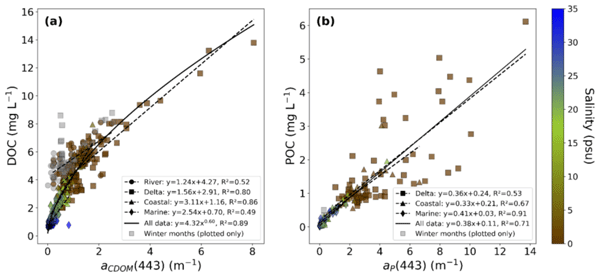
Lines 398-406: “A strong, non-linear relationship was found between observed DOC concentrations and aCDOM(443) across the full salinity gradient, with an overall coefficient of determination of r2=0.81 (Fig. 6a). While compartment-specific relationships were generally linear, combining samples across compartments resulted in a non-linear relationship. The overall regression reflects the combined variability of river and delta samples at higher aCDOM(443) values, while marine samples form a tightly clustered low-concentration group. The strength and type of this relationship vary markedly among compartments with the coastal compartment exhibiting the strongest linear relationship (r2=0.86), whereas the delta (r2=0.54) and marine (r2=0.49) compartments showed weaker relationships and narrower range of DOC variability. The compartment-specific regressions differed not only in strength but also in slope, with steeper relationships observed in coastal and marine compartments compared to river and delta samples, contributing to the non-linear cross-compartment scaling.”
What does the non-linear relationship indicate about CDOM absorption along the river to ocean continuum? Is the non-linear relationship expected? By considering and answering these questions, the authors should be able to address whether considering linear relationships within compartments is reasonable for analyzing this data, and what the within-water type relationships and “global” relationship represent about CDOM biogeochemistry across the salinity gradient.
Lines 425-436: There is no mention in the Results of specific attributes of the data presented that indicate processes such as flocculation, photodegradation, or other biogeochemical processing. As currently written, the Results present the data but do not extend into describing the data and linking with these processes. This paragraph also only indicates that this biogeochemical cycling occurs, but does not point to the emergence of these signals in the dataset presented here.
Line 438: You do not indicate any “hot spots” of DOM transformation in the dataset.
Lines 439-440: Where are these processes “suggested” within the data? This is not presented or highlighted in the Results.
Lines 444-450: Again – does the data presented here show these processes? Concentrations alone do not belie biogeochemical processes. How are you interpreting the data to determine that flocculation and particle settling are driving POC concentration gradients, and not dilution? Is the shape of the relationship consistent with a particular biogeochemical process, or dilution? Are there residuals in relationships that emerge in specific locations or time periods (seasons) that indicate a specific process? Without this supporting interpretation, this is a data paper with significant speculation only.
Lines 510-521: The non-linear relationship in Fig. 6 is driven largely by a few points. Additionally, there are a large number of river points that are bad data (negative CDOM absorption values at 443 nm, and even very low values that are likely indicating issues with analysis or sample handling). Without assessing the robustness of the fit when removing these values (e.g., ~6-8 delta values with elevated CDOM absorption), or considering why the delta values that display elevated carbon concentration relative to absorption (CDOM and particulate in Fig. 6), you lack the ability to interpret this data and extend the relevance of this dataset to remote sensing frameworks. If all river values with aCDOM(443) < 0.5 m-1, and DOC values > ~3 are removed, what does the relationship look like? If the delta values that fall significantly off a linear trend line are removed, what does the relationship look like? These questions need to be addressed to effectively assess this dataset and extend interpretation to implications for remote sensing.
Lines 514-517: Linear relationships have been observed across river-delta-plume-ocean transects within the same period. There is interpretation of these dynamics in Clark et al. (2022), widely cited here, and not directly but observations, which are associated with the work in Clark et al. (2022), in Grunert et al. (2021) (see Supplementary Info). There is also more general discussion of these dynamics across a number of papers by Cedric Fichot and Maria Tzortziou. One of the issues with this study is a lack of spatiotemporal context within the dataset. Overlapping multiple conservative mixing relationships may offer the appearance of emergent biogeochemical processing when applying a global relationship, when in fact singular relationships representing a temporally fixed space state (spring freshet in 2017, for example) would display predominantly conservative mixing. There is a need to consider seasonal dynamics, and spatial dynamics, within this dataset and how these overlap to inform the extent of conservative vs. nonconservative processes. Additionally, deviations from relationships can be informative to determine. One key dynamic that is not addressed here, but is mentioned throughout papers cited, is the role that spring discharge plays in largely conservative mixing, while nonconservative processes occur more in summer months when flow rates are slower, solar irradiance is higher and often penetrates deeper, and temperatures are relatively warmer, enhancing microbial metabolic rates.
Citation: https://doi.org/10.5194/egusphere-2026-997-RC2 -
AC3: 'Reply on RC2', Annabeth McCall, 08 Jun 2026
The comment was uploaded in the form of a supplement: https://egusphere.copernicus.org/preprints/2026/egusphere-2026-997/egusphere-2026-997-AC3-supplement.pdf
-
AC3: 'Reply on RC2', Annabeth McCall, 08 Jun 2026
Peer review completion


Interactive discussion
Status: closed
-
RC1: 'Comment on egusphere-2026-997', Piotr Kowalczuk, 20 Apr 2026
Authors have presented combined set of biogeochemical, optical and radiometric data collected in the Mackenzie River Delta and adjacent southern Beaufort Sea waters between 2009-2024. Observation were done during several oceanic campaigns and river monitoring programs resulting in the discrepancies in methodology that could affect data integrity and accuracy. Authors have done significant effort to harmonize data, and assure their quality. Authors have analyzed spatial and temporal distribution of CDOM and particulate absorption coefficient at 443 nm, aCDOM(443) and ap(443), and particulate and dissolved organic carbon POC, DOC, and total suspended matter concentration in the salinity gradients. Based on salinity thresholds and ranges of variability of considered parameters, Authors have distinguished regional compartments: river, delta, coastal and marine. Values of all parameters decreased with increasing salinity from river to marine compartments, although POC and SPM have exhibited more variability with marked reductions across the transition, consistent with retention and transformation processes in deltaic and nearshore zones. In all regional compartments concentration of DOC was higher than POC. The temporal distribution of POC, and SPM measured at the Tsiigehtchic observatory closely followed the river flow pattern with maximum valued measured in June and July, followed by gradual decrease toward autumn with minim values in winter. The DOC concentration was less affected by the river flow and has less pronounced seasonal pattern. DOC was significantly, nonlinearly correlated with aCDOM(443) across all regions, while the POC was linearly correlated with ap(443). Significant variability in slopes and intercepts of linear approximation between POC and DOC and respective absorption coefficient were observed within considered regional compartments. Based on measured hyperspectral remote sensing spectra Authors have distinguished 7 Optical Water Types. Authors have calculated the frequency distribution of Optica Water Types in salinity gradients and within delta, coastal and marine compartments. The remote sensing reflectance spectra resolved transition from turbid, particulate dominated riverine and deltaic waters to more clear coastal and marine waters enabling constraining and better selection of remote sensing algorithms.
In my opinion this is very interesting study that aimed to integrate and harmonize data from different sources and present synthetically variability of optical properties and associated geochemical variables in the Arctic deltaic region impacted by the global warming. This study provided baseline of the particulate and dissolved organic carbon fraction discharged into Beaufort Sea and western Arctic Ocean. This study will enable better quantification of the dissolved organic carbon fraction fluxes into the Arctic Ocean using optical proxies and remote sensing techniques. This study deserves publication after moderate revision.
Detailed comments
Introduction
Line 39
Typo. Please delete redundant phrase: is “… remineralization and flocculation (Eisma, 1986)( occur”. Should be “… remineralization and flocculation (Eisma, 1986).”
Materials and Method
Table 1.
I suggest to remove subscripts in parameters description e.g aCDOMa, apb. This is looking awkward. It is methodological correct to define measured parameters as” aCDOM(l) – Colored Dissolved Organic Matter absorption spectrum, ap(l) particulate absorption spectrum, and place those definitions below table.
Line 232
Please define symbol – Rrs.
Line 250
The description of filtration methods regarding CDOM sampling. Usage of both filter types used – 0.7 mm GF/F and 0.45 mm cellulose acetate filters is methodologically incorrect. The community accepted definition of soluble compounds present in water is the remaining filtrate after passing through 0.2 mm filters. So, in all your measured absorption spectra of filtered water either through – 0.7 mm GF/F or 0.45 mm cellulose acetate filters, there will be particulate absorption signal, than need to be corrected. This contribution could be significant in sediment loaded riverine and deltaic water. Please communicate if that issue has been considered during data analysis and how it influenced the uncertainty of measured CDOM absorption spectra.
Table 2. Radiometric data
Please harmonize the terminology used in Table 2 in column describing sensors. In all methods describe for measurements of remote sensing reflectance: radiometric profiles, floating radiometer or above water radiometric measurements, the measured water leaving radiance spectrum Lw(l) shall be divided by the measured spectrum of incident solar irradiance at the sea surface Es(l). So usage of terms such as: “Global solar irradiance” or “Downwelling incident irradiance” are not correct. Please harmonize terminology in Table 2.
Line 271.
“In situ measurements of bio-optical properties are essential for the calibration and validation of OCRS algorithms” Please define abbreviation OCRS when used first time.
Citation: https://doi.org/10.5194/egusphere-2026-997-RC1 -
AC1: 'Reply on RC1', Annabeth McCall, 08 Jun 2026
These are our responses to comments from Reviewer #1
We are grateful to the anonymous reviewer for their careful review and valuable comments on this manuscript. The constructive feedback provided has been instrumental in strengthening the manuscript, and we appreciate the opportunity to address the reviewer’s suggestions during the revision process. We have carefully considered all comments and revised the manuscript accordingly. Reviewer comments and our detailed responses are provided below.
Responses:
Line 39: Typo. Please delete redundant phrase: is “… remineralization and flocculation (Eisma, 1986)( occur”. Should be “… remineralization and flocculation (Eisma, 1986).”
Response: Thank you for the recommendation. Text changed to, "remineralization and flocculation (Eisma, 1986) occur."
Table 1: I suggest removing subscripts in parameters description e.g aCDOMa, apb. This is looking awkward. It is methodological correct to define measured parameters as” aCDOM(l) – Colored Dissolved Organic Matter absorption spectrum, ap(l) particulate absorption spectrum, and place those definitions below table.
Response: Thank you for this suggestion. Superscripts removed and changed to: aCDOM = Absorption of colored dissolved organic matter, aP = Particulate absorption
Line 232: Please define the symbol – Rrs.
Response: This correction also applies to a comment by RC2; please see the correction provided in RC2 comment line 232-234.
Line 250: The description of filtration methods regarding CDOM sampling. Usage of both filter types used – 0.7 mm GF/F and 0.45 mm cellulose acetate filters is methodologically incorrect. The community accepted definition of soluble compounds present in water is the remaining filtrate after passing through 0.2 mm filters. So, in all your measured absorption spectra of filtered water either through – 0.7 mm GF/F or 0.45 mm cellulose acetate filters, there will be particulate absorption signal, than need to be corrected. This contribution could be significant in sediment loaded riverine and deltaic water. Please communicate if that issue has been considered during data analysis and how it influenced the uncertainty of measured CDOM absorption spectra.
Response: We understand that 0.22 µm filters are commonly used in ocean optics studies as recommended in e.g. IOCCG reports. However, this study focuses across terrestrial and marine scientific communities partly on particle-rich, turbid coastal environments where larger pore size filters (0.45 µm and 0.7 µm) are recommended and necessary to allow adequate filtration of water samples. Previous studies (Supplementary Fig. S1 in Juhls et al., 2020) conducted in similar environments (Lena River) have shown that the difference in absorption measurements between 0.22 µm and 0.45 µm filters is typically below 5%, while the mean absolute difference in DOC concentrations between 0.45 µm and 0.7 µm filters is approximately 2.5%. While we cannot completely exclude minor contributions from particles passing through larger pore-size filters, previous comparisons suggest that this uncertainty is small relative to the observed variability across the fluvial–marine gradient and does not affect the main conclusions.
A correction has been made in line 259 of the manuscript text where (Supplementary Fig. S1 in Juhls et al., 2021) has been replaced with “(Supplementary Fig. S1 in Juhls et al., 2020).”
Table 2: Please harmonize the terminology used in Table 2 in column describing sensors. In all methods describe for measurements of remote sensing reflectance: radiometric profiles, floating radiometer or above water radiometric measurements, the measured water leaving radiance spectrum Lw(l) shall be divided by the measured spectrum of incident solar irradiance at the sea surface Es(l). So usage of terms such as: “Global solar irradiance” or “Downwelling incident irradiance” are not correct. Please harmonize terminology in Table 2.
Response: Thank you, we have adapted the table.
Campaign
Instrument type
Deployment
Sensor type
Spectral range/resolution
MALINA 2009 (Massicotte et al., 2021)
Compact Optical Profiling System (C-OPS)
Profile
Downwelling irradiance (Ed) (mW m-2 nm-1 sr-1)
Upwelling radiance (Lu) (mW m-2 nm-1 sr-1)
320-780 nm @ specific wavelengths
Nunataryuk 2019 (Lizotte et al., 2023)
Compact Optical Profiling System (C-OPS)
Profile
Downwelling irradiance (Ed) (mW m-2 nm-1 sr-1)
Upwelling radiance (Lu) (mW m-2 nm-1 sr-1)
395-865 nm @ specific wavelengths
PeCaBeau 2021 (Broder et al., 2022)
TriOS Ramses
TriOS Ramses
TriOS Ramses
Above-water
Floating
In-water
Downwelling radiance from sky, (Lsky)(λ,+10m) (mW m-2 nm-1 sr-1)Upwelling radiance, (Lu) (mW m-2 nm-1 sr-1)
Downwelling irradiance from the sky, (Ed) (λ,+10m) (mW m-2 nm-1)
Upwelling radiance mounted 6 cm below the water surface, Lu(λ,- 0.06m) (mW m-2 nm-1 sr-1)
Upwelling radiance (Lu)
Upwelling radiance (Lu) (mW m-2 nm-1 sr-1), 2x
Downwelling irradiance (Ed) (mW m-2 nm-1 sr-1)
300-850 nm @ 4 nm increments
300-850 nm @ 4 nm increments
300-850 nm @ 4 nm increments
FLOCHAR 2024
TriOS Ramses
TriOS Ramses
TriOS Ramses
Above-water
Floating
Profile
Downwelling radiance from sky, (Lsky) (mW m-2 nm-1 sr-1)Upwelling radiance (Lu) (mW m-2 nm-1 sr-1)
Downwelling irradiance from the sky, (Ed) (mW m-2 nm-1 sr-1)
Upwelling radiance (Lu) (mW m-2 nm-1 sr-1)
Downwelling irradiance (Ed) (mW m-2 nm-1 sr-1)
Upwelling radiance (Lu) (mW m-2 nm-1 sr-1)
Downwelling irradiance (Ed) (mW m-2 nm-1 sr-1)
350-950 nm @ 2.5 nm increments
350-950 nm @ 2.5 nm increments
350-950 nm @ 2.5 nm increments
Line 271: “In situ measurements of bio-optical properties are essential for the calibration and validation of OCRS algorithms” Please define abbreviation OCRS when used for the first time.
Response: Thank you for the suggestion. The text has been updated to: "In situ measurements of bio-optical properties are essential for the calibration and validation of ocean color remote sensing (OCRS) algorithms."
Citation: https://doi.org/10.5194/egusphere-2026-997-AC1 -
AC2: 'Reply on RC1', Annabeth McCall, 08 Jun 2026
The comment was uploaded in the form of a supplement: https://egusphere.copernicus.org/preprints/2026/egusphere-2026-997/egusphere-2026-997-AC2-supplement.pdf
-
AC1: 'Reply on RC1', Annabeth McCall, 08 Jun 2026
-
RC2: 'Comment on egusphere-2026-997', Anonymous Referee #2, 21 Apr 2026
General Comments
The authors have compiled a highly relevant dataset for understanding Arctic change across the Mackenzie River river-delta-plume-ocean continuum, including relevant timescales to capture some optical variability associated with Arctic change. The overall framing of the science is timely and could provide meaningful implications for remote sensing across the Arctic river-coastal ocean continuum. However, a number of issues must be addressed before the potential of the manuscript and associated data can be fully realized.
The Introduction describes many characteristics of the Mackenzie River watershed, but there is not a clear representation of how these traits manifest in satellite-observable traits, or how they impact the main goals and findings of this study. This points to a primary issue with the current version of the manuscript – data is presented, but not interpreted. Throughout the manuscript, “assumed” and synonyms appear frequently, indicating a lack of consideration of how the spatiotemporally broad dataset here resolves biogeochemical processes occurring across the Mackenzie River watershed and coastal zone, in space and time. Many of these processes are difficult to observe, even with careful, planned observation campaigns by a single group cross targeted times and regions; there is potential for apparent processes to emerge in this dataset, but the authors have not pushed past broad, generalized relationships that do not acknowledge distinct drivers of variability – for example, how did discharge, temperature, precipitation, or thaw timing relate to CDOM variability within and across years in this dataset?
Additionally, while there are challenges in compiling diverse datasets, there appear to be issues with the data used here, particularly CDOM absorption values. How do the authors justify negative CDOM absorption at 443 nm? How do these values impact relationships determined here? How do apparent outliers influence relationships, and whether a linear or non-linear relationship is found to best explain the data?
Beyond these general comments, I have listed concerns with general errors, questions and concerns that will improve manuscript quality and transparency, and many specific comments that point to major weaknesses in the manuscript. I believe there is significant potential in this dataset and the framing of the manuscript, but I recommend the authors make significant changes to realize the intended analysis of the dataset and implications for remote sensing.
General Errors
Check tense throughout – it switches between past and present tense.
Check figure captions for typos (e.g., extra period, misspelling)
Questions to Advance Analysis
While the Methods cover sample collection extensively, there is no indication to how variables considered in the paper were derived. Equations for calculating terms need to be included so it is clear throughout what values are being presented (i.e., AC-S vs. spectrophotometer) and how these values were determined. A good example is indicated in Specific Comments, but presumably the ap(443) presented here was derived from at – aCDOM from the AC-S?
How does the temporal mismatch in the data impact analysis?
How do OWTs relate to apparent biogeochemical processes that emerge across multiple variables?
Specific Comments
The permafrost zones from Brown et al. 2002 are referenced – have these zones shifted, and how is this expected to influence the data and your analysis over a fairly broad study period in a region that is rapidly transforming due to warming?Lines 117-119: “The basin spans the full permafrost gradient, from continuous to discontinuous and sporadic permafrost zones with approximately 13 % underlain by continuous permafrost and 42 % by continuous and discontinuous permafrost combined, of which approximately 80 % is underlain by permafrost”
This is unclear, please re-word to clearly depict what percentage of the watershed is underlain by continuous permafrost, discontinuous permafrost, and no permafrost. Currently, it reads as 42% of the watershed contains some form of permafrost (presumably, 13% continuous, 29% discontinuous). The 80% conflicts with the other values provided, but presumably represents the total coverage of all permafrost types.
Lines 120-121: “This broad permafrost transition exerts strong controls on hydrology, sediment delivery, and organic carbon composition entering the delta-shelf system.”
What type of controls? Even if you reference, rather than explicitly state, it is beneficial to indicate how each permafrost type would control hydrology, sediment delivery, and OC composition briefly to emphasize how this transition will manifest in observable dynamics from satellite.
Line 228: This should be “overestimate” rather than “underestimate” – if salts remained on the SPM filters, they would have a greater weight. This uncertainty, while not quantified, sometimes appears in the replicate agreement, so you may point to that rather than indicating you don’t believe it impacted the results. This may also be true for POC (line 209).
Lines 231-233: I recommend splitting this sentence into two sentences, and ensure it is in the past tense.
Lines 233-234: “The total light absorption (at(λ)) and attenuation (ct(λ)) coefficients were measured by filling the optical path of the AC-s (10 cm) with the unfiltered water sample.”
The AC-S was used as a benchtop unit, correct? If so, can you describe how samples were debubbled, or otherwise provide a brief sentence on if/how measurement noise was addressed. These types of measurements tend to be quite noisy. I am assuming these were measured in the field? If not, how was whole water maintained?
Line 236: ap was determined by subtracting aCDOM from at?
Line 240: No “-“ between “ocean” and “color”
Table 2 indicates that C-OPS radiometry was collected above-water. Was this through the sky block approach? If so, it would be beneficial to indicate this in the table.
Line 272: OCRS needs to be defined, and the definition later in the manuscript can be removed from that instance.
Line 277: “The classification scheme aims to a broad applicability”
This needs to be reworded.
Lines 286-287: “categories river, delta, coastal, and marine are used as well.”
This needs to be reworded.
Line 338: I would avoid describing aCDOM(443) in marine waters as “near-zero”. CDOM absorption is quite low in the open ocean relative to river values, but this does not mean it is not an important component of ocean biogeochemistry. Framing this end member value (e.g., 0.1) provides meaningful biogeochemical context while not offering a phrasing that implies it is absent from the system or otherwise unimportant. This comment is true for all of the Results – indicate the average or global minimum for your dataset. All of these values will be close to zero relative to river values, but the value itself is still important for interpretation of the data.
Figure 4: Why are negative aCDOM(443) values present in the dataset? Where are these data sourced from? This is surprising for freshwaters and indicates issues with sampling or sample handling and processing. I would suggest these data be excluded from analysis. This is particularly troublesome when the DOC values are >2 mg/L for these same samples.
Figure 4: Why are relationships and fits not presented for c and d? Even if the relationship is poor, this is helpful for interpreting the data and understanding system dynamics across these variables and relative to each other.
Figure 5: Are the aCDOM(443) values in this figure averages? They diverge from what is shown in Fig. 4, presumably due to a wide range, and inclusion of incorrect (negative), absorption values for freshwater samples.
Lines 362-373: Linked with the comment on Fig. 5, there is a wide discrepancy between organic carbon concentrations and optics, but this is presumably due to high inorganic particle loads. There is no indication of this in the Results, and it would be helpful to understand what is driving this significant difference between ap and aCDOM. Also – did the AC-S ever saturate?
Lines 375-376: These are repeat lines.
Line 376: Is there another way to indicate “systematic shift”? This has appeared quite a few times, and appears to be a rhetorical device that hides a lack of interpretation of the data. The Results are descriptive, but do not elucidate the meaning of the data.
Lines 398-406: “A strong, non-linear relationship was found between observed DOC concentrations and aCDOM(443) across the full salinity gradient, with an overall coefficient of determination of r2=0.81 (Fig. 6a). While compartment-specific relationships were generally linear, combining samples across compartments resulted in a non-linear relationship. The overall regression reflects the combined variability of river and delta samples at higher aCDOM(443) values, while marine samples form a tightly clustered low-concentration group. The strength and type of this relationship vary markedly among compartments with the coastal compartment exhibiting the strongest linear relationship (r2=0.86), whereas the delta (r2=0.54) and marine (r2=0.49) compartments showed weaker relationships and narrower range of DOC variability. The compartment-specific regressions differed not only in strength but also in slope, with steeper relationships observed in coastal and marine compartments compared to river and delta samples, contributing to the non-linear cross-compartment scaling.”
What does the non-linear relationship indicate about CDOM absorption along the river to ocean continuum? Is the non-linear relationship expected? By considering and answering these questions, the authors should be able to address whether considering linear relationships within compartments is reasonable for analyzing this data, and what the within-water type relationships and “global” relationship represent about CDOM biogeochemistry across the salinity gradient.
Lines 425-436: There is no mention in the Results of specific attributes of the data presented that indicate processes such as flocculation, photodegradation, or other biogeochemical processing. As currently written, the Results present the data but do not extend into describing the data and linking with these processes. This paragraph also only indicates that this biogeochemical cycling occurs, but does not point to the emergence of these signals in the dataset presented here.
Line 438: You do not indicate any “hot spots” of DOM transformation in the dataset.
Lines 439-440: Where are these processes “suggested” within the data? This is not presented or highlighted in the Results.
Lines 444-450: Again – does the data presented here show these processes? Concentrations alone do not belie biogeochemical processes. How are you interpreting the data to determine that flocculation and particle settling are driving POC concentration gradients, and not dilution? Is the shape of the relationship consistent with a particular biogeochemical process, or dilution? Are there residuals in relationships that emerge in specific locations or time periods (seasons) that indicate a specific process? Without this supporting interpretation, this is a data paper with significant speculation only.
Lines 510-521: The non-linear relationship in Fig. 6 is driven largely by a few points. Additionally, there are a large number of river points that are bad data (negative CDOM absorption values at 443 nm, and even very low values that are likely indicating issues with analysis or sample handling). Without assessing the robustness of the fit when removing these values (e.g., ~6-8 delta values with elevated CDOM absorption), or considering why the delta values that display elevated carbon concentration relative to absorption (CDOM and particulate in Fig. 6), you lack the ability to interpret this data and extend the relevance of this dataset to remote sensing frameworks. If all river values with aCDOM(443) < 0.5 m-1, and DOC values > ~3 are removed, what does the relationship look like? If the delta values that fall significantly off a linear trend line are removed, what does the relationship look like? These questions need to be addressed to effectively assess this dataset and extend interpretation to implications for remote sensing.
Lines 514-517: Linear relationships have been observed across river-delta-plume-ocean transects within the same period. There is interpretation of these dynamics in Clark et al. (2022), widely cited here, and not directly but observations, which are associated with the work in Clark et al. (2022), in Grunert et al. (2021) (see Supplementary Info). There is also more general discussion of these dynamics across a number of papers by Cedric Fichot and Maria Tzortziou. One of the issues with this study is a lack of spatiotemporal context within the dataset. Overlapping multiple conservative mixing relationships may offer the appearance of emergent biogeochemical processing when applying a global relationship, when in fact singular relationships representing a temporally fixed space state (spring freshet in 2017, for example) would display predominantly conservative mixing. There is a need to consider seasonal dynamics, and spatial dynamics, within this dataset and how these overlap to inform the extent of conservative vs. nonconservative processes. Additionally, deviations from relationships can be informative to determine. One key dynamic that is not addressed here, but is mentioned throughout papers cited, is the role that spring discharge plays in largely conservative mixing, while nonconservative processes occur more in summer months when flow rates are slower, solar irradiance is higher and often penetrates deeper, and temperatures are relatively warmer, enhancing microbial metabolic rates.
Citation: https://doi.org/10.5194/egusphere-2026-997-RC2 -
AC3: 'Reply on RC2', Annabeth McCall, 08 Jun 2026
The comment was uploaded in the form of a supplement: https://egusphere.copernicus.org/preprints/2026/egusphere-2026-997/egusphere-2026-997-AC3-supplement.pdf
-
AC3: 'Reply on RC2', Annabeth McCall, 08 Jun 2026
Peer review completion
Journal article(s) based on this preprint
Viewed
| HTML | XML | Total | BibTeX | EndNote | |
|---|---|---|---|---|---|
| 899 | 466 | 92 | 1,457 | 93 | 104 |
- HTML: 899
- PDF: 466
- XML: 92
- Total: 1,457
- BibTeX: 93
- EndNote: 104
Viewed (geographical distribution)
| Country | # | Views | % |
|---|
| Total: | 0 |
| HTML: | 0 |
| PDF: | 0 |
| XML: | 0 |
- 1
Annabeth McCall

Martin Hieronymi
P. Paul Overduin
Lisa Bröder
Julie Lattaud
Rüdiger Röttgers
Irina Overeem
Anne Morgenstern
Guido Grosse
Bennet Juhls
The requested preprint has a corresponding peer-reviewed final revised paper. You are encouraged to refer to the final revised version.
- Preprint
(1633 KB) - Metadata XML
Authors have presented combined set of biogeochemical, optical and radiometric data collected in the Mackenzie River Delta and adjacent southern Beaufort Sea waters between 2009-2024. Observation were done during several oceanic campaigns and river monitoring programs resulting in the discrepancies in methodology that could affect data integrity and accuracy. Authors have done significant effort to harmonize data, and assure their quality. Authors have analyzed spatial and temporal distribution of CDOM and particulate absorption coefficient at 443 nm, aCDOM(443) and ap(443), and particulate and dissolved organic carbon POC, DOC, and total suspended matter concentration in the salinity gradients. Based on salinity thresholds and ranges of variability of considered parameters, Authors have distinguished regional compartments: river, delta, coastal and marine. Values of all parameters decreased with increasing salinity from river to marine compartments, although POC and SPM have exhibited more variability with marked reductions across the transition, consistent with retention and transformation processes in deltaic and nearshore zones. In all regional compartments concentration of DOC was higher than POC. The temporal distribution of POC, and SPM measured at the Tsiigehtchic observatory closely followed the river flow pattern with maximum valued measured in June and July, followed by gradual decrease toward autumn with minim values in winter. The DOC concentration was less affected by the river flow and has less pronounced seasonal pattern. DOC was significantly, nonlinearly correlated with aCDOM(443) across all regions, while the POC was linearly correlated with ap(443). Significant variability in slopes and intercepts of linear approximation between POC and DOC and respective absorption coefficient were observed within considered regional compartments. Based on measured hyperspectral remote sensing spectra Authors have distinguished 7 Optical Water Types. Authors have calculated the frequency distribution of Optica Water Types in salinity gradients and within delta, coastal and marine compartments. The remote sensing reflectance spectra resolved transition from turbid, particulate dominated riverine and deltaic waters to more clear coastal and marine waters enabling constraining and better selection of remote sensing algorithms.
In my opinion this is very interesting study that aimed to integrate and harmonize data from different sources and present synthetically variability of optical properties and associated geochemical variables in the Arctic deltaic region impacted by the global warming. This study provided baseline of the particulate and dissolved organic carbon fraction discharged into Beaufort Sea and western Arctic Ocean. This study will enable better quantification of the dissolved organic carbon fraction fluxes into the Arctic Ocean using optical proxies and remote sensing techniques. This study deserves publication after moderate revision.
Detailed comments
Introduction
Line 39
Typo. Please delete redundant phrase: is “… remineralization and flocculation (Eisma, 1986)( occur”. Should be “… remineralization and flocculation (Eisma, 1986).”
Materials and Method
Table 1.
I suggest to remove subscripts in parameters description e.g aCDOMa, apb. This is looking awkward. It is methodological correct to define measured parameters as” aCDOM(l) – Colored Dissolved Organic Matter absorption spectrum, ap(l) particulate absorption spectrum, and place those definitions below table.
Line 232
Please define symbol – Rrs.
Line 250
The description of filtration methods regarding CDOM sampling. Usage of both filter types used – 0.7 mm GF/F and 0.45 mm cellulose acetate filters is methodologically incorrect. The community accepted definition of soluble compounds present in water is the remaining filtrate after passing through 0.2 mm filters. So, in all your measured absorption spectra of filtered water either through – 0.7 mm GF/F or 0.45 mm cellulose acetate filters, there will be particulate absorption signal, than need to be corrected. This contribution could be significant in sediment loaded riverine and deltaic water. Please communicate if that issue has been considered during data analysis and how it influenced the uncertainty of measured CDOM absorption spectra.
Table 2. Radiometric data
Please harmonize the terminology used in Table 2 in column describing sensors. In all methods describe for measurements of remote sensing reflectance: radiometric profiles, floating radiometer or above water radiometric measurements, the measured water leaving radiance spectrum Lw(l) shall be divided by the measured spectrum of incident solar irradiance at the sea surface Es(l). So usage of terms such as: “Global solar irradiance” or “Downwelling incident irradiance” are not correct. Please harmonize terminology in Table 2.
Line 271.
“In situ measurements of bio-optical properties are essential for the calibration and validation of OCRS algorithms” Please define abbreviation OCRS when used first time.