
the Creative Commons Attribution 4.0 License.
the Creative Commons Attribution 4.0 License.
 | 15 Apr 2026
Editorial: Introducing a new article type: Limitations, Errors, Surprises, Shortcomings and Opportunities for New Science (LESSONS)
Abstract. Science is a rich process of well-informed trial-and-error and learning from errors often paves the way to scientific advances. However, this process and associated so-called null results are seldomly shared, because the publication culture and career incentives are biased towards positive results. This bias impedes scientific progress because errors or null results can be repeated by other scientists unless they are made public. In contrast, the publication of non-positive results and associated learnings completes an unbiased record of the research effort, contributes to open and transparent science, allows the authors and others to learn and may open opportunities for new science. A dedicated article type for these kinds of lessons as part of established journals clearly encourages such articles, and increases their visibility and recognition.
Here, we introduce and explain a new article type that covers lessons learned to help overcome the positive publishing bias and that is being introduced in participating European Geoscience Union (EGU) publications. "LESSONS" articles describe the Limitations, Errors, Surprises, Shortcomings and Opportunities for New Science emerging from the scientific process. Note that the terms included in the LESSONS abbreviation are just examples to clarify what these article types stand for without indicating definitions or exclusive categories. Importantly, a LESSONS article will offer a substantial, valuable insight within the scope of geosciences.
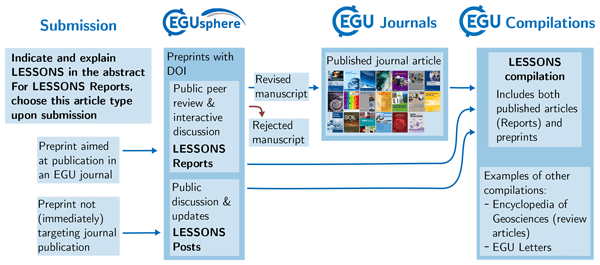
Specifically, we present two types of articles: LESSONS Reports are journal articles that apply the public peer review model of EGU's journals, whilst LESSONS Posts are not peer-reviewed preprints that allow early-stage reporting. Both article types are short, so the extent and depth to which the subject can be explored is deliberately limited (e.g., as for the GC Insights or Letter format) to help lower the barrier to journal publication. Details of how to structure and submit both of these article types are given, as well as guidance for reviewers. LESSONS articles will be published in EGU's community journals but are also summarized in a dedicated and ongoing interjournal compilation. In this way, these insights are easily findable for other scientists looking to prevent duplicate research, improve their meta-analyses, or otherwise gain value from the LESSONS articles of others.
Competing interests: At least one of the (co-)authors is a member of the editorial board of Geoscience Communication.
Publisher's note: Copernicus Publications remains neutral with regard to jurisdictional claims made in the text, published maps, institutional affiliations, or any other geographical representation in this paper. While Copernicus Publications makes every effort to include appropriate place names, the final responsibility lies with the authors. Views expressed in the text are those of the authors and do not necessarily reflect the views of the publisher.-
Notice on discussion status
The requested preprint has a corresponding peer-reviewed final revised paper. You are encouraged to refer to the final revised version.
-
Preprint
(4721 KB)
-
The requested preprint has a corresponding peer-reviewed final revised paper. You are encouraged to refer to the final revised version.
- Preprint
(4721 KB) - Metadata XML
- BibTeX
- EndNote
- Final revised paper


Journal article(s) based on this preprint
Interactive discussion
Status: closed
-
RC1: 'Comment on egusphere-2026-987', Daniela Brito Melo, 13 May 2026
The manuscript presents a new article type (LESSONS), dedicated to scientific errors, limitations and null results - topics frequently absent in classic scientific literature. It refers to several peer-reviewed articles addressing these topics, which showcase the impact of a positively biased publication culture, as well as the scientific value of reporting errors, limitations and null results. The article properly states the need and advantages of this type of article. I warmly congratulate the authors on this initiative.
Before publication, I would recommend considering the following suggestions:
L.117-124: In this part of the text, the authors give examples of discontinued journals dedicated to the same topic. In my view, it would be helpful to reflect on the potential causes and to state what will be done to avoid a similar ending for the LESSONS article type.
L.222-223: the authors highlight that limitations, errors, etc. (i.e. LESSONS) have been published before in "regular research articles", together with "substantial new results, advances". In my view, the advantage of publishing this type of results in a LESSONS article type in comparison to a "regular" article type is not clearly stated. Are LESSONS articles a temporary need while the publishing culture does not change? If not, this should be clearly stated.
Chapter 3: I think it would be worth adding to this section the answer to "When to write a LESSONS article". In my perspective, a researcher will continue investigating a problem until the "substantial new result" is found. At that time, they might prioritize writing a "regular research article" in comparison to a LESSONS article. There are sufficient arguments in the manuscript supporting the writing of a LESSONS article. However, current career incentives might pressure researchers to move on to the next finding instead of documenting the LESSONS from their just published work. I think it would be useful if the authors could acknowledge and elaborate on these challenges and motivate the need to timely document the discovered errors and shortcomings.
L.240, 258, 358, 360, 362: capitalize "report(s)" for consistency.
L.240-241: introduce ACP after "article processing charges" just for clarity.
L. 250, 359, 361: capitalize "post(s)" for consistency.
Citation: https://doi.org/10.5194/egusphere-2026-987-RC1 - AC1: 'Reply on RC1', Jonas Pyschik, 23 Jun 2026
-
RC2: 'Comment on egusphere-2026-987', Melissa Reidy, 19 May 2026
This manuscript introduces an article type titled LESSONS, which is to be included in some EGU publications moving forward. LESSONS are actually two types of articles but both types aim to overcome the bias towards positive-results publishing. The manuscript details the motivation behind this initiative as well as outlining article scope and format and guidelines for writing, editing and reviewing LESSONS articles. In the introduction, the authors provide some compelling reasons as to why this type of article will be valuable to researchers moving forward. It is clear that there is definitely room, and need, for LESSONS articles in the scientific publishing sphere. Well done to the authors for this optimistic initiative and I look forward to reading some of the LESSONS articles in the future.
I’ve provided some comments below as suggestions for very minor improvements to the finished manuscript.
Section 1.1: Have the authors considered whether certain groups of researchers are more likely to benefit from writing and reading LESSONS articles than others? For example, LESSONS articles might be more adopted by early career stage researchers, or researchers operating within limited resource environments since they are less likely to be able to ‘afford’ mistakes and errors compared to senior researchers or those with stable funding. And from this, are there certain groups of researchers that will be more likely to submit LESSONS articles compared to others? The authors could speculate on this using abstracts submitted to the BUGS session later mentioned in the article. I do understand that this information might not be out there to include in this section, but it could offer useful insight if that’s possible.
Line 111 – 113: The inclusion of the BUGS sessions at the General Assembly provides good context for the need for LESSONS articles. The authors could include some basic information such as number of abstracts submitted to BUGS sessions in previous years, or number of posters/presentations etc to strengthen this context.
Line 117-124: I agree with the comment from another reviewer here. As well as offering some reflection on why this topic has not been adopted successfully in previous attempts, it could be useful to include some details as context. For example, if the ‘Black Swans’ manuscript category received no submissions, how many submissions did other manuscript categories receive in contrast? Is there any information about whether the submission process for this category was different in any way to other categories?
Section 4: I’m curious about the review process for the LESSONS articles and it’s great that the authors have a specific section on this. One of my concerns about the LESSONS articles is not the articles themselves, but that a positive result bias may also translate to a positive result review bias. Can the authors speculate as to whether it would be more difficult to attract reviewers for LESSONS articles compared to other research articles? Perhaps there is information about this from some of the other publications previously mentioned earlier in the article. Given that one part of peer review may be to suggest to authors different ways of analyzing data or improving methods, is there a risk with LESSONS articles that during the peer review process, the ‘error’ that the article is based on is actually solved? And how does that affect the relevance of the article submitted? All of this is just to say that the section on editing and reviewing could be strengthened by the authors having a bit of a discussion about how the peer review process for a LESSONS article may differ and how these differences will be tackled by reviewers.
Citation: https://doi.org/10.5194/egusphere-2026-987-RC2 - AC2: 'Reply on RC2', Jonas Pyschik, 23 Jun 2026
Peer review completion


Interactive discussion
Status: closed
-
RC1: 'Comment on egusphere-2026-987', Daniela Brito Melo, 13 May 2026
The manuscript presents a new article type (LESSONS), dedicated to scientific errors, limitations and null results - topics frequently absent in classic scientific literature. It refers to several peer-reviewed articles addressing these topics, which showcase the impact of a positively biased publication culture, as well as the scientific value of reporting errors, limitations and null results. The article properly states the need and advantages of this type of article. I warmly congratulate the authors on this initiative.
Before publication, I would recommend considering the following suggestions:
L.117-124: In this part of the text, the authors give examples of discontinued journals dedicated to the same topic. In my view, it would be helpful to reflect on the potential causes and to state what will be done to avoid a similar ending for the LESSONS article type.
L.222-223: the authors highlight that limitations, errors, etc. (i.e. LESSONS) have been published before in "regular research articles", together with "substantial new results, advances". In my view, the advantage of publishing this type of results in a LESSONS article type in comparison to a "regular" article type is not clearly stated. Are LESSONS articles a temporary need while the publishing culture does not change? If not, this should be clearly stated.
Chapter 3: I think it would be worth adding to this section the answer to "When to write a LESSONS article". In my perspective, a researcher will continue investigating a problem until the "substantial new result" is found. At that time, they might prioritize writing a "regular research article" in comparison to a LESSONS article. There are sufficient arguments in the manuscript supporting the writing of a LESSONS article. However, current career incentives might pressure researchers to move on to the next finding instead of documenting the LESSONS from their just published work. I think it would be useful if the authors could acknowledge and elaborate on these challenges and motivate the need to timely document the discovered errors and shortcomings.
L.240, 258, 358, 360, 362: capitalize "report(s)" for consistency.
L.240-241: introduce ACP after "article processing charges" just for clarity.
L. 250, 359, 361: capitalize "post(s)" for consistency.
Citation: https://doi.org/10.5194/egusphere-2026-987-RC1 - AC1: 'Reply on RC1', Jonas Pyschik, 23 Jun 2026
-
RC2: 'Comment on egusphere-2026-987', Melissa Reidy, 19 May 2026
This manuscript introduces an article type titled LESSONS, which is to be included in some EGU publications moving forward. LESSONS are actually two types of articles but both types aim to overcome the bias towards positive-results publishing. The manuscript details the motivation behind this initiative as well as outlining article scope and format and guidelines for writing, editing and reviewing LESSONS articles. In the introduction, the authors provide some compelling reasons as to why this type of article will be valuable to researchers moving forward. It is clear that there is definitely room, and need, for LESSONS articles in the scientific publishing sphere. Well done to the authors for this optimistic initiative and I look forward to reading some of the LESSONS articles in the future.
I’ve provided some comments below as suggestions for very minor improvements to the finished manuscript.
Section 1.1: Have the authors considered whether certain groups of researchers are more likely to benefit from writing and reading LESSONS articles than others? For example, LESSONS articles might be more adopted by early career stage researchers, or researchers operating within limited resource environments since they are less likely to be able to ‘afford’ mistakes and errors compared to senior researchers or those with stable funding. And from this, are there certain groups of researchers that will be more likely to submit LESSONS articles compared to others? The authors could speculate on this using abstracts submitted to the BUGS session later mentioned in the article. I do understand that this information might not be out there to include in this section, but it could offer useful insight if that’s possible.
Line 111 – 113: The inclusion of the BUGS sessions at the General Assembly provides good context for the need for LESSONS articles. The authors could include some basic information such as number of abstracts submitted to BUGS sessions in previous years, or number of posters/presentations etc to strengthen this context.
Line 117-124: I agree with the comment from another reviewer here. As well as offering some reflection on why this topic has not been adopted successfully in previous attempts, it could be useful to include some details as context. For example, if the ‘Black Swans’ manuscript category received no submissions, how many submissions did other manuscript categories receive in contrast? Is there any information about whether the submission process for this category was different in any way to other categories?
Section 4: I’m curious about the review process for the LESSONS articles and it’s great that the authors have a specific section on this. One of my concerns about the LESSONS articles is not the articles themselves, but that a positive result bias may also translate to a positive result review bias. Can the authors speculate as to whether it would be more difficult to attract reviewers for LESSONS articles compared to other research articles? Perhaps there is information about this from some of the other publications previously mentioned earlier in the article. Given that one part of peer review may be to suggest to authors different ways of analyzing data or improving methods, is there a risk with LESSONS articles that during the peer review process, the ‘error’ that the article is based on is actually solved? And how does that affect the relevance of the article submitted? All of this is just to say that the section on editing and reviewing could be strengthened by the authors having a bit of a discussion about how the peer review process for a LESSONS article may differ and how these differences will be tackled by reviewers.
Citation: https://doi.org/10.5194/egusphere-2026-987-RC2 - AC2: 'Reply on RC2', Jonas Pyschik, 23 Jun 2026
Peer review completion
Journal article(s) based on this preprint
Viewed
| HTML | XML | Total | BibTeX | EndNote | |
|---|---|---|---|---|---|
| 1,239 | 291 | 52 | 1,582 | 267 | 285 |
- HTML: 1,239
- PDF: 291
- XML: 52
- Total: 1,582
- BibTeX: 267
- EndNote: 285
Viewed (geographical distribution)
| Country | # | Views | % |
|---|
| Total: | 0 |
| HTML: | 0 |
| PDF: | 0 |
| XML: | 0 |
- 1

John Hillier
Stefan Gaillard
Theresa Blume
Eduardo Queiroz Alves
Susanne Buiter
Ken S. Carslaw
Kirsten von Elverfeldt
Tim H. M. van Emmerik
Barbara Ervens
Sam Illingworth
Daniel Klotz
Jonas Pyschik
The requested preprint has a corresponding peer-reviewed final revised paper. You are encouraged to refer to the final revised version.
- Preprint
(4721 KB) - Metadata XML