
the Creative Commons Attribution 4.0 License.
the Creative Commons Attribution 4.0 License.
 | 16 Mar 2026
Airborne eddy covariance measurements of ocean-air VOC fluxes: Distinguishing signal from noise
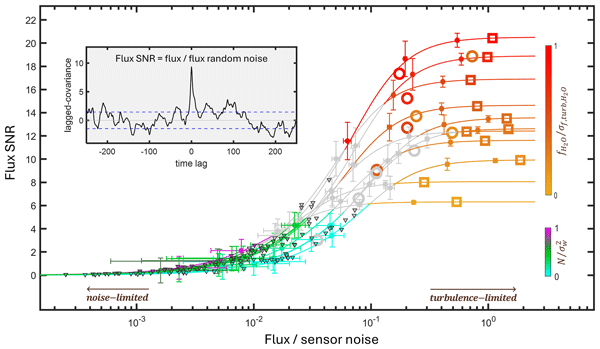
Abstract. Ocean-atmosphere exchange plays an important but uncertain role for many volatile organic compounds (VOCs). Airborne eddy covariance (EC) enables direct flux quantification over large areas, but VOC applications have largely been performed over land. Here we combine the EC methodology with aircraft-based measurements from the North Atlantic Aerosol and Marine Ecosystem Study (NAAMES) and use the results to characterize air-sea VOC fluxes and to elucidate random and systematic drivers of error. Using perturbation experiments, we show that uncorrelated sensor noise (USN) causes flux biases by obscuring the sensor-wind time lag; such biases are avoided by imposing a time-lag constraint (e.g., from a higher-flux compound or time). We define the flux signal-to-noise ratio SNRf and characterize its dependence on USN and sampling regime. Results show a transition from a USN-dominated regime to one where SNRf is limited by turbulent stochasticity. The NAAMES VOC fluxes are noise-limited, whereas H2O and sensible heat fluxes lie respectively in turbulence-limited and transitional regimes. We provide a methodology for determining sensor noise levels needed for robust flux detection: for the NAAMES subset examined here, a factor of 18 USN reduction would enable 75 % (rather than 15 %) of measured VOC fluxes to attain SNRf > 3. The airborne NAAMES results reveal VOCs with universally upward (e.g., dimethyl sulfide), downward (e.g., acetone), bidirectional (e.g., acetaldehyde), and undetectable (e.g., monoterpenes) air-sea exchange, with controls including wind speed and planktonic activity. Findings highlight the importance of USN for VOC flux quantification by airborne EC and lay a foundation for expanded use of this technique.
Competing interests: At least one of the (co-)authors is a member of the editorial board of Atmospheric Measurement Techniques. The peer-review process was guided by an independent editor, and the authors also have no other competing interests to declare.
Publisher's note: Copernicus Publications remains neutral with regard to jurisdictional claims made in the text, published maps, institutional affiliations, or any other geographical representation in this paper. While Copernicus Publications makes every effort to include appropriate place names, the final responsibility lies with the authors. Views expressed in the text are those of the authors and do not necessarily reflect the views of the publisher.-
Notice on discussion status
The requested preprint has a corresponding peer-reviewed final revised paper. You are encouraged to refer to the final revised version.
-
Preprint
(3749 KB)
-
Supplement
(41456 KB)
-
The requested preprint has a corresponding peer-reviewed final revised paper. You are encouraged to refer to the final revised version.
- Preprint
(3749 KB) - Metadata XML
-
Supplement
(41456 KB) - BibTeX
- EndNote
- Final revised paper


Journal article(s) based on this preprint
Interactive discussion
Status: closed
-
RC1: 'Comment on egusphere-2026-976', Anonymous Referee #1, 07 Apr 2026
-
AC1: 'Reply on RC1', Xin Chen, 19 May 2026
The comment was uploaded in the form of a supplement: https://egusphere.copernicus.org/preprints/2026/egusphere-2026-976/egusphere-2026-976-AC1-supplement.pdf
-
AC1: 'Reply on RC1', Xin Chen, 19 May 2026
-
RC2: 'Comment on egusphere-2026-976', Mingxi Yang, 17 Apr 2026
This is a highly technical paper that reports aircraft VOC fluxes measured by a PTR-tof-MS. The paper looks in detail at sources of random and systematic uncertainties in the flux measurements. Due to the small magnitude of the VOC fluxes, the authors found that only DMS (emission) and acetone (deposition) fluxes were unambiguously detected on a consistent basis. Overall, I think this is a useful methods paper. Though it doesn’t seem that the flight plans were designed to optimize flux measurements, and the numbers of flux segments were very small, thus it’s hard to say how representative the measured fluxes are of air-sea exchange in the North Atlantic.
Detailed comments:
The introduction had a very comprehensive review of previous techniques.
Sensitivity cps/ppb of PTR-tof-MS for main compounds of interest? What’s the mass resolution?
Line 105. Altitude of low level legs?
Line 110. This might have been described briefly, but is worth repeating. Was the PTR calibrated against standard gases? What was used as the background or blank measurement? Type/length of inlet? Flow rate? What’s the expected e-folding time (response time) of the system?
Line 135. Was a correction for the aircraft motion on the measured relative winds necessary for these flights?
Figure 2. please use different marker shapes for people who might struggle with the colors.
Line 176. Random uncertainty in flux can usually be reduced by more averaging (scales with 1/sqrt(N)). Here a rather large range in averaging time (and so space) was chosen: 3-25 km, which by itself preassembly leads to quite different noise levels. Why not just using 3 km averaging period through out? And if needed, further average the 3-km fluxes afterwards?
Line 186. How different are flux results using this approach vs a simple linear detrend?
Line 190. What is roughly the expected lag time based on the inlet dimensions and flow rates? Have authors tested with injections of VOC standards to see whether different VOC show comparable or different responses within their inlet?
Figure 3. on my screen there looks to be breaks in the cospectral density plots?
Line 254. Again, what’s the response time of the PTR/inlet system? It might be that the cospectra are too noisy to say with confidence that high frequency attenuation is negligible. Were there conditions of stable atmosphere, where attenuation might be more pronounced?
Line 260. The detrend method used implicitly assumes that there are no low frequency eddies that contribute to flux, right? Again, a simple comparison with this approach vs linear detrend would be useful.
Line 314. The use of ‘VOCs’ here is ambiguous. Surely the random error contribution to well resolved fluxes such as DMS and maybe acetone is smaller than for VOCs such as benzene and monoterpenes?
Figure 5. This is a neat way to illustrate the importance of getting the lag time correctly. But I don’t get why such a large lag wind window (+/- 50s) is needed for the lag correlation calculation. Was the pump flow so variable (e.g. with altitude)?
Figure 7. Again, I think it’d be useful to specify which VOC here, as the S/N must be very different for say DMS vs benzene.
Table 1. where it says ‘uncertainty of the mean flux’, this seems to be 3 stdev. Is this the flux noise or the flux detection limit? It seems like it might be the latter to me.
How are error-weighted mean flux and its uncertainty computed?
Section 5.1 This section is interpreted in the context of the expected air-sea fluxes. However the authors never mentioned the height of their ‘low level legs’. EC fluxes are generally thought to be representative of surface fluxes if they’re measured within the surface layer of the atmosphere, which is roughly lowest 10% of the marine boundary layer. Thus if the boundary layer is 500 m, the aircraft would need to fly below 50 m for the flues to be representative of surface exchange. Above the surface layer there’s expected to be a vertical gradient in flux (driven by the strength of surface flux and entrainment flux at top of the marine boundary layer).
Section 5.2 Eddy covariance fluxes, as the authors have shown, have relatively large random uncertainties that require sufficient averaging to draw robust conclusions. I’m not saying that the conclusions in this section is wrong, but given the very low number of above LOD flux segments for these VOCs, it’s very difficult to say how representative the aircraft fluxes are. I’d be tempted to minimize/remove this section. But if the authors want to keep it in, put a disclaimer at the beginning of the section about how limited the data coverage is.
Note: I co-reviewed this paper with my PhD student, Irene Monreal-Campos
Citation: https://doi.org/10.5194/egusphere-2026-976-RC2 -
AC2: 'Reply on RC2', Xin Chen, 19 May 2026
The comment was uploaded in the form of a supplement: https://egusphere.copernicus.org/preprints/2026/egusphere-2026-976/egusphere-2026-976-AC2-supplement.pdf
-
AC2: 'Reply on RC2', Xin Chen, 19 May 2026
Peer review completion


Interactive discussion
Status: closed
-
RC1: 'Comment on egusphere-2026-976', Anonymous Referee #1, 07 Apr 2026
Review of Chen et al.: Airborne eddy covariance of ocean-air VOC fluxes: distinguishing signal from noise
The manuscript uses PTR-TOF-MS-measured VOC data from an airborne campaign over the North Atlantic to calculate airborne fluxes. The data is characterized by low signal-to-noise ratios, which the authors use as an opportunity to explore different sources of errors, especially uncorrelated sensor noise. This systematic analysis will be a valuable source of information and inspiration for scientists who want to conduct similar measurements and have to decide which kind of sensor to take on board, or who are analyzing airborne flux data and are wondering which sources of error to take into account. I do not have many criticisms, my main concern being that the authors ignored vertical flux divergence as a potential source of systematic uncertainty and as a potential reason for underestimation of the flux values which they report. The text is generally well written, the figures could partly be presented in a clearer way. Some more specific points are below. They should be addressed before the manuscript can be accepted for publishing in ACP.
- l. 106: How low were the low-level legs, and how long were they? The actual flight altitudes should be given, since this influences the potential importance of vertical flux divergence on the reported fluxes. I found the information in Table S1 (which is not even properly referenced in the text), but a summary of the range should at least be given in the main text. Or just put the table in the main manuscript.
- l. 108: What type of PTR-TOF-MS? Brand name/mass resolution of the TOF should be given (basics should not require looking up the Müller et al. paper)?
- l. 110: Why were the measurements not conducted at 10 Hz? What influence on the results might this have, if any?
- l. 107 ff: Please report the sensitivities (cps/ppb or ncps/ppb) and limits of detection for the VOCs. This seems an important piece of information since the sensitivity and detection limit are linked to instrument signal/noise ratio, which in turn is later discussed as the most important source of uncertainty here. With this piece of information, readers may be able to estimate how well their type of PTR instrument would fare in conducting similar airborne flux measurements. How were the compounds calibrated?
- l. 153: Are the authors sure that there is no fragment of monoterpenes on the toluene (and potentially also benzene) mass in the PTR? See Kari et al., 2018
- Fig. 2: The choice of colors is not colorblind-friendly. To help distinguish the different traces, please use different markers.
- Fig. 3: It took me a while to find the tiny panel labels a-j. Please consider enhancing their size.
- l. 260: It is not clear to me how the low-frequency loss is computed / recognized. Please explain more clearly.
- l. 287 ff: Is the method the one that is called “noise covariance method” in the Supplement of Wolfe et al., 2015?
- l. 344: Was the search window for the lag time in the non-prescribed runs limited in any way? Is there any risk in choosing an arbitrary window for the lag “far away” from the true lag in the Spirig/Wienhold approach? What window was chosen as the “far away” window?
- Fig. 5: At least in the caption it would be helpful to mention how much noise was added in each panel, it is not reader-friendly to have to look it up in the text.
- l. 467 ff: In the discussion of the magnitudes of the fluxes, the authors are not mentioning the fact that vertical flux divergence may have caused a bias in their measurements causing underestimation of surface fluxes. Especially over the ocean with strong horizontal winds, this may be important even at the relatively low altitudes of ~140 m. In another airborne flux study of DMS over an ocean, Conley et al., 2009 showed a clear vertical divergence of the DMS flux. The authors should try to use their vertically resolved data to get some indication on whether or not vertical divergence played a role here and discuss systematic uncertainties of their reported fluxes in that regard.
- l. 540 ff: Are these really benzene/toluene? Please consider fragmentation as discussed by Kari et al., 2018.
- Sect. 6: Please discuss the potential impact of vertical flux divergence.
References
Conley, S. A., Faloona, I., Miller, G. H., Lenschow, D. H., Blomquist, B., and Bandy, A.: Closing the dimethyl sulfide budget in the tropical marine boundary layer during the Pacific Atmospheric Sulfur Experiment, Atmos. Chem. Phys., 9, 8745–8756, https://doi.org/10.5194/acp-9-8745-2009, 2009.
Kari, E., Miettinen, P., Yli-Pirilä, P., Virtanen, A., and Faiola, C. L.: PTR-ToF-MS product ion distributions and humidity-dependence of biogenic volatile organic compounds, International Journal of Mass Spectrometry, 430, 87–97, https://doi.org/10.1016/j.ijms.2018.05.003, available at: http://www.sciencedirect.com/science/article/pii/S1387380617304943, 2018.
Wolfe, G. M., Hanisco, T. F., Arkinson, H. L., Bui, T. P., Crounse, J. D., Dean-Day, J., Goldstein, A., Guenther, A., Hall, S. R., Huey, G., Jacob, D. J., Karl, T., Kim, P. S., Liu, X., Marvin, M. R., Mikoviny, T., Misztal, P. K., Nguyen, T. B., Peischl, J., Pollack, I., Ryerson, T., St. Clair, J. M., Teng, A., Travis, K. R., Ullmann, K., Wennberg, P. O., and Wisthaler, A.: Quantifying sources and sinks of reactive gases in the lower atmosphere using airborne flux observations, Geophys. Res. Lett., 42, 8231–8240, https://doi.org/10.1002/2015GL065839, 2015.
Citation: https://doi.org/10.5194/egusphere-2026-976-RC1 -
AC1: 'Reply on RC1', Xin Chen, 19 May 2026
The comment was uploaded in the form of a supplement: https://egusphere.copernicus.org/preprints/2026/egusphere-2026-976/egusphere-2026-976-AC1-supplement.pdf
-
RC2: 'Comment on egusphere-2026-976', Mingxi Yang, 17 Apr 2026
This is a highly technical paper that reports aircraft VOC fluxes measured by a PTR-tof-MS. The paper looks in detail at sources of random and systematic uncertainties in the flux measurements. Due to the small magnitude of the VOC fluxes, the authors found that only DMS (emission) and acetone (deposition) fluxes were unambiguously detected on a consistent basis. Overall, I think this is a useful methods paper. Though it doesn’t seem that the flight plans were designed to optimize flux measurements, and the numbers of flux segments were very small, thus it’s hard to say how representative the measured fluxes are of air-sea exchange in the North Atlantic.
Detailed comments:
The introduction had a very comprehensive review of previous techniques.
Sensitivity cps/ppb of PTR-tof-MS for main compounds of interest? What’s the mass resolution?
Line 105. Altitude of low level legs?
Line 110. This might have been described briefly, but is worth repeating. Was the PTR calibrated against standard gases? What was used as the background or blank measurement? Type/length of inlet? Flow rate? What’s the expected e-folding time (response time) of the system?
Line 135. Was a correction for the aircraft motion on the measured relative winds necessary for these flights?
Figure 2. please use different marker shapes for people who might struggle with the colors.
Line 176. Random uncertainty in flux can usually be reduced by more averaging (scales with 1/sqrt(N)). Here a rather large range in averaging time (and so space) was chosen: 3-25 km, which by itself preassembly leads to quite different noise levels. Why not just using 3 km averaging period through out? And if needed, further average the 3-km fluxes afterwards?
Line 186. How different are flux results using this approach vs a simple linear detrend?
Line 190. What is roughly the expected lag time based on the inlet dimensions and flow rates? Have authors tested with injections of VOC standards to see whether different VOC show comparable or different responses within their inlet?
Figure 3. on my screen there looks to be breaks in the cospectral density plots?
Line 254. Again, what’s the response time of the PTR/inlet system? It might be that the cospectra are too noisy to say with confidence that high frequency attenuation is negligible. Were there conditions of stable atmosphere, where attenuation might be more pronounced?
Line 260. The detrend method used implicitly assumes that there are no low frequency eddies that contribute to flux, right? Again, a simple comparison with this approach vs linear detrend would be useful.
Line 314. The use of ‘VOCs’ here is ambiguous. Surely the random error contribution to well resolved fluxes such as DMS and maybe acetone is smaller than for VOCs such as benzene and monoterpenes?
Figure 5. This is a neat way to illustrate the importance of getting the lag time correctly. But I don’t get why such a large lag wind window (+/- 50s) is needed for the lag correlation calculation. Was the pump flow so variable (e.g. with altitude)?
Figure 7. Again, I think it’d be useful to specify which VOC here, as the S/N must be very different for say DMS vs benzene.
Table 1. where it says ‘uncertainty of the mean flux’, this seems to be 3 stdev. Is this the flux noise or the flux detection limit? It seems like it might be the latter to me.
How are error-weighted mean flux and its uncertainty computed?
Section 5.1 This section is interpreted in the context of the expected air-sea fluxes. However the authors never mentioned the height of their ‘low level legs’. EC fluxes are generally thought to be representative of surface fluxes if they’re measured within the surface layer of the atmosphere, which is roughly lowest 10% of the marine boundary layer. Thus if the boundary layer is 500 m, the aircraft would need to fly below 50 m for the flues to be representative of surface exchange. Above the surface layer there’s expected to be a vertical gradient in flux (driven by the strength of surface flux and entrainment flux at top of the marine boundary layer).
Section 5.2 Eddy covariance fluxes, as the authors have shown, have relatively large random uncertainties that require sufficient averaging to draw robust conclusions. I’m not saying that the conclusions in this section is wrong, but given the very low number of above LOD flux segments for these VOCs, it’s very difficult to say how representative the aircraft fluxes are. I’d be tempted to minimize/remove this section. But if the authors want to keep it in, put a disclaimer at the beginning of the section about how limited the data coverage is.
Note: I co-reviewed this paper with my PhD student, Irene Monreal-Campos
Citation: https://doi.org/10.5194/egusphere-2026-976-RC2 -
AC2: 'Reply on RC2', Xin Chen, 19 May 2026
The comment was uploaded in the form of a supplement: https://egusphere.copernicus.org/preprints/2026/egusphere-2026-976/egusphere-2026-976-AC2-supplement.pdf
-
AC2: 'Reply on RC2', Xin Chen, 19 May 2026
Peer review completion
Journal article(s) based on this preprint
Viewed
| HTML | XML | Total | Supplement | BibTeX | EndNote | |
|---|---|---|---|---|---|---|
| 975 | 461 | 104 | 1,540 | 192 | 110 | 100 |
- HTML: 975
- PDF: 461
- XML: 104
- Total: 1,540
- Supplement: 192
- BibTeX: 110
- EndNote: 100
Viewed (geographical distribution)
| Country | # | Views | % |
|---|
| Total: | 0 |
| HTML: | 0 |
| PDF: | 0 |
| XML: | 0 |
- 1

Glenn M. Wolfe
Erin R. Delaria
M. Julian Deventer
Markus Müller
Arne Schiller
Kenneth Lee Thornhill
Armin Wisthaler
The requested preprint has a corresponding peer-reviewed final revised paper. You are encouraged to refer to the final revised version.
- Preprint
(3749 KB) - Metadata XML
-
Supplement
(41456 KB) - BibTeX
- EndNote
- Final revised paper
Review of Chen et al.: Airborne eddy covariance of ocean-air VOC fluxes: distinguishing signal from noise
The manuscript uses PTR-TOF-MS-measured VOC data from an airborne campaign over the North Atlantic to calculate airborne fluxes. The data is characterized by low signal-to-noise ratios, which the authors use as an opportunity to explore different sources of errors, especially uncorrelated sensor noise. This systematic analysis will be a valuable source of information and inspiration for scientists who want to conduct similar measurements and have to decide which kind of sensor to take on board, or who are analyzing airborne flux data and are wondering which sources of error to take into account. I do not have many criticisms, my main concern being that the authors ignored vertical flux divergence as a potential source of systematic uncertainty and as a potential reason for underestimation of the flux values which they report. The text is generally well written, the figures could partly be presented in a clearer way. Some more specific points are below. They should be addressed before the manuscript can be accepted for publishing in ACP.
References
Conley, S. A., Faloona, I., Miller, G. H., Lenschow, D. H., Blomquist, B., and Bandy, A.: Closing the dimethyl sulfide budget in the tropical marine boundary layer during the Pacific Atmospheric Sulfur Experiment, Atmos. Chem. Phys., 9, 8745–8756, https://doi.org/10.5194/acp-9-8745-2009, 2009.
Kari, E., Miettinen, P., Yli-Pirilä, P., Virtanen, A., and Faiola, C. L.: PTR-ToF-MS product ion distributions and humidity-dependence of biogenic volatile organic compounds, International Journal of Mass Spectrometry, 430, 87–97, https://doi.org/10.1016/j.ijms.2018.05.003, available at: http://www.sciencedirect.com/science/article/pii/S1387380617304943, 2018.
Wolfe, G. M., Hanisco, T. F., Arkinson, H. L., Bui, T. P., Crounse, J. D., Dean-Day, J., Goldstein, A., Guenther, A., Hall, S. R., Huey, G., Jacob, D. J., Karl, T., Kim, P. S., Liu, X., Marvin, M. R., Mikoviny, T., Misztal, P. K., Nguyen, T. B., Peischl, J., Pollack, I., Ryerson, T., St. Clair, J. M., Teng, A., Travis, K. R., Ullmann, K., Wennberg, P. O., and Wisthaler, A.: Quantifying sources and sinks of reactive gases in the lower atmosphere using airborne flux observations, Geophys. Res. Lett., 42, 8231–8240, https://doi.org/10.1002/2015GL065839, 2015.