
the Creative Commons Attribution 4.0 License.
the Creative Commons Attribution 4.0 License.
 | 22 Jan 2026
Multi-season evaluation of temperature and wind in the marine boundary layer along the United States northeast coast in the High-Resolution Rapid Refresh model
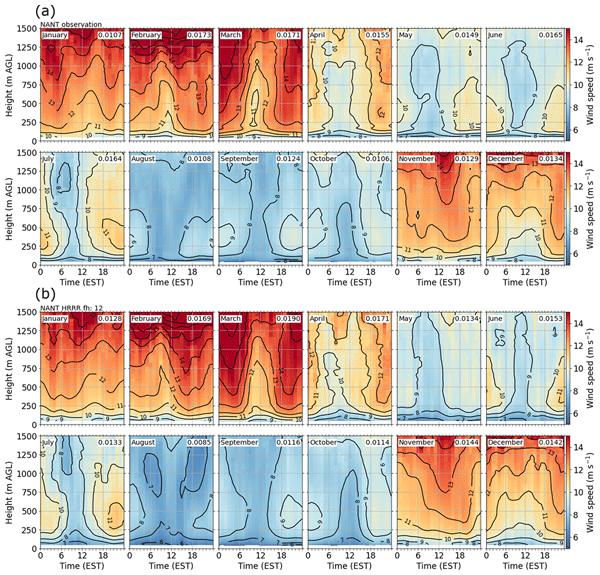
Abstract. The High-Resolution Rapid Refresh (HRRR) model is run operationally by the National Oceanic and Atmospheric Administration to provide high-resolution short-range forecasts for the continental United States. The evaluation of the HRRR model off of the U.S. coasts has been challenged by the lack of suitable continuous profile observations in the marine boundary layer in the past. State-of-the art remote sensing instruments were recently deployed along the coast of New England in the northeastern United States for the multi-year Third Wind Forecast Improvement Project and provide a unique opportunity for the evaluation of temperature and wind in the marine boundary layer in the HRRR model. We used 1 year of data at three sites, two of which were on islands, to document the seasonal characteristics of the marine boundary layer and its representation in the HRRR model for different forecast hours. Overall, the HRRR model captured the seasonal and diurnal evolution of temperature and wind very well. However, low-level horizontal wind shear and static stability were too weak in the model, especially during the warmer months, which might be partly linked to errors in sea surface temperature. Low-level jets (LLJs) occurred in approximately 20 % of the hourly profiles with a maximum frequency during spring and summer. Up to 60 % of the LLJ profiles during peak seasons were correctly predicted, using the critical success index as a measure. Systematic model errors in wind and temperature were found during LLJs, when the HRRR model frequently underestimated wind speed at nose height and shear below nose height, often accompanied by static stability that was too weak. These errors resulted in low-level Bulk Richardson numbers that were consistently too large at all three sites, indicating an overestimation of dynamic stability in the boundary layer in the model. Such systematic errors in low-level wind shear and stability were largely absent during correct rejections, that is, when an LLJ was neither observed nor simulated, indicating that LLJs were responsible for a large part of the model errors.
Competing interests: At least one of the (co-)authors is a member of the editorial board of Geoscientific Model Development. The peer-review process was guided by an independent editor, and the authors also have no other competing interests to declare.
Publisher's note: Copernicus Publications remains neutral with regard to jurisdictional claims made in the text, published maps, institutional affiliations, or any other geographical representation in this paper. While Copernicus Publications makes every effort to include appropriate place names, the final responsibility lies with the authors. Views expressed in the text are those of the authors and do not necessarily reflect the views of the publisher.-
Notice on discussion status
The requested preprint has a corresponding peer-reviewed final revised paper. You are encouraged to refer to the final revised version.
-
Preprint
(4282 KB)
-
Supplement
(4440 KB)
-
The requested preprint has a corresponding peer-reviewed final revised paper. You are encouraged to refer to the final revised version.
- Preprint
(4282 KB) - Metadata XML
-
Supplement
(4440 KB) - BibTeX
- EndNote
- Final revised paper


Journal article(s) based on this preprint
Interactive discussion
Status: closed
-
CEC1: 'Comment on egusphere-2026-97 - No compliance with the policy of the journal', Juan Antonio Añel, 11 Feb 2026
-
AC1: 'Reply on CEC1', Bianca Adler, 19 Feb 2026
Dear Executive Editor,
Our apologies for not complying with the GMD code and data policy. As requested, we published the used data and code on Zenodo under DOI .
The updated ‘Code and Data Availability’ section is as follows:
The data and code that are used to conduct the analysis and produce the plots presented in this paper are archived on Zenodo under DOI https://doi.org/10.5281/zenodo.18675835. The observational Third Wind Forecasting Improvement Project (WFIP3) data can also be downloaded from the Wind Data Hub funded by U.S. Department of Energy Office of Energy Efficiency and Renewable Energy’s Wind Energy Technologies Office operated and maintained by Pacific Northwest National Laboratory at https://wdh.energy.gov. TROPoe retrieval data are available at NANT (https://doi.org/10.21947/2997977, Adler, B. and Bianco, L., 2025b), BLOC (https://doi.org/10.21947/2997964, Adler, B. and Bianco,L., 2025a), and RHOD (https://doi.org/10.21947/2575060, Letizia, S., 2025) and WINDoe retrieval data are available at NANT (https://doi.org/10.21947/2997968, Adler, B., 2025b), BLOC (https://doi.org/10.21947/2997966, Adler, B., 2025a), and RHOD (https://doi.org/10.21947/2997965, Adler, B., 2025c). Buoy measurements are available for Buoyz01 (https://doi.org/10.21947/2569866, Krishnamurthy, R., 2025) and Buoy44085 (https://www.ndbc.noaa.gov, National Oceanic and Atmospheric Administration (NOAA), 2025). OSTIA data are available at (https://data.marine.copernicus.eu/product/SST_GLO_SST_L4_NRT_OBSERVATIONS_010_001, Copernicus Marine Service, 2025). HRRR model data are available from National Oceanic and Atmospheric Administration, Department of Commerce, at https://registry.opendata.aws/noaa-hrrr-pds/. The TROPoe docker container (version 0.18 and 0.19) is available from Docker Hub at (https://hub.docker.com/r/davidturner53/tropoe/tags, Turner, 2025) and the source code code is available in the GitHub repository (https://github.com/OAR-atmospheric-observations/TROPoe). The WINDoe software is available for use at the Github repository (https://github.com/OAR-atmospheric-observations/WINDoe).
We hope that these steps now make our manuscript compliant with the GMD policy.
Kind regards,
Bianca Adler
Citation: https://doi.org/10.5194/egusphere-2026-97-AC1 -
CEC2: 'Reply on AC1', Juan Antonio Añel, 19 Feb 2026
Dear authors,
Thanks for your reply. Unfortunately, from it, it is unclear if you have hosted all the models, code and data necessary to entirely replicate your work in Zenodo, or if the additional webpages that you continue citing (e.g. the Wind Data Hub) are necessary on top of the contents of Zenodo. We have to insist on the fact that the webpages that you link and are not acceptable repositories according to our policy, should not be cited, as they do not serve the purpose of providing a trusted long-term source for the assets necessary to perform the research presented. Therefore, please, provide a new text for the Code and Data policy of you manuscript, removing the mentions to sites such as energy.gov, wind data hub, etc., and reply to this comment with it, ensuring that all the data and code are stored in the acceptable repositories, such as Zenodo.
Juan A. Añel
Geosci. Model Dev. Executive Editor
Citation: https://doi.org/10.5194/egusphere-2026-97-CEC2 -
AC2: 'Reply on CEC2', Bianca Adler, 19 Feb 2026
Dear Executive Editor,
As requested, we modified the ‘Code and Data Availability’ section as follows:
The data and code that are used to conduct the analysis and produce the plots presented in this paper are archived on Zenodo under DOI https://doi.org/10.5281/zenodo.18675835.
Kind regards,
Bianca Adler
Citation: https://doi.org/10.5194/egusphere-2026-97-AC2 -
EC1: 'Reply on AC2', Mingxu Liu, 12 Mar 2026
Dear authors,
As requested by the Executive Editor, the original codes of the models used in this study should be made publicly available in Zenodo. After I checked the Zenodo link you provided, it is still not clear if you have put the model codes there. Please host the HRRR model codes and other software separately in Zenodo, rather than within a whole compressed file. During the peer-review process, both the editor and reviewers will check the availability of the core model applied in the study.
Best,
Mingxu Liu, handling editor
Citation: https://doi.org/10.5194/egusphere-2026-97-EC1 -
AC3: 'Reply on EC1', Bianca Adler, 13 Mar 2026
Dear Mingxu Liu,
We added the reference to the Zenodo archive that includes the HRRR version 4 model code to the ‘Code and data availability section’:
"The data and code that are used to conduct the analysis and produce the plots presented in this paper are archived on Zenodo under DOI https://doi.org/10.5281/zenodo.19009233. The HRRR version 4 model code is archived on Zenodo under DOI https://doi.org/10.5281/zenodo.6672454."
We also uploaded the software code separately to the Zenodo repository https://doi.org/10.5281/zenodo.19009233 as requested, which resulted in the creation of repository Version V2.
Kind regards,
Bianca Adler
Citation: https://doi.org/10.5194/egusphere-2026-97-AC3
-
AC3: 'Reply on EC1', Bianca Adler, 13 Mar 2026
-
EC1: 'Reply on AC2', Mingxu Liu, 12 Mar 2026
-
AC2: 'Reply on CEC2', Bianca Adler, 19 Feb 2026
-
CEC2: 'Reply on AC1', Juan Antonio Añel, 19 Feb 2026
-
AC1: 'Reply on CEC1', Bianca Adler, 19 Feb 2026
-
RC1: 'Comment on egusphere-2026-97', Xin Zhou, 16 May 2026
This manuscript presents a rigorous, multi-season evaluation of the NOAA HRRR model v4 in the U.S. Northeast coastal marine boundary layer using unique, high-quality remote sensing observations from WFIP3. The work addresses a critical knowledge gap and delivers clear, physically consistent results relevant to offshore wind energy, aviation, and marine forecasting. The paper is well-structured, technically sound, and I have only four major comments:
Major Comments:
- The manuscript suggests that overestimated SST contributes to warm biases near the bottom of the stability layer and therefore to underestimated static stability. This is plausible and supported by the weak negative correlation between SST error and stability error at NANT and BLOC. However, the correlations are modest, and the relationship is not evident at RHOD. Therefore, the causal wording should be softened in places. For example, instead of implying that SST errors are the primary cause of stability errors, the authors could state that SST errors are “a likely contributing factor,” particularly for island sites and southwesterly flow regimes. Other possible contributors, such as boundary-layer mixing, surface-layer parameterization, vertical resolution, land–sea mask representation, and horizontal advection errors, should also be acknowledged. This would make the interpretation more balanced and avoid over-attribution.2. Site Representation Uncertainty
- The authors use a modified Bonner-type LLJ criterion with a wind speed threshold of 8 m s⁻¹, which is lower than in some previous studies. The justification is that many profiles with clear LLJ structure would otherwise be missed. This is reasonable, but the choice of threshold can strongly influence LLJ frequency, CSI, frequency bias, and the classification of weak LLJs. Since about 35–40% of observed LLJs are classified as the weakest class 0, the results may be sensitive to this threshold. I suggest adding a short sensitivity test, perhaps in the supplement, showing how LLJ frequency and model skill change if a 10 m s⁻¹ threshold is used. Even a brief comparison would help readers assess whether the main conclusions are robust to the LLJ definition.
- The analysis of bulk Richardson number is a strong part of the manuscript. The finding that HRRR underrepresents low-Ri regimes during LLJ hits is important because it links wind and thermodynamic errors to the dynamic stability of the marine boundary layer. However, the physical implications could be explained more clearly. For instance, if the model overestimates Ri because it underestimates shear more strongly than it underestimates static stability, this could imply that the model boundary layer is dynamically too stable, potentially affecting turbulent mixing, rotor-layer structure, wind-energy-relevant shear, and LLJ maintenance. The authors should briefly discuss how this error might influence forecast applications and model physics development.
- The discussion of HRRR errors in low-level temperature, static stability, and wind shear could be strengthened by briefly considering uncertainties in surface energy budget representation. The manuscript mainly attributes some near-surface errors to SST and land-sea thermal contrast, which is reasonable. However, other surface energy exchange processes may also influence boundary-layer structure, especially under precipitation conditions. Studies (Gillett & Cullen. 2011; Zhou et al. 2024a,b) have shown that precipitation-induced surface sensible heat flux, a process often neglected in weather and climate models, can modify surface energy partitioning and affect regional simulations. I suggest that the authors briefly discussing broader uncertainties in surface energy budget processes and model physics.
Gillett, S., & Cullen, N. J. (2011). Atmospheric controls on summer ablation over Brewster Glacier, New Zealand. International Journal of Climatology, 31(13), 2033–2048.
Zhou, X., Ray, P., Tan, H., Dudhia, J., Ajayamohan, R. S., Gomes, H., & Pan, Y. (2024). Rain‐induced surface sensible heat flux reduces monsoonal rainfall over India. Geophysical Research Letters, 51(14), e2023GL107796
Zhou, X., Ray, P., Dudhia, J., Tewari, M., Nikolopoulos, E., Johnson, N. C., & Hagos, S. (2024). On the importance of precipitation‐induced surface sensible heat flux for diurnal cycle of precipitation in the maritime continent. Geophysical Research Letters, 51, e2024GL111940.
Minor comments:
- The abstract is clear and informative, but the statement that SST errors partly explain the weakened stability should be phrased cautiously because the evidence is site-dependent and correlations are weak to moderate.
- In Sect. 3.2, the authors show that wind speed standard deviation increases with forecast hour, while mean biases remain relatively stable. This is an interesting result and could be highlighted more clearly as evidence that forecast variability errors grow faster than systematic mean errors.
- The conclusion should more clearly separate robust findings from site-specific findings. For example, the underestimation of static stability appears robust across sites, while the source of shear error differs by site.
Citation: https://doi.org/10.5194/egusphere-2026-97-RC1 -
AC4: 'Reply on RC1', Bianca Adler, 22 May 2026
The comment was uploaded in the form of a supplement: https://egusphere.copernicus.org/preprints/2026/egusphere-2026-97/egusphere-2026-97-AC4-supplement.pdf
-
RC2: 'Comment on egusphere-2026-97', Jeffrey Freedman, 16 Jul 2026
-
AC5: 'Reply on RC2', Bianca Adler, 13 Aug 2026
The comment was uploaded in the form of a supplement: https://egusphere.copernicus.org/preprints/2026/egusphere-2026-97/egusphere-2026-97-AC5-supplement.pdf
-
AC5: 'Reply on RC2', Bianca Adler, 13 Aug 2026
Peer review completion


Interactive discussion
Status: closed
-
CEC1: 'Comment on egusphere-2026-97 - No compliance with the policy of the journal', Juan Antonio Añel, 11 Feb 2026
Dear authors,
Unfortunately, after checking your manuscript, it has come to our attention that it does not comply with our "Code and Data Policy".
https://www.geoscientific-model-development.net/policies/code_and_data_policy.html
You have archived your code on sites that we can not accept such as Docke or GitHub. They are not suitable repositories for scientific publication. In addition, you have archived the data used and produced in your work in sites that do not comply neither, such as AWS or the Wind Data Hub. These sites do not fulfil GMD’s requirements for a persistent data archive because:
- They do not appear to have a published policy for data preservation over many years or decades (some flexibility exists over the precise length of preservation, but the policy must exist).
- They do not appear to have a published mechanism for preventing authors from unilaterally removing material. Archives must have a policy which makes removal of materials only possible in exceptional circumstances and subject to an independent curatorial decision,If we have missed a published policy which does in fact address this matter satisfactorily, please post a response linking to it. If you have any questions about this issue, please post them in a reply.
The GMD review and publication process depends on reviewers and community commentators being able to access, during the discussion phase, the code and data on which a manuscript depends, and on ensuring the provenance of replicability of the published papers for years after their publication. Please, therefore, publish your code and data in one of the appropriate repositories and reply to this comment with the relevant information (link and a permanent identifier for it (e.g. DOI)) as soon as possible. We cannot have manuscripts under discussion that do not comply with our policy.
The 'Code and Data Availability’ section must also be modified to cite the new repository locations, and corresponding references added to the bibliography.
I must note that if you do not fix this problem, we cannot continue with the peer-review process or accept your manuscript for publication in GMD.
Juan A. Añel
Geosci. Model Dev. Executive EditorCitation: https://doi.org/10.5194/egusphere-2026-97-CEC1 -
AC1: 'Reply on CEC1', Bianca Adler, 19 Feb 2026
Dear Executive Editor,
Our apologies for not complying with the GMD code and data policy. As requested, we published the used data and code on Zenodo under DOI .
The updated ‘Code and Data Availability’ section is as follows:
The data and code that are used to conduct the analysis and produce the plots presented in this paper are archived on Zenodo under DOI https://doi.org/10.5281/zenodo.18675835. The observational Third Wind Forecasting Improvement Project (WFIP3) data can also be downloaded from the Wind Data Hub funded by U.S. Department of Energy Office of Energy Efficiency and Renewable Energy’s Wind Energy Technologies Office operated and maintained by Pacific Northwest National Laboratory at https://wdh.energy.gov. TROPoe retrieval data are available at NANT (https://doi.org/10.21947/2997977, Adler, B. and Bianco, L., 2025b), BLOC (https://doi.org/10.21947/2997964, Adler, B. and Bianco,L., 2025a), and RHOD (https://doi.org/10.21947/2575060, Letizia, S., 2025) and WINDoe retrieval data are available at NANT (https://doi.org/10.21947/2997968, Adler, B., 2025b), BLOC (https://doi.org/10.21947/2997966, Adler, B., 2025a), and RHOD (https://doi.org/10.21947/2997965, Adler, B., 2025c). Buoy measurements are available for Buoyz01 (https://doi.org/10.21947/2569866, Krishnamurthy, R., 2025) and Buoy44085 (https://www.ndbc.noaa.gov, National Oceanic and Atmospheric Administration (NOAA), 2025). OSTIA data are available at (https://data.marine.copernicus.eu/product/SST_GLO_SST_L4_NRT_OBSERVATIONS_010_001, Copernicus Marine Service, 2025). HRRR model data are available from National Oceanic and Atmospheric Administration, Department of Commerce, at https://registry.opendata.aws/noaa-hrrr-pds/. The TROPoe docker container (version 0.18 and 0.19) is available from Docker Hub at (https://hub.docker.com/r/davidturner53/tropoe/tags, Turner, 2025) and the source code code is available in the GitHub repository (https://github.com/OAR-atmospheric-observations/TROPoe). The WINDoe software is available for use at the Github repository (https://github.com/OAR-atmospheric-observations/WINDoe).
We hope that these steps now make our manuscript compliant with the GMD policy.
Kind regards,
Bianca Adler
Citation: https://doi.org/10.5194/egusphere-2026-97-AC1 -
CEC2: 'Reply on AC1', Juan Antonio Añel, 19 Feb 2026
Dear authors,
Thanks for your reply. Unfortunately, from it, it is unclear if you have hosted all the models, code and data necessary to entirely replicate your work in Zenodo, or if the additional webpages that you continue citing (e.g. the Wind Data Hub) are necessary on top of the contents of Zenodo. We have to insist on the fact that the webpages that you link and are not acceptable repositories according to our policy, should not be cited, as they do not serve the purpose of providing a trusted long-term source for the assets necessary to perform the research presented. Therefore, please, provide a new text for the Code and Data policy of you manuscript, removing the mentions to sites such as energy.gov, wind data hub, etc., and reply to this comment with it, ensuring that all the data and code are stored in the acceptable repositories, such as Zenodo.
Juan A. Añel
Geosci. Model Dev. Executive Editor
Citation: https://doi.org/10.5194/egusphere-2026-97-CEC2 -
AC2: 'Reply on CEC2', Bianca Adler, 19 Feb 2026
Dear Executive Editor,
As requested, we modified the ‘Code and Data Availability’ section as follows:
The data and code that are used to conduct the analysis and produce the plots presented in this paper are archived on Zenodo under DOI https://doi.org/10.5281/zenodo.18675835.
Kind regards,
Bianca Adler
Citation: https://doi.org/10.5194/egusphere-2026-97-AC2 -
EC1: 'Reply on AC2', Mingxu Liu, 12 Mar 2026
Dear authors,
As requested by the Executive Editor, the original codes of the models used in this study should be made publicly available in Zenodo. After I checked the Zenodo link you provided, it is still not clear if you have put the model codes there. Please host the HRRR model codes and other software separately in Zenodo, rather than within a whole compressed file. During the peer-review process, both the editor and reviewers will check the availability of the core model applied in the study.
Best,
Mingxu Liu, handling editor
Citation: https://doi.org/10.5194/egusphere-2026-97-EC1 -
AC3: 'Reply on EC1', Bianca Adler, 13 Mar 2026
Dear Mingxu Liu,
We added the reference to the Zenodo archive that includes the HRRR version 4 model code to the ‘Code and data availability section’:
"The data and code that are used to conduct the analysis and produce the plots presented in this paper are archived on Zenodo under DOI https://doi.org/10.5281/zenodo.19009233. The HRRR version 4 model code is archived on Zenodo under DOI https://doi.org/10.5281/zenodo.6672454."
We also uploaded the software code separately to the Zenodo repository https://doi.org/10.5281/zenodo.19009233 as requested, which resulted in the creation of repository Version V2.
Kind regards,
Bianca Adler
Citation: https://doi.org/10.5194/egusphere-2026-97-AC3
-
AC3: 'Reply on EC1', Bianca Adler, 13 Mar 2026
-
EC1: 'Reply on AC2', Mingxu Liu, 12 Mar 2026
-
AC2: 'Reply on CEC2', Bianca Adler, 19 Feb 2026
-
CEC2: 'Reply on AC1', Juan Antonio Añel, 19 Feb 2026
-
AC1: 'Reply on CEC1', Bianca Adler, 19 Feb 2026
-
RC1: 'Comment on egusphere-2026-97', Xin Zhou, 16 May 2026
This manuscript presents a rigorous, multi-season evaluation of the NOAA HRRR model v4 in the U.S. Northeast coastal marine boundary layer using unique, high-quality remote sensing observations from WFIP3. The work addresses a critical knowledge gap and delivers clear, physically consistent results relevant to offshore wind energy, aviation, and marine forecasting. The paper is well-structured, technically sound, and I have only four major comments:
Major Comments:
- The manuscript suggests that overestimated SST contributes to warm biases near the bottom of the stability layer and therefore to underestimated static stability. This is plausible and supported by the weak negative correlation between SST error and stability error at NANT and BLOC. However, the correlations are modest, and the relationship is not evident at RHOD. Therefore, the causal wording should be softened in places. For example, instead of implying that SST errors are the primary cause of stability errors, the authors could state that SST errors are “a likely contributing factor,” particularly for island sites and southwesterly flow regimes. Other possible contributors, such as boundary-layer mixing, surface-layer parameterization, vertical resolution, land–sea mask representation, and horizontal advection errors, should also be acknowledged. This would make the interpretation more balanced and avoid over-attribution.2. Site Representation Uncertainty
- The authors use a modified Bonner-type LLJ criterion with a wind speed threshold of 8 m s⁻¹, which is lower than in some previous studies. The justification is that many profiles with clear LLJ structure would otherwise be missed. This is reasonable, but the choice of threshold can strongly influence LLJ frequency, CSI, frequency bias, and the classification of weak LLJs. Since about 35–40% of observed LLJs are classified as the weakest class 0, the results may be sensitive to this threshold. I suggest adding a short sensitivity test, perhaps in the supplement, showing how LLJ frequency and model skill change if a 10 m s⁻¹ threshold is used. Even a brief comparison would help readers assess whether the main conclusions are robust to the LLJ definition.
- The analysis of bulk Richardson number is a strong part of the manuscript. The finding that HRRR underrepresents low-Ri regimes during LLJ hits is important because it links wind and thermodynamic errors to the dynamic stability of the marine boundary layer. However, the physical implications could be explained more clearly. For instance, if the model overestimates Ri because it underestimates shear more strongly than it underestimates static stability, this could imply that the model boundary layer is dynamically too stable, potentially affecting turbulent mixing, rotor-layer structure, wind-energy-relevant shear, and LLJ maintenance. The authors should briefly discuss how this error might influence forecast applications and model physics development.
- The discussion of HRRR errors in low-level temperature, static stability, and wind shear could be strengthened by briefly considering uncertainties in surface energy budget representation. The manuscript mainly attributes some near-surface errors to SST and land-sea thermal contrast, which is reasonable. However, other surface energy exchange processes may also influence boundary-layer structure, especially under precipitation conditions. Studies (Gillett & Cullen. 2011; Zhou et al. 2024a,b) have shown that precipitation-induced surface sensible heat flux, a process often neglected in weather and climate models, can modify surface energy partitioning and affect regional simulations. I suggest that the authors briefly discussing broader uncertainties in surface energy budget processes and model physics.
Gillett, S., & Cullen, N. J. (2011). Atmospheric controls on summer ablation over Brewster Glacier, New Zealand. International Journal of Climatology, 31(13), 2033–2048.
Zhou, X., Ray, P., Tan, H., Dudhia, J., Ajayamohan, R. S., Gomes, H., & Pan, Y. (2024). Rain‐induced surface sensible heat flux reduces monsoonal rainfall over India. Geophysical Research Letters, 51(14), e2023GL107796
Zhou, X., Ray, P., Dudhia, J., Tewari, M., Nikolopoulos, E., Johnson, N. C., & Hagos, S. (2024). On the importance of precipitation‐induced surface sensible heat flux for diurnal cycle of precipitation in the maritime continent. Geophysical Research Letters, 51, e2024GL111940.
Minor comments:
- The abstract is clear and informative, but the statement that SST errors partly explain the weakened stability should be phrased cautiously because the evidence is site-dependent and correlations are weak to moderate.
- In Sect. 3.2, the authors show that wind speed standard deviation increases with forecast hour, while mean biases remain relatively stable. This is an interesting result and could be highlighted more clearly as evidence that forecast variability errors grow faster than systematic mean errors.
- The conclusion should more clearly separate robust findings from site-specific findings. For example, the underestimation of static stability appears robust across sites, while the source of shear error differs by site.
Citation: https://doi.org/10.5194/egusphere-2026-97-RC1 -
AC4: 'Reply on RC1', Bianca Adler, 22 May 2026
The comment was uploaded in the form of a supplement: https://egusphere.copernicus.org/preprints/2026/egusphere-2026-97/egusphere-2026-97-AC4-supplement.pdf
-
RC2: 'Comment on egusphere-2026-97', Jeffrey Freedman, 16 Jul 2026
-
AC5: 'Reply on RC2', Bianca Adler, 13 Aug 2026
The comment was uploaded in the form of a supplement: https://egusphere.copernicus.org/preprints/2026/egusphere-2026-97/egusphere-2026-97-AC5-supplement.pdf
-
AC5: 'Reply on RC2', Bianca Adler, 13 Aug 2026
Peer review completion
Journal article(s) based on this preprint
Viewed
| HTML | XML | Total | Supplement | BibTeX | EndNote | |
|---|---|---|---|---|---|---|
| 1,851 | 817 | 201 | 2,869 | 363 | 144 | 164 |
- HTML: 1,851
- PDF: 817
- XML: 201
- Total: 2,869
- Supplement: 363
- BibTeX: 144
- EndNote: 164
Viewed (geographical distribution)
| Country | # | Views | % |
|---|
| Total: | 0 |
| HTML: | 0 |
| PDF: | 0 |
| XML: | 0 |
- 1
Cited



Laura Bianco
David D. Turner
Joseph B. Olson
Xia Sun
Joshua Gebauer
Nicola Bodini
Stefano Letizia
James M. Wilczak
The requested preprint has a corresponding peer-reviewed final revised paper. You are encouraged to refer to the final revised version.
- Preprint
(4282 KB) - Metadata XML
-
Supplement
(4440 KB) - BibTeX
- EndNote
- Final revised paper
Dear authors,
Unfortunately, after checking your manuscript, it has come to our attention that it does not comply with our "Code and Data Policy".
https://www.geoscientific-model-development.net/policies/code_and_data_policy.html
You have archived your code on sites that we can not accept such as Docke or GitHub. They are not suitable repositories for scientific publication. In addition, you have archived the data used and produced in your work in sites that do not comply neither, such as AWS or the Wind Data Hub. These sites do not fulfil GMD’s requirements for a persistent data archive because:
- They do not appear to have a published policy for data preservation over many years or decades (some flexibility exists over the precise length of preservation, but the policy must exist).
- They do not appear to have a published mechanism for preventing authors from unilaterally removing material. Archives must have a policy which makes removal of materials only possible in exceptional circumstances and subject to an independent curatorial decision,
If we have missed a published policy which does in fact address this matter satisfactorily, please post a response linking to it. If you have any questions about this issue, please post them in a reply.
The GMD review and publication process depends on reviewers and community commentators being able to access, during the discussion phase, the code and data on which a manuscript depends, and on ensuring the provenance of replicability of the published papers for years after their publication. Please, therefore, publish your code and data in one of the appropriate repositories and reply to this comment with the relevant information (link and a permanent identifier for it (e.g. DOI)) as soon as possible. We cannot have manuscripts under discussion that do not comply with our policy.
The 'Code and Data Availability’ section must also be modified to cite the new repository locations, and corresponding references added to the bibliography.
I must note that if you do not fix this problem, we cannot continue with the peer-review process or accept your manuscript for publication in GMD.
Juan A. Añel
Geosci. Model Dev. Executive Editor