
the Creative Commons Attribution 4.0 License.
the Creative Commons Attribution 4.0 License.
 | 19 Jan 2026
Global Fatal Coastal Landslides
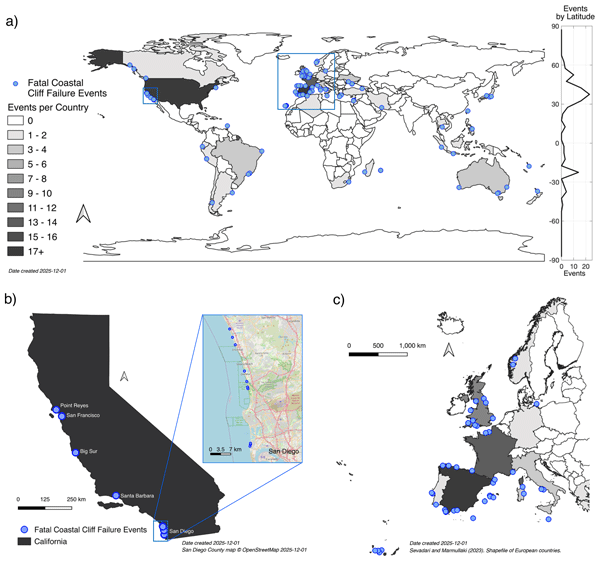
Abstract. Coastal cliffs shape the world’s coastlines, providing areas of beauty, habitat, scientific discovery, and recreation. However, as erosional features, coastal cliffs can also pose fatal hazards. This paper presents a database of global fatal coastal landslides from public databases and media articles. In total, the coastal landslide database includes 292 fatalities resulting from 114 landslide events from 1927–2024. Landslide events occurred in 32 countries, with the most events in Spain (20), the United States (19), France (14), and the United Kingdom (10), and include two 10-event hot spots on Reunion Island, France, and San Diego County, California, USA. Most fatalities occurred in temperate regions, with about half of events occurring during months with above average precipitation (and half below), differing from databases that include non coastal fatal landslide events driven largely by rainfall. The database is likely incomplete in part from reporting bias, and the analysis presented here should be interpreted with caution. However, the present results suggest that the timing of coastal fatal landslides may be influenced by (a) elevated rainfall causing reduced cliff stability, leading to more failures in wet seasons and (b) time periods of increased tourism and recreational beach activity, exposing more people to coastal cliff failure hazards in relatively dry seasons. The results can help inform beach hazard management.
-
Notice on discussion status
The requested preprint has a corresponding peer-reviewed final revised paper. You are encouraged to refer to the final revised version.
-
Preprint
(4633 KB)
-
Supplement
(82 KB)
-
The requested preprint has a corresponding peer-reviewed final revised paper. You are encouraged to refer to the final revised version.
- Preprint
(4633 KB) - Metadata XML
-
Supplement
(82 KB) - BibTeX
- EndNote
- Final revised paper


Journal article(s) based on this preprint
Interactive discussion
Status: closed
-
RC1: 'Comment on egusphere-2026-96', Anonymous Referee #1, 26 Jan 2026
-
AC1: 'Reply on RC1', Malia Reiss, 08 Apr 2026
Please see our following response (bold text) to comment 1 (normal text).
The paper by Reiss et al. explores a database of 114 fatal coastal cliff collapses over 97 years. Geographic hotspots of coastal landslides were identified, including San Diego County (USA) and Réunion (France). The timing of fatal landslides was further analysed in relation to precipitation in the region during the month of the event. Around 50% of the events occurred during “dry” months, partly because more people were on beaches during these periods. The findings highlight the importance of accounting for both environmental effects on cliff collapse hazards and human behaviour and displacement patterns in coastal hazard management efforts.
Thank you for the constructive and thoughtful review. We have used the comments to improve the manuscript as suggested. Below are specific changes made to address each comment.
The paper is well-written and structured. However, some major points remain to be clarified and further analysed. These are the following general comments:
- The title seems misleading, as the paper does not address all coastal landslides but only coastal cliff collapses. Other types of landslides impacting the coast, such as inland slides reaching the coast, debris flows or tsunami impacts from distant slides, were excluded from the database. In addition, the term “global” might be considered overly confident given clear and correctly stated sampling biases.
We agree that the title should be changed to better reflect the nature of the database, and suggest a new title of “A Database of Fatal Coastal Cliff Failures.” We have also changed language throughout the manuscript to better reflect “coastal cliff failures” rather than "coastal landslides.”
- The distinction between coastal cliff collapses and other landslide events is sometimes difficult. In addition, large landslides impacting the coast or generating fatal tsunamis are excluded from the database (rule number 2, lines 66-68), even though they are coastal landslides and important events for regions such as Alaska and Greenland. A better explanation of why to exclude such landslides and of how to categorise borderline cases is necessary.
The reviewer makes a good point, and this is something that we discussed at length when compiling the events in this database.
Most of the events in the database are coastal cliff rockfalls, however we also included other landslides that occurred on slopes in contact with the ocean or beach. We did not include landslides originating on non-coastal slopes, because the goal of this project was to compile landslides potentially related to coastal processes (e.g. wave action). We focus on the hazards associated specifically with coastal slope failures, not landslides that originate inland and happen to reach the coast.
We chose not to include fatalities from landslide-caused tsunamis because we focus on the direct impact of landslides on people, not indirect. Throughout the paper, we have changed “landslide” language to focus more on “cliff failures,” including renaming the database. This was clarified in the methods section: “This database only considers events that occurred on coastal slopes and cliffs. Indirect fatalities, such as large landslides generating fatal tsunamis, are excluded, as well as landslides that originate inland.”
- While an effort has been made to include more languages than English alone, the database might be skewed towards regions with better records and media access to remote locations, rather than global coverage. It is likely that many events in the global South were not accounted for, particularly single-victim events, events in the typhoon and monsoon seasons, and that additional languages should be included in a global database. An alternative might be to exclude parts of the world where coverage is likely to be too poor.
We agree that the database is likely skewed toward regions with better media access than remote locations and have expanded the discussion regarding this issue.
Example text changes include:
(1) “Because the database is likely incomplete and/or biased, the tested relationships and statistics should be interpreted with caution.”
(2) “The database presented here underestimates the actual number of fatal coastal slope failures worldwide, and includes reporting biases similar to other global landslide databases.”
(3) “The database is likely incomplete and we caveat tested relationships on incomplete data.”
As suggested, we extended our search using keywords in additional languages, making sure to include all languages that have 50 million or more total speakers (Ethnologue, 2025). Our added languages include Urdu, Egyptian Arabic, Marathi, Telugu, Hausa, Western Punjabi, Tagalog, Tamil, Yue Chinese, Wu Chinese, Iranian Persian, Korean, Javanese, Gujarati, Levantine Arabic, Amharic, Kannada, Bhojpuri, Zulu, Yoruba, and Sudanese Arabic. We used Google Translate and OpenAI for translations, however we did not find any new events with those translated search terms.
- 114 events are a relatively small statistical population. That makes it difficult to draw global conclusions about landslide triggers, particularly because only fatal landslides are considered. Classic statistical tests and measures are not presented for the monthly rainfall analysis. Such tests should account for the link between rainfall and human presence, as these are not independent variables.
Thank you for your comments on our rainfall analysis. We agree and have changed the entire analysis of our rainfall section (see more below). We completed new analysis with daily rainfall values for 1-day, day-of, 7-day, and 30-day antecedent precipitation. We use negative binomial regression to account for non-normal distribution of the event and fatality count data. Classic statistical tests are also included throughout this new section.
The approach of binning each event by monthly total precipitation seems too simplistic. An event at the start of a month would take into account rainfall in the weeks following the event, not in the weeks preceding it. A better approach would be to use the 1-month rainfall total at the time of the event rather than the calendar-month rainfall total. In addition, using the same approach, different rainfall durations (e.g., 3 days or 1 week) could be evaluated, which might be more appropriate for shallow landslides. With this approach, it might be possible to draw more robust conclusions about the effects of intense rainfall events during the dry season. Similarly, at some tourist locations, we could expect more visitors on weekends. A test of landslides grouped by day of the week, during the tourist season and the off-season, might yield new insights for the identified local hotspots.
We agree, thank you for your suggestion. We have now modified the entire rainfall analysis to include daily total precipitation and precipitation anomalies for day-of, day-before, 7-day antecedent, and 30-day antecedent precipitation. This analysis is also a negative binomial regression to account for overdispersion of events and fatality counts.
We found that the number of per-event coastal cliff failure-associated fatalities were positively correlated to 7-day and 30-day antecedent rainfall anomalies, and day-of, day-before, 7-day, and 30-day antecedent total precipitation. In contrast, when examining the number of fatal coastal cliff failure events, more events were associated with negative rainfall anomalies (less rainfall than average) for day-of, day-before, and 7 day antecedent anomaly precipitation.
Our seasonal analysis also now uses daily rainfall data. Landslides grouped by day of the week (separated also by season) unfortunately did not yield new insights possibly because of the small sample size, although the reviewer’s idea was very intriguing.
Additional minor comments are:
- Since most events occur in temperate climates and the Northern Hemisphere, the results might not be applicable to tropical, arid, or polar coasts, where landslides may exhibit different temporal dynamics. Once again, this point challenges the “global” approach and should be at least mentioned.
This is a good point. We decreased the use of “global” throughout the manuscript. The database is now called “A Database of Fatal Coastal Cliff Failures.” We clarify that although it was a global search for events, the results include reporting bias that may have resulted in certain countries being over or under represented. However, our event search procedures follow other well-accepted global landslide databases, and we similarly experience reporting bias noted in other studies. To clarify, we added: “The database presented here underestimates the actual number of fatal coastal slope failures worldwide, and includes reporting biases similar to other global landslide databases.”
- The tools for translating keywords and searching media online were not clearly specified. Were AI tools involved? If yes, which ones?
We used Google Translate to translate keywords. AI tools were not originally used, however we tested using OpenAI to search for translation terms when Google Translate provided no results. This did not impact results. The following was added to the text: “Most translations were made using Google Translate, however we used OpenAI for some language translations when Google Translate terms did not result in any articles.”
- Thresholds to consider a correlation significant are not discussed.
Thank you for pointing this out, we added standard significance thresholds to methods (p<0.05).
In addition, I note the following technical corrections:
- The lack of an accent for Réunion Island, which should be added.
The accent for Réunion Island was added as suggested.
- GDP units seem not correct. The sources for the GDP data are missing. GDP per capita would probably be more appropriate for this analysis.
Thank you for the helpful suggestion. We updated the analysis to use GDP per capita and corrected units accordingly.
- Figure 1: Black boxes should be removed.
The black boxes were removed as suggested.
- Figure 2: The title should be removed above the figure.
We removed the title as suggested.
- Figure 3: A large number of countries seem to have a single landslide event. This might influence the statistics. Countries with no landslides could be included.
This database is most likely incomplete, and because of that, we want to avoid causing zero inflation. Because of this potential issue, we only use data from countries with at least one entry, and added further caveats that the tested relationships/statistics are very likely based on incomplete data.
The methods section now states:
“Countries without a recorded fatal coastal landslide event were excluded to avoid zero-inflation; however, the database is likely incomplete and we caveat tested relationships on incomplete data.”
The discussion now states:
“Because the database is likely incomplete and/or biased, the tested relationships and statistics should be interpreted with caution. Our exclusion of countries without a documented fatal coastal cliff failure may also contribute to this.”
- Figure 8 should include a second panel, with the same analysis for Réunion Island.
Thank you for this suggestion. We conducted a new analysis on Réunion Island, which provided interesting results. We added the results to Figure 8 as suggested. New text states:
“In the Southern Hemisphere, Réunion Island had 9 events (12 fatalities) that also show a bimodal seasonal pattern, peaking in February-March and October. This February-March peak occurs in the wet season and overlaps with both high and low levels of tourism. The October peak occurs during moderate rainfall and tourism conditions.”
In the database, the “Victim” category is unclear, the “Tourism season” category is always left empty, and the “Distance from coast” category lacks units and appears binary.
Thank you for the technical corrections. We have more clearly defined “Victim” in a new appendix section with database field definitions. “Tourism season” and “Distance from coast” were removed from the database.
Citation: https://doi.org/10.5194/egusphere-2026-96-AC1
-
AC1: 'Reply on RC1', Malia Reiss, 08 Apr 2026
-
RC2: 'Comment on egusphere-2026-96', Anonymous Referee #2, 17 Feb 2026
Dear authors,
This manuscript compiles a “Global Fatal Coastal Landslide Database” covering fatal coastal cliff/bluff failures over the period 1927–2024. The authors define inclusion/exclusion criteria for what qualifies as a fatal coastal landslide and aggregate events and fatalities by country. They then explore (i) spatial clustering (“hot spots”), (ii) country-scale statistical relationships between fatal-event counts/fatalities and proxy variables such as tourism, population, GDP, and measures of cliffed coastline, and (iii) seasonality and rainfall context using gridded monthly precipitation. A regional case study (San Diego County) illustrates how visitor seasonality may shape fatality rates. The main interpretive message is that observed fatalities reflect a combination of hazard and exposure, with tourism/population proxies emerging as stronger predictors than simple coastline/cliff metrics, and with rainfall seasonality patterns not providing a clean global trigger signal under the selected precipitation metric.
While the paper presents an interesting topic, several issues need to be addressed. Please find my detailed feedback below, which aims to enhance the clarity and quality of your work.
General Questions:
- Is the manuscript primarily intended as a database paper or as a global driver/attribution study? The current conclusions read as causal in places, but the dataset and methods support only limited inference.
- How do you separate physical hazard controls from exposure and reporting bias? Given the known under-reporting and strong temporal changes in reporting, how do you justify interpreting country-scale correlations as “drivers” rather than “drivers of reporting and exposure”?
- Tourism (single-year) and population (single-year) proxies are used to explain a century-scale record. What sensitivity analyses (e.g., post-1995 subset; decade bins; time-varying covariates) demonstrate that the conclusions are stable?
- Event and fatality counts are non-negative, overdispersed, and heavy-tailed. Why not use count models (Poisson/negative binomial), robust methods, or rank correlations? How are leverage points handled without excluding high-consequence events? what uncertainty is reported?
- Monthly 1° precipitation cannot resolve short-duration triggers or antecedent hydrology relevant to rockfall and cliff collapse. Do you intend this section as a trigger test or purely as seasonality context? The conclusions should be revised accordingly.
- What is the justification for treating high-fatality events as statistical outliers to be removed? In risk research, these events are often of greatest societal importance.
Specific Comments:
Lines 55–63: Please add a concise data dictionary (in-text or supplement) defining each recorded field, allowable values (e.g., trigger categories, victim affiliation), and how “location precision” is quantified.
Lines 80–94: The relationship between the main database and the supplemental spreadsheet needs to be operationally defined (decision rules, intended use, and whether both are released). Please clarify whether “marginally meeting criteria” cases are excluded from all analyses, and how 2025 events in the supplemental file are treated in interpretations.
Lines 95–99: The rule for events with confirmed occurrence but unknown victim count should be stated as an explicit variable/flag in the dataset (so readers can reproduce “event” vs “fatality” analyses without ambiguity).
Also, the citation labeling here appears inconsistent: the South Africa (Durban-area) Landslide Blog entry is cited as Petley (2022a), but the bibliography assigns 2022a to a different event (Philippines). Please correct the a/b label for this citation.
Lines 100–106: The multilingual search procedure is a strength; however, the language list is exceptionally long in the main text. Consider moving the full list to an appendix and retaining only a summarized description (languages, approach, and the role of native speakers) in the Methods.
Lines 115–126: This paragraph is where readers will judge the credibility of the country-scale analysis. Please report, at minimum: (i) the number of countries used in each regression, (ii) exact model specification (response variable, transformations if any), and (iii) influence/diagnostic reporting. The definitions of “hotspot” radius and “fatality outliers” should be justified here (or explicitly motivated with a sensitivity analysis plan).
Lines 127–136: Please explicitly state how missing precipitation matches (events outside the precipitation product window or gaps) are handled downstream, and ensure the rainfall section is written as testing what the method can actually resolve (triggering vs broad seasonality context).
Lines 145–148: The manuscript notes that some sources contain duplicate information. Please add a concise description of the deduplication procedure (matching rules and conflict resolution for fatality counts and dates/locations), and whether the final dataset retains source provenance for merged entries.
Lines 170–181: Please ensure that results reporting includes the sample size (countries) associated with each correlation in addition to r²/p. For “locals vs tourists,” define precisely how affiliation was assigned and how “unknown affiliation” cases are treated in any percentage statements.
Lines 240–250: Please review this discussion for wording that implies causality from the proxy correlations. The interpretation should be written to remain valid under the limitations raised by exposure/reporting bias and temporal proxy mismatch.
Lines 260–266: The in-text citation “Georgopoulou et al. (2018)” appears inconsistent with the bibliography (listed as 2019). Please reconcile the year and ensure the cited reference supports the stated linkage between climate preferences and beach tourism.
Lines 290–295: The in-text “Maerz et al. (2016)” appears inconsistent with the bibliography (listed as 2015). Please correct the year and verify that the cited paper supports the specific claim about manual/mechanical removal of hazardous rock.
Lines 303–305: The in-text “Olsen et al. (2008)” appears inconsistent with the bibliography (listed as 2012). Please correct the year and verify the reference supports the stated lidar-monitoring application.
Also please fix these points:
- Correct “Haque et at, 2016” to “Haque et al., 2016” and ensure consistency with the reference entry.
- Table 1: “Calvello and Peco raro, 2025” contains a spacing/typo in the author name.
- Reference list: Castedo et al. (2017) repeats author strings (appears duplicated).
- Fix DOI formatting where “https://doi.org/https://doi.org/…” appears, e.g., Young et al. (2009) and Silva et al. (2016), and Stringham (2015).
- Herre and Samborska (2023) reference entry appears to have a missing parenthesis and awkward date punctuation.
Respectfully,
Citation: https://doi.org/10.5194/egusphere-2026-96-RC2 -
AC2: 'Reply on RC2', Malia Reiss, 08 Apr 2026
Please see our following response (bold text) to comment 2 (normal text).
This manuscript compiles a “Global Fatal Coastal Landslide Database” covering fatal coastal cliff/bluff failures over the period 1927–2024. The authors define inclusion/exclusion criteria for what qualifies as a fatal coastal landslide and aggregate events and fatalities by country. They then explore (i) spatial clustering (“hot spots”), (ii) country-scale statistical relationships between fatal-event counts/fatalities and proxy variables such as tourism, population, GDP, and measures of cliffed coastline, and (iii) seasonality and rainfall context using gridded monthly precipitation. A regional case study (San Diego County) illustrates how visitor seasonality may shape fatality rates. The main interpretive message is that observed fatalities reflect a combination of hazard and exposure, with tourism/population proxies emerging as stronger predictors than simple coastline/cliff metrics, and with rainfall seasonality patterns not providing a clean global trigger signal under the selected precipitation metric.
While the paper presents an interesting topic, several issues need to be addressed. Please find my detailed feedback below, which aims to enhance the clarity and quality of your work.
Thank you for the constructive and detailed review. We have used the comments to improve the manuscript as suggested. Below are specific changes made to address each comment.
General Questions:
Is the manuscript primarily intended as a database paper or as a global driver/attribution study? The current conclusions read as causal in places, but the dataset and methods support only limited inference.
Thank you for the good comment, we agree. This paper is intended as an initial compilation of a database, which we hope will provide the foundation for other studies and for expansion as new information and events occur. A few potential drivers/attributions were tested following other fatal landslide studies, but the results are limited by the small number of entries. To further clarify the limitations of statistical inference from this limited dataset, we added the following to the introduction:
“Although we test relationships of potential drivers of fatal coastal cliff failures, the dataset is an initial compilation and not a complete global database. The dataset is limited, and intended to provide the foundation for future studies and for expansion as new information and events occur.”
How do you separate physical hazard controls from exposure and reporting bias? Given the known under-reporting and strong temporal changes in reporting, how do you justify interpreting country-scale correlations as “drivers” rather than “drivers of reporting and exposure”?
Thank you, this is a good point, and a major challenge for work that relies on media reporting. We agree and acknowledge this bias, however we cannot address this problem with our existing dataset without further information. Our dataset is a review of available documented events. We added text to further caution limitations based on this reporting bias in the results and discussion.
For example, we added: (1) “The following analysis does not include countries without reported events to reduce bias; however we caution interpreting reported correlations as drivers.” (2) “Because the database is likely incomplete and/or biased, the tested relationships and statistics should be interpreted with caution.” (3) “The database presented here underestimates the actual number of fatal coastal slope failures worldwide, and includes reporting biases similar to other global landslide databases.”
Tourism (single-year) and population (single-year) proxies are used to explain a century-scale record. What sensitivity analyses (e.g., post-1995 subset; decade bins; time-varying covariates) demonstrate that the conclusions are stable?
The United Nations Tourism Dashboard only includes data starting in 2015. We used tourism data from 2018 to avoid bias from low tourism during the COVID pandemic and data gaps in recent years. We agree that the relative amount of tourism between different countries could vary with time. We added the following caveat to address this point:
“The United Nations Tourism Dashboard lacks data prior to 2015 and the tourism metrics used may not reflect historical tourism values during the span of this coastal cliff failure database.”
We appreciate this useful suggestion and added a post-1995 subset to the results to demonstrate the stability of the conclusions.
Event and fatality counts are non-negative, overdispersed, and heavy-tailed. Why not use count models (Poisson/negative binomial), robust methods, or rank correlations? How are leverage points handled without excluding high-consequence events? what uncertainty is reported?
Thank you very much for this input. As suggested, our analysis now uses a negative binomial regression to account for extreme values and overdispersion, confirmed with the Pearson chi-square dispersion test. We now use both a multivariate and univariate approach. The GDP metric was changed to GDP per capita, making it more reasonable to retain the U.S. in the analysis. This new analysis did not strongly change our interpretation of the results. Per-country international tourism and per-capita GDP still show the strongest relationship with fatal coastal cliff failure events, and per-country population still show the strongest relationship with cliff fatalities. Fatal coastal cliff failure events and fatalities were not correlated to the proportion of coastlines backed by cliffs or total length of cliffed coastline per country.
Monthly 1° precipitation cannot resolve short-duration triggers or antecedent hydrology relevant to rockfall and cliff collapse. Do you intend this section as a trigger test or purely as seasonality context? The conclusions should be revised accordingly.
We agree, thank you for your suggestion. We have now modified the entire rainfall analysis to include daily total precipitation and precipitation anomalies for day-of, day-before, 7-day antecedent, and 30-day antecedent precipitation. This analysis now uses a negative binomial regression to account for overdispersion of events and fatality counts. We removed discussion of rainfall triggers from the rainfall analysis to reduce ambiguity.
We found that the number of per-event coastal cliff failure-associated fatalities were positively correlated to 7-day and 30-day antecedent rainfall anomalies, and day-of, day-before, 7-day, and 30-day antecedent total precipitation. In contrast, when looking at the number of fatal coastal cliff failure events, more events were associated with negative rainfall anomalies (less rainfall than normal) for day-of, day-before, and 7 day antecedent anomaly precipitation.
What is the justification for treating high-fatality events as statistical outliers to be removed? In risk research, these events are often of greatest societal importance.
Thank you for this comment. Based on the reviewer's helpful suggestion, we modified our analysis to include all outliers and adjusted the statistical approach to account for the over-dispersion of the data.
Specific Comments:
Lines 55–63: Please add a concise data dictionary (in-text or supplement) defining each recorded field, allowable values (e.g., trigger categories, victim affiliation), and how “location precision” is quantified.
Thank you for this suggestion. We now provide an appendix with database field definitions, as well as a list of languages used in media searches. In the appendix, we clarified definitions and added a description of how we estimated the precision of the location based on the spatial extent of the described location in the source.
Lines 80–94: The relationship between the main database and the supplemental spreadsheet needs to be operationally defined (decision rules, intended use, and whether both are released). Please clarify whether “marginally meeting criteria” cases are excluded from all analyses, and how 2025 events in the supplemental file are treated in interpretations.
As suggested, we modified the text to clarify the relationship between the main database and the supplemental spreadsheet. We now clarify that all events in the supplemental spreadsheet are excluded from analysis. We also added text to the introduction:
“This spreadsheet provides additional information of potential events, but lacks details for event confirmation,” and “The statistical analysis excludes events in the supplemental database.”
Lines 95–99: The rule for events with confirmed occurrence but unknown victim count should be stated as an explicit variable/flag in the dataset (so readers can reproduce “event” vs “fatality” analyses without ambiguity).
As suggested, we added a new field with a YES(1) /NO(0) to the database named “Fatalities known” for clarification and statistical reproduction. This field is also now defined in the “Database field definitions” section of a new appendix.
Also, the citation labeling here appears inconsistent: the South Africa (Durban-area) Landslide Blog entry is cited as Petley (2022a), but the bibliography assigns 2022a to a different event (Philippines). Please correct the a/b label for this citation.
Thank you, we fixed the citation label.
Lines 100–106: The multilingual search procedure is a strength; however, the language list is exceptionally long in the main text. Consider moving the full list to an appendix and retaining only a summarized description (languages, approach, and the role of native speakers) in the Methods.
Thank you for this suggestion. We moved the list of languages to the appendix, and provide a summarized description in the methods.
Lines 115–126: This paragraph is where readers will judge the credibility of the country-scale analysis. Please report, at minimum: (i) the number of countries used in each regression, (ii) exact model specification (response variable, transformations if any), and (iii) influence/diagnostic reporting. The definitions of “hotspot” radius and “fatality outliers” should be justified here (or explicitly motivated with a sensitivity analysis plan).
Thank you for this suggestion. Sample size, detailed model specification (now negative binomial regression), transformations, diagnostic reporting, and definitions are now reported in the methods section. We now include fatality outliers because of changes of the analysis method using negative binomial regression. We selected hotspot clusters with a 25 km radius because it seemed like a reasonable choice for a localized analysis. Radii of 15-105 km did not change our result of the two primary hotposts with 5 or more events in the cluster. This description was modified to state:
“We defined fatal coastal landslide “hot spots” as locations with 5 or more events within a 25 km radius. Hot spot regions remained consistent across varied parameter choices (15-105 km radii).”
Lines 127–136: Please explicitly state how missing precipitation matches (events outside the precipitation product window or gaps) are handled downstream, and ensure the rainfall section is written as testing what the method can actually resolve (triggering vs broad seasonality context).
We now state that missing precipitation matches are not included in the rainfall analysis:
“....events lacked precipitation matches because they occurred outside the timespan of the precipitation data (October 1996-present). Events without matches were excluded from the rainfall analysis.”
In addition, as described above, the rainfall section was rewritten to address these issues.
Lines 145–148: The manuscript notes that some sources contain duplicate information. Please add a concise description of the deduplication procedure (matching rules and conflict resolution for fatality counts and dates/locations), and whether the final dataset retains source provenance for merged entries.
As suggested, we added the following to the ‘Source’ field definition section in the appendix:
“The first source found that documented the event. Duplicate sources are not listed unless they provided additional information used to locate or date the event.”
Lines 170–181: Please ensure that results reporting includes the sample size (countries) associated with each correlation in addition to r²/p. For “locals vs tourists,” define precisely how affiliation was assigned and how “unknown affiliation” cases are treated in any percentage statements.
As suggested, we added the sample size to each result.
The local/tourist field description was clarified to state:
“{Victim:} This field indicates whether the victim was a local, tourist, or unknown affiliation. This was determined using media reports indicating if the victim lived in the area (local) or traveled to get to the destination (tourist).”
Lines 240–250: Please review this discussion for wording that implies causality from the proxy correlations. The interpretation should be written to remain valid under the limitations raised by exposure/reporting bias and temporal proxy mismatch.
We agree and clarified the limitations. The results now state:
“Considering database limitations, analysis demonstrated that fatal coastal cliff failure events and fatalities were not correlated to the proportion of coastlines backed by cliffs or total length of cliffed coastline per country despite these factors providing more opportunities for fatalities associated with cliff failures.”
Other text changes include:
(1) “Because the database is likely incomplete and/or biased, the tested relationships and statistics should be interpreted with caution.”
(2) “The database presented here underestimates the actual number of fatal coastal slope failures worldwide, and includes reporting biases similar to other global landslide databases.”
(3) “The database is likely incomplete and we caveat tested relationships on incomplete data.”
Lines 260–266: The in-text citation “Georgopoulou et al. (2018)” appears inconsistent with the bibliography (listed as 2019). Please reconcile the year and ensure the cited reference supports the stated linkage between climate preferences and beach tourism.
We corrected the citation as suggested.
Lines 290–295: The in-text “Maerz et al. (2016)” appears inconsistent with the bibliography (listed as 2015). Please correct the year and verify that the cited paper supports the specific claim about manual/mechanical removal of hazardous rock.
We corrected the citation as suggested.
Lines 303–305: The in-text “Olsen et al. (2008)” appears inconsistent with the bibliography (listed as 2012). Please correct the year and verify the reference supports the stated lidar-monitoring application.
We corrected the citation as suggested.
Also please fix these points:
Correct “Haque et at, 2016” to “Haque et al., 2016” and ensure consistency with the reference entry.
We corrected the citation as suggested.
Table 1: “Calvello and Peco raro, 2025” contains a spacing/typo in the author name.
We corrected the citation as suggested.
Reference list: Castedo et al. (2017) repeats author strings (appears duplicated).
We corrected the citation as suggested.
Fix DOI formatting where “https://doi.org/https://doi.org/…” appears, e.g., Young et al. (2009) and Silva et al. (2016), and Stringham (2015).
We corrected the DOI as suggested.
Herre and Samborska (2023) reference entry appears to have a missing parenthesis and awkward date punctuation.
We corrected the citation as suggested.
Thank you so much for catching all of these errors. It is greatly appreciated.
Citation: https://doi.org/10.5194/egusphere-2026-96-AC2
Peer review completion


Interactive discussion
Status: closed
-
RC1: 'Comment on egusphere-2026-96', Anonymous Referee #1, 26 Jan 2026
The paper by Reiss et al. explores a database of 114 fatal coastal cliff collapses over 97 years. Geographic hotspots of coastal landslides were identified, including San Diego County (USA) and Réunion (France). The timing of fatal landslides was further analysed in relation to precipitation in the region during the month of the event. Around 50% of the events occurred during “dry” months, partly because more people were on beaches during these periods. The findings highlight the importance of accounting for both environmental effects on cliff collapse hazards and human behaviour and displacement patterns in coastal hazard management efforts.
The paper is well-written and structured. However, some major points remain to be clarified and further analysed. These are the following general comments:
- The title seems misleading, as the paper does not address all coastal landslides but only coastal cliff collapses. Other types of landslides impacting the coast, such as inland slides reaching the coast, debris flows or tsunami impacts from distant slides, were excluded from the database. In addition, the term “global” might be considered overly confident given clear and correctly stated sampling biases.
- The distinction between coastal cliff collapses and other landslide events is sometimes difficult. In addition, large landslides impacting the coast or generating fatal tsunamis are excluded from the database (rule number 2, lines 66-68), even though they are coastal landslides and important events for regions such as Alaska and Greenland. A better explanation of why to exclude such landslides and of how to categorise borderline cases is necessary.
- While an effort has been made to include more languages than English alone, the database might be skewed towards regions with better records and media access to remote locations, rather than global coverage. It is likely that many events in the global South were not accounted for, particularly single-victim events, events in the typhoon and monsoon seasons, and that additional languages should be included in a global database. An alternative might be to exclude parts of the world where coverage is likely to be too poor.
- 114 events are a relatively small statistical population. That makes it difficult to draw global conclusions about landslide triggers, particularly because only fatal landslides are considered. Classic statistical tests and measures are not presented for the monthly rainfall analysis. Such tests should account for the link between rainfall and human presence, as these are not independent variables.
- The approach of binning each event by monthly total precipitation seems too simplistic. An event at the start of a month would take into account rainfall in the weeks following the event, not in the weeks preceding it. A better approach would be to use the 1-month rainfall total at the time of the event rather than the calendar-month rainfall total. In addition, using the same approach, different rainfall durations (e.g., 3 days or 1 week) could be evaluated, which might be more appropriate for shallow landslides. With this approach, it might be possible to draw more robust conclusions about the effects of intense rainfall events during the dry season. Similarly, at some tourist locations, we could expect more visitors on weekends. A test of landslides grouped by day of the week, during the tourist season and the off-season, might yield new insights for the identified local hotspots.
Additional minor comments are:
- Since most events occur in temperate climates and the Northern Hemisphere, the results might not be applicable to tropical, arid, or polar coasts, where landslides may exhibit different temporal dynamics. Once again, this point challenges the “global” approach and should be at least mentioned.
- The tools for translating keywords and searching media online were not clearly specified. Were AI tools involved? If yes, which ones?
- Thresholds to consider a correlation significant are not discussed.
In addition, I note the following technical corrections:
- The lack of an accent for Réunion Island, which should be added.
- GDP units seem not correct. The sources for the GDP data are missing. GDP per capita would probably be more appropriate for this analysis.
- Figure 1: Black boxes should be removed.
- Figure 2: The title should be removed above the figure.
- Figure 3: A large number of countries seem to have a single landslide event. This might influence the statistics. Countries with no landslides could be included.
- Figure 8 should include a second panel, with the same analysis for Réunion Island.
- In the database, the “Victim” category is unclear, the “Tourism season” category is always left empty, and the “Distance from coast” category lacks units and appears binary.
Citation: https://doi.org/10.5194/egusphere-2026-96-RC1 -
AC1: 'Reply on RC1', Malia Reiss, 08 Apr 2026
Please see our following response (bold text) to comment 1 (normal text).
The paper by Reiss et al. explores a database of 114 fatal coastal cliff collapses over 97 years. Geographic hotspots of coastal landslides were identified, including San Diego County (USA) and Réunion (France). The timing of fatal landslides was further analysed in relation to precipitation in the region during the month of the event. Around 50% of the events occurred during “dry” months, partly because more people were on beaches during these periods. The findings highlight the importance of accounting for both environmental effects on cliff collapse hazards and human behaviour and displacement patterns in coastal hazard management efforts.
Thank you for the constructive and thoughtful review. We have used the comments to improve the manuscript as suggested. Below are specific changes made to address each comment.
The paper is well-written and structured. However, some major points remain to be clarified and further analysed. These are the following general comments:
- The title seems misleading, as the paper does not address all coastal landslides but only coastal cliff collapses. Other types of landslides impacting the coast, such as inland slides reaching the coast, debris flows or tsunami impacts from distant slides, were excluded from the database. In addition, the term “global” might be considered overly confident given clear and correctly stated sampling biases.
We agree that the title should be changed to better reflect the nature of the database, and suggest a new title of “A Database of Fatal Coastal Cliff Failures.” We have also changed language throughout the manuscript to better reflect “coastal cliff failures” rather than "coastal landslides.”
- The distinction between coastal cliff collapses and other landslide events is sometimes difficult. In addition, large landslides impacting the coast or generating fatal tsunamis are excluded from the database (rule number 2, lines 66-68), even though they are coastal landslides and important events for regions such as Alaska and Greenland. A better explanation of why to exclude such landslides and of how to categorise borderline cases is necessary.
The reviewer makes a good point, and this is something that we discussed at length when compiling the events in this database.
Most of the events in the database are coastal cliff rockfalls, however we also included other landslides that occurred on slopes in contact with the ocean or beach. We did not include landslides originating on non-coastal slopes, because the goal of this project was to compile landslides potentially related to coastal processes (e.g. wave action). We focus on the hazards associated specifically with coastal slope failures, not landslides that originate inland and happen to reach the coast.
We chose not to include fatalities from landslide-caused tsunamis because we focus on the direct impact of landslides on people, not indirect. Throughout the paper, we have changed “landslide” language to focus more on “cliff failures,” including renaming the database. This was clarified in the methods section: “This database only considers events that occurred on coastal slopes and cliffs. Indirect fatalities, such as large landslides generating fatal tsunamis, are excluded, as well as landslides that originate inland.”
- While an effort has been made to include more languages than English alone, the database might be skewed towards regions with better records and media access to remote locations, rather than global coverage. It is likely that many events in the global South were not accounted for, particularly single-victim events, events in the typhoon and monsoon seasons, and that additional languages should be included in a global database. An alternative might be to exclude parts of the world where coverage is likely to be too poor.
We agree that the database is likely skewed toward regions with better media access than remote locations and have expanded the discussion regarding this issue.
Example text changes include:
(1) “Because the database is likely incomplete and/or biased, the tested relationships and statistics should be interpreted with caution.”
(2) “The database presented here underestimates the actual number of fatal coastal slope failures worldwide, and includes reporting biases similar to other global landslide databases.”
(3) “The database is likely incomplete and we caveat tested relationships on incomplete data.”
As suggested, we extended our search using keywords in additional languages, making sure to include all languages that have 50 million or more total speakers (Ethnologue, 2025). Our added languages include Urdu, Egyptian Arabic, Marathi, Telugu, Hausa, Western Punjabi, Tagalog, Tamil, Yue Chinese, Wu Chinese, Iranian Persian, Korean, Javanese, Gujarati, Levantine Arabic, Amharic, Kannada, Bhojpuri, Zulu, Yoruba, and Sudanese Arabic. We used Google Translate and OpenAI for translations, however we did not find any new events with those translated search terms.
- 114 events are a relatively small statistical population. That makes it difficult to draw global conclusions about landslide triggers, particularly because only fatal landslides are considered. Classic statistical tests and measures are not presented for the monthly rainfall analysis. Such tests should account for the link between rainfall and human presence, as these are not independent variables.
Thank you for your comments on our rainfall analysis. We agree and have changed the entire analysis of our rainfall section (see more below). We completed new analysis with daily rainfall values for 1-day, day-of, 7-day, and 30-day antecedent precipitation. We use negative binomial regression to account for non-normal distribution of the event and fatality count data. Classic statistical tests are also included throughout this new section.
The approach of binning each event by monthly total precipitation seems too simplistic. An event at the start of a month would take into account rainfall in the weeks following the event, not in the weeks preceding it. A better approach would be to use the 1-month rainfall total at the time of the event rather than the calendar-month rainfall total. In addition, using the same approach, different rainfall durations (e.g., 3 days or 1 week) could be evaluated, which might be more appropriate for shallow landslides. With this approach, it might be possible to draw more robust conclusions about the effects of intense rainfall events during the dry season. Similarly, at some tourist locations, we could expect more visitors on weekends. A test of landslides grouped by day of the week, during the tourist season and the off-season, might yield new insights for the identified local hotspots.
We agree, thank you for your suggestion. We have now modified the entire rainfall analysis to include daily total precipitation and precipitation anomalies for day-of, day-before, 7-day antecedent, and 30-day antecedent precipitation. This analysis is also a negative binomial regression to account for overdispersion of events and fatality counts.
We found that the number of per-event coastal cliff failure-associated fatalities were positively correlated to 7-day and 30-day antecedent rainfall anomalies, and day-of, day-before, 7-day, and 30-day antecedent total precipitation. In contrast, when examining the number of fatal coastal cliff failure events, more events were associated with negative rainfall anomalies (less rainfall than average) for day-of, day-before, and 7 day antecedent anomaly precipitation.
Our seasonal analysis also now uses daily rainfall data. Landslides grouped by day of the week (separated also by season) unfortunately did not yield new insights possibly because of the small sample size, although the reviewer’s idea was very intriguing.
Additional minor comments are:
- Since most events occur in temperate climates and the Northern Hemisphere, the results might not be applicable to tropical, arid, or polar coasts, where landslides may exhibit different temporal dynamics. Once again, this point challenges the “global” approach and should be at least mentioned.
This is a good point. We decreased the use of “global” throughout the manuscript. The database is now called “A Database of Fatal Coastal Cliff Failures.” We clarify that although it was a global search for events, the results include reporting bias that may have resulted in certain countries being over or under represented. However, our event search procedures follow other well-accepted global landslide databases, and we similarly experience reporting bias noted in other studies. To clarify, we added: “The database presented here underestimates the actual number of fatal coastal slope failures worldwide, and includes reporting biases similar to other global landslide databases.”
- The tools for translating keywords and searching media online were not clearly specified. Were AI tools involved? If yes, which ones?
We used Google Translate to translate keywords. AI tools were not originally used, however we tested using OpenAI to search for translation terms when Google Translate provided no results. This did not impact results. The following was added to the text: “Most translations were made using Google Translate, however we used OpenAI for some language translations when Google Translate terms did not result in any articles.”
- Thresholds to consider a correlation significant are not discussed.
Thank you for pointing this out, we added standard significance thresholds to methods (p<0.05).
In addition, I note the following technical corrections:
- The lack of an accent for Réunion Island, which should be added.
The accent for Réunion Island was added as suggested.
- GDP units seem not correct. The sources for the GDP data are missing. GDP per capita would probably be more appropriate for this analysis.
Thank you for the helpful suggestion. We updated the analysis to use GDP per capita and corrected units accordingly.
- Figure 1: Black boxes should be removed.
The black boxes were removed as suggested.
- Figure 2: The title should be removed above the figure.
We removed the title as suggested.
- Figure 3: A large number of countries seem to have a single landslide event. This might influence the statistics. Countries with no landslides could be included.
This database is most likely incomplete, and because of that, we want to avoid causing zero inflation. Because of this potential issue, we only use data from countries with at least one entry, and added further caveats that the tested relationships/statistics are very likely based on incomplete data.
The methods section now states:
“Countries without a recorded fatal coastal landslide event were excluded to avoid zero-inflation; however, the database is likely incomplete and we caveat tested relationships on incomplete data.”
The discussion now states:
“Because the database is likely incomplete and/or biased, the tested relationships and statistics should be interpreted with caution. Our exclusion of countries without a documented fatal coastal cliff failure may also contribute to this.”
- Figure 8 should include a second panel, with the same analysis for Réunion Island.
Thank you for this suggestion. We conducted a new analysis on Réunion Island, which provided interesting results. We added the results to Figure 8 as suggested. New text states:
“In the Southern Hemisphere, Réunion Island had 9 events (12 fatalities) that also show a bimodal seasonal pattern, peaking in February-March and October. This February-March peak occurs in the wet season and overlaps with both high and low levels of tourism. The October peak occurs during moderate rainfall and tourism conditions.”
In the database, the “Victim” category is unclear, the “Tourism season” category is always left empty, and the “Distance from coast” category lacks units and appears binary.
Thank you for the technical corrections. We have more clearly defined “Victim” in a new appendix section with database field definitions. “Tourism season” and “Distance from coast” were removed from the database.
Citation: https://doi.org/10.5194/egusphere-2026-96-AC1
-
RC2: 'Comment on egusphere-2026-96', Anonymous Referee #2, 17 Feb 2026
Dear authors,
This manuscript compiles a “Global Fatal Coastal Landslide Database” covering fatal coastal cliff/bluff failures over the period 1927–2024. The authors define inclusion/exclusion criteria for what qualifies as a fatal coastal landslide and aggregate events and fatalities by country. They then explore (i) spatial clustering (“hot spots”), (ii) country-scale statistical relationships between fatal-event counts/fatalities and proxy variables such as tourism, population, GDP, and measures of cliffed coastline, and (iii) seasonality and rainfall context using gridded monthly precipitation. A regional case study (San Diego County) illustrates how visitor seasonality may shape fatality rates. The main interpretive message is that observed fatalities reflect a combination of hazard and exposure, with tourism/population proxies emerging as stronger predictors than simple coastline/cliff metrics, and with rainfall seasonality patterns not providing a clean global trigger signal under the selected precipitation metric.
While the paper presents an interesting topic, several issues need to be addressed. Please find my detailed feedback below, which aims to enhance the clarity and quality of your work.
General Questions:
- Is the manuscript primarily intended as a database paper or as a global driver/attribution study? The current conclusions read as causal in places, but the dataset and methods support only limited inference.
- How do you separate physical hazard controls from exposure and reporting bias? Given the known under-reporting and strong temporal changes in reporting, how do you justify interpreting country-scale correlations as “drivers” rather than “drivers of reporting and exposure”?
- Tourism (single-year) and population (single-year) proxies are used to explain a century-scale record. What sensitivity analyses (e.g., post-1995 subset; decade bins; time-varying covariates) demonstrate that the conclusions are stable?
- Event and fatality counts are non-negative, overdispersed, and heavy-tailed. Why not use count models (Poisson/negative binomial), robust methods, or rank correlations? How are leverage points handled without excluding high-consequence events? what uncertainty is reported?
- Monthly 1° precipitation cannot resolve short-duration triggers or antecedent hydrology relevant to rockfall and cliff collapse. Do you intend this section as a trigger test or purely as seasonality context? The conclusions should be revised accordingly.
- What is the justification for treating high-fatality events as statistical outliers to be removed? In risk research, these events are often of greatest societal importance.
Specific Comments:
Lines 55–63: Please add a concise data dictionary (in-text or supplement) defining each recorded field, allowable values (e.g., trigger categories, victim affiliation), and how “location precision” is quantified.
Lines 80–94: The relationship between the main database and the supplemental spreadsheet needs to be operationally defined (decision rules, intended use, and whether both are released). Please clarify whether “marginally meeting criteria” cases are excluded from all analyses, and how 2025 events in the supplemental file are treated in interpretations.
Lines 95–99: The rule for events with confirmed occurrence but unknown victim count should be stated as an explicit variable/flag in the dataset (so readers can reproduce “event” vs “fatality” analyses without ambiguity).
Also, the citation labeling here appears inconsistent: the South Africa (Durban-area) Landslide Blog entry is cited as Petley (2022a), but the bibliography assigns 2022a to a different event (Philippines). Please correct the a/b label for this citation.
Lines 100–106: The multilingual search procedure is a strength; however, the language list is exceptionally long in the main text. Consider moving the full list to an appendix and retaining only a summarized description (languages, approach, and the role of native speakers) in the Methods.
Lines 115–126: This paragraph is where readers will judge the credibility of the country-scale analysis. Please report, at minimum: (i) the number of countries used in each regression, (ii) exact model specification (response variable, transformations if any), and (iii) influence/diagnostic reporting. The definitions of “hotspot” radius and “fatality outliers” should be justified here (or explicitly motivated with a sensitivity analysis plan).
Lines 127–136: Please explicitly state how missing precipitation matches (events outside the precipitation product window or gaps) are handled downstream, and ensure the rainfall section is written as testing what the method can actually resolve (triggering vs broad seasonality context).
Lines 145–148: The manuscript notes that some sources contain duplicate information. Please add a concise description of the deduplication procedure (matching rules and conflict resolution for fatality counts and dates/locations), and whether the final dataset retains source provenance for merged entries.
Lines 170–181: Please ensure that results reporting includes the sample size (countries) associated with each correlation in addition to r²/p. For “locals vs tourists,” define precisely how affiliation was assigned and how “unknown affiliation” cases are treated in any percentage statements.
Lines 240–250: Please review this discussion for wording that implies causality from the proxy correlations. The interpretation should be written to remain valid under the limitations raised by exposure/reporting bias and temporal proxy mismatch.
Lines 260–266: The in-text citation “Georgopoulou et al. (2018)” appears inconsistent with the bibliography (listed as 2019). Please reconcile the year and ensure the cited reference supports the stated linkage between climate preferences and beach tourism.
Lines 290–295: The in-text “Maerz et al. (2016)” appears inconsistent with the bibliography (listed as 2015). Please correct the year and verify that the cited paper supports the specific claim about manual/mechanical removal of hazardous rock.
Lines 303–305: The in-text “Olsen et al. (2008)” appears inconsistent with the bibliography (listed as 2012). Please correct the year and verify the reference supports the stated lidar-monitoring application.
Also please fix these points:
- Correct “Haque et at, 2016” to “Haque et al., 2016” and ensure consistency with the reference entry.
- Table 1: “Calvello and Peco raro, 2025” contains a spacing/typo in the author name.
- Reference list: Castedo et al. (2017) repeats author strings (appears duplicated).
- Fix DOI formatting where “https://doi.org/https://doi.org/…” appears, e.g., Young et al. (2009) and Silva et al. (2016), and Stringham (2015).
- Herre and Samborska (2023) reference entry appears to have a missing parenthesis and awkward date punctuation.
Respectfully,
Citation: https://doi.org/10.5194/egusphere-2026-96-RC2 -
AC2: 'Reply on RC2', Malia Reiss, 08 Apr 2026
Please see our following response (bold text) to comment 2 (normal text).
This manuscript compiles a “Global Fatal Coastal Landslide Database” covering fatal coastal cliff/bluff failures over the period 1927–2024. The authors define inclusion/exclusion criteria for what qualifies as a fatal coastal landslide and aggregate events and fatalities by country. They then explore (i) spatial clustering (“hot spots”), (ii) country-scale statistical relationships between fatal-event counts/fatalities and proxy variables such as tourism, population, GDP, and measures of cliffed coastline, and (iii) seasonality and rainfall context using gridded monthly precipitation. A regional case study (San Diego County) illustrates how visitor seasonality may shape fatality rates. The main interpretive message is that observed fatalities reflect a combination of hazard and exposure, with tourism/population proxies emerging as stronger predictors than simple coastline/cliff metrics, and with rainfall seasonality patterns not providing a clean global trigger signal under the selected precipitation metric.
While the paper presents an interesting topic, several issues need to be addressed. Please find my detailed feedback below, which aims to enhance the clarity and quality of your work.
Thank you for the constructive and detailed review. We have used the comments to improve the manuscript as suggested. Below are specific changes made to address each comment.
General Questions:
Is the manuscript primarily intended as a database paper or as a global driver/attribution study? The current conclusions read as causal in places, but the dataset and methods support only limited inference.
Thank you for the good comment, we agree. This paper is intended as an initial compilation of a database, which we hope will provide the foundation for other studies and for expansion as new information and events occur. A few potential drivers/attributions were tested following other fatal landslide studies, but the results are limited by the small number of entries. To further clarify the limitations of statistical inference from this limited dataset, we added the following to the introduction:
“Although we test relationships of potential drivers of fatal coastal cliff failures, the dataset is an initial compilation and not a complete global database. The dataset is limited, and intended to provide the foundation for future studies and for expansion as new information and events occur.”
How do you separate physical hazard controls from exposure and reporting bias? Given the known under-reporting and strong temporal changes in reporting, how do you justify interpreting country-scale correlations as “drivers” rather than “drivers of reporting and exposure”?
Thank you, this is a good point, and a major challenge for work that relies on media reporting. We agree and acknowledge this bias, however we cannot address this problem with our existing dataset without further information. Our dataset is a review of available documented events. We added text to further caution limitations based on this reporting bias in the results and discussion.
For example, we added: (1) “The following analysis does not include countries without reported events to reduce bias; however we caution interpreting reported correlations as drivers.” (2) “Because the database is likely incomplete and/or biased, the tested relationships and statistics should be interpreted with caution.” (3) “The database presented here underestimates the actual number of fatal coastal slope failures worldwide, and includes reporting biases similar to other global landslide databases.”
Tourism (single-year) and population (single-year) proxies are used to explain a century-scale record. What sensitivity analyses (e.g., post-1995 subset; decade bins; time-varying covariates) demonstrate that the conclusions are stable?
The United Nations Tourism Dashboard only includes data starting in 2015. We used tourism data from 2018 to avoid bias from low tourism during the COVID pandemic and data gaps in recent years. We agree that the relative amount of tourism between different countries could vary with time. We added the following caveat to address this point:
“The United Nations Tourism Dashboard lacks data prior to 2015 and the tourism metrics used may not reflect historical tourism values during the span of this coastal cliff failure database.”
We appreciate this useful suggestion and added a post-1995 subset to the results to demonstrate the stability of the conclusions.
Event and fatality counts are non-negative, overdispersed, and heavy-tailed. Why not use count models (Poisson/negative binomial), robust methods, or rank correlations? How are leverage points handled without excluding high-consequence events? what uncertainty is reported?
Thank you very much for this input. As suggested, our analysis now uses a negative binomial regression to account for extreme values and overdispersion, confirmed with the Pearson chi-square dispersion test. We now use both a multivariate and univariate approach. The GDP metric was changed to GDP per capita, making it more reasonable to retain the U.S. in the analysis. This new analysis did not strongly change our interpretation of the results. Per-country international tourism and per-capita GDP still show the strongest relationship with fatal coastal cliff failure events, and per-country population still show the strongest relationship with cliff fatalities. Fatal coastal cliff failure events and fatalities were not correlated to the proportion of coastlines backed by cliffs or total length of cliffed coastline per country.
Monthly 1° precipitation cannot resolve short-duration triggers or antecedent hydrology relevant to rockfall and cliff collapse. Do you intend this section as a trigger test or purely as seasonality context? The conclusions should be revised accordingly.
We agree, thank you for your suggestion. We have now modified the entire rainfall analysis to include daily total precipitation and precipitation anomalies for day-of, day-before, 7-day antecedent, and 30-day antecedent precipitation. This analysis now uses a negative binomial regression to account for overdispersion of events and fatality counts. We removed discussion of rainfall triggers from the rainfall analysis to reduce ambiguity.
We found that the number of per-event coastal cliff failure-associated fatalities were positively correlated to 7-day and 30-day antecedent rainfall anomalies, and day-of, day-before, 7-day, and 30-day antecedent total precipitation. In contrast, when looking at the number of fatal coastal cliff failure events, more events were associated with negative rainfall anomalies (less rainfall than normal) for day-of, day-before, and 7 day antecedent anomaly precipitation.
What is the justification for treating high-fatality events as statistical outliers to be removed? In risk research, these events are often of greatest societal importance.
Thank you for this comment. Based on the reviewer's helpful suggestion, we modified our analysis to include all outliers and adjusted the statistical approach to account for the over-dispersion of the data.
Specific Comments:
Lines 55–63: Please add a concise data dictionary (in-text or supplement) defining each recorded field, allowable values (e.g., trigger categories, victim affiliation), and how “location precision” is quantified.
Thank you for this suggestion. We now provide an appendix with database field definitions, as well as a list of languages used in media searches. In the appendix, we clarified definitions and added a description of how we estimated the precision of the location based on the spatial extent of the described location in the source.
Lines 80–94: The relationship between the main database and the supplemental spreadsheet needs to be operationally defined (decision rules, intended use, and whether both are released). Please clarify whether “marginally meeting criteria” cases are excluded from all analyses, and how 2025 events in the supplemental file are treated in interpretations.
As suggested, we modified the text to clarify the relationship between the main database and the supplemental spreadsheet. We now clarify that all events in the supplemental spreadsheet are excluded from analysis. We also added text to the introduction:
“This spreadsheet provides additional information of potential events, but lacks details for event confirmation,” and “The statistical analysis excludes events in the supplemental database.”
Lines 95–99: The rule for events with confirmed occurrence but unknown victim count should be stated as an explicit variable/flag in the dataset (so readers can reproduce “event” vs “fatality” analyses without ambiguity).
As suggested, we added a new field with a YES(1) /NO(0) to the database named “Fatalities known” for clarification and statistical reproduction. This field is also now defined in the “Database field definitions” section of a new appendix.
Also, the citation labeling here appears inconsistent: the South Africa (Durban-area) Landslide Blog entry is cited as Petley (2022a), but the bibliography assigns 2022a to a different event (Philippines). Please correct the a/b label for this citation.
Thank you, we fixed the citation label.
Lines 100–106: The multilingual search procedure is a strength; however, the language list is exceptionally long in the main text. Consider moving the full list to an appendix and retaining only a summarized description (languages, approach, and the role of native speakers) in the Methods.
Thank you for this suggestion. We moved the list of languages to the appendix, and provide a summarized description in the methods.
Lines 115–126: This paragraph is where readers will judge the credibility of the country-scale analysis. Please report, at minimum: (i) the number of countries used in each regression, (ii) exact model specification (response variable, transformations if any), and (iii) influence/diagnostic reporting. The definitions of “hotspot” radius and “fatality outliers” should be justified here (or explicitly motivated with a sensitivity analysis plan).
Thank you for this suggestion. Sample size, detailed model specification (now negative binomial regression), transformations, diagnostic reporting, and definitions are now reported in the methods section. We now include fatality outliers because of changes of the analysis method using negative binomial regression. We selected hotspot clusters with a 25 km radius because it seemed like a reasonable choice for a localized analysis. Radii of 15-105 km did not change our result of the two primary hotposts with 5 or more events in the cluster. This description was modified to state:
“We defined fatal coastal landslide “hot spots” as locations with 5 or more events within a 25 km radius. Hot spot regions remained consistent across varied parameter choices (15-105 km radii).”
Lines 127–136: Please explicitly state how missing precipitation matches (events outside the precipitation product window or gaps) are handled downstream, and ensure the rainfall section is written as testing what the method can actually resolve (triggering vs broad seasonality context).
We now state that missing precipitation matches are not included in the rainfall analysis:
“....events lacked precipitation matches because they occurred outside the timespan of the precipitation data (October 1996-present). Events without matches were excluded from the rainfall analysis.”
In addition, as described above, the rainfall section was rewritten to address these issues.
Lines 145–148: The manuscript notes that some sources contain duplicate information. Please add a concise description of the deduplication procedure (matching rules and conflict resolution for fatality counts and dates/locations), and whether the final dataset retains source provenance for merged entries.
As suggested, we added the following to the ‘Source’ field definition section in the appendix:
“The first source found that documented the event. Duplicate sources are not listed unless they provided additional information used to locate or date the event.”
Lines 170–181: Please ensure that results reporting includes the sample size (countries) associated with each correlation in addition to r²/p. For “locals vs tourists,” define precisely how affiliation was assigned and how “unknown affiliation” cases are treated in any percentage statements.
As suggested, we added the sample size to each result.
The local/tourist field description was clarified to state:
“{Victim:} This field indicates whether the victim was a local, tourist, or unknown affiliation. This was determined using media reports indicating if the victim lived in the area (local) or traveled to get to the destination (tourist).”
Lines 240–250: Please review this discussion for wording that implies causality from the proxy correlations. The interpretation should be written to remain valid under the limitations raised by exposure/reporting bias and temporal proxy mismatch.
We agree and clarified the limitations. The results now state:
“Considering database limitations, analysis demonstrated that fatal coastal cliff failure events and fatalities were not correlated to the proportion of coastlines backed by cliffs or total length of cliffed coastline per country despite these factors providing more opportunities for fatalities associated with cliff failures.”
Other text changes include:
(1) “Because the database is likely incomplete and/or biased, the tested relationships and statistics should be interpreted with caution.”
(2) “The database presented here underestimates the actual number of fatal coastal slope failures worldwide, and includes reporting biases similar to other global landslide databases.”
(3) “The database is likely incomplete and we caveat tested relationships on incomplete data.”
Lines 260–266: The in-text citation “Georgopoulou et al. (2018)” appears inconsistent with the bibliography (listed as 2019). Please reconcile the year and ensure the cited reference supports the stated linkage between climate preferences and beach tourism.
We corrected the citation as suggested.
Lines 290–295: The in-text “Maerz et al. (2016)” appears inconsistent with the bibliography (listed as 2015). Please correct the year and verify that the cited paper supports the specific claim about manual/mechanical removal of hazardous rock.
We corrected the citation as suggested.
Lines 303–305: The in-text “Olsen et al. (2008)” appears inconsistent with the bibliography (listed as 2012). Please correct the year and verify the reference supports the stated lidar-monitoring application.
We corrected the citation as suggested.
Also please fix these points:
Correct “Haque et at, 2016” to “Haque et al., 2016” and ensure consistency with the reference entry.
We corrected the citation as suggested.
Table 1: “Calvello and Peco raro, 2025” contains a spacing/typo in the author name.
We corrected the citation as suggested.
Reference list: Castedo et al. (2017) repeats author strings (appears duplicated).
We corrected the citation as suggested.
Fix DOI formatting where “https://doi.org/https://doi.org/…” appears, e.g., Young et al. (2009) and Silva et al. (2016), and Stringham (2015).
We corrected the DOI as suggested.
Herre and Samborska (2023) reference entry appears to have a missing parenthesis and awkward date punctuation.
We corrected the citation as suggested.
Thank you so much for catching all of these errors. It is greatly appreciated.
Citation: https://doi.org/10.5194/egusphere-2026-96-AC2
Peer review completion
Journal article(s) based on this preprint
Viewed
| HTML | XML | Total | Supplement | BibTeX | EndNote | |
|---|---|---|---|---|---|---|
| 1,986 | 788 | 157 | 2,931 | 220 | 92 | 137 |
- HTML: 1,986
- PDF: 788
- XML: 157
- Total: 2,931
- Supplement: 220
- BibTeX: 92
- EndNote: 137
Viewed (geographical distribution)
| Country | # | Views | % |
|---|
| Total: | 0 |
| HTML: | 0 |
| PDF: | 0 |
| XML: | 0 |
- 1
Malia N Reiss
Adam P Young

Jessica Carilli
The requested preprint has a corresponding peer-reviewed final revised paper. You are encouraged to refer to the final revised version.
- Preprint
(4633 KB) - Metadata XML
-
Supplement
(82 KB) - BibTeX
- EndNote
- Final revised paper
The paper by Reiss et al. explores a database of 114 fatal coastal cliff collapses over 97 years. Geographic hotspots of coastal landslides were identified, including San Diego County (USA) and Réunion (France). The timing of fatal landslides was further analysed in relation to precipitation in the region during the month of the event. Around 50% of the events occurred during “dry” months, partly because more people were on beaches during these periods. The findings highlight the importance of accounting for both environmental effects on cliff collapse hazards and human behaviour and displacement patterns in coastal hazard management efforts.
The paper is well-written and structured. However, some major points remain to be clarified and further analysed. These are the following general comments:
Additional minor comments are:
In addition, I note the following technical corrections: