
the Creative Commons Attribution 4.0 License.
the Creative Commons Attribution 4.0 License.
 | 05 Mar 2026
Winter fluxes determine the annual carbon balance of an unmanaged subarctic drained peatland
Abstract. Peatlands are critical components of the global carbon (C) cycle, storing large amounts of soil organic carbon (SOC). However, drainage substantially alters their carbon exchange and hydrological functioning, often converting them into net carbon dioxide (CO2) sources. This study presents the first year-round, ecosystem-scale Eddy Covariance (EC) assessment of CO2 dynamics from an unmanaged drained peatland in western Iceland, originally drained in the early 1960s. Two years of continuous EC measurements were collected alongside high-resolution environmental data, including solar radiation, air and soil temperatures, soil water content, and groundwater level. Several multispectral drone flights were also conducted during the study period, which provided seasonal NDVI-based estimates of canopy greenness. The two study years differed markedly in annual weather during the growing season (GS), with 2023 GS being unusually warm and dry, while 2024 GS was cold and wet. Despite these contrasts, annual net ecosystem exchange (NEE) remained similar between the two years. The annual NEE was dominated by non-growing-season (NGS) respiration, which highlighted the necessity for year-round measurements. Overall, the site remained a persistent CO2 source, emitting 4.1–4.4 t CO2-C ha−1 yr−1 nearly 60 years after drainage. Temperature exerted the strongest control on ecosystem respiration (Reco), while gross primary production (GPP) responded primarily to seasonal irradiance and NDVI. A compensatory mechanism was observed during the warm year (2023) at this relatively cool site, where warming-induced increases in Reco were offset by an enhanced GPP, resulting in a relatively stable annual NEE despite meteorological contrasts. Soil moisture and vapor pressure deficit played only minor roles under these cool and moist conditions. These findings highlight the need for continued monitoring of unmanaged drained peatlands to better quantify their contribution to regional greenhouse gas budgets.
-
Notice on discussion status
The requested preprint has a corresponding peer-reviewed final revised paper. You are encouraged to refer to the final revised version.
-
Preprint
(1923 KB)
-
Supplement
(7 KB)
-
The requested preprint has a corresponding peer-reviewed final revised paper. You are encouraged to refer to the final revised version.
- Preprint
(1923 KB) - Metadata XML
-
Supplement
(7 KB) - BibTeX
- EndNote
- Final revised paper


Journal article(s) based on this preprint
Interactive discussion
Status: closed
-
RC1: 'Comment on egusphere-2026-945', Anonymous Referee #1, 27 Mar 2026
- AC1: 'Reply on RC1', Asra Salimi, 07 May 2026
-
RC2: 'Comment on egusphere-2026-945', Anonymous Referee #2, 04 Apr 2026
This study used eddy covariance to assess the carbon balance of an unmanaged drained peatland in Iceland. The partitioned carbon fluxes (gross primary productivity and ecosystem respiration) were analyzed alongside environmental drivers to understand processes of carbon uptake and release in this system. The two-year sampling period allowed them to capture processes under both dry and warm conditions, and wet and cool conditions.
This research will have important impacts for both scientific inquiry and national reporting. This study adds to the literature on the influence of water level on NEE, and how changes in GPP can be compensated by changes in ecosystem respiration. It also highlighted the need for yearly emission monitoring, especially in regions with mild temperatures during the non-growing season. This study will also support updating emission factors for unmanaged drained peatlands in Iceland to better align with current research.
This paper was well prepared and clearly written. I propose minor revisions. Below I listed out potential areas for improvement.
Line 118: How far away was the weather station from the study site?
Line 145: Was soil moisture assessed at 10 cm below the surface, or is this an average soil moisture across the top 10 cm? Additionally, were any calibrations performed on it for organic soil?
Line 295: Can you add in a comment here about whether the dominant vegetation characteristics changed after raising the tower and increasing the footprint area?
Line 302: Can you clarify this. You first say that there was no discernible spatial trend in depth variation, and then you say that deeper peat was found in certain sections, and shallower peat in other sections.
Figure 4: Many of the black points are hidden behind the blue points. Is it possible to make the blue points slightly transparent, or some other modification to improve readability?
Table 3: Can you include how many days were in the growing and non-growing season for each year in the table caption? This will help readers better interpret the data presented.
Figure 7: I suggested mentioning that your weekly aggregated fluxes were computed using non-gap filled data in the figure caption.
Line 454: Do you mean exposure to aerobic microbial decomposition?
Figure 7: I think it is the same Reco vs WL plot in this figure, and in Appendix B2. But the R2 and p-values are slightly different in the main text versus appendix.
Section 4.1: Can you include some discussion of how your GPP values compare to other unmanaged drained peatlands? Your work is contributing to EFs for unmanaged peatlands in Iceland. Is the vegetation at this site representative of conditions commonly found?
Line 525: Have other studies also seen this compensation mechanism?
Line 537: Can you clarify if this statement is based on interpretation of the negative linear relationship between Reco and WL, or if you tested if fluxes were significantly higher in 2023 compared to 2024. “In fact, Reco showed a significantly enhanced response to lower WL.”
Line 538: Can you justify this line a bit more. “The authors concluded that the mean annual effective water-table depth represents the overwhelmingly dominant control on CO2 fluxes in these ecosystems.” By CO2 fluxes do you mean NEE, or GPP or Reco? Earlier you show the WL did not have a significant effect on Reco is 2024, but did in 2023. You also say that NEE is similar between years.
Citation: https://doi.org/10.5194/egusphere-2026-945-RC2 - AC2: 'Reply on RC2', Asra Salimi, 07 May 2026
Peer review completion


Interactive discussion
Status: closed
-
RC1: 'Comment on egusphere-2026-945', Anonymous Referee #1, 27 Mar 2026
General comments:
This study presents two years of eddy covariance CO2 measurements from an unmanaged peatland drained 60 years ago in Iceland. The authors show that the site is still a significant and stable carbon source despite different weather conditions in the two years of measurements. They highlight specifically the importance of continuous carbon emissions during the non-growing season to the annual carbon balance of the site. Having year-round measurements in such a location is an important scientific contribution and the study helps to highlight that emissions factors used for IPCC reporting may overestimate emissions for drained Icelandic peatlands. However, I’m concerned that the results may have been partly confounded by emissions from the fuel cell used to power the flux tower. In addition, the results text is too detailed and the study performs some unnecessary analyses that could be improved to be of more interest to the reader, please see below for more details.
Specific comments:
- l.140 says a methanol fuel-cell generator was used to power the site. These fuel cells emit CO2, which could have been measured by the gas analyzer and confounded the study results. I am concerned that the emissions from the fuel cell would have increased the measured NEE especially during the non-growing season when the generator was likely most used and the ecosystem fluxes would have been small and this period is one of the main focus points of the paper. Where was the generator placed relative to the gas analyzer? One solution could be to exclude EC measurements from when the wind came from the direction the fuel cell was located in (e.g. see Dunn et al 2007, A long-term record of carbon exchange in a boreal black spruce forest)
- l. 237 please clarify what kind of cross-validation techniques were used and how much data was used for model training and validation. Please also provide information on how you checked for model overfitting.
- l. 249. An XGBoost algorithm is used to partition NEE but no information is provided about its accuracy, whether the authors checked for model overfitting or any cross-validation methods used to test its accuracy. Please provide this information in the main text or in an appendix
- l. 260 please clarify what is meant by ‘bootstrap resampling of the entire processing chain’
- Section 2.4.2: ER and GPP are modelled variables which we know are primarily driven by temperature and light availability respectively. So I don’t think that performing linear regressions between these fluxes and temperature and PAR is particularly useful in the context of this study. In fact, the results from all the regression and correlation analysis are hardly discussed in the discussion section. It would make more sense to use partial regressions for example, to assess the effect of water table depth on ER while holding temperature constant. Since ER is partly modelled with an XGBoost algorithm, why not just present the results of the SHAP analysis to understand what variables beyond temperature influence ER?
- Section 3.2 I don’t think it’s necessary to describe all the weather data in so much detail, given that it is already presented in Figure 3. I suggest shortening this section to give a general overview of the weather in both years
- Similarly, I suggest removing some of the numbers written in Sections 3.4, 3.5 and 3.6 to help make the text less dry and more easily readable. I don’t think that much detail is needed in the main text when the data is already presented in figures and tables
Technical corrections:
- l. 223 change ‘power outings’ to ‘power outages’
- l. 236 this sentence can be removed, it is repetitive
- l. 295 the maximum footprint would be almost infinite, I think you mean the 80% footprint remained within the study area
- l. 356 ‘within the expected range’, please provide a citation for this
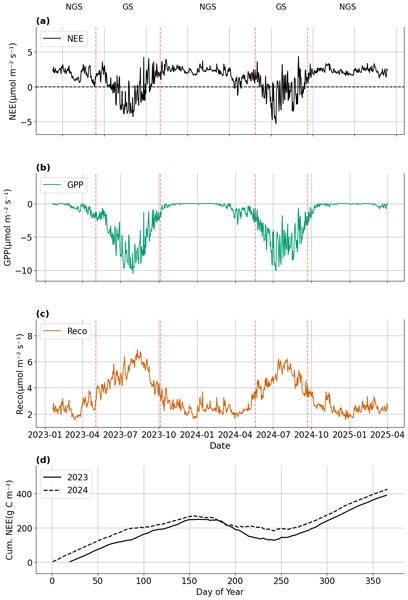
- Figure 3. please make sure the plot legends don’t cover the time series
- Figure 4. please decrease the size of the plotted points so it’s easier to see the individual data points
- Figure 5. I suggest to remove the dots indicating the peak magnitudes, they just look odd. Please also explain what the shading around the lines represents
- Figure 6. Instead of presenting the cumulative NEE on the same plot as the time series, I suggest to plot it in a separate subplot, with both years on top of each other so they can be compared. I suggest removing the cumulative GPP and ER, they don’t add much useful information
Citation: https://doi.org/10.5194/egusphere-2026-945-RC1 - AC1: 'Reply on RC1', Asra Salimi, 07 May 2026
-
RC2: 'Comment on egusphere-2026-945', Anonymous Referee #2, 04 Apr 2026
This study used eddy covariance to assess the carbon balance of an unmanaged drained peatland in Iceland. The partitioned carbon fluxes (gross primary productivity and ecosystem respiration) were analyzed alongside environmental drivers to understand processes of carbon uptake and release in this system. The two-year sampling period allowed them to capture processes under both dry and warm conditions, and wet and cool conditions.
This research will have important impacts for both scientific inquiry and national reporting. This study adds to the literature on the influence of water level on NEE, and how changes in GPP can be compensated by changes in ecosystem respiration. It also highlighted the need for yearly emission monitoring, especially in regions with mild temperatures during the non-growing season. This study will also support updating emission factors for unmanaged drained peatlands in Iceland to better align with current research.
This paper was well prepared and clearly written. I propose minor revisions. Below I listed out potential areas for improvement.
Line 118: How far away was the weather station from the study site?
Line 145: Was soil moisture assessed at 10 cm below the surface, or is this an average soil moisture across the top 10 cm? Additionally, were any calibrations performed on it for organic soil?
Line 295: Can you add in a comment here about whether the dominant vegetation characteristics changed after raising the tower and increasing the footprint area?
Line 302: Can you clarify this. You first say that there was no discernible spatial trend in depth variation, and then you say that deeper peat was found in certain sections, and shallower peat in other sections.
Figure 4: Many of the black points are hidden behind the blue points. Is it possible to make the blue points slightly transparent, or some other modification to improve readability?
Table 3: Can you include how many days were in the growing and non-growing season for each year in the table caption? This will help readers better interpret the data presented.
Figure 7: I suggested mentioning that your weekly aggregated fluxes were computed using non-gap filled data in the figure caption.
Line 454: Do you mean exposure to aerobic microbial decomposition?
Figure 7: I think it is the same Reco vs WL plot in this figure, and in Appendix B2. But the R2 and p-values are slightly different in the main text versus appendix.
Section 4.1: Can you include some discussion of how your GPP values compare to other unmanaged drained peatlands? Your work is contributing to EFs for unmanaged peatlands in Iceland. Is the vegetation at this site representative of conditions commonly found?
Line 525: Have other studies also seen this compensation mechanism?
Line 537: Can you clarify if this statement is based on interpretation of the negative linear relationship between Reco and WL, or if you tested if fluxes were significantly higher in 2023 compared to 2024. “In fact, Reco showed a significantly enhanced response to lower WL.”
Line 538: Can you justify this line a bit more. “The authors concluded that the mean annual effective water-table depth represents the overwhelmingly dominant control on CO2 fluxes in these ecosystems.” By CO2 fluxes do you mean NEE, or GPP or Reco? Earlier you show the WL did not have a significant effect on Reco is 2024, but did in 2023. You also say that NEE is similar between years.
Citation: https://doi.org/10.5194/egusphere-2026-945-RC2 - AC2: 'Reply on RC2', Asra Salimi, 07 May 2026
Peer review completion
Journal article(s) based on this preprint
Viewed
| HTML | XML | Total | Supplement | BibTeX | EndNote | |
|---|---|---|---|---|---|---|
| 980 | 499 | 91 | 1,570 | 148 | 86 | 123 |
- HTML: 980
- PDF: 499
- XML: 91
- Total: 1,570
- Supplement: 148
- BibTeX: 86
- EndNote: 123
Viewed (geographical distribution)
| Country | # | Views | % |
|---|
| Total: | 0 |
| HTML: | 0 |
| PDF: | 0 |
| XML: | 0 |
- 1
Asra Salimi

Bjarni Diðrik Sigurðsson
Brynhildur Bjarnadóttir
Chenxin Feng
Hlynur Óskarsson
Ivan Mammarella
The requested preprint has a corresponding peer-reviewed final revised paper. You are encouraged to refer to the final revised version.
- Preprint
(1923 KB) - Metadata XML
General comments:
This study presents two years of eddy covariance CO2 measurements from an unmanaged peatland drained 60 years ago in Iceland. The authors show that the site is still a significant and stable carbon source despite different weather conditions in the two years of measurements. They highlight specifically the importance of continuous carbon emissions during the non-growing season to the annual carbon balance of the site. Having year-round measurements in such a location is an important scientific contribution and the study helps to highlight that emissions factors used for IPCC reporting may overestimate emissions for drained Icelandic peatlands. However, I’m concerned that the results may have been partly confounded by emissions from the fuel cell used to power the flux tower. In addition, the results text is too detailed and the study performs some unnecessary analyses that could be improved to be of more interest to the reader, please see below for more details.
Specific comments:
Technical corrections: