
the Creative Commons Attribution 4.0 License.
the Creative Commons Attribution 4.0 License.
 | 13 Mar 2026
What is the neutral wind in height-integrated ionospheric electrodynamics?
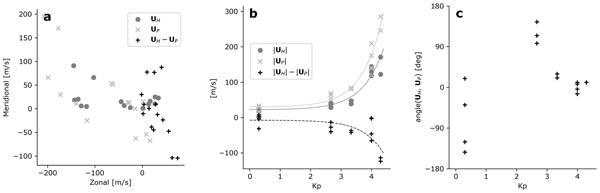
Abstract. In many studies of the electrodynamics of the coupled ionosphere-thermosphere (IT) system at high latitudes, the ionosphere is represented as a two-dimensional spherical shell and the height-integrated ionospheric Ohm's law is used to understand IT electrodynamic coupling. Thermospheric winds play a central role in IT electrodynamics, but they are generally ignored in existing empirical models and assimilative methods. While the primary issue is a lack of comprehensive wind measurements, there is also a gap in the literature on how to represent the thermospheric winds—which often exhibit strong variations with altitude—in a height-integrated description of high-latitude IT electrodynamics, and what the associated sources of error might be. Here we highlight that there is in general no single suitable definition of the neutral wind term in high-latitude, height-integrated IT electrodynamics. Instead, two neutral wind terms weighted by Hall and Pedersen conductivities appear in the height-integrated Ohm's law. Using altitude profiles of neutral winds and ionospheric conductivities respectively derived from sounding rocket chemical release experiments near Poker Flat, Alaska, and Poker Flat Incoherent Scatter Radar (PFISR) measurements, we find magnitude differences of order 10–100 m/s between the two neutral wind terms. The difference in magnitude increases with increasing geomagnetic activity. We show that a commonly used expression for Joule heating in terms of height-integrated quantities is a lower bound of the actual height-integrated Joule heating. We find experimentally that the relative error associated with the term that depends exclusively on the winds decreases with increasing geomagnetic activity. We also show that the thermospheric winds at the altitude at which the Pedersen conductivity peaks is the best proxy for the thermospheric wind term in height-integrated, high-latitude electrodynamics.
-
Notice on discussion status
The requested preprint has a corresponding peer-reviewed final revised paper. You are encouraged to refer to the final revised version.
-
Preprint
(1759 KB)
-
Supplement
(5995 KB)
-
The requested preprint has a corresponding peer-reviewed final revised paper. You are encouraged to refer to the final revised version.
- Preprint
(1759 KB) - Metadata XML
-
Supplement
(5995 KB) - BibTeX
- EndNote
- Final revised paper


Journal article(s) based on this preprint
Interactive discussion
Status: closed
-
RC1: 'Comment on egusphere-2026-940', Anonymous Referee #1, 08 Apr 2026
- AC1: 'Reply to RC1', Spencer Hatch, 18 Jun 2026
-
RC2: 'Comment on egusphere-2026-940', Theodore Sarris, 18 May 2026
This paper presents an investigation of how the neutral wind is approximated in height-integrated ionospheric electrodynamics in commonly used expressions for Joule heating. It is found experimentally from rocket flights combined with ISR measurements that the thermospheric winds at the altitude at which the Pedersen conductivity peaks is the best proxy for the thermospheric wind term in height-integrated, high-latitude electrodynamics, and that assuming zero winds is a better approximation than using winds at other altitudes as proxies. It is also found that the relative error associated with the term that depends exclusively on the winds decreases with increasing geomagnetic activity.
The paper is well written and at the forefront of research, and we recommend publication after the following minor comments are considered:
The title seems a bit general; would the authors consider something that is more closely associated with the findings and scope of this paper? e.g., “Representation of weighted neutral winds in high-latitude, height-integrated ionospheric electrodynamics”, or something similar (this is just a recommendation; the authors are welcome to keep the existing title if they feel it is more appropriate).
L34: The more recent study by Baloukidis et al. (2023) could be referenced here, as an assessment of the contribution of neutral winds on Joule heating statistically in EISCAT and TIE-GCM.
L49: “which is typically left undefined and most often simply taken to be zero” —> could the authors provide examples of studies that assume either of the two cases?
L64: “To our knowledge, all published studies in which conductance distributions have been estimated experimentally via Equations 5–6 have assumed U = 0” —> same as above, could the authors give some examples?
L55: Since Jper and Eperp are defined in relation to the magnetic field, isn’t it more general and correct representation to use b^ instead of r^? It is understood that in the context of the discussion above these are the equivalent, since B is assumed to be radial.
L96: “or when the neutral wind u does not vary with altitude. As noted in the Introduction, these idealized conditions are virtually never manifest in measured altitude profiles of the conductivities and neutral winds...”
Attached in the figure in the supplement pdf there is an example of neutral winds that are fairly constant with altitude (these are from the JOULE-1 rocket, PhD thesis of Laureline Sangalli, 2009). Could the authors comment? If these measurements are considered accurate and valid, perhaps the above statement (“virtually never manifest”) could be revised.
L10: what is the meaning of the double vertical line in || u x B || in equation (10), compared to the single vertical line in |Eperp +uxB| ?
Going one step back in this analysis: a main assumption of this work is the condition of steady-state stress balance between Lorentz and collisional drag forces. How accurate do the authors think that the assumption is, and how confident are we that this applies in particular in the regions where σP maximizes, or in the 110-130 km altitude range? What are the implications to this work if this assumption does not hold true, in particular during active times? Could the authors add a comment in the discussions on this topic?
- AC2: 'Reply to RC2', Spencer Hatch, 18 Jun 2026
Peer review completion


Interactive discussion
Status: closed
-
RC1: 'Comment on egusphere-2026-940', Anonymous Referee #1, 08 Apr 2026
The paper presents a comprehensive discussion of how the neutral wind is and could be considered in height-integrated ionospheric electrodynamics. Rocket and radar measurements are applied to study the actual “effective neutral wind” and evaluate common proxies. The paper is a very interesting contribution to the field of ionospheric electrodynamics and addresses a relevant issue. It can be published with minor revisions. Please see some suggestions below:
1. Equation 1 and following:
I assume b is the unit vector in magnetic field direction, i.e. b=B/|B|? Please clarify.
2. Section 3.3 and Figure 3
The statistics applied here are somewhat unclear to me: What is the statistical meaning of Q3+1.5IQR? Also, just roughly estimating for the left box in Figure 3a, IQR seems to be ~200m/s (with Q3~225m/s and Q1~25m/s), but the upper horizontal line (Q3+1.5IQR) is at about 300m/s. This might be a misunderstanding on my part, but in general, I don’t see the need for too much statistical analysis on only 15 wind profiles, so just showing the median values and Q3 and Q1 should suffice.
Also, it seems in Figure 3b that u=0 has a slightly lower median error than the wind at the Pedersen peak. The difference is minor, but contradicts the statement in lines 16 and 17, which is very general in claiming to have found the best proxy (one might come up with other proxies than the four investigated here). Figure 3 suggests that the Pedersen peak wind could serve as an improved proxy for effective neutral wind compared to the commonly applied u=0 and u=u160.
3. Lines 223-225
This statement is somewhat confusing. From Lines 111-112, I understood that the Pedersen-weighted neutral wind is the most natural definition of the effective neutral wind, given Equation 11. I do not see the connection to Figure 3, where the Pedersen-weighted neutral wind is used as a baseline to compare different proxies.
4. Section 3.4 and associated discussion
It would be interesting to give an estimate of how large the third term of Equation 10 RHS is in comparison to the other two terms, e.g., for a constant electric field or shown as a plot over varying electric field strength. This would allow to assess the inequality in Equation 11 and how good the application of Pedersen-weighted neutral wind as the effective neutral wind is. Also, if I understand Equation 10 correctly, the mix term (second term RHS) also carries some of the difference caused by assuming U_P as the effective neutral wind? Therefore, why do you focus solely on the exclusively wind-dependent term?
Some estimate of how this affects the Joule heating estimate quantitatively would be appreciated, and I’d suggest stating this in the abstract instead of the sentence in lines 14-17, which seems a bit vague.
Citation: https://doi.org/10.5194/egusphere-2026-940-RC1 - AC1: 'Reply to RC1', Spencer Hatch, 18 Jun 2026
-
RC2: 'Comment on egusphere-2026-940', Theodore Sarris, 18 May 2026
This paper presents an investigation of how the neutral wind is approximated in height-integrated ionospheric electrodynamics in commonly used expressions for Joule heating. It is found experimentally from rocket flights combined with ISR measurements that the thermospheric winds at the altitude at which the Pedersen conductivity peaks is the best proxy for the thermospheric wind term in height-integrated, high-latitude electrodynamics, and that assuming zero winds is a better approximation than using winds at other altitudes as proxies. It is also found that the relative error associated with the term that depends exclusively on the winds decreases with increasing geomagnetic activity.
The paper is well written and at the forefront of research, and we recommend publication after the following minor comments are considered:
The title seems a bit general; would the authors consider something that is more closely associated with the findings and scope of this paper? e.g., “Representation of weighted neutral winds in high-latitude, height-integrated ionospheric electrodynamics”, or something similar (this is just a recommendation; the authors are welcome to keep the existing title if they feel it is more appropriate).
L34: The more recent study by Baloukidis et al. (2023) could be referenced here, as an assessment of the contribution of neutral winds on Joule heating statistically in EISCAT and TIE-GCM.
L49: “which is typically left undefined and most often simply taken to be zero” —> could the authors provide examples of studies that assume either of the two cases?
L64: “To our knowledge, all published studies in which conductance distributions have been estimated experimentally via Equations 5–6 have assumed U = 0” —> same as above, could the authors give some examples?
L55: Since Jper and Eperp are defined in relation to the magnetic field, isn’t it more general and correct representation to use b^ instead of r^? It is understood that in the context of the discussion above these are the equivalent, since B is assumed to be radial.
L96: “or when the neutral wind u does not vary with altitude. As noted in the Introduction, these idealized conditions are virtually never manifest in measured altitude profiles of the conductivities and neutral winds...”
Attached in the figure in the supplement pdf there is an example of neutral winds that are fairly constant with altitude (these are from the JOULE-1 rocket, PhD thesis of Laureline Sangalli, 2009). Could the authors comment? If these measurements are considered accurate and valid, perhaps the above statement (“virtually never manifest”) could be revised.
L10: what is the meaning of the double vertical line in || u x B || in equation (10), compared to the single vertical line in |Eperp +uxB| ?
Going one step back in this analysis: a main assumption of this work is the condition of steady-state stress balance between Lorentz and collisional drag forces. How accurate do the authors think that the assumption is, and how confident are we that this applies in particular in the regions where σP maximizes, or in the 110-130 km altitude range? What are the implications to this work if this assumption does not hold true, in particular during active times? Could the authors add a comment in the discussions on this topic?
- AC2: 'Reply to RC2', Spencer Hatch, 18 Jun 2026
Peer review completion
Journal article(s) based on this preprint
Viewed
| HTML | XML | Total | Supplement | BibTeX | EndNote | |
|---|---|---|---|---|---|---|
| 906 | 404 | 79 | 1,389 | 214 | 85 | 102 |
- HTML: 906
- PDF: 404
- XML: 79
- Total: 1,389
- Supplement: 214
- BibTeX: 85
- EndNote: 102
Viewed (geographical distribution)
| Country | # | Views | % |
|---|
| Total: | 0 |
| HTML: | 0 |
| PDF: | 0 |
| XML: | 0 |
- 1

Johnathan K. Burchill
Heikki Vanhamäki
Rafael Luiz Araujo de Mesquita
Karl Magnus Laundal
The requested preprint has a corresponding peer-reviewed final revised paper. You are encouraged to refer to the final revised version.
- Preprint
(1759 KB) - Metadata XML
-
Supplement
(5995 KB) - BibTeX
- EndNote
- Final revised paper
The paper presents a comprehensive discussion of how the neutral wind is and could be considered in height-integrated ionospheric electrodynamics. Rocket and radar measurements are applied to study the actual “effective neutral wind” and evaluate common proxies. The paper is a very interesting contribution to the field of ionospheric electrodynamics and addresses a relevant issue. It can be published with minor revisions. Please see some suggestions below:
1. Equation 1 and following:
I assume b is the unit vector in magnetic field direction, i.e. b=B/|B|? Please clarify.
2. Section 3.3 and Figure 3
The statistics applied here are somewhat unclear to me: What is the statistical meaning of Q3+1.5IQR? Also, just roughly estimating for the left box in Figure 3a, IQR seems to be ~200m/s (with Q3~225m/s and Q1~25m/s), but the upper horizontal line (Q3+1.5IQR) is at about 300m/s. This might be a misunderstanding on my part, but in general, I don’t see the need for too much statistical analysis on only 15 wind profiles, so just showing the median values and Q3 and Q1 should suffice.
Also, it seems in Figure 3b that u=0 has a slightly lower median error than the wind at the Pedersen peak. The difference is minor, but contradicts the statement in lines 16 and 17, which is very general in claiming to have found the best proxy (one might come up with other proxies than the four investigated here). Figure 3 suggests that the Pedersen peak wind could serve as an improved proxy for effective neutral wind compared to the commonly applied u=0 and u=u160.
3. Lines 223-225
This statement is somewhat confusing. From Lines 111-112, I understood that the Pedersen-weighted neutral wind is the most natural definition of the effective neutral wind, given Equation 11. I do not see the connection to Figure 3, where the Pedersen-weighted neutral wind is used as a baseline to compare different proxies.
4. Section 3.4 and associated discussion
It would be interesting to give an estimate of how large the third term of Equation 10 RHS is in comparison to the other two terms, e.g., for a constant electric field or shown as a plot over varying electric field strength. This would allow to assess the inequality in Equation 11 and how good the application of Pedersen-weighted neutral wind as the effective neutral wind is. Also, if I understand Equation 10 correctly, the mix term (second term RHS) also carries some of the difference caused by assuming U_P as the effective neutral wind? Therefore, why do you focus solely on the exclusively wind-dependent term?
Some estimate of how this affects the Joule heating estimate quantitatively would be appreciated, and I’d suggest stating this in the abstract instead of the sentence in lines 14-17, which seems a bit vague.