
the Creative Commons Attribution 4.0 License.
the Creative Commons Attribution 4.0 License.
 | 23 Apr 2026
The one-Layer Antarctic model for Dynamical Downscaling of Ice–ocean Exchanges (LADDIE) version 2.0
Abstract. Projections of Antarctic mass loss and its contribution to sea-level rise are highly sensitive to the applied ocean-driven melting. As fully coupled continental-scale ocean–ice sheet models are scarce, ice sheet models are typically run in standalone configurations, forced with parameterised sub-shelf melting. To provide a physically more detailed alternative to melt parameterisations, we here present version 2.0 of the one-Layer Antarctic model for Dynamical Downscaling of Ice–ocean Exchanges (LADDIE). LADDIE is a two-dimensional model of the upper mixed layer below ice shelves and can reproduce observed spatial patterns in sub-shelf melting. Version 2.0 has improved computational performance due to parallellisation, discretisation on an unstructured mesh, and a more stable time stepping scheme. The model is fully integrated with the UFEMISM ice sheet model, allowing for coupled simulations on the same mesh. We evaluate the model by comparing it to LADDIE 1.0, showing that the simulated melt patterns are consistent across both model versions, whilst the computation time can be reduced by one order of magnitude due to parallellisation. The model is evaluated against an ensemble of 3D ocean models in both idealised and realistic pan-Antarctic domains at 2 km resolution. In both cases, LADDIE melt rates, melt patterns, and melt sensitivities are close to the multi-model mean. An evaluation against four pan-Antarctic satellite estimates, shows an overall good agreement in integrated melt rates per ice shelf, without the need for regional tuning. At a resolution of 120 m, LADDIE is able to reproduce the fine-scaled network of basal channels, observed on Pine Island ice shelf. Finally, we compare an idealised coupled UFEMISM–LADDIE simulation to a simulation with a quadratic melt parameterisation. The coupled simulation produces a threefold increase in grounding line retreat and volume above floatation loss. Based on these results, we conclude that LADDIE 2.0 can be a useful tool to simulate ice–ocean interactions in a computationally efficient way.
-
Notice on discussion status
The requested preprint has a corresponding peer-reviewed final revised paper. You are encouraged to refer to the final revised version.
-
Preprint
(20756 KB)
-
The requested preprint has a corresponding peer-reviewed final revised paper. You are encouraged to refer to the final revised version.
- Preprint
(20756 KB) - Metadata XML
- BibTeX
- EndNote
- Final revised paper


Journal article(s) based on this preprint
Interactive discussion
Status: closed
-
RC1: 'Comment on egusphere-2026-930', Anonymous Referee #1, 26 May 2026
-
AC1: 'Reply on RC1', Erwin Lambert, 23 Jul 2026
We would like to thank the anonymous referee for their very positive review. We agree with the points raised and give a detailed reply below.
Fig. 3: We will indeed change the colourmap of panel c to the same Red/Blue one of panel f. We also like the suggestion to include velocity vectors and will include those.
Line 242-3: This is indeed the case for this example, and we have seen similar behaviour for other examples. We will highlight this explicitly.
Line 245-6: This is a fair point, and we fully agree that in this example, the use of 64 cores is difficult to justify compared to 16 cores. We will mention explicitly that for this example, 16 cores would indeed be optimal, though this may differ between use cases.
Line 333: This is a good point, and also visible in Fig 5. We will add this paragraph to this section to highlight this discrepancy: We also find a large difference in median melt rates between the RISE ensemble and LADDIE. This median value reflects the typical melt rates in the relatively flat and shallow regions of ice shelves. A notable example is the Amery ice shelf (# 29), where 3D ocean models simulate melting on the order of 1 m/yr, whereas LADDIE simulates near-zero melt rates. A similar discrepancy is found in the idealised ISOMIP+ configuration (Fig. 5). We attribute this difference to underestimated temporal variability in LADDIE, which converges to a nearly static steady state, whereas ocean models retain a considerable temporal variability in ocean speeds. This variability can induce a net transport of heat towards otherwise cold shallow regions, along with non-zero friction velocities. A specific example of how variability causes enhanced melting is 'mode 3' melting, induced by seasonal intrusions of warm water into the shallow regions of the cavity, which is not represented by LADDIE. Because these regions typically contribute little to buttressing, we consider this discrepancy of lesser importance.
Citation: https://doi.org/10.5194/egusphere-2026-930-AC1
-
AC1: 'Reply on RC1', Erwin Lambert, 23 Jul 2026
-
RC2: 'Comment on egusphere-2026-930', Rupert Gladstone, 25 Jun 2026
General comments
This paper, like the LADDIE model itself, aims to fill the gap between, on the one side, computationally expensive physics based 3D ocean circulation models and, on the other side, empirical and machine learning paramerisations and plume or overturning models. LADDIE V2.0 is a physics based 2D circulation model for ice shelf cavities, much cheaper to integrate than 3D ocean models (hence can be run at a finer resolution) and incorporating a more physically complete circulation than the simpler approaches. This is a glaring gap in the current generation of ice sheet models used for future projection (ISMIP6/7 models). LADDIE V2.0, and this paper, therefore represents an important contribution to the modelling toolkit and the literature.
My perspective: I am primarily an ice sheet modeller, not an ocean physics expert. So my review considers the demonstrated capabilities of LADDIE and its application to ice sheet modelling rather than the derivation of governing equations and the oceanographic assumptions that have gone into these.
The layout is very clear. The model is well described. An informative selection of comparisons are presented. The comparison between LADDIE and the quadratic melt rate in the coupled setup is very powerful.
I have only minor comments to provide.I like the LADDIE logo, but I personally don't like it being included in the figures. It feels too much like advertising. Same for the UPSY and UFEMISM logos.
In principle, a paper should provide sufficient information for a reader to repeat the experiments. But sometimes the isn't enough specific information, especially in section 4 (see also my specific comments).
I've cloned the code out of curiosity. The LADDIE model itself is a very small part of the total repository, both in terms of file count and disk space. This isn't perfect, and the file counts of the repo are quite large (some HPC machines are very strict about this), but it is probably small enough not to cause problems.
I've scanned the code from a coupling perspective, assuming that the authors wish for LADDIE to be coupled to models other than UFEMISM in the future. The mesh information and partition information seems to be very well and clearly stored. The initialise and run routines look to be compatible with being called through a different model, though a wrapper to group the multiple initialisation routines might be needed for some couplers. For some couplers the MPI communicator might need to be passed to the submodels. This would need the "MPI_COMM_WORLD" instances changes to be able to use a communicator passed to LADDIE, which might not be the global MPI context. In short, some minor changes might be needed for coupling, but the code structures are mostly well designed for coupling.
I couldn't see a description of which Stokes approximation was used in UFEMISM. My understanding is that several are implemented and DIVA is commonly used. Please clarify that in the text.
Shameless self promotion: There's a new study led by Qin Zhou that applies very fine resolution 3D ocean modelling to ice shelf channels under Fimbul. Could be relevant to your introduction and around pages 17-19.
"Channelized Topography amplifies melt-sensitivity of cold Antarctic ice shelves", Nature Comms, May 2026.
Specific commentsI didn't find an explanation for what the parameter A_h means in equations 2 and 3. Or K_h.
Figure 1 caption. Technically, triangles have zero thickness. It is probably better to say "triangular prism" than "triangle with finite thickness".
Line 106 "melting of" -> "melting or"
Is there supposed to be an equation 16? It's showing blank for me.
Page 8. I got quite confused by the notation here, until I realised that "n" has rather carelessly been allowed to wander from timestep counting to substep counting. Please make sure not to mention n in the phrases "the weights beta_n" and "for substep n" at the start and end of the first paragraph following the equations. Please ensure that your terminology for counting timesteps is separate from the terminology for counting substeps.
Using stars for H is a viable way to indicate substeps, but then it becomes confusing that beta uses a different notation. H^** and beta_2 both imply that we're in the second substep. Why not use stars for both? e.g. beta^** for the second substep?
Figure 2. The figure seems to imply that the mesh is updated less frequently than every coupling interval, but the text states "At each coupling time step, the mesh is provided by UPSY". This looks contradictory to me.
A note on accelerated forcing. It's not quite as simple as implied at the end of page 8, especially when rates of change are either directly passed between models or implied by the boundary conditions that are directly passed between models. I think you need to be clear about whether you intend the ocean model to equilibrate each timestep (which is kind of implied in your text but you don't talk about demonstrating this) or accelerate the rates of change.
If you pass temperature from ice to ocean, you're implying a rate of heat transfer. If your ocean model runs for a fraction of the full coupling interval, and you've not "accelerated" this heat transfer, you might get a different result compared to running the ocean model for the full coupling interval. Is your intention here that the ocean model runs long enough to equilibrate to the updated temperature, such that the rate of heat transfer doesn't matter?
Line 259 typo "het salt"
Line 291 typo "Ice-shelf/ocen"
It is very notable that the LADDIE median and mean meltrates are below and above the RISE range respectively. This warrants at least a sentence or two. I guess it is due to a spatial distribution with small regions of very high melt that lift the mean? Perhaps related to finer resolution than the RISE models?
Looking at figures 5 and 6 LADDIE seems more ready than other models to drop melt rates toward zero far from grounding lines. Why is this? Who is "correct" here?
Line 339. Do you compare to the Davison dataset because you have more confidence in that data set? Or because it gives a closer match to the LADDIE melt rates? And yes, this question is intentionally tongue in cheek... but readers will be wondering why, if you don't give a reason for choosing that data set for your visual comparison. After all, the comparison to models was a multi-model mean, so why not a multi-data mean?
Line 380. Would you like to say something about why satellite estimates don't work near the GL? Is it because they have to make the hydrostatic assumption? Or are there other reasons?
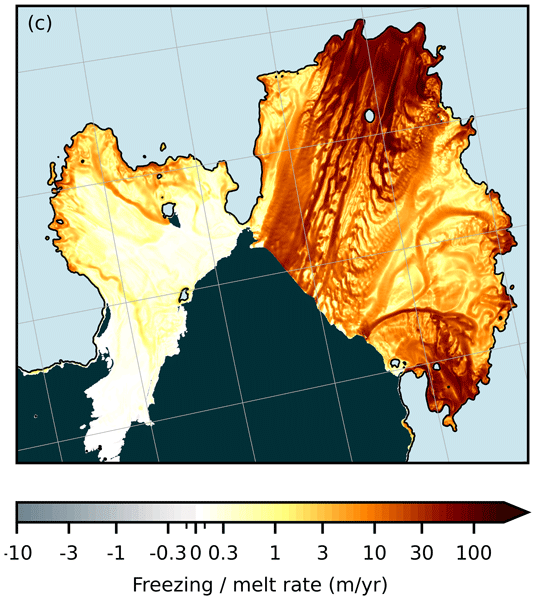
Page 19/Figure 8. There's a very elegant pattern of curved high melt regions on the west side of the main trunk of the PIG ice shelf in LADDIE. I don't see this in the satellite estimates. Can you say anything about this? Perhaps at least say why it occurs in LADDIE, even if you don't know why it doesn't occur in the satellite estimates? Does it follow a pattern of curved channels in the geometry you use?
Line 389. Do you mean applying an idealised ocean forcing to LADDIE or directly to a melt parameterisation?
Line 390. I know you provide a reference, but could you say just slightly more about WARM?
Line 390. What does the 300 years refer to? After the spinup? In which case how long is the spinup?
Line 392. Can you quantify "significantly"?
Line 418. Typo "dependend"
Line 418. Can you speculate on what might be different between the ice sheet models? Is it the Stokes approximation? The sliding law? Resolution?
Line 427. Could also be due to using an unstructured mesh instead of having a row of square grid cells perfectly aligned with the GL.
Line 461. Typo? Not sure what "at" is doing in "repository at to optimise"
Citation: https://doi.org/10.5194/egusphere-2026-930-RC2 - AC3: 'Reply on RC2', Erwin Lambert, 23 Jul 2026
- AC2: 'Reply on RC2', Erwin Lambert, 23 Jul 2026
Peer review completion


Interactive discussion
Status: closed
-
RC1: 'Comment on egusphere-2026-930', Anonymous Referee #1, 26 May 2026
This manuscript presents an updated version of the existing one-layer melt rate model LADDIE. The new model version is not just incremental; it includes translation to a new code language, a new mesh structure, parallelisation and full integration with an ice sheet model, making this a significant upgrade to the older version. Differences in the new model version are described thoroughly in a well-referenced and easy-to-follow section of the paper. The model is then assessed against LADDIE v1, multi-model means from ice-ocean coupled ensembles and satellite-derived melt rates in a detailed analysis, showing its strengths and honestly discussing potential drawbacks. Results are then presented of a coupled simulation using the MISOMIP+ protocol, compared to using a parameterised melt. The discussion section raises a few important points which I was pleased to see highlighted.
I enjoyed reading and learning about this work, and am very interested to see future applications of this new model version. I find the manuscript to be exceptionally well-written and contain a good level of detail in its presentation. I found very few instances where I felt the need to suggest improvement. This manuscript is certainly suitable for publication in GMD, and I recommend publication after a few minor revisions, detailed below.
Fig. 3: I don’t find the blue/grey colourscale in panel (c) to be clear unless I zoom in on the image. Perhaps using the same colourmap as panel (f), or something similar, would be a better choice for easy visibility of the differences. It may also be beneficial to show the velocity vectors as well as the speed distribution.
Line 242-3: It looks as if doubling from 16 to 32 does not make much difference, and to get the ~33% time reduction you would need to quadruple to 64. Is this common in other tests than the one shown in Fig.4?
Line 245-6: Related to the above, 32 or 64 cores may produce the most rapid simulations, but looking at the results in Fig.4, I would question whether increasing the number of CPUs beyond 16 is justified by the fairly minimal gains in time. What would your thoughts be on the optimal number of cores for efficient use of computing resources?
Line 333: While LADDIE has higher mean melt rates, it has a much lower median melt rate, which I think should be addressed in this section. In Fig.6 it is clear that LADDIE produces close to zero melt over large areas of the ice shelves, where the multi-model mean from RISE has a baseline ~1m/yr melt across many of these areas. This is particularly noticeable when comparing the melt rates of Amery ice shelf, but is a common occurrence. In many places the satellite estimates in Fig.7 also show this (although notably not on Amery, where estimates actually show more refreezing) Why does LADDIE not replicate this low, but non-zero, melting?
Citation: https://doi.org/10.5194/egusphere-2026-930-RC1 -
AC1: 'Reply on RC1', Erwin Lambert, 23 Jul 2026
We would like to thank the anonymous referee for their very positive review. We agree with the points raised and give a detailed reply below.
Fig. 3: We will indeed change the colourmap of panel c to the same Red/Blue one of panel f. We also like the suggestion to include velocity vectors and will include those.
Line 242-3: This is indeed the case for this example, and we have seen similar behaviour for other examples. We will highlight this explicitly.
Line 245-6: This is a fair point, and we fully agree that in this example, the use of 64 cores is difficult to justify compared to 16 cores. We will mention explicitly that for this example, 16 cores would indeed be optimal, though this may differ between use cases.
Line 333: This is a good point, and also visible in Fig 5. We will add this paragraph to this section to highlight this discrepancy: We also find a large difference in median melt rates between the RISE ensemble and LADDIE. This median value reflects the typical melt rates in the relatively flat and shallow regions of ice shelves. A notable example is the Amery ice shelf (# 29), where 3D ocean models simulate melting on the order of 1 m/yr, whereas LADDIE simulates near-zero melt rates. A similar discrepancy is found in the idealised ISOMIP+ configuration (Fig. 5). We attribute this difference to underestimated temporal variability in LADDIE, which converges to a nearly static steady state, whereas ocean models retain a considerable temporal variability in ocean speeds. This variability can induce a net transport of heat towards otherwise cold shallow regions, along with non-zero friction velocities. A specific example of how variability causes enhanced melting is 'mode 3' melting, induced by seasonal intrusions of warm water into the shallow regions of the cavity, which is not represented by LADDIE. Because these regions typically contribute little to buttressing, we consider this discrepancy of lesser importance.
Citation: https://doi.org/10.5194/egusphere-2026-930-AC1
-
AC1: 'Reply on RC1', Erwin Lambert, 23 Jul 2026
-
RC2: 'Comment on egusphere-2026-930', Rupert Gladstone, 25 Jun 2026
General comments
This paper, like the LADDIE model itself, aims to fill the gap between, on the one side, computationally expensive physics based 3D ocean circulation models and, on the other side, empirical and machine learning paramerisations and plume or overturning models. LADDIE V2.0 is a physics based 2D circulation model for ice shelf cavities, much cheaper to integrate than 3D ocean models (hence can be run at a finer resolution) and incorporating a more physically complete circulation than the simpler approaches. This is a glaring gap in the current generation of ice sheet models used for future projection (ISMIP6/7 models). LADDIE V2.0, and this paper, therefore represents an important contribution to the modelling toolkit and the literature.
My perspective: I am primarily an ice sheet modeller, not an ocean physics expert. So my review considers the demonstrated capabilities of LADDIE and its application to ice sheet modelling rather than the derivation of governing equations and the oceanographic assumptions that have gone into these.
The layout is very clear. The model is well described. An informative selection of comparisons are presented. The comparison between LADDIE and the quadratic melt rate in the coupled setup is very powerful.
I have only minor comments to provide.I like the LADDIE logo, but I personally don't like it being included in the figures. It feels too much like advertising. Same for the UPSY and UFEMISM logos.
In principle, a paper should provide sufficient information for a reader to repeat the experiments. But sometimes the isn't enough specific information, especially in section 4 (see also my specific comments).
I've cloned the code out of curiosity. The LADDIE model itself is a very small part of the total repository, both in terms of file count and disk space. This isn't perfect, and the file counts of the repo are quite large (some HPC machines are very strict about this), but it is probably small enough not to cause problems.
I've scanned the code from a coupling perspective, assuming that the authors wish for LADDIE to be coupled to models other than UFEMISM in the future. The mesh information and partition information seems to be very well and clearly stored. The initialise and run routines look to be compatible with being called through a different model, though a wrapper to group the multiple initialisation routines might be needed for some couplers. For some couplers the MPI communicator might need to be passed to the submodels. This would need the "MPI_COMM_WORLD" instances changes to be able to use a communicator passed to LADDIE, which might not be the global MPI context. In short, some minor changes might be needed for coupling, but the code structures are mostly well designed for coupling.
I couldn't see a description of which Stokes approximation was used in UFEMISM. My understanding is that several are implemented and DIVA is commonly used. Please clarify that in the text.
Shameless self promotion: There's a new study led by Qin Zhou that applies very fine resolution 3D ocean modelling to ice shelf channels under Fimbul. Could be relevant to your introduction and around pages 17-19.
"Channelized Topography amplifies melt-sensitivity of cold Antarctic ice shelves", Nature Comms, May 2026.
Specific commentsI didn't find an explanation for what the parameter A_h means in equations 2 and 3. Or K_h.
Figure 1 caption. Technically, triangles have zero thickness. It is probably better to say "triangular prism" than "triangle with finite thickness".
Line 106 "melting of" -> "melting or"
Is there supposed to be an equation 16? It's showing blank for me.
Page 8. I got quite confused by the notation here, until I realised that "n" has rather carelessly been allowed to wander from timestep counting to substep counting. Please make sure not to mention n in the phrases "the weights beta_n" and "for substep n" at the start and end of the first paragraph following the equations. Please ensure that your terminology for counting timesteps is separate from the terminology for counting substeps.
Using stars for H is a viable way to indicate substeps, but then it becomes confusing that beta uses a different notation. H^** and beta_2 both imply that we're in the second substep. Why not use stars for both? e.g. beta^** for the second substep?
Figure 2. The figure seems to imply that the mesh is updated less frequently than every coupling interval, but the text states "At each coupling time step, the mesh is provided by UPSY". This looks contradictory to me.
A note on accelerated forcing. It's not quite as simple as implied at the end of page 8, especially when rates of change are either directly passed between models or implied by the boundary conditions that are directly passed between models. I think you need to be clear about whether you intend the ocean model to equilibrate each timestep (which is kind of implied in your text but you don't talk about demonstrating this) or accelerate the rates of change.
If you pass temperature from ice to ocean, you're implying a rate of heat transfer. If your ocean model runs for a fraction of the full coupling interval, and you've not "accelerated" this heat transfer, you might get a different result compared to running the ocean model for the full coupling interval. Is your intention here that the ocean model runs long enough to equilibrate to the updated temperature, such that the rate of heat transfer doesn't matter?
Line 259 typo "het salt"
Line 291 typo "Ice-shelf/ocen"
It is very notable that the LADDIE median and mean meltrates are below and above the RISE range respectively. This warrants at least a sentence or two. I guess it is due to a spatial distribution with small regions of very high melt that lift the mean? Perhaps related to finer resolution than the RISE models?
Looking at figures 5 and 6 LADDIE seems more ready than other models to drop melt rates toward zero far from grounding lines. Why is this? Who is "correct" here?
Line 339. Do you compare to the Davison dataset because you have more confidence in that data set? Or because it gives a closer match to the LADDIE melt rates? And yes, this question is intentionally tongue in cheek... but readers will be wondering why, if you don't give a reason for choosing that data set for your visual comparison. After all, the comparison to models was a multi-model mean, so why not a multi-data mean?
Line 380. Would you like to say something about why satellite estimates don't work near the GL? Is it because they have to make the hydrostatic assumption? Or are there other reasons?
Page 19/Figure 8. There's a very elegant pattern of curved high melt regions on the west side of the main trunk of the PIG ice shelf in LADDIE. I don't see this in the satellite estimates. Can you say anything about this? Perhaps at least say why it occurs in LADDIE, even if you don't know why it doesn't occur in the satellite estimates? Does it follow a pattern of curved channels in the geometry you use?
Line 389. Do you mean applying an idealised ocean forcing to LADDIE or directly to a melt parameterisation?
Line 390. I know you provide a reference, but could you say just slightly more about WARM?
Line 390. What does the 300 years refer to? After the spinup? In which case how long is the spinup?
Line 392. Can you quantify "significantly"?
Line 418. Typo "dependend"
Line 418. Can you speculate on what might be different between the ice sheet models? Is it the Stokes approximation? The sliding law? Resolution?
Line 427. Could also be due to using an unstructured mesh instead of having a row of square grid cells perfectly aligned with the GL.
Line 461. Typo? Not sure what "at" is doing in "repository at to optimise"
Citation: https://doi.org/10.5194/egusphere-2026-930-RC2 - AC3: 'Reply on RC2', Erwin Lambert, 23 Jul 2026
- AC2: 'Reply on RC2', Erwin Lambert, 23 Jul 2026
Peer review completion
Journal article(s) based on this preprint
Viewed
| HTML | XML | Total | BibTeX | EndNote | |
|---|---|---|---|---|---|
| 410 | 224 | 50 | 684 | 42 | 46 |
- HTML: 410
- PDF: 224
- XML: 50
- Total: 684
- BibTeX: 42
- EndNote: 46
Viewed (geographical distribution)
| Country | # | Views | % |
|---|
| Total: | 0 |
| HTML: | 0 |
| PDF: | 0 |
| XML: | 0 |
- 1

Franka Jesse
Constantijn J. Berends
The requested preprint has a corresponding peer-reviewed final revised paper. You are encouraged to refer to the final revised version.
- Preprint
(20756 KB) - Metadata XML
This manuscript presents an updated version of the existing one-layer melt rate model LADDIE. The new model version is not just incremental; it includes translation to a new code language, a new mesh structure, parallelisation and full integration with an ice sheet model, making this a significant upgrade to the older version. Differences in the new model version are described thoroughly in a well-referenced and easy-to-follow section of the paper. The model is then assessed against LADDIE v1, multi-model means from ice-ocean coupled ensembles and satellite-derived melt rates in a detailed analysis, showing its strengths and honestly discussing potential drawbacks. Results are then presented of a coupled simulation using the MISOMIP+ protocol, compared to using a parameterised melt. The discussion section raises a few important points which I was pleased to see highlighted.
I enjoyed reading and learning about this work, and am very interested to see future applications of this new model version. I find the manuscript to be exceptionally well-written and contain a good level of detail in its presentation. I found very few instances where I felt the need to suggest improvement. This manuscript is certainly suitable for publication in GMD, and I recommend publication after a few minor revisions, detailed below.
Fig. 3: I don’t find the blue/grey colourscale in panel (c) to be clear unless I zoom in on the image. Perhaps using the same colourmap as panel (f), or something similar, would be a better choice for easy visibility of the differences. It may also be beneficial to show the velocity vectors as well as the speed distribution.
Line 242-3: It looks as if doubling from 16 to 32 does not make much difference, and to get the ~33% time reduction you would need to quadruple to 64. Is this common in other tests than the one shown in Fig.4?
Line 245-6: Related to the above, 32 or 64 cores may produce the most rapid simulations, but looking at the results in Fig.4, I would question whether increasing the number of CPUs beyond 16 is justified by the fairly minimal gains in time. What would your thoughts be on the optimal number of cores for efficient use of computing resources?
Line 333: While LADDIE has higher mean melt rates, it has a much lower median melt rate, which I think should be addressed in this section. In Fig.6 it is clear that LADDIE produces close to zero melt over large areas of the ice shelves, where the multi-model mean from RISE has a baseline ~1m/yr melt across many of these areas. This is particularly noticeable when comparing the melt rates of Amery ice shelf, but is a common occurrence. In many places the satellite estimates in Fig.7 also show this (although notably not on Amery, where estimates actually show more refreezing) Why does LADDIE not replicate this low, but non-zero, melting?