
the Creative Commons Attribution 4.0 License.
the Creative Commons Attribution 4.0 License.
 | 21 Jan 2026
Modulation of Internal Tides Properties off the Vitória–Trindade Ridge during Contrasted Seasons from Altimetry and a Regional Ocean Model
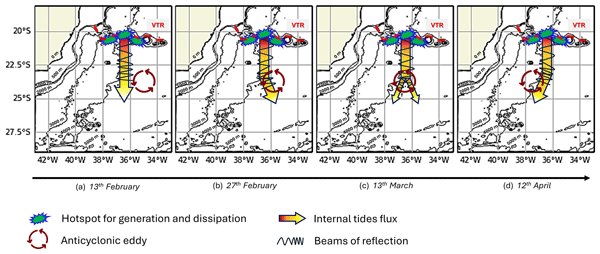
Abstract. The incoherent fraction of internal tides, generated through interactions with mesoscale eddies and other transient oceanic features, remains poorly understood and challenging to predict. This knowledge gap limits our ability to accurately represent energy transfers and mixing processes in the ocean induced by these waves. The Vitória–Trindade Ridge, located off the Brazilian shelf, provides a particularly relevant natural laboratory to investigate these processes, as it constitutes a hotspot for internal tides generation embedded in a region characterized by strong mesoscale activity and vigorous eddy fluxes. To assess how seasonal stratification and mesoscale variability modulate internal tide properties, we combined two complementary approaches: internal tide signals were extracted from a 27-year satellite altimetry record and compared with a high-resolution (1/36°) regional simulation performed with the ocean model NEMO v4.0.2. This joint analysis allowed for a consistent characterization of the generation, propagation, and dissipation of internal tides under two contrasted oceanic regimes. Austral winter (defined here from May to October) is marked by a deep pycnocline, whereas austral summer (defined here from November to April) is associated with a shallower, sharper seasonal pycnocline. Both the model and observations depict six intense, in-phase reflection beams propagating southward from the ridge. The first two beams of reflection are associated with a wavelength of 100 km approximately corresponding to the mode 1 of propagation, while the beams further from the ridge are separated by about 50 km only, which likely corresponds to the second mode of propagation. Quantification from the model show that internal tide generation rates are 5 to 15 % higher in summer than in winter. Dissipation occurs predominantly in the vicinity of the ridge (45 %) but also extends offshore (40 %), reaching beyond 2 to 3 mode-1 wavelengths. In the open ocean, dissipation rates are up to 40 % higher during winter than in summer. In the model, these seasonal differences result in stronger baroclinic fluxes that propagate farther south during summer, whereas winter fluxes are more rapidly dissipated. Altimetric observations further confirm pronounced seasonal variations in both wavelength and amplitude, in particular for mode-2 internal tides. In addition, a representative case of interaction between internal tides and a mesoscale eddy is documented under summer conditions, showing deviation and diffraction of the baroclinic flux as it encounters the eddy. This study demonstrates that mesoscale variability and seasonal stratification act jointly to modulate the coherence and energy pathways of internal tides. These findings are essential for improving predictions of the incoherent tide and for guiding the interpretation of recent high-resolution altimetric observations.
-
Notice on discussion status
The requested preprint has a corresponding peer-reviewed final revised paper. You are encouraged to refer to the final revised version.
-
Preprint
(68850 KB)
-
The requested preprint has a corresponding peer-reviewed final revised paper. You are encouraged to refer to the final revised version.
- Preprint
(68850 KB) - Metadata XML
- BibTeX
- EndNote
- Final revised paper


Journal article(s) based on this preprint
Interactive discussion
Status: closed
-
RC1: 'Comment on egusphere-2026-93', Anonymous Referee #1, 18 Feb 2026
-
AC1: 'Reply on RC1', Perrine Bauchot, 11 May 2026
Dear Reviewer,
We thank you for your valuable feedback which helped us improve the quality of this study. You will find attached our detailed responses to your comments and remarks. We remain available for any additional information or discussion.
Best regards,
Perrine Bauchot
-
AC1: 'Reply on RC1', Perrine Bauchot, 11 May 2026
-
RC2: 'Comment on egusphere-2026-93', Anonymous Referee #2, 23 Mar 2026
Below is a review of “modulation of internal tides properties off the Vitoria-Trindade Ridge during contrasted seasons from altimetry and a regional ocean model” by P. Bauchot and co-authors.
This paper uses an ocean model and historical altimeter data to demonstrate that mesoscale variability and seasonal stratification act jointly to modulate the coherence and energy pathways of internal tides.
I enjoyed this paper and found it interesting. I think the conclusions are reasonable based on the data and analyses presented and I have no major comments to offer in that regard. The main comments are either editorial in nature, or connected to a concept where you are assuming the reader understands what is being discussed.
I recommend accept subject to minor revisions. I would gladly re-read the paper post edits to ensure my comments were satisfactorily addressed.
My comments are enumerated below.
Lines 12-13 – “reflection beams” – what exactly are they? They are never defined in the manuscript. I’ve thought about internal tides for a while and it’s a term I’m not familiar with. This term is used in other places in the manuscript where you assume the reader understands. I looked the term up in Google and I think I know what it is but I’m not quite sure. EGUsphere’s readers are smart but not all specialists. They should get an explanation of what reflection beams are and how to see them in the results you are presenting.
Line 26 – “in the climate regulation” – doesn’t read well, either “the regulation of climate” or removing “the” reads better
Line 32 – “one of the main responsible” – doesn’t read well, perhaps inserting “mechanisms” between “main” and “responsible”?
Line 113 – “is in adequacy” – doesn’t read well. I was going to suggest a rewrite but I’m not completely sure of what you’re trying to convey.
Line 132 – “2,5.10^-3” – I’m not used to scientific notation being presented this way. Can this be rewritten in more standard notation (e.g. .0025)?
Line 156 – “The temperature and salinity profiles of the first 500 metres of the water column of TAPIOCA-36 appear really close to the ones reported by the WOA, which therefore make our model reliable” – this is at best a qualitative argument to claim “reliability”. Can you present a more quantitative case to justify this statement?
Figure 3 – right panel. “temperature and salinity profiles of tapioca-36 against WOA data”. What am I looking at? A single location, a mean across all profiles? If you are presenting this as T-S validation of TAPIOCA-36, you should give more details. For example, numbers of profiles and mean and rms error statistics.
Line 173 – “box n° 3” – how about calling it box 3 – as is done in the figure?
Figure 5 – green and red line, at least in my printout appear muted and hard to differentiate. Please consider a better version with better colors see. Also, “signal barocline” in the label of the left panel should be changed to match the legend.
Starting at line 195 (as well as Figure 5) - There is a discussion of beams of reflection. I didn’t fully understand the concept because it was never defined by the writers. It made this discussion nearly impossible to appreciate. My line 12 comments hold here too. Don’t assume the readers understand a term, define it so they can appreciate what you’re discussing. The readership of EGUsphere are smart nonspecialists.
Line 207 – “we retrieved that almost 45% of the dissipation occurs locally” – are you trying to say that “we find that almost 45% …….”
Line 233 – As the conversion rate C – I assume you mean barotropic to baroclinic? If so, please specify.
Figure 10 – never mentioned in the text
Figure 11 – what are the lines near -21 and -22? Should define in legend.
Line 263 – “After three periods of internal tides”. This confused me. Are you talking about 3 mode-1 wavelengths, which would be a distance or some sort of time interval? This is confusing and should be expressed more clearly.
Line 264 – First period of reflection – not defined, so I have no guidance to interpret what this means.
Figure 12 – Panel labels are way too small, they need to be increased in size. Also, you have a mix of (presumably) French and English, please be consistent (e.g., isopyncne).
Line 294 – “period” – I think you meant “periods”
Line 334 – “six beams of reflections” – commented on earlier.
Line 335-336 – “Altimetry allows to retrieve the wavelength of each mode of propagation: 140 km and 65 km for the first and second mode of propagation, respectively” – reads awkward, how about “Altimetry allows the retrieval of the …”
Citation: https://doi.org/10.5194/egusphere-2026-93-RC2 -
AC2: 'Reply on RC2', Perrine Bauchot, 11 May 2026
Dear Reviewer,
We thank you for your valuable feedback which helped us improve the quality of this study. You will find attached our detailed responses to your comments and remarks. We remain available for any additional information or discussion.
Best regards,
Perrine Bauchot
-
AC2: 'Reply on RC2', Perrine Bauchot, 11 May 2026
Peer review completion


Interactive discussion
Status: closed
-
RC1: 'Comment on egusphere-2026-93', Anonymous Referee #1, 18 Feb 2026
This paper looks at internal tides in the Vitoria-Trindade region using both satellite altimetry and a high-resolution ocean model. The approach is straightforward and the results seem reasonable to me. I recommend some minor changes before publication.
I was especially intrigued by the propagation study that examined how a large mesoscale eddy impacted internal tide fluxes -- Figures 12 and 13. The authors emphasized the change in propagation direction (clear in the cartoon of Fig 13, less clear to me in the actual data of Fig 12). But even more striking to me was the nearly complete disappearance in panel (b) [Feb 24] of the energy fluxes south of the eddy. This seems more significant than the small perturbations to direction. But it also raises a number of questions. Most of this paper focuses on M2 alone. Is Fig 12 showing just M2, or is it a general "semidiurnal" flux? If just M2, then I'd like more details about how M2 could be isolated from all the other constituents in their model. If all tides are shown, is the lack of energy in panel (b) just the spring-neap cycle, and thus of minor significance? Perhaps the authors could fill in more details behind these diagrams. (They could also improve the aesthetics of Figure 12, since some fonts are too tiny to see. Maybe some tiny text is not needed?)
I also had some concerns with Fig 5 that compared model and altimetry. The altimetry has mostly smaller amplitudes. I agree that this could stem from the altimetry being an average over 20+ years. But the altimetry is also somewhat noisy and one naturally wonders about error bars. It would be good to see error estimates here, which should be easily derivable from their altimeter analysis.
Some other minor points (with line numbers):
The instructions to OS say the Abstract should be "short, clear, concise." It is written clearly, but it does seem somewhat long.
32 - main -> main mechanism? missing word?
38 - the reference to Carter et al. does not seem appropriate, since that work was focused on the Hawaiian Ridge, not the global energetics.
43 - "to a day" - It can be many days, as shown by some waves crossing ocean basins.
88 - The altimeter data extend past 2020, even if not all of it is used here.
90 - "without aliasing" is not correct. The tidal signals are still aliased, no matter how long the time series.
97 - "contribution of baroclinic tides" is part of the noise?? Perhaps the authors mean "incoherent" baroclininc tides.
99 - Arbic reference not needed for the frequency of M2, surely.
101 - I think Step 2 is actually a part of Step 3 and can be removed. It is just a part of any filtering step. There are really only two important steps here.
113 - I did not understand what is "in adequacy"
Fig 5 panels for barotropic tide. The phase plot is not informative as it just shows big ±180° jumps. Changing the y-axis to some other range would show the data better.
136 "boundaries" might be better than "frontiers"
140 - Was FES2014 model used for forcing only on the open boundaries?
144 - I think it would be useful to say how barotropic and baroclinic signals were separated. This can be sometimes a source of confusion, so it is good to state what was done.
Fig 3, right panels: Are these profiles a MEAN over the whole region? And over what time range?
Fig 3, left panels: Is this the "barotropic" SSH for the model, or the "full" SSH? I suspect it is the full external+internal tide, which would explain the phase jitters.
Also, what is contour interval for phase lines?163 - why "global"?
Fig 4. Box 1 is mostly red, boxes 3-6 mostly blue. Why are all boxes negative in the bar chart? It seems Box 1 should be positive.
Fig 5 and corresponding text, for wavelength determined from altimetry. The peak in the wavenumber spectrum is used. Was this corrected for the orientation of the T/P track? The track crosses the main beams at an angle. (This same issue arises in the Conclusions, too -- line 336.)
Fig 10 - aside from a small change in wavelength, summer versus winter, more pronounced is the differences in the energy level. Summer peak is much reduced in magnitude.
Fig 11 - seems rather cramped and hard to see. Would a log scale for dissipation be better?
474 - The reference is wrong. This cites it as a OS Discussion paper. The actual publication was in OS in 2022.
Citation: https://doi.org/10.5194/egusphere-2026-93-RC1 -
AC1: 'Reply on RC1', Perrine Bauchot, 11 May 2026
Dear Reviewer,
We thank you for your valuable feedback which helped us improve the quality of this study. You will find attached our detailed responses to your comments and remarks. We remain available for any additional information or discussion.
Best regards,
Perrine Bauchot
-
AC1: 'Reply on RC1', Perrine Bauchot, 11 May 2026
-
RC2: 'Comment on egusphere-2026-93', Anonymous Referee #2, 23 Mar 2026
Below is a review of “modulation of internal tides properties off the Vitoria-Trindade Ridge during contrasted seasons from altimetry and a regional ocean model” by P. Bauchot and co-authors.
This paper uses an ocean model and historical altimeter data to demonstrate that mesoscale variability and seasonal stratification act jointly to modulate the coherence and energy pathways of internal tides.
I enjoyed this paper and found it interesting. I think the conclusions are reasonable based on the data and analyses presented and I have no major comments to offer in that regard. The main comments are either editorial in nature, or connected to a concept where you are assuming the reader understands what is being discussed.
I recommend accept subject to minor revisions. I would gladly re-read the paper post edits to ensure my comments were satisfactorily addressed.
My comments are enumerated below.
Lines 12-13 – “reflection beams” – what exactly are they? They are never defined in the manuscript. I’ve thought about internal tides for a while and it’s a term I’m not familiar with. This term is used in other places in the manuscript where you assume the reader understands. I looked the term up in Google and I think I know what it is but I’m not quite sure. EGUsphere’s readers are smart but not all specialists. They should get an explanation of what reflection beams are and how to see them in the results you are presenting.
Line 26 – “in the climate regulation” – doesn’t read well, either “the regulation of climate” or removing “the” reads better
Line 32 – “one of the main responsible” – doesn’t read well, perhaps inserting “mechanisms” between “main” and “responsible”?
Line 113 – “is in adequacy” – doesn’t read well. I was going to suggest a rewrite but I’m not completely sure of what you’re trying to convey.
Line 132 – “2,5.10^-3” – I’m not used to scientific notation being presented this way. Can this be rewritten in more standard notation (e.g. .0025)?
Line 156 – “The temperature and salinity profiles of the first 500 metres of the water column of TAPIOCA-36 appear really close to the ones reported by the WOA, which therefore make our model reliable” – this is at best a qualitative argument to claim “reliability”. Can you present a more quantitative case to justify this statement?
Figure 3 – right panel. “temperature and salinity profiles of tapioca-36 against WOA data”. What am I looking at? A single location, a mean across all profiles? If you are presenting this as T-S validation of TAPIOCA-36, you should give more details. For example, numbers of profiles and mean and rms error statistics.
Line 173 – “box n° 3” – how about calling it box 3 – as is done in the figure?
Figure 5 – green and red line, at least in my printout appear muted and hard to differentiate. Please consider a better version with better colors see. Also, “signal barocline” in the label of the left panel should be changed to match the legend.
Starting at line 195 (as well as Figure 5) - There is a discussion of beams of reflection. I didn’t fully understand the concept because it was never defined by the writers. It made this discussion nearly impossible to appreciate. My line 12 comments hold here too. Don’t assume the readers understand a term, define it so they can appreciate what you’re discussing. The readership of EGUsphere are smart nonspecialists.
Line 207 – “we retrieved that almost 45% of the dissipation occurs locally” – are you trying to say that “we find that almost 45% …….”
Line 233 – As the conversion rate C – I assume you mean barotropic to baroclinic? If so, please specify.
Figure 10 – never mentioned in the text
Figure 11 – what are the lines near -21 and -22? Should define in legend.
Line 263 – “After three periods of internal tides”. This confused me. Are you talking about 3 mode-1 wavelengths, which would be a distance or some sort of time interval? This is confusing and should be expressed more clearly.
Line 264 – First period of reflection – not defined, so I have no guidance to interpret what this means.
Figure 12 – Panel labels are way too small, they need to be increased in size. Also, you have a mix of (presumably) French and English, please be consistent (e.g., isopyncne).
Line 294 – “period” – I think you meant “periods”
Line 334 – “six beams of reflections” – commented on earlier.
Line 335-336 – “Altimetry allows to retrieve the wavelength of each mode of propagation: 140 km and 65 km for the first and second mode of propagation, respectively” – reads awkward, how about “Altimetry allows the retrieval of the …”
Citation: https://doi.org/10.5194/egusphere-2026-93-RC2 -
AC2: 'Reply on RC2', Perrine Bauchot, 11 May 2026
Dear Reviewer,
We thank you for your valuable feedback which helped us improve the quality of this study. You will find attached our detailed responses to your comments and remarks. We remain available for any additional information or discussion.
Best regards,
Perrine Bauchot
-
AC2: 'Reply on RC2', Perrine Bauchot, 11 May 2026
Peer review completion
Journal article(s) based on this preprint
Viewed
| HTML | XML | Total | BibTeX | EndNote | |
|---|---|---|---|---|---|
| 1,212 | 511 | 144 | 1,867 | 119 | 217 |
- HTML: 1,212
- PDF: 511
- XML: 144
- Total: 1,867
- BibTeX: 119
- EndNote: 217
Viewed (geographical distribution)
| Country | # | Views | % |
|---|
| Total: | 0 |
| HTML: | 0 |
| PDF: | 0 |
| XML: | 0 |
- 1
Perrine Bauchot

Ariane Koch-Larrouy
Michel Tchilibou
Loren Carrère
Fabrice Hernandez
Guillaume Morvan
Jérôme Chanut
The requested preprint has a corresponding peer-reviewed final revised paper. You are encouraged to refer to the final revised version.
- Preprint
(68850 KB) - Metadata XML
This paper looks at internal tides in the Vitoria-Trindade region using both satellite altimetry and a high-resolution ocean model. The approach is straightforward and the results seem reasonable to me. I recommend some minor changes before publication.
I was especially intrigued by the propagation study that examined how a large mesoscale eddy impacted internal tide fluxes -- Figures 12 and 13. The authors emphasized the change in propagation direction (clear in the cartoon of Fig 13, less clear to me in the actual data of Fig 12). But even more striking to me was the nearly complete disappearance in panel (b) [Feb 24] of the energy fluxes south of the eddy. This seems more significant than the small perturbations to direction. But it also raises a number of questions. Most of this paper focuses on M2 alone. Is Fig 12 showing just M2, or is it a general "semidiurnal" flux? If just M2, then I'd like more details about how M2 could be isolated from all the other constituents in their model. If all tides are shown, is the lack of energy in panel (b) just the spring-neap cycle, and thus of minor significance? Perhaps the authors could fill in more details behind these diagrams. (They could also improve the aesthetics of Figure 12, since some fonts are too tiny to see. Maybe some tiny text is not needed?)
I also had some concerns with Fig 5 that compared model and altimetry. The altimetry has mostly smaller amplitudes. I agree that this could stem from the altimetry being an average over 20+ years. But the altimetry is also somewhat noisy and one naturally wonders about error bars. It would be good to see error estimates here, which should be easily derivable from their altimeter analysis.
Some other minor points (with line numbers):
The instructions to OS say the Abstract should be "short, clear, concise." It is written clearly, but it does seem somewhat long.
32 - main -> main mechanism? missing word?
38 - the reference to Carter et al. does not seem appropriate, since that work was focused on the Hawaiian Ridge, not the global energetics.
43 - "to a day" - It can be many days, as shown by some waves crossing ocean basins.
88 - The altimeter data extend past 2020, even if not all of it is used here.
90 - "without aliasing" is not correct. The tidal signals are still aliased, no matter how long the time series.
97 - "contribution of baroclinic tides" is part of the noise?? Perhaps the authors mean "incoherent" baroclininc tides.
99 - Arbic reference not needed for the frequency of M2, surely.
101 - I think Step 2 is actually a part of Step 3 and can be removed. It is just a part of any filtering step. There are really only two important steps here.
113 - I did not understand what is "in adequacy"
Fig 5 panels for barotropic tide. The phase plot is not informative as it just shows big ±180° jumps. Changing the y-axis to some other range would show the data better.
136 "boundaries" might be better than "frontiers"
140 - Was FES2014 model used for forcing only on the open boundaries?
144 - I think it would be useful to say how barotropic and baroclinic signals were separated. This can be sometimes a source of confusion, so it is good to state what was done.
Fig 3, right panels: Are these profiles a MEAN over the whole region? And over what time range?
Fig 3, left panels: Is this the "barotropic" SSH for the model, or the "full" SSH? I suspect it is the full external+internal tide, which would explain the phase jitters.
Also, what is contour interval for phase lines?
163 - why "global"?
Fig 4. Box 1 is mostly red, boxes 3-6 mostly blue. Why are all boxes negative in the bar chart? It seems Box 1 should be positive.
Fig 5 and corresponding text, for wavelength determined from altimetry. The peak in the wavenumber spectrum is used. Was this corrected for the orientation of the T/P track? The track crosses the main beams at an angle. (This same issue arises in the Conclusions, too -- line 336.)
Fig 10 - aside from a small change in wavelength, summer versus winter, more pronounced is the differences in the energy level. Summer peak is much reduced in magnitude.
Fig 11 - seems rather cramped and hard to see. Would a log scale for dissipation be better?
474 - The reference is wrong. This cites it as a OS Discussion paper. The actual publication was in OS in 2022.