
the Creative Commons Attribution 4.0 License.
the Creative Commons Attribution 4.0 License.
 | 26 Feb 2026
Validation of EarthCARE CPR reflectivity using the ACTRIS cloud radar network
Abstract. The Earth Cloud, Aerosol, and Radiation Explorer (EarthCARE) satellite carries a cloud profiling radar (CPR) designed to observe global cloud properties. In this study, we assess the calibration of CPR reflectivity profiles by comparing them with seven calibrated ground-based cloud radars from the European Aerosol, Clouds and Trace Gases Research Infrastructure (ACTRIS).
We compare the statistics of ice cloud reflectivities observed from space and from each ground site. The CPR dataset includes all observations within a 200 km radius of each site, while the ground-based dataset comprises vertical profiles collected during the same time period. By analysing the differences in reflectivity statistics, we estimate the calibration bias between CPR and each site. To ensure robustness, we implement a method to select height bins with comparable reflectivity statistics, excluding uncorrelated observations that could contaminate the results. The reliability of our bias estimates is validated through closure: each ground radar has been calibrated using the same reference, and the independently derived space-versus-ground biases obtained across sites are consistent. Our methodology also provides uncertainty estimates for the reflectivity biases and explores the time sampling required for reliable comparisons.
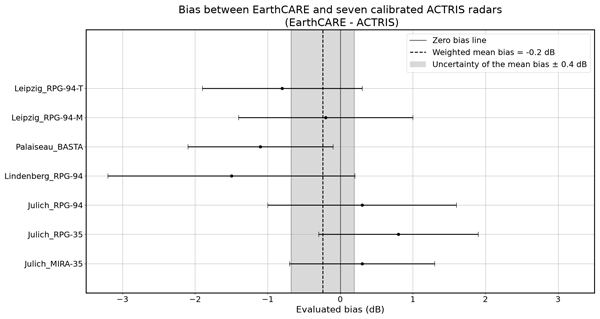
Based on the comparisons from the seven ground-sites, we find that the bias in the EarthCARE L2a reflectivity product is of -0.2 ± 0.4 dB, confirming the high quality of the satellite's calibration. This robust statistical approach, validated with calibrated radars, establishes EarthCARE as a potential reference for calibrating ACTRIS and other ground-based sites in the future.
-
Notice on discussion status
The requested preprint has a corresponding peer-reviewed final revised paper. You are encouraged to refer to the final revised version.
-
Preprint
(4404 KB)
-
The requested preprint has a corresponding peer-reviewed final revised paper. You are encouraged to refer to the final revised version.
- Preprint
(4404 KB) - Metadata XML
- BibTeX
- EndNote
- Final revised paper


Journal article(s) based on this preprint
Interactive discussion
Status: closed
-
CC1: 'Comment on egusphere-2026-925', Ulrich Görsdorf, 20 Apr 2026
- AC3: 'Reply on CC1', Nathan Feuillard, 23 Jul 2026
-
CC2: 'Comment on egusphere-2026-925', Patric Seifert, 30 Apr 2026
Dear Nathan, dear all,
First of all, thanks a lot for making this nice and important study available to the community!
Purpose of this short comment is just to address the aspect of the community engagement in the acquisition of the underlying datasets. Many of the measurements used in your study were only made available by special funds. Specifically, ATMO-ACCESS should be mentioned here. E.g., "The preparatory work for EarthCARE validation has been supported by the European Commission under the Horizon 2020 – Research and Innovation Framework Programme, through the ATMO-ACCESS Integrating Activity under grant agreement No 101008004." But also the ACTRIS funds provided by the individual member countries are very relevant, as, e.g., TROPOS/Leipzig would not be able to run any 94GHz radar without the ACTRIS-D funds. E.g., for TROPOS: "ACTRIS-D is funded by the German Federal Ministry of Research, Technology and Space (BMFTR, formerly the German Federal Ministry of Education and Research (BMBF), grant no. 01LK2001A) under the FONA Strategy “Research for Sustainability”. See, e.g., the more community-driven approach of the EarthCARE ATLID Cal/Val study of Baars et al. (2026): https://doi.org/10.5194/egusphere-2026-1490. I also see other ACTRIS funding numbers missing, e.g., for the Basta calibration campaigns.
Overall, the investments don't get visible in your study, even though they were the prerequisites for the used datasets (and partly provided solely for the sake of EarthCARE CAl/Val). Unfortunately, they also don't become visible by just pointing to the Cloudnet database (as it is done in the discussion manuscript). Here, I further suggest to use the option of the Cloudnet web portal to create individual DOIs for each dataset you were using. The CLU Team can support with that, or you just select a site & date range --> select "download" --> "create DOI".
I would appreciate if you could extend the acknowledgements accordingly, so that the activities underlying your study can be tracked appropriately.
A small final additional comment (while I leave the actual review to the reviewers): It would be nice to list the date range of evaluation already in the abstract (and not just in Tab. 1). This might become a relevant aspect with increasing temporal extent of the EarthCARE dataset.
Kind regards,
Patric Seifert.
Citation: https://doi.org/10.5194/egusphere-2026-925-CC2 - AC4: 'Reply on CC2', Nathan Feuillard, 23 Jul 2026
-
RC1: 'Comment on egusphere-2026-925', Anonymous Referee #1, 30 Apr 2026
This is a thorough and important study demonstrating how the CloudNet radar network can be leveraged to provide intercalibration between ground-based and spaceborne cloud radars; it expands and improves upon the previous work by Protat et al. and Kollias et al using similar methods, and will provide an important means of monitoring and calibrating ground-based radars and EarthCARE during its lifetime. The manuscript is well-structured and clearly written, and the figures are well-presented; however, there are some methodological issues which need addressing to make the treatment of EarthCARE data consistent with the ground-based and CloudSat data. I recommend this paper for publication subject to major revisions.
For the selection of ice clouds from the ground-based and CloudSat datasets, the CloudNet and DARDAR-MASK target classification products are used to identify liquid cloud layers. Both of these products are synergistic radar-lidar target classifications, wherein the lidar provides the bulk of the detections of liquid cloud. For the current analysis of EarthCARE CPR data, however, it appears that the CPR L2a product (C-TC) is being used. While C-TC contains a classification of liquid cloud (alongside many detections of rain and melting layers, as described in Section 4.3), it will miss the vast majority of non-precipitating liquid cloud—and especially supercooled liquid cloud. This was shown in Irbah et al. (2023). In fact, the C-TC product is not capable of diagnosing supercooled liquid at all: all hydrometeors detected at temperatures below the freezing level will be classed as ice or snow. It may be that the existing criteria for selection of data are screening these cases out to some extent, but there’s a good chance that mixed-phase clouds are not entirely removed from the EarthCARE data at present.
Another apparent issue in the data screening is indicated by the presence of a local maximum in the EarthCARE CFAD (e.g. Figure 3) around -30 dBZ and 2.5km above ground level. Although I see that there is a (smaller & shallower) maximum in the ground-based data near here, I suspect there’s a contribution to the EarthCARE CPR detections from a measurement artefact. This feature is highly characteristic of a known second-trip echo effect that occurs over highly reflective surfaces (including rivers, lakes, ponds, flooded fields, as well as salt-flats and the open ocean in light wind conditions). It was not yet removed from the L2a CPR products at the time of the BA baseline, but will be identified & removed in later versions. These second-trip echoes will occur only in profiles where the surface return (sigma0) in the CPR data exceeds around 30 dBZ, so could be screened for using this criterion.
The only other comment I have is very minor: In the CFAD plot introduced in Fig 3., the “discarded data” section of the ground-based CFAD corresponds to the minimum detectable signal of the EarthCARE CPR. But in some of the plots in the appendix, the lower thresholds of the CFADs and PDFs of reflectivity (panel c) are not consistent between the ground and satellite: Figs. A1, B4, B5 & B6.
Citation: https://doi.org/10.5194/egusphere-2026-925-RC1 - AC1: 'Reply on RC1', Nathan Feuillard, 23 Jul 2026
-
RC2: 'Comment on egusphere-2026-925', Anonymous Referee #2, 25 Jun 2026
Review comments on the article 2026-925 “Validation of EarthCARE CPR reflectivity using the ACTRIS cloud radar network” by Nathan Feuillard et al., submitted to AMT.
Major comments
The article showed the method to derive bias of radar reflectivity factor (Ze) from Cloud Profiling Radar (CPR) onboard EarthCARE satellite by comparing with seven ground-based cloud radars in four European ACTRIS sites. They selected EarthCARE ESA’s CPR L2a product data within 200km radius from the ACTRIS sites for 15 months-period. For the ground data, they use all data for the same periods without considering the temporal matches with the EarthCARE overpass. They selected ice cloud data from CPR and also from the ground-based radars. They further applied the three criteria to determine the height range for the statistical comparisons. Overall, the methods described are reasonable and they showed very small biases in the calibration level of CPR.
Instead of introducing a fixed time-window around overpass time, they just used all of the ground-based radar data obtained during the comparison period of 15 months. This implies that CPR detected clouds are different from ground-based radar detected clouds. However, there is an assumption that CPR detected many clouds within 200km around an ACTRIS site contain the same ensemble of clouds detected by ground-based radar in the site although different time is chosen. The assumption is not clearly written/defined and justification of ignoring the time issue might be insufficient, e.g., diurnal variations of cloud structure and nature might occur. Some discussion of this point might be given.
If they will add above mentioned points and related discussions, the manuscript will be hopefully improved.
Minor comments
(1) Product name and the baseline(version) of the product should be explicitly written.
(2) In page 10-11, they wrote minimum detectable radar reflectivity is -35dBZ but in Figure 3, data with lower than -35dBZ seem to be used for comparisons. If they actually used data below -35 dBZ, the value of minimum Ze should be written.
- In page 11, Figure 3 2.a and 2.b, shapes of the frequency of reflectivity are different between CPR and ground-based radar. More fraction of small Ze are detected by CPR than by the ground-based radar. Contrary, in p.13, Figure 4 shows the shape are more or less similar and center position of the distribution is similar between the two. Clarification is needed.
- In page 13, line 287, the first parameter. It seems only two values of centersto derive correlation. Then it is not clear how to derive the correlation of two centers.
- In Page 15, height bin selections relied on three parameters. For example, sigma ratio is lower than 0.4. Please add some discussions why the three values are selected.
- In page 18, line 385, Since same minimum Ze were used for both CloudSat and the ground radar to derive biases CloudSat, is it correct that the bias change attributed to the change of power of CloudSat?
- In pages 23 and 24 Figure A1 and A2, dynamic range of color bar for frequency in A1 is different from A2. Please use the same. Same for B3 and B4.
Citation: https://doi.org/10.5194/egusphere-2026-925-RC2 - AC2: 'Reply on RC2', Nathan Feuillard, 23 Jul 2026
Peer review completion


Interactive discussion
Status: closed
-
CC1: 'Comment on egusphere-2026-925', Ulrich Görsdorf, 20 Apr 2026
This comment refers to Section 6, Figure 7 of the paper. The variations in the reflectivity bias cannot be attributed to the installation of the clutter fence, as it does not obstruct the radar beam; therefore, no attenuation caused by the fence is expected. Following consultation with the radar manufacturer, the variations in the reflectivity bias are considered to be at least partly attributable to a misalignment of the phase correction position (PCP) in the signal processing chain of the magnetron-based pulse-Doppler radar MIRA. Due to the random phase of the transmit pulses of the magnetron transmitter, the phase reference must be determined at a well-defined position within the transmitted pulse. Contrary to initial assumptions, the PCP was not automatically adjusted or tracked by the system so it had to be set manually.
If this position is not optimally configured, or if it drifts over time (e.g., due to aging of the modulator tube), the phase correction becomes suboptimal. This leads to a reduction in pulse-to-pulse coherence and consequently to a loss in effective sensitivity, which can manifest as a systematic underestimation of radar reflectivity.
Since 2019, the PCP has been regularly monitored and manually adjusted to account for such drifts, which has improved the stability of the reflectivity measurements.
Citation: https://doi.org/10.5194/egusphere-2026-925-CC1 - AC3: 'Reply on CC1', Nathan Feuillard, 23 Jul 2026
-
CC2: 'Comment on egusphere-2026-925', Patric Seifert, 30 Apr 2026
Dear Nathan, dear all,
First of all, thanks a lot for making this nice and important study available to the community!
Purpose of this short comment is just to address the aspect of the community engagement in the acquisition of the underlying datasets. Many of the measurements used in your study were only made available by special funds. Specifically, ATMO-ACCESS should be mentioned here. E.g., "The preparatory work for EarthCARE validation has been supported by the European Commission under the Horizon 2020 – Research and Innovation Framework Programme, through the ATMO-ACCESS Integrating Activity under grant agreement No 101008004." But also the ACTRIS funds provided by the individual member countries are very relevant, as, e.g., TROPOS/Leipzig would not be able to run any 94GHz radar without the ACTRIS-D funds. E.g., for TROPOS: "ACTRIS-D is funded by the German Federal Ministry of Research, Technology and Space (BMFTR, formerly the German Federal Ministry of Education and Research (BMBF), grant no. 01LK2001A) under the FONA Strategy “Research for Sustainability”. See, e.g., the more community-driven approach of the EarthCARE ATLID Cal/Val study of Baars et al. (2026): https://doi.org/10.5194/egusphere-2026-1490. I also see other ACTRIS funding numbers missing, e.g., for the Basta calibration campaigns.
Overall, the investments don't get visible in your study, even though they were the prerequisites for the used datasets (and partly provided solely for the sake of EarthCARE CAl/Val). Unfortunately, they also don't become visible by just pointing to the Cloudnet database (as it is done in the discussion manuscript). Here, I further suggest to use the option of the Cloudnet web portal to create individual DOIs for each dataset you were using. The CLU Team can support with that, or you just select a site & date range --> select "download" --> "create DOI".
I would appreciate if you could extend the acknowledgements accordingly, so that the activities underlying your study can be tracked appropriately.
A small final additional comment (while I leave the actual review to the reviewers): It would be nice to list the date range of evaluation already in the abstract (and not just in Tab. 1). This might become a relevant aspect with increasing temporal extent of the EarthCARE dataset.
Kind regards,
Patric Seifert.
Citation: https://doi.org/10.5194/egusphere-2026-925-CC2 - AC4: 'Reply on CC2', Nathan Feuillard, 23 Jul 2026
-
RC1: 'Comment on egusphere-2026-925', Anonymous Referee #1, 30 Apr 2026
This is a thorough and important study demonstrating how the CloudNet radar network can be leveraged to provide intercalibration between ground-based and spaceborne cloud radars; it expands and improves upon the previous work by Protat et al. and Kollias et al using similar methods, and will provide an important means of monitoring and calibrating ground-based radars and EarthCARE during its lifetime. The manuscript is well-structured and clearly written, and the figures are well-presented; however, there are some methodological issues which need addressing to make the treatment of EarthCARE data consistent with the ground-based and CloudSat data. I recommend this paper for publication subject to major revisions.
For the selection of ice clouds from the ground-based and CloudSat datasets, the CloudNet and DARDAR-MASK target classification products are used to identify liquid cloud layers. Both of these products are synergistic radar-lidar target classifications, wherein the lidar provides the bulk of the detections of liquid cloud. For the current analysis of EarthCARE CPR data, however, it appears that the CPR L2a product (C-TC) is being used. While C-TC contains a classification of liquid cloud (alongside many detections of rain and melting layers, as described in Section 4.3), it will miss the vast majority of non-precipitating liquid cloud—and especially supercooled liquid cloud. This was shown in Irbah et al. (2023). In fact, the C-TC product is not capable of diagnosing supercooled liquid at all: all hydrometeors detected at temperatures below the freezing level will be classed as ice or snow. It may be that the existing criteria for selection of data are screening these cases out to some extent, but there’s a good chance that mixed-phase clouds are not entirely removed from the EarthCARE data at present.
Another apparent issue in the data screening is indicated by the presence of a local maximum in the EarthCARE CFAD (e.g. Figure 3) around -30 dBZ and 2.5km above ground level. Although I see that there is a (smaller & shallower) maximum in the ground-based data near here, I suspect there’s a contribution to the EarthCARE CPR detections from a measurement artefact. This feature is highly characteristic of a known second-trip echo effect that occurs over highly reflective surfaces (including rivers, lakes, ponds, flooded fields, as well as salt-flats and the open ocean in light wind conditions). It was not yet removed from the L2a CPR products at the time of the BA baseline, but will be identified & removed in later versions. These second-trip echoes will occur only in profiles where the surface return (sigma0) in the CPR data exceeds around 30 dBZ, so could be screened for using this criterion.
The only other comment I have is very minor: In the CFAD plot introduced in Fig 3., the “discarded data” section of the ground-based CFAD corresponds to the minimum detectable signal of the EarthCARE CPR. But in some of the plots in the appendix, the lower thresholds of the CFADs and PDFs of reflectivity (panel c) are not consistent between the ground and satellite: Figs. A1, B4, B5 & B6.
Citation: https://doi.org/10.5194/egusphere-2026-925-RC1 - AC1: 'Reply on RC1', Nathan Feuillard, 23 Jul 2026
-
RC2: 'Comment on egusphere-2026-925', Anonymous Referee #2, 25 Jun 2026
Review comments on the article 2026-925 “Validation of EarthCARE CPR reflectivity using the ACTRIS cloud radar network” by Nathan Feuillard et al., submitted to AMT.
Major comments
The article showed the method to derive bias of radar reflectivity factor (Ze) from Cloud Profiling Radar (CPR) onboard EarthCARE satellite by comparing with seven ground-based cloud radars in four European ACTRIS sites. They selected EarthCARE ESA’s CPR L2a product data within 200km radius from the ACTRIS sites for 15 months-period. For the ground data, they use all data for the same periods without considering the temporal matches with the EarthCARE overpass. They selected ice cloud data from CPR and also from the ground-based radars. They further applied the three criteria to determine the height range for the statistical comparisons. Overall, the methods described are reasonable and they showed very small biases in the calibration level of CPR.
Instead of introducing a fixed time-window around overpass time, they just used all of the ground-based radar data obtained during the comparison period of 15 months. This implies that CPR detected clouds are different from ground-based radar detected clouds. However, there is an assumption that CPR detected many clouds within 200km around an ACTRIS site contain the same ensemble of clouds detected by ground-based radar in the site although different time is chosen. The assumption is not clearly written/defined and justification of ignoring the time issue might be insufficient, e.g., diurnal variations of cloud structure and nature might occur. Some discussion of this point might be given.
If they will add above mentioned points and related discussions, the manuscript will be hopefully improved.
Minor comments
(1) Product name and the baseline(version) of the product should be explicitly written.
(2) In page 10-11, they wrote minimum detectable radar reflectivity is -35dBZ but in Figure 3, data with lower than -35dBZ seem to be used for comparisons. If they actually used data below -35 dBZ, the value of minimum Ze should be written.
- In page 11, Figure 3 2.a and 2.b, shapes of the frequency of reflectivity are different between CPR and ground-based radar. More fraction of small Ze are detected by CPR than by the ground-based radar. Contrary, in p.13, Figure 4 shows the shape are more or less similar and center position of the distribution is similar between the two. Clarification is needed.
- In page 13, line 287, the first parameter. It seems only two values of centersto derive correlation. Then it is not clear how to derive the correlation of two centers.
- In Page 15, height bin selections relied on three parameters. For example, sigma ratio is lower than 0.4. Please add some discussions why the three values are selected.
- In page 18, line 385, Since same minimum Ze were used for both CloudSat and the ground radar to derive biases CloudSat, is it correct that the bias change attributed to the change of power of CloudSat?
- In pages 23 and 24 Figure A1 and A2, dynamic range of color bar for frequency in A1 is different from A2. Please use the same. Same for B3 and B4.
Citation: https://doi.org/10.5194/egusphere-2026-925-RC2 - AC2: 'Reply on RC2', Nathan Feuillard, 23 Jul 2026
Peer review completion
Journal article(s) based on this preprint
Viewed
| HTML | XML | Total | BibTeX | EndNote | |
|---|---|---|---|---|---|
| 1,385 | 718 | 117 | 2,220 | 116 | 161 |
- HTML: 1,385
- PDF: 718
- XML: 117
- Total: 2,220
- BibTeX: 116
- EndNote: 161
Viewed (geographical distribution)
| Country | # | Views | % |
|---|
| Total: | 0 |
| HTML: | 0 |
| PDF: | 0 |
| XML: | 0 |
- 1
Nathan Feuillard

Felipe Toledo Bittner
Lukas Pfitzenmaier
Jean-François Ribaud
Julien Delanoë
Martial Haeffelin
Jean-Charles Dupont
The requested preprint has a corresponding peer-reviewed final revised paper. You are encouraged to refer to the final revised version.
- Preprint
(4404 KB) - Metadata XML
This comment refers to Section 6, Figure 7 of the paper. The variations in the reflectivity bias cannot be attributed to the installation of the clutter fence, as it does not obstruct the radar beam; therefore, no attenuation caused by the fence is expected. Following consultation with the radar manufacturer, the variations in the reflectivity bias are considered to be at least partly attributable to a misalignment of the phase correction position (PCP) in the signal processing chain of the magnetron-based pulse-Doppler radar MIRA. Due to the random phase of the transmit pulses of the magnetron transmitter, the phase reference must be determined at a well-defined position within the transmitted pulse. Contrary to initial assumptions, the PCP was not automatically adjusted or tracked by the system so it had to be set manually.
If this position is not optimally configured, or if it drifts over time (e.g., due to aging of the modulator tube), the phase correction becomes suboptimal. This leads to a reduction in pulse-to-pulse coherence and consequently to a loss in effective sensitivity, which can manifest as a systematic underestimation of radar reflectivity.
Since 2019, the PCP has been regularly monitored and manually adjusted to account for such drifts, which has improved the stability of the reflectivity measurements.