
the Creative Commons Attribution 4.0 License.
the Creative Commons Attribution 4.0 License.
 | 04 Mar 2026
The remarkable inefficiency of stratocumulus
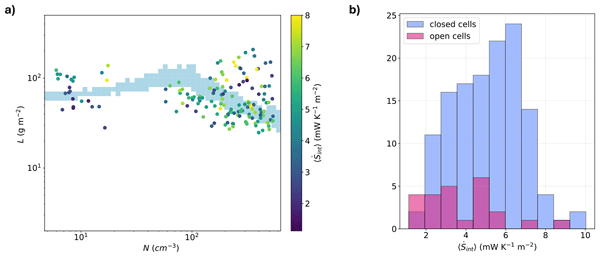
Abstract. Marine stratocumulus clouds play a central role in Earth’s climate system by reflecting incoming solar radiation and exerting a strong cooling effect. Their organization into open and closed mesoscale cellular morphologies can be thought of as an example of bistable dynamics driven by aerosol–cloud interactions and mesoscale processes. From the perspective of non-equilibrium thermodynamics, these structures are an example of a far-from-equilibrium open system that continuously produces and exports entropy. While entropy production has been studied in idealized deep convective systems, it has not yet been quantified for shallow clouds. Here, we compute and decompose the internal entropy production of open- and closed-cell stratocumulus using an ensemble of large-eddy simulations. We show that the overall entropy production of stratocumulus is low, reflecting the limited vertical extent and corresponding reduced ability to utilize the energy fluxes at the system's boundaries. Moist processes dominate the overall irreversibility, which, combined with their low entropy production, leads to a mechanical efficiency about an order of magnitude smaller than in deep convective systems. Although the dominant irreversible processes differ between open- and closed-cell regimes, the distributions of total entropy production largely overlap across the ensemble, limiting the ability to distinguish the dynamics of individual cases based solely on total entropy production.
Competing interests: At least one of the (co-)authors is a member of the editorial board of Atmospheric Chemistry and Physics.
Publisher's note: Copernicus Publications remains neutral with regard to jurisdictional claims made in the text, published maps, institutional affiliations, or any other geographical representation in this paper. While Copernicus Publications makes every effort to include appropriate place names, the final responsibility lies with the authors. Views expressed in the text are those of the authors and do not necessarily reflect the views of the publisher.-
Notice on discussion status
The requested preprint has a corresponding peer-reviewed final revised paper. You are encouraged to refer to the final revised version.
-
Preprint
(2454 KB)
-
The requested preprint has a corresponding peer-reviewed final revised paper. You are encouraged to refer to the final revised version.
- Preprint
(2454 KB) - Metadata XML
- BibTeX
- EndNote
- Final revised paper


Journal article(s) based on this preprint
Interactive discussion
Status: closed
-
RC1: 'Comment on egusphere-2026-923', Anonymous Referee #1, 03 Apr 2026
-
AC1: 'Reply on RC1', Benjamin Hernandez, 15 Jun 2026
We thank the reviewer for their careful reading of the manuscript, their kind words, and their constructive suggestions. We are pleased that the reviewer finds our results valuable and our manuscript well written and worthy of publication. Attached we provide detailed responses to each comment, with manuscript changes highlighted in blue.
-
AC1: 'Reply on RC1', Benjamin Hernandez, 15 Jun 2026
-
RC2: 'Comment on egusphere-2026-923', Anonymous Referee #2, 17 Apr 2026
Summary:
This manuscript by Hernandez et al. provides valuable insight into the entropy production of open- and closed- cell stratocumulus using LES simulations. In both regimes, moist processes dominate the total entropy production. Specifically, cloud-top entrainment and cold-pool dynamics are identified as the primary drivers of closed-cell and open-cell organizations, respectively. The finding that stratocumulus entropy production is approximately one order of magnitude smaller than in deep convective clouds is particularly interesting.
Overall, the manuscript is concise and well written. The methodology is sound and clearly described, and the discussion is thorough and well supported by the results. With minor revisions, I recommend this paper for publications in Atmospheric Chemistry and Physics.
General Comments:
Case Selection: Why are all cases nocturnal? A brief justification in the text would be helpful.
Additionally, you reference Glassmeier et al. (2019) as a justification for excluding cases that don’t produce clouds or precipitate quickly, but isn’t this essentially excluding a third stable mode? Even though is a relatively small proportion of the total ((191-159)/191=0.16 = 16%), it doesn’t seem small enough to justify excluding them even if the overall science question concerns stratocumulus clouds. Are these excluded cases examples of increased efficiency? How much different are the open cell cases from these clear cases given that there isn’t as much cloud water in the open cell cases? Are they essentially the same as the clear cases that were excluded?
Specific Comments:
Lines 75-80: Should turbulence dissipation be in (3)? I assume these are the “diffusive” terms?
Additionally, should the term be referred to as “specific production of entropy”? The term “specific” is typically used when mass or density are normalized out.
Line 81: Please clarify what it meant by “sum over repeated indices”.
Lines 105-110: How is it possible to have “frictional dissipation due to turbulent motion”? Molecules do not “rub” together. Turbulent dissipation increases the kinetic energy of the gas, which is NOT friction.
Lines 178-180: I am not sure it is “surprising” that it occupies only 1% of the mass but is responsible for 90% of the entropy production. The remaining constituents cannot undergo a phase change and, other than turbulent dissipation, have no means to increase entropy because they are likely dominated by adiabatic processes.
Line 200: It is difficult to conclude from Fig. A3 that open cells show a stronger contribution from horizontal gradients, since the values are both very small and y-axis ranges differ between panels. Mentioning the actual values in the figure or text would strengthen this statement.
Lines 208-210: The word “roughly” appeared twice in the same sentence. Consider revising for better readability.
Line 265: “First, the shallow vertical extent of the system severely limits the available temperature gradient. This in turn constrains the maximum theoretical work that could be generated from a given set of boundary fluxes and effective temperatures (Pauluis and Held, 2002a).” This is an important statement and maybe the most important in the paper.
Line 319: “Large number (>100) of closed-cell cases” – It would be helpful to explicitly state the number of open- vs. closed- cell cases, either here or earlier in section 3.
Line 369: Capital “M” should be made lowercase or capitalize the entire “Maximum Entropy Production”.
Lines 374-377: “A stochastic analysis of our LES ensemble shows that the probabilistic landscape is not symmetric, and the open-cell state is the globally stable one (Hernandez and Glassmeier, personal communication, 2026). Therefore, the total irreversible entropy production does not appear to select the observed state, and the open-cell configuration, contrary to a maximum entropy production expectation, instead has a lower median dissipation.” The term “globally stable one” needs a bit more explanation. Are you referring to “global” in terms of the ensemble of LES simulations or “global” in terms of the global coverage being greater? I wonder if the Entropy Maximization Hypothesis is relevant only if the holistic global cloud system is considered. In other words, maybe entropy maximization includes an integral that includes all such systems operating globally at any point in time? In other words, maybe inefficient closed cellular structure exists over a larger area and/or last for a longer period, thereby increasing its overall global entropy increase.
Figure A2 & A3: Fig. A3 is referenced before Fig. A2 in the text. Consider switching the order of these two figures for consistency.
Appendix B: “TKE” is capitalized in Fig. A8 caption but lowercased in the text. I suggest capitalizing “TKE” throughout.
Citation: https://doi.org/10.5194/egusphere-2026-923-RC2 -
AC2: 'Reply on RC2', Benjamin Hernandez, 15 Jun 2026
We thank the reviewer for their careful reading of the manuscript, their kind words, and their constructive suggestions. We are pleased that the reviewer finds our results valuable and worthy of publication. Attached we provide detailed responses to each comment, with manuscript changes highlighted in blue.
-
AC2: 'Reply on RC2', Benjamin Hernandez, 15 Jun 2026
-
RC3: 'Comment on egusphere-2026-923', Olivier Pauluis, 18 Apr 2026
The comment was uploaded in the form of a supplement: https://egusphere.copernicus.org/preprints/2026/egusphere-2026-923/egusphere-2026-923-RC3-supplement.pdf
-
AC3: 'Reply on RC3', Benjamin Hernandez, 15 Jun 2026
We thank the reviewer for their careful reading of the manuscript and for their positive assessment of our work. We are pleased that the reviewer finds our results important and worthy of publication. We would like to apologize for missing the very relevant pieces of literature mentioned in the review, and thank the reviewer for pointing them out. We believe these additions have strengthened the manuscript. We are also grateful for the insightful comment on the work done to lift water, which we believe is another important addition to the manuscript. Attached we provide detailed responses to each comment, with manuscript changes highlighted in blue.
-
AC3: 'Reply on RC3', Benjamin Hernandez, 15 Jun 2026
Peer review completion


Interactive discussion
Status: closed
-
RC1: 'Comment on egusphere-2026-923', Anonymous Referee #1, 03 Apr 2026
The remarkable inefficiency of stratocumulus
Benjamin Hernandez, Martin S. Singh, Takanobu Yamaguchi, Graham Feingold, and Franziska Glassmeier
In their manuscript “The remarkable inefficiency of stratocumulus”, Hernandez et al. dissect the entropy budget of stratocumulus topped boundary layers, distinguishing both open-cell and closed-cell morphologies, as a physically grounded way to 1) assess the mechanisms driving both cloud regimes and 2) emphasize the differences between these shallow cloud systems and deep convective clouds. This is overall a very valuable work that fills a gap in our general knowledge of the thermodynamics of moist processes in the atmosphere. Although no new groundbreaking results are presented, the method employed is deeply rooted in the fundamental laws of thermodynamics which makes it very reliable, interpretable, and generally an essential addition to the existing literature on the topic. The methodology is clearly exposed, the results are presented in a concise but understandable way, and the manuscript is overall well written, organized and pleasant to read. I would therefore recommend only minor corrections before the manuscript can be accepted for publication (see comments below).
Minor comments:
Intro line ~50: perhaps expand a little on the main findings of Pauluis and Held?
Section 2 line ~70: Shouldn’t you consider cloud top radiative cooling as an internal source of entropy since the process (cooling) happens within the system? Please comment.
Section 2: Please explicitly differentiate entropy S from s early on.
Line 255: Repeated “LES formulation”
Line 149: Subtitle 3.1 is probably not necessary since there is no 3.2 and further.
Table 1 and section 4: Would be informative to estimate the uncertainty associated with each contribution. I am wondering in particular how much of the discrepancies between your stratocumulus and the RCE cases could be explained by differences in the parameterization of moist processes. I am also wondering how much we can trust the heat dissipation contribution in RCE experiments given the relative coarse vertical grid and idealized surface fluxes. Please comment.
Section 5, Line 212: the sentence is unclear and should be rephrased.
Section 6: A relevant reference to cite would be “Natural Convection as a Heat Engine: A Theory for CAPE”, Renno and Ingersoll, https://doi.org/10.1175/1520-0469(1996)053<0572:NCAAHE>2.0.CO;2
Section 6, lines 254-255: Shouldn’t surface friction be also considered to evaluate the total work produced? Also, figure A8 clearly shows the balance between tke production and dissipation in the steady state atmosphere.
Section 6, eq 14 and text: I think that it is worth illustrating the energy balance with a figure or table to quantify and visualize the contribution from the 3 main energy sources and sinks mentioned (surface fluxes, radiative cooling and subsidence). It would also be useful to show that the boundary layer is energetically in equilibrium in both selected cases.
Section 8, line 358-359: Please rephrase the sentence. I am not sure the current formulation is at all correct.
Line 369-371: This is grammatically awkward, please rephrase.
Line 376 onward: I would refrain from using such an argument, or at least would not emphasize it, simply because the system considered is not closed and is to a large extent driven by external fluxes and exchanges of energy (radiation and subsidence are treated as external sources).
Appendix B is referenced before Appendix A. You should swap them to follow this order.
Citation: https://doi.org/10.5194/egusphere-2026-923-RC1 -
AC1: 'Reply on RC1', Benjamin Hernandez, 15 Jun 2026
We thank the reviewer for their careful reading of the manuscript, their kind words, and their constructive suggestions. We are pleased that the reviewer finds our results valuable and our manuscript well written and worthy of publication. Attached we provide detailed responses to each comment, with manuscript changes highlighted in blue.
-
AC1: 'Reply on RC1', Benjamin Hernandez, 15 Jun 2026
-
RC2: 'Comment on egusphere-2026-923', Anonymous Referee #2, 17 Apr 2026
Summary:
This manuscript by Hernandez et al. provides valuable insight into the entropy production of open- and closed- cell stratocumulus using LES simulations. In both regimes, moist processes dominate the total entropy production. Specifically, cloud-top entrainment and cold-pool dynamics are identified as the primary drivers of closed-cell and open-cell organizations, respectively. The finding that stratocumulus entropy production is approximately one order of magnitude smaller than in deep convective clouds is particularly interesting.
Overall, the manuscript is concise and well written. The methodology is sound and clearly described, and the discussion is thorough and well supported by the results. With minor revisions, I recommend this paper for publications in Atmospheric Chemistry and Physics.
General Comments:
Case Selection: Why are all cases nocturnal? A brief justification in the text would be helpful.
Additionally, you reference Glassmeier et al. (2019) as a justification for excluding cases that don’t produce clouds or precipitate quickly, but isn’t this essentially excluding a third stable mode? Even though is a relatively small proportion of the total ((191-159)/191=0.16 = 16%), it doesn’t seem small enough to justify excluding them even if the overall science question concerns stratocumulus clouds. Are these excluded cases examples of increased efficiency? How much different are the open cell cases from these clear cases given that there isn’t as much cloud water in the open cell cases? Are they essentially the same as the clear cases that were excluded?
Specific Comments:
Lines 75-80: Should turbulence dissipation be in (3)? I assume these are the “diffusive” terms?
Additionally, should the term be referred to as “specific production of entropy”? The term “specific” is typically used when mass or density are normalized out.
Line 81: Please clarify what it meant by “sum over repeated indices”.
Lines 105-110: How is it possible to have “frictional dissipation due to turbulent motion”? Molecules do not “rub” together. Turbulent dissipation increases the kinetic energy of the gas, which is NOT friction.
Lines 178-180: I am not sure it is “surprising” that it occupies only 1% of the mass but is responsible for 90% of the entropy production. The remaining constituents cannot undergo a phase change and, other than turbulent dissipation, have no means to increase entropy because they are likely dominated by adiabatic processes.
Line 200: It is difficult to conclude from Fig. A3 that open cells show a stronger contribution from horizontal gradients, since the values are both very small and y-axis ranges differ between panels. Mentioning the actual values in the figure or text would strengthen this statement.
Lines 208-210: The word “roughly” appeared twice in the same sentence. Consider revising for better readability.
Line 265: “First, the shallow vertical extent of the system severely limits the available temperature gradient. This in turn constrains the maximum theoretical work that could be generated from a given set of boundary fluxes and effective temperatures (Pauluis and Held, 2002a).” This is an important statement and maybe the most important in the paper.
Line 319: “Large number (>100) of closed-cell cases” – It would be helpful to explicitly state the number of open- vs. closed- cell cases, either here or earlier in section 3.
Line 369: Capital “M” should be made lowercase or capitalize the entire “Maximum Entropy Production”.
Lines 374-377: “A stochastic analysis of our LES ensemble shows that the probabilistic landscape is not symmetric, and the open-cell state is the globally stable one (Hernandez and Glassmeier, personal communication, 2026). Therefore, the total irreversible entropy production does not appear to select the observed state, and the open-cell configuration, contrary to a maximum entropy production expectation, instead has a lower median dissipation.” The term “globally stable one” needs a bit more explanation. Are you referring to “global” in terms of the ensemble of LES simulations or “global” in terms of the global coverage being greater? I wonder if the Entropy Maximization Hypothesis is relevant only if the holistic global cloud system is considered. In other words, maybe entropy maximization includes an integral that includes all such systems operating globally at any point in time? In other words, maybe inefficient closed cellular structure exists over a larger area and/or last for a longer period, thereby increasing its overall global entropy increase.
Figure A2 & A3: Fig. A3 is referenced before Fig. A2 in the text. Consider switching the order of these two figures for consistency.
Appendix B: “TKE” is capitalized in Fig. A8 caption but lowercased in the text. I suggest capitalizing “TKE” throughout.
Citation: https://doi.org/10.5194/egusphere-2026-923-RC2 -
AC2: 'Reply on RC2', Benjamin Hernandez, 15 Jun 2026
We thank the reviewer for their careful reading of the manuscript, their kind words, and their constructive suggestions. We are pleased that the reviewer finds our results valuable and worthy of publication. Attached we provide detailed responses to each comment, with manuscript changes highlighted in blue.
-
AC2: 'Reply on RC2', Benjamin Hernandez, 15 Jun 2026
-
RC3: 'Comment on egusphere-2026-923', Olivier Pauluis, 18 Apr 2026
The comment was uploaded in the form of a supplement: https://egusphere.copernicus.org/preprints/2026/egusphere-2026-923/egusphere-2026-923-RC3-supplement.pdf
-
AC3: 'Reply on RC3', Benjamin Hernandez, 15 Jun 2026
We thank the reviewer for their careful reading of the manuscript and for their positive assessment of our work. We are pleased that the reviewer finds our results important and worthy of publication. We would like to apologize for missing the very relevant pieces of literature mentioned in the review, and thank the reviewer for pointing them out. We believe these additions have strengthened the manuscript. We are also grateful for the insightful comment on the work done to lift water, which we believe is another important addition to the manuscript. Attached we provide detailed responses to each comment, with manuscript changes highlighted in blue.
-
AC3: 'Reply on RC3', Benjamin Hernandez, 15 Jun 2026
Peer review completion
Journal article(s) based on this preprint
Viewed
| HTML | XML | Total | BibTeX | EndNote | |
|---|---|---|---|---|---|
| 1,068 | 543 | 73 | 1,684 | 70 | 91 |
- HTML: 1,068
- PDF: 543
- XML: 73
- Total: 1,684
- BibTeX: 70
- EndNote: 91
Viewed (geographical distribution)
| Country | # | Views | % |
|---|
| Total: | 0 |
| HTML: | 0 |
| PDF: | 0 |
| XML: | 0 |
- 1
Benjamin Hernandez
Martin S. Singh
Takanobu Yamaguchi
Graham Feingold
Franziska Glassmeier
The requested preprint has a corresponding peer-reviewed final revised paper. You are encouraged to refer to the final revised version.
- Preprint
(2454 KB) - Metadata XML
The remarkable inefficiency of stratocumulus
Benjamin Hernandez, Martin S. Singh, Takanobu Yamaguchi, Graham Feingold, and Franziska Glassmeier
In their manuscript “The remarkable inefficiency of stratocumulus”, Hernandez et al. dissect the entropy budget of stratocumulus topped boundary layers, distinguishing both open-cell and closed-cell morphologies, as a physically grounded way to 1) assess the mechanisms driving both cloud regimes and 2) emphasize the differences between these shallow cloud systems and deep convective clouds. This is overall a very valuable work that fills a gap in our general knowledge of the thermodynamics of moist processes in the atmosphere. Although no new groundbreaking results are presented, the method employed is deeply rooted in the fundamental laws of thermodynamics which makes it very reliable, interpretable, and generally an essential addition to the existing literature on the topic. The methodology is clearly exposed, the results are presented in a concise but understandable way, and the manuscript is overall well written, organized and pleasant to read. I would therefore recommend only minor corrections before the manuscript can be accepted for publication (see comments below).
Minor comments:
Intro line ~50: perhaps expand a little on the main findings of Pauluis and Held?
Section 2 line ~70: Shouldn’t you consider cloud top radiative cooling as an internal source of entropy since the process (cooling) happens within the system? Please comment.
Section 2: Please explicitly differentiate entropy S from s early on.
Line 255: Repeated “LES formulation”
Line 149: Subtitle 3.1 is probably not necessary since there is no 3.2 and further.
Table 1 and section 4: Would be informative to estimate the uncertainty associated with each contribution. I am wondering in particular how much of the discrepancies between your stratocumulus and the RCE cases could be explained by differences in the parameterization of moist processes. I am also wondering how much we can trust the heat dissipation contribution in RCE experiments given the relative coarse vertical grid and idealized surface fluxes. Please comment.
Section 5, Line 212: the sentence is unclear and should be rephrased.
Section 6: A relevant reference to cite would be “Natural Convection as a Heat Engine: A Theory for CAPE”, Renno and Ingersoll, https://doi.org/10.1175/1520-0469(1996)053<0572:NCAAHE>2.0.CO;2
Section 6, lines 254-255: Shouldn’t surface friction be also considered to evaluate the total work produced? Also, figure A8 clearly shows the balance between tke production and dissipation in the steady state atmosphere.
Section 6, eq 14 and text: I think that it is worth illustrating the energy balance with a figure or table to quantify and visualize the contribution from the 3 main energy sources and sinks mentioned (surface fluxes, radiative cooling and subsidence). It would also be useful to show that the boundary layer is energetically in equilibrium in both selected cases.
Section 8, line 358-359: Please rephrase the sentence. I am not sure the current formulation is at all correct.
Line 369-371: This is grammatically awkward, please rephrase.
Line 376 onward: I would refrain from using such an argument, or at least would not emphasize it, simply because the system considered is not closed and is to a large extent driven by external fluxes and exchanges of energy (radiation and subsidence are treated as external sources).
Appendix B is referenced before Appendix A. You should swap them to follow this order.