
the Creative Commons Attribution 4.0 License.
the Creative Commons Attribution 4.0 License.
 | 25 Feb 2026
Greenland tip jet and deep convection in the Irminger Sea: disentangling the roles of heat loss and wind stress
Abstract. The strength of the Atlantic Meridional Overturning Circulation (AMOC) depends on deep-water formation in the Subpolar Gyre, particularly in the Irminger Sea, where convection is strongly modulated by short-lived but intense Greenland tip jet. These mesoscale westerlies induce substantial surface heat loss and impose wind stress on the ocean, jointly influencing convective intensity. Using the high-resolution Parallel Ocean Program (POP) within the Community Earth System Model (CESM), we disentangle the thermal and mechanical effects of tip jet on mixed layer deepening through three ensemble experiments: full-forcing (heat loss + wind stress anomalies), heat-only, and wind-only, each compared to a climatological control run. All forced cases show a significant December–April deepening of the mixed layer relative to the control. The heat-only and full-forcing experiments produce similar mixed layer depth (MLD) increases (+1200 m; reaching ~1800 m), confirming that surface heat loss is the primary driver of deep convection. The wind-only case shows a smaller but still significant increase (+400 m; MLD ~1000 m), associated with enhanced early-winter mixing and wind-driven salinity increases in the upper ocean. This wind stress forcing erodes the fresh surface layer, reduces buoyancy, and promotes shear-driven mixing in December so that climatological winter heat loss can deepen the mixed layer more efficiently. Because wind stress is not projected to weaken under future warming, its mechanical influence may help delay or modulate the decline of convection in the Irminger Sea as surface heat loss decreases.
-
Notice on discussion status
The requested preprint has a corresponding peer-reviewed final revised paper. You are encouraged to refer to the final revised version.
-
Preprint
(3059 KB)
-
The requested preprint has a corresponding peer-reviewed final revised paper. You are encouraged to refer to the final revised version.
- Preprint
(3059 KB) - Metadata XML
- BibTeX
- EndNote
- Final revised paper


Journal article(s) based on this preprint
Interactive discussion
Status: closed
-
RC1: 'Comment on egusphere-2026-918', Anonymous Referee #1, 18 Mar 2026
-
AC2: 'Reply on RC1', Aleksandr M. Fedorov, 07 May 2026
The manuscript presents a detailed and well-structured analysis of the role of Greenland tip jets in driving mixed layer deepening and deep convection in the Irminger Sea. The authors employ a set of ensemble ocean model simulations to separate the contributions of surface heat loss and wind stress. They compare heat-only, wind-only, and full-forcing experiments against a climatological control. While the manuscript is clearly written and the analysis is comprehensive, I have a few comments regarding the limitations of the experimental framework and the associated results sensitivity. This is not a criticism, as limitations are inherent to modeling works. I don’t recommend running additional simulations that would be a significant amount of work, but I suggest better acknowledging these limitations. Overall, the manuscript is of good quality and addresses an important question in subpolar ocean dynamics. I look forward to reading a revised version.
We thank the reviewer for the constructive and encouraging assessment of our manuscript. We are grateful for the careful reading and for the helpful suggestions regarding the limitations of the experimental framework, the interpretation of the salinity response, and the clarity of the Methods section. We agree that these points needed clearer explanation in the manuscript. In the revised version, we have expanded the discussion of the idealized forcing design, clarified the distinction between westerly tip-jet forcing and the broader spectrum of Greenland mesoscale wind events, added explanations of the relationship between shelf freshwater export and interior salinification, and improved the description of the forcing geometry and statistical testing. We have also added a schematic of the experimental design to Fig. 1d. Our detailed responses are provided below.Major Comments
- The authors attribute the observed changes in mixed layer depth and convection specifically to tip jets. However, from my understanding, since the control run is forced with a smoothed climatological annual cycle that contains no high-frequency variability, the experiments as designed cannot distinguish the effect of tip jets specifically from the effect of any intense episodic atmospheric forcing event. Could the results simply reflect the ocean's response to high-frequency wind and heat flux variability in general, rather than to the particular spatial and temporal structure of tip jets? The authors could explain what makes tip jet forcing dynamically distinct from other intense weather events in the region, such as reversed tip-jets, or acknowledge more explicitly that their results may generalize beyond tip jets to high-frequency atmospheric forcing.
We agree that, because the control simulation is forced with a repeated climatological annual cycle and does not include high-frequency atmospheric variability, our experimental design cannot fully separate the ocean response to the specific spatial structure of westerly Greenland tip jets from the more general response to intense episodic wind and heat-flux forcing. Our intention was to isolate the response to a controlled, canonical westerly tip-jet forcing pattern, but we agree that this limitation needed to be stated more explicitly.
We have therefore revised the Discussion to clarify that the response identified in our experiments may partly represent the response of the Irminger Sea to intense high-frequency winter atmospheric forcing more broadly, rather than to westerly tip jets alone. At the same time, we now emphasize that the imposed anomalies retain the characteristic spatial structure of westerly Greenland tip jets, including localized forcing over the central Irminger Sea, where these events produce strong negative buoyancy flux anomalies. We therefore interpret the results as the response to strong canonical westerly tip-jet forcing, not as a complete representation of all possible high-frequency atmospheric forcing events around southern Greenland.
This clarification has been added to the revised Discussion, lines 409–424. Related changes were also made in the Introduction, lines 40–54, where we now distinguish westerly tip jets from easterly/reverse tip jets and clarify why the present study focuses on the westerly type.
- The study relies on a composite representation of tip jets, based on the strongest 10% of westerly wind events. However, recent studies (DuVivier and Cassano 2015, Coquereau et al., 2024) have demonstrated that tip jets exist in various forms, with distinct spatial structures, intensities, and frequencies. Some of these forms are more prevalent than the canonical type examined in this study. For instance, Coquereau et al. (2024) found that tip-jet-like events occur in an average of 12% of the time, which is approximately twice as frequent as the peak frequency of canonical events during the 2014-2015 period. This frequency increases to 42% in DuVivier and Cassano (2015), because more events are associated to tip-jets. It remains uncertain how the results would change if a more realistic distribution of wind events in general (and tip-jets specifically) considered.
I appreciated the effort made to quantify the uncertainty presented at the end of the discussion (around l. 399-400). The authors should also discuss how the idealized composite forcing may limit the generalizability of their conclusions, and how the importance of heat loss compared to wind stress could vary across the entire spectrum of tip jets. This could potentially lead to less extreme canonical events compared to the 2014-2015 period but an increase in the occurrence of other types of tip jets.
We agree that the original manuscript did not sufficiently discuss the diversity of Greenland tip-jet events and the resulting limitation of using a single composite representation. Our experiments use a composite of strong westerly tip-jet events, based on the strongest 10% of westerly wind events, and therefore represent a canonical westerly tip-jet forcing pattern rather than the full spectrum of mesoscale wind events around southern Greenland.
We have revised the Introduction to acknowledge that different types of tip jets occur around Cape Farewell, including easterly/reverse tip jets. We now mention that easterly tip jets occur frequently and influence the western Irminger Sea and southeastern Labrador Sea, but that westerly tip jets are the dominant wind pattern for causing a negative buoyancy forcing over the central Irminger Sea. This provides a clearer justification for focusing on westerly tip jets. These changes are included in lines 40–54.
We have also expanded the limitation paragraph in the Discussion, lines 409–424. We now state explicitly that our results should be interpreted as the response to strong canonical westerly tip-jet forcing, not as a complete representation of all Greenland mesoscale wind events. We further acknowledge that using a more realistic distribution of westerly, easterly, and other tip-jet-like events could alter both the magnitude of the mixed-layer response and the relative importance of heat loss and wind stress. This broader distribution could include less extreme canonical westerly events, but also more frequent occurrences of other tip-jet-like wind patterns.
- In the introduction, the authors state that “variations in wind stress can drive […] Ekman-driven freshwater export from the Greenland shelf near Cape Farewell.” In the literature, tip jets are indeed suspected to have an impact on this shelfwater export to the gyre (Duyck et al. 2022, Coquereau et al. 2024 …). However, in the modeling framework, the applied tip-jet pattern does not extend to the shelf and is confined to the deep ocean (Fig 1). This raises questions about how the results shown, where tip jets predominantly drive a salinification of the Irminger Sea, reconcile with these previous results. Does the modeling framework underestimate the shelf water export, or is this process negligible compared to the enhanced vertical mixing of the surface ocean induced by tip-jets?
We agree that wind-driven freshwater export from the Greenland shelf near Cape Farewell is an important pathway documented in previous studies, and that the original manuscript did not sufficiently clarify how this process relates to the salinity increase diagnosed in our experiments.
We have revised the Introduction, lines 63–69, to clarify that wind-stress forcing can contribute to Ekman-driven freshwater export from the Greenland shelf and that this pathway is important for shelf–basin exchange and near-boundary stratification. At the same time, we now note that existing evidence suggests that this exported freshwater is strongly constrained by the boundary-current system and does not provide a persistent direct pathway to the main Irminger Sea convection region. We therefore distinguish between wind-driven freshwater export from the shelf and the mechanism analysed in this study, namely wind-driven open-ocean mixing in the Irminger Sea interior.
We have also clarified the interpretation of the salinity response in the Results section, lines 303–305 mentioning the lateral freshwater exchange: “Thus, the salinification diagnosed in the convective region reflects local mixing and entrainment rather than a persistent lateral freshwater signal from the shelf.”. In our experiments, the positive salinity anomaly in the convective region is accompanied by reduced salinity below the shallow mixed layer, indicating vertical redistribution of salt within the interior water column. Although the imposed forcing includes the coastal tapering zone, the freshwater signal associated with the boundary-current region does not penetrate persistently into the main convective region. We therefore interpret the salinification in the wind-only experiment as resulting from local wind-driven mixing and entrainment of saltier subsurface water in the Irminger Sea interior, rather than show wind-driven freshwater export from the Greenland shelf (as contradicting studies indicate).
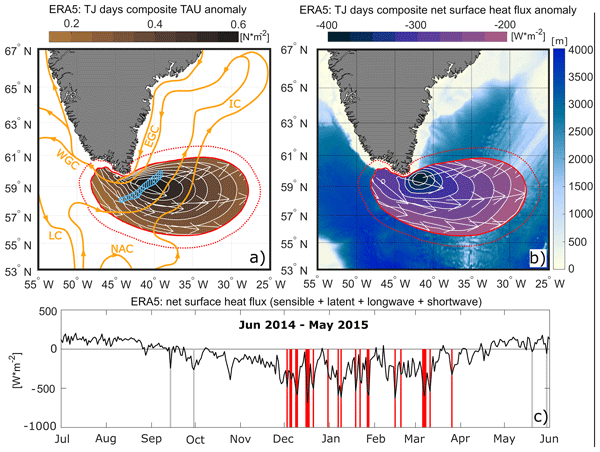
We also added the location of the tapering zone to Fig. 1 a,b to make the imposed forcing pattern clearer. We also have changed the caption accordingly
- The wind stress anomaly is applied within a confined region and gradually decreases to zero over a buffer zone. However, any lateral gradient in wind stress will cause Ekman divergence or convergence at the forcing boundary, potentially leading to spurious upwelling or downwelling that could affect the results. Have you checked for any systematic vertical velocity or MLD signal around your forcing area? Do you think this could impact your results?
We agree that tapering the wind-stress anomaly does not eliminate wind-stress gradients at the forcing boundary. The purpose of the 10-grid-cell (~100 km) buffer was to avoid an abrupt discontinuity in the imposed anomaly.
We did not use vertical velocity near the forcing boundary as a primary diagnostic, because parts of the coastal/shelf region are represented by only a few vertical layers, which limits the reliability of such an assessment. Instead, we inspected the MLD response around the forcing boundary. The MLD response is not organized as a narrow boundary-following signal along the edge of the forcing mask (see for example Fig.2). The strongest deepening occurs in the interior Irminger Basin, within the main convective region, where the imposed wind-stress and heat-loss anomalies are largest. We therefore do not expect the taper-induced boundary gradients to control the main MLD response.
We have clarified this point in the Methods section, lines 128–132.
Minor Comments
- l. 120: Given the complexity of the experimental design (4 simulation types, 5 ensemble members each, 6-year integration), I believe a schematic figure illustrating the experimental framework would greatly help the reader.
We agree that a schematic helps to clarify the experimental setup. We have added a schematic of the experimental design as Fig. 1d and expanded the Fig. 1 caption accordingly.
- l. 133: I initially struggled to understand the permutation you performed and was unsure about the composition of your groups of sizes 24 and 25. I suggest updating the sentence to clarify that both groups contain a fraction of forced and control simulations randomly assigned.
We have revised the Methods section, lines 150–154, to clarify the permutation procedure. We now explicitly state that the 49 realizations are pooled and randomly reassigned into two groups of sizes 25 and 24, and that each permuted group can contain a mixture of originally forced and control realizations.
- l. 317 and Figure 6b: You are referring to Ri<1, while in the method section, you mention the Miles–Howard criterion with Ri<0.25. I understand that this lower criterion is due to your output frequency, but it might be helpful to add a sentence to explain your Ri<1 criteria used in the results section.
We have addressed this in the Results section, lines 341–346. We now clarify that the classical Miles–Howard threshold of Ri < 0.25 applies to instantaneous shear instability, whereas our Ri values are computed from daily-mean fields. We therefore use Ri < 1 not as a strict instability threshold, but as an indicator of regions where the potential for shear-driven mixing remains elevated even after daily averaging.
References
- K. DuVivier, J. J. Cassano, Exploration of turbulent heat fluxes and wind stress curl in WRF and ERA- interim during wintertime mesoscale wind events around southeastern Greenland. J. Geophys. Res. 120, 3593–3609 (2015).
Duyck, E., Gelderloos, R., and de Jong, M. F.: Wind‐Driven Freshwater Export at Cape Farewell, J. Geophys. Res. Oceans, 127, https://doi.org/10.1029/2021JC018309, 2022.
Arthur Coquereau et al. ,Extreme wind events responsible for an outsized role in shelf-basin exchange around the southern tip of Greenland. Sci Adv 10,eadp9266(2024).DOI:10.1126/sciadv.adp9266
Citation: https://doi.org/10.5194/egusphere-2026-918-AC2
-
AC2: 'Reply on RC1', Aleksandr M. Fedorov, 07 May 2026
-
RC2: 'Comment on egusphere-2026-918', Anonymous Referee #2, 20 Apr 2026
Review of “Greenland tip jet and deep convection in the Irminger Sea: disentangling the roles of heat loss and wind stress” by Fedorov et al.
The authors present an idealised ocean modelling study to assess the role of the westerly Greenland tip jet on the Irminger Sea region. Tip jets are added to control (CORE) atmospheric forcing fields by adding a perturbation to the surface sensible heat flux, the surface momentum or both (full forcing) that is based on a simple definition of westerly tip jets and ERA5 fields. The surface latent heat flux is not changed in this study. The findings clearly show the sensible heat flux is the primary driver of mixed-layer deepening, but the surface stress also plays a role in early winter ML deepening.
Overall, this is a well-constructed study, clearly written and illustrated. The diagnostics focus on mixed-layer depth responses to the forcing. With some additional figures delving into the mixing response via shear and Richardson number. The findings are not really unexpected but confirm what others have discussed in observational studies or studies using 1D ML models. I only have one major concern, which can be readily addressed and also I make a few minor suggestions.
Major point
Tip jets also perturb the surface latent heat flux, primarily because of the enhanced near-surface winds. This effect is neglected in this study, as mentioned. However, there is no discussion of any ramifications of this decision. If anything, adding in a LHF component will increase the effect of tip jets on the ocean in terms of deepening the mixed layer. I would recommend adding a few sentences on this point.
Specific Points
Line 13, I’d recommend adding “…Greenland tip jet wind events” to the end of the first sentence of the abstract, given this is an oceanic journal.
Lines 30-60 – there is a good introduction to the role of westerly Greenland tip jets in forcing the ocean where I think most of the key points are made and key references cited. However, there is no mention of easterly tip jets in the introduction. Easterly (or reverse) Greenland tip jets occur almost as frequently and impact the western Irminger Sea and the SE Labrador Sea (e.g. Moore and Renfrew 2005). They have been observed with research aircraft (Renfrew et al. 2009) and their dynamics explained both in broad terms (Moore and Renfrew 2005) and in detail for selected cases (Outten et al. 2009). Their impact on the ocean has been assessed via 1-D modelling (Sproson et al. 2008). I think this introduction should include 2-3 sentences on these phenomena, given their relevance to the subpolar North Atlantic.
Note: the area of deep ML in the SE Labrador Sea seen in the control run (Figure 2 bottom row) is investigated in Sproson et al. (2008).
Lines 235-242 – Figure 3d demonstrates that even the wind stress only experiments see considerable buoyancy change over the year (B_ocean), despite not having any tip jet heating forcing. This buoyancy loss must be coming from firstly the control heat loss (SHF+LHF) plus radiative heat loss at the surface (presumably from longwave heat loss in the main). It may be worth a comment on this point. At the moment there isn’t really an explantion here.
Lines 310-335 – in discussing the wind stress only forcing and the impact on ocean shear and Richardson number, the authors may be interested in looking over Zhou et al. (2018) – although focused on a different area, this study also partitions heat and momentum forcing and looks in detail at MLD changes. They also clearly show wind forcing deepens the ML, corroborating your findings.
References
Outten S.D., I.A. Renfrew, and G.N. Petersen, 2009: An easterly tip jet off Cape Farewell, Greenland. Part II: Simulations and dynamics, Quarterly J. Royal Meteorological Society, 135, 1934-1949. doi:10.1002/qj.531
Renfrew, I.A., S.D. Outten and G.W.K. Moore, 2009: An easterly tip jet off Cape Farewell, Greenland. Part I: Aircraft observations, Quarterly J. Royal Meteorological Society, 135, 1919-1933. doi:10.1002/qj.513
Sproson, D.A.J., I.A. Renfrew and K.J. Heywood, 2008: Atmospheric conditions associated with oceanic convection in the south-east Labrador Sea, Geophysical Research Letters, 35, L06601, doi:10.1029/2007GL032971
Zhou, S. X. Zhai, and I. A. Renfrew 2018: The impact of high-frequency weather systems on SST and surface mixed layer in the central Arabian Sea, J. Geophysical Research: Oceans, 123, doi: 10.1002/2017JC013609
Citation: https://doi.org/10.5194/egusphere-2026-918-RC2 -
AC3: 'Reply on RC2', Aleksandr M. Fedorov, 07 May 2026
Review of “Greenland tip jet and deep convection in the Irminger Sea: disentangling the roles of heat loss and wind stress” by Fedorov et al.
The authors present an idealised ocean modelling study to assess the role of the westerly Greenland tip jet on the Irminger Sea region. Tip jets are added to control (CORE) atmospheric forcing fields by adding a perturbation to the surface sensible heat flux, the surface momentum or both (full forcing) that is based on a simple definition of westerly tip jets and ERA5 fields. The surface latent heat flux is not changed in this study. The findings clearly show the sensible heat flux is the primary driver of mixed-layer deepening, but the surface stress also plays a role in early winter ML deepening.
Overall, this is a well-constructed study, clearly written and illustrated. The diagnostics focus on mixed-layer depth responses to the forcing. With some additional figures delving into the mixing response via shear and Richardson number. The findings are not really unexpected but confirm what others have discussed in observational studies or studies using 1D ML models. I only have one major concern, which can be readily addressed and also I make a few minor suggestions.
We thank the reviewer for the positive and constructive assessment of our manuscript. We are grateful for the careful reading and for the helpful suggestions regarding the description of the heat-flux forcing, the role of easterly tip jets, and the interpretation of buoyancy-content changes in the wind-only experiment. We have revised the manuscript accordingly. In particular, we clarified that the imposed heat-flux anomaly is a net surface heat-flux anomaly that includes latent heat flux, revised Fig. 1 and its caption to avoid ambiguity in the term “SHF”, added discussion of easterly/reverse tip jets in the Introduction, and clarified the interpretation of the B_ocean response in the wind-only experiment. Our detailed responses are given below.
Major point
Tip jets also perturb the surface latent heat flux, primarily because of the enhanced near-surface winds. This effect is neglected in this study, as mentioned. However, there is no discussion of any ramifications of this decision. If anything, adding in a LHF component will increase the effect of tip jets on the ocean in terms of deepening the mixed layer. I would recommend adding a few sentences on this point.
We thank the reviewer for pointing out this ambiguity. We agree that latent heat flux is an important component of the oceanic heat-loss response during tip-jet events. In the original manuscript, our terminology was not sufficiently clear. The imposed heat-flux anomaly is not a sensible heat-flux anomaly alone; it is a net surface heat-flux anomaly derived from ERA5, including turbulent sensible and latent heat fluxes as well as longwave and shortwave radiative fluxes. Thus, the latent heat-flux contribution associated with enhanced near-surface winds during tip jets is included in the prescribed heat-loss forcing.
We have revised the Methods section to clarify this point. We now state explicitly that heat loss refers to negative net surface heat flux directed out of the ocean and that the imposed heat-flux anomaly includes sensible, latent, longwave, and shortwave components (lines 105-108). We have also revised Fig. 1 and its caption to avoid the abbreviation “SHF”, which could be confused with sensible heat flux.
Specific Points
Line 13, I’d recommend adding “…Greenland tip jet wind events” to the end of the first sentence of the abstract, given this is an oceanic journal.
We have revised the first sentence of the Abstract accordingly and now refer explicitly to “Greenland tip jet wind events.”
Lines 30-60 – there is a good introduction to the role of westerly Greenland tip jets in forcing the ocean where I think most of the key points are made and key references cited. However, there is no mention of easterly tip jets in the introduction. Easterly (or reverse) Greenland tip jets occur almost as frequently and impact the western Irminger Sea and the SE Labrador Sea (e.g. Moore and Renfrew 2005). They have been observed with research aircraft (Renfrew et al. 2009) and their dynamics explained both in broad terms (Moore and Renfrew 2005) and in detail for selected cases (Outten et al. 2009). Their impact on the ocean has been assessed via 1-D modelling (Sproson et al. 2008). I think this introduction should include 2-3 sentences on these phenomena, given their relevance to the subpolar North Atlantic.;Note: the area of deep ML in the SE Labrador Sea seen in the control run (Figure 2 bottom row) is investigated in Sproson et al. (2008).
We have addressed this remark in the introduction ( lines 40-52) to include easterly/reverse tip jets and their relevance for the western Irminger Sea and southeastern Labrador Sea. We now state that both westerly/direct and easterly/reverse tip jets occur around Cape Farewell, include their approximate November–March frequencies from DuVivier et al. (2016), and note that easterly tip jets have been linked to convection in the southeastern Labrador Sea. We also clarify why the present study focuses on westerly tip jets: they produce the strongest negative buoyancy-flux anomalies over the central Irminger Sea.
Lines 235-242 – Figure 3d demonstrates that even the wind stress only experiments see considerable buoyancy change over the year (B_ocean), despite not having any tip jet heating forcing. This buoyancy loss must be coming from firstly the control heat loss (SHF+LHF) plus radiative heat loss at the surface (presumably from longwave heat loss in the main). It may be worth a comment on this point. At the moment there isn’t really an explantion here.
We thank the reviewer for this helpful comment. We agree that the seasonal decrease in B_ocean in the wind-only experiment occurs under the influence of the climatological net surface heat flux. The original text did not distinguish sufficiently clearly between the absolute seasonal decrease in B_ocean, which is expected in all experiments during winter, and the enhanced decrease relative to the control simulation.
We have revised the Results section (lines 253–271) to clarify this point. The wind-only experiment does not include an additional tip-jet heat-flux anomaly, and its cumulative B_flux remains within the range of the control simulation. Therefore, the stronger B_ocean decrease relative to control cannot be attributed to additional surface heat-loss forcing. Instead, it indicates that wind stress modifies the ocean buoyancy response through processes not captured by the cumulative surface buoyancy flux alone. This motivates the later sections, where we analyse the salinity, shear, and Richardson-number responses to wind-stress forcing.
Lines 310-335 – in discussing the wind stress only forcing and the impact on ocean shear and Richardson number, the authors may be interested in looking over Zhou et al. (2018) – although focused on a different area, this study also partitions heat and momentum forcing and looks in detail at MLD changes. They also clearly show wind forcing deepens the ML, corroborating your findings.
We thank the reviewer for suggesting this reference. We now mention Zhou et al. (2018) as supporting evidence that wind forcing can deepen the mixed layer through mechanical effects, even though their study focuses on a different region. The reference is included in the Introduction, line 68, and in the Results discussion of the wind-only shear/Richardson-number response (lines 362-364).
References
Outten S.D., I.A. Renfrew, and G.N. Petersen, 2009: An easterly tip jet off Cape Farewell, Greenland. Part II: Simulations and dynamics, Quarterly J. Royal Meteorological Society, 135, 1934-1949. doi:10.1002/qj.531
Renfrew, I.A., S.D. Outten and G.W.K. Moore, 2009: An easterly tip jet off Cape Farewell, Greenland. Part I: Aircraft observations, Quarterly J. Royal Meteorological Society, 135, 1919-1933. doi:10.1002/qj.513
Sproson, D.A.J., I.A. Renfrew and K.J. Heywood, 2008: Atmospheric conditions associated with oceanic convection in the south-east Labrador Sea, Geophysical Research Letters, 35, L06601, doi:10.1029/2007GL032971
Zhou, S. X. Zhai, and I. A. Renfrew 2018: The impact of high-frequency weather systems on SST and surface mixed layer in the central Arabian Sea, J. Geophysical Research: Oceans, 123, doi: 10.1002/2017JC013609
Citation: https://doi.org/10.5194/egusphere-2026-918-AC3
-
AC3: 'Reply on RC2', Aleksandr M. Fedorov, 07 May 2026
-
EC1: 'Comment on egusphere-2026-918', Karen J. Heywood, 22 Apr 2026
I am very grateful to both reviewers for their detailed and constructive reviews, and for their suggestions for strengthening the manuscript. I hope that the authors will be able to take these comments onboard. I look forward to receiving their responses and to a revised manuscript.
Please respond here in the open online discussion. You do not have to have made all the necessary changes at that stage. After you submit your responses here, you will then get another month or so to submit your revised manuscript, together with responses to the referees. These responses can be the same as you post online, or can be updated. If you require additional time at any stage please do not hesitate to ask.
Karen J Heywood (co-editor-in-chief)
Citation: https://doi.org/10.5194/egusphere-2026-918-EC1 -
AC1: 'Comment on egusphere-2026-918', Aleksandr M. Fedorov, 23 Apr 2026
Dear Reviewers and Editor,
On behalf of my co-authors, I would like to thank you for your detailed and constructive comments, as well as for your guidance throughout the review process. We appreciate the time and effort you have invested in improving our manuscript.
We will provide a detailed response to the comments, together with a revised version of the manuscript, within the next month.
Kind regards,
Aleksandr FedorovCitation: https://doi.org/10.5194/egusphere-2026-918-AC1
Peer review completion


Interactive discussion
Status: closed
-
RC1: 'Comment on egusphere-2026-918', Anonymous Referee #1, 18 Mar 2026
The manuscript presents a detailed and well-structured analysis of the role of Greenland tip jets in driving mixed layer deepening and deep convection in the Irminger Sea. The authors employ a set of ensemble ocean model simulations to separate the contributions of surface heat loss and wind stress. They compare heat-only, wind-only, and full-forcing experiments against a climatological control. While the manuscript is clearly written and the analysis is comprehensive, I have a few comments regarding the limitations of the experimental framework and the associated results sensitivity. This is not a criticism, as limitations are inherent to modeling works. I don’t recommend running additional simulations that would be a significant amount of work, but I suggest better acknowledging these limitations. Overall, the manuscript is of good quality and addresses an important question in subpolar ocean dynamics. I look forward to reading a revised version.
Major Comments
1. The authors attribute the observed changes in mixed layer depth and convection specifically to tip jets. However, from my understanding, since the control run is forced with a smoothed climatological annual cycle that contains no high-frequency variability, the experiments as designed cannot distinguish the effect of tip jets specifically from the effect of any intense episodic atmospheric forcing event. Could the results simply reflect the ocean's response to high-frequency wind and heat flux variability in general, rather than to the particular spatial and temporal structure of tip jets? The authors could explain what makes tip jet forcing dynamically distinct from other intense weather events in the region, such as reversed tip-jets, or acknowledge more explicitly that their results may generalize beyond tip jets to high-frequency atmospheric forcing.
2. The study relies on a composite representation of tip jets, based on the strongest 10% of westerly wind events. However, recent studies (DuVivier and Cassano 2015, Coquereau et al., 2024) have demonstrated that tip jets exist in various forms, with distinct spatial structures, intensities, and frequencies. Some of these forms are more prevalent than the canonical type examined in this study. For instance, Coquereau et al. (2024) found that tip-jet-like events occur in an average of 12% of the time, which is approximately twice as frequent as the peak frequency of canonical events during the 2014-2015 period. This frequency increases to 42% in DuVivier and Cassano (2015), because more events are associated to tip-jets. It remains uncertain how the results would change if a more realistic distribution of wind events in general (and tip-jets specifically) considered.
I appreciated the effort made to quantify the uncertainty presented at the end of the discussion (around l. 399-400). The authors should also discuss how the idealized composite forcing may limit the generalizability of their conclusions, and how the importance of heat loss compared to wind stress could vary across the entire spectrum of tip jets. This could potentially lead to less extreme canonical events compared to the 2014-2015 period but an increase in the occurrence of other types of tip jets.
3. In the introduction, the authors state that “variations in wind stress can drive […] Ekman-driven freshwater export from the Greenland shelf near Cape Farewell.” In the literature, tip jets are indeed suspected to have an impact on this shelfwater export to the gyre (Duyck et al. 2022, Coquereau et al. 2024 …). However, in the modeling framework, the applied tip-jet pattern does not extend to the shelf and is confined to the deep ocean (Fig 1). This raises questions about how the results shown, where tip jets predominantly drive a salinification of the Irminger Sea, reconcile with these previous results. Does the modeling framework underestimate the shelf water export, or is this process negligible compared to the enhanced vertical mixing of the surface ocean induced by tip-jets?
4. The wind stress anomaly is applied within a confined region and gradually decreases to zero over a buffer zone. However, any lateral gradient in wind stress will cause Ekman divergence or convergence at the forcing boundary, potentially leading to spurious upwelling or downwelling that could affect the results. Have you checked for any systematic vertical velocity or MLD signal around your forcing area? Do you think this could impact your results?
Minor Comments
- l. 120: Given the complexity of the experimental design (4 simulation types, 5 ensemble members each, 6-year integration), I believe a schematic figure illustrating the experimental framework would greatly help the reader.
- l. 133: I initially struggled to understand the permutation you performed and was unsure about the composition of your groups of sizes 24 and 25. I suggest updating the sentence to clarify that both groups contain a fraction of forced and control simulations randomly assigned.
- l. 317 and Figure 6b: You are referring to Ri<1, while in the method section, you mention the Miles–Howard criterion with Ri<0.25. I understand that this lower criterion is due to your output frequency, but it might be helpful to add a sentence to explain your Ri<1 criteria used in the results section.
References
A. K. DuVivier, J. J. Cassano, Exploration of turbulent heat fluxes and wind stress curl in WRF and ERA- interim during wintertime mesoscale wind events around southeastern Greenland. J. Geophys. Res. 120, 3593–3609 (2015).
Duyck, E., Gelderloos, R., and de Jong, M. F.: Wind‐Driven Freshwater Export at Cape Farewell, J. Geophys. Res. Oceans, 127, https://doi.org/10.1029/2021JC018309, 2022.
Arthur Coquereau et al. ,Extreme wind events responsible for an outsized role in shelf-basin exchange around the southern tip of Greenland. Sci Adv 10,eadp9266(2024).DOI:10.1126/sciadv.adp9266
Citation: https://doi.org/10.5194/egusphere-2026-918-RC1 -
AC2: 'Reply on RC1', Aleksandr M. Fedorov, 07 May 2026
The manuscript presents a detailed and well-structured analysis of the role of Greenland tip jets in driving mixed layer deepening and deep convection in the Irminger Sea. The authors employ a set of ensemble ocean model simulations to separate the contributions of surface heat loss and wind stress. They compare heat-only, wind-only, and full-forcing experiments against a climatological control. While the manuscript is clearly written and the analysis is comprehensive, I have a few comments regarding the limitations of the experimental framework and the associated results sensitivity. This is not a criticism, as limitations are inherent to modeling works. I don’t recommend running additional simulations that would be a significant amount of work, but I suggest better acknowledging these limitations. Overall, the manuscript is of good quality and addresses an important question in subpolar ocean dynamics. I look forward to reading a revised version.
We thank the reviewer for the constructive and encouraging assessment of our manuscript. We are grateful for the careful reading and for the helpful suggestions regarding the limitations of the experimental framework, the interpretation of the salinity response, and the clarity of the Methods section. We agree that these points needed clearer explanation in the manuscript. In the revised version, we have expanded the discussion of the idealized forcing design, clarified the distinction between westerly tip-jet forcing and the broader spectrum of Greenland mesoscale wind events, added explanations of the relationship between shelf freshwater export and interior salinification, and improved the description of the forcing geometry and statistical testing. We have also added a schematic of the experimental design to Fig. 1d. Our detailed responses are provided below.Major Comments
- The authors attribute the observed changes in mixed layer depth and convection specifically to tip jets. However, from my understanding, since the control run is forced with a smoothed climatological annual cycle that contains no high-frequency variability, the experiments as designed cannot distinguish the effect of tip jets specifically from the effect of any intense episodic atmospheric forcing event. Could the results simply reflect the ocean's response to high-frequency wind and heat flux variability in general, rather than to the particular spatial and temporal structure of tip jets? The authors could explain what makes tip jet forcing dynamically distinct from other intense weather events in the region, such as reversed tip-jets, or acknowledge more explicitly that their results may generalize beyond tip jets to high-frequency atmospheric forcing.
We agree that, because the control simulation is forced with a repeated climatological annual cycle and does not include high-frequency atmospheric variability, our experimental design cannot fully separate the ocean response to the specific spatial structure of westerly Greenland tip jets from the more general response to intense episodic wind and heat-flux forcing. Our intention was to isolate the response to a controlled, canonical westerly tip-jet forcing pattern, but we agree that this limitation needed to be stated more explicitly.
We have therefore revised the Discussion to clarify that the response identified in our experiments may partly represent the response of the Irminger Sea to intense high-frequency winter atmospheric forcing more broadly, rather than to westerly tip jets alone. At the same time, we now emphasize that the imposed anomalies retain the characteristic spatial structure of westerly Greenland tip jets, including localized forcing over the central Irminger Sea, where these events produce strong negative buoyancy flux anomalies. We therefore interpret the results as the response to strong canonical westerly tip-jet forcing, not as a complete representation of all possible high-frequency atmospheric forcing events around southern Greenland.
This clarification has been added to the revised Discussion, lines 409–424. Related changes were also made in the Introduction, lines 40–54, where we now distinguish westerly tip jets from easterly/reverse tip jets and clarify why the present study focuses on the westerly type.
- The study relies on a composite representation of tip jets, based on the strongest 10% of westerly wind events. However, recent studies (DuVivier and Cassano 2015, Coquereau et al., 2024) have demonstrated that tip jets exist in various forms, with distinct spatial structures, intensities, and frequencies. Some of these forms are more prevalent than the canonical type examined in this study. For instance, Coquereau et al. (2024) found that tip-jet-like events occur in an average of 12% of the time, which is approximately twice as frequent as the peak frequency of canonical events during the 2014-2015 period. This frequency increases to 42% in DuVivier and Cassano (2015), because more events are associated to tip-jets. It remains uncertain how the results would change if a more realistic distribution of wind events in general (and tip-jets specifically) considered.
I appreciated the effort made to quantify the uncertainty presented at the end of the discussion (around l. 399-400). The authors should also discuss how the idealized composite forcing may limit the generalizability of their conclusions, and how the importance of heat loss compared to wind stress could vary across the entire spectrum of tip jets. This could potentially lead to less extreme canonical events compared to the 2014-2015 period but an increase in the occurrence of other types of tip jets.
We agree that the original manuscript did not sufficiently discuss the diversity of Greenland tip-jet events and the resulting limitation of using a single composite representation. Our experiments use a composite of strong westerly tip-jet events, based on the strongest 10% of westerly wind events, and therefore represent a canonical westerly tip-jet forcing pattern rather than the full spectrum of mesoscale wind events around southern Greenland.
We have revised the Introduction to acknowledge that different types of tip jets occur around Cape Farewell, including easterly/reverse tip jets. We now mention that easterly tip jets occur frequently and influence the western Irminger Sea and southeastern Labrador Sea, but that westerly tip jets are the dominant wind pattern for causing a negative buoyancy forcing over the central Irminger Sea. This provides a clearer justification for focusing on westerly tip jets. These changes are included in lines 40–54.
We have also expanded the limitation paragraph in the Discussion, lines 409–424. We now state explicitly that our results should be interpreted as the response to strong canonical westerly tip-jet forcing, not as a complete representation of all Greenland mesoscale wind events. We further acknowledge that using a more realistic distribution of westerly, easterly, and other tip-jet-like events could alter both the magnitude of the mixed-layer response and the relative importance of heat loss and wind stress. This broader distribution could include less extreme canonical westerly events, but also more frequent occurrences of other tip-jet-like wind patterns.
- In the introduction, the authors state that “variations in wind stress can drive […] Ekman-driven freshwater export from the Greenland shelf near Cape Farewell.” In the literature, tip jets are indeed suspected to have an impact on this shelfwater export to the gyre (Duyck et al. 2022, Coquereau et al. 2024 …). However, in the modeling framework, the applied tip-jet pattern does not extend to the shelf and is confined to the deep ocean (Fig 1). This raises questions about how the results shown, where tip jets predominantly drive a salinification of the Irminger Sea, reconcile with these previous results. Does the modeling framework underestimate the shelf water export, or is this process negligible compared to the enhanced vertical mixing of the surface ocean induced by tip-jets?
We agree that wind-driven freshwater export from the Greenland shelf near Cape Farewell is an important pathway documented in previous studies, and that the original manuscript did not sufficiently clarify how this process relates to the salinity increase diagnosed in our experiments.
We have revised the Introduction, lines 63–69, to clarify that wind-stress forcing can contribute to Ekman-driven freshwater export from the Greenland shelf and that this pathway is important for shelf–basin exchange and near-boundary stratification. At the same time, we now note that existing evidence suggests that this exported freshwater is strongly constrained by the boundary-current system and does not provide a persistent direct pathway to the main Irminger Sea convection region. We therefore distinguish between wind-driven freshwater export from the shelf and the mechanism analysed in this study, namely wind-driven open-ocean mixing in the Irminger Sea interior.
We have also clarified the interpretation of the salinity response in the Results section, lines 303–305 mentioning the lateral freshwater exchange: “Thus, the salinification diagnosed in the convective region reflects local mixing and entrainment rather than a persistent lateral freshwater signal from the shelf.”. In our experiments, the positive salinity anomaly in the convective region is accompanied by reduced salinity below the shallow mixed layer, indicating vertical redistribution of salt within the interior water column. Although the imposed forcing includes the coastal tapering zone, the freshwater signal associated with the boundary-current region does not penetrate persistently into the main convective region. We therefore interpret the salinification in the wind-only experiment as resulting from local wind-driven mixing and entrainment of saltier subsurface water in the Irminger Sea interior, rather than show wind-driven freshwater export from the Greenland shelf (as contradicting studies indicate).
We also added the location of the tapering zone to Fig. 1 a,b to make the imposed forcing pattern clearer. We also have changed the caption accordingly
- The wind stress anomaly is applied within a confined region and gradually decreases to zero over a buffer zone. However, any lateral gradient in wind stress will cause Ekman divergence or convergence at the forcing boundary, potentially leading to spurious upwelling or downwelling that could affect the results. Have you checked for any systematic vertical velocity or MLD signal around your forcing area? Do you think this could impact your results?
We agree that tapering the wind-stress anomaly does not eliminate wind-stress gradients at the forcing boundary. The purpose of the 10-grid-cell (~100 km) buffer was to avoid an abrupt discontinuity in the imposed anomaly.
We did not use vertical velocity near the forcing boundary as a primary diagnostic, because parts of the coastal/shelf region are represented by only a few vertical layers, which limits the reliability of such an assessment. Instead, we inspected the MLD response around the forcing boundary. The MLD response is not organized as a narrow boundary-following signal along the edge of the forcing mask (see for example Fig.2). The strongest deepening occurs in the interior Irminger Basin, within the main convective region, where the imposed wind-stress and heat-loss anomalies are largest. We therefore do not expect the taper-induced boundary gradients to control the main MLD response.
We have clarified this point in the Methods section, lines 128–132.
Minor Comments
- l. 120: Given the complexity of the experimental design (4 simulation types, 5 ensemble members each, 6-year integration), I believe a schematic figure illustrating the experimental framework would greatly help the reader.
We agree that a schematic helps to clarify the experimental setup. We have added a schematic of the experimental design as Fig. 1d and expanded the Fig. 1 caption accordingly.
- l. 133: I initially struggled to understand the permutation you performed and was unsure about the composition of your groups of sizes 24 and 25. I suggest updating the sentence to clarify that both groups contain a fraction of forced and control simulations randomly assigned.
We have revised the Methods section, lines 150–154, to clarify the permutation procedure. We now explicitly state that the 49 realizations are pooled and randomly reassigned into two groups of sizes 25 and 24, and that each permuted group can contain a mixture of originally forced and control realizations.
- l. 317 and Figure 6b: You are referring to Ri<1, while in the method section, you mention the Miles–Howard criterion with Ri<0.25. I understand that this lower criterion is due to your output frequency, but it might be helpful to add a sentence to explain your Ri<1 criteria used in the results section.
We have addressed this in the Results section, lines 341–346. We now clarify that the classical Miles–Howard threshold of Ri < 0.25 applies to instantaneous shear instability, whereas our Ri values are computed from daily-mean fields. We therefore use Ri < 1 not as a strict instability threshold, but as an indicator of regions where the potential for shear-driven mixing remains elevated even after daily averaging.
References
- K. DuVivier, J. J. Cassano, Exploration of turbulent heat fluxes and wind stress curl in WRF and ERA- interim during wintertime mesoscale wind events around southeastern Greenland. J. Geophys. Res. 120, 3593–3609 (2015).
Duyck, E., Gelderloos, R., and de Jong, M. F.: Wind‐Driven Freshwater Export at Cape Farewell, J. Geophys. Res. Oceans, 127, https://doi.org/10.1029/2021JC018309, 2022.
Arthur Coquereau et al. ,Extreme wind events responsible for an outsized role in shelf-basin exchange around the southern tip of Greenland. Sci Adv 10,eadp9266(2024).DOI:10.1126/sciadv.adp9266
Citation: https://doi.org/10.5194/egusphere-2026-918-AC2
-
RC2: 'Comment on egusphere-2026-918', Anonymous Referee #2, 20 Apr 2026
Review of “Greenland tip jet and deep convection in the Irminger Sea: disentangling the roles of heat loss and wind stress” by Fedorov et al.
The authors present an idealised ocean modelling study to assess the role of the westerly Greenland tip jet on the Irminger Sea region. Tip jets are added to control (CORE) atmospheric forcing fields by adding a perturbation to the surface sensible heat flux, the surface momentum or both (full forcing) that is based on a simple definition of westerly tip jets and ERA5 fields. The surface latent heat flux is not changed in this study. The findings clearly show the sensible heat flux is the primary driver of mixed-layer deepening, but the surface stress also plays a role in early winter ML deepening.
Overall, this is a well-constructed study, clearly written and illustrated. The diagnostics focus on mixed-layer depth responses to the forcing. With some additional figures delving into the mixing response via shear and Richardson number. The findings are not really unexpected but confirm what others have discussed in observational studies or studies using 1D ML models. I only have one major concern, which can be readily addressed and also I make a few minor suggestions.
Major point
Tip jets also perturb the surface latent heat flux, primarily because of the enhanced near-surface winds. This effect is neglected in this study, as mentioned. However, there is no discussion of any ramifications of this decision. If anything, adding in a LHF component will increase the effect of tip jets on the ocean in terms of deepening the mixed layer. I would recommend adding a few sentences on this point.
Specific Points
Line 13, I’d recommend adding “…Greenland tip jet wind events” to the end of the first sentence of the abstract, given this is an oceanic journal.
Lines 30-60 – there is a good introduction to the role of westerly Greenland tip jets in forcing the ocean where I think most of the key points are made and key references cited. However, there is no mention of easterly tip jets in the introduction. Easterly (or reverse) Greenland tip jets occur almost as frequently and impact the western Irminger Sea and the SE Labrador Sea (e.g. Moore and Renfrew 2005). They have been observed with research aircraft (Renfrew et al. 2009) and their dynamics explained both in broad terms (Moore and Renfrew 2005) and in detail for selected cases (Outten et al. 2009). Their impact on the ocean has been assessed via 1-D modelling (Sproson et al. 2008). I think this introduction should include 2-3 sentences on these phenomena, given their relevance to the subpolar North Atlantic.
Note: the area of deep ML in the SE Labrador Sea seen in the control run (Figure 2 bottom row) is investigated in Sproson et al. (2008).
Lines 235-242 – Figure 3d demonstrates that even the wind stress only experiments see considerable buoyancy change over the year (B_ocean), despite not having any tip jet heating forcing. This buoyancy loss must be coming from firstly the control heat loss (SHF+LHF) plus radiative heat loss at the surface (presumably from longwave heat loss in the main). It may be worth a comment on this point. At the moment there isn’t really an explantion here.
Lines 310-335 – in discussing the wind stress only forcing and the impact on ocean shear and Richardson number, the authors may be interested in looking over Zhou et al. (2018) – although focused on a different area, this study also partitions heat and momentum forcing and looks in detail at MLD changes. They also clearly show wind forcing deepens the ML, corroborating your findings.
References
Outten S.D., I.A. Renfrew, and G.N. Petersen, 2009: An easterly tip jet off Cape Farewell, Greenland. Part II: Simulations and dynamics, Quarterly J. Royal Meteorological Society, 135, 1934-1949. doi:10.1002/qj.531
Renfrew, I.A., S.D. Outten and G.W.K. Moore, 2009: An easterly tip jet off Cape Farewell, Greenland. Part I: Aircraft observations, Quarterly J. Royal Meteorological Society, 135, 1919-1933. doi:10.1002/qj.513
Sproson, D.A.J., I.A. Renfrew and K.J. Heywood, 2008: Atmospheric conditions associated with oceanic convection in the south-east Labrador Sea, Geophysical Research Letters, 35, L06601, doi:10.1029/2007GL032971
Zhou, S. X. Zhai, and I. A. Renfrew 2018: The impact of high-frequency weather systems on SST and surface mixed layer in the central Arabian Sea, J. Geophysical Research: Oceans, 123, doi: 10.1002/2017JC013609
Citation: https://doi.org/10.5194/egusphere-2026-918-RC2 -
AC3: 'Reply on RC2', Aleksandr M. Fedorov, 07 May 2026
Review of “Greenland tip jet and deep convection in the Irminger Sea: disentangling the roles of heat loss and wind stress” by Fedorov et al.
The authors present an idealised ocean modelling study to assess the role of the westerly Greenland tip jet on the Irminger Sea region. Tip jets are added to control (CORE) atmospheric forcing fields by adding a perturbation to the surface sensible heat flux, the surface momentum or both (full forcing) that is based on a simple definition of westerly tip jets and ERA5 fields. The surface latent heat flux is not changed in this study. The findings clearly show the sensible heat flux is the primary driver of mixed-layer deepening, but the surface stress also plays a role in early winter ML deepening.
Overall, this is a well-constructed study, clearly written and illustrated. The diagnostics focus on mixed-layer depth responses to the forcing. With some additional figures delving into the mixing response via shear and Richardson number. The findings are not really unexpected but confirm what others have discussed in observational studies or studies using 1D ML models. I only have one major concern, which can be readily addressed and also I make a few minor suggestions.
We thank the reviewer for the positive and constructive assessment of our manuscript. We are grateful for the careful reading and for the helpful suggestions regarding the description of the heat-flux forcing, the role of easterly tip jets, and the interpretation of buoyancy-content changes in the wind-only experiment. We have revised the manuscript accordingly. In particular, we clarified that the imposed heat-flux anomaly is a net surface heat-flux anomaly that includes latent heat flux, revised Fig. 1 and its caption to avoid ambiguity in the term “SHF”, added discussion of easterly/reverse tip jets in the Introduction, and clarified the interpretation of the B_ocean response in the wind-only experiment. Our detailed responses are given below.
Major point
Tip jets also perturb the surface latent heat flux, primarily because of the enhanced near-surface winds. This effect is neglected in this study, as mentioned. However, there is no discussion of any ramifications of this decision. If anything, adding in a LHF component will increase the effect of tip jets on the ocean in terms of deepening the mixed layer. I would recommend adding a few sentences on this point.
We thank the reviewer for pointing out this ambiguity. We agree that latent heat flux is an important component of the oceanic heat-loss response during tip-jet events. In the original manuscript, our terminology was not sufficiently clear. The imposed heat-flux anomaly is not a sensible heat-flux anomaly alone; it is a net surface heat-flux anomaly derived from ERA5, including turbulent sensible and latent heat fluxes as well as longwave and shortwave radiative fluxes. Thus, the latent heat-flux contribution associated with enhanced near-surface winds during tip jets is included in the prescribed heat-loss forcing.
We have revised the Methods section to clarify this point. We now state explicitly that heat loss refers to negative net surface heat flux directed out of the ocean and that the imposed heat-flux anomaly includes sensible, latent, longwave, and shortwave components (lines 105-108). We have also revised Fig. 1 and its caption to avoid the abbreviation “SHF”, which could be confused with sensible heat flux.
Specific Points
Line 13, I’d recommend adding “…Greenland tip jet wind events” to the end of the first sentence of the abstract, given this is an oceanic journal.
We have revised the first sentence of the Abstract accordingly and now refer explicitly to “Greenland tip jet wind events.”
Lines 30-60 – there is a good introduction to the role of westerly Greenland tip jets in forcing the ocean where I think most of the key points are made and key references cited. However, there is no mention of easterly tip jets in the introduction. Easterly (or reverse) Greenland tip jets occur almost as frequently and impact the western Irminger Sea and the SE Labrador Sea (e.g. Moore and Renfrew 2005). They have been observed with research aircraft (Renfrew et al. 2009) and their dynamics explained both in broad terms (Moore and Renfrew 2005) and in detail for selected cases (Outten et al. 2009). Their impact on the ocean has been assessed via 1-D modelling (Sproson et al. 2008). I think this introduction should include 2-3 sentences on these phenomena, given their relevance to the subpolar North Atlantic.;Note: the area of deep ML in the SE Labrador Sea seen in the control run (Figure 2 bottom row) is investigated in Sproson et al. (2008).
We have addressed this remark in the introduction ( lines 40-52) to include easterly/reverse tip jets and their relevance for the western Irminger Sea and southeastern Labrador Sea. We now state that both westerly/direct and easterly/reverse tip jets occur around Cape Farewell, include their approximate November–March frequencies from DuVivier et al. (2016), and note that easterly tip jets have been linked to convection in the southeastern Labrador Sea. We also clarify why the present study focuses on westerly tip jets: they produce the strongest negative buoyancy-flux anomalies over the central Irminger Sea.
Lines 235-242 – Figure 3d demonstrates that even the wind stress only experiments see considerable buoyancy change over the year (B_ocean), despite not having any tip jet heating forcing. This buoyancy loss must be coming from firstly the control heat loss (SHF+LHF) plus radiative heat loss at the surface (presumably from longwave heat loss in the main). It may be worth a comment on this point. At the moment there isn’t really an explantion here.
We thank the reviewer for this helpful comment. We agree that the seasonal decrease in B_ocean in the wind-only experiment occurs under the influence of the climatological net surface heat flux. The original text did not distinguish sufficiently clearly between the absolute seasonal decrease in B_ocean, which is expected in all experiments during winter, and the enhanced decrease relative to the control simulation.
We have revised the Results section (lines 253–271) to clarify this point. The wind-only experiment does not include an additional tip-jet heat-flux anomaly, and its cumulative B_flux remains within the range of the control simulation. Therefore, the stronger B_ocean decrease relative to control cannot be attributed to additional surface heat-loss forcing. Instead, it indicates that wind stress modifies the ocean buoyancy response through processes not captured by the cumulative surface buoyancy flux alone. This motivates the later sections, where we analyse the salinity, shear, and Richardson-number responses to wind-stress forcing.
Lines 310-335 – in discussing the wind stress only forcing and the impact on ocean shear and Richardson number, the authors may be interested in looking over Zhou et al. (2018) – although focused on a different area, this study also partitions heat and momentum forcing and looks in detail at MLD changes. They also clearly show wind forcing deepens the ML, corroborating your findings.
We thank the reviewer for suggesting this reference. We now mention Zhou et al. (2018) as supporting evidence that wind forcing can deepen the mixed layer through mechanical effects, even though their study focuses on a different region. The reference is included in the Introduction, line 68, and in the Results discussion of the wind-only shear/Richardson-number response (lines 362-364).
References
Outten S.D., I.A. Renfrew, and G.N. Petersen, 2009: An easterly tip jet off Cape Farewell, Greenland. Part II: Simulations and dynamics, Quarterly J. Royal Meteorological Society, 135, 1934-1949. doi:10.1002/qj.531
Renfrew, I.A., S.D. Outten and G.W.K. Moore, 2009: An easterly tip jet off Cape Farewell, Greenland. Part I: Aircraft observations, Quarterly J. Royal Meteorological Society, 135, 1919-1933. doi:10.1002/qj.513
Sproson, D.A.J., I.A. Renfrew and K.J. Heywood, 2008: Atmospheric conditions associated with oceanic convection in the south-east Labrador Sea, Geophysical Research Letters, 35, L06601, doi:10.1029/2007GL032971
Zhou, S. X. Zhai, and I. A. Renfrew 2018: The impact of high-frequency weather systems on SST and surface mixed layer in the central Arabian Sea, J. Geophysical Research: Oceans, 123, doi: 10.1002/2017JC013609
Citation: https://doi.org/10.5194/egusphere-2026-918-AC3
-
AC3: 'Reply on RC2', Aleksandr M. Fedorov, 07 May 2026
-
EC1: 'Comment on egusphere-2026-918', Karen J. Heywood, 22 Apr 2026
I am very grateful to both reviewers for their detailed and constructive reviews, and for their suggestions for strengthening the manuscript. I hope that the authors will be able to take these comments onboard. I look forward to receiving their responses and to a revised manuscript.
Please respond here in the open online discussion. You do not have to have made all the necessary changes at that stage. After you submit your responses here, you will then get another month or so to submit your revised manuscript, together with responses to the referees. These responses can be the same as you post online, or can be updated. If you require additional time at any stage please do not hesitate to ask.
Karen J Heywood (co-editor-in-chief)
Citation: https://doi.org/10.5194/egusphere-2026-918-EC1 -
AC1: 'Comment on egusphere-2026-918', Aleksandr M. Fedorov, 23 Apr 2026
Dear Reviewers and Editor,
On behalf of my co-authors, I would like to thank you for your detailed and constructive comments, as well as for your guidance throughout the review process. We appreciate the time and effort you have invested in improving our manuscript.
We will provide a detailed response to the comments, together with a revised version of the manuscript, within the next month.
Kind regards,
Aleksandr FedorovCitation: https://doi.org/10.5194/egusphere-2026-918-AC1
Peer review completion
Journal article(s) based on this preprint
Viewed
| HTML | XML | Total | BibTeX | EndNote | |
|---|---|---|---|---|---|
| 914 | 328 | 93 | 1,335 | 95 | 121 |
- HTML: 914
- PDF: 328
- XML: 93
- Total: 1,335
- BibTeX: 95
- EndNote: 121
Viewed (geographical distribution)
| Country | # | Views | % |
|---|
| Total: | 0 |
| HTML: | 0 |
| PDF: | 0 |
| XML: | 0 |
- 1
Aleksandr M. Fedorov

M. Femke De Jong
Claudia E. Wieners
Elodie Duyck
Henk A. Dijkstra
The requested preprint has a corresponding peer-reviewed final revised paper. You are encouraged to refer to the final revised version.
- Preprint
(3059 KB) - Metadata XML
The manuscript presents a detailed and well-structured analysis of the role of Greenland tip jets in driving mixed layer deepening and deep convection in the Irminger Sea. The authors employ a set of ensemble ocean model simulations to separate the contributions of surface heat loss and wind stress. They compare heat-only, wind-only, and full-forcing experiments against a climatological control. While the manuscript is clearly written and the analysis is comprehensive, I have a few comments regarding the limitations of the experimental framework and the associated results sensitivity. This is not a criticism, as limitations are inherent to modeling works. I don’t recommend running additional simulations that would be a significant amount of work, but I suggest better acknowledging these limitations. Overall, the manuscript is of good quality and addresses an important question in subpolar ocean dynamics. I look forward to reading a revised version.
Major Comments
1. The authors attribute the observed changes in mixed layer depth and convection specifically to tip jets. However, from my understanding, since the control run is forced with a smoothed climatological annual cycle that contains no high-frequency variability, the experiments as designed cannot distinguish the effect of tip jets specifically from the effect of any intense episodic atmospheric forcing event. Could the results simply reflect the ocean's response to high-frequency wind and heat flux variability in general, rather than to the particular spatial and temporal structure of tip jets? The authors could explain what makes tip jet forcing dynamically distinct from other intense weather events in the region, such as reversed tip-jets, or acknowledge more explicitly that their results may generalize beyond tip jets to high-frequency atmospheric forcing.
2. The study relies on a composite representation of tip jets, based on the strongest 10% of westerly wind events. However, recent studies (DuVivier and Cassano 2015, Coquereau et al., 2024) have demonstrated that tip jets exist in various forms, with distinct spatial structures, intensities, and frequencies. Some of these forms are more prevalent than the canonical type examined in this study. For instance, Coquereau et al. (2024) found that tip-jet-like events occur in an average of 12% of the time, which is approximately twice as frequent as the peak frequency of canonical events during the 2014-2015 period. This frequency increases to 42% in DuVivier and Cassano (2015), because more events are associated to tip-jets. It remains uncertain how the results would change if a more realistic distribution of wind events in general (and tip-jets specifically) considered.
I appreciated the effort made to quantify the uncertainty presented at the end of the discussion (around l. 399-400). The authors should also discuss how the idealized composite forcing may limit the generalizability of their conclusions, and how the importance of heat loss compared to wind stress could vary across the entire spectrum of tip jets. This could potentially lead to less extreme canonical events compared to the 2014-2015 period but an increase in the occurrence of other types of tip jets.
3. In the introduction, the authors state that “variations in wind stress can drive […] Ekman-driven freshwater export from the Greenland shelf near Cape Farewell.” In the literature, tip jets are indeed suspected to have an impact on this shelfwater export to the gyre (Duyck et al. 2022, Coquereau et al. 2024 …). However, in the modeling framework, the applied tip-jet pattern does not extend to the shelf and is confined to the deep ocean (Fig 1). This raises questions about how the results shown, where tip jets predominantly drive a salinification of the Irminger Sea, reconcile with these previous results. Does the modeling framework underestimate the shelf water export, or is this process negligible compared to the enhanced vertical mixing of the surface ocean induced by tip-jets?
4. The wind stress anomaly is applied within a confined region and gradually decreases to zero over a buffer zone. However, any lateral gradient in wind stress will cause Ekman divergence or convergence at the forcing boundary, potentially leading to spurious upwelling or downwelling that could affect the results. Have you checked for any systematic vertical velocity or MLD signal around your forcing area? Do you think this could impact your results?
Minor Comments
References
A. K. DuVivier, J. J. Cassano, Exploration of turbulent heat fluxes and wind stress curl in WRF and ERA- interim during wintertime mesoscale wind events around southeastern Greenland. J. Geophys. Res. 120, 3593–3609 (2015).
Duyck, E., Gelderloos, R., and de Jong, M. F.: Wind‐Driven Freshwater Export at Cape Farewell, J. Geophys. Res. Oceans, 127, https://doi.org/10.1029/2021JC018309, 2022.
Arthur Coquereau et al. ,Extreme wind events responsible for an outsized role in shelf-basin exchange around the southern tip of Greenland. Sci Adv 10,eadp9266(2024).DOI:10.1126/sciadv.adp9266