
the Creative Commons Attribution 4.0 License.
the Creative Commons Attribution 4.0 License.
 | 21 Jan 2026
Disentangling the drivers of soil CO2 ventilation in a Mediterranean dryland using in situ and remote sensing techniques
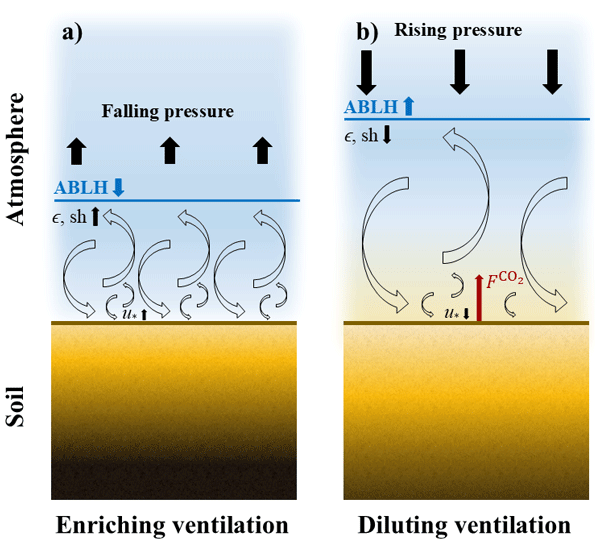
Abstract. Subterranean CO2 concentrations are driven by complex interactions between biological and physical processes. In semiarid ecosystems, atmospheric processes can play a relevant role in modulating soil CO2 storage and release. In the current study, a multi-instrumental dataset, collected in a Mediterranean shrubland in southern Spain, was analyzed, and the main atmospheric drivers controlling soil CO2 and radon (Rn) dynamics were investigated. Based on a precise methodology, 10 significant ventilation events were detected, and the Spearman correlation coefficients between the soil CO2 and Rn concentrations and the different atmospheric variables were calculated.
The results identified surface atmospheric pressure as the most consistent and independent driver across the events, exhibiting strong negative correlations with the subterranean CO2 and Rn concentrations. Surface-level friction velocity (u*), boundary-layer turbulent kinetic energy dissipation rate (ϵ) and wind shear (sh) showed significant positive correlations. However, their independence was not consistent comparing diluting ventilation events, when u* was more relevant, with enriching ventilation periods, that were more influenced by boundary-layer ϵ and sh. In contrast, at lower altitudes ϵ, sh, atmospheric boundary layer height and mixing layer height were less strongly correlated with soil CO2 and Rn concentration changes.
These findings provide new insights into the mechanisms that promote soil-atmosphere transport in drylands, especially those regarding the carbon cycle, and highlight the need to incorporate such mechanisms into Earth system models to improve carbon cycle predictions under future climate scenarios.
-
Notice on discussion status
The requested preprint has a corresponding peer-reviewed final revised paper. You are encouraged to refer to the final revised version.
-
Preprint
(913 KB)
-
The requested preprint has a corresponding peer-reviewed final revised paper. You are encouraged to refer to the final revised version.
- Preprint
(913 KB) - Metadata XML
- BibTeX
- EndNote
- Final revised paper


Journal article(s) based on this preprint
Interactive discussion
Status: closed
-
RC1: 'Comment on egusphere-2026-91', Anonymous Referee #1, 26 Feb 2026
-
AC1: 'Reply on RC1', J. L. Guerrero-Rascado, 23 Mar 2026
The comment was uploaded in the form of a supplement: https://egusphere.copernicus.org/preprints/2026/egusphere-2026-91/egusphere-2026-91-AC1-supplement.pdf
-
AC1: 'Reply on RC1', J. L. Guerrero-Rascado, 23 Mar 2026
-
RC2: 'Comment on egusphere-2026-91', Anonymous Referee #2, 27 Feb 2026
Review of Abril-Gago et al. (2026), “Disentangling the Drivers of Soil CO2 Ventilation in a Mediterranean Dryland using In Situ and Remote Sensing Techniques”
In this study, the authors investigate how atmospheric processes drive CO2 exchange between the soil and the atmosphere in a semiarid region. They analyze 10 soil ventilation events, which are characterized by an increase in soil CO2 and Rn concentrations and a simultaneous decrease in atmospheric pressure, followed by a decline in the soil concentrations and an increase in atmospheric pressure. The authors conduct a detailed statistical analysis to identify and evaluate the potential atmospheric drivers underlying these events.
The manuscript is well-structured and clearly written, with figures and results presented in a comprehensive way.
My main suggestion for improvement lies in amplifying the broader significance of the study. I think that the impact and relevance of this case study could be enhanced if the authors describe how frequent/typical such soil ventilation events are and how important the related CO2 exchange with the atmosphere is compared to other (e.g. biological) CO2 fluxes. Furthermore, the authors could discuss in more detail how their results can be used to improve the carbon cycle models and what is still missing/open for future research. This could be done in the introduction and in the final discussion.
Below are more specific, line-by-line comments.
L. 45: Please provide a reference for this statement. You could also provide more details here to strengthen the motivation for your study.
L. 171: Are there time periods with very low MLH << 500m (e.g., during nights), which may not be detected due to the reduced overlap of the laser beam with the receiver field of view? If so, how have you treated such periods in the statistical analysis of the ventilation events?
L. 172: Please explain briefly the difference between ABLH and MLH.
L. 178: To guide the reader, it would be helpful to explain here for which purpose the additional borehole setup has been installed.
L. 206-208: If the ventilation events are selected based on the requirement that the CO2 and Rn concentration increase has to coincide with an atmospheric pressure decrease, it appears quite obvious that the atmospheric pressure and the soil concentration is correlated. Is the conclusion in Fig. 2 that Pair and CO2 are correlated then not trivial? Please clarify.
L. 212-215: Please motivate why the additional high-turbulence conditions need to be fulfilled. Is this a strong criterium, i.e., does this high-turbulence condition lead to much less events?
L. 246-248: How did you define the exact start and end points of the ventilation events? Does this have an impact on the (time-shifted) correlations?
L. 271-272: From Fig. 1 it seems that the CO2 concentration begins to decrease in the lowest soil layer as the dilution event starts. However, one might expect that if atmospheric air infiltrates the soil, the CO2concentration in the upper soil layer would decrease before that in the deeper layers. Is it due to upward transport of CO2 from deeper soil layers? Can you comment on this?
L. 278: Maybe change “Rn-free” into “Rn-depleted”.
L. 301-303: Soil water content is expected to influence Rn emanation (see e.g. Zhuo et al., 2006, https://doi.org/10.1080/18811248.2006.9711127). Since Rn is used as a tracer for soil ventilation, its source strength must be stable or well-characterized. Please discuss whether soil moisture variability could introduce bias into the interpretation of Rn as a pure ventilation tracer or if the effect is negligible.
Fig. 2: Please clarify whether the correlation coefficient rs was calculated individually for each of the 10 ventilation events and then averaged, or whether a single rs was derived from the pooled data across all events.
L. 311-312: Are you referring to the correlation between CO2air and the soil concentration of Rn or the soil concentration of CO2 (or both)?
L. 395-399: How much larger is the maximized (shifted) correlation compared to the un-shifted correlation, e.g., in respect of the uncertainty/variability in the derived correlation coefficients?
Citation: https://doi.org/10.5194/egusphere-2026-91-RC2 -
AC2: 'Reply on RC2', J. L. Guerrero-Rascado, 23 Mar 2026
The comment was uploaded in the form of a supplement: https://egusphere.copernicus.org/preprints/2026/egusphere-2026-91/egusphere-2026-91-AC2-supplement.pdf
-
AC2: 'Reply on RC2', J. L. Guerrero-Rascado, 23 Mar 2026


Interactive discussion
Status: closed
-
RC1: 'Comment on egusphere-2026-91', Anonymous Referee #1, 26 Feb 2026
Review Report on the Paper: "Disentangling the Drivers of Soil CO2 Ventilation in a Mediterranean Dryland using In Situ and Remote Sensing Techniques"
Summary of the Paper
The paper titled "Disentangling the Drivers of Soil CO2 Ventilation in a Mediterranean Dryland using In Situ and Remote Sensing Techniques" by Jesús Abril-Gago et al. investigates the main atmospheric drivers controlling soil CO2 and radon (Rn) dynamics in a Mediterranean shrubland in southern Spain. The study identifies 10 periods where dilution and enriching ventilation periods can be seen.
General comments
The authors provide a comprehensive view of the ventilation phenomena. The methodology is detailed and involves sensible statistical analysis. The identification of surface atmospheric pressure as a key driver is a significant contribution to understanding soil-atmosphere interactions in drylands.
The paper does not discuss the flux contribution of the phenomena to the overall surface flux. Doing so, would strengthen the discussion and connect to the authors introduction: “CO2 fluxes obtained with the EC technique have been traditionally associated with biological processes […] while abiotic geochemical and mechanical processes […] were traditionally neglected”.
The paper is well-structured with clear sections on methodology, results, and discussion. The use of figures and tables support the findings effectively. The writing is clear and the arguments are well-presented.
Technical comments
As the paper does not discuss the flux quantification for the phenomena, it is hard to grasp how important is it and if the enriching and diluting ventilations compensate each other over the time. This point should be further discussed.
The authors have identified surface atmospheric pressure as a key driver for the ventilation phenomena. It would add to the paper to have an annex figure which identifies periods which shifts in surface atmospheric pressure and maybe other conditions (strong turbulence) are in place but ventilation is not possible (high water content). It would be a counter example for figure 1.
Overall Assessment
Overall, the paper is clear and brings contributions to the field of soil-atmosphere interactions in drylands. The methodology is well-explained, and the findings are supported by the observations. The flux quantification not a goal for the study is a minor limitations that should be mentioned in the discussion and could be addressed in future research.
Citation: https://doi.org/10.5194/egusphere-2026-91-RC1 -
AC1: 'Reply on RC1', J. L. Guerrero-Rascado, 23 Mar 2026
The comment was uploaded in the form of a supplement: https://egusphere.copernicus.org/preprints/2026/egusphere-2026-91/egusphere-2026-91-AC1-supplement.pdf
-
AC1: 'Reply on RC1', J. L. Guerrero-Rascado, 23 Mar 2026
-
RC2: 'Comment on egusphere-2026-91', Anonymous Referee #2, 27 Feb 2026
Review of Abril-Gago et al. (2026), “Disentangling the Drivers of Soil CO2 Ventilation in a Mediterranean Dryland using In Situ and Remote Sensing Techniques”
In this study, the authors investigate how atmospheric processes drive CO2 exchange between the soil and the atmosphere in a semiarid region. They analyze 10 soil ventilation events, which are characterized by an increase in soil CO2 and Rn concentrations and a simultaneous decrease in atmospheric pressure, followed by a decline in the soil concentrations and an increase in atmospheric pressure. The authors conduct a detailed statistical analysis to identify and evaluate the potential atmospheric drivers underlying these events.
The manuscript is well-structured and clearly written, with figures and results presented in a comprehensive way.
My main suggestion for improvement lies in amplifying the broader significance of the study. I think that the impact and relevance of this case study could be enhanced if the authors describe how frequent/typical such soil ventilation events are and how important the related CO2 exchange with the atmosphere is compared to other (e.g. biological) CO2 fluxes. Furthermore, the authors could discuss in more detail how their results can be used to improve the carbon cycle models and what is still missing/open for future research. This could be done in the introduction and in the final discussion.
Below are more specific, line-by-line comments.
L. 45: Please provide a reference for this statement. You could also provide more details here to strengthen the motivation for your study.
L. 171: Are there time periods with very low MLH << 500m (e.g., during nights), which may not be detected due to the reduced overlap of the laser beam with the receiver field of view? If so, how have you treated such periods in the statistical analysis of the ventilation events?
L. 172: Please explain briefly the difference between ABLH and MLH.
L. 178: To guide the reader, it would be helpful to explain here for which purpose the additional borehole setup has been installed.
L. 206-208: If the ventilation events are selected based on the requirement that the CO2 and Rn concentration increase has to coincide with an atmospheric pressure decrease, it appears quite obvious that the atmospheric pressure and the soil concentration is correlated. Is the conclusion in Fig. 2 that Pair and CO2 are correlated then not trivial? Please clarify.
L. 212-215: Please motivate why the additional high-turbulence conditions need to be fulfilled. Is this a strong criterium, i.e., does this high-turbulence condition lead to much less events?
L. 246-248: How did you define the exact start and end points of the ventilation events? Does this have an impact on the (time-shifted) correlations?
L. 271-272: From Fig. 1 it seems that the CO2 concentration begins to decrease in the lowest soil layer as the dilution event starts. However, one might expect that if atmospheric air infiltrates the soil, the CO2concentration in the upper soil layer would decrease before that in the deeper layers. Is it due to upward transport of CO2 from deeper soil layers? Can you comment on this?
L. 278: Maybe change “Rn-free” into “Rn-depleted”.
L. 301-303: Soil water content is expected to influence Rn emanation (see e.g. Zhuo et al., 2006, https://doi.org/10.1080/18811248.2006.9711127). Since Rn is used as a tracer for soil ventilation, its source strength must be stable or well-characterized. Please discuss whether soil moisture variability could introduce bias into the interpretation of Rn as a pure ventilation tracer or if the effect is negligible.
Fig. 2: Please clarify whether the correlation coefficient rs was calculated individually for each of the 10 ventilation events and then averaged, or whether a single rs was derived from the pooled data across all events.
L. 311-312: Are you referring to the correlation between CO2air and the soil concentration of Rn or the soil concentration of CO2 (or both)?
L. 395-399: How much larger is the maximized (shifted) correlation compared to the un-shifted correlation, e.g., in respect of the uncertainty/variability in the derived correlation coefficients?
Citation: https://doi.org/10.5194/egusphere-2026-91-RC2 -
AC2: 'Reply on RC2', J. L. Guerrero-Rascado, 23 Mar 2026
The comment was uploaded in the form of a supplement: https://egusphere.copernicus.org/preprints/2026/egusphere-2026-91/egusphere-2026-91-AC2-supplement.pdf
-
AC2: 'Reply on RC2', J. L. Guerrero-Rascado, 23 Mar 2026
Peer review completion


Journal article(s) based on this preprint
Viewed
| HTML | XML | Total | BibTeX | EndNote | |
|---|---|---|---|---|---|
| 227 | 69 | 24 | 320 | 14 | 17 |
- HTML: 227
- PDF: 69
- XML: 24
- Total: 320
- BibTeX: 14
- EndNote: 17
Viewed (geographical distribution)
| Country | # | Views | % |
|---|
| Total: | 0 |
| HTML: | 0 |
| PDF: | 0 |
| XML: | 0 |
- 1
Irene Tovar
Enrique Echeverría-Martín
Juana Andújar-Maqueda
Pablo Ortiz-Amezcua
Germán Cabrera-Carrillo
Penélope Serrano-Ortiz
Francisco Domingo
Lucas Alados-Arboledas
Andrew S. Kowalski
Enrique P. Sánchez-Cañete
Juan Luis Guerrero-Rascado
The requested preprint has a corresponding peer-reviewed final revised paper. You are encouraged to refer to the final revised version.
- Preprint
(913 KB) - Metadata XML
Review Report on the Paper: "Disentangling the Drivers of Soil CO2 Ventilation in a Mediterranean Dryland using In Situ and Remote Sensing Techniques"
Summary of the Paper
The paper titled "Disentangling the Drivers of Soil CO2 Ventilation in a Mediterranean Dryland using In Situ and Remote Sensing Techniques" by Jesús Abril-Gago et al. investigates the main atmospheric drivers controlling soil CO2 and radon (Rn) dynamics in a Mediterranean shrubland in southern Spain. The study identifies 10 periods where dilution and enriching ventilation periods can be seen.
General comments
The authors provide a comprehensive view of the ventilation phenomena. The methodology is detailed and involves sensible statistical analysis. The identification of surface atmospheric pressure as a key driver is a significant contribution to understanding soil-atmosphere interactions in drylands.
The paper does not discuss the flux contribution of the phenomena to the overall surface flux. Doing so, would strengthen the discussion and connect to the authors introduction: “CO2 fluxes obtained with the EC technique have been traditionally associated with biological processes […] while abiotic geochemical and mechanical processes […] were traditionally neglected”.
The paper is well-structured with clear sections on methodology, results, and discussion. The use of figures and tables support the findings effectively. The writing is clear and the arguments are well-presented.
Technical comments
As the paper does not discuss the flux quantification for the phenomena, it is hard to grasp how important is it and if the enriching and diluting ventilations compensate each other over the time. This point should be further discussed.
The authors have identified surface atmospheric pressure as a key driver for the ventilation phenomena. It would add to the paper to have an annex figure which identifies periods which shifts in surface atmospheric pressure and maybe other conditions (strong turbulence) are in place but ventilation is not possible (high water content). It would be a counter example for figure 1.
Overall Assessment
Overall, the paper is clear and brings contributions to the field of soil-atmosphere interactions in drylands. The methodology is well-explained, and the findings are supported by the observations. The flux quantification not a goal for the study is a minor limitations that should be mentioned in the discussion and could be addressed in future research.