
the Creative Commons Attribution 4.0 License.
the Creative Commons Attribution 4.0 License.
 | 31 Mar 2026
An absolute reference frame for nitrous oxide clumped and position-specific isotopes provided by thermal equilibration
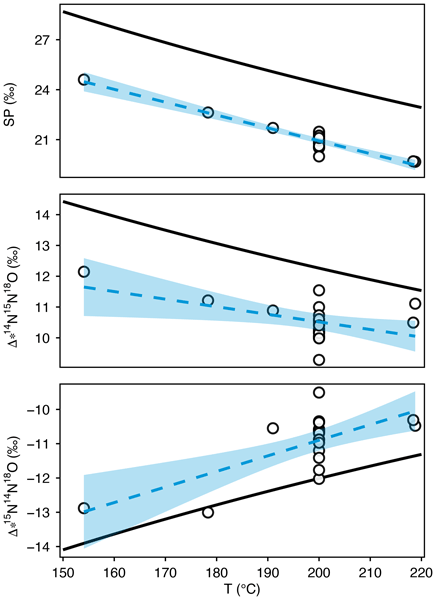
Abstract. Clumped isotopic measurements of nitrous oxide (N₂O) have the potential to offer unique constraints on the processes governing N₂O production and destruction, building on the information provided by δ15N, δ18O and 15N site preference (SP). Extending their application requires a robust absolute reference frame. Here we show that thermal equilibration of N₂O over γ-Al₂O₃ provides such a reference frame for measurements of the isotopologues 14N15N18O and 15N14N18O, as well as for SP. Using a quantum cascade laser absorption spectroscopy (QCLAS) platform, we simultaneously quantify seven isotopologues of N₂O, including 14N15N18O, 15N14N18O, and 15N15N16O. Experiments starting from isotopically-distinct starting materials show convergence to time-invariant compositions that are in agreement with theoretically predicted temperature dependencies. These results demonstrate that γ-Al₂O₃ activated at ≥ 550 °C catalyzes isotope exchange among isotopologues of N₂O at equilibration temperatures between 153 °C and 218 °C and thereby define an absolute stochastic reference frame for Δ14N15N18O and Δ15N14N18O. In contrast, 15N15N16O does not equilibrate under these conditions, suggesting selective activation of N–O but not N–N bonds. Comparison of equilibrium SP values with theoretical predictions reveals a systematic offset relative to the current reference scale, which will require future work to reconcile.
-
Notice on discussion status
The requested preprint has a corresponding peer-reviewed final revised paper. You are encouraged to refer to the final revised version.
-
Preprint
(876 KB)
-
Supplement
(377 KB)
-
The requested preprint has a corresponding peer-reviewed final revised paper. You are encouraged to refer to the final revised version.
- Preprint
(876 KB) - Metadata XML
-
Supplement
(377 KB) - BibTeX
- EndNote
- Final revised paper


Journal article(s) based on this preprint
Interactive discussion
Status: closed
-
RC1: 'Comment on egusphere-2026-874', Anonymous Referee #2, 21 Apr 2026
-
AC1: 'Reply on RC1', Paul Magyar, 17 Jul 2026
The comment was uploaded in the form of a supplement: https://egusphere.copernicus.org/preprints/2026/egusphere-2026-874/egusphere-2026-874-AC1-supplement.pdf
-
AC1: 'Reply on RC1', Paul Magyar, 17 Jul 2026
-
RC2: 'Comment on egusphere-2026-874', Anonymous Referee #3, 04 Jun 2026
The comment was uploaded in the form of a supplement: https://egusphere.copernicus.org/preprints/2026/egusphere-2026-874/egusphere-2026-874-RC2-supplement.pdf
-
AC2: 'Reply on RC2', Paul Magyar, 17 Jul 2026
The comment was uploaded in the form of a supplement: https://egusphere.copernicus.org/preprints/2026/egusphere-2026-874/egusphere-2026-874-AC2-supplement.pdf
-
AC2: 'Reply on RC2', Paul Magyar, 17 Jul 2026
Peer review completion


Interactive discussion
Status: closed
-
RC1: 'Comment on egusphere-2026-874', Anonymous Referee #2, 21 Apr 2026
This is a very thorough study of a promising approach for establishing a stochastic reference frame for the clumped isotopes of nitrous oxide. As the paper states, better understanding of the nitrous oxide atmospheric budget is extremely important due to its contribution to global radiative forcing. In general, quantifying the atmospheric budget is an under-determined problem and the use of additional isotopic species is likely to provide useful constraints. This will be most useful if highly accurate measurement techniques are developed. This, in turn, requires effective calibration methods and a stochastic reference frame is critical to achieving this for clumped isotopes. Hence, the topic is appropriate to this journal. Furthermore, the approach is creative and builds effectively upon previous work. And the results are substantial. The authors demonstrate a very promising approach for creating a stochastic reference frame for two of the three clumped species of interest and for SP. Even the null result that the 15N15N clumped species does not equilibrate is an important and useful finding. This paper should certainly be published in AMT with a few minor modifications.
My only significant recommendation is that the authors should do a better job of assessing their progress toward the ultimate goal of having a sufficiently accurate reference frame. That is to say, is equilibrium achieved with sufficient accuracy to match the measurement uncertainty? It seems, at least in some cases, that this is not the case (See Fig 4 and Table 1) since at line 180, the authors state that the measurement uncertainty “ranged from 0.09 ‰ to 0.18 ‰ for all isotopologues”. If complete equilibration is not achieved, then the authors should say why not and how significant is any remaining systematic variation and what they propose to do about it in future work. If, on the other hand, they believe that they have achieved complete randomization within the experimental error, they should state that more clearly and quantitatively.
Finally, I have a few additional comments and questions.
- At line 165, unspecified decomposition products were separated from N2O. How was this accomplished and what were the likely products?
- At line 88, the authors begin a description of their fast dual-inlet system for trapped gases and cite two references. They should also cite Wang et al. (Anal. Chem. 2020, 92, 2, 2034–2042), which first described this innovation.
- The temperature dependence of the catalyst activation shown in Figure 3 is extremely useful.
- The paper is well written, and the authors do give proper credit to related work. The abstract is clear and complete, and the language throughout the paper is fluent and precise. The paper is appropriately referenced.
Citation: https://doi.org/10.5194/egusphere-2026-874-RC1 -
AC1: 'Reply on RC1', Paul Magyar, 17 Jul 2026
The comment was uploaded in the form of a supplement: https://egusphere.copernicus.org/preprints/2026/egusphere-2026-874/egusphere-2026-874-AC1-supplement.pdf
-
RC2: 'Comment on egusphere-2026-874', Anonymous Referee #3, 04 Jun 2026
The comment was uploaded in the form of a supplement: https://egusphere.copernicus.org/preprints/2026/egusphere-2026-874/egusphere-2026-874-RC2-supplement.pdf
-
AC2: 'Reply on RC2', Paul Magyar, 17 Jul 2026
The comment was uploaded in the form of a supplement: https://egusphere.copernicus.org/preprints/2026/egusphere-2026-874/egusphere-2026-874-AC2-supplement.pdf
-
AC2: 'Reply on RC2', Paul Magyar, 17 Jul 2026
Peer review completion
Journal article(s) based on this preprint
Viewed
| HTML | XML | Total | Supplement | BibTeX | EndNote | |
|---|---|---|---|---|---|---|
| 444 | 178 | 49 | 671 | 88 | 40 | 51 |
- HTML: 444
- PDF: 178
- XML: 49
- Total: 671
- Supplement: 88
- BibTeX: 40
- EndNote: 51
Viewed (geographical distribution)
| Country | # | Views | % |
|---|
| Total: | 0 |
| HTML: | 0 |
| PDF: | 0 |
| XML: | 0 |
- 1

Nico Kueter
Simone Brunamonti
Naizhong Zhang
Ivan Prokhorov
Noémy Chénier
Lukas Emmenegger
Béla Tuzson
Joachim Mohn
The requested preprint has a corresponding peer-reviewed final revised paper. You are encouraged to refer to the final revised version.
- Preprint
(876 KB) - Metadata XML
-
Supplement
(377 KB) - BibTeX
- EndNote
- Final revised paper
This is a very thorough study of a promising approach for establishing a stochastic reference frame for the clumped isotopes of nitrous oxide. As the paper states, better understanding of the nitrous oxide atmospheric budget is extremely important due to its contribution to global radiative forcing. In general, quantifying the atmospheric budget is an under-determined problem and the use of additional isotopic species is likely to provide useful constraints. This will be most useful if highly accurate measurement techniques are developed. This, in turn, requires effective calibration methods and a stochastic reference frame is critical to achieving this for clumped isotopes. Hence, the topic is appropriate to this journal. Furthermore, the approach is creative and builds effectively upon previous work. And the results are substantial. The authors demonstrate a very promising approach for creating a stochastic reference frame for two of the three clumped species of interest and for SP. Even the null result that the 15N15N clumped species does not equilibrate is an important and useful finding. This paper should certainly be published in AMT with a few minor modifications.
My only significant recommendation is that the authors should do a better job of assessing their progress toward the ultimate goal of having a sufficiently accurate reference frame. That is to say, is equilibrium achieved with sufficient accuracy to match the measurement uncertainty? It seems, at least in some cases, that this is not the case (See Fig 4 and Table 1) since at line 180, the authors state that the measurement uncertainty “ranged from 0.09 ‰ to 0.18 ‰ for all isotopologues”. If complete equilibration is not achieved, then the authors should say why not and how significant is any remaining systematic variation and what they propose to do about it in future work. If, on the other hand, they believe that they have achieved complete randomization within the experimental error, they should state that more clearly and quantitatively.
Finally, I have a few additional comments and questions.