
the Creative Commons Attribution 4.0 License.
the Creative Commons Attribution 4.0 License.
 | 10 Apr 2026
Mesoscale Structure of Flickering Aurora from Wide-Field High-Speed Imaging
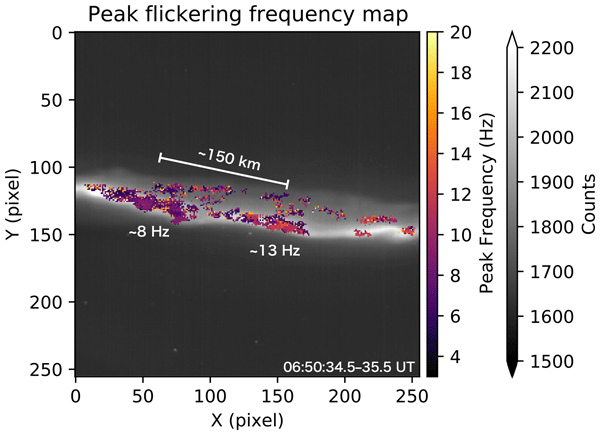
Abstract. We report wide-field observations of flickering aurora obtained with a fast sCMOS camera and a diagonal fisheye lens at Poker Flat Research Range, Alaska, on 8 February 2016. The system recorded 512×512 pixel images at 80 Hz, enabling us to investigate the mesoscale organization of flickering along a discrete auroral arc over spatial scales of several hundred kilometers. Flickering occurred intermittently with dominant frequencies between 3 and 20 Hz, most commonly within a narrower band of 4–12 Hz. Spatial maps of the peak frequency reveal that regions with similar periodicities sometimes formed coherent clusters on scales of∼10 km, and that multiple clusters with different frequencies (e.g., ∼8 and∼13 Hz) could coexist simultaneously along the same arc, separated by ∼150 km. Some of these clusters moved together with the background arc, suggesting that the modulation is closely tied to the local plasma environment and inverted-V potential structures associated with discrete aurora. An automated patch detection analysis showed that, although individual events may locally suggest an inverse relationship between flickering frequency and patch size, this trend does not persist statistically. Instead, flickering at a given dominant frequency occurs over a wide range of patch sizes, with a typical north–south scale of 4.4±2.4 km at 110 km altitude. These results are consistent with generation scenarios in which electron precipitation is modulated by interference among multiple EMIC waves in the auroral acceleration region, extending previous narrow-field studies to the mesoscale and demonstrating the diagnostic value of wide-field, high-cadence imaging for wave–particle interactions in the auroral ionosphere.
Competing interests: At least one of the (co-)authors is a member of the editorial board of Annales Geophysicae. The peer-review process was guided by an independent editor, and the authors also have no other competing interests to declare.
Publisher's note: Copernicus Publications remains neutral with regard to jurisdictional claims made in the text, published maps, institutional affiliations, or any other geographical representation in this paper. While Copernicus Publications makes every effort to include appropriate place names, the final responsibility lies with the authors. Views expressed in the text are those of the authors and do not necessarily reflect the views of the publisher.-
Notice on discussion status
The requested preprint has a corresponding peer-reviewed final revised paper. You are encouraged to refer to the final revised version.
-
Preprint
(8140 KB)
-
The requested preprint has a corresponding peer-reviewed final revised paper. You are encouraged to refer to the final revised version.
- Preprint
(8140 KB) - Metadata XML
- BibTeX
- EndNote
- Final revised paper


Journal article(s) based on this preprint
Interactive discussion
Status: closed
-
RC1: 'Comment on egusphere-2026-865', Anonymous Referee #1, 13 Apr 2026
-
AC1: 'Reply on RC1', Sota Nanjo, 17 Jun 2026
Author response to RC1
We thank the referee for the careful, quick, and constructive review and for the positive assessment of the novelty and clarity of the manuscript. In the revised manuscript, we plan to clarify the limitations of the wide-field single-station imaging, add quantitative checks where feasible, and provide a brief geophysical context for the event. Below we respond to each comment individually.
Major comment 1:
The line-of-sight and fisheye lens distortions need more careful consideration. While the authors provide reasonable mentioning at a qualitative level, more quantitative estimates of projection effects (particularly far from zenith) would strengthen the conclusions. Points to consider are mapping distortions vs. elevation angle, uncertainties in patch size and cluster boundaries, and systematic biases due to variable emission altitudes.Response:
We agree. In the revised manuscript, we will expand the discussion of line-of-sight and projection effects. We will clarify that the reported patch sizes should be interpreted as apparent mapped scales at an assumed emission altitude, rather than uniquely reconstructed true horizontal sizes.We also plan to add a simple quantitative estimate of the possible smearing caused by finite emission thickness. For example, if an emission layer with an effective vertical thickness H is viewed at elevation angle e, the projected horizontal smearing can be estimated approximately as H / tan(e). This estimate will be used to illustrate that low-elevation observations can overestimate apparent patch sizes. We will also check whether the main frequency-size result changes when only higher-elevation detections are used.
Major comment 2
As the authors point out, the patch detection via keograms may potentially bias the size statistics. So it remains unclear if the authors have analyzed how their patch detection criteria may influence their results (e.g. with different count thresholds or vertical extent criteria)? How sensitive is the patch-size distribution to the threshold for ∆Count? Did the authors try different values than the threshold of 30, or why was this value chosen? Have the authors looked at how often the keogram slice misses the true center of a patch? A more careful analysis would further strengthen the significance of the conclusions.
Response:
We agree. We will clarify that the keogram-based patch-size estimate has limitations because a one-dimensional slice may not pass through the true center of each patch. Therefore, the derived size distribution should be interpreted as a distribution of apparent cross-slice extents, not exact two-dimensional patch diameters.To test the sensitivity to the detection threshold, we plan to repeat the patch-detection and frequency-size analysis using several \delta Count thresholds, for example 20, 30, and 40. We will report how the number of detected patches and the patch-size distribution change with threshold, and whether the main conclusion regarding the absence of a robust monotonic frequency-size relation remains unchanged.
We will also briefly explain why the main statistical analysis focuses on the north-south direction. Since the auroral arc was mainly elongated in the east-west direction, east-west slices can miss the auroral emission in top/bottom areas of the field-of-view. We plan to mention this limitation in the revised manuscript.
Major comment 3
The patch size and spatial separation rely on a fixed emission altitude that the authors have chosen (110 km). However, literature shows that there can be significant spread in the peak auroral emission heights (Whiter et al., 2023). Some reports also claim that there can be 557.7 nm emissions below 90 km altitude in the summer mesosphere (Lee et al., 2017), or higher than 120 km (Mende et al., 1993). What is the scientific justification that the authors have used for choosing a fixed emission height of 110 km? How will the spatial estimates be affected if the chosen emission altitude is slightly inaccurate? A more careful analysis of uncertainties, and some quantitative numbers on potential errors, will further strengthen the results.
Response:
We agree that the fixed-altitude mapping should be justified more clearly. We used 110 km as a representative altitude for the green-line-dominated auroral emission, but we do not regard it as a uniquely determined emission height, especially because the camera was not equipped any filter and the emission altitude can vary with precipitation energy.In the revised manuscript, we will state explicitly that all mapped distances are apparent horizontal distances at an assumed altitude. We also plan to estimate how the patch sizes change if the projection altitude is varied, for example over 90, 100, 110, and 120 km. This will allow us to quantify how much the absolute patch-size values depend on the assumed altitude.
We will also connect this point with the finite-emission-thickness estimate described in response to Major comment 1. The key clarification will be that the assumed altitude and line-of-sight geometry affect the absolute patch sizes and separations, while the measured flickering frequencies themselves are not altered by this mapping assumption.
Major comment 4
The analysis focuses solely on the auroral observations, with no reference to a broader geophysical context. The paper does not mention the solar wind activity level, geomagnetic activity indices, substorm phase, etc. It may not be necessary with additional figures here, but the broader implications of the results can easily be improved if the authors add a few lines of text to the manuscript about the overall activity level during the observation period. Was this a particularly quiet or active time, in terms of solar wind, magnetic indices, or substorms?
Response:
We agree. We will add a brief description of the broader geophysical context of the event. We plan to inspect available contextual optical data, such as keograms from other cameras and for longer time, to describe whether the flickering interval was embedded in a broader auroral activation.
We will also add a summary of solar-wind and geomagnetic conditions based on OMNI and geomagnetic indices. In particular, we will summarize the solar-wind speed, IMF Bz, AE/AL activity, and SYM-H level during the analyzed interval, in order to clarify whether the event occurred under quiet or enhanced geomagnetic conditions.
Major comment 5
The paper does not mention any in-situ or ground-based radar/magnetometer data, that might be of relevance. The conclusions might be further strengthened and supported by additional ground magnetometer pulsation data, Poker Flat ISR electron density/temperature measurements, or spaceborne EMIC wave observations (THEMIS, Arase, etc). If unavailable, the authors should at least state this explicitly and discuss the limitations.
Response:
We agree that such data would be valuable for testing the EMIC-wave interpretation. We will check the availability of relevant supporting observations and describe the result in the revised manuscript.In particular, we plan to examine Poker Flat ground magnetometer data during the optical interval. These data can indicate whether the event occurred during an active auroral electrojet or substorm-time interval, it could be challenging by themselves to identify the source-region wave mode responsible for the flickering aurora.
We will also check whether suitable conjugate in-situ wave observations are available using spacecraft conjunction. If no suitable conjunction is found, we will state this explicitly. In addition, we will check the availability of the ISR data in Madrigal. If no suitable radar data are available, we will clarify that the present interpretation is based mainly on optical observations.
Minor comment 1
Line 202: The video supplement is very helpful. However, please consider referencing a few specific times in the text that show key features.
Response:
We agree. We will fix this.
Minor comment 2
The authors may also want to add a few more references to small-scale structures in flickering aurora (Whiter et al., 2008), patch size evolution during pulsating aurora (Partamies et al., 2019), or wave-like structures in the aurora before substorm onset (Wu et al., 2025).
Response:
We agree. We will add the suggested references where appropriate.
Citation: https://doi.org/10.5194/egusphere-2026-865-AC1
-
AC1: 'Reply on RC1', Sota Nanjo, 17 Jun 2026
-
RC2: 'Comment on egusphere-2026-865', Robert Michell, 11 May 2026
This paper presents a case study of a flickering auroral event, which persisted for quite a long time, allowing for a detailed analysis, using a wide FOV sCMOS camera. The data and analysis is presented in a clear and logical manner. I only have a few minor comments that should be addressed before this paper can be accepted.
Minor comments:
1) Figure 1 and the FFT spectra. The bright, broadband spectral features, such as the one around 07:05 UT can be caused by the sudden change in brightness when the bright feature moves into the region where the time series is being extracted from. Care must be taken to not include such 'spatial' changes as rapid temporal variations. Perhaps a comment about this could be added. With FFTs a rapid change in brightness can lead to an artificial frequency response at many frequencies...
2) Line 135: Do you mean panels (b) and (d)? Panels (a) and (c) do not appear to show clear propagation of the auroral structure within the boxed region. Perhaps clarify what is meant here, if I am wrong.
3). Figure 4 and 5: It seems this analysis was only done in one direction through the images, have you done this same analysis through the other direction in the images? For example at Y = 130 and Y = 120 and then remake Figures 4, 5 and 6, for the other direction (the size of the patches in the other direction). If you do not do this in the paper, you should at least explain why it was not done. It seems only natural to examine the size of the patches in both directions, not just one. We can't assume the patches are symmetric in x and y.
4) Discussion, around line 245 or so. You discuss the larger context of the auroral event that contains the flickering aurora. Have you considered adding in an all-sky image or an all-sky keogram from the whole night to show the overall context within which this flickering event is contained? I know all-sky camera data from Poker Flat exists for this day and time, at least in the green line.
5) Line 320 and 345: There is also a comparison to a dispersion relation presented in Michell, et al., 2012, Figure 12. They showed that there was some consistency between the theoretical dispersion relation for O+ EMIC waves, for a range of k-parallel and the observed features of the flickering aurora.
Citation: https://doi.org/10.5194/egusphere-2026-865-RC2 -
AC2: 'Reply on RC2', Sota Nanjo, 17 Jun 2026
Author response to RC2
We thank the referee for the positive assessment of the manuscript. In the revised manuscript, we plan to address the points raised by clarifying the interpretation of the FFT overview, correcting the panel reference in Figure 3, explaining the directional limitation of the patch-size analysis, adding broader context, and adding the suggested reference. Below we respond to each comment individually.
Minor comment 1:
Figure 1 and the FFT spectra. The bright, broadband spectral features, such as the one around 07:05 UT, can be caused by the sudden change in brightness when the bright feature moves into the region where the time series is being extracted from. Care must be taken to not include such “spatial” changes as rapid temporal variations. Perhaps a comment about this could be added. With FFTs a rapid change in brightness can lead to an artificial frequency response at many frequencies.Response:
We agree. In the revised manuscript, we will add a note on possible artifacts in the FFT overview shown in Figure 1. We will check the bright vertical spike-like structures in Figure 1f, including those around 06:48:00 UT, 06:55:44 UT, and 07:03:44 UT, and clarify whether they are related to short image-acquisition gaps or rapid brightness changes as auroral structures move into the analyzed region.Minor comment 2
Line 135: Do you mean panels (b) and (d)? Panels (a) and (c) do not appear to show clear propagation of the auroral structure within the boxed region. Perhaps clarify what is meant here, if I am wrong.
Response:
Yes, the referee is correct. We meant panels (b) and (d) for the motion of the frequency cluster. We will correct the text accordingly.
Minor comment 3
Figures 4 and 5: It seems this analysis was only done in one direction through the images. Have you done this same analysis through the other direction in the images? For example at Y = 130 and Y = 120 and then remake Figures 4, 5 and 6, for the other direction. If you do not do this in the paper, you should at least explain why it was not done. It seems only natural to examine the size of the patches in both directions, not just one. We cannot assume the patches are symmetric in x and y.
Response:
We agree that the patches should not be assumed to be symmetric. In the revised manuscript, we will clarify that the reported patch sizes are apparent extents measured along the selected keogram slices, not full two-dimensional patch sizes.The main reason for using vertical slices is that the discrete arc extended mainly in the horizontal, approximately east-west, direction. Therefore, fixed horizontal slices near the upper or lower part of the field of view may not sample the flickering patches efficiently. In addition, some patches propagate along the arc in the horizontal direction, so horizontal slices can overestimate the apparent patch length by mixing spatial extent with along-arc motion. For these reasons, we will keep the main statistical analysis in the vertical direction, and we will explicitly state this limitation in the revised manuscript.
Minor comment 4
Discussion, around line 245 or so. Have you considered adding in an all-sky image or an all-sky keogram from the whole night to show the overall context within which this flickering event is contained? I know all-sky camera data from Poker Flat exists for this day and time, at least in the green line.
Response:
Thank you for the suggestion. We agree that a longer-time optical context is useful. In the revised manuscript, we will add a keogram with longer temporal coverage for this night to show that the flickering interval was embedded in a broader auroral activation.
Minor comment 5
Line 320 and 345: There is also a comparison to a dispersion relation presented in Michell et al. (2012), Figure 12. They showed that there was some consistency between the theoretical dispersion relation for O+ EMIC waves, for a range of k-parallel and the observed features of the flickering aurora.
Response:
Thank you for pointing this out. We will add Michell et al. (2012) to the discussion of the EMIC-wave dispersion relation.Citation: https://doi.org/10.5194/egusphere-2026-865-AC2
-
AC2: 'Reply on RC2', Sota Nanjo, 17 Jun 2026
Peer review completion


Interactive discussion
Status: closed
-
RC1: 'Comment on egusphere-2026-865', Anonymous Referee #1, 13 Apr 2026
Review of «Mesoscale Structure of Flickering Aurora from Wide-Field High-Speed Imaging» by S. Nanjo et al.
The paper presents a novel investigation of the mesoscale organization of flickering aurora using a wide-field, high-cadence camera at Poker Flat. Unlike most prior studies, which rely on narrow-field or photometric measurements, the authors use a 180° fisheye lens and 80 Hz sampling to study auroral contexts across hundreds of kilometers, while retaining sufficient temporal resolution to resolve 3–20 Hz flickering. The paper adds important observational evidence for EMIC wave scenarios of flickering aurora. The analysis is technically sound, clearly written, and presents new findings. But some extra clarification and improvement is recommended.
Major comments
The line-of-sight and fisheye lens distortions need more careful consideration. While the authors provide reasonable mentioning at a qualitative level, more quantitative estimates of projection effects (particularly far from zenith) would strengthen the conclusions. Points to consider are mapping distortions vs. elevation angle, uncertainties in patch size and cluster boundaries, and systematic biases due to variable emission altitudes.
As the authors point out, the patch detection via keograms may potentially bias the size statistics. So it remains unclear if the authors have analyzed how their patch detection criteria may influence their results (e.g. with different count thresholds or vertical extent criteria)? How sensitive is the patch-size distribution to the threshold for ∆Count? Did the authors try different values than the threshold of 30, or why was this value chosen? Have the authors looked at how often the keogram slice misses the true center of a patch? A more careful analysis would further strengthen the significance of the conclusions.
The patch size and spatial separation rely on a fixed emission altitude that the authors have chosen (110 km). However, literature shows that there can be significant spread in the peak auroral emission heights (Whiter et al., 2023). Some reports also claim that there can be 557.7 nm emissions below 90 km altitude in the summer mesosphere (Lee et al., 2017), or higher than 120 km (Mende et al., 1993). What is the scientific justification that the authors have used for choosing a fixed emission height of 110 km? How will the spatial estimates be affected if the chosen emission altitude is slightly inaccurate? A more careful analysis of uncertainties, and some quantitative numbers on potential errors, will further strengthen the results.
The analysis focuses solely on the auroral observations, with no reference to a broader geophysical context. The paper does not mention the solar wind activity level, geomagnetic activity indices, substorm phase, etc. It may not be necessary with additional figures here, but the broader implications of the results can easily be improved if the authors add a few lines of text to the manuscript about the overall activity level during the observation period. Was this a particularly quiet or active time, in terms of solar wind, magnetic indices, or substorms?
The paper does not mention any in-situ or ground-based radar/magnetometer data, that might be of relevance. The conclusions might be further strengthened and supported by additional ground magnetometer pulsation data, Poker Flat ISR electron density/temperature measurements, or spaceborne EMIC wave observations (THEMIS, Arase, etc). If unavailable, the authors should at least state this explicitly and discuss the limitations.
Minor comments
Line 202: The video supplement is very helpful. However, please consider referencing a few specific times in the text that show key features.
The authors may also want to add a few more references to small-scale structures in flickering aurora (Whiter et al., 2008), patch size evolution during pulsating aurora (Partamies et al., 2019), or wave-like structures in the aurora before substorm onset (Wu et al., 2025).
References:
Lee, Y.-S., Y.-S.Kwak, K.-C.Kim, B.Solheim, R.Lee, and J.Lee (2017), Observation of atomic oxygen O(1S) green-line emission in the summer polar upper mesosphere associated with high-energy (≥30 keV) electron precipitation during high-speed solar wind streams, J. Geophys. Res. Space Physics, 122, 1042–1054, https://doi.org/10.1002/2016JA023413
Mende, S. B., G. R.Swenson, S. P.Geller, R. A.Viereck, E.Murad, and C. P.Pike (1993), Limb view spectrum of the Earth's airglow, J. Geophys. Res., 98(A11), 19117–19125, https://doi.org/10.1029/93JA02282
Partamies, N., Bolmgren, K., Heino, E., Ivchenko, N., Borovsky, J. E., & Dahlgren, H. (2019). Patch size evolution during pulsating aurora. Journal of Geophysical Research: Space Physics, 124, 4725–4738. https://doi.org/10.1029/2018JA026423
Whiter, D. K., B. S.Lanchester, B.Gustavsson, N.Ivchenko, J. M.Sullivan, and H.Dahlgren (2008), Small-scale structures in flickering aurora, Geophys. Res. Lett., 35, L23103, https://doi.org/10.1029/2008GL036134
Whiter, D. K., Partamies, N., Gustavsson, B., and Kauristie, K. (2023), The altitude of green OI 557.7 nm and blue N2+ 427.8 nm aurora, Ann. Geophys., 41, 1–12, https://doi.org/10.5194/angeo-41-1-2023
Wu, S.Y., Whiter, D.K., Lamy, L. et al. (2025), Radio emissions reveal Alfvénic activity and electron acceleration prior to substorm onset. Nat Commun 16, 10553, https://doi.org/10.1038/s41467-025-65580-8
Citation: https://doi.org/10.5194/egusphere-2026-865-RC1 -
AC1: 'Reply on RC1', Sota Nanjo, 17 Jun 2026
Author response to RC1
We thank the referee for the careful, quick, and constructive review and for the positive assessment of the novelty and clarity of the manuscript. In the revised manuscript, we plan to clarify the limitations of the wide-field single-station imaging, add quantitative checks where feasible, and provide a brief geophysical context for the event. Below we respond to each comment individually.
Major comment 1:
The line-of-sight and fisheye lens distortions need more careful consideration. While the authors provide reasonable mentioning at a qualitative level, more quantitative estimates of projection effects (particularly far from zenith) would strengthen the conclusions. Points to consider are mapping distortions vs. elevation angle, uncertainties in patch size and cluster boundaries, and systematic biases due to variable emission altitudes.Response:
We agree. In the revised manuscript, we will expand the discussion of line-of-sight and projection effects. We will clarify that the reported patch sizes should be interpreted as apparent mapped scales at an assumed emission altitude, rather than uniquely reconstructed true horizontal sizes.We also plan to add a simple quantitative estimate of the possible smearing caused by finite emission thickness. For example, if an emission layer with an effective vertical thickness H is viewed at elevation angle e, the projected horizontal smearing can be estimated approximately as H / tan(e). This estimate will be used to illustrate that low-elevation observations can overestimate apparent patch sizes. We will also check whether the main frequency-size result changes when only higher-elevation detections are used.
Major comment 2
As the authors point out, the patch detection via keograms may potentially bias the size statistics. So it remains unclear if the authors have analyzed how their patch detection criteria may influence their results (e.g. with different count thresholds or vertical extent criteria)? How sensitive is the patch-size distribution to the threshold for ∆Count? Did the authors try different values than the threshold of 30, or why was this value chosen? Have the authors looked at how often the keogram slice misses the true center of a patch? A more careful analysis would further strengthen the significance of the conclusions.
Response:
We agree. We will clarify that the keogram-based patch-size estimate has limitations because a one-dimensional slice may not pass through the true center of each patch. Therefore, the derived size distribution should be interpreted as a distribution of apparent cross-slice extents, not exact two-dimensional patch diameters.To test the sensitivity to the detection threshold, we plan to repeat the patch-detection and frequency-size analysis using several \delta Count thresholds, for example 20, 30, and 40. We will report how the number of detected patches and the patch-size distribution change with threshold, and whether the main conclusion regarding the absence of a robust monotonic frequency-size relation remains unchanged.
We will also briefly explain why the main statistical analysis focuses on the north-south direction. Since the auroral arc was mainly elongated in the east-west direction, east-west slices can miss the auroral emission in top/bottom areas of the field-of-view. We plan to mention this limitation in the revised manuscript.
Major comment 3
The patch size and spatial separation rely on a fixed emission altitude that the authors have chosen (110 km). However, literature shows that there can be significant spread in the peak auroral emission heights (Whiter et al., 2023). Some reports also claim that there can be 557.7 nm emissions below 90 km altitude in the summer mesosphere (Lee et al., 2017), or higher than 120 km (Mende et al., 1993). What is the scientific justification that the authors have used for choosing a fixed emission height of 110 km? How will the spatial estimates be affected if the chosen emission altitude is slightly inaccurate? A more careful analysis of uncertainties, and some quantitative numbers on potential errors, will further strengthen the results.
Response:
We agree that the fixed-altitude mapping should be justified more clearly. We used 110 km as a representative altitude for the green-line-dominated auroral emission, but we do not regard it as a uniquely determined emission height, especially because the camera was not equipped any filter and the emission altitude can vary with precipitation energy.In the revised manuscript, we will state explicitly that all mapped distances are apparent horizontal distances at an assumed altitude. We also plan to estimate how the patch sizes change if the projection altitude is varied, for example over 90, 100, 110, and 120 km. This will allow us to quantify how much the absolute patch-size values depend on the assumed altitude.
We will also connect this point with the finite-emission-thickness estimate described in response to Major comment 1. The key clarification will be that the assumed altitude and line-of-sight geometry affect the absolute patch sizes and separations, while the measured flickering frequencies themselves are not altered by this mapping assumption.
Major comment 4
The analysis focuses solely on the auroral observations, with no reference to a broader geophysical context. The paper does not mention the solar wind activity level, geomagnetic activity indices, substorm phase, etc. It may not be necessary with additional figures here, but the broader implications of the results can easily be improved if the authors add a few lines of text to the manuscript about the overall activity level during the observation period. Was this a particularly quiet or active time, in terms of solar wind, magnetic indices, or substorms?
Response:
We agree. We will add a brief description of the broader geophysical context of the event. We plan to inspect available contextual optical data, such as keograms from other cameras and for longer time, to describe whether the flickering interval was embedded in a broader auroral activation.
We will also add a summary of solar-wind and geomagnetic conditions based on OMNI and geomagnetic indices. In particular, we will summarize the solar-wind speed, IMF Bz, AE/AL activity, and SYM-H level during the analyzed interval, in order to clarify whether the event occurred under quiet or enhanced geomagnetic conditions.
Major comment 5
The paper does not mention any in-situ or ground-based radar/magnetometer data, that might be of relevance. The conclusions might be further strengthened and supported by additional ground magnetometer pulsation data, Poker Flat ISR electron density/temperature measurements, or spaceborne EMIC wave observations (THEMIS, Arase, etc). If unavailable, the authors should at least state this explicitly and discuss the limitations.
Response:
We agree that such data would be valuable for testing the EMIC-wave interpretation. We will check the availability of relevant supporting observations and describe the result in the revised manuscript.In particular, we plan to examine Poker Flat ground magnetometer data during the optical interval. These data can indicate whether the event occurred during an active auroral electrojet or substorm-time interval, it could be challenging by themselves to identify the source-region wave mode responsible for the flickering aurora.
We will also check whether suitable conjugate in-situ wave observations are available using spacecraft conjunction. If no suitable conjunction is found, we will state this explicitly. In addition, we will check the availability of the ISR data in Madrigal. If no suitable radar data are available, we will clarify that the present interpretation is based mainly on optical observations.
Minor comment 1
Line 202: The video supplement is very helpful. However, please consider referencing a few specific times in the text that show key features.
Response:
We agree. We will fix this.
Minor comment 2
The authors may also want to add a few more references to small-scale structures in flickering aurora (Whiter et al., 2008), patch size evolution during pulsating aurora (Partamies et al., 2019), or wave-like structures in the aurora before substorm onset (Wu et al., 2025).
Response:
We agree. We will add the suggested references where appropriate.
Citation: https://doi.org/10.5194/egusphere-2026-865-AC1
-
AC1: 'Reply on RC1', Sota Nanjo, 17 Jun 2026
-
RC2: 'Comment on egusphere-2026-865', Robert Michell, 11 May 2026
This paper presents a case study of a flickering auroral event, which persisted for quite a long time, allowing for a detailed analysis, using a wide FOV sCMOS camera. The data and analysis is presented in a clear and logical manner. I only have a few minor comments that should be addressed before this paper can be accepted.
Minor comments:
1) Figure 1 and the FFT spectra. The bright, broadband spectral features, such as the one around 07:05 UT can be caused by the sudden change in brightness when the bright feature moves into the region where the time series is being extracted from. Care must be taken to not include such 'spatial' changes as rapid temporal variations. Perhaps a comment about this could be added. With FFTs a rapid change in brightness can lead to an artificial frequency response at many frequencies...
2) Line 135: Do you mean panels (b) and (d)? Panels (a) and (c) do not appear to show clear propagation of the auroral structure within the boxed region. Perhaps clarify what is meant here, if I am wrong.
3). Figure 4 and 5: It seems this analysis was only done in one direction through the images, have you done this same analysis through the other direction in the images? For example at Y = 130 and Y = 120 and then remake Figures 4, 5 and 6, for the other direction (the size of the patches in the other direction). If you do not do this in the paper, you should at least explain why it was not done. It seems only natural to examine the size of the patches in both directions, not just one. We can't assume the patches are symmetric in x and y.
4) Discussion, around line 245 or so. You discuss the larger context of the auroral event that contains the flickering aurora. Have you considered adding in an all-sky image or an all-sky keogram from the whole night to show the overall context within which this flickering event is contained? I know all-sky camera data from Poker Flat exists for this day and time, at least in the green line.
5) Line 320 and 345: There is also a comparison to a dispersion relation presented in Michell, et al., 2012, Figure 12. They showed that there was some consistency between the theoretical dispersion relation for O+ EMIC waves, for a range of k-parallel and the observed features of the flickering aurora.
Citation: https://doi.org/10.5194/egusphere-2026-865-RC2 -
AC2: 'Reply on RC2', Sota Nanjo, 17 Jun 2026
Author response to RC2
We thank the referee for the positive assessment of the manuscript. In the revised manuscript, we plan to address the points raised by clarifying the interpretation of the FFT overview, correcting the panel reference in Figure 3, explaining the directional limitation of the patch-size analysis, adding broader context, and adding the suggested reference. Below we respond to each comment individually.
Minor comment 1:
Figure 1 and the FFT spectra. The bright, broadband spectral features, such as the one around 07:05 UT, can be caused by the sudden change in brightness when the bright feature moves into the region where the time series is being extracted from. Care must be taken to not include such “spatial” changes as rapid temporal variations. Perhaps a comment about this could be added. With FFTs a rapid change in brightness can lead to an artificial frequency response at many frequencies.Response:
We agree. In the revised manuscript, we will add a note on possible artifacts in the FFT overview shown in Figure 1. We will check the bright vertical spike-like structures in Figure 1f, including those around 06:48:00 UT, 06:55:44 UT, and 07:03:44 UT, and clarify whether they are related to short image-acquisition gaps or rapid brightness changes as auroral structures move into the analyzed region.Minor comment 2
Line 135: Do you mean panels (b) and (d)? Panels (a) and (c) do not appear to show clear propagation of the auroral structure within the boxed region. Perhaps clarify what is meant here, if I am wrong.
Response:
Yes, the referee is correct. We meant panels (b) and (d) for the motion of the frequency cluster. We will correct the text accordingly.
Minor comment 3
Figures 4 and 5: It seems this analysis was only done in one direction through the images. Have you done this same analysis through the other direction in the images? For example at Y = 130 and Y = 120 and then remake Figures 4, 5 and 6, for the other direction. If you do not do this in the paper, you should at least explain why it was not done. It seems only natural to examine the size of the patches in both directions, not just one. We cannot assume the patches are symmetric in x and y.
Response:
We agree that the patches should not be assumed to be symmetric. In the revised manuscript, we will clarify that the reported patch sizes are apparent extents measured along the selected keogram slices, not full two-dimensional patch sizes.The main reason for using vertical slices is that the discrete arc extended mainly in the horizontal, approximately east-west, direction. Therefore, fixed horizontal slices near the upper or lower part of the field of view may not sample the flickering patches efficiently. In addition, some patches propagate along the arc in the horizontal direction, so horizontal slices can overestimate the apparent patch length by mixing spatial extent with along-arc motion. For these reasons, we will keep the main statistical analysis in the vertical direction, and we will explicitly state this limitation in the revised manuscript.
Minor comment 4
Discussion, around line 245 or so. Have you considered adding in an all-sky image or an all-sky keogram from the whole night to show the overall context within which this flickering event is contained? I know all-sky camera data from Poker Flat exists for this day and time, at least in the green line.
Response:
Thank you for the suggestion. We agree that a longer-time optical context is useful. In the revised manuscript, we will add a keogram with longer temporal coverage for this night to show that the flickering interval was embedded in a broader auroral activation.
Minor comment 5
Line 320 and 345: There is also a comparison to a dispersion relation presented in Michell et al. (2012), Figure 12. They showed that there was some consistency between the theoretical dispersion relation for O+ EMIC waves, for a range of k-parallel and the observed features of the flickering aurora.
Response:
Thank you for pointing this out. We will add Michell et al. (2012) to the discussion of the EMIC-wave dispersion relation.Citation: https://doi.org/10.5194/egusphere-2026-865-AC2
-
AC2: 'Reply on RC2', Sota Nanjo, 17 Jun 2026
Peer review completion
Journal article(s) based on this preprint
Viewed
| HTML | XML | Total | BibTeX | EndNote | |
|---|---|---|---|---|---|
| 333 | 171 | 31 | 535 | 33 | 38 |
- HTML: 333
- PDF: 171
- XML: 31
- Total: 535
- BibTeX: 33
- EndNote: 38
Viewed (geographical distribution)
| Country | # | Views | % |
|---|
| Total: | 0 |
| HTML: | 0 |
| PDF: | 0 |
| XML: | 0 |
- 1

Satoshi Kurita
Tima Sergienko
Yoshizumi Miyoshi
Ryuho Kataoka
The requested preprint has a corresponding peer-reviewed final revised paper. You are encouraged to refer to the final revised version.
- Preprint
(8140 KB) - Metadata XML
Review of «Mesoscale Structure of Flickering Aurora from Wide-Field High-Speed Imaging» by S. Nanjo et al.
The paper presents a novel investigation of the mesoscale organization of flickering aurora using a wide-field, high-cadence camera at Poker Flat. Unlike most prior studies, which rely on narrow-field or photometric measurements, the authors use a 180° fisheye lens and 80 Hz sampling to study auroral contexts across hundreds of kilometers, while retaining sufficient temporal resolution to resolve 3–20 Hz flickering. The paper adds important observational evidence for EMIC wave scenarios of flickering aurora. The analysis is technically sound, clearly written, and presents new findings. But some extra clarification and improvement is recommended.
Major comments
The line-of-sight and fisheye lens distortions need more careful consideration. While the authors provide reasonable mentioning at a qualitative level, more quantitative estimates of projection effects (particularly far from zenith) would strengthen the conclusions. Points to consider are mapping distortions vs. elevation angle, uncertainties in patch size and cluster boundaries, and systematic biases due to variable emission altitudes.
As the authors point out, the patch detection via keograms may potentially bias the size statistics. So it remains unclear if the authors have analyzed how their patch detection criteria may influence their results (e.g. with different count thresholds or vertical extent criteria)? How sensitive is the patch-size distribution to the threshold for ∆Count? Did the authors try different values than the threshold of 30, or why was this value chosen? Have the authors looked at how often the keogram slice misses the true center of a patch? A more careful analysis would further strengthen the significance of the conclusions.
The patch size and spatial separation rely on a fixed emission altitude that the authors have chosen (110 km). However, literature shows that there can be significant spread in the peak auroral emission heights (Whiter et al., 2023). Some reports also claim that there can be 557.7 nm emissions below 90 km altitude in the summer mesosphere (Lee et al., 2017), or higher than 120 km (Mende et al., 1993). What is the scientific justification that the authors have used for choosing a fixed emission height of 110 km? How will the spatial estimates be affected if the chosen emission altitude is slightly inaccurate? A more careful analysis of uncertainties, and some quantitative numbers on potential errors, will further strengthen the results.
The analysis focuses solely on the auroral observations, with no reference to a broader geophysical context. The paper does not mention the solar wind activity level, geomagnetic activity indices, substorm phase, etc. It may not be necessary with additional figures here, but the broader implications of the results can easily be improved if the authors add a few lines of text to the manuscript about the overall activity level during the observation period. Was this a particularly quiet or active time, in terms of solar wind, magnetic indices, or substorms?
The paper does not mention any in-situ or ground-based radar/magnetometer data, that might be of relevance. The conclusions might be further strengthened and supported by additional ground magnetometer pulsation data, Poker Flat ISR electron density/temperature measurements, or spaceborne EMIC wave observations (THEMIS, Arase, etc). If unavailable, the authors should at least state this explicitly and discuss the limitations.
Minor comments
Line 202: The video supplement is very helpful. However, please consider referencing a few specific times in the text that show key features.
The authors may also want to add a few more references to small-scale structures in flickering aurora (Whiter et al., 2008), patch size evolution during pulsating aurora (Partamies et al., 2019), or wave-like structures in the aurora before substorm onset (Wu et al., 2025).
References:
Lee, Y.-S., Y.-S.Kwak, K.-C.Kim, B.Solheim, R.Lee, and J.Lee (2017), Observation of atomic oxygen O(1S) green-line emission in the summer polar upper mesosphere associated with high-energy (≥30 keV) electron precipitation during high-speed solar wind streams, J. Geophys. Res. Space Physics, 122, 1042–1054, https://doi.org/10.1002/2016JA023413
Mende, S. B., G. R.Swenson, S. P.Geller, R. A.Viereck, E.Murad, and C. P.Pike (1993), Limb view spectrum of the Earth's airglow, J. Geophys. Res., 98(A11), 19117–19125, https://doi.org/10.1029/93JA02282
Partamies, N., Bolmgren, K., Heino, E., Ivchenko, N., Borovsky, J. E., & Dahlgren, H. (2019). Patch size evolution during pulsating aurora. Journal of Geophysical Research: Space Physics, 124, 4725–4738. https://doi.org/10.1029/2018JA026423
Whiter, D. K., B. S.Lanchester, B.Gustavsson, N.Ivchenko, J. M.Sullivan, and H.Dahlgren (2008), Small-scale structures in flickering aurora, Geophys. Res. Lett., 35, L23103, https://doi.org/10.1029/2008GL036134
Whiter, D. K., Partamies, N., Gustavsson, B., and Kauristie, K. (2023), The altitude of green OI 557.7 nm and blue N2+ 427.8 nm aurora, Ann. Geophys., 41, 1–12, https://doi.org/10.5194/angeo-41-1-2023
Wu, S.Y., Whiter, D.K., Lamy, L. et al. (2025), Radio emissions reveal Alfvénic activity and electron acceleration prior to substorm onset. Nat Commun 16, 10553, https://doi.org/10.1038/s41467-025-65580-8