
the Creative Commons Attribution 4.0 License.
the Creative Commons Attribution 4.0 License.
 | 10 Apr 2026
Dual-frequency profiler study of hydrometeor fall speeds in tropical deep convection
Abstract. This study investigates hydrometeor fall speeds using a dual-frequency profiling radar operating during the 2005–2006 monsoon season near Darwin, Australia. Our focus is on tropical deep convection where the observations provide a new perspective on hydrometeor fall speeds within and near intense drafts having mixed-phase media. The techniques we employ avoid undue assumptions on the air motion or media distributions, offering a convenient path to estimate bulk radar reflectivity(Z)-weighted hydrometeor fall speed Vt. While these mixed-phase media estimates are not specific to size or density, they may be replicated by models and are practical for radar-based retrievals that necessitate Vt assumptions.
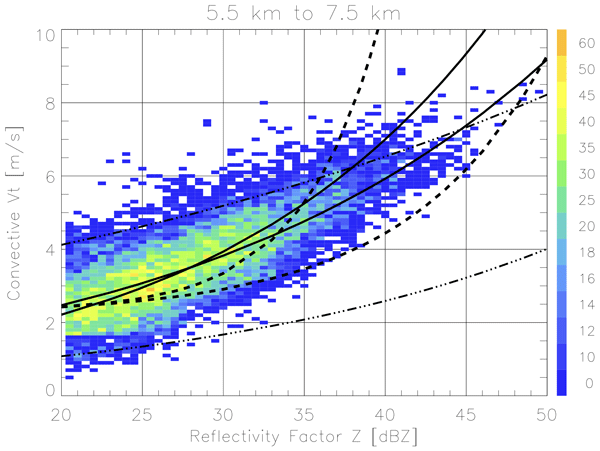
Tests performed under rain and snow conditions show comparable performance to disdrometer and other references. The standard deviation of residuals for rain and snow relationships are ≅ 1 ms-1 and ≅ 0.4 ms-1, respectively. In convective core regions aloft, Darwin observations align with existing graupel Vt-Z treatments, however mixed-phase media typically falls faster (> 1–2 ms-1) for Z < 35 dBZ than prior relationships. Breakdowns suggest that Active and Break monsoon conditions favor a similar Vt-Z behavior in strong cores. However, Break conditions – those more favorable to intense daytime tropical convection – potentially indicate the presence of additional lofted liquid or melting media mixed in volumes at convective core peripheries Z < 35 dBZ. Break events also show higher variability in Vt-Z pairs, with select samples having Vt faster than rain for a given Z that argues for partially-melted graupel coupled with size-sorting.
-
Notice on discussion status
The requested preprint has a corresponding peer-reviewed final revised paper. You are encouraged to refer to the final revised version.
-
Preprint
(2294 KB)
-
The requested preprint has a corresponding peer-reviewed final revised paper. You are encouraged to refer to the final revised version.
- Preprint
(2294 KB) - Metadata XML
- BibTeX
- EndNote
- Final revised paper


Journal article(s) based on this preprint
Interactive discussion
Status: closed
-
RC1: 'Comment on egusphere-2026-856', Anonymous Referee #2, 01 May 2026
-
AC1: 'Reply on RC1', Scott Giangrande, 11 Jun 2026
The comment was uploaded in the form of a supplement: https://egusphere.copernicus.org/preprints/2026/egusphere-2026-856/egusphere-2026-856-AC1-supplement.pdf
-
AC1: 'Reply on RC1', Scott Giangrande, 11 Jun 2026
-
RC2: 'Comment on egusphere-2026-856', Anonymous Referee #1, 15 May 2026
General: This is an interesting observational study that gives a better understanding of hydrometeor behavior within deep convection. It refines the reflectivity-based parameterization for estimating terminal fall speed of graupel in tropical regimes based on dual-frequency profiler observations that graupel falls faster in Darwin convection than Oklahoma for the same reflectivity. The study has no apparent major flaws, and the manuscript is well-written. However, there are some minor clarifications required.
Specific comments:
- Echo classification: Figure 1 presents 4 different classes, but it is not clear how these profiles are assigned, especially what is the difference between stratiform and bright band—aren’t they one and the same? The text refers to the technique used in Giangrande et al. (2013), but the relevant section in that reference is rather vague on what conditions define each of these four classes.
- Profiler matching: This matching result needs some additional clarification, especially since NBF is mentioned. What is the combined spatial scale of the two profilers (i.e., do the beams overlap and if so how much)? An idea of how far apart the systems are located would help.
- Disdrometer analysis: The text around line 195 states indicates that fall speed is not a direct measurement of the disdrometer. However, this study uses a 2DVD, which provide a direct measurement of fall speed because they use two cameras with 6-7 mm vertically offset fields of view (Schonhuber et al. 2008).
- Stratiform processes and resultant DSDs: Around line 240, a relevant citation is warranted but missing. Here are some to consider: Waldvogel 1974, Huggel et al. 1996, Gatlin et al. 2018.
- Line 281, grammatical mistake: “…increasingly rapidly…”
- Other relevant studies to consider: Matrosov (2023) also examined the fall speed of frozen hydrometeors using a vertically pointing radar. Albeit that was for snowfall regimes, it included cases with rimed particles and thus should be considered for comparison with the observations from Darwin.
- Figure 5: Suggest using different types of lines to delineate the two fits in each panel
References:
Schönhuber, M., Lammer, G., Randeu, W.L. (2008), doi: 10.1007/978-3-540-77655-0_1
Waldvogel 1974, doi: 10.1175/1520-0469(1974)031<1067:TJORS>2.0.CO;2
Huggel et al. 1996, doi: 10.1175/1520-0450(1996)035<1688:RSDATR>2.0.CO;2
Gatlin et al. 2018, doi: 10.3390/atmos908031
Matrosov 2023: 10.1175/JAMC-D-23-0002.1
Citation: https://doi.org/10.5194/egusphere-2026-856-RC2 -
AC2: 'Reply on RC2', Scott Giangrande, 11 Jun 2026
The comment was uploaded in the form of a supplement: https://egusphere.copernicus.org/preprints/2026/egusphere-2026-856/egusphere-2026-856-AC2-supplement.pdf
Peer review completion


Interactive discussion
Status: closed
-
RC1: 'Comment on egusphere-2026-856', Anonymous Referee #2, 01 May 2026
General comments: The study quantifies relationships between fall speeds and reflectivity above the freezing level using two profilers in Darwin. The dual-frequency approach allows for more robust separation between air motions and fall speeds so that the reflectivity-weighted fall speed can be retrieved. The authors use a large sample size of data to quantify the Z-vt relationships for rain, snow, and mixed-phase media. The analysis is particularly helpful for quantifying and reducing the fall speed uncertainty of mixed-phase media.
The manuscript is very well written, and the analyses use existing techniques that are well-established. I have a few minor comments for the authors to consider.
Minor comments:
- Line 12: Place Vt in parentheses
- Line 83: Did the authors mean deep instead of deeper?
- Line 115: Raleigh should be Rayleigh
- Line 150: Suggest cross-beam distance or other wording rather than beamwidth since most readers will relate beamwidth to its measure in degrees
- Section 2: While past research supports the idea that break events have more intense updrafts, did the authors consider using profiler or other data to confirm that the updrafts were actually more intense or other storm characteristics were different (e.g., particle size implied by maximum Z, echo top, etc.)?
- Line 346: I presume that the peripheral regions also have large reflectivity gradients that are smoothed by the profiler’s larger beamwidth. Is it possible that a portion of the volume contains higher Z and media with higher vt, but the volume-averaged Z is lower due to the gradient? Thus, this could result in a higher vt than expected for a given Z.
- Line 352: Should influence be influencing?
- Line 364: The end of this sentence is awkward. Please rephrase
- Line 472: Suggest tropical thunderstorms to avoid any potential confusion with tropical storms/cyclones
- 2–4 captions: Please add histogram after cumulative to convey the type of plot
- The focus of the study is on profiling radars. However, can the authors comment on the utility of these fall speed relationships for scanning weather radars operating at S-X bands (e.g., for multi-Doppler wind retrieval)?
- Table 1: To make the table easier to read, please include the height range as a separate column entry.
Citation: https://doi.org/10.5194/egusphere-2026-856-RC1 -
AC1: 'Reply on RC1', Scott Giangrande, 11 Jun 2026
The comment was uploaded in the form of a supplement: https://egusphere.copernicus.org/preprints/2026/egusphere-2026-856/egusphere-2026-856-AC1-supplement.pdf
-
RC2: 'Comment on egusphere-2026-856', Anonymous Referee #1, 15 May 2026
General: This is an interesting observational study that gives a better understanding of hydrometeor behavior within deep convection. It refines the reflectivity-based parameterization for estimating terminal fall speed of graupel in tropical regimes based on dual-frequency profiler observations that graupel falls faster in Darwin convection than Oklahoma for the same reflectivity. The study has no apparent major flaws, and the manuscript is well-written. However, there are some minor clarifications required.
Specific comments:
- Echo classification: Figure 1 presents 4 different classes, but it is not clear how these profiles are assigned, especially what is the difference between stratiform and bright band—aren’t they one and the same? The text refers to the technique used in Giangrande et al. (2013), but the relevant section in that reference is rather vague on what conditions define each of these four classes.
- Profiler matching: This matching result needs some additional clarification, especially since NBF is mentioned. What is the combined spatial scale of the two profilers (i.e., do the beams overlap and if so how much)? An idea of how far apart the systems are located would help.
- Disdrometer analysis: The text around line 195 states indicates that fall speed is not a direct measurement of the disdrometer. However, this study uses a 2DVD, which provide a direct measurement of fall speed because they use two cameras with 6-7 mm vertically offset fields of view (Schonhuber et al. 2008).
- Stratiform processes and resultant DSDs: Around line 240, a relevant citation is warranted but missing. Here are some to consider: Waldvogel 1974, Huggel et al. 1996, Gatlin et al. 2018.
- Line 281, grammatical mistake: “…increasingly rapidly…”
- Other relevant studies to consider: Matrosov (2023) also examined the fall speed of frozen hydrometeors using a vertically pointing radar. Albeit that was for snowfall regimes, it included cases with rimed particles and thus should be considered for comparison with the observations from Darwin.
- Figure 5: Suggest using different types of lines to delineate the two fits in each panel
References:
Schönhuber, M., Lammer, G., Randeu, W.L. (2008), doi: 10.1007/978-3-540-77655-0_1
Waldvogel 1974, doi: 10.1175/1520-0469(1974)031<1067:TJORS>2.0.CO;2
Huggel et al. 1996, doi: 10.1175/1520-0450(1996)035<1688:RSDATR>2.0.CO;2
Gatlin et al. 2018, doi: 10.3390/atmos908031
Matrosov 2023: 10.1175/JAMC-D-23-0002.1
Citation: https://doi.org/10.5194/egusphere-2026-856-RC2 -
AC2: 'Reply on RC2', Scott Giangrande, 11 Jun 2026
The comment was uploaded in the form of a supplement: https://egusphere.copernicus.org/preprints/2026/egusphere-2026-856/egusphere-2026-856-AC2-supplement.pdf
Peer review completion
Journal article(s) based on this preprint
Viewed
| HTML | XML | Total | BibTeX | EndNote | |
|---|---|---|---|---|---|
| 357 | 117 | 48 | 522 | 43 | 47 |
- HTML: 357
- PDF: 117
- XML: 48
- Total: 522
- BibTeX: 43
- EndNote: 47
Viewed (geographical distribution)
| Country | # | Views | % |
|---|
| Total: | 0 |
| HTML: | 0 |
| PDF: | 0 |
| XML: | 0 |
- 1

Christopher R. Williams
Alain Protat
The requested preprint has a corresponding peer-reviewed final revised paper. You are encouraged to refer to the final revised version.
- Preprint
(2294 KB) - Metadata XML
General comments: The study quantifies relationships between fall speeds and reflectivity above the freezing level using two profilers in Darwin. The dual-frequency approach allows for more robust separation between air motions and fall speeds so that the reflectivity-weighted fall speed can be retrieved. The authors use a large sample size of data to quantify the Z-vt relationships for rain, snow, and mixed-phase media. The analysis is particularly helpful for quantifying and reducing the fall speed uncertainty of mixed-phase media.
The manuscript is very well written, and the analyses use existing techniques that are well-established. I have a few minor comments for the authors to consider.
Minor comments: