
the Creative Commons Attribution 4.0 License.
the Creative Commons Attribution 4.0 License.
 | 06 Mar 2026
Ammonium and nitrite oxidation in the upper euphotic zone of the oligotrophic Red Sea
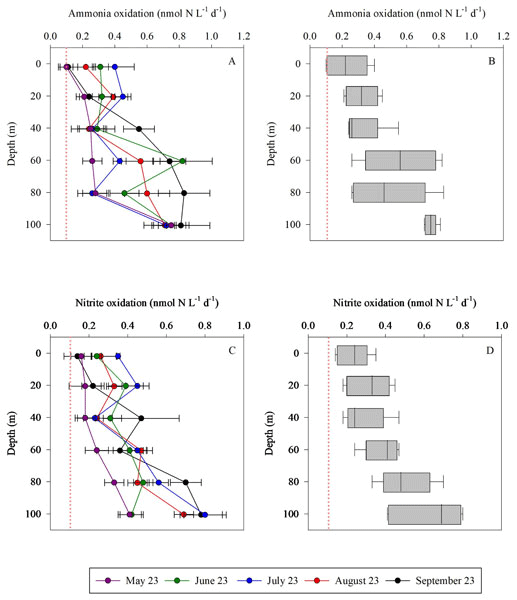
Abstract. Nitrification is widely understood to be inhibited by light in the surface ocean, however, increasing evidence indicates its occurrence at low levels at many sites. The extent to which nitrification remains active in the euphotic zone could have important implications to new production calculations, yet it remains understudied. Here, we quantified ammonium and nitrite oxidation rates in the euphotic zone of the Gulf of Aqaba (Northern Red Sea) from late spring to late summer and examined environmental controls and implications for dark carbon fixation (chemoautotrophy) and new production. Both ammonium and nitrite oxidation were detectable throughout the euphotic zone (~0.1–0.8 nmol N L-1 d-1). Overall, rates increased with depth and were strongly suppressed in the highest irradiance surface waters. Integrated rates over the entire euphotic zone (24–56 µmol N m-2 d-1) were among the lowest reported for oligotrophic regions globally. This reflects extremely low substrate concentrations and intense, though not complete, photoinhibition. Ammonium and nitrite oxidation together supported <2 % of chemoautotrophic activity, suggesting other processes, not accounted for, such as anaplerosis may be important. Depth-resolved correlations with environmental parameters highlight light, temperature, and substrate availability as key regulators of both processes. Our results show that nitrification in the Gulf of Aqaba operates at the lower bounds of global euphotic zone rates and is loosely coupled to carbon cycling. These findings underscore the need to better resolve nitrification dynamics in ultra-oligotrophic, rapidly warming, seas to refine estimates of new production and chemoautotrophic carbon assimilation under future ocean conditions.
-
Notice on discussion status
The requested preprint has a corresponding peer-reviewed final revised paper. You are encouraged to refer to the final revised version.
-
Preprint
(1043 KB)
-
The requested preprint has a corresponding peer-reviewed final revised paper. You are encouraged to refer to the final revised version.
- Preprint
(1043 KB) - Metadata XML
- BibTeX
- EndNote
- Final revised paper


Journal article(s) based on this preprint
Interactive discussion
Status: closed
-
RC1: 'Comment on egusphere-2026-855', Anonymous Referee #1, 08 Apr 2026
- AC1: 'Reply on RC1', Eyal Rahav, 01 May 2026
-
RC2: 'Comment on egusphere-2026-855', Anonymous Referee #2, 29 Apr 2026
The upper ocean nitrification is certainly a field that attract great interest from marine biogeochemist, which could relate to new production and carbon cycle. This paper suggests a negligible contribution of nitrifiers to Red Sea euphotic zone dark carbon cycle. Generally, it can be a potential piece of contribution, but I think there are some concerns regarding to methods and discussion:
Major concerns:
My personal experience suggests that one of the difficulties of euphotic zone nitrification in such oligotrophic regions is to measure the product isotope. The usual demanding N amount for denitrifier or chemical methods is 10-20 nmol N (or ~5 nmol for higher 15N ratio). In the context of low nitrate/nitrite level ~10 nmol/L, it will require 100 mL water to only achieve 1 nmol N in IRMS analysis (usually means large deviation between samples). The usual denitrifier bottle is max for 20 mL water injection. I am very confused about how to obtain isotopic results in such a low N concentration. Of course, now there are some more advanced mass spectra or protocols for lower N amount, but authors didn’t mention any of these in the methods (Line 119-122).
Another usual way to deal with this is adding carrier 14N into analysis bottles. But it would cause another serious detection limit problem, such a low rate with carriers 14N will means very small variation in isotopic signal. I didn’t see any data or figure to support the detectable of end product and, thus, the rate.
The incubation could be a potential problem. The high PP will also mean a quick turnover in the DIN system. This is even true under dark incubation, since N uptake is usually less sensitive to light and higher dark N uptake can be present. The nM level of N can be perturbated significantly, e.g., regeneration will dilute 15NH3 and/or uptake can eat all the 15N signals in product. The authors should provide evidence to suggest their system is valid for rate measurement in 1 day timescale, usually time series and carrier protection of product. The authors can also provide the end concentration of nitrite/nitrate compared with t0, which are usually simultaneously obtained with isotope ratio measurement.
Generally, the methods and validity of results are the basis to further discuss the environmental significance.
Some minor suggestions:
Title
Line 1 Ammonia oxidation is more commonly used in the field (e.g., Bayer et al., 2025, nature geosciences; Ward 2008 etc.), instead of ammonium oxidation
Line 43 nitrogen instead of N, or define before
Line 64 using PAR to define euphotic zone is a more common way or simply say upper ocean.
Line 95 precision of ~20 nmol L-1 may be not enough for low concentration of nitrite/nitrate in this case. As substrate concentration has a proportional impact on the rate calculation. Some note should be added in discussion. I will suggest adding example standard working curves and precision test of N species in the appendix in this case.
Line 100 low concentration measurement may be affected by blank effect, that is the water preparing standard working curve may contain NH3 blank which affect the final results.
Line 112-114 The adding concentration may stimulate the rate, especially when natural substrate level is low.
Line 119-122 see my major concerns The author omitted the nitrite removal protocol in nitrite oxidation rate measurement.
Line 234 PAR can be present in log and % scale and mark the 1% or 0.1% light level.
Line 237 typo in June 253
Line 281-line 308 Line 354 I think DCF in the upper sunlit ocean is somehow differ with aphotic ocean setting. Even under dark, phytoplankton can significantly contribute to DCF. Some discussion will be helpful. Also, some heterotrophs can contribute to DCF.
Baltar, F. and Herndl, G. J.: Ideas and perspectives: Is dark carbon fixation relevant for oceanic primary production estimates?, Biogeosciences, 16, 3793–3799, https://doi.org/10.5194/bg-16-3793-2019, 2019.
Li W. K. W., Irwin B. D., Dickie P. M., (1993), Dark fixation of 14C: Variations related to biomass and productivity of phytoplankton and bacteria, Limnology and Oceanography, 38, doi: 10.4319/lo.1993.38.3.0483.
Morris Ian, Yentsch Clarice M., Yentsch Charles S., (1971), RELATIONSHIP BETWEEN LIGHT CARBON DIOXIDE FIXATION AND DARK CARBON DIOXIDE FIXATION BY MARINE ALGAE, Limnology and Oceanography, 6, doi: 10.4319/lo.1971.16.6.0854.
Line 318 Relation does not necessarily relate to causation, the rate correlated with depth and PAR. And the temperature just covaries with depth and rate. I don’t see it as a surprise
Line 345-346 Phytoplankton biomass is not necessary represented by Chl a, especially in the light-decreasing depth context, photo acclimation can change the relationship.
Line 388 Figure 5. More explanation of data selection criteria should be clarified. For examples, how to filter euphotic zone, 100 m can be quite deep for coastal ocean, but too shallow for gyre. I will suggest authors to classify the regions to add some depth of discussion. I am personally very interested about, e.g., where has highest euphotic zone nitrification, where is low, why?
Citation: https://doi.org/10.5194/egusphere-2026-855-RC2 - AC2: 'Reply on RC2', Eyal Rahav, 01 May 2026
-
AC3: 'Comment on egusphere-2026-855', Eyal Rahav, 05 May 2026
Hi
Just making sure - I uploaded our reply to the reviewers’ comments/edits, but I have not yet submitted the revised manuscript itself (a track change version and/or without ). Did I miss something? Is there a separate platform or section where the revised manuscript file(s) should be uploaded?
Thanks
Eyal
Citation: https://doi.org/10.5194/egusphere-2026-855-AC3 -
EC1: 'Reply on AC3', Yuan Shen, 06 May 2026
At this stage, please await the Editor's decision, which will be made based on the reviews and your response. Should major or minor revisions be required, you will be invited to submit a revised version. Stay tuned.
Citation: https://doi.org/10.5194/egusphere-2026-855-EC1
-
EC1: 'Reply on AC3', Yuan Shen, 06 May 2026
Peer review completion


Interactive discussion
Status: closed
-
RC1: 'Comment on egusphere-2026-855', Anonymous Referee #1, 08 Apr 2026
Summary:
This paper aims to assess the contribution of ammonium and nitrite oxidation to nitrogen cycling in the sunlit surface ocean of the Gulf of Aqaba during late spring and summer.
They report that they measure the lowest integrated ammonia and nitrite oxidation rates ever measured in oligotrophic waters, however their rate data is difficult to interpret without reporting limits of detection for their rate measurements. The low contribution of nitrification to total dark carbon fixation in the surface ocean is interesting in the context of Bayer et al 2025’s paper showing that ammonia oxidizers don’t account for all the DIC fixed in the deep ocean.
General:
This paper is very clearly written and easy to read. The reporting of nitrification rates from the GoA is interesting, and would help understand how nitrification works in oligotrophic systems. The connection to total carbon fixation and the “missing” fixed carbon is relevant to current questions. Broadly, more detail is required about the methods and caveats of the data collected, and the discussion could include more about how these collected data can and cannot clarify how nitrification works in the upper 100m of the GOA.
The caveats of the experimental design need to be clearly discussed. For example, a 24hr incubation can run into issues of substrate regeneration and/or grazer activity etc. I am curious how the 20nM NH4 15N tracer addition relates to your measured NH4 concentrations. It can be quite hard to add tracer at low levels (<10%) in oligotrophic systems without perturbing the rates, and understanding these rates in the context of kinetics is interesting since even with these N additions the reported rates are low.. Even with 30-50% added NH4, the rates are all still low, and similarly low? Does that mean the AOA community is not really substrate limited? Does the rate remain low because there are so few AOA there? Please describe this design and its repercussions further.
I believe the limit of detection for all rates are needed, especially when reporting such low oxidation rates. These values are very near zero and difficult to interpret. Measurements below detection limit should be noted on figure of NO3 measurements.
Ammonia oxidation rates (and ammonia concentrations) are often highest below the deep chl max in other systems and previous research shows fairly abrupt rates increases that correspond to archaeal gene counts, but ore offset from peak ammonium concentrations (eg Beman et al 2012). Does your correlation between NH4 concentration and oxidation rate tell you something about how ammonium supply in the surface (above the deep chl max) behaves differently from deeper in the euphotic zone?
I don't think you can strongly conclude that much about phytoplankton influence on the N cycling. You only have carbon based photosynthetic rates and chl a data. There is room for discussion around this though, and you could discuss the need to co-measure phytoplankton and nitrifiers in future studies.
Are the rates you see at 5m statistically different from 60-80m? Other papers suggest the rates are uniformly low in the upper water before an abrupt increase ( eg Beman 2012 Fig 6) vs other papers that show a less abrupt decline in rates more like your data (eg. Travis et al 2023 Fig 4). Its curious why rates are not uniform through the N-depleted surface. How deep is the mix layer?
You will need to discuss how the data was summarized into your pearson correlation chart with a section in the methods. Correlations of 1 are a perfect fit, and many of your relationships look close to 1 or -1 on the color scale. I suggest showing the regression data in the supplement. I’m assuming you aggregated all the profiles, and did one linear regression, but this feels a bit misleading. Be very careful when interpreting correlations because so many things co-vary but are not necessary causal. The limited depths of this dataset (0-100) makes it harder to draw comparisons to datasets that work down to the typical nitrification maxima (below the chl max).
Something about the missing carbon should probably be in the conclusion.
Specific line comments:
Line 21: I suggest reversing the order of the clauses in this sentence (ie suppressed rates first, increasing with depth second)
Line 22: I’m not sure the rates were “suppressed” because you didn't experimentally test if light inhibited the rates. You have measured low rates at high light levels.
Line 22: Are you comparing integrated rates to the Tang database? Your last figure is comparing the per L rates….
Line 26: <2% of chemoautotrophic activity or DFC? Define chemoautotrophic activity as dark carbon fixation? Or not, because DCF includes heterotrophic activity too.... please clarify. Referring to anaplerosis here feels like a jump. Maybe clarify the sentence so it is clear you are talking about carbon now.
Line 104: Is this your detection limit, or what Meeder reported in their data?
Line 109: With a 24 hour incubation some discussion about the potential caveats on your rates measurements is warranted. Daylong incubations in sunlit surface waters will likely capture uptake by phytoplankton as well as release of nitrite (even if chl is low, prochlorococcus and synechococcus are active as seen by your photosynthesis rates). Al-Qutob et al 2002 and Travis et al 2024 both document release of nitrite by phytoplankton via nitrate reduction which might dilute your labeled nitrite pool over 24 hours and lead to underestimates of ammonia oxidation and nitrite oxidation. You could use simple modeling to estimate how these dilutions with nitrite would influence your calculated rates.
Line 123: What are your detection limits here?
Line 187: Without a clear vertical trend feels contradictory to your later correlation with ammonia oxidations rates that appear to have a clear vertical increase, especially the summary in Fig 3B.
Line 194: Ko et al. does not seem like the best reference for nitrite release from phytoplankton. Depending on whether you suggest nitrite release solely from light limitation or from co-occurring access to NO3 at depth, one of these references may be more appropriate (Collos, 1998; Kiefer et al., 1976; Lomas and Glibert, 2000; Lomas et al., 2000; Sciandra and Amara, 1994; Vaccaro and Ryther, 1960; Wada and Hattori, 1971; Berube et al., 2023). You may also consider that nitrite is released under high light too (see Travis et al 2024 nitrate reduction rates, and original idea in Lomas and Glibert 1999).
Line 203: Confusing sentence here. Do you mean below the depths you measured? Or below ~20m? All your DIN measurements are similarly nano-molar levels.
206: Where are the chlorophyll maxima relative to where you stopped sampling at 100m? What is the mix layer depth?
234: Fig 1. Some of your nitrate and nitrite concentrations appear to be below your detection limits. It would also help to have the X axes start at 0.
Line 237: Photosynthesis rate in carbon units converted to nitrogen requirement with a Redfield approximation (C:N ~7) suggests your phytoplankton community a <20m is using 70-100 nmol N L-1 d-1. This would suggest to me that there might be competition for N substrates at these depths...Mackey et al 2011 has ammonia oxidation rate vs ammonia uptake rates that show 20x higher ammonia uptake rates in this system.
Line 244: You mention light inhibition controlling the ammonia oxidation rates, but what is the abundance of the nitrifiers? Can you distinguish between AOX communities that have low abundance, vs communities that are more abundant but have inhibited rates per cell? Typically amoA genes abundance is near zero in the surface and leads to near zero rates of ammonia oxidation (eg. Santoro 2013, Beman 2012)
Line 256: High chlorophyll is often associated with increased NH4 levels, which would enhance substrate-dependent ammonia oxidation rates. Phytoplankton uptake of ammonium can still occur. I don't think you have data justifying that phytoplankton are not consuming available N in this low-N system. Prochlorococcus and syn are both present and capable of taking up NH4 (and possibly NO2). Especially since your incubation were carried out in ambient light. Do you have any dark bottle incubations? Attempting to prevent photosynthesis would get closer to a nitrifer-only rate.
Line 258: Can you explain further why lack of correlation between chl and Nh4 means there is no competition between nitrifiers and phytoplankton for nh4?
Line 272: Higher sensitivity of nitrite oxidizing bacteria to light was done in studies comparing nitrite oxidizing bacteria to ammonia oxidizing bacteria (Guerrero and Jones, 1996; Olson, 1981). Since we now understand AOA to dominate ammonia oxidation in the ocean, we’re not entirely sure this is true in situ. For example, see Travis et al 2024 where nitrite oxidation rates appeared to be less inhibited by increasing light compared to the co-occurring ammonia oxidizing community. Sources of ammonia substrate to fuel ammonia oxidation may just be coming from more shallow sources (decaying phytoplankton blooms), while nitrite substrate could be produced via ammonia oxidation across deeper depths.
Line 274: I think this conclusion is too broad. Meeder and Mackey both show that nitrite concentration and inventory varies significantly across season/bloom. Your dataset is focused on May-Sept, and thus misses the deep winter mix layer and spring bloom where you see nitrite accumulate. I suggest being more specific, and say that your comparable rates means there is low net nitrite production coming from any mismatch in the two steps of nitrification during these seasons.
Line 282: Could some of the carbon fixed be from urea oxidation by ammonia oxidizers? (Wan et al 2024)
Line 306: remove one “also”
Line 318: I would be careful with interpreting these correlations as surprising. The warmest temperature have very low NH4 so rates are likely responding to substrate regardless of temperature. Please show the regressions.
Line 329: I’m wondering about this correlation between NH4 and oxidation rates. Classically, high nh4 concentrations occur because of phytoplankton bloom/decay (ie nh4 accumulates below a bloom) and are often ~10m offset from peak ammonia oxidation. My guess is that the near-surface is more “stable” and down towards the chlorophyll max experiences more variability in substrate and the responding AOA community abundance and then the rates. See
Line 353: The expectation that nitrification would be a large component of DCF and then the fact that it is not, is one of the more interesting parts of the paper. I’d like to see the regression figure of this data.
Line 355: Wouldn't other archaeal and bacterial community members also be possible contributers to DCF? Heterotrophic DIC fixation? Urea oxidation? I think there is room for more discussion about that else could be happening here.
Fig 4: Need to see the regressions.
Line 368: Your ammonium concentrations are low, but can you really say the low rates are caused directly by low substate? You mention trace metals and light. There is no data on abundance of archaea, per cell rates could be high?
372: I think the global compilation includes many oligotrophic datapoints, or at least low NH4. You could pull out a subset of the global compilation from systems that are closer to the Gulf of Aqaba. I’m not sure how relevant it is to plot your data with the super high southern ocean data…
Line 376+: Do you think we need to go out and measure more really low nitrification rates? I guess Mackey et al 2011’s spring ammonia oxidation rates was much higher, so maybe you’d expect to see higher nitrification in the spring.
I think your data could suggest measuring other things to find what fixes the missing inorganic carbon. You didn't mention the carbon stuff in your conclusion.
Line 415: Just use the 2025 reviewed version?
Citation: https://doi.org/10.5194/egusphere-2026-855-RC1 - AC1: 'Reply on RC1', Eyal Rahav, 01 May 2026
-
RC2: 'Comment on egusphere-2026-855', Anonymous Referee #2, 29 Apr 2026
The upper ocean nitrification is certainly a field that attract great interest from marine biogeochemist, which could relate to new production and carbon cycle. This paper suggests a negligible contribution of nitrifiers to Red Sea euphotic zone dark carbon cycle. Generally, it can be a potential piece of contribution, but I think there are some concerns regarding to methods and discussion:
Major concerns:
My personal experience suggests that one of the difficulties of euphotic zone nitrification in such oligotrophic regions is to measure the product isotope. The usual demanding N amount for denitrifier or chemical methods is 10-20 nmol N (or ~5 nmol for higher 15N ratio). In the context of low nitrate/nitrite level ~10 nmol/L, it will require 100 mL water to only achieve 1 nmol N in IRMS analysis (usually means large deviation between samples). The usual denitrifier bottle is max for 20 mL water injection. I am very confused about how to obtain isotopic results in such a low N concentration. Of course, now there are some more advanced mass spectra or protocols for lower N amount, but authors didn’t mention any of these in the methods (Line 119-122).
Another usual way to deal with this is adding carrier 14N into analysis bottles. But it would cause another serious detection limit problem, such a low rate with carriers 14N will means very small variation in isotopic signal. I didn’t see any data or figure to support the detectable of end product and, thus, the rate.
The incubation could be a potential problem. The high PP will also mean a quick turnover in the DIN system. This is even true under dark incubation, since N uptake is usually less sensitive to light and higher dark N uptake can be present. The nM level of N can be perturbated significantly, e.g., regeneration will dilute 15NH3 and/or uptake can eat all the 15N signals in product. The authors should provide evidence to suggest their system is valid for rate measurement in 1 day timescale, usually time series and carrier protection of product. The authors can also provide the end concentration of nitrite/nitrate compared with t0, which are usually simultaneously obtained with isotope ratio measurement.
Generally, the methods and validity of results are the basis to further discuss the environmental significance.
Some minor suggestions:
Title
Line 1 Ammonia oxidation is more commonly used in the field (e.g., Bayer et al., 2025, nature geosciences; Ward 2008 etc.), instead of ammonium oxidation
Line 43 nitrogen instead of N, or define before
Line 64 using PAR to define euphotic zone is a more common way or simply say upper ocean.
Line 95 precision of ~20 nmol L-1 may be not enough for low concentration of nitrite/nitrate in this case. As substrate concentration has a proportional impact on the rate calculation. Some note should be added in discussion. I will suggest adding example standard working curves and precision test of N species in the appendix in this case.
Line 100 low concentration measurement may be affected by blank effect, that is the water preparing standard working curve may contain NH3 blank which affect the final results.
Line 112-114 The adding concentration may stimulate the rate, especially when natural substrate level is low.
Line 119-122 see my major concerns The author omitted the nitrite removal protocol in nitrite oxidation rate measurement.
Line 234 PAR can be present in log and % scale and mark the 1% or 0.1% light level.
Line 237 typo in June 253
Line 281-line 308 Line 354 I think DCF in the upper sunlit ocean is somehow differ with aphotic ocean setting. Even under dark, phytoplankton can significantly contribute to DCF. Some discussion will be helpful. Also, some heterotrophs can contribute to DCF.
Baltar, F. and Herndl, G. J.: Ideas and perspectives: Is dark carbon fixation relevant for oceanic primary production estimates?, Biogeosciences, 16, 3793–3799, https://doi.org/10.5194/bg-16-3793-2019, 2019.
Li W. K. W., Irwin B. D., Dickie P. M., (1993), Dark fixation of 14C: Variations related to biomass and productivity of phytoplankton and bacteria, Limnology and Oceanography, 38, doi: 10.4319/lo.1993.38.3.0483.
Morris Ian, Yentsch Clarice M., Yentsch Charles S., (1971), RELATIONSHIP BETWEEN LIGHT CARBON DIOXIDE FIXATION AND DARK CARBON DIOXIDE FIXATION BY MARINE ALGAE, Limnology and Oceanography, 6, doi: 10.4319/lo.1971.16.6.0854.
Line 318 Relation does not necessarily relate to causation, the rate correlated with depth and PAR. And the temperature just covaries with depth and rate. I don’t see it as a surprise
Line 345-346 Phytoplankton biomass is not necessary represented by Chl a, especially in the light-decreasing depth context, photo acclimation can change the relationship.
Line 388 Figure 5. More explanation of data selection criteria should be clarified. For examples, how to filter euphotic zone, 100 m can be quite deep for coastal ocean, but too shallow for gyre. I will suggest authors to classify the regions to add some depth of discussion. I am personally very interested about, e.g., where has highest euphotic zone nitrification, where is low, why?
Citation: https://doi.org/10.5194/egusphere-2026-855-RC2 - AC2: 'Reply on RC2', Eyal Rahav, 01 May 2026
-
AC3: 'Comment on egusphere-2026-855', Eyal Rahav, 05 May 2026
Hi
Just making sure - I uploaded our reply to the reviewers’ comments/edits, but I have not yet submitted the revised manuscript itself (a track change version and/or without ). Did I miss something? Is there a separate platform or section where the revised manuscript file(s) should be uploaded?
Thanks
Eyal
Citation: https://doi.org/10.5194/egusphere-2026-855-AC3 -
EC1: 'Reply on AC3', Yuan Shen, 06 May 2026
At this stage, please await the Editor's decision, which will be made based on the reviews and your response. Should major or minor revisions be required, you will be invited to submit a revised version. Stay tuned.
Citation: https://doi.org/10.5194/egusphere-2026-855-EC1
-
EC1: 'Reply on AC3', Yuan Shen, 06 May 2026
Peer review completion
Journal article(s) based on this preprint
Viewed
| HTML | XML | Total | BibTeX | EndNote | |
|---|---|---|---|---|---|
| 868 | 387 | 109 | 1,364 | 85 | 119 |
- HTML: 868
- PDF: 387
- XML: 109
- Total: 1,364
- BibTeX: 85
- EndNote: 119
Viewed (geographical distribution)
| Country | # | Views | % |
|---|
| Total: | 0 |
| HTML: | 0 |
| PDF: | 0 |
| XML: | 0 |
- 1

Scott D. Wankel
Adina Paytan
The requested preprint has a corresponding peer-reviewed final revised paper. You are encouraged to refer to the final revised version.
- Preprint
(1043 KB) - Metadata XML
Summary:
This paper aims to assess the contribution of ammonium and nitrite oxidation to nitrogen cycling in the sunlit surface ocean of the Gulf of Aqaba during late spring and summer.
They report that they measure the lowest integrated ammonia and nitrite oxidation rates ever measured in oligotrophic waters, however their rate data is difficult to interpret without reporting limits of detection for their rate measurements. The low contribution of nitrification to total dark carbon fixation in the surface ocean is interesting in the context of Bayer et al 2025’s paper showing that ammonia oxidizers don’t account for all the DIC fixed in the deep ocean.
General:
This paper is very clearly written and easy to read. The reporting of nitrification rates from the GoA is interesting, and would help understand how nitrification works in oligotrophic systems. The connection to total carbon fixation and the “missing” fixed carbon is relevant to current questions. Broadly, more detail is required about the methods and caveats of the data collected, and the discussion could include more about how these collected data can and cannot clarify how nitrification works in the upper 100m of the GOA.
The caveats of the experimental design need to be clearly discussed. For example, a 24hr incubation can run into issues of substrate regeneration and/or grazer activity etc. I am curious how the 20nM NH4 15N tracer addition relates to your measured NH4 concentrations. It can be quite hard to add tracer at low levels (<10%) in oligotrophic systems without perturbing the rates, and understanding these rates in the context of kinetics is interesting since even with these N additions the reported rates are low.. Even with 30-50% added NH4, the rates are all still low, and similarly low? Does that mean the AOA community is not really substrate limited? Does the rate remain low because there are so few AOA there? Please describe this design and its repercussions further.
I believe the limit of detection for all rates are needed, especially when reporting such low oxidation rates. These values are very near zero and difficult to interpret. Measurements below detection limit should be noted on figure of NO3 measurements.
Ammonia oxidation rates (and ammonia concentrations) are often highest below the deep chl max in other systems and previous research shows fairly abrupt rates increases that correspond to archaeal gene counts, but ore offset from peak ammonium concentrations (eg Beman et al 2012). Does your correlation between NH4 concentration and oxidation rate tell you something about how ammonium supply in the surface (above the deep chl max) behaves differently from deeper in the euphotic zone?
I don't think you can strongly conclude that much about phytoplankton influence on the N cycling. You only have carbon based photosynthetic rates and chl a data. There is room for discussion around this though, and you could discuss the need to co-measure phytoplankton and nitrifiers in future studies.
Are the rates you see at 5m statistically different from 60-80m? Other papers suggest the rates are uniformly low in the upper water before an abrupt increase ( eg Beman 2012 Fig 6) vs other papers that show a less abrupt decline in rates more like your data (eg. Travis et al 2023 Fig 4). Its curious why rates are not uniform through the N-depleted surface. How deep is the mix layer?
You will need to discuss how the data was summarized into your pearson correlation chart with a section in the methods. Correlations of 1 are a perfect fit, and many of your relationships look close to 1 or -1 on the color scale. I suggest showing the regression data in the supplement. I’m assuming you aggregated all the profiles, and did one linear regression, but this feels a bit misleading. Be very careful when interpreting correlations because so many things co-vary but are not necessary causal. The limited depths of this dataset (0-100) makes it harder to draw comparisons to datasets that work down to the typical nitrification maxima (below the chl max).
Something about the missing carbon should probably be in the conclusion.
Specific line comments:
Line 21: I suggest reversing the order of the clauses in this sentence (ie suppressed rates first, increasing with depth second)
Line 22: I’m not sure the rates were “suppressed” because you didn't experimentally test if light inhibited the rates. You have measured low rates at high light levels.
Line 22: Are you comparing integrated rates to the Tang database? Your last figure is comparing the per L rates….
Line 26: <2% of chemoautotrophic activity or DFC? Define chemoautotrophic activity as dark carbon fixation? Or not, because DCF includes heterotrophic activity too.... please clarify. Referring to anaplerosis here feels like a jump. Maybe clarify the sentence so it is clear you are talking about carbon now.
Line 104: Is this your detection limit, or what Meeder reported in their data?
Line 109: With a 24 hour incubation some discussion about the potential caveats on your rates measurements is warranted. Daylong incubations in sunlit surface waters will likely capture uptake by phytoplankton as well as release of nitrite (even if chl is low, prochlorococcus and synechococcus are active as seen by your photosynthesis rates). Al-Qutob et al 2002 and Travis et al 2024 both document release of nitrite by phytoplankton via nitrate reduction which might dilute your labeled nitrite pool over 24 hours and lead to underestimates of ammonia oxidation and nitrite oxidation. You could use simple modeling to estimate how these dilutions with nitrite would influence your calculated rates.
Line 123: What are your detection limits here?
Line 187: Without a clear vertical trend feels contradictory to your later correlation with ammonia oxidations rates that appear to have a clear vertical increase, especially the summary in Fig 3B.
Line 194: Ko et al. does not seem like the best reference for nitrite release from phytoplankton. Depending on whether you suggest nitrite release solely from light limitation or from co-occurring access to NO3 at depth, one of these references may be more appropriate (Collos, 1998; Kiefer et al., 1976; Lomas and Glibert, 2000; Lomas et al., 2000; Sciandra and Amara, 1994; Vaccaro and Ryther, 1960; Wada and Hattori, 1971; Berube et al., 2023). You may also consider that nitrite is released under high light too (see Travis et al 2024 nitrate reduction rates, and original idea in Lomas and Glibert 1999).
Line 203: Confusing sentence here. Do you mean below the depths you measured? Or below ~20m? All your DIN measurements are similarly nano-molar levels.
206: Where are the chlorophyll maxima relative to where you stopped sampling at 100m? What is the mix layer depth?
234: Fig 1. Some of your nitrate and nitrite concentrations appear to be below your detection limits. It would also help to have the X axes start at 0.
Line 237: Photosynthesis rate in carbon units converted to nitrogen requirement with a Redfield approximation (C:N ~7) suggests your phytoplankton community a <20m is using 70-100 nmol N L-1 d-1. This would suggest to me that there might be competition for N substrates at these depths...Mackey et al 2011 has ammonia oxidation rate vs ammonia uptake rates that show 20x higher ammonia uptake rates in this system.
Line 244: You mention light inhibition controlling the ammonia oxidation rates, but what is the abundance of the nitrifiers? Can you distinguish between AOX communities that have low abundance, vs communities that are more abundant but have inhibited rates per cell? Typically amoA genes abundance is near zero in the surface and leads to near zero rates of ammonia oxidation (eg. Santoro 2013, Beman 2012)
Line 256: High chlorophyll is often associated with increased NH4 levels, which would enhance substrate-dependent ammonia oxidation rates. Phytoplankton uptake of ammonium can still occur. I don't think you have data justifying that phytoplankton are not consuming available N in this low-N system. Prochlorococcus and syn are both present and capable of taking up NH4 (and possibly NO2). Especially since your incubation were carried out in ambient light. Do you have any dark bottle incubations? Attempting to prevent photosynthesis would get closer to a nitrifer-only rate.
Line 258: Can you explain further why lack of correlation between chl and Nh4 means there is no competition between nitrifiers and phytoplankton for nh4?
Line 272: Higher sensitivity of nitrite oxidizing bacteria to light was done in studies comparing nitrite oxidizing bacteria to ammonia oxidizing bacteria (Guerrero and Jones, 1996; Olson, 1981). Since we now understand AOA to dominate ammonia oxidation in the ocean, we’re not entirely sure this is true in situ. For example, see Travis et al 2024 where nitrite oxidation rates appeared to be less inhibited by increasing light compared to the co-occurring ammonia oxidizing community. Sources of ammonia substrate to fuel ammonia oxidation may just be coming from more shallow sources (decaying phytoplankton blooms), while nitrite substrate could be produced via ammonia oxidation across deeper depths.
Line 274: I think this conclusion is too broad. Meeder and Mackey both show that nitrite concentration and inventory varies significantly across season/bloom. Your dataset is focused on May-Sept, and thus misses the deep winter mix layer and spring bloom where you see nitrite accumulate. I suggest being more specific, and say that your comparable rates means there is low net nitrite production coming from any mismatch in the two steps of nitrification during these seasons.
Line 282: Could some of the carbon fixed be from urea oxidation by ammonia oxidizers? (Wan et al 2024)
Line 306: remove one “also”
Line 318: I would be careful with interpreting these correlations as surprising. The warmest temperature have very low NH4 so rates are likely responding to substrate regardless of temperature. Please show the regressions.
Line 329: I’m wondering about this correlation between NH4 and oxidation rates. Classically, high nh4 concentrations occur because of phytoplankton bloom/decay (ie nh4 accumulates below a bloom) and are often ~10m offset from peak ammonia oxidation. My guess is that the near-surface is more “stable” and down towards the chlorophyll max experiences more variability in substrate and the responding AOA community abundance and then the rates. See
Line 353: The expectation that nitrification would be a large component of DCF and then the fact that it is not, is one of the more interesting parts of the paper. I’d like to see the regression figure of this data.
Line 355: Wouldn't other archaeal and bacterial community members also be possible contributers to DCF? Heterotrophic DIC fixation? Urea oxidation? I think there is room for more discussion about that else could be happening here.
Fig 4: Need to see the regressions.
Line 368: Your ammonium concentrations are low, but can you really say the low rates are caused directly by low substate? You mention trace metals and light. There is no data on abundance of archaea, per cell rates could be high?
372: I think the global compilation includes many oligotrophic datapoints, or at least low NH4. You could pull out a subset of the global compilation from systems that are closer to the Gulf of Aqaba. I’m not sure how relevant it is to plot your data with the super high southern ocean data…
Line 376+: Do you think we need to go out and measure more really low nitrification rates? I guess Mackey et al 2011’s spring ammonia oxidation rates was much higher, so maybe you’d expect to see higher nitrification in the spring.
I think your data could suggest measuring other things to find what fixes the missing inorganic carbon. You didn't mention the carbon stuff in your conclusion.
Line 415: Just use the 2025 reviewed version?