
the Creative Commons Attribution 4.0 License.
the Creative Commons Attribution 4.0 License.
 | 19 Feb 2026
Valley longitudinal profiles record the fluvial landscape evolution and geological structure of the Gamburtsev Subglacial Mountains, East Antarctica
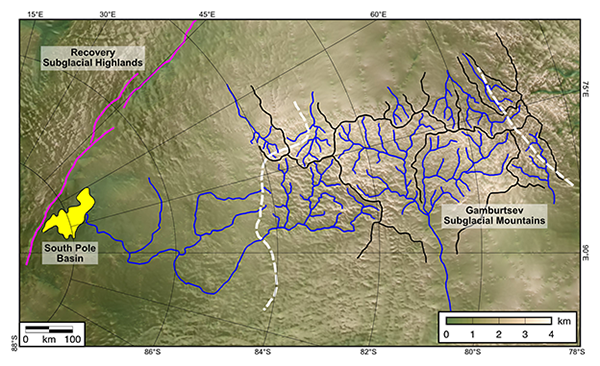
Abstract. Fluvial valley networks in mountain ranges record the interactions between climate, tectonics, and lithology. While drainage network analysis has transformed our understanding of these interactions in subaerial settings, the landscape evolution of ice-covered orogens is poorly known. The Gamburtsev Subglacial Mountains are a ~600 km-long mountain range situated beneath the East Antarctic Ice Sheet. These mountains were an important nucleation site for the ice sheet approximately 34 million years ago and are now buried beneath ~2 km of ice. Airborne radar surveying has revealed that the Gamburtsevs are characterised by a rugged, incised landscape, but their geological structure and uplift history remain enigmatic. Here we use a compilation of radar survey data to extract and quantify valley longitudinal profiles from the Gamburtsevs and in turn infer details of their tectonic and geomorphic development. We use 𝜒-mapping and stream power incision modelling to show that the morphology of the valley network is largely consistent with fluvial incision that occurred prior to glaciation. In addition, the spatial distribution of channel steepness indices allows us to confirm the position of major geological boundaries at the edges of the mountains. We also use independent estimates of denudation rates to evaluate competing scenarios for the timing of mountain uplift and valley incision, finding that uplift of the modern Gamburtsevs most likely commenced in the Mesozoic. Regional geomorphic analysis suggests that base level for some Gamburtsev fluvial catchments was set by enclosed interior basins associated with extensional faulting. These depocentres may retain detrital sedimentary material eroded from the Gamburtsevs prior to Antarctic glaciation and are potential targets for future sub-ice drilling campaigns.
Competing interests: At least one of the (co-)authors is a member of the editorial board of Earth Surface Dynamics.
Publisher's note: Copernicus Publications remains neutral with regard to jurisdictional claims made in the text, published maps, institutional affiliations, or any other geographical representation in this paper. While Copernicus Publications makes every effort to include appropriate place names, the final responsibility lies with the authors. Views expressed in the text are those of the authors and do not necessarily reflect the views of the publisher.-
Notice on discussion status
The requested preprint has a corresponding peer-reviewed final revised paper. You are encouraged to refer to the final revised version.
-
Preprint
(5874 KB)
-
Supplement
(11161 KB)
-
The requested preprint has a corresponding peer-reviewed final revised paper. You are encouraged to refer to the final revised version.
- Preprint
(5874 KB) - Metadata XML
-
Supplement
(11161 KB) - BibTeX
- EndNote
- Final revised paper


Journal article(s) based on this preprint
Interactive discussion
Status: closed
-
RC1: 'Comment on egusphere-2026-847', Anonymous Referee #1, 04 Mar 2026
The manuscript presents a novel adaptation of existing methodologies. Little is known of the geologic and tectonic history of Antarctica for large swaths. The authors attempt to address this gap for the Gamburtsev Subglacial Mountains under the East Antarctic Ice Sheet. They apply theoretically and empirically well-founded approaches from fluvial geomorphology to recent sub-ice topographic data.
Their approach is rigorous and well-considered and sufficiently documented. Through careful data handling, they have reduced potential spatial biases as far as can be expected until higher resolution topographic data become available. An important result of the study is the implication of preserved foreland basin sediments in the South Pole Basin, which would hold an archive of the geology and tectonic history of this section of Antarctica. My only concern with regards to the approach is the authors’ choice of denudation rate ranges for the pre-glaciation mountain range. There modelled range is significantly lower than the rates measured in modern mountain ranges, with the implication that the response times reported here are too long. This could be easily remedied by running the stream power incision model for an expanded range of erosion. I suspect that, other than timing, the overall conclusions would not change appreciably.
The manuscript itself is well-written, and the figures are well-drafted. The supplemental data are complete and well-presented.
Specific Comments:
The authors clearly present their assumptions. However, one assumption in particular is questionable. The authors use Summerfield and Hilton 1994 as a basis for a first estimate of denudation rates. This work measured river loads in some of the worlds largest rivers. There are two potential problems with this approach. First, river loads integrate over years, and are prone to producing either high or low outliers (see Kirchner et al., 2001). Second, these large basins integrate both mountainous and more gentle landscapes. As such, they underestimate the erosion occurring in the mountainous areas.
More recent studies/compilations that use longer-term time-averaging approaches such as cosmogenic nuclides suggest significantly faster erosion in active tectonic settings (see Portenga and Bierman, 2011; Wittmann et al., 2016; among others). The Wittmann paper provides a good example of the first problem. From S&H 1994, the Danube is recorded as having a total denudation rate of 52 m/Myr while cosmogenic nuclides suggest that the denudation rate over geological time-scales is 412 m/Myr. From P&B 2001, the average denudation rate from all measured seismically active basins is 367 m/Myr.
In the European Alps, which the authors note resembles the GSM, thermochronometry-derived exhumation rates often approach 1000 m/Myr (Fox et al., 2016; among others) and cosmogenic nuclide-derived denudation rates often exceed 1000 m/Myr (see Delunel et al., 2020; among others). Indeed, the authors also cite Koppes and Montgomery 2007 in support of 100 m/Myr as a fast erosion rate, however as far as I can tell, 100 m/Myr is among the slowest rates reported for active orogens by these authors, with erosion rates in excess of 10000 m/Myr being common (note that K&M 2007 report their rates in mm/yr). As an active orogen, the GSM was likely uplifting significantly faster than 100 m/Myr. Clearly this would lead to faster response times for these fluvial systems and has implications for the interpreted tectonic history. The relationship between erosion rate and relief ratio would also change.
Overall, this is a sound study adopting fluvial geomorphic analysis to provide some constraints on the timing and style of tectonics in a little-investigated region.
Citation: https://doi.org/10.5194/egusphere-2026-847-RC1 -
RC2: 'Comment on egusphere-2026-847', Anna Grau Galofre, 01 Apr 2026
Review for ‘Valley longitudinal profiles record the fluvial landscape evolution and geological structure of the Gamburtsev Subglacial Mountains, East Antarctica’ by Guy J. G. Paxman, Fiona J. Clubb, Stewart S. R. Jamieson, and Alexander L. Densmore.
This manuscript addresses the geology, geomorphology, and uplift and erosion history of the Gamburtsev Subglacial Mountains (GSM), located under the East Antarctic Ice Sheet (EAIS). This is an ambitious and multidisciplinary study that utilizes a combination of geophysical datasets and quantitative geomorphology approaches to shed light on the history of a poorly understood landscape. Under the assumption that little erosion has occurred on the GSM since the onset of EAIS glaciation nearly 34 Ma, and thus that the landscape preserved is largely fluvial, the authors perform a detailed Khi analysis issued from quantitative fluvial geomorphology techniques to interrogate the coupled erosion-uplift history, identify and investigate possible geological boundaries (lithology, tectonics), and test hypothesis regarding the age of formation of the mountain range.
We certainly appreciated the breadth and depth of the manuscript and we would like to commend the authors on the interdisciplinary approach they applied to a difficult question. Hence we recommend publication of the work, following a series of major revisions that we enclose to the authors in the attached pdf.
We hope that our comments help the authors improve this interesting manuscript, and we invite them to contact us with any queries.
Kindly,
Anna Grau Galofre and Evan Blanc (PhD student)
-
AC1: 'Comment on egusphere-2026-847', Guy Paxman, 05 May 2026
We thank both reviewers for their positive and constructive comments on our manuscript. We have responded to each of the comments from the two reviewers, including details of how we propose to revise the manuscript to address their concerns, in the attached pdf document.
Best wishes,
Guy Paxman (on behalf of all authors)
-
EC1: 'Comment on egusphere-2026-847', Dirk Scherler, 11 May 2026
Dear authors,
thanks for your response to the reviewer comments. I'm looking forward to receive the revised version of your manuscript.
I also received a late review on your manuscript by Robert Bingham, which I copy-paste below for your interest. Your revised version is required to address only the comments of the two reviews already posted; but you may find the third review nevertheless helpful.
Sorry for the delay in making this available to you.
Best regards,
Dirk Scherler
Peer review completion


Interactive discussion
Status: closed
-
RC1: 'Comment on egusphere-2026-847', Anonymous Referee #1, 04 Mar 2026
The manuscript presents a novel adaptation of existing methodologies. Little is known of the geologic and tectonic history of Antarctica for large swaths. The authors attempt to address this gap for the Gamburtsev Subglacial Mountains under the East Antarctic Ice Sheet. They apply theoretically and empirically well-founded approaches from fluvial geomorphology to recent sub-ice topographic data.
Their approach is rigorous and well-considered and sufficiently documented. Through careful data handling, they have reduced potential spatial biases as far as can be expected until higher resolution topographic data become available. An important result of the study is the implication of preserved foreland basin sediments in the South Pole Basin, which would hold an archive of the geology and tectonic history of this section of Antarctica. My only concern with regards to the approach is the authors’ choice of denudation rate ranges for the pre-glaciation mountain range. There modelled range is significantly lower than the rates measured in modern mountain ranges, with the implication that the response times reported here are too long. This could be easily remedied by running the stream power incision model for an expanded range of erosion. I suspect that, other than timing, the overall conclusions would not change appreciably.
The manuscript itself is well-written, and the figures are well-drafted. The supplemental data are complete and well-presented.
Specific Comments:
The authors clearly present their assumptions. However, one assumption in particular is questionable. The authors use Summerfield and Hilton 1994 as a basis for a first estimate of denudation rates. This work measured river loads in some of the worlds largest rivers. There are two potential problems with this approach. First, river loads integrate over years, and are prone to producing either high or low outliers (see Kirchner et al., 2001). Second, these large basins integrate both mountainous and more gentle landscapes. As such, they underestimate the erosion occurring in the mountainous areas.
More recent studies/compilations that use longer-term time-averaging approaches such as cosmogenic nuclides suggest significantly faster erosion in active tectonic settings (see Portenga and Bierman, 2011; Wittmann et al., 2016; among others). The Wittmann paper provides a good example of the first problem. From S&H 1994, the Danube is recorded as having a total denudation rate of 52 m/Myr while cosmogenic nuclides suggest that the denudation rate over geological time-scales is 412 m/Myr. From P&B 2001, the average denudation rate from all measured seismically active basins is 367 m/Myr.
In the European Alps, which the authors note resembles the GSM, thermochronometry-derived exhumation rates often approach 1000 m/Myr (Fox et al., 2016; among others) and cosmogenic nuclide-derived denudation rates often exceed 1000 m/Myr (see Delunel et al., 2020; among others). Indeed, the authors also cite Koppes and Montgomery 2007 in support of 100 m/Myr as a fast erosion rate, however as far as I can tell, 100 m/Myr is among the slowest rates reported for active orogens by these authors, with erosion rates in excess of 10000 m/Myr being common (note that K&M 2007 report their rates in mm/yr). As an active orogen, the GSM was likely uplifting significantly faster than 100 m/Myr. Clearly this would lead to faster response times for these fluvial systems and has implications for the interpreted tectonic history. The relationship between erosion rate and relief ratio would also change.
Overall, this is a sound study adopting fluvial geomorphic analysis to provide some constraints on the timing and style of tectonics in a little-investigated region.
Citation: https://doi.org/10.5194/egusphere-2026-847-RC1 -
RC2: 'Comment on egusphere-2026-847', Anna Grau Galofre, 01 Apr 2026
Review for ‘Valley longitudinal profiles record the fluvial landscape evolution and geological structure of the Gamburtsev Subglacial Mountains, East Antarctica’ by Guy J. G. Paxman, Fiona J. Clubb, Stewart S. R. Jamieson, and Alexander L. Densmore.
This manuscript addresses the geology, geomorphology, and uplift and erosion history of the Gamburtsev Subglacial Mountains (GSM), located under the East Antarctic Ice Sheet (EAIS). This is an ambitious and multidisciplinary study that utilizes a combination of geophysical datasets and quantitative geomorphology approaches to shed light on the history of a poorly understood landscape. Under the assumption that little erosion has occurred on the GSM since the onset of EAIS glaciation nearly 34 Ma, and thus that the landscape preserved is largely fluvial, the authors perform a detailed Khi analysis issued from quantitative fluvial geomorphology techniques to interrogate the coupled erosion-uplift history, identify and investigate possible geological boundaries (lithology, tectonics), and test hypothesis regarding the age of formation of the mountain range.
We certainly appreciated the breadth and depth of the manuscript and we would like to commend the authors on the interdisciplinary approach they applied to a difficult question. Hence we recommend publication of the work, following a series of major revisions that we enclose to the authors in the attached pdf.
We hope that our comments help the authors improve this interesting manuscript, and we invite them to contact us with any queries.
Kindly,
Anna Grau Galofre and Evan Blanc (PhD student)
-
AC1: 'Comment on egusphere-2026-847', Guy Paxman, 05 May 2026
We thank both reviewers for their positive and constructive comments on our manuscript. We have responded to each of the comments from the two reviewers, including details of how we propose to revise the manuscript to address their concerns, in the attached pdf document.
Best wishes,
Guy Paxman (on behalf of all authors)
-
EC1: 'Comment on egusphere-2026-847', Dirk Scherler, 11 May 2026
Dear authors,
thanks for your response to the reviewer comments. I'm looking forward to receive the revised version of your manuscript.
I also received a late review on your manuscript by Robert Bingham, which I copy-paste below for your interest. Your revised version is required to address only the comments of the two reviews already posted; but you may find the third review nevertheless helpful.
Sorry for the delay in making this available to you.
Best regards,
Dirk Scherler
Peer review completion
Journal article(s) based on this preprint
Viewed
| HTML | XML | Total | Supplement | BibTeX | EndNote | |
|---|---|---|---|---|---|---|
| 1,301 | 822 | 96 | 2,219 | 304 | 71 | 129 |
- HTML: 1,301
- PDF: 822
- XML: 96
- Total: 2,219
- Supplement: 304
- BibTeX: 71
- EndNote: 129
Viewed (geographical distribution)
| Country | # | Views | % |
|---|
| Total: | 0 |
| HTML: | 0 |
| PDF: | 0 |
| XML: | 0 |
- 1
Cited


1 citations as recorded by crossref.
Saved

Guy J. G. Paxman

Fiona J. Clubb
Stewart S. R. Jamieson
Alexander L. Densmore
The requested preprint has a corresponding peer-reviewed final revised paper. You are encouraged to refer to the final revised version.
- Preprint
(5874 KB) - Metadata XML
-
Supplement
(11161 KB) - BibTeX
- EndNote
- Final revised paper