
the Creative Commons Attribution 4.0 License.
the Creative Commons Attribution 4.0 License.
 | 23 Feb 2026
Macroalgal influence on particulate organic matter sources and early transformation in an Arctic fjord
Abstract. Accelerated Arctic warming is promoting the expansion of coastal macroalgal habitats, yet their influence on pelagic organic carbon cycling remains unresolved. This study investigate the influence of macroalgal beds on the biochemical composition of surface particulate organic matter (POM) in Kongsfjorden, Svalbard, during late summer 2023. Surface waters were sampled at four macroalgal-dominated sites (MDS) and from adjacent waters (Adj-W) located 500 m and 1500 m away. A multi-proxy approach integrating elemental composition, stable isotopes, biopolymeric fractions, monosaccharides, and amino acids was used to trace macroalgal contributions and their lateral redistribution. Concentrations of particulate organic carbon, particulate nitrogen, particulate carbohydrates, and proteins were consistently higher at MDS than in Adj-W, indicating localized enrichment of biochemically labile organic matter within macroalgal habitats. Molecular analyses revealed elevated concentrations of monosaccharides and amino acids at MDS, including macroalgal-associated sugars (glucose, galactose, fucose, mannuronic acid) and labile amino acids (Asp, Glu, Gly, Ser, Ala), demonstrating incorporation of macroalgal-bed derived matter into surface POM. Declining concentrations and composition shift in Adj-W, together with internal reorganization of biopolymeric and molecular composition, indicate efficient lateral export with selective early-stage transformation of POM. Bulk δ¹³C showed minimal spatial variation (−26.8 to −29.1 ‰), suggesting that macroalgal influence is expressed through biochemical restructuring rather than isotopic dominance. Principal component analysis identified a continuous macroalgal–pelagic gradient, with MDS occupying the macroalgal-influenced end. Overall, these findings indicate that Arctic macroalgal beds act as dynamic coastal biogeochemical hotspot, redistributing and transforming organic carbon beyond their immediate habitat.
-
Notice on discussion status
The requested preprint has a corresponding peer-reviewed final revised paper. You are encouraged to refer to the final revised version.
-
Preprint
(1516 KB)
-
Supplement
(536 KB)
-
The requested preprint has a corresponding peer-reviewed final revised paper. You are encouraged to refer to the final revised version.
- Preprint
(1516 KB) - Metadata XML
-
Supplement
(536 KB) - BibTeX
- EndNote
- Final revised paper


Journal article(s) based on this preprint
Interactive discussion
Status: closed
-
RC1: 'Comment on egusphere-2026-843', Anonymous Referee #1, 21 Apr 2026
-
AC1: 'Reply on RC1', Ashok Jagtap, 19 May 2026
This manuscript investigates the influence of macroalgal beds in the Arctic Kongsfjorden on the sources and early transformation processes of surface particulate organic matter. By comparing surface water samples from four macroalgae-dominated sites and their adjacent waters (500 m and 1500 m), and employing a combination of elemental analysis, stable isotopes, macromolecular composition, and molecular biomarkers, the authors found that macroalgal beds are a significant source of labile carbon and nitrogen compounds in surface POM, with their molecular fingerprints (e.g., monosaccharide and amino acid composition) showing distinct signatures. POM derived from macroalgae can be exported to the fjord scale and undergoes selective transformation during lateral transport. Principal component analysis revealed a continuous biogeochemical gradient from the macroalgal beds to the adjacent waters. Among the sites, Brandal stands out as a distinct biogeochemical hotspot influenced by macroalgae. This study provides important multi-proxy evidence for understanding how expanding macroalgal communities, under rapid Arctic warming, influence the sources, transport, and transformation of coastal organic carbon through benthic-pelagic coupling processes. It holds clear academic value for deepening the understanding of the Arctic coastal carbon cycle and is worthy of publication after revision.
Response: We sincerely thank the reviewer for the positive and constructive evaluation of our manuscript. We greatly appreciate the reviewer’s recognition of the novelty and multiproxy approach in elucidating the influence of Arctic macroalgal beds on the sources, transport, and transformation of POM in Kongsfjorden. We appreciate the reviewer’s acknowledgement of the importance of biochemical and molecular-level analysis, including elemental composition, stable isotopes, amino acids, sugars, and multivariate approaches, in identifying macroalgal-derived signatures and biogeochemical gradients from coastal beds to adjacent fjord waters. Following the reviewer’s suggestions, we have carefully revised the manuscript to improve clarity, strengthen interpretations, and address all specific comments in detail. We believe these revisions have substantially improved the quality and readability of the manuscript.
Major Deficiencies and Revision Suggestions
- The abstract and highlights sections are repetitive and could be further refined. (Lines 14-22, 24-45). It is suggested that the author revisits and integrates the content of these two sections. Consider refining the "Highlights" into the most concise and eye-catching core innovative findings, while the "Abstract" should maintain its independence, providing a complete yet succinct overview of the research background, methods, main results, and conclusions, avoiding simple repetition of the highlight statements.
Response: We thank the reviewer for this helpful comment. We have revised the abstract to provide a complete overview of the research background, methods, main results, and conclusions. The highlights have been revised to focus only on core innovative findings in a concise manner without repetition. The revised Highlights and Abstract are as follows:
Revised highlights
- Macroalgal-dominated sites were observed with higher labile surface particulate organic carbon and nitrogen signatures than adjacent waters.
- Biochemical and biomolecular composition indicated lateral transport from macroalgal-beds with conservative reorganization.
- Brandal was identified as a model site for future biogeochemical studies related to macroalgal expansion.
Revised Abstract
Accelerated Arctic warming is promoting the expansion of coastal macroalgal habitats; yet their influence on pelagic organic carbon cycling remains unresolved. This study investigates the influence of macroalgal beds on the biochemical composition of surface particulate organic matter (POM) in Kongsfjorden, Svalbard, during late summer 2023. Surface waters were sampled at four macroalgal-dominated sites (MDS) and from adjacent waters (Adj-W) located 500 m and 1500 m away. A multi-proxy approach integrating elemental composition, stable isotopes, biopolymeric fractions, monosaccharides, and amino acids was used to trace macroalgal contributions and their lateral redistribution. Concentrations of particulate organic carbon, nitrogen, carbohydrates, and proteins were consistently higher at MDS than in Adj-W, indicating localized enrichment of biochemically labile organic matter within macroalgal habitats. Molecular analyses further revealed elevated concentrations of macroalgal-associated sugars (glucose, galactose, fucose, mannuronic acid) and labile amino acids (Asp, Glu, Gly, Ser, Ala) reinforcing macroalgal-derived contributions to surface POM. While, δ¹³CPOC showed minimal spatial variation (−26.8 to −29.1‰), the biochemical and molecular signatures indicated a decreasing macroalgal contribution towards Adj-W, along with internal reorganization, suggesting lateral transport of macroalgal-derived POM with selective early-stage transformation. Overall, these findings indicate that Arctic macroalgal beds act as dynamic coastal biogeochemical hotspots, redistributing and transforming organic carbon beyond their habitat.
2) Lines 511-536: The explanation for the mechanism behind the finding that "Brandal is a biogeochemical hotspot influenced by macroalgae" is primarily attributed to "high biomass," "favorable growth conditions," and "possible promotion of detritus retention by hydrological conditions," which is somewhat general. It is suggested to add a subsection or paragraph to explore more specifically the potential local driving factors that make the Brandal site a hotspot. For example, can known information about the site's geographical location, water depth, hydrodynamic characteristics (e.g., whether it is in a circulation or upwelling area), degree of freshwater input, etc., or citations of relevant literature, be incorporated to support the speculation that "hydrological conditions promote retention," making the conclusion more robust.
Response: Thank you for the suggestions. We have added a new paragraph in Section 4.4, expanded our discussion of local driving factors at Brandal in text as “BD station, among all studied stations, consistently emerged as an organic-rich site, showing characteristics of macroalgal-influenced surface POM, highlighting its role as a biogeochemical hotspot within Kongsfjorden. With the highest concentrations of POC, PN, PCHO, PPRT, total monosaccharides, and total amino acids, the BD station contributed the most in the PCA biplot (Fig. 5), which demonstrated local production and accumulation of biochemically labile organic matter within this macroalgal-dominated habitat. The strong gradient observed across PN, δ¹⁵N, C:N, PPRT, and amino acid composition from MDS to Adj-W at BD indicated nitrogen assimilation, dominance of fresh marine organic matter in macroalgal bed, and their progressive downstream alteration. At the molecular level also, BD_MDS was strongly enriched in glucose and other macroalgal sugars (fucose, galactose, mannuronic acid), with total monosaccharides and glucose declining offshore. Similarly, the offshore decrease in labile amino acids (e.g., Asp, Glu) provides a molecular signature for early degradation during export, indicating that the BD macroalgal bed is a major source of biochemically active POM and a key contributor to fjord-scale redistribution (van der Mheen et al., 2024).
Situated on the westernmost part of the south shore, BD is influenced by Atlantic water inflow, which creates relatively warmer and more saline conditions (Williams, 2017; Wilson, 2022; Woelfel et al., 2014), that support abundant micro-phytobenthic and benthic mosses (Woelfel et al., 2014). At BD, macroalgal cover is not higher than other sites, yet detritus accumulation is substantial, supporting elevated benthic faunal diversity. The presence of a deep trench, combined with storm-driven transport, concentrates detritus at BD (Schimani Katherina, 2019). Habitat heterogeneity further drives microbial community assembly and functional differentiation (Huang et al., 2026), reflected in high macroalgal detrital cover and meiofaunal density (Schimani et al., 2022). Additionally, BD exhibits significantly lower turbidity than glacier-proximal sites, which prevents mineral masking of organic signatures and provides a stable light regime for primary producers (Bianchi et al., 2020). Collectively, these features make BD a retention zone for macroalgal detritus, acting as a biogeochemical hotspot and a critical repository for macroalgal-derived carbon. While Brandal represents a biogeochemical hotspot, its broader representativeness is constrained due to spatial variability in macroalgal structure and function across high Arctic fjords, driven by variation in latitude, ice scour, light availability, terrestrial runoff, and glacier-induced salinity and turbidity gradients (Bartsch et al., 2016). Thus, although Brandal provides a high-resolution case study, caution is required when extrapolating its biogeochemical fluxes to fjords characterized by intense glacial runoff, seasonal sea-ice cover, and a different community composition.”
3) Specific citation suggestions:
1) Lines 89-91: In the introduction, when discussing the complexity of organic matter sources in the Arctic coastal zone, after ".....(Singh et al., 2024b) and sediments (Roy et al., 2025) in Kongsfjorden", add: "Similarly, studies on the Qinghai-Tibetan Plateau saline lakes have shown that the molecular composition of dissolved organic matter is also strongly influenced by watershed inputs and internal biological processes (Jiang et al., 2022), and that terrestrially derived organic matter can be transformed driven by aquatic microbial communities (Yang et al., 2020)."
Response: We thank the reviewer for this suggestion. We have incorporated the relevant citations into the introduction in the revised manuscript.
- Line 457: After "observed decline in POC from MDS to Adj-W", insert: "This aligns with the classical understanding of preferential degradation of labile components in marine environments. In lake sediment systems, inputs of algal and terrestrial organic matter have been shown to stimulate significantly different microbial degradation processes (priming effects) (Yang et al., 2023), with methanogenesis potentially dominating the carbon flow under anoxic conditions (Yang et al., 2025), implying the key control of organic matter molecular composition on its transformation pathways."
Response: We thank the reviewer for the suggestion. We have incorporated the relevant citations in the revised manuscript.
3) Line 517: After "matter within this macroalgal-dominated habitat", insert: "Habitat heterogeneity is considered a primary factor driving microbial community assembly and functional differentiation in extreme environments (Huang et al., 2026). In Qinghai Lake, the assembly mechanisms of prokaryotic and microeukaryotic communities have been shown to be significantly different and regulated by different environmental factors (Han et al., 2023). Similarly, research in the Aral Sea region indicates that minor differences in salinity and mineralogy can lead to distinctly different responses in microbial and endophytic communities (Jiang et al., 2021). Therefore, the Brandal hotspot may result from the combined action of its unique substrate (macroalgal bed), local hydrodynamics (forming a 'retention zone'), and the resulting unique microbial community, reflecting the high specificity of biogeochemical processes at the microhabitat scale."
Response: We thank the reviewer for this insightful suggestion. We have integrated the relevant citations in the revised manuscript.
Citation: https://doi.org/10.5194/egusphere-2026-843-AC1
-
AC1: 'Reply on RC1', Ashok Jagtap, 19 May 2026
-
RC2: 'Comment on egusphere-2026-843', Anonymous Referee #2, 29 Apr 2026
Overall, this is a strong and timely study that applies a comprehensive multi-proxy approach to explore macroalgal influences on particulate organic matter dynamics in an Arctic fjord. The dataset is robust and the analyses are generally well interpreted, providing valuable insight into benthic–pelagic coupling in a rapidly changing Arctic coastal system. A number of revisions would further strengthen the manuscript, particularly improvements to figure clarity and accessibility, minor typographical and formatting corrections, and additional detail in the statistical methods to improve transparency and reproducibility. The manuscript would also benefit from some streamlining of lengthy results sections and clearer structuring of the discussion, including a brief synthesis of key findings and a slightly stronger emphasis on broader implications. Addressing these points would enhance readability and ensure the study’s contributions are fully accessible to a wide readership.
General typos and suggestions for clarification
Line 26 This study investigates
Lines 67 – 70 not needed, can remove
Lines 71 – 73, how are the macroalgal beds lost? Provide an example of the process/reasons for these losses.
Figure 1 – consider adding place names and enlarge latitude/longitude text.
Section 2.7 Statistical analysis – what packages did you use in R for your statistical analysis? Did you test for equal variance and normality assumptions before proceeding to ANOVA?
Tabel 1 – if you’re abbreviating, include the abbreviation in brackets in your table cation (e.g. sal for salinity).
Figure 2 – this is very hard to read, consider enlarging and making all text bigger
Table 2 – fix table caption
Figure 3 – avoid using red (colour blind implications)
Sections 3.3.2, 3.3.3 and 3.3.4 – consider summarising all the data ranges in tables to avoid big text sections. You could potentially include these in the Appendices since you already include graphs.
Line 351 – PCA analysis should be PCA
Section 4 Discussion – consider adding a short paragraph at the beginning that summarises all your key findings and then expand on the detail in the subsequent sections.
The emphasis on Brandal as a biogeochemical hotspot is well supported by the data; however, a brief discussion on how representative this site may be of Arctic macroalgal beds more broadly, or which site characteristics may limit generalisation, would help place the findings in a wider Arctic context.
Figure 6 – add labels for 55 and 1500, add arrows with the label decreasing for the compounds/concentrations
Line 551 – missing full stop
Section 4.5 Implications – lines 538 – 548 is a summary of your results, consider moving this, along with Figure 6, to the start of your discussion. Expand on the implications sections so it focusses on the ‘so what does this mean for future research and climate/ecosystem implications’. The novelty of the study would benefit from being made more explicit, particularly in relation to previous POM studies in Kongsfjorden. A short clarification of what is fundamentally new here (e.g. molecular resolution, spatial design, or integration of proxies) would help situate the contribution more clearly within the existing literature.
Citation: https://doi.org/10.5194/egusphere-2026-843-RC2 -
AC2: 'Reply on RC2', Ashok Jagtap, 19 May 2026
Overall, this is a strong and timely study that applies a comprehensive multi-proxy approach to explore macroalgal influences on particulate organic matter dynamics in an Arctic fjord. The dataset is robust and the analyses are generally well interpreted, providing valuable insight into benthic–pelagic coupling in a rapidly changing Arctic coastal system. A number of revisions would further strengthen the manuscript, particularly improvements to figure clarity and accessibility, minor typographical and formatting corrections, and additional detail in the statistical methods to improve transparency and reproducibility. The manuscript would also benefit from some streamlining of lengthy results sections and clearer structuring of the discussion, including a brief synthesis of key findings and a slightly stronger emphasis on broader implications. Addressing these points would enhance readability and ensure the study’s contributions are fully accessible to a wide readership.
Reply: We sincerely thank the reviewer for the positive and thoughtful evaluation of our manuscript. We greatly appreciate the reviewers' recognition of the novelty and comprehensive multiproxy approach of this study, as well as its contribution to understanding particulate organic matter dynamics in Arctic coastal systems undergoing rapid environmental change. We also appreciate the reviewers’ constructive suggestions for improving the manuscript. In response, we have carefully revised the figures to improve clarity, readability, and accessibility, and corrected the identified typographical errors throughout the manuscript. Additional details on statistical analysis have been included to enhance the transparency and reproducibility. We have also streamlined the Results section to improve flow and readability, and reorganized the Discussion section to provide a clearer thematic structure, stronger synthesis of the main findings, and broader contextual implications for Arctic coastal carbon cycling under climate warming. We believe these revisions have substantially strengthened the manuscript and improved its accessibility to a wider readership.
General typos and suggestions for clarification
Line 26 This study investigates
Reply: Thank you for pointing out the grammatical error; we have corrected it in the revised manuscript.
Lines 67 – 70 not needed, can remove
Reply: Thank you for the suggestion. As suggested, the statement has been removed in the revised manuscript.
Lines 71 – 73, how are the macroalgal beds lost? Provide an example of the process / reasons for these losses.
Reply: Thank you for the comment. To clarify, the focus of lines 71–73 is specifically on macroalgal blade erosion and fragmentation rather than the loss of the entire macroalgal bed. This distinction is important because blade erosion represents a continuous, daily contribution of organic material to the Particulate Organic Carbon (POC) pool, even while the macroalgal bed remains intact.
For clarity, the process of macroalgal blade erosion is provided, which is mainly driven by mechanical stress, physical abrasion against rocky substrates, seasonal increases in tissue brittleness, and biological weakening by epiphytes. All of these facilitate the gradual fragmentation of the blade into the particulate organic matter pool.
Figure 1 – Consider adding place names and enlarge latitude/longitude text.
Reply: Thank you for the suggestion. As suggested, the place names were added in Figure 1, and the font size of the latitude and longitude text is increased for better visibility.
Section 2.7 Statistical analysis – what packages did you use in R for your statistical analysis? Did you test for equal variance and normality assumptions before proceeding to ANOVA?
Reply: We have updated Section 2.7 to: “Statistical analysis was performed using R (version 4.6.0), normality of the data was assessed using the Shapiro-Wilk test, and homogeneity of variance was verified using Levene’s test. Pearson correlation analysis was performed at a significance level of 0.05 to examine the relationship between the variables. Principal component analysis (PCA) was employed using the vegan and factoextra packages to visualize the biogeochemical gradient, and all plots were generated using ggplot2. Analysis of variance (ANOVA) was used to test for significant differences in POM composition between the MDS and Adj-W sites.”
Tabel 1 – if you’re abbreviating, include the abbreviation in brackets in your table cation (e.g. sal for salinity).
Reply: Thank you for pointing out that we have updated the abbreviation in the revised manuscript.
Figure 2 – this is very hard to read, consider enlarging and making all text bigger
Reply: Thank you for the constructive feedback regarding Figure 2. As suggested, we have revised the figure to ensure its readability.
Table 2 – fix table caption
Reply: Thank you for the suggestion. We have revised the caption for Table 2 to be more comprehensive. The revised caption is “Table 2. Concentrations of particulate biochemical components, including carbohydrates (P-CHO), proteins (P-PRT), and lipids (P-LIP), alongside their biopolymeric carbon equivalents (BPC-CHO, BPC-PRT, BPC-LIP) and total biopolymeric carbon (BPC) across the sampling stations.”
Figure 3 – avoid using red (colour blind implications)
Reply: Thank you for the valuable suggestion. We have revised Figure 3 to avoid the use of red, ensuring that the plot is accessible to readers with colour vision deficiencies.
Sections 3.3.2, 3.3.3 and 3.3.4 – consider summarising all the data ranges in tables to avoid big text sections. You could potentially include these in the Appendices since you already include graphs.
Reply: We thank the reviewer for this helpful suggestion to improve the manuscript flow. We agree that the extensive data ranges in Sections 3.3.2, 3.3.3 and 3.3.4 made the text dense and difficult to follow. As suggested, we have summarized this biochemical characterization and percentages in Supplementary Table (S2) and streamlined the corresponding text to improve the clarity of the Results section.
Line 351 – PCA analysis should be PCA
Reply: Thank you for pointing out this redundancy. We have corrected the text in revised manuscript to “PCA” instead of “PCA analysis”.
Section 4 Discussion – consider adding a short paragraph at the beginning that summarises all your key findings and then expand on the detail in the subsequent sections.
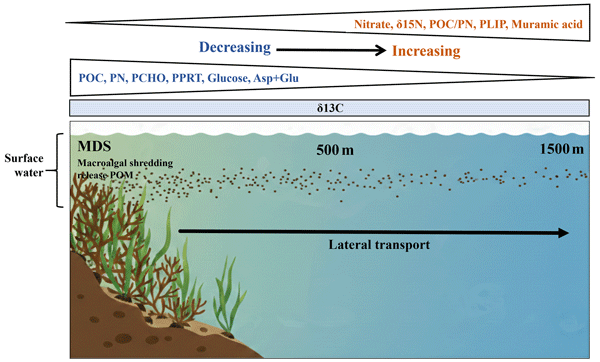
Reply: Thank you for this excellent suggestion. We have added a short paragraph, as suggested, at the beginning of the discussion in Section 4 that summarizes our key findings as “The present study provided a multi-proxy assessment of POM in surface waters of macroalgal beds in Kongsfjorden, integrating bulk biogeochemistry, isotopes, bio-polymeric composition, and molecular biomarkers. Elevated bulk (POC, PN, PCHO, and PPRT) and molecular (monosaccharides and amino acids) concentrations at MDS indicated that macroalgal beds act as localized sources of biochemically labile organic matter. The results demonstrated that macroalgal beds imprint surface waters with distinct biochemical and molecular signatures that are rapidly redistributed across fjord-scale gradients. The PCA demonstrates that macroalgae influence surface POM along a continuous multivariate gradient rather than discrete habitat classes. The systematic offshore decline of these compounds, together with internal reorganization of bio-polymeric and molecular composition, shows that macroalgal-derived POM is efficiently exported and selectively transformed during lateral transport (Fig. 6).”
The emphasis on Brandal as a biogeochemical hotspot is well supported by the data; however, a brief discussion on how representative this site may be of Arctic macroalgal beds more broadly, or which site characteristics may limit generalisation, would help place the findings in a wider Arctic context.
Reply: We thank the reviewer for this insightful suggestion. We have added a brief discussion in the revised manuscript addressing the representativeness of the brandal within Arctic macroalgal systems and the limitations associated with extrapolating these findings across the Arctic.
Figure 6 – add labels for 55 and 1500, add arrows with the label decreasing for the compounds/concentrations
Reply: Thank you for these specific suggestions to improve the clarity of our conceptual model in Figure 6. We have revised the figure as suggested to include the labels for 500m and 1500m sampling stations in bold text. Furthermore, we have added directional arrows to clearly illustrate the decreasing and increasing concentration of key biochemical compounds as they are transported away from macroalgal beds.
Line 551 – missing full stop
Reply: Thank you for pointing out this redundancy. We have corrected the grammatical error in the revised manuscript.
Section 4.5 Implications – lines 538 – 548 is a summary of your results, consider moving this, along with Figure 6, to the start of your discussion. Expand on the implications sections so it focusses on the ‘so what does this mean for future research and climate/ecosystem implications’. The novelty of the study would benefit from being made more explicit, particularly in relation to previous POM studies in Kongsfjorden. A short clarification of what is fundamentally new here (e.g. molecular resolution, spatial design, or integration of proxies) would help situate the contribution more clearly within the existing literature.
Reply: We thank the reviewer for this strategic advice on the structure and impact of the discussion. We have reorganized the Discussion section by moving the summary-oriented content from Section 4.5, along with Figure 6, to the beginning of the Discussion to provide a clearer conceptual overview of the main findings. We have also substantially revised and expanded the implications section to focus more explicitly on the broader significance of our findings for future Arctic research and climate-driven ecosystem change. We have clarified the novelty and key advances of this study in relation to previous POM studies conducted in Kongsfjorden.
Citation: https://doi.org/10.5194/egusphere-2026-843-AC2
-
AC2: 'Reply on RC2', Ashok Jagtap, 19 May 2026
Peer review completion


Interactive discussion
Status: closed
-
RC1: 'Comment on egusphere-2026-843', Anonymous Referee #1, 21 Apr 2026
This manuscript investigates the influence of macroalgal beds in the Arctic Kongsfjorden on the sources and early transformation processes of surface particulate organic matter. By comparing surface water samples from four macroalgae-dominated sites and their adjacent waters (500 m and 1500 m), and employing a combination of elemental analysis, stable isotopes, macromolecular composition, and molecular biomarkers, the authors found that macroalgal beds are a significant source of labile carbon and nitrogen compounds in surface POM, with their molecular fingerprints (e.g., monosaccharide and amino acid composition) showing distinct signatures. POM derived from macroalgae can be exported to the fjord scale and undergoes selective transformation during lateral transport. Principal component analysis revealed a continuous biogeochemical gradient from the macroalgal beds to the adjacent waters. Among the sites, Brandal stands out as a distinct biogeochemical hotspot influenced by macroalgae. This study provides important multi-proxy evidence for understanding how expanding macroalgal communities, under rapid Arctic warming, influence the sources, transport, and transformation of coastal organic carbon through benthic-pelagic coupling processes. It holds clear academic value for deepening the understanding of the Arctic coastal carbon cycle and is worthy of publication after revision.
Major Deficiencies and Revision Suggestions
1) The abstract and highlights sections are repetitive and could be further refined. (Lines 14-22, 24-45). It is suggested that the author revisits and integrates the content of these two sections. Consider refining the "Highlights" into the most concise and eye-catching core innovative findings, while the "Abstract" should maintain its independence, providing a complete yet succinct overview of the research background, methods, main results, and conclusions, avoiding simple repetition of the highlight statements.
2) Lines 511-536: The explanation for the mechanism behind the finding that "Brandal is a biogeochemical hotspot influenced by macroalgae" is primarily attributed to "high biomass," "favorable growth conditions," and "possible promotion of detritus retention by hydrological conditions," which is somewhat general. It is suggested to add a subsection or paragraph to explore more specifically the potential local driving factors that make the Brandal site a hotspot. For example, can known information about the site's geographical location, water depth, hydrodynamic characteristics (e.g., whether it is in a circulation or upwelling area), degree of freshwater input, etc., or citations of relevant literature, be incorporated to support the speculation that "hydrological conditions promote retention," making the conclusion more robust.
3) .Specific citation suggestions:
1) Lines 89-91: In the introduction, when discussing the complexity of organic matter sources in the Arctic coastal zone, after ".....(Singh et al., 2024b) and sediments (Roy et al., 2025) in Kongsfjorden", add: "Similarly, studies on the Qinghai-Tibetan Plateau saline lakes have shown that the molecular composition of dissolved organic matter is also strongly influenced by watershed inputs and internal biological processes (Jiang et al., 2022), and that terrestrially derived organic matter can be transformed driven by aquatic microbial communities (Yang et al., 2020)."
2)Line 457: After "observed decline in POC from MDS to Adj-W", insert: "This aligns with the classical understanding of preferential degradation of labile components in marine environments. In lake sediment systems, inputs of algal and terrestrial organic matter have been shown to stimulate significantly different microbial degradation processes (priming effects) (Yang et al., 2023), with methanogenesis potentially dominating the carbon flow under anoxic conditions (Yang et al., 2025), implying the key control of organic matter molecular composition on its transformation pathways."
3)Line 517: After "matter within this macroalgal-dominated habitat", insert: "Habitat heterogeneity is considered a primary factor driving microbial community assembly and functional differentiation in extreme environments (Huang et al., 2026). In Qinghai Lake, the assembly mechanisms of prokaryotic and microeukaryotic communities have been shown to be significantly different and regulated by different environmental factors (Han et al., 2023). Similarly, research in the Aral Sea region indicates that minor differences in salinity and mineralogy can lead to distinctly different responses in microbial and endophytic communities (Jiang et al., 2021). Therefore, the Brandal hotspot may result from the combined action of its unique substrate (macroalgal bed), local hydrodynamics (forming a 'retention zone'), and the resulting unique microbial community, reflecting the high specificity of biogeochemical processes at the microhabitat scale."
Yang et al. (2020) Potential utilization of terrestrially derived dissolved organic matter by aquatic microbial communities in saline lakes. The ISME Journal 14(9): 2313-2324.https://doi.org/10.1038/s41396-020-0689-0
Jiang et al, (2021) Onshore soil microbes and endophytes respond differently to salinity and mineralogy in the Aral Sea. Science of the Total Environment 765: 142675,https://doi.org/10.1016/j.scitotenv.2020.142675
Yang et al. (2022) Positive priming effects induced by allochthonous and autochthonous organic matter input in the lake sediments with different salinity. Geophysical Research Letters 49(5): e2021GL096133. https://doi.org/10.1029/2021GL096133
Jiang*, et al. (2022) Molecular composition of dissolved organic matter in saline lakes of the Qing-Tibetan Plateau. Organic Geochemistry 167: 104400. https://doi.org/10.1016/j.orggeochem.2022.104400
Han, et al. (2023) Distinct assembly mechanisms for prokaryotic and microeukaryotic communities in the water of Qinghai Lake. Journal of Earth Science 34(4): 1189-1200, https://doi.org/10.1007/s12583-023-1812-8
Yang, et al., (2023) Predominance of positive priming effects induced by algal and terrestrial organic matter input in saline lake sediments. Geochimica et Cosmochimica Acta 349: 126–134, https://doi.org/10.1016/j.gca.2023.04.005
Yang, et al., (2025) Methanogenesis rather than carbon dioxide production frives positive priming effects in anoxic sediments of saline lakes. Chemical Geology 678: 122680, https://doi.org/10.1016/j.chemgeo.2025.122680
Huang et al. (2026) Habitat heterogeneity drives microbial community assembly and functional specialization in extreme arid ecosystems. Applied and Environmental Microbiology, https://doi.org/10.1128/aem.02588-25
Citation: https://doi.org/10.5194/egusphere-2026-843-RC1 -
AC1: 'Reply on RC1', Ashok Jagtap, 19 May 2026
This manuscript investigates the influence of macroalgal beds in the Arctic Kongsfjorden on the sources and early transformation processes of surface particulate organic matter. By comparing surface water samples from four macroalgae-dominated sites and their adjacent waters (500 m and 1500 m), and employing a combination of elemental analysis, stable isotopes, macromolecular composition, and molecular biomarkers, the authors found that macroalgal beds are a significant source of labile carbon and nitrogen compounds in surface POM, with their molecular fingerprints (e.g., monosaccharide and amino acid composition) showing distinct signatures. POM derived from macroalgae can be exported to the fjord scale and undergoes selective transformation during lateral transport. Principal component analysis revealed a continuous biogeochemical gradient from the macroalgal beds to the adjacent waters. Among the sites, Brandal stands out as a distinct biogeochemical hotspot influenced by macroalgae. This study provides important multi-proxy evidence for understanding how expanding macroalgal communities, under rapid Arctic warming, influence the sources, transport, and transformation of coastal organic carbon through benthic-pelagic coupling processes. It holds clear academic value for deepening the understanding of the Arctic coastal carbon cycle and is worthy of publication after revision.
Response: We sincerely thank the reviewer for the positive and constructive evaluation of our manuscript. We greatly appreciate the reviewer’s recognition of the novelty and multiproxy approach in elucidating the influence of Arctic macroalgal beds on the sources, transport, and transformation of POM in Kongsfjorden. We appreciate the reviewer’s acknowledgement of the importance of biochemical and molecular-level analysis, including elemental composition, stable isotopes, amino acids, sugars, and multivariate approaches, in identifying macroalgal-derived signatures and biogeochemical gradients from coastal beds to adjacent fjord waters. Following the reviewer’s suggestions, we have carefully revised the manuscript to improve clarity, strengthen interpretations, and address all specific comments in detail. We believe these revisions have substantially improved the quality and readability of the manuscript.
Major Deficiencies and Revision Suggestions
- The abstract and highlights sections are repetitive and could be further refined. (Lines 14-22, 24-45). It is suggested that the author revisits and integrates the content of these two sections. Consider refining the "Highlights" into the most concise and eye-catching core innovative findings, while the "Abstract" should maintain its independence, providing a complete yet succinct overview of the research background, methods, main results, and conclusions, avoiding simple repetition of the highlight statements.
Response: We thank the reviewer for this helpful comment. We have revised the abstract to provide a complete overview of the research background, methods, main results, and conclusions. The highlights have been revised to focus only on core innovative findings in a concise manner without repetition. The revised Highlights and Abstract are as follows:
Revised highlights
- Macroalgal-dominated sites were observed with higher labile surface particulate organic carbon and nitrogen signatures than adjacent waters.
- Biochemical and biomolecular composition indicated lateral transport from macroalgal-beds with conservative reorganization.
- Brandal was identified as a model site for future biogeochemical studies related to macroalgal expansion.
Revised Abstract
Accelerated Arctic warming is promoting the expansion of coastal macroalgal habitats; yet their influence on pelagic organic carbon cycling remains unresolved. This study investigates the influence of macroalgal beds on the biochemical composition of surface particulate organic matter (POM) in Kongsfjorden, Svalbard, during late summer 2023. Surface waters were sampled at four macroalgal-dominated sites (MDS) and from adjacent waters (Adj-W) located 500 m and 1500 m away. A multi-proxy approach integrating elemental composition, stable isotopes, biopolymeric fractions, monosaccharides, and amino acids was used to trace macroalgal contributions and their lateral redistribution. Concentrations of particulate organic carbon, nitrogen, carbohydrates, and proteins were consistently higher at MDS than in Adj-W, indicating localized enrichment of biochemically labile organic matter within macroalgal habitats. Molecular analyses further revealed elevated concentrations of macroalgal-associated sugars (glucose, galactose, fucose, mannuronic acid) and labile amino acids (Asp, Glu, Gly, Ser, Ala) reinforcing macroalgal-derived contributions to surface POM. While, δ¹³CPOC showed minimal spatial variation (−26.8 to −29.1‰), the biochemical and molecular signatures indicated a decreasing macroalgal contribution towards Adj-W, along with internal reorganization, suggesting lateral transport of macroalgal-derived POM with selective early-stage transformation. Overall, these findings indicate that Arctic macroalgal beds act as dynamic coastal biogeochemical hotspots, redistributing and transforming organic carbon beyond their habitat.
2) Lines 511-536: The explanation for the mechanism behind the finding that "Brandal is a biogeochemical hotspot influenced by macroalgae" is primarily attributed to "high biomass," "favorable growth conditions," and "possible promotion of detritus retention by hydrological conditions," which is somewhat general. It is suggested to add a subsection or paragraph to explore more specifically the potential local driving factors that make the Brandal site a hotspot. For example, can known information about the site's geographical location, water depth, hydrodynamic characteristics (e.g., whether it is in a circulation or upwelling area), degree of freshwater input, etc., or citations of relevant literature, be incorporated to support the speculation that "hydrological conditions promote retention," making the conclusion more robust.
Response: Thank you for the suggestions. We have added a new paragraph in Section 4.4, expanded our discussion of local driving factors at Brandal in text as “BD station, among all studied stations, consistently emerged as an organic-rich site, showing characteristics of macroalgal-influenced surface POM, highlighting its role as a biogeochemical hotspot within Kongsfjorden. With the highest concentrations of POC, PN, PCHO, PPRT, total monosaccharides, and total amino acids, the BD station contributed the most in the PCA biplot (Fig. 5), which demonstrated local production and accumulation of biochemically labile organic matter within this macroalgal-dominated habitat. The strong gradient observed across PN, δ¹⁵N, C:N, PPRT, and amino acid composition from MDS to Adj-W at BD indicated nitrogen assimilation, dominance of fresh marine organic matter in macroalgal bed, and their progressive downstream alteration. At the molecular level also, BD_MDS was strongly enriched in glucose and other macroalgal sugars (fucose, galactose, mannuronic acid), with total monosaccharides and glucose declining offshore. Similarly, the offshore decrease in labile amino acids (e.g., Asp, Glu) provides a molecular signature for early degradation during export, indicating that the BD macroalgal bed is a major source of biochemically active POM and a key contributor to fjord-scale redistribution (van der Mheen et al., 2024).
Situated on the westernmost part of the south shore, BD is influenced by Atlantic water inflow, which creates relatively warmer and more saline conditions (Williams, 2017; Wilson, 2022; Woelfel et al., 2014), that support abundant micro-phytobenthic and benthic mosses (Woelfel et al., 2014). At BD, macroalgal cover is not higher than other sites, yet detritus accumulation is substantial, supporting elevated benthic faunal diversity. The presence of a deep trench, combined with storm-driven transport, concentrates detritus at BD (Schimani Katherina, 2019). Habitat heterogeneity further drives microbial community assembly and functional differentiation (Huang et al., 2026), reflected in high macroalgal detrital cover and meiofaunal density (Schimani et al., 2022). Additionally, BD exhibits significantly lower turbidity than glacier-proximal sites, which prevents mineral masking of organic signatures and provides a stable light regime for primary producers (Bianchi et al., 2020). Collectively, these features make BD a retention zone for macroalgal detritus, acting as a biogeochemical hotspot and a critical repository for macroalgal-derived carbon. While Brandal represents a biogeochemical hotspot, its broader representativeness is constrained due to spatial variability in macroalgal structure and function across high Arctic fjords, driven by variation in latitude, ice scour, light availability, terrestrial runoff, and glacier-induced salinity and turbidity gradients (Bartsch et al., 2016). Thus, although Brandal provides a high-resolution case study, caution is required when extrapolating its biogeochemical fluxes to fjords characterized by intense glacial runoff, seasonal sea-ice cover, and a different community composition.”
3) Specific citation suggestions:
1) Lines 89-91: In the introduction, when discussing the complexity of organic matter sources in the Arctic coastal zone, after ".....(Singh et al., 2024b) and sediments (Roy et al., 2025) in Kongsfjorden", add: "Similarly, studies on the Qinghai-Tibetan Plateau saline lakes have shown that the molecular composition of dissolved organic matter is also strongly influenced by watershed inputs and internal biological processes (Jiang et al., 2022), and that terrestrially derived organic matter can be transformed driven by aquatic microbial communities (Yang et al., 2020)."
Response: We thank the reviewer for this suggestion. We have incorporated the relevant citations into the introduction in the revised manuscript.
- Line 457: After "observed decline in POC from MDS to Adj-W", insert: "This aligns with the classical understanding of preferential degradation of labile components in marine environments. In lake sediment systems, inputs of algal and terrestrial organic matter have been shown to stimulate significantly different microbial degradation processes (priming effects) (Yang et al., 2023), with methanogenesis potentially dominating the carbon flow under anoxic conditions (Yang et al., 2025), implying the key control of organic matter molecular composition on its transformation pathways."
Response: We thank the reviewer for the suggestion. We have incorporated the relevant citations in the revised manuscript.
3) Line 517: After "matter within this macroalgal-dominated habitat", insert: "Habitat heterogeneity is considered a primary factor driving microbial community assembly and functional differentiation in extreme environments (Huang et al., 2026). In Qinghai Lake, the assembly mechanisms of prokaryotic and microeukaryotic communities have been shown to be significantly different and regulated by different environmental factors (Han et al., 2023). Similarly, research in the Aral Sea region indicates that minor differences in salinity and mineralogy can lead to distinctly different responses in microbial and endophytic communities (Jiang et al., 2021). Therefore, the Brandal hotspot may result from the combined action of its unique substrate (macroalgal bed), local hydrodynamics (forming a 'retention zone'), and the resulting unique microbial community, reflecting the high specificity of biogeochemical processes at the microhabitat scale."
Response: We thank the reviewer for this insightful suggestion. We have integrated the relevant citations in the revised manuscript.
Citation: https://doi.org/10.5194/egusphere-2026-843-AC1
-
AC1: 'Reply on RC1', Ashok Jagtap, 19 May 2026
-
RC2: 'Comment on egusphere-2026-843', Anonymous Referee #2, 29 Apr 2026
Overall, this is a strong and timely study that applies a comprehensive multi-proxy approach to explore macroalgal influences on particulate organic matter dynamics in an Arctic fjord. The dataset is robust and the analyses are generally well interpreted, providing valuable insight into benthic–pelagic coupling in a rapidly changing Arctic coastal system. A number of revisions would further strengthen the manuscript, particularly improvements to figure clarity and accessibility, minor typographical and formatting corrections, and additional detail in the statistical methods to improve transparency and reproducibility. The manuscript would also benefit from some streamlining of lengthy results sections and clearer structuring of the discussion, including a brief synthesis of key findings and a slightly stronger emphasis on broader implications. Addressing these points would enhance readability and ensure the study’s contributions are fully accessible to a wide readership.
General typos and suggestions for clarification
Line 26 This study investigates
Lines 67 – 70 not needed, can remove
Lines 71 – 73, how are the macroalgal beds lost? Provide an example of the process/reasons for these losses.
Figure 1 – consider adding place names and enlarge latitude/longitude text.
Section 2.7 Statistical analysis – what packages did you use in R for your statistical analysis? Did you test for equal variance and normality assumptions before proceeding to ANOVA?
Tabel 1 – if you’re abbreviating, include the abbreviation in brackets in your table cation (e.g. sal for salinity).
Figure 2 – this is very hard to read, consider enlarging and making all text bigger
Table 2 – fix table caption
Figure 3 – avoid using red (colour blind implications)
Sections 3.3.2, 3.3.3 and 3.3.4 – consider summarising all the data ranges in tables to avoid big text sections. You could potentially include these in the Appendices since you already include graphs.
Line 351 – PCA analysis should be PCA
Section 4 Discussion – consider adding a short paragraph at the beginning that summarises all your key findings and then expand on the detail in the subsequent sections.
The emphasis on Brandal as a biogeochemical hotspot is well supported by the data; however, a brief discussion on how representative this site may be of Arctic macroalgal beds more broadly, or which site characteristics may limit generalisation, would help place the findings in a wider Arctic context.
Figure 6 – add labels for 55 and 1500, add arrows with the label decreasing for the compounds/concentrations
Line 551 – missing full stop
Section 4.5 Implications – lines 538 – 548 is a summary of your results, consider moving this, along with Figure 6, to the start of your discussion. Expand on the implications sections so it focusses on the ‘so what does this mean for future research and climate/ecosystem implications’. The novelty of the study would benefit from being made more explicit, particularly in relation to previous POM studies in Kongsfjorden. A short clarification of what is fundamentally new here (e.g. molecular resolution, spatial design, or integration of proxies) would help situate the contribution more clearly within the existing literature.
Citation: https://doi.org/10.5194/egusphere-2026-843-RC2 -
AC2: 'Reply on RC2', Ashok Jagtap, 19 May 2026
Overall, this is a strong and timely study that applies a comprehensive multi-proxy approach to explore macroalgal influences on particulate organic matter dynamics in an Arctic fjord. The dataset is robust and the analyses are generally well interpreted, providing valuable insight into benthic–pelagic coupling in a rapidly changing Arctic coastal system. A number of revisions would further strengthen the manuscript, particularly improvements to figure clarity and accessibility, minor typographical and formatting corrections, and additional detail in the statistical methods to improve transparency and reproducibility. The manuscript would also benefit from some streamlining of lengthy results sections and clearer structuring of the discussion, including a brief synthesis of key findings and a slightly stronger emphasis on broader implications. Addressing these points would enhance readability and ensure the study’s contributions are fully accessible to a wide readership.
Reply: We sincerely thank the reviewer for the positive and thoughtful evaluation of our manuscript. We greatly appreciate the reviewers' recognition of the novelty and comprehensive multiproxy approach of this study, as well as its contribution to understanding particulate organic matter dynamics in Arctic coastal systems undergoing rapid environmental change. We also appreciate the reviewers’ constructive suggestions for improving the manuscript. In response, we have carefully revised the figures to improve clarity, readability, and accessibility, and corrected the identified typographical errors throughout the manuscript. Additional details on statistical analysis have been included to enhance the transparency and reproducibility. We have also streamlined the Results section to improve flow and readability, and reorganized the Discussion section to provide a clearer thematic structure, stronger synthesis of the main findings, and broader contextual implications for Arctic coastal carbon cycling under climate warming. We believe these revisions have substantially strengthened the manuscript and improved its accessibility to a wider readership.
General typos and suggestions for clarification
Line 26 This study investigates
Reply: Thank you for pointing out the grammatical error; we have corrected it in the revised manuscript.
Lines 67 – 70 not needed, can remove
Reply: Thank you for the suggestion. As suggested, the statement has been removed in the revised manuscript.
Lines 71 – 73, how are the macroalgal beds lost? Provide an example of the process / reasons for these losses.
Reply: Thank you for the comment. To clarify, the focus of lines 71–73 is specifically on macroalgal blade erosion and fragmentation rather than the loss of the entire macroalgal bed. This distinction is important because blade erosion represents a continuous, daily contribution of organic material to the Particulate Organic Carbon (POC) pool, even while the macroalgal bed remains intact.
For clarity, the process of macroalgal blade erosion is provided, which is mainly driven by mechanical stress, physical abrasion against rocky substrates, seasonal increases in tissue brittleness, and biological weakening by epiphytes. All of these facilitate the gradual fragmentation of the blade into the particulate organic matter pool.
Figure 1 – Consider adding place names and enlarge latitude/longitude text.
Reply: Thank you for the suggestion. As suggested, the place names were added in Figure 1, and the font size of the latitude and longitude text is increased for better visibility.
Section 2.7 Statistical analysis – what packages did you use in R for your statistical analysis? Did you test for equal variance and normality assumptions before proceeding to ANOVA?
Reply: We have updated Section 2.7 to: “Statistical analysis was performed using R (version 4.6.0), normality of the data was assessed using the Shapiro-Wilk test, and homogeneity of variance was verified using Levene’s test. Pearson correlation analysis was performed at a significance level of 0.05 to examine the relationship between the variables. Principal component analysis (PCA) was employed using the vegan and factoextra packages to visualize the biogeochemical gradient, and all plots were generated using ggplot2. Analysis of variance (ANOVA) was used to test for significant differences in POM composition between the MDS and Adj-W sites.”
Tabel 1 – if you’re abbreviating, include the abbreviation in brackets in your table cation (e.g. sal for salinity).
Reply: Thank you for pointing out that we have updated the abbreviation in the revised manuscript.
Figure 2 – this is very hard to read, consider enlarging and making all text bigger
Reply: Thank you for the constructive feedback regarding Figure 2. As suggested, we have revised the figure to ensure its readability.
Table 2 – fix table caption
Reply: Thank you for the suggestion. We have revised the caption for Table 2 to be more comprehensive. The revised caption is “Table 2. Concentrations of particulate biochemical components, including carbohydrates (P-CHO), proteins (P-PRT), and lipids (P-LIP), alongside their biopolymeric carbon equivalents (BPC-CHO, BPC-PRT, BPC-LIP) and total biopolymeric carbon (BPC) across the sampling stations.”
Figure 3 – avoid using red (colour blind implications)
Reply: Thank you for the valuable suggestion. We have revised Figure 3 to avoid the use of red, ensuring that the plot is accessible to readers with colour vision deficiencies.
Sections 3.3.2, 3.3.3 and 3.3.4 – consider summarising all the data ranges in tables to avoid big text sections. You could potentially include these in the Appendices since you already include graphs.
Reply: We thank the reviewer for this helpful suggestion to improve the manuscript flow. We agree that the extensive data ranges in Sections 3.3.2, 3.3.3 and 3.3.4 made the text dense and difficult to follow. As suggested, we have summarized this biochemical characterization and percentages in Supplementary Table (S2) and streamlined the corresponding text to improve the clarity of the Results section.
Line 351 – PCA analysis should be PCA
Reply: Thank you for pointing out this redundancy. We have corrected the text in revised manuscript to “PCA” instead of “PCA analysis”.
Section 4 Discussion – consider adding a short paragraph at the beginning that summarises all your key findings and then expand on the detail in the subsequent sections.
Reply: Thank you for this excellent suggestion. We have added a short paragraph, as suggested, at the beginning of the discussion in Section 4 that summarizes our key findings as “The present study provided a multi-proxy assessment of POM in surface waters of macroalgal beds in Kongsfjorden, integrating bulk biogeochemistry, isotopes, bio-polymeric composition, and molecular biomarkers. Elevated bulk (POC, PN, PCHO, and PPRT) and molecular (monosaccharides and amino acids) concentrations at MDS indicated that macroalgal beds act as localized sources of biochemically labile organic matter. The results demonstrated that macroalgal beds imprint surface waters with distinct biochemical and molecular signatures that are rapidly redistributed across fjord-scale gradients. The PCA demonstrates that macroalgae influence surface POM along a continuous multivariate gradient rather than discrete habitat classes. The systematic offshore decline of these compounds, together with internal reorganization of bio-polymeric and molecular composition, shows that macroalgal-derived POM is efficiently exported and selectively transformed during lateral transport (Fig. 6).”
The emphasis on Brandal as a biogeochemical hotspot is well supported by the data; however, a brief discussion on how representative this site may be of Arctic macroalgal beds more broadly, or which site characteristics may limit generalisation, would help place the findings in a wider Arctic context.
Reply: We thank the reviewer for this insightful suggestion. We have added a brief discussion in the revised manuscript addressing the representativeness of the brandal within Arctic macroalgal systems and the limitations associated with extrapolating these findings across the Arctic.
Figure 6 – add labels for 55 and 1500, add arrows with the label decreasing for the compounds/concentrations
Reply: Thank you for these specific suggestions to improve the clarity of our conceptual model in Figure 6. We have revised the figure as suggested to include the labels for 500m and 1500m sampling stations in bold text. Furthermore, we have added directional arrows to clearly illustrate the decreasing and increasing concentration of key biochemical compounds as they are transported away from macroalgal beds.
Line 551 – missing full stop
Reply: Thank you for pointing out this redundancy. We have corrected the grammatical error in the revised manuscript.
Section 4.5 Implications – lines 538 – 548 is a summary of your results, consider moving this, along with Figure 6, to the start of your discussion. Expand on the implications sections so it focusses on the ‘so what does this mean for future research and climate/ecosystem implications’. The novelty of the study would benefit from being made more explicit, particularly in relation to previous POM studies in Kongsfjorden. A short clarification of what is fundamentally new here (e.g. molecular resolution, spatial design, or integration of proxies) would help situate the contribution more clearly within the existing literature.
Reply: We thank the reviewer for this strategic advice on the structure and impact of the discussion. We have reorganized the Discussion section by moving the summary-oriented content from Section 4.5, along with Figure 6, to the beginning of the Discussion to provide a clearer conceptual overview of the main findings. We have also substantially revised and expanded the implications section to focus more explicitly on the broader significance of our findings for future Arctic research and climate-driven ecosystem change. We have clarified the novelty and key advances of this study in relation to previous POM studies conducted in Kongsfjorden.
Citation: https://doi.org/10.5194/egusphere-2026-843-AC2
-
AC2: 'Reply on RC2', Ashok Jagtap, 19 May 2026
Peer review completion
Journal article(s) based on this preprint
Viewed
| HTML | XML | Total | Supplement | BibTeX | EndNote | |
|---|---|---|---|---|---|---|
| 677 | 300 | 66 | 1,043 | 113 | 63 | 107 |
- HTML: 677
- PDF: 300
- XML: 66
- Total: 1,043
- Supplement: 113
- BibTeX: 63
- EndNote: 107
Viewed (geographical distribution)
| Country | # | Views | % |
|---|
| Total: | 0 |
| HTML: | 0 |
| PDF: | 0 |
| XML: | 0 |
- 1
Ashok Shivaji Jagtap
Archana Singh
Anand Jain
Nandini Raj
Manish Tiwari
The requested preprint has a corresponding peer-reviewed final revised paper. You are encouraged to refer to the final revised version.
- Preprint
(1516 KB) - Metadata XML
-
Supplement
(536 KB) - BibTeX
- EndNote
- Final revised paper
This manuscript investigates the influence of macroalgal beds in the Arctic Kongsfjorden on the sources and early transformation processes of surface particulate organic matter. By comparing surface water samples from four macroalgae-dominated sites and their adjacent waters (500 m and 1500 m), and employing a combination of elemental analysis, stable isotopes, macromolecular composition, and molecular biomarkers, the authors found that macroalgal beds are a significant source of labile carbon and nitrogen compounds in surface POM, with their molecular fingerprints (e.g., monosaccharide and amino acid composition) showing distinct signatures. POM derived from macroalgae can be exported to the fjord scale and undergoes selective transformation during lateral transport. Principal component analysis revealed a continuous biogeochemical gradient from the macroalgal beds to the adjacent waters. Among the sites, Brandal stands out as a distinct biogeochemical hotspot influenced by macroalgae. This study provides important multi-proxy evidence for understanding how expanding macroalgal communities, under rapid Arctic warming, influence the sources, transport, and transformation of coastal organic carbon through benthic-pelagic coupling processes. It holds clear academic value for deepening the understanding of the Arctic coastal carbon cycle and is worthy of publication after revision.
Major Deficiencies and Revision Suggestions
1) The abstract and highlights sections are repetitive and could be further refined. (Lines 14-22, 24-45). It is suggested that the author revisits and integrates the content of these two sections. Consider refining the "Highlights" into the most concise and eye-catching core innovative findings, while the "Abstract" should maintain its independence, providing a complete yet succinct overview of the research background, methods, main results, and conclusions, avoiding simple repetition of the highlight statements.
2) Lines 511-536: The explanation for the mechanism behind the finding that "Brandal is a biogeochemical hotspot influenced by macroalgae" is primarily attributed to "high biomass," "favorable growth conditions," and "possible promotion of detritus retention by hydrological conditions," which is somewhat general. It is suggested to add a subsection or paragraph to explore more specifically the potential local driving factors that make the Brandal site a hotspot. For example, can known information about the site's geographical location, water depth, hydrodynamic characteristics (e.g., whether it is in a circulation or upwelling area), degree of freshwater input, etc., or citations of relevant literature, be incorporated to support the speculation that "hydrological conditions promote retention," making the conclusion more robust.
3) .Specific citation suggestions:
1) Lines 89-91: In the introduction, when discussing the complexity of organic matter sources in the Arctic coastal zone, after ".....(Singh et al., 2024b) and sediments (Roy et al., 2025) in Kongsfjorden", add: "Similarly, studies on the Qinghai-Tibetan Plateau saline lakes have shown that the molecular composition of dissolved organic matter is also strongly influenced by watershed inputs and internal biological processes (Jiang et al., 2022), and that terrestrially derived organic matter can be transformed driven by aquatic microbial communities (Yang et al., 2020)."
2)Line 457: After "observed decline in POC from MDS to Adj-W", insert: "This aligns with the classical understanding of preferential degradation of labile components in marine environments. In lake sediment systems, inputs of algal and terrestrial organic matter have been shown to stimulate significantly different microbial degradation processes (priming effects) (Yang et al., 2023), with methanogenesis potentially dominating the carbon flow under anoxic conditions (Yang et al., 2025), implying the key control of organic matter molecular composition on its transformation pathways."
3)Line 517: After "matter within this macroalgal-dominated habitat", insert: "Habitat heterogeneity is considered a primary factor driving microbial community assembly and functional differentiation in extreme environments (Huang et al., 2026). In Qinghai Lake, the assembly mechanisms of prokaryotic and microeukaryotic communities have been shown to be significantly different and regulated by different environmental factors (Han et al., 2023). Similarly, research in the Aral Sea region indicates that minor differences in salinity and mineralogy can lead to distinctly different responses in microbial and endophytic communities (Jiang et al., 2021). Therefore, the Brandal hotspot may result from the combined action of its unique substrate (macroalgal bed), local hydrodynamics (forming a 'retention zone'), and the resulting unique microbial community, reflecting the high specificity of biogeochemical processes at the microhabitat scale."
Yang et al. (2020) Potential utilization of terrestrially derived dissolved organic matter by aquatic microbial communities in saline lakes. The ISME Journal 14(9): 2313-2324.https://doi.org/10.1038/s41396-020-0689-0
Jiang et al, (2021) Onshore soil microbes and endophytes respond differently to salinity and mineralogy in the Aral Sea. Science of the Total Environment 765: 142675,https://doi.org/10.1016/j.scitotenv.2020.142675
Yang et al. (2022) Positive priming effects induced by allochthonous and autochthonous organic matter input in the lake sediments with different salinity. Geophysical Research Letters 49(5): e2021GL096133. https://doi.org/10.1029/2021GL096133
Jiang*, et al. (2022) Molecular composition of dissolved organic matter in saline lakes of the Qing-Tibetan Plateau. Organic Geochemistry 167: 104400. https://doi.org/10.1016/j.orggeochem.2022.104400
Han, et al. (2023) Distinct assembly mechanisms for prokaryotic and microeukaryotic communities in the water of Qinghai Lake. Journal of Earth Science 34(4): 1189-1200, https://doi.org/10.1007/s12583-023-1812-8
Yang, et al., (2023) Predominance of positive priming effects induced by algal and terrestrial organic matter input in saline lake sediments. Geochimica et Cosmochimica Acta 349: 126–134, https://doi.org/10.1016/j.gca.2023.04.005
Yang, et al., (2025) Methanogenesis rather than carbon dioxide production frives positive priming effects in anoxic sediments of saline lakes. Chemical Geology 678: 122680, https://doi.org/10.1016/j.chemgeo.2025.122680
Huang et al. (2026) Habitat heterogeneity drives microbial community assembly and functional specialization in extreme arid ecosystems. Applied and Environmental Microbiology, https://doi.org/10.1128/aem.02588-25