
the Creative Commons Attribution 4.0 License.
the Creative Commons Attribution 4.0 License.
 | 20 Mar 2026
Water, carbon, and light use efficiencies in an old hemiboreal coniferous forest: nine-year patterns under hydroclimatic variability
Abstract. Hemiboreal forests bridge boreal and temperate biomes by combining functional and compositional features of both and playing a key role in regional carbon and water cycling. Water (WUE), carbon (CUE), and light (LUE) use efficiencies provide integrative indicators of how effectively ecosystems convert available resources into carbon uptake yet their long-term dynamics and controlling factors remain poorly explained in hemiboreal forests. We analysed nine consecutive growing seasons (2016–2024) of eddy-covariance measurements from an old upland hemiboreal coniferous forest in southern Estonia to quantify WUE, CUE, and LUE and to identify their controls across daily and interannual scales and along a standardized precipitation-evapotranspiration index (SPEI) defined hydroclimatic gradient.
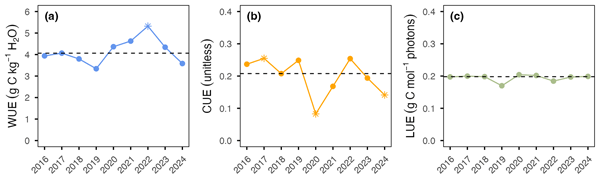
Growing-season temperature and vapour pressure deficit (VPD) increased over the study period. Despite this trend, WUE remained comparatively stable across years, with only one deviating growing season (2022) linked to intensified carbon uptake over a shorter season length. In contrast, CUE exhibited pronounced interannual variability driven primarily by changes in net ecosystem production and respiration dynamics. LUE was remarkably stable and showed no indication of age-related decline.
At the daily scale, VPD controlled WUE and LUE, whereas photosynthetically active radiation exerted dominant control over CUE. Across the hydroclimatic gradient, CUE displayed the strongest non-linear response, indicating rapid shifts in ecosystem balance under moisture anomalies, whereas WUE remained comparatively resistant. Changes in LUE suggested a moisture optimum but high efficiency was maintained under dry extremes, likely reflecting structural and physiological adjustments within the canopy.
Together, these results reveal differentiated sensitivities of ecosystem efficiencies to atmospheric drying and identify CUE as the most responsive indicator of hydroclimatic variability. Our findings provide new insight into the functional stability and potential thresholds of hemiboreal coniferous forests undergoing climate change.
-
Notice on discussion status
The requested preprint has a corresponding peer-reviewed final revised paper. You are encouraged to refer to the final revised version.
-
Preprint
(30377 KB)
-
The requested preprint has a corresponding peer-reviewed final revised paper. You are encouraged to refer to the final revised version.
- Preprint
(30377 KB) - Metadata XML
- BibTeX
- EndNote
- Final revised paper


Journal article(s) based on this preprint
Interactive discussion
Status: closed
-
RC1: 'Comment on egusphere-2026-837', Anonymous Referee #1, 20 Apr 2026
- AC1: 'Reply on RC1', Svyatoslav Rogozin, 28 May 2026
-
RC2: 'Comment on egusphere-2026-837', Anonymous Referee #2, 05 May 2026
Rogozin et al.’s manuscript presents the nine-year dynamics of WUE, CUE, and LUE in a hemiboreal forest in Estonia, and determines which climatic variables drive them at daily and interannual scales. They found VPD to be the main driver of daily WUE and LUE, PAR to be the main driver of daily CUE, and temperature to be important for all three. SPEI analysis shows complex effects of drought and wetness on the three RUEs. Overall, this paper provides valuable insights on the dynamics of an understudied ecosystem type and is clearly written. Some of the methods choices should be reconsidered though, and more extensive analysis is needed to have clear takeaways from the SPEI analysis – the authors make claims that should be supported by further data and analysis from their site. The relevance of hemiboreal forests and the previous research that has been done on RUEs should also be expanded upon.
My main feedback includes:
- Clearer relevance of their research. The introduction is superficial and doesn’t give the reader sufficient reason for why the study system is unique, nor explanation of what has been researched to this point and what those studies found.
- L51-53: why does occupying the boreal-temperate ecotone make hemiboreal forests especially sensitive to climate variability? More explanation would be good here – why do these forests respond more strongly to the same amount of climatic variability than another forest type would? Or do you mean that the boreal-temperate ecotone is experiencing more variability?
- L65-77: In this paragraph, please make it clearer where studies in the hemiboreal zone have been conducted: it sounds like only in southern Siberia? Maybe start with this, and mention what they found? And then compare and contrast with what was found in regions close to the hemiboreal zone elsewhere?
- L98-100: here in the methods, it sounds like the site is really only coniferous forest. The intro emphasizes that a hemiboreal forest is characterized by a species composition that combines elements of both northern coniferous and southern deciduous forests. The reader needs more justification/explanation here of what the deciduous characteristics are of your forest site, and what distinguishes it from other coniferous eddy covariance sites that have been studied.
- Potential methodological issues:
- Partitioning method (L153-154): consider also calculating daytime partitioning – if your results agree between the two methods, it would make them more robust. Neither partitioning method is completely reliable, and can lead to very different results depending on site. If you don’t consider both, please provide a reason for choosing night time partitioning.
- Growing season determination: based on Fig D1 (L763), in the current GS determination method, SOS and EOS dates rely heavily on the shape of the seasonal curve instead of on when plants were active. For instance, years 2020-2022 have SOS/EOS dates well into when plants were active, while for other years the growing season starts and ends right around when plants begin showing activity. Years 2020-2022 have clearer peaks than the other years. Based on this, I believe you should use a metric that is more robust to GEP growing season shape – for instance fitting SSA and then using a threshold of max GEP for that year would yield more reliable results across years. The current approach does not capture the phase of plant activity equally well in different years, which is what growing season should measure.
- WUE (L176-182): please justify why you’re using eWUE instead of another WUE metric (such as inherent or intrinsic WUE). Also, you should exclude at least a day or two after a rainfall event (due to strong soil evaporation signal in ET).
- LUE (L192): LUE is typically calculated using absorbed PAR, (APAR), not just PAR.
- SPEI (L243): please explain in more detail what is meant. Was 3 month SPEI calculated as a rolling window and compared to each daily RUE? Does SPEI have just 1 value each month, or is a new 3 month SPEI calculated for each day?
- Additional analysis needed to support SPEI claims: In section 4.4, better explanation is needed for why some SPEI bins show significant deviation from normal and others do not. Perhaps it has to do with the number of samples in each bin? This would be good data to provide alongside fig. 7. The range of variation for each bin should also be provided for all RUEs. Overall, additional supporting analysis is needed before clear takeaways can be made from the SPEI analysis in my opinion – I find some of the claims the authors make to be over-reaching based on the data provided.
- In the WUE section (L643-666), authors imply the significant differences found during moderate drought and mildly wet conditions are minor since the actual range of variation spans the normal conditions. Is this not the case for CUE and LUE bins? This data must be provided. If significant differences in WUE can be disregarded, why can’t significant differences in CUE and LUE be disregarded?
- The CUE paragraph (L667 to 687) needs to be supported by another figure showing GEP, RECO, and NEP responses in the different SPEI bins to show that the behavior they are hypothesizing is in fact taking place.
- When explaining LUE response to SPEI, the authors appear to contradict previous sections when trying to explain why LUE increases from normal in mild drought/wet conditions, when they say that these conditions ‘do not impair ecosystem function, as boreal species are adapted to such fluctuations’ (L691-692). This contrasts both WUE and CUE decreasing under mild wet conditions. The explanation for the much higher LUE under severe drought also seems dubious without further evidence to support claims. Even if shaded canopy now has a relatively higher contribution, overall GEP would still be lowered if less of the canopy is photosynthesizing, and since LUE is calculated by GEP/PAR here, LUE should also be lower. Overall, the SPEI results seem difficult to interpret and unclear.
Other comments:
L125-126: what qualifies as unreliable values?
L151: need to define NEE
L344-346: there’s hardly any difference between which variable dominates each of the RUEs in Table G1, I feel like this sentence is misleading.
L348-356: Lines identical content to L338-346, one of the two passages needs to be deleted.
Fig 5: it’s hard to see the black lines, and even harder to see the grey shading.
L532-534: Please justify more why IAV of CUE is primarily driven by NEP, when there seem to be very small differences in partial r between NEP and GEP influences on CUE (0.996 vs -0.964). Here GEP seems to drive CUE only very slightly less?
L576: The structure of section 4.3 is a bit hard for the reader to follow. Perhaps small changes like combining some of the paragraphs that are about the same climatic driver could help.
L599-605: I don’t think Fig. 5j really supports the slight decline in response at highest irradiance. It’s not clear visually, and if the high VPD effects on WUE and LUE are discounted as model artifacts in the previous paragraph, it’s hard to understand why the much milder signal of CUE decreasing at high PAR (which I honestly can’t see in the fig) should be significant and not also a model artifact. Perhaps showing similar figures of GEP, RECO, and NEP vs PAR could help support these claims.
L629-631: why is air temp important for CUE in one daily analysis and not the other? Shouldn’t that make it a less robust driver of CUE overall, and perhaps not be named the second-most important driver of CUE (L616)? I understand this is because of the results of the random forest model, but in this case you should justify why you trust the random forest over the GAM analysis. Since other prominent drivers of RUEs in the random forest tend to agree more with the GAM analysis than in the case of Tair and CUE, I think your analysis does not necessarily support daily Tair being a main driver of CUE.
- AC2: 'Reply on RC2', Svyatoslav Rogozin, 28 May 2026
- Clearer relevance of their research. The introduction is superficial and doesn’t give the reader sufficient reason for why the study system is unique, nor explanation of what has been researched to this point and what those studies found.
Peer review completion


Interactive discussion
Status: closed
-
RC1: 'Comment on egusphere-2026-837', Anonymous Referee #1, 20 Apr 2026
General comments
The manuscript presents an impressive nine-year time series of water, carbon and light-use efficiencies measured with the eddy covariance technique in a hemiboreal forest in southern Estonia. The authors examined various control factors of the aforementioned resource-use efficiencies at daily and interannual scales along the hydroclimatic gradient. Resource-use efficiencies have been studied extensively in boreal and temperate forest ecosystems, but less so in hemiboreal forest ecosystems; therefore, this study provides valuable insight into this previously neglected sub-climatic zone. The manuscript gives mixed signals: it is well written at times, but sloppy at others. My main issues concern the methodology, which may at least in part be due to the ambiguous description of the data analysis methods.
The introduction is generally well-written. However, I would suggest opening up more about what the different resource-use efficiencies mean. You could move the sentences from discussion rows L476, L513, L546 to the introduction section and rephrase them.
I have several concerns about the methodology. The first issue concerns the maintenance of the eddy covariance system and how it affects the spectral attenuation of the H2O measurement and its time lag. I’m not convinced that the authors have adequately considered spectral attenuation and time lag in the H2O data. The second issue concerns the u*-threshold and its large variation across years. My third concern is related to the ambiguous description of filling the gaps in the CO2 and H2O data. The authors do not explain which drivers they used in the gap-filling. I’m worried that when the authors investigate the main environmental drivers of RUEs, they engage in circular reasoning. See specific comments below for more information about these issues.
Sec. 2.3 should be split into two sections: the first two paragraphs would have their own section, for example, “Eddy covariance data processing” and the rest would be about RUEs.
Energy balance ratio (EBR) is interesting for this kind of time series, but not that relevant in terms of the objectives of this study. Also, you do not present any EBC results in the results section and there is only one sentence about EBR in the Discussion section. Therefore, the EBR methodology in Sect. 2.5 should be moved to Appendix C, where the table about EBR results is also presented.
The annual CO2 and H2O flux daytime and nighttime data coverage should be listed somewhere in a table.
The discussion section is extensive and well-written. However, you should always clearly indicate if you are discussing annual or daily RUEs.
Specific comments:
Figure 1: Are the footprint contours shown here for the whole dataset or some specific period? Clarify that in the caption.
L99-100: Have you made any measurements of tree stand characteristics at the site (trees per hectare, height, basal area, stem volume)? It would be nice to have that information here.
L113: I was expecting to see more information about the EC system, such as the length and size of the heated (?) inlet tubing and the flow rate. If this is mentioned in some previous paper, please reference that. Also, the exact measurement height is not mentioned; it is unclear whether it is the same as the tower’s height of 39 meters. Please rephrase.
L120: “… in two different locations per site.” What does “per site” mean? Did you have multiple sites? How far apart were the SWC measurement locations, and how far were they from the EC tower?
L126: What do you mean by “unreliable”? Did you use some thresholds to filter some absurd values or something else? Please, clarify.
L133: Add the EddyPro version number.
L134: I suppose all this flux calculation methodology applies to H2O as well. Mention that here if so.
L137: Did you consider the RH dependence of the H2O time lag? H2O time lag depends strongly on RH and it should be taken into account. See also my next comment below.
L139: Is there a specific reason why you did not use in-situ methods for spectral corrections as they are relatively simple to apply in EddyPro? In-situ methods (Ibrom et al., 2007 and Fratini et al., 2012) are generally preferred over older analytical methods, also in LI-7200 systems. Did you check the H2O spectra/cospectra? H2O spectra and time lags depend strongly on the dirtiness of the inlet line, even when the inlet line is shorter than 1 m, while CO2 is much more forgiving. How often did you change the sample line? Did you check the spectra annually? Especially if the sample line is not changed annually, you should check the H2O spectra every year, as they can change substantially from year to year and affect the spectral correction factors.
L139: “Periods with technical issues or interruptions were excluded.” Do you mean the whole dataset or the spectral analysis? Did you filter by steady-state and ITC flags? If not, you should do it and add the description of that here! Which flagging system did you use for those tests? Did you apply footprint filtering?
L141: You are measuring in a forest at 39 m height(?) and you estimate the storage flux by the tower-top method. Don’t you have a concentration profile measurement on your site to get a more accurate estimate of storage flux?
L146-147: The annual u*-threshold varied quite a lot during the study period. No management activities or changing the measurement height were mentioned in the site description, so the u*-threshold should remain relatively stable over the years and within a year, as the forest does not contain deciduous tree species. Can you think of any reason why the u*-threshold varied so much? If there was a lot of nighttime data missing in some years, determining the u*-threshold may be difficult and you may get an anomalous u*-threshold for that year compared to others. In that case, using a “bad” threshold for that year is not the best way to go. I suggest estimating a single u*-threshold from periods of good data quality (ignoring winters if they cause issues) for the entire study period, or using another approach to handle anomalous annual u*-thresholds.
L147-148: This was done only for the 30-min NEP or also for LE? This whole paragraph basically describes the NEP data processing, but nothing is written about H2O. I’m sure that most of them apply for H2O as well. Please clarify what was done for the H2O data.
L149: Clarify which drivers you used to gapfill CO2 and H2O fluxes. Also, did you do the gap-filling annually or for the whole dataset as one?
L152/Figure A1: Why make this plot for NEE when in Sect. 2.3 you write that in this manuscript, you use NEP and the ecological sign convention?
L153: Did you use filled NEP to model Reco?
L154: Add the version number of the ReddyProc package.
L175: Figure D1 is referenced in the text before Table C1. Order the appendices in the order of reference.
L205: Clarify that you used filled values.
L219: What is this 20% threshold based on? Currently, it seems arbitrarily selected, but it is an important threshold because it affects how you draw conclusions from your data. Therefore, the threshold should be well justified.
L221: I’m confused, were the annual and growing season flux sums for RUEs the same thing in this manuscript? If yes, choose either the annual or the growing season flux sum and use it throughout the manuscript. Do not use both terms if they mean the same thing here, as it is confusing.
L226: Which drivers did you use to fill NEP and ET, and model Reco? If I understand correctly, you are creating a dependence between the predictor and the response. You can’t use the same variables in this analysis as those you used (or variables that strongly correlate with them) to fill NEP and ET. For example, it does not make sense to model NEP using Tair, PAR, and VPD to fill data gaps, and then investigate the importance of Tair, PAR, and VPD in CUE when NEP is one of the two parameters used to calculate CUE. The same applies to GEP, as that is calculated based on NEP. This is circular reasoning. This is especially important if a significant portion of your EC flux data is gap-filled, which is almost always the case.
L266-267: So, are these the drivers used to fill the gaps in NEP? They also should be mentioned earlier when you describe the gap-filling methodology in Sect. 2.3.
L281: What about u*-uncertainty described in the two previous sentences? Is it included here? If so, please clarify. If not, what was the purpose of u*-threshold scenarios?
L292: The variables were defined just before equation #5. No need to do it here again.
L338: What was the multi-year median of ET? Add it here.
L338: Replace the left parenthesis “(“ with a full stop “.”.
L339: “Seasonal NEP was higher than the multi-year median…”? Add also the value for the multi-year median. Aren’t these based on the numbers in Table 2? If that is the case, add reference(s) to Table 2 in the paragraph.
L346: Table G1 referenced before Figures E1 and F1. Order the appendices in the order of reference.
L348-356: There is something wrong here. This is pretty much a duplicate of the previous paragraph.
L362: As you do not mention it, I assume that WUE in 2019 did not differ by over 20% from the median. I can’t make out the exact numbers from Fig. 3, but it has to be quite close to the 20% deviation limit. So, it might be worth mentioning in the text, especially when you do not justify the 20% deviation limit in the methods in any way, which makes it seem arbitrary.
L363: Instead of using the words “increased” and “declining”, I suggest using “higher” and “lower” than the median.
Figure 4: Add titles to the subplots (WUE, CUE, LUE).
L388: “Figure 5 illustrates…” This sentence is redundant, as figure captions are meant to tell what the figure contains. Replace this sentence with a general sentence about the results in this paragraph.
L389-392: Were all the variables with the highest variance explained statistically significantly? Clarify.
Figure 5: Grey shading of the GAM fit is barely visible. Some R2 values are bolded (significance?) while others are not, which is not explained in the figure caption. In the legend, add a colon after the word “Season” or move it to the top of the legend.
L403: I doubt that the “slight increase” was significant. If it was not significant, then there was no increase.
L404: “it” -> “WUE”
L407: “…after which a slight decline was observed.” I had to zoom quite a lot to see that slight decline, which is probably not significant. Consider removing this part or rephrasing.
L476, L513, L546: The first sentences in these paragraphs would be a better fit in the introduction than here. See my general comment about the introduction section.
L485: I have commented on this 20% deviation a couple of times before. I would consider adding a brief discussion of the 2019 WUE.
L499: But what could be the reason behind the lower EBR in 2022, and also in 2020 and 2021? Can you rule out possible problems in the measurement system? Were the filter and the inlet sample line replaced regularly? If not, they could cause changes in H2O spectra that may not be accounted for in Moncrieff’s method, resulting in lower spectral correction factors and lower EBR.
L549: “Despite age of…” Add “the”.
L577: I don’t think this paragraph is needed here. Consider removing or moving to, e.g., the introduction section.
L582: Why is there a paragraph break here?
L597: According to whom or is this a result of your study? Clarify.
L655: The comma here is unnecessary.
L653-L658: This is a long and hard-to-follow sentence. Consider rephrasing.
Figure B1: The word “Methods” in the label at the bottom of the figures is weirdly positioned. Add a colon after “Methods” or move it to the top of the label.
Citation: https://doi.org/10.5194/egusphere-2026-837-RC1 - AC1: 'Reply on RC1', Svyatoslav Rogozin, 28 May 2026
-
RC2: 'Comment on egusphere-2026-837', Anonymous Referee #2, 05 May 2026
Rogozin et al.’s manuscript presents the nine-year dynamics of WUE, CUE, and LUE in a hemiboreal forest in Estonia, and determines which climatic variables drive them at daily and interannual scales. They found VPD to be the main driver of daily WUE and LUE, PAR to be the main driver of daily CUE, and temperature to be important for all three. SPEI analysis shows complex effects of drought and wetness on the three RUEs. Overall, this paper provides valuable insights on the dynamics of an understudied ecosystem type and is clearly written. Some of the methods choices should be reconsidered though, and more extensive analysis is needed to have clear takeaways from the SPEI analysis – the authors make claims that should be supported by further data and analysis from their site. The relevance of hemiboreal forests and the previous research that has been done on RUEs should also be expanded upon.
My main feedback includes:
- Clearer relevance of their research. The introduction is superficial and doesn’t give the reader sufficient reason for why the study system is unique, nor explanation of what has been researched to this point and what those studies found.
- L51-53: why does occupying the boreal-temperate ecotone make hemiboreal forests especially sensitive to climate variability? More explanation would be good here – why do these forests respond more strongly to the same amount of climatic variability than another forest type would? Or do you mean that the boreal-temperate ecotone is experiencing more variability?
- L65-77: In this paragraph, please make it clearer where studies in the hemiboreal zone have been conducted: it sounds like only in southern Siberia? Maybe start with this, and mention what they found? And then compare and contrast with what was found in regions close to the hemiboreal zone elsewhere?
- L98-100: here in the methods, it sounds like the site is really only coniferous forest. The intro emphasizes that a hemiboreal forest is characterized by a species composition that combines elements of both northern coniferous and southern deciduous forests. The reader needs more justification/explanation here of what the deciduous characteristics are of your forest site, and what distinguishes it from other coniferous eddy covariance sites that have been studied.
- Potential methodological issues:
- Partitioning method (L153-154): consider also calculating daytime partitioning – if your results agree between the two methods, it would make them more robust. Neither partitioning method is completely reliable, and can lead to very different results depending on site. If you don’t consider both, please provide a reason for choosing night time partitioning.
- Growing season determination: based on Fig D1 (L763), in the current GS determination method, SOS and EOS dates rely heavily on the shape of the seasonal curve instead of on when plants were active. For instance, years 2020-2022 have SOS/EOS dates well into when plants were active, while for other years the growing season starts and ends right around when plants begin showing activity. Years 2020-2022 have clearer peaks than the other years. Based on this, I believe you should use a metric that is more robust to GEP growing season shape – for instance fitting SSA and then using a threshold of max GEP for that year would yield more reliable results across years. The current approach does not capture the phase of plant activity equally well in different years, which is what growing season should measure.
- WUE (L176-182): please justify why you’re using eWUE instead of another WUE metric (such as inherent or intrinsic WUE). Also, you should exclude at least a day or two after a rainfall event (due to strong soil evaporation signal in ET).
- LUE (L192): LUE is typically calculated using absorbed PAR, (APAR), not just PAR.
- SPEI (L243): please explain in more detail what is meant. Was 3 month SPEI calculated as a rolling window and compared to each daily RUE? Does SPEI have just 1 value each month, or is a new 3 month SPEI calculated for each day?
- Additional analysis needed to support SPEI claims: In section 4.4, better explanation is needed for why some SPEI bins show significant deviation from normal and others do not. Perhaps it has to do with the number of samples in each bin? This would be good data to provide alongside fig. 7. The range of variation for each bin should also be provided for all RUEs. Overall, additional supporting analysis is needed before clear takeaways can be made from the SPEI analysis in my opinion – I find some of the claims the authors make to be over-reaching based on the data provided.
- In the WUE section (L643-666), authors imply the significant differences found during moderate drought and mildly wet conditions are minor since the actual range of variation spans the normal conditions. Is this not the case for CUE and LUE bins? This data must be provided. If significant differences in WUE can be disregarded, why can’t significant differences in CUE and LUE be disregarded?
- The CUE paragraph (L667 to 687) needs to be supported by another figure showing GEP, RECO, and NEP responses in the different SPEI bins to show that the behavior they are hypothesizing is in fact taking place.
- When explaining LUE response to SPEI, the authors appear to contradict previous sections when trying to explain why LUE increases from normal in mild drought/wet conditions, when they say that these conditions ‘do not impair ecosystem function, as boreal species are adapted to such fluctuations’ (L691-692). This contrasts both WUE and CUE decreasing under mild wet conditions. The explanation for the much higher LUE under severe drought also seems dubious without further evidence to support claims. Even if shaded canopy now has a relatively higher contribution, overall GEP would still be lowered if less of the canopy is photosynthesizing, and since LUE is calculated by GEP/PAR here, LUE should also be lower. Overall, the SPEI results seem difficult to interpret and unclear.
Other comments:
L125-126: what qualifies as unreliable values?
L151: need to define NEE
L344-346: there’s hardly any difference between which variable dominates each of the RUEs in Table G1, I feel like this sentence is misleading.
L348-356: Lines identical content to L338-346, one of the two passages needs to be deleted.
Fig 5: it’s hard to see the black lines, and even harder to see the grey shading.
L532-534: Please justify more why IAV of CUE is primarily driven by NEP, when there seem to be very small differences in partial r between NEP and GEP influences on CUE (0.996 vs -0.964). Here GEP seems to drive CUE only very slightly less?
L576: The structure of section 4.3 is a bit hard for the reader to follow. Perhaps small changes like combining some of the paragraphs that are about the same climatic driver could help.
L599-605: I don’t think Fig. 5j really supports the slight decline in response at highest irradiance. It’s not clear visually, and if the high VPD effects on WUE and LUE are discounted as model artifacts in the previous paragraph, it’s hard to understand why the much milder signal of CUE decreasing at high PAR (which I honestly can’t see in the fig) should be significant and not also a model artifact. Perhaps showing similar figures of GEP, RECO, and NEP vs PAR could help support these claims.
L629-631: why is air temp important for CUE in one daily analysis and not the other? Shouldn’t that make it a less robust driver of CUE overall, and perhaps not be named the second-most important driver of CUE (L616)? I understand this is because of the results of the random forest model, but in this case you should justify why you trust the random forest over the GAM analysis. Since other prominent drivers of RUEs in the random forest tend to agree more with the GAM analysis than in the case of Tair and CUE, I think your analysis does not necessarily support daily Tair being a main driver of CUE.
- AC2: 'Reply on RC2', Svyatoslav Rogozin, 28 May 2026
- Clearer relevance of their research. The introduction is superficial and doesn’t give the reader sufficient reason for why the study system is unique, nor explanation of what has been researched to this point and what those studies found.
Peer review completion
Journal article(s) based on this preprint
Viewed
| HTML | XML | Total | BibTeX | EndNote | |
|---|---|---|---|---|---|
| 627 | 369 | 84 | 1,080 | 71 | 75 |
- HTML: 627
- PDF: 369
- XML: 84
- Total: 1,080
- BibTeX: 71
- EndNote: 75
Viewed (geographical distribution)
| Country | # | Views | % |
|---|
| Total: | 0 |
| HTML: | 0 |
| PDF: | 0 |
| XML: | 0 |
- 1
Svyatoslav Rogozin

Alisa Krasnova
Ülo Mander
Kaido Soosaar
The requested preprint has a corresponding peer-reviewed final revised paper. You are encouraged to refer to the final revised version.
- Preprint
(30377 KB) - Metadata XML
General comments
The manuscript presents an impressive nine-year time series of water, carbon and light-use efficiencies measured with the eddy covariance technique in a hemiboreal forest in southern Estonia. The authors examined various control factors of the aforementioned resource-use efficiencies at daily and interannual scales along the hydroclimatic gradient. Resource-use efficiencies have been studied extensively in boreal and temperate forest ecosystems, but less so in hemiboreal forest ecosystems; therefore, this study provides valuable insight into this previously neglected sub-climatic zone. The manuscript gives mixed signals: it is well written at times, but sloppy at others. My main issues concern the methodology, which may at least in part be due to the ambiguous description of the data analysis methods.
The introduction is generally well-written. However, I would suggest opening up more about what the different resource-use efficiencies mean. You could move the sentences from discussion rows L476, L513, L546 to the introduction section and rephrase them.
I have several concerns about the methodology. The first issue concerns the maintenance of the eddy covariance system and how it affects the spectral attenuation of the H2O measurement and its time lag. I’m not convinced that the authors have adequately considered spectral attenuation and time lag in the H2O data. The second issue concerns the u*-threshold and its large variation across years. My third concern is related to the ambiguous description of filling the gaps in the CO2 and H2O data. The authors do not explain which drivers they used in the gap-filling. I’m worried that when the authors investigate the main environmental drivers of RUEs, they engage in circular reasoning. See specific comments below for more information about these issues.
Sec. 2.3 should be split into two sections: the first two paragraphs would have their own section, for example, “Eddy covariance data processing” and the rest would be about RUEs.
Energy balance ratio (EBR) is interesting for this kind of time series, but not that relevant in terms of the objectives of this study. Also, you do not present any EBC results in the results section and there is only one sentence about EBR in the Discussion section. Therefore, the EBR methodology in Sect. 2.5 should be moved to Appendix C, where the table about EBR results is also presented.
The annual CO2 and H2O flux daytime and nighttime data coverage should be listed somewhere in a table.
The discussion section is extensive and well-written. However, you should always clearly indicate if you are discussing annual or daily RUEs.
Specific comments:
Figure 1: Are the footprint contours shown here for the whole dataset or some specific period? Clarify that in the caption.
L99-100: Have you made any measurements of tree stand characteristics at the site (trees per hectare, height, basal area, stem volume)? It would be nice to have that information here.
L113: I was expecting to see more information about the EC system, such as the length and size of the heated (?) inlet tubing and the flow rate. If this is mentioned in some previous paper, please reference that. Also, the exact measurement height is not mentioned; it is unclear whether it is the same as the tower’s height of 39 meters. Please rephrase.
L120: “… in two different locations per site.” What does “per site” mean? Did you have multiple sites? How far apart were the SWC measurement locations, and how far were they from the EC tower?
L126: What do you mean by “unreliable”? Did you use some thresholds to filter some absurd values or something else? Please, clarify.
L133: Add the EddyPro version number.
L134: I suppose all this flux calculation methodology applies to H2O as well. Mention that here if so.
L137: Did you consider the RH dependence of the H2O time lag? H2O time lag depends strongly on RH and it should be taken into account. See also my next comment below.
L139: Is there a specific reason why you did not use in-situ methods for spectral corrections as they are relatively simple to apply in EddyPro? In-situ methods (Ibrom et al., 2007 and Fratini et al., 2012) are generally preferred over older analytical methods, also in LI-7200 systems. Did you check the H2O spectra/cospectra? H2O spectra and time lags depend strongly on the dirtiness of the inlet line, even when the inlet line is shorter than 1 m, while CO2 is much more forgiving. How often did you change the sample line? Did you check the spectra annually? Especially if the sample line is not changed annually, you should check the H2O spectra every year, as they can change substantially from year to year and affect the spectral correction factors.
L139: “Periods with technical issues or interruptions were excluded.” Do you mean the whole dataset or the spectral analysis? Did you filter by steady-state and ITC flags? If not, you should do it and add the description of that here! Which flagging system did you use for those tests? Did you apply footprint filtering?
L141: You are measuring in a forest at 39 m height(?) and you estimate the storage flux by the tower-top method. Don’t you have a concentration profile measurement on your site to get a more accurate estimate of storage flux?
L146-147: The annual u*-threshold varied quite a lot during the study period. No management activities or changing the measurement height were mentioned in the site description, so the u*-threshold should remain relatively stable over the years and within a year, as the forest does not contain deciduous tree species. Can you think of any reason why the u*-threshold varied so much? If there was a lot of nighttime data missing in some years, determining the u*-threshold may be difficult and you may get an anomalous u*-threshold for that year compared to others. In that case, using a “bad” threshold for that year is not the best way to go. I suggest estimating a single u*-threshold from periods of good data quality (ignoring winters if they cause issues) for the entire study period, or using another approach to handle anomalous annual u*-thresholds.
L147-148: This was done only for the 30-min NEP or also for LE? This whole paragraph basically describes the NEP data processing, but nothing is written about H2O. I’m sure that most of them apply for H2O as well. Please clarify what was done for the H2O data.
L149: Clarify which drivers you used to gapfill CO2 and H2O fluxes. Also, did you do the gap-filling annually or for the whole dataset as one?
L152/Figure A1: Why make this plot for NEE when in Sect. 2.3 you write that in this manuscript, you use NEP and the ecological sign convention?
L153: Did you use filled NEP to model Reco?
L154: Add the version number of the ReddyProc package.
L175: Figure D1 is referenced in the text before Table C1. Order the appendices in the order of reference.
L205: Clarify that you used filled values.
L219: What is this 20% threshold based on? Currently, it seems arbitrarily selected, but it is an important threshold because it affects how you draw conclusions from your data. Therefore, the threshold should be well justified.
L221: I’m confused, were the annual and growing season flux sums for RUEs the same thing in this manuscript? If yes, choose either the annual or the growing season flux sum and use it throughout the manuscript. Do not use both terms if they mean the same thing here, as it is confusing.
L226: Which drivers did you use to fill NEP and ET, and model Reco? If I understand correctly, you are creating a dependence between the predictor and the response. You can’t use the same variables in this analysis as those you used (or variables that strongly correlate with them) to fill NEP and ET. For example, it does not make sense to model NEP using Tair, PAR, and VPD to fill data gaps, and then investigate the importance of Tair, PAR, and VPD in CUE when NEP is one of the two parameters used to calculate CUE. The same applies to GEP, as that is calculated based on NEP. This is circular reasoning. This is especially important if a significant portion of your EC flux data is gap-filled, which is almost always the case.
L266-267: So, are these the drivers used to fill the gaps in NEP? They also should be mentioned earlier when you describe the gap-filling methodology in Sect. 2.3.
L281: What about u*-uncertainty described in the two previous sentences? Is it included here? If so, please clarify. If not, what was the purpose of u*-threshold scenarios?
L292: The variables were defined just before equation #5. No need to do it here again.
L338: What was the multi-year median of ET? Add it here.
L338: Replace the left parenthesis “(“ with a full stop “.”.
L339: “Seasonal NEP was higher than the multi-year median…”? Add also the value for the multi-year median. Aren’t these based on the numbers in Table 2? If that is the case, add reference(s) to Table 2 in the paragraph.
L346: Table G1 referenced before Figures E1 and F1. Order the appendices in the order of reference.
L348-356: There is something wrong here. This is pretty much a duplicate of the previous paragraph.
L362: As you do not mention it, I assume that WUE in 2019 did not differ by over 20% from the median. I can’t make out the exact numbers from Fig. 3, but it has to be quite close to the 20% deviation limit. So, it might be worth mentioning in the text, especially when you do not justify the 20% deviation limit in the methods in any way, which makes it seem arbitrary.
L363: Instead of using the words “increased” and “declining”, I suggest using “higher” and “lower” than the median.
Figure 4: Add titles to the subplots (WUE, CUE, LUE).
L388: “Figure 5 illustrates…” This sentence is redundant, as figure captions are meant to tell what the figure contains. Replace this sentence with a general sentence about the results in this paragraph.
L389-392: Were all the variables with the highest variance explained statistically significantly? Clarify.
Figure 5: Grey shading of the GAM fit is barely visible. Some R2 values are bolded (significance?) while others are not, which is not explained in the figure caption. In the legend, add a colon after the word “Season” or move it to the top of the legend.
L403: I doubt that the “slight increase” was significant. If it was not significant, then there was no increase.
L404: “it” -> “WUE”
L407: “…after which a slight decline was observed.” I had to zoom quite a lot to see that slight decline, which is probably not significant. Consider removing this part or rephrasing.
L476, L513, L546: The first sentences in these paragraphs would be a better fit in the introduction than here. See my general comment about the introduction section.
L485: I have commented on this 20% deviation a couple of times before. I would consider adding a brief discussion of the 2019 WUE.
L499: But what could be the reason behind the lower EBR in 2022, and also in 2020 and 2021? Can you rule out possible problems in the measurement system? Were the filter and the inlet sample line replaced regularly? If not, they could cause changes in H2O spectra that may not be accounted for in Moncrieff’s method, resulting in lower spectral correction factors and lower EBR.
L549: “Despite age of…” Add “the”.
L577: I don’t think this paragraph is needed here. Consider removing or moving to, e.g., the introduction section.
L582: Why is there a paragraph break here?
L597: According to whom or is this a result of your study? Clarify.
L655: The comma here is unnecessary.
L653-L658: This is a long and hard-to-follow sentence. Consider rephrasing.
Figure B1: The word “Methods” in the label at the bottom of the figures is weirdly positioned. Add a colon after “Methods” or move it to the top of the label.