
the Creative Commons Attribution 4.0 License.
the Creative Commons Attribution 4.0 License.
 | 12 Mar 2026
Summertime ozone sensitivity to temperature in China: observational evidence and mechanistic attribution in urban and rural areas in the Yangtze River Delta region
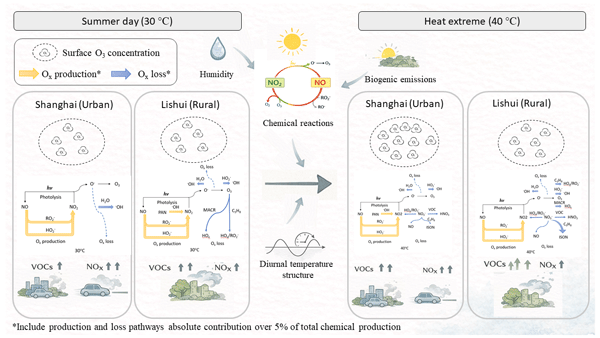
Abstract. As climate change increases frequency and intensity of hot extremes, understanding how elevated temperatures influence surface ozone (O3) across different chemical regimes is critical. We combine observations from summer 2022 in the Yangtze River Delta (YRD) with targeted United Kingdom Chemistry and Aerosols (UKCA) Box experiments to quantify and attribute the temperature sensitivity of ground-level O3 in a VOC-limited urban megacity (Shanghai) and a predominantly NOx-limited rural region (Lishui). Observed daily-maximum O3 increases with temperature at both sites, with a stronger response in Shanghai. Two-dimensional T-RH distributions show that O3 rises with temperature and decreases with relative humidity (RH), implying that part of the temperature response is mediated by drying. Factorial box-model experiments separate the roles of temperature-driven shifts in chemical partitioning, diurnal thermal structure, temperature-dependent isoprene emissions, and humidity. In Shanghai, the increase in O3 between 30 °C and 40 °C is dominated by BVOC-driven chemistry, with temperature-amplified isoprene emissions explaining most of the observed response. In Lishui, O3 sensitivity is governed primarily by radical-NOx chemistry and thermal PAN-NOx cycling, with a much smaller role for BVOCs. Fixed RH scenarios substantially reduce the apparent contribution of “thermal chemistry”, highlighting humidity-dependent Ox loss and HOx-NOx cycling as key modifiers of the climate penalty. These regime-specific O3-temperature mechanisms, including BVOC-driven in the urban core, radical-NOx-PAN-driven in the rural area, and significant humidity modulation, provide a process basis for heat-resilient emission controls and demonstrate the value of observation-constrained box models as a bridge to regional chemistry-climate simulations.
-
Notice on discussion status
The requested preprint has a corresponding peer-reviewed final revised paper. You are encouraged to refer to the final revised version.
-
Preprint
(3123 KB)
-
Supplement
(810 KB)
-
The requested preprint has a corresponding peer-reviewed final revised paper. You are encouraged to refer to the final revised version.
- Preprint
(3123 KB) - Metadata XML
-
Supplement
(810 KB) - BibTeX
- EndNote
- Final revised paper


Journal article(s) based on this preprint
Interactive discussion
Status: closed
-
RC1: 'Comment on egusphere-2026-836', Anonymous Referee #1, 07 Jun 2026
-
AC1: 'Reply on RC1', Massimo Bollasina, 27 Jul 2026
The comment was uploaded in the form of a supplement: https://egusphere.copernicus.org/preprints/2026/egusphere-2026-836/egusphere-2026-836-AC1-supplement.pdf
-
AC1: 'Reply on RC1', Massimo Bollasina, 27 Jul 2026
-
RC2: 'Comment on egusphere-2026-836', Anonymous Referee #2, 08 Jun 2026
This manuscript attempted to illustrate the summertime ozone sensitivity to temperature at both urban and rural conditions in the YRD region. They applied the UKCA box model with factorial box-model experiments to quantify the key factors driving ozone-temperature sensitivity. Although the topic of this manuscript is timely, the key conclusions are not convincing due to the unclear methodology and arbitrary model assumptions. I have the following concerns that should be well addressed in the revisions.
- i) the methodology for box model is not clear.
It is not clear how to set up the Box-model emissions. As shown in L218, the emissions are tuned to satisfy observed precursor constraints. What kind of observed precursors? I didn’t find the measurements for NOx and VOC that should be important for your emission constraint.
Figure 2 shows very low AVOC emissions relative to BVOC emissions in Shanghai. Is it reasonable for megacity?
Tuning Box-model ozone to match observations is also not clear. As said in L256-258, it is hard to understand how to tune local O3 emissions and depositions.
- ii) the O3 chemistry in Box-model may be inconsistent with measurements.
In Fig.6, the simulated response of O3 to NOx/VOC emission perturbations is almost unchanged across the temperature range. However, previous studies have shown that O3 formation regime is changing under different temperature conditions.
In addition, the comparisons in Table 3 are not helpful. All of the species (PAN, OH, HO2, and C5H8) are reactive and of short lifetime. The observations were conducted in different seasons and different years. I think such an observation-model comparison can be used to evaluate the UKCA Box Model.
The conclusions show that In Shanghai, the isoprene temperature response explained ~70 % of the observed O3 increase from 30 to 40 °C. I don’t agree with this argument. This is misleading if the model used very high BVOC emissions, as shown in Fig.2. The role of AVOC emissions should be strongly underestimated in current model.
Other minor corrections:
L42: add NOx for “(i) emissions of O3 precursors (VOCs)”
L178: it is better to specify the temperature values of the 90th percentile threshold
The reason for focusing on the summer of 2022 should be well justified. In addition, anthropogenic emissions are changing rapidly in China and if the current results are supportive for future ozone controls is questionable. More model scenario simulations are needed.
Citation: https://doi.org/10.5194/egusphere-2026-836-RC2 -
AC2: 'Reply on RC2', Massimo Bollasina, 27 Jul 2026
The comment was uploaded in the form of a supplement: https://egusphere.copernicus.org/preprints/2026/egusphere-2026-836/egusphere-2026-836-AC2-supplement.pdf
Peer review completion


Interactive discussion
Status: closed
-
RC1: 'Comment on egusphere-2026-836', Anonymous Referee #1, 07 Jun 2026
This manuscript combines surface observations with the UKCA box model and UKESM simulations to investigate summertime ozone sensitivity to temperature in the Yangtze River Delta (YRD), contrasting Shanghai and Lishui during the extreme summer of 2022. The topic is timely and relevant, and the process-based sensitivity experiments provide useful insights into the roles of gas-phase chemistry, biogenic VOC emissions, and humidity in shaping ozone responses to temperature.
However, several critical aspects of the study require stronger justification before it can be considered for publication. My primary concerns center on the spatial representativeness of the selected sites, the consistency between the different modeling frameworks, and the omission of key chemical and physical processes. I recommend major revision.
Specific Comments
1 The rationale for selecting Shanghai and Lishui as representative urban and rural environments within the YRD requires stronger justification. The conclusions are largely based on two locations, yet the manuscript frequently discusses implications for the broader YRD region. While case studies are useful for mechanistic analysis, the limited spatial sampling raises concerns regarding regional representativeness. Given the dense air-quality monitoring network across the YRD, the authors should explain why a broader regional classification was not conducted and discuss the extent to which the selected sites capture the diversity of chemical regimes across the region.
2 The analysis is based exclusively on observations from 2022, an exceptionally hot summer characterized by severe heatwave conditions. Notably, the observed decrease in ozone sensitivity to temperature in Shanghai during heatwaves is an interesting result and appears consistent with recent studies reporting ozone suppression under extremely high temperatures. However, as acknowledged by the authors, conclusions derived from a single anomalous year may not be representative of climatological behavior. Extending the observational analysis to additional years would substantially improve the robustness of the conclusions and help determine whether the reported ozone–temperature relationships are specific to 2022 or representative of longer-term conditions. If possible, additional box-model simulations for other years should also be provided.
3 Section 2.2 interweaves descriptions of the UKESM simulations and the UKCA box model, which confuses the overall modeling framework. I recommend separating this section into dedicated subsections, first describing the UKESM configuration and then the box-model setup. This will greatly improve readability.
4 The conclusion that BVOCs account for 73% of the ozone increase between 30 and 40 °C relies heavily on the parameterization used for temperature-dependent isoprene emissions. The authors should provide a stronger justification for adopting the simplified empirical function rather than the original MEGAN formulation and discuss the associated uncertainty. In addition, no local observational constraints on isoprene concentrations or emissions are provided. Given the lack of direct measurements, the uncertainty associated with BVOC attribution may be substantial.
Furthermore, the authors should address the temperature dependence of anthropogenic VOCs. Treating anthropogenic VOC emissions as temperature-independent may lead to an overestimation of the BVOC contribution. The potential influence of this assumption should be discussed in greater detail.
5 There are concerns regarding the consistency between observations and model simulations at Lishui. The manuscript reports an underestimation of approximately 17 μg m⁻³ in daily mean ozone, while later sections indicate biases approaching 50 μg m⁻³ for daily maximum ozone. Such discrepancies are substantial and require a more rigorous explanation. The argument that these differences arise primarily from grid-scale dilution of precursor emissions appears insufficient, particularly given the relatively limited spatial scale represented by the model grid. Additional analysis is needed to explain the origin of these biases and assess their implications for the subsequent attribution results.
6 The manuscript uses UKESM diagnostics to evaluate the chemical performance of the box model, yet little information is provided regarding the performance of UKESM itself over the YRD region. Since UKESM operates at relatively coarse spatial resolution, its ability to reproduce local ozone variability and ozone–temperature relationships should be evaluated before it is used as a benchmark for the box-model analysis. In addition, the manuscript attributes differences in Ox sink terms between the box model and UKESM to unresolved transport processes in the box model. However, no explicit diagnostics of horizontal transport, vertical mixing, or other dynamical terms are presented from UKESM. Providing these diagnostics would greatly strengthen the interpretation.
7 The attribution framework appears to place primary emphasis on chemical processes, including temperature-dependent reaction kinetics, BVOC emissions, and humidity effects, while giving relatively limited consideration to other processes that co-vary with temperature. Previous studies have shown that ozone-temperature relationships can also be strongly influenced by changes in solar radiation, cloud cover, atmospheric stagnation, boundary-layer dynamics, transport processes, and temperature-sensitive natural emissions (e.g., soil NOx)(Fu and Tian, 2019; Lu et al., 2019). Several recent studies have further demonstrated that the ozone climate penalty arises from the combined effects of chemical and meteorological drivers rather than from chemistry alone(Barnes and Fiore, 2013; Kerr et al., 2020; Porter and Heald, 2019).
This issue is particularly important because the attribution results presented in Lines 566-570 suggest that deposition and transport play only a minor role in the ozone response to temperature. Such a conclusion appears difficult to reconcile with a number of previous studies that identified meteorological covariability and transport-related processes as major contributors to ozone-temperature sensitivity. The authors should therefore provide a more comprehensive discussion of how their attribution framework differs from those used in previous studies and explain why their results yield substantially different relative contributions.
Barnes, E. A. and Fiore, A. M.: Surface ozone variability and the jet position: Implications for projecting future air quality, Geophys. Res. Lett., 40, 2839–2844, https://doi.org/10.1002/grl.50411, 2013.
Fu, T.-M. and Tian, H.: Climate Change Penalty to Ozone Air Quality: Review of Current Understandings and Knowledge Gaps, Curr. Pollut. Rep., 5, 159–171, https://doi.org/10.1007/s40726-019-00115-6, 2019.
Kerr, G. H., Waugh, D. W., Steenrod, S. D., Strode, S. A., and Strahan, S. E.: Surface Ozone-Meteorology Relationships: Spatial Variations and the Role of the Jet Stream, J. Geophys. Res. Atmospheres, 125, e2020JD032735, https://doi.org/10.1029/2020JD032735, 2020.
Lu, X., Zhang, L., and Shen, L.: Meteorology and Climate Influences on Tropospheric Ozone: a Review of Natural Sources, Chemistry, and Transport Patterns, Curr. Pollut. Rep., 5, 238–260, https://doi.org/10.1007/s40726-019-00118-3, 2019.
Porter, W. C. and Heald, C. L.: The mechanisms and meteorological drivers of the summertime ozone–temperature relationship, Atmospheric Chem. Phys., 19, 13367–13381, https://doi.org/10.5194/acp-19-13367-2019, 2019.
Other comments
1 Lines 182–183: Why were the years 2020 and 2021 excluded? Does this exclusion have any impact on the selection of heatwave days?
2 Line 217: Why did the authors choose to use the CEDS inventory instead of the MEIC inventory?
3 Line 287: 30C to 30℃
4 Line 326: Why was 38.3 chosen as the stagnation point?
5 Figure 4: Is this the average result across all sites? How was the spatial variability of ozone concentrations among different sites accounted for?
Citation: https://doi.org/10.5194/egusphere-2026-836-RC1 -
AC1: 'Reply on RC1', Massimo Bollasina, 27 Jul 2026
The comment was uploaded in the form of a supplement: https://egusphere.copernicus.org/preprints/2026/egusphere-2026-836/egusphere-2026-836-AC1-supplement.pdf
-
AC1: 'Reply on RC1', Massimo Bollasina, 27 Jul 2026
-
RC2: 'Comment on egusphere-2026-836', Anonymous Referee #2, 08 Jun 2026
This manuscript attempted to illustrate the summertime ozone sensitivity to temperature at both urban and rural conditions in the YRD region. They applied the UKCA box model with factorial box-model experiments to quantify the key factors driving ozone-temperature sensitivity. Although the topic of this manuscript is timely, the key conclusions are not convincing due to the unclear methodology and arbitrary model assumptions. I have the following concerns that should be well addressed in the revisions.
- i) the methodology for box model is not clear.
It is not clear how to set up the Box-model emissions. As shown in L218, the emissions are tuned to satisfy observed precursor constraints. What kind of observed precursors? I didn’t find the measurements for NOx and VOC that should be important for your emission constraint.
Figure 2 shows very low AVOC emissions relative to BVOC emissions in Shanghai. Is it reasonable for megacity?
Tuning Box-model ozone to match observations is also not clear. As said in L256-258, it is hard to understand how to tune local O3 emissions and depositions.
- ii) the O3 chemistry in Box-model may be inconsistent with measurements.
In Fig.6, the simulated response of O3 to NOx/VOC emission perturbations is almost unchanged across the temperature range. However, previous studies have shown that O3 formation regime is changing under different temperature conditions.
In addition, the comparisons in Table 3 are not helpful. All of the species (PAN, OH, HO2, and C5H8) are reactive and of short lifetime. The observations were conducted in different seasons and different years. I think such an observation-model comparison can be used to evaluate the UKCA Box Model.
The conclusions show that In Shanghai, the isoprene temperature response explained ~70 % of the observed O3 increase from 30 to 40 °C. I don’t agree with this argument. This is misleading if the model used very high BVOC emissions, as shown in Fig.2. The role of AVOC emissions should be strongly underestimated in current model.
Other minor corrections:
L42: add NOx for “(i) emissions of O3 precursors (VOCs)”
L178: it is better to specify the temperature values of the 90th percentile threshold
The reason for focusing on the summer of 2022 should be well justified. In addition, anthropogenic emissions are changing rapidly in China and if the current results are supportive for future ozone controls is questionable. More model scenario simulations are needed.
Citation: https://doi.org/10.5194/egusphere-2026-836-RC2 -
AC2: 'Reply on RC2', Massimo Bollasina, 27 Jul 2026
The comment was uploaded in the form of a supplement: https://egusphere.copernicus.org/preprints/2026/egusphere-2026-836/egusphere-2026-836-AC2-supplement.pdf
Peer review completion
Journal article(s) based on this preprint
Viewed
| HTML | XML | Total | Supplement | BibTeX | EndNote | |
|---|---|---|---|---|---|---|
| 1,013 | 497 | 88 | 1,598 | 199 | 88 | 109 |
- HTML: 1,013
- PDF: 497
- XML: 88
- Total: 1,598
- Supplement: 199
- BibTeX: 88
- EndNote: 109
Viewed (geographical distribution)
| Country | # | Views | % |
|---|
| Total: | 0 |
| HTML: | 0 |
| PDF: | 0 |
| XML: | 0 |
- 1
Chang Su

Massimo Bollasina
James Weber
David Stevenson
The requested preprint has a corresponding peer-reviewed final revised paper. You are encouraged to refer to the final revised version.
- Preprint
(3123 KB) - Metadata XML
-
Supplement
(810 KB) - BibTeX
- EndNote
- Final revised paper
This manuscript combines surface observations with the UKCA box model and UKESM simulations to investigate summertime ozone sensitivity to temperature in the Yangtze River Delta (YRD), contrasting Shanghai and Lishui during the extreme summer of 2022. The topic is timely and relevant, and the process-based sensitivity experiments provide useful insights into the roles of gas-phase chemistry, biogenic VOC emissions, and humidity in shaping ozone responses to temperature.
However, several critical aspects of the study require stronger justification before it can be considered for publication. My primary concerns center on the spatial representativeness of the selected sites, the consistency between the different modeling frameworks, and the omission of key chemical and physical processes. I recommend major revision.
Specific Comments
1 The rationale for selecting Shanghai and Lishui as representative urban and rural environments within the YRD requires stronger justification. The conclusions are largely based on two locations, yet the manuscript frequently discusses implications for the broader YRD region. While case studies are useful for mechanistic analysis, the limited spatial sampling raises concerns regarding regional representativeness. Given the dense air-quality monitoring network across the YRD, the authors should explain why a broader regional classification was not conducted and discuss the extent to which the selected sites capture the diversity of chemical regimes across the region.
2 The analysis is based exclusively on observations from 2022, an exceptionally hot summer characterized by severe heatwave conditions. Notably, the observed decrease in ozone sensitivity to temperature in Shanghai during heatwaves is an interesting result and appears consistent with recent studies reporting ozone suppression under extremely high temperatures. However, as acknowledged by the authors, conclusions derived from a single anomalous year may not be representative of climatological behavior. Extending the observational analysis to additional years would substantially improve the robustness of the conclusions and help determine whether the reported ozone–temperature relationships are specific to 2022 or representative of longer-term conditions. If possible, additional box-model simulations for other years should also be provided.
3 Section 2.2 interweaves descriptions of the UKESM simulations and the UKCA box model, which confuses the overall modeling framework. I recommend separating this section into dedicated subsections, first describing the UKESM configuration and then the box-model setup. This will greatly improve readability.
4 The conclusion that BVOCs account for 73% of the ozone increase between 30 and 40 °C relies heavily on the parameterization used for temperature-dependent isoprene emissions. The authors should provide a stronger justification for adopting the simplified empirical function rather than the original MEGAN formulation and discuss the associated uncertainty. In addition, no local observational constraints on isoprene concentrations or emissions are provided. Given the lack of direct measurements, the uncertainty associated with BVOC attribution may be substantial.
Furthermore, the authors should address the temperature dependence of anthropogenic VOCs. Treating anthropogenic VOC emissions as temperature-independent may lead to an overestimation of the BVOC contribution. The potential influence of this assumption should be discussed in greater detail.
5 There are concerns regarding the consistency between observations and model simulations at Lishui. The manuscript reports an underestimation of approximately 17 μg m⁻³ in daily mean ozone, while later sections indicate biases approaching 50 μg m⁻³ for daily maximum ozone. Such discrepancies are substantial and require a more rigorous explanation. The argument that these differences arise primarily from grid-scale dilution of precursor emissions appears insufficient, particularly given the relatively limited spatial scale represented by the model grid. Additional analysis is needed to explain the origin of these biases and assess their implications for the subsequent attribution results.
6 The manuscript uses UKESM diagnostics to evaluate the chemical performance of the box model, yet little information is provided regarding the performance of UKESM itself over the YRD region. Since UKESM operates at relatively coarse spatial resolution, its ability to reproduce local ozone variability and ozone–temperature relationships should be evaluated before it is used as a benchmark for the box-model analysis. In addition, the manuscript attributes differences in Ox sink terms between the box model and UKESM to unresolved transport processes in the box model. However, no explicit diagnostics of horizontal transport, vertical mixing, or other dynamical terms are presented from UKESM. Providing these diagnostics would greatly strengthen the interpretation.
7 The attribution framework appears to place primary emphasis on chemical processes, including temperature-dependent reaction kinetics, BVOC emissions, and humidity effects, while giving relatively limited consideration to other processes that co-vary with temperature. Previous studies have shown that ozone-temperature relationships can also be strongly influenced by changes in solar radiation, cloud cover, atmospheric stagnation, boundary-layer dynamics, transport processes, and temperature-sensitive natural emissions (e.g., soil NOx)(Fu and Tian, 2019; Lu et al., 2019). Several recent studies have further demonstrated that the ozone climate penalty arises from the combined effects of chemical and meteorological drivers rather than from chemistry alone(Barnes and Fiore, 2013; Kerr et al., 2020; Porter and Heald, 2019).
This issue is particularly important because the attribution results presented in Lines 566-570 suggest that deposition and transport play only a minor role in the ozone response to temperature. Such a conclusion appears difficult to reconcile with a number of previous studies that identified meteorological covariability and transport-related processes as major contributors to ozone-temperature sensitivity. The authors should therefore provide a more comprehensive discussion of how their attribution framework differs from those used in previous studies and explain why their results yield substantially different relative contributions.
Barnes, E. A. and Fiore, A. M.: Surface ozone variability and the jet position: Implications for projecting future air quality, Geophys. Res. Lett., 40, 2839–2844, https://doi.org/10.1002/grl.50411, 2013.
Fu, T.-M. and Tian, H.: Climate Change Penalty to Ozone Air Quality: Review of Current Understandings and Knowledge Gaps, Curr. Pollut. Rep., 5, 159–171, https://doi.org/10.1007/s40726-019-00115-6, 2019.
Kerr, G. H., Waugh, D. W., Steenrod, S. D., Strode, S. A., and Strahan, S. E.: Surface Ozone-Meteorology Relationships: Spatial Variations and the Role of the Jet Stream, J. Geophys. Res. Atmospheres, 125, e2020JD032735, https://doi.org/10.1029/2020JD032735, 2020.
Lu, X., Zhang, L., and Shen, L.: Meteorology and Climate Influences on Tropospheric Ozone: a Review of Natural Sources, Chemistry, and Transport Patterns, Curr. Pollut. Rep., 5, 238–260, https://doi.org/10.1007/s40726-019-00118-3, 2019.
Porter, W. C. and Heald, C. L.: The mechanisms and meteorological drivers of the summertime ozone–temperature relationship, Atmospheric Chem. Phys., 19, 13367–13381, https://doi.org/10.5194/acp-19-13367-2019, 2019.
Other comments
1 Lines 182–183: Why were the years 2020 and 2021 excluded? Does this exclusion have any impact on the selection of heatwave days?
2 Line 217: Why did the authors choose to use the CEDS inventory instead of the MEIC inventory?
3 Line 287: 30C to 30℃
4 Line 326: Why was 38.3 chosen as the stagnation point?
5 Figure 4: Is this the average result across all sites? How was the spatial variability of ozone concentrations among different sites accounted for?