
the Creative Commons Attribution 4.0 License.
the Creative Commons Attribution 4.0 License.
 | 25 Feb 2026
THEMIS: Spin Axis Magnetic Field Reconstruction
Abstract. The Time History of Events and Macroscale Interactions during Substorms (THEMIS) mission investigates the coupling between the solar wind and Earth's magnetosphere using five identical spinning spacecraft. Each spacecraft rotates at a predefined rate to stabilize it and carries a suite of instruments, including a fluxgate magnetometer (FGM) that measures the three-dimensional magnetic field. Since May 24, 2024, the FGM on board THEMIS E has no longer recorded the magnetic field component along the spin axis, while the two components approximately within the spin plane remain fully available.
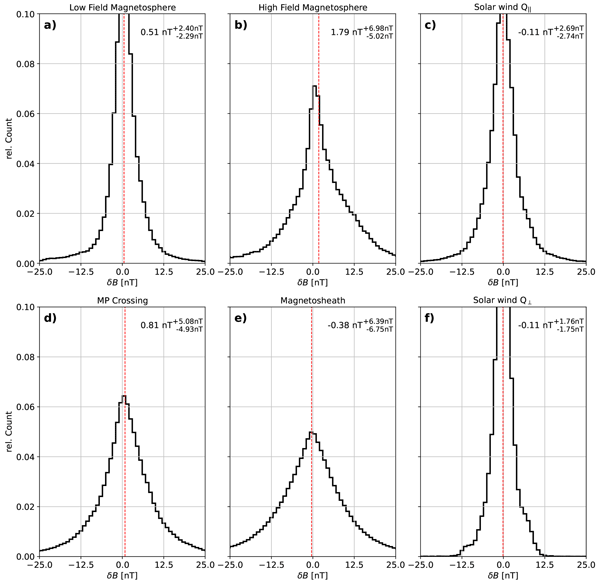
We present a method to reconstruct the missing magnetic field component using data from these two remaining components together with the spacecraft spin, yielding full three-component magnetic field vectors at spin-period resolution. The approach was validated using original THEMIS E data from 2017, when all three sensor components were available. The width of the residual distributions between reconstructed and original measurements is approximately 4 nT in the low-field magnetosphere, 12 nT in the high-field magnetosphere, 10 nT near magnetopause crossings, 14 nT in the magnetosheath, 6 nT in the quasi-parallel solar wind, and 3 nT in the quasi-perpendicular solar wind.
These results demonstrate that on a spinning spacecraft, two components that are almost within but slightly out of the spin plane are sufficient to reconstruct three-dimensional magnetic field vectors at spin-period resolution, allowing continued magnetospheric observations despite the loss of one sensor component.
-
Notice on discussion status
The requested preprint has a corresponding peer-reviewed final revised paper. You are encouraged to refer to the final revised version.
-
Preprint
(4910 KB)
-
The requested preprint has a corresponding peer-reviewed final revised paper. You are encouraged to refer to the final revised version.
- Preprint
(4910 KB) - Metadata XML
- BibTeX
- EndNote
- Final revised paper


Journal article(s) based on this preprint
Interactive discussion
Status: closed
-
RC1: 'Comment on egusphere-2026-803', Anonymous Referee #1, 05 May 2026
- AC1: 'Reply on RC1', Adrian Pöppelwerth, 26 Jun 2026
-
RC2: 'Comment on egusphere-2026-803', Anonymous Referee #2, 11 Jun 2026
The review is provided in the attached file.
-
AC2: 'Reply on RC2', Adrian Pöppelwerth, 26 Jun 2026
Thank you for your comments. Please find attached our detailed responses to the comments.
-
RC3: 'Reply on AC2', Anonymous Referee #2, 26 Jun 2026
I look forward to your revised manuscript. Good luck.
Citation: https://doi.org/10.5194/egusphere-2026-803-RC3
-
RC3: 'Reply on AC2', Anonymous Referee #2, 26 Jun 2026
-
AC2: 'Reply on RC2', Adrian Pöppelwerth, 26 Jun 2026
Peer review completion


Interactive discussion
Status: closed
-
RC1: 'Comment on egusphere-2026-803', Anonymous Referee #1, 05 May 2026
Generally, the paper is treating a very important subject. The recovery of THEMIS E spin axis data in a time with only 3 spacecraft within the earth-orbiting formation is highly relevant for further scientific use of 2024+ data. I would therefore highly recommend to continue working on this subject.
The paper itself is written well, presentation and structure are also fine. The use of plain language and the flow of information in the text (writing style) is great.
Unfortunately, the paper has several major problems that would need to be fixed before publications.
- The authors are presenting background claims and statements without reference/proof. While those statements may be correct, they cannot be simply assumed.
- The basic method in equations 11 and 13 is not well explained – in fact the notation is not suitable to actually conclude how the analysis was performed. One can guess, but this is not enough.
- In addition, the method suffers from fundamental problems in (a) weights used in averaging and (b) neglecting the impact of bandwidth.
- This neglection of bandwidth is also continued in later result analysis. This neglection increases the calculated errors – i.e. the results may actually be better than what is presented in this publication.
- The presented method is reducing error analysis to an empirical comparison using 3-axis vs. 2-axis data. The origin of the errors is not analyzed well – i.e. there are error sources like noise that generate a lowest bound on the error of the method.
The work that is required for fixing these problems would require to redo the complete analysis, it is therefore not really advisable to force the authors to do this work during the limited time that is given for revisions.
I would therefore suggest to consider to withdraw the paper at this time and to republish at a later time to remove this pressure of doing things in a hurry.
With that I would definitely encourage the authors to take the chance and improve their work – it is highly relevant and an important contribution for future scientific work that will rely on the generated data. The work that was performed for getting to the presented state is already great, it is only lacking the last layer of polishing.
Line 10:
- The error comparison for different regions is as such not useful in an abstract. It does not compare to achievable quality in the regular case (all axes working) and it does not relate the error to the measured fields (percentual) – e.g. a deviation of 2 nT in solar wind has a different impact as 12 nT in the high field magnetosphere. Provide more information or less.
Line 25:
- Please state why this deviation occurs (mechanical alignment/boom etc.)
Line 50:
- The assumption for accurate spin plane offsets is unclear. The calculation of spin plane offsets requires precise elevation angles, otherwise a constant contribution of the spin axis field (to be expected over many field regions) could be mistaken for spin axis offsets. Precise elevation angles in turn require knowledge of the spin axis field, but this field is in turn recovered by the method below with considerable error.
- There is a danger of a circular dependency, so a simple assumption should not be used without analysis (or presented without justification, if the analysis was done, but is not included)
- It is clear that there will be an error and that the situation is not perfect. Nevertheless, the assumption without further information is not enough. An IGRF-comparison could provide an estimate (i.e. rather than correlating spin axis variations to spin plane variations, one could correlate IGRF variations to spin plane to find thetas.
- It might be that the variations in theta are small enough to be irrelevant, but this should be brought to support the initial claim of spin plane offsets.
Line 51:
- The angle alpha is not very clear for the outside world. A drawing would help.
Line 53:
- The tradeoff is unclear. 2017 is not “close”. This needs more precise justification. No big problem, just needs to be done.
Line 85:
- Provide a citation for constant sensor-internal orthogonality. The statement is true enough, but should be backed up. Past calibration values could help.
Line 95:
- The choice of the wording “spin tone” is very unfortunate. It probably originates from the fact that the contribution of BST would result in a spin tone if despun.
- What is considered here is the “true” magnetic field in the spin axis (+ errors) that is amplified and used as spin axis field. Even equation 11 is considering a “spinning” part (A+B) and a non-spinning part (C+D), but the latter is then referred to as spin tone.
- In that sense the word “spin tone” is the name of what A+B if they were demodulated, but they are not and used for something else.
- (My personal experience was that I first skipped the index ST, just had a look at the equation and things were quite clear. After that I checked what ST means and got confused and started to look for what I have misread, which was nothing)
- Please find a new term to make this more clear.
Line 100:
- The fit is not with respect to Braw – Braw is the desired result. The fit is done with respect to A/B/C/D
- It is also not clear whether the parameters ws and phi are part of the variable parameters. They probably are, with some limitations on prior knowledge.
Line 104:
- Phi is not the phase; it is the angle of the external field that is projected onto the spin plane. This appears as a phase shift in the equation, but does not correspond to the usual term of phase shift, i.e. a fixed time or angle shift. It is a variable, data dependent shift. Please change wording to avoid confusion
- Line 104 uses phis, while eq. 11 uses only phi. Also the use of omega/omegas is inconsistent across equation and text.
Line 119
- The method for averaging was chosen in time units rather than samples. The impact and justification for this was not given. Samples would generate overcomplete/incomplete spins, while time generates a variable number of samples. The choice was not explained, but will have some (minor) impact.
Method in 3.1
The method used in chapter 3.1 is not well explained. The authors are using the following measures to improve the quality of their result:
- Assume a first order least square fit for the magnetic field and considering everything else as error signal.
- Using the fit onto 2.5 spin periods, shifting by 1 spin period (overlap 40%).
- Using a weighted moving average over 2 minutes. Weight increases with constant part of the spin plane component and decreases with the error signal (i.e. true error and higher frequency contributions).
Nevertheless, the formulation of equation Eq. 13 is not clear. BST is defined as a function of t in Eq. 11. Equation 13 also uses BST(t) but it is obvious that this is not the same definition – Here BST is averaged over 2 minutes, while it is only defined for 2.5 spins in Eq. 11.
I assume that the authors average the central values of the respective length-2.5 periods (i.e BST(@1.25*tspin)), but this is not stated anywhere. Please clarify.
Assuming equal weights (will be discussed later), the application of a 2-minute weighted average would result in a bandwidth reduction 1/120 Hz, i.e. even though one averaged value per spin is provided, the included bandwidth is much lower. While this corresponds to the abstract statement of providing one estimate per spin, this is still generating the wrong impression of a higher bandwidth. This fact is only stated at the very end (line 264). Nevertheless, it seems that also the authors do not consider this reduction of bandwidth, see comment to Figure 5.
The other thing is the topic of weighted averages.
- The authors use a weight that decreases with the error signal. The error signal is the residual between fit and measured signal and contains (a) components with higher frequencies and (b) disturbance/noise and (c) low frequency signals that are not covered by the model of eq. 11 – the latter is the actual fit error the authors are looking for.
The presence of higher frequencies is not an error, it is by choice of the bandwidth.
The attempt to extract one spin “model” over 2.5 spins means that the actual bandwidth that is relevant for the fit is clearly less than the raw Nyquist of 2 Hz in FGL. As a result, the resulting fit quality estimate fmin is not only giving the quality of the fit, but also the amount of higher-frequency contribution. The latter is not really an error, it is just an artificial residual that is generated by the choice of bandwidth.
It would be more consequent (and it would most probably deliver better results) to reduce bandwidth first and remove the higher-frequency components. This is also justified by the fact that later averaging is massively reducing this bandwidth anyway, so there is no loss as long as the upper bandwidth limit is sufficiently above fspin. - The other topic is the weighting with the value of A, i.e. the constant spin plane field. While of course such a field could increase some errors, it might also be correlated with the spin axis field – i.e. high spin plane and axis fields come at the same time. While the first degrades results, the second is actually improving results. IMO the weights should be revisited.
In addition there might also be a correlation between field magnitude and field variation, i.e. fmin. This would require analysis before specifying an error criterion.
One could also discuss the justification of this scaling. The quality measure would only increase the weight of high field regions in the case there are also low field regions within the same 1-minute interval. In all other cases, the field is (typically) consistently either high or low over 1 minutes, so the scaling will not have any effect. - Generally, the application of such an error criterion over such a long time (1 minute or 15-ish spins) is not advisable. Generally, as also done in most filtering applications, the weight of a sub-estimate should be reduced with the time distance to the currently averaged point. While its quality of a point with high time distance may be higher, its validity for the current time is typically lower.
The used approach here could (theoretically) mean that a single spin with high field could dominate a complete 1-minute interval.
There are 2 options out of this time problem:- Scale with time distance and/or
- Decrease output cadence to 1 minute instead of Tspin (even then additional distance scaling might be appropriate)
Line 132 and 140
- The factor alpha has not been explained well, see above.
Line 150
- The impact of alphaS1 and S2 is relevant and the method is correct, but there is no error estimate and no method is presented.
Line 159:
- There is no real error/sensitivity analysis. The impact of having wrong calibration parameters is not discussed. The impact of amplifying the tiny spin axis part within the spin plane with a value from several tens to 100 (e.g. for elevation=1°) is not discussed – this would e.g. also scale sensor noise and have a relevant impact on the expectable quality of the result. It cannot become any better than that.
- As a result, the authors only present an empirical error of the given data set, which is an upper bound for a given data set. Nevertheless, it is not known if this error is different for other data sets and what the sensitivity of these bounds relative to other calibration parameters is. I am aware that not all of this should be written in the paper, but there is some room to improve.
Figure 3:
- The chosen time + amplitude scales of the plot are not suitable to actually demonstrate the quality of the recovery. An overview plot is great, but detail plots would be needed.
- In addition, the choice of unfiltered FGS vs. the recovered signal suggests differences that are in fact caused by the higher bandwidth of FGS – it would be necessary to reduce the bandwidth of FGS to the one of Br before doing this comparison. This would most probably show better results.
- The same applies to figure 4
Figure 4:
- It might be worth to reduce bandwidth and to use time lags for comparing the 2 spacecraft
Figure 5:
- Also this figure has the problem of different bandwidth between Br and FGS. The shown errors are a mixture of actual error and high frequency content. With the general inverse power laws, the existence of higher frequency signals with lower amplitude is more probable and so the error distribution is potentially highly related to the high frequency components rather than the actual error.
- This plot has identical scaling on the x axis. This choice is valid, but it is not really giving a quality estimate for the residual – e.g. in solar wind the error will be small per se, as there is not a lot of signal anyway. Even an opposite signal might result in an error of 4 nT.
In addition, the SNR of the tiny bit of spin axis field in the plane axes is probably quite bad, it is probably not that much above the noise. It might be worth to add some “SNR limit line” that helps to differentiate between errors in recovery and the limitations of noise that is just unavoidable.
Line 283:
- This statement should not be given without proper analysis (e.g. impact on currently used calibration method, errors and parameter accuracy). One example is that every axis offset would require a mixture of Hedgecock and spin calibration output – but those require different external magnetic field conditions and are therefore executed on different data sets and times.
- Suggestion for a change: “The impact of such an intentional tilt would require detailed analysis though, as it might impact the sensitivity and errors of calibration during normal operation scenarios.”
Sorry that I have to be the bringer of bad news and will cause more work and delay, but the subject is too important - this is going to be a publication that is a reference document for all 2024+ work on Themis data, so it is relevant and will (hopefully) be cited quite often.
Citation: https://doi.org/10.5194/egusphere-2026-803-RC1 - AC1: 'Reply on RC1', Adrian Pöppelwerth, 26 Jun 2026
-
RC2: 'Comment on egusphere-2026-803', Anonymous Referee #2, 11 Jun 2026
The review is provided in the attached file.
-
AC2: 'Reply on RC2', Adrian Pöppelwerth, 26 Jun 2026
Thank you for your comments. Please find attached our detailed responses to the comments.
-
RC3: 'Reply on AC2', Anonymous Referee #2, 26 Jun 2026
I look forward to your revised manuscript. Good luck.
Citation: https://doi.org/10.5194/egusphere-2026-803-RC3
-
RC3: 'Reply on AC2', Anonymous Referee #2, 26 Jun 2026
-
AC2: 'Reply on RC2', Adrian Pöppelwerth, 26 Jun 2026
Peer review completion
Journal article(s) based on this preprint
Viewed
| HTML | XML | Total | BibTeX | EndNote | |
|---|---|---|---|---|---|
| 763 | 298 | 83 | 1,144 | 85 | 158 |
- HTML: 763
- PDF: 298
- XML: 83
- Total: 1,144
- BibTeX: 85
- EndNote: 158
Viewed (geographical distribution)
| Country | # | Views | % |
|---|
| Total: | 0 |
| HTML: | 0 |
| PDF: | 0 |
| XML: | 0 |
- 1
Adrian Pöppelwerth

Hans-Ulrich Auster
Vassilis Angelopoulos
James M. McTiernan
James W. Lewis
Ferdinand Plaschke
The requested preprint has a corresponding peer-reviewed final revised paper. You are encouraged to refer to the final revised version.
- Preprint
(4910 KB) - Metadata XML
Generally, the paper is treating a very important subject. The recovery of THEMIS E spin axis data in a time with only 3 spacecraft within the earth-orbiting formation is highly relevant for further scientific use of 2024+ data. I would therefore highly recommend to continue working on this subject.
The paper itself is written well, presentation and structure are also fine. The use of plain language and the flow of information in the text (writing style) is great.
Unfortunately, the paper has several major problems that would need to be fixed before publications.
The work that is required for fixing these problems would require to redo the complete analysis, it is therefore not really advisable to force the authors to do this work during the limited time that is given for revisions.
I would therefore suggest to consider to withdraw the paper at this time and to republish at a later time to remove this pressure of doing things in a hurry.
With that I would definitely encourage the authors to take the chance and improve their work – it is highly relevant and an important contribution for future scientific work that will rely on the generated data. The work that was performed for getting to the presented state is already great, it is only lacking the last layer of polishing.
Line 10:
Line 25:
Line 50:
Line 51:
Line 53:
Line 85:
Line 95:
Line 100:
Line 104:
Line 119
Method in 3.1
The method used in chapter 3.1 is not well explained. The authors are using the following measures to improve the quality of their result:
Nevertheless, the formulation of equation Eq. 13 is not clear. BST is defined as a function of t in Eq. 11. Equation 13 also uses BST(t) but it is obvious that this is not the same definition – Here BST is averaged over 2 minutes, while it is only defined for 2.5 spins in Eq. 11.
I assume that the authors average the central values of the respective length-2.5 periods (i.e BST(@1.25*tspin)), but this is not stated anywhere. Please clarify.
Assuming equal weights (will be discussed later), the application of a 2-minute weighted average would result in a bandwidth reduction 1/120 Hz, i.e. even though one averaged value per spin is provided, the included bandwidth is much lower. While this corresponds to the abstract statement of providing one estimate per spin, this is still generating the wrong impression of a higher bandwidth. This fact is only stated at the very end (line 264). Nevertheless, it seems that also the authors do not consider this reduction of bandwidth, see comment to Figure 5.
The other thing is the topic of weighted averages.
The presence of higher frequencies is not an error, it is by choice of the bandwidth.
The attempt to extract one spin “model” over 2.5 spins means that the actual bandwidth that is relevant for the fit is clearly less than the raw Nyquist of 2 Hz in FGL. As a result, the resulting fit quality estimate fmin is not only giving the quality of the fit, but also the amount of higher-frequency contribution. The latter is not really an error, it is just an artificial residual that is generated by the choice of bandwidth.
It would be more consequent (and it would most probably deliver better results) to reduce bandwidth first and remove the higher-frequency components. This is also justified by the fact that later averaging is massively reducing this bandwidth anyway, so there is no loss as long as the upper bandwidth limit is sufficiently above fspin.
In addition there might also be a correlation between field magnitude and field variation, i.e. fmin. This would require analysis before specifying an error criterion.
One could also discuss the justification of this scaling. The quality measure would only increase the weight of high field regions in the case there are also low field regions within the same 1-minute interval. In all other cases, the field is (typically) consistently either high or low over 1 minutes, so the scaling will not have any effect.
The used approach here could (theoretically) mean that a single spin with high field could dominate a complete 1-minute interval.
There are 2 options out of this time problem:
Line 132 and 140
Line 150
Line 159:
Figure 3:
Figure 4:
Figure 5:
In addition, the SNR of the tiny bit of spin axis field in the plane axes is probably quite bad, it is probably not that much above the noise. It might be worth to add some “SNR limit line” that helps to differentiate between errors in recovery and the limitations of noise that is just unavoidable.
Line 283:
Sorry that I have to be the bringer of bad news and will cause more work and delay, but the subject is too important - this is going to be a publication that is a reference document for all 2024+ work on Themis data, so it is relevant and will (hopefully) be cited quite often.