
the Creative Commons Attribution 4.0 License.
the Creative Commons Attribution 4.0 License.
 | 18 Feb 2026
North Atlantic sea level budget revisited
Abstract. Based on satellite altimetry, GRACE space gravimetry and Argo-based steric data down to 2000 m, recent studies have shown that the North Atlantic sea level budget (i.e., altimetry-based sea level minus sum of components) of the past two decades is not closed, with strong regional residuals in the North Atlantic. This was suggested to result from salinity errors reported since ~2015 in some Argo float measurements. In this study, we revisit the North Atlantic sea level budget, using satellite altimetry, GRACE and GRACE-FO data, different Argo products and two ocean reanalyses (CIGAR and ORAS5) over the 2004–2022 time span. The ocean reanalyses are used to estimate the manometric contribution, an alternative to using GRACE data, as well as the deep ocean contribution to the sea level budget, not yet fully sampled by Argo. Analyzing different data sets allows us to evaluate their impact on the previously reported non-closure of the North Atlantic sea level budget. We first find that using the CIGAR ocean reanalysis-based manometric component significantly reduces the residuals of the North Atlantic sea level budget compared to GRACE. We also find that accounting for the deep ocean (below 2000m) thermal expansion (using the CIGAR reanalysis) allows for 30 % reduction of the North Atlantic budget residuals when using GRACE for the manometric component, while the mean residual trend is reduced by a factor of 2 when using CIGAR for the manometric sea level. In the latter case, the budget is closed within data uncertainties. The North Atlantic halosteric component based on Argo and CIGAR in the upper 2000m displays a small decrease since the early 2010s. However, this negative trend becomes stronger after 2016. The 2010–2016 halosteric decrease may reflect a real salinity increase in the region, although salinity measurement errors may have impacted the halosteric component after that date.
-
Notice on discussion status
The requested preprint has a corresponding peer-reviewed final revised paper. You are encouraged to refer to the final revised version.
-
Preprint
(6368 KB)
-
The requested preprint has a corresponding peer-reviewed final revised paper. You are encouraged to refer to the final revised version.
- Preprint
(6368 KB) - Metadata XML
- BibTeX
- EndNote
- Final revised paper


Journal article(s) based on this preprint
Interactive discussion
Status: closed
-
RC1: 'Comment on egusphere-2026-802', Anonymous Referee #1, 21 Apr 2026
-
AC1: 'Reply on RC1', Zhe Song, 11 May 2026
See below the responses to Reviewer 1. We also attach the tracked revised manuscript called "Song_article_revised_tracked_11May2026" in order that the Reviewer can see our modifications.
Responses to the Reviewers’ comments
(in italics, bold)
Reviewer 1
Review for: “North Atlantic sea level budget revisited” by Zhe Song, Anny Cazenave1, William Llovel, Andrea Storto and Marie Bouih (https://doi.org/10.5194/egusphere-2026-802). This study examines the North Atlantic sea level budget from 2004-2022, comparing satellite altimetry data with estimates of steric and manometric contributions from various sources (ARGO floats, ocean reanalyses, and GRACE). While a complete sea level budget (altimetry balanced by steric and manometric components) was not achieved using GRACE data and any ARGO/reanalysis combinations, it was closed when using full-depth steric data from the CIGAR and ORA5S reanalyses with the CIGAR manometric component. The authors found that the deep steric component of CIGAR significantly contributed to this closure, and highlight potential issues with GRACE measurements, particularly in the Northeastern Atlantic. Even when the overall budget is balanced, significant regional anomalies in sea level trends persist. The paper is generally well-written and the figures are clear. However, the altimetry and GRACE data sets are not sufficiently cited. The numerous analyses presented can make it challenging to discern the main points. A table detailing the mean contributions from each component (altimetry, steric, deep steric, manometric) would improve clarity and facilitate comparison. The conclusions would be strengthened by more robust substantiation.
- A table detailing the mean contributions from each component (altimetry, steric, deep steric, manometric) would improve clarity and facilitate comparison.
Answer: Two tables gathering the trend contribution of each component of the North Atlantic sea level budget have been added in the revised manuscript (new Table 3 for the steric 0-2000m case and new Table 4 for the steric full depth case)
- A key concern is the reliance of the manometric component conclusions on the validity of the CIGAR deep steric data, given the considerable differences observed between CIGAR and ORA5S estimates – potentially indicating differing underlying physical processes.
Answer: In our previous article on the regional sea level budget (Bouih et al., Ocean sciences, 12, 1425-1440, https://doi.org/10.5194/os-21-1425-2025, 2025), we computed the manometric component over 2005-2019 using six different ocean reanalyses (G-CLORS, GLORYS, ORAS5, SODA, CIGAR and FOAM), as well as an ensemble mean of the first five (excluding FOAM because of spurious signal in the Southern Ocean). While some regional differences were observed between the different reanalyses, the CIGAR-based and ensemble mean manometric maps agreed well, including in the North Atlantic. Besides, as shown in the present revised manuscript, comparisons between ‘Altimetry minus Steric’ map (equivalent to the manometric component) and GRACE-based manometric in the North Atlantic clearly shows opposite signs (unlike with CIGAR or ensemble mean manometric), indicating a problem with GRACE.
- The observed warming and salinization in the deep western North Atlantic within CIGAR since 2004 should be validated using in-situ data, such as from existing moorings (e.g., see https://www.nature.com/articles/s43247-025-02170-y ).
Answer: Yes indeed, it is what we plan to do, not only using mooring data at 26.5°N but also Deep Argo float measurements since there are a few available in the Northwest Atlantic. However, considering the short delay allowed to revise our manuscript, such an analysis could be achieved before the deadline. We will perform such a work in the near future, comparing in situ data not only with CIGAR but also other available reanalyses.
We thank Reviewer 1 for the Chomiak et al’s article. The cooling trend observed at 26.5°N in the deep western Atlantic is a long-term trend since 1980. In our study, we show that deep ocean warming emerges around 2016 in the Northwest Atlantic (see for example Cazenave et al., Evidence of increased deep ocean warming from a sea level budget approach, Earth’s Future, 14, e2025EF007403. https://doi.org/10.1029/2025EF007403 2026), thus at the end of the record shown in Chomiak et al.
- Considering the potential impact of the derived changes in the manometric component on the Atlantic Meridional Overturning Circulation (AMOC) would enhance the paper's discussion.
Answer: The regional manometric changes are closely inter-connected to the North Atlantic circulation variability. The manometric component mainly reflects redistribution of ocean mass by circulation and, thus, includes the barotropic signature of changes in the gyre circulation and/or
AMOC-driven circulation. The AMOC variability can modify large-scale pressure gradients, western-boundary currents, return flows, etc., which may reflect into the east-west manometric dipole present in the North Atlantic, in the CIGAR reanalysis. However, our present analysis does
not allow establishing causality. It is difficult to conclude whether the changes in manometric sea level will affect the AMOC variability, or this is among the causes of deep western North Atlantic warming and associated halosteric compensation, visible in CIGAR, because of changes
in overturning and ventilation, including a possible AMOC slowdown. Causality and process-oriented analyses are beyond the scope of the present work and will be deepened in a follow-up study.--------------------
Specific points:
Page 5, line 117: the mascon solution is probably not from GFZ, but rather from GSFC?
Answer: Corrected.
Page 5, line 128: in the following no individual mascon solutions but only ensemble means are shown and discussed
Answer : We have revised the wording.
Page 8, line 201-203: how do the global mean values compare between the datasets?
Answer : We added two tables (new Tables 3 and 4) in which are presented the global mean trends over the study period.
Figure 1: what would be the corresponding ORA5S component?
Answer : We do not consider ORAS5 manometric component in this study because the corresponding manometric dataset prepared for our previous study (Bouih et al., 2025) by our CNR colleagues (A. Storto and C. Yang) ends in 2019, thus does not cover our whole study time span (2004-2022).
Figures 1, 2, and 3: what is the confidence level for the corresponding trends?
Answer : Here, our discussion focuses more on the spatial distribution of trends for each dataset. For specific trend value, we compute it in section 3.4.
Page 9/10, lines 224-228: phrasing potentially misleading: larger trends => GRACE show positive trends while CIGAR trends are negative? Most significant differences seem to be rather in the North East Atlantic than near Greenland.
Answer : We have revised the wording.
Page 13, lines 271-276: Why is it necessary for the deep steric component to align with the upper steric component?
Answer : The corresponding sentence has been removed
Page 14, lines 292-294: If the reliability of that dataset is questionable, consider excluding it from the study.
Answer : This is exactly what is written in the text. We discarded the JAMSTEC data.
Figure 4: might be an option to add the corresponding manometric curves
Answer : We only discuss steric sea level change here. The manometric component curves are presented in Figures 9 and 10.
Figure 6, caption: scatter plots of sea level trends in mm/year?, what does the normalization of the data include?
Answer : The values presented in the scatter plots (Figure 6) are not the raw sea level trends in mm/yr, but rather the standardized values (Z-scores). The normalization of the data includes the following transformation applied to each spatial field independently:
where x represents the local sea level trend, is the spatial mean of the trends over the North Atlantic region, and is the spatial standard deviation.
Figure 7/8, caption: map of residual SL trends … im mm/year ?
Answer : We added the "mm/yr" in the caption for clarity.
Tables 1/2/3: The reported uncertainty may be unrealistically low, considering the uncertainties inherent in the contributing data sources.
Answer : We only use the coefficient uncertainty of linear regression in our study; it might underestimate the uncertainty value. We will consider a more detailed method to compute the uncertainties in the future.
Figures 9-13: very similar, hard to distinguish
Answer : We added two tables in the revised version (new Tables 3 and 4) with the trend valuesof each component
Page 31, line 575: steric sea level trends? Page 31, line 583: decreasing trend -> negative trend
Answer : corrected
Reviewer 2
The study of the regional sea-level balance is essential for better identifying all the causes of the sea-level rise observed in recent decades. This study, which re-examines the sea-level balance in the North Atlantic over the 2004–2022 period by combining multiple data sources (satellite altimetry and gravimetry, in situ measurements, and ocean reanalyses), will thus enable the scientific community to better understand the imbalance in the sea level budget observed in this region (with significant residuals) by several studies, notably Bouih et al. (2025), which is likely due to an error in estimating the halosteric component in certain Argo float measurements. The authors assessed the impact of each product on the sea-level balance imbalance in the North Atlantic, while accounting for the warming of deep waters below 2,000 m (not sampled by Argo) using estimates derived from ocean reanalyses.
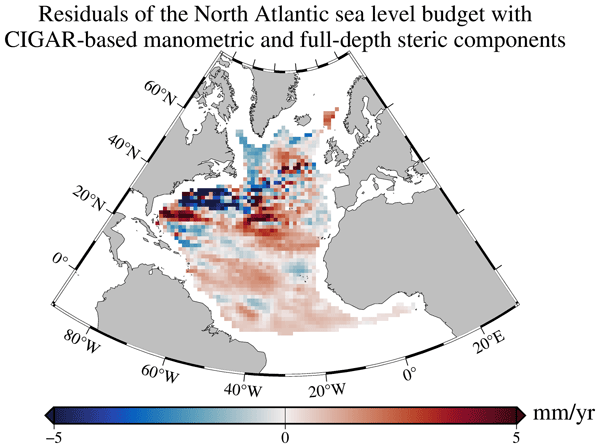
The authors demonstrated the validity of sea-level measurements obtained via satellite altimetry (within the limits of measurement uncertainties) when they used the CIGAR reanalysis to estimate the barometric component (instead of GRACE) and the steric component of the ocean (instead of Argo data, in order to account for ocean depths greater than 2,000 m). They highlighted a slight decrease in the trend of the North Atlantic halosteric component over the 2010–2016 period, using Argo and CIGAR data for the first 2,000 meters. This decrease could reflect an actual increase in salinity in the region, although salinity measurement errors may have influenced the halosteric component over the entire period. Thus, this study shows that the contribution of deep water (below 2,000 m depth, estimated at 0.62 ± 0.04 mm/year by CIGAR data) to the sea level balance in the North Atlantic is not negligible and must be taken into account to improve the consistency of this balance in the region. Including this factor reduces the residuals of the sea level balance in the North Atlantic by 30% with the GRACE manometric component and by 50% with CIGAR data (and full-depth CIGAR data for the steric component). In the latter case, the average residual trend over the North Atlantic is less than 1 mm/yr, which is of the same order of magnitude as the regional trend error in the gridded altimetry data.
This study is important because it not only makes a significant contribution to our understanding of the regional sea-level budget in the North Atlantic, but also highlights the need to improve deep-water observations and raises open scientific questions for future research, the answers to which will contribute to a better understanding of the processes involved in studying the regional sea-level budget beyond the North Atlantic.
This article is very well written and structured, and the results are clear and well analyzed. However, please find attached a list of minor questions to which we would like to receive responses from the authors.
- Isn't this extrapolation from 2016 to 2022 a bit rough, given that several studies show an acceleration in the ocean's mass component over the past two decades? Even if the global average trend in ocean mass has since been removed, isn’t there another way to complete the data through 2022?
Answer : The GRD signal is very small, thus a linear extrapolation seems acceptable. Reproducing the Adhikari et al’s study is clearly beyond the scope of the present study.
- Give a reference
Answer: This is a very classical procedure
- Why do you use mascons instead of spherical harmonics solutions ?
Answer : In our previous study on the regional sea level budget (Bouih et al., Ocean sciences, 12, 1425-1440, https://doi.org/10.5194/os-21-1425-2025, 2025), we compared the mascon solutions with spherical harmonic solutions and found that the latter are very noisy with the well-known north-south stripes very apparent, especially in the North Atlantic. Thus we prefer to use the mascon solutions.
- What might explain the difference in trends between the eastern and western parts of the basin observed by CIGAR? Do you have any ideas?
Answer : This remains an issue to clarify in the future. The transitions seems to be correlated with the bathymetry, in particular the location of the Mid-Atlantic ridge.
- Although the objective of the study is to verify the closure of the sea-level budget in the North Atlantic, it would also be interesting for the reader to gain an appreciation of each of the contributions from the regional components of sea level in terms of trend (i.e., mass change and thermosteric and halosteric components down to a depth of 2,000 m) in this region, similar to what you did for the steric component of the deep ocean (which is 0.62 ± 0.04 mm/yr according to CIGAR data).
Answer : Two tables have been added with the trend values of each component of the budget.
- Add a “Conclusion” section or make sure to clearly indicate it in the discussion
Answer : The discussion is now strengthened with a few concluding sentences.
-
AC1: 'Reply on RC1', Zhe Song, 11 May 2026
-
RC2: 'Comment on egusphere-2026-802', Anonymous Referee #2, 22 Apr 2026
The study of the regional sea-level balance is essential for better identifying all the causes of the sea-level rise observed in recent decades. This study, which re-examines the sea-level balance in the North Atlantic over the 2004–2022 period by combining multiple data sources (satellite altimetry and gravimetry, in situ measurements, and ocean reanalyses), will thus enable the scientific community to better understand the imbalance in the sea level buget observed in this region (with significant residuals) by several studies, notably Bouih et al. (2025), which is likely due to an error in estimating the halosteric component in certain Argo float measurements. The authors assessed the impact of each product on the sea-level balance imbalance in the North Atlantic, while accounting for the warming of deep waters below 2,000 m (not sampled by Argo) using estimates derived from ocean reanalyses.
The authors demonstrated the validity of sea-level measurements obtained via satellite altimetry (within the limits of measurement uncertainties) when they used the CIGAR reanalysis to estimate the barometric component (instead of GRACE) and the steric component of the ocean (instead of Argo data, in order to account for ocean depths greater than 2,000 m). They highlighted a slight decrease in the trend of the North Atlantic halosteric component over the 2010–2016 period, using Argo and CIGAR data for the first 2,000 meters. This decrease could reflect an actual increase in salinity in the region, although salinity measurement errors may have influenced the halosteric component over the entire period. Thus, this study shows that the contribution of deep water (below 2,000 m depth, estimated at 0.62 ± 0.04 mm/year by CIGAR data) to the sea level balance in the North Atlantic is not negligible and must be taken into account to improve the consistency of this balance in the region. Including this factor reduces the residuals of the sea level balance in the North Atlantic by 30% with the GRACE manometric component and by 50% with CIGAR data (and full-depth CIGAR data for the steric component). In the latter case, the average residual trend over the North Atlantic is less than 1 mm/yr, which is of the same order of magnitude as the regional trend error in the gridded altimetry data.
This study is important because it not only makes a significant contribution to our understanding of the regional sea-level budget in the North Atlantic, but also highlights the need to improve deep-water observations and raises open scientific questions for future research, the answers to which will contribute to a better understanding of the processes involved in studying the regional sea-level budget beyond the North Atlantic.
This article is very well written and structured, and the results are clear and well analyzed. However, please find attached a list of minor questions to which we would like to receive responses from the authors.
-
AC3: 'Reply on RC2', Zhe Song, 11 May 2026
See below the responses to Reviewer 2. We also attach the tracked revised manuscript called "Song_article_revised_tracked_11May2026" in order that the Reviewer can see our modifications.
Responses to the Reviewers’ comments
(in italics, bold)
Reviewer 1
Review for: “North Atlantic sea level budget revisited” by Zhe Song, Anny Cazenave1, William Llovel, Andrea Storto and Marie Bouih (https://doi.org/10.5194/egusphere-2026-802). This study examines the North Atlantic sea level budget from 2004-2022, comparing satellite altimetry data with estimates of steric and manometric contributions from various sources (ARGO floats, ocean reanalyses, and GRACE). While a complete sea level budget (altimetry balanced by steric and manometric components) was not achieved using GRACE data and any ARGO/reanalysis combinations, it was closed when using full-depth steric data from the CIGAR and ORA5S reanalyses with the CIGAR manometric component. The authors found that the deep steric component of CIGAR significantly contributed to this closure, and highlight potential issues with GRACE measurements, particularly in the Northeastern Atlantic. Even when the overall budget is balanced, significant regional anomalies in sea level trends persist. The paper is generally well-written and the figures are clear. However, the altimetry and GRACE data sets are not sufficiently cited. The numerous analyses presented can make it challenging to discern the main points. A table detailing the mean contributions from each component (altimetry, steric, deep steric, manometric) would improve clarity and facilitate comparison. The conclusions would be strengthened by more robust substantiation.
- A table detailing the mean contributions from each component (altimetry, steric, deep steric, manometric) would improve clarity and facilitate comparison.
Answer: Two tables gathering the trend contribution of each component of the North Atlantic sea level budget have been added in the revised manuscript (new Table 3 for the steric 0-2000m case and new Table 4 for the steric full depth case)
- A key concern is the reliance of the manometric component conclusions on the validity of the CIGAR deep steric data, given the considerable differences observed between CIGAR and ORA5S estimates – potentially indicating differing underlying physical processes.
Answer: In our previous article on the regional sea level budget (Bouih et al., Ocean sciences, 12, 1425-1440, https://doi.org/10.5194/os-21-1425-2025, 2025), we computed the manometric component over 2005-2019 using six different ocean reanalyses (G-CLORS, GLORYS, ORAS5, SODA, CIGAR and FOAM), as well as an ensemble mean of the first five (excluding FOAM because of spurious signal in the Southern Ocean). While some regional differences were observed between the different reanalyses, the CIGAR-based and ensemble mean manometric maps agreed well, including in the North Atlantic. Besides, as shown in the present revised manuscript, comparisons between ‘Altimetry minus Steric’ map (equivalent to the manometric component) and GRACE-based manometric in the North Atlantic clearly shows opposite signs (unlike with CIGAR or ensemble mean manometric), indicating a problem with GRACE.
- The observed warming and salinization in the deep western North Atlantic within CIGAR since 2004 should be validated using in-situ data, such as from existing moorings (e.g., see https://www.nature.com/articles/s43247-025-02170-y ).
Answer: Yes indeed, it is what we plan to do, not only using mooring data at 26.5°N but also Deep Argo float measurements since there are a few available in the Northwest Atlantic. However, considering the short delay allowed to revise our manuscript, such an analysis could be achieved before the deadline. We will perform such a work in the near future, comparing in situ data not only with CIGAR but also other available reanalyses.
We thank Reviewer 1 for the Chomiak et al’s article. The cooling trend observed at 26.5°N in the deep western Atlantic is a long-term trend since 1980. In our study, we show that deep ocean warming emerges around 2016 in the Northwest Atlantic (see for example Cazenave et al., Evidence of increased deep ocean warming from a sea level budget approach, Earth’s Future, 14, e2025EF007403. https://doi.org/10.1029/2025EF007403 2026), thus at the end of the record shown in Chomiak et al.
- Considering the potential impact of the derived changes in the manometric component on the Atlantic Meridional Overturning Circulation (AMOC) would enhance the paper's discussion.
Answer: The regional manometric changes are closely inter-connected to the North Atlantic circulation variability. The manometric component mainly reflects redistribution of ocean mass by circulation and, thus, includes the barotropic signature of changes in the gyre circulation and/or
AMOC-driven circulation. The AMOC variability can modify large-scale pressure gradients, western-boundary currents, return flows, etc., which may reflect into the east-west manometric dipole present in the North Atlantic, in the CIGAR reanalysis. However, our present analysis does
not allow establishing causality. It is difficult to conclude whether the changes in manometric sea level will affect the AMOC variability, or this is among the causes of deep western North Atlantic warming and associated halosteric compensation, visible in CIGAR, because of changes
in overturning and ventilation, including a possible AMOC slowdown. Causality and process-oriented analyses are beyond the scope of the present work and will be deepened in a follow-up study.--------------------
Specific points:
Page 5, line 117: the mascon solution is probably not from GFZ, but rather from GSFC?
Answer: Corrected.
Page 5, line 128: in the following no individual mascon solutions but only ensemble means are shown and discussed
Answer : We have revised the wording.
Page 8, line 201-203: how do the global mean values compare between the datasets?
Answer : We added two tables (new Tables 3 and 4) in which are presented the global mean trends over the study period.
Figure 1: what would be the corresponding ORA5S component?
Answer : We do not consider ORAS5 manometric component in this study because the corresponding manometric dataset prepared for our previous study (Bouih et al., 2025) by our CNR colleagues (A. Storto and C. Yang) ends in 2019, thus does not cover our whole study time span (2004-2022).
Figures 1, 2, and 3: what is the confidence level for the corresponding trends?
Answer : Here, our discussion focuses more on the spatial distribution of trends for each dataset. For specific trend value, we compute it in section 3.4.
Page 9/10, lines 224-228: phrasing potentially misleading: larger trends => GRACE show positive trends while CIGAR trends are negative? Most significant differences seem to be rather in the North East Atlantic than near Greenland.
Answer : We have revised the wording.
Page 13, lines 271-276: Why is it necessary for the deep steric component to align with the upper steric component?
Answer : The corresponding sentence has been removed
Page 14, lines 292-294: If the reliability of that dataset is questionable, consider excluding it from the study.
Answer : This is exactly what is written in the text. We discarded the JAMSTEC data.
Figure 4: might be an option to add the corresponding manometric curves
Answer : We only discuss steric sea level change here. The manometric component curves are presented in Figures 9 and 10.
Figure 6, caption: scatter plots of sea level trends in mm/year?, what does the normalization of the data include?
Answer : The values presented in the scatter plots (Figure 6) are not the raw sea level trends in mm/yr, but rather the standardized values (Z-scores). The normalization of the data includes the following transformation applied to each spatial field independently:
where x represents the local sea level trend, is the spatial mean of the trends over the North Atlantic region, and is the spatial standard deviation.
Figure 7/8, caption: map of residual SL trends … im mm/year ?
Answer : We added the "mm/yr" in the caption for clarity.
Tables 1/2/3: The reported uncertainty may be unrealistically low, considering the uncertainties inherent in the contributing data sources.
Answer : We only use the coefficient uncertainty of linear regression in our study; it might underestimate the uncertainty value. We will consider a more detailed method to compute the uncertainties in the future.
Figures 9-13: very similar, hard to distinguish
Answer : We added two tables in the revised version (new Tables 3 and 4) with the trend valuesof each component
Page 31, line 575: steric sea level trends? Page 31, line 583: decreasing trend -> negative trend
Answer : corrected
Reviewer 2
The study of the regional sea-level balance is essential for better identifying all the causes of the sea-level rise observed in recent decades. This study, which re-examines the sea-level balance in the North Atlantic over the 2004–2022 period by combining multiple data sources (satellite altimetry and gravimetry, in situ measurements, and ocean reanalyses), will thus enable the scientific community to better understand the imbalance in the sea level budget observed in this region (with significant residuals) by several studies, notably Bouih et al. (2025), which is likely due to an error in estimating the halosteric component in certain Argo float measurements. The authors assessed the impact of each product on the sea-level balance imbalance in the North Atlantic, while accounting for the warming of deep waters below 2,000 m (not sampled by Argo) using estimates derived from ocean reanalyses.
The authors demonstrated the validity of sea-level measurements obtained via satellite altimetry (within the limits of measurement uncertainties) when they used the CIGAR reanalysis to estimate the barometric component (instead of GRACE) and the steric component of the ocean (instead of Argo data, in order to account for ocean depths greater than 2,000 m). They highlighted a slight decrease in the trend of the North Atlantic halosteric component over the 2010–2016 period, using Argo and CIGAR data for the first 2,000 meters. This decrease could reflect an actual increase in salinity in the region, although salinity measurement errors may have influenced the halosteric component over the entire period. Thus, this study shows that the contribution of deep water (below 2,000 m depth, estimated at 0.62 ± 0.04 mm/year by CIGAR data) to the sea level balance in the North Atlantic is not negligible and must be taken into account to improve the consistency of this balance in the region. Including this factor reduces the residuals of the sea level balance in the North Atlantic by 30% with the GRACE manometric component and by 50% with CIGAR data (and full-depth CIGAR data for the steric component). In the latter case, the average residual trend over the North Atlantic is less than 1 mm/yr, which is of the same order of magnitude as the regional trend error in the gridded altimetry data.
This study is important because it not only makes a significant contribution to our understanding of the regional sea-level budget in the North Atlantic, but also highlights the need to improve deep-water observations and raises open scientific questions for future research, the answers to which will contribute to a better understanding of the processes involved in studying the regional sea-level budget beyond the North Atlantic.
This article is very well written and structured, and the results are clear and well analyzed. However, please find attached a list of minor questions to which we would like to receive responses from the authors.
- Isn't this extrapolation from 2016 to 2022 a bit rough, given that several studies show an acceleration in the ocean's mass component over the past two decades? Even if the global average trend in ocean mass has since been removed, isn’t there another way to complete the data through 2022?
Answer : The GRD signal is very small, thus a linear extrapolation seems acceptable. Reproducing the Adhikari et al’s study is clearly beyond the scope of the present study.
- Give a reference
Answer: This is a very classical procedure
- Why do you use mascons instead of spherical harmonics solutions ?
Answer : In our previous study on the regional sea level budget (Bouih et al., Ocean sciences, 12, 1425-1440, https://doi.org/10.5194/os-21-1425-2025, 2025), we compared the mascon solutions with spherical harmonic solutions and found that the latter are very noisy with the well-known north-south stripes very apparent, especially in the North Atlantic. Thus we prefer to use the mascon solutions.
- What might explain the difference in trends between the eastern and western parts of the basin observed by CIGAR? Do you have any ideas?
Answer : This remains an issue to clarify in the future. The transitions seems to be correlated with the bathymetry, in particular the location of the Mid-Atlantic ridge.
- Although the objective of the study is to verify the closure of the sea-level budget in the North Atlantic, it would also be interesting for the reader to gain an appreciation of each of the contributions from the regional components of sea level in terms of trend (i.e., mass change and thermosteric and halosteric components down to a depth of 2,000 m) in this region, similar to what you did for the steric component of the deep ocean (which is 0.62 ± 0.04 mm/yr according to CIGAR data).
Answer : Two tables have been added with the trend values of each component of the budget.
- Add a “Conclusion” section or make sure to clearly indicate it in the discussion
Answer : The discussion is now strengthened with a few concluding sentences.
-
AC3: 'Reply on RC2', Zhe Song, 11 May 2026
-
AC2: 'Reply on RC2', Zhe Song, 11 May 2026
See below the responses to Reviewer 2. We also attach the tracked revised manuscript called "Song_article_revised_tracked_11May2026" in order that the Reviewer can see our modifications.
Responses to the Reviewers’ comments
(in italics, bold)
Reviewer 1
Review for: “North Atlantic sea level budget revisited” by Zhe Song, Anny Cazenave1, William Llovel, Andrea Storto and Marie Bouih (https://doi.org/10.5194/egusphere-2026-802). This study examines the North Atlantic sea level budget from 2004-2022, comparing satellite altimetry data with estimates of steric and manometric contributions from various sources (ARGO floats, ocean reanalyses, and GRACE). While a complete sea level budget (altimetry balanced by steric and manometric components) was not achieved using GRACE data and any ARGO/reanalysis combinations, it was closed when using full-depth steric data from the CIGAR and ORA5S reanalyses with the CIGAR manometric component. The authors found that the deep steric component of CIGAR significantly contributed to this closure, and highlight potential issues with GRACE measurements, particularly in the Northeastern Atlantic. Even when the overall budget is balanced, significant regional anomalies in sea level trends persist. The paper is generally well-written and the figures are clear. However, the altimetry and GRACE data sets are not sufficiently cited. The numerous analyses presented can make it challenging to discern the main points. A table detailing the mean contributions from each component (altimetry, steric, deep steric, manometric) would improve clarity and facilitate comparison. The conclusions would be strengthened by more robust substantiation.
- A table detailing the mean contributions from each component (altimetry, steric, deep steric, manometric) would improve clarity and facilitate comparison.
Answer: Two tables gathering the trend contribution of each component of the North Atlantic sea level budget have been added in the revised manuscript (new Table 3 for the steric 0-2000m case and new Table 4 for the steric full depth case)
- A key concern is the reliance of the manometric component conclusions on the validity of the CIGAR deep steric data, given the considerable differences observed between CIGAR and ORA5S estimates – potentially indicating differing underlying physical processes.
Answer: In our previous article on the regional sea level budget (Bouih et al., Ocean sciences, 12, 1425-1440, https://doi.org/10.5194/os-21-1425-2025, 2025), we computed the manometric component over 2005-2019 using six different ocean reanalyses (G-CLORS, GLORYS, ORAS5, SODA, CIGAR and FOAM), as well as an ensemble mean of the first five (excluding FOAM because of spurious signal in the Southern Ocean). While some regional differences were observed between the different reanalyses, the CIGAR-based and ensemble mean manometric maps agreed well, including in the North Atlantic. Besides, as shown in the present revised manuscript, comparisons between ‘Altimetry minus Steric’ map (equivalent to the manometric component) and GRACE-based manometric in the North Atlantic clearly shows opposite signs (unlike with CIGAR or ensemble mean manometric), indicating a problem with GRACE.
- The observed warming and salinization in the deep western North Atlantic within CIGAR since 2004 should be validated using in-situ data, such as from existing moorings (e.g., see https://www.nature.com/articles/s43247-025-02170-y ).
Answer: Yes indeed, it is what we plan to do, not only using mooring data at 26.5°N but also Deep Argo float measurements since there are a few available in the Northwest Atlantic. However, considering the short delay allowed to revise our manuscript, such an analysis could be achieved before the deadline. We will perform such a work in the near future, comparing in situ data not only with CIGAR but also other available reanalyses.
We thank Reviewer 1 for the Chomiak et al’s article. The cooling trend observed at 26.5°N in the deep western Atlantic is a long-term trend since 1980. In our study, we show that deep ocean warming emerges around 2016 in the Northwest Atlantic (see for example Cazenave et al., Evidence of increased deep ocean warming from a sea level budget approach, Earth’s Future, 14, e2025EF007403. https://doi.org/10.1029/2025EF007403 2026), thus at the end of the record shown in Chomiak et al.
- Considering the potential impact of the derived changes in the manometric component on the Atlantic Meridional Overturning Circulation (AMOC) would enhance the paper's discussion.
Answer: The regional manometric changes are closely inter-connected to the North Atlantic circulation variability. The manometric component mainly reflects redistribution of ocean mass by circulation and, thus, includes the barotropic signature of changes in the gyre circulation and/or
AMOC-driven circulation. The AMOC variability can modify large-scale pressure gradients, western-boundary currents, return flows, etc., which may reflect into the east-west manometric dipole present in the North Atlantic, in the CIGAR reanalysis. However, our present analysis does
not allow establishing causality. It is difficult to conclude whether the changes in manometric sea level will affect the AMOC variability, or this is among the causes of deep western North Atlantic warming and associated halosteric compensation, visible in CIGAR, because of changes
in overturning and ventilation, including a possible AMOC slowdown. Causality and process-oriented analyses are beyond the scope of the present work and will be deepened in a follow-up study.--------------------
Specific points:
Page 5, line 117: the mascon solution is probably not from GFZ, but rather from GSFC?
Answer: Corrected.
Page 5, line 128: in the following no individual mascon solutions but only ensemble means are shown and discussed
Answer : We have revised the wording.
Page 8, line 201-203: how do the global mean values compare between the datasets?
Answer : We added two tables (new Tables 3 and 4) in which are presented the global mean trends over the study period.
Figure 1: what would be the corresponding ORA5S component?
Answer : We do not consider ORAS5 manometric component in this study because the corresponding manometric dataset prepared for our previous study (Bouih et al., 2025) by our CNR colleagues (A. Storto and C. Yang) ends in 2019, thus does not cover our whole study time span (2004-2022).
Figures 1, 2, and 3: what is the confidence level for the corresponding trends?
Answer : Here, our discussion focuses more on the spatial distribution of trends for each dataset. For specific trend value, we compute it in section 3.4.
Page 9/10, lines 224-228: phrasing potentially misleading: larger trends => GRACE show positive trends while CIGAR trends are negative? Most significant differences seem to be rather in the North East Atlantic than near Greenland.
Answer : We have revised the wording.
Page 13, lines 271-276: Why is it necessary for the deep steric component to align with the upper steric component?
Answer : The corresponding sentence has been removed
Page 14, lines 292-294: If the reliability of that dataset is questionable, consider excluding it from the study.
Answer : This is exactly what is written in the text. We discarded the JAMSTEC data.
Figure 4: might be an option to add the corresponding manometric curves
Answer : We only discuss steric sea level change here. The manometric component curves are presented in Figures 9 and 10.
Figure 6, caption: scatter plots of sea level trends in mm/year?, what does the normalization of the data include?
Answer : The values presented in the scatter plots (Figure 6) are not the raw sea level trends in mm/yr, but rather the standardized values (Z-scores). The normalization of the data includes the following transformation applied to each spatial field independently:
where x represents the local sea level trend, is the spatial mean of the trends over the North Atlantic region, and is the spatial standard deviation.
Figure 7/8, caption: map of residual SL trends … im mm/year ?
Answer : We added the "mm/yr" in the caption for clarity.
Tables 1/2/3: The reported uncertainty may be unrealistically low, considering the uncertainties inherent in the contributing data sources.
Answer : We only use the coefficient uncertainty of linear regression in our study; it might underestimate the uncertainty value. We will consider a more detailed method to compute the uncertainties in the future.
Figures 9-13: very similar, hard to distinguish
Answer : We added two tables in the revised version (new Tables 3 and 4) with the trend valuesof each component
Page 31, line 575: steric sea level trends? Page 31, line 583: decreasing trend -> negative trend
Answer : corrected
Reviewer 2
The study of the regional sea-level balance is essential for better identifying all the causes of the sea-level rise observed in recent decades. This study, which re-examines the sea-level balance in the North Atlantic over the 2004–2022 period by combining multiple data sources (satellite altimetry and gravimetry, in situ measurements, and ocean reanalyses), will thus enable the scientific community to better understand the imbalance in the sea level budget observed in this region (with significant residuals) by several studies, notably Bouih et al. (2025), which is likely due to an error in estimating the halosteric component in certain Argo float measurements. The authors assessed the impact of each product on the sea-level balance imbalance in the North Atlantic, while accounting for the warming of deep waters below 2,000 m (not sampled by Argo) using estimates derived from ocean reanalyses.
The authors demonstrated the validity of sea-level measurements obtained via satellite altimetry (within the limits of measurement uncertainties) when they used the CIGAR reanalysis to estimate the barometric component (instead of GRACE) and the steric component of the ocean (instead of Argo data, in order to account for ocean depths greater than 2,000 m). They highlighted a slight decrease in the trend of the North Atlantic halosteric component over the 2010–2016 period, using Argo and CIGAR data for the first 2,000 meters. This decrease could reflect an actual increase in salinity in the region, although salinity measurement errors may have influenced the halosteric component over the entire period. Thus, this study shows that the contribution of deep water (below 2,000 m depth, estimated at 0.62 ± 0.04 mm/year by CIGAR data) to the sea level balance in the North Atlantic is not negligible and must be taken into account to improve the consistency of this balance in the region. Including this factor reduces the residuals of the sea level balance in the North Atlantic by 30% with the GRACE manometric component and by 50% with CIGAR data (and full-depth CIGAR data for the steric component). In the latter case, the average residual trend over the North Atlantic is less than 1 mm/yr, which is of the same order of magnitude as the regional trend error in the gridded altimetry data.
This study is important because it not only makes a significant contribution to our understanding of the regional sea-level budget in the North Atlantic, but also highlights the need to improve deep-water observations and raises open scientific questions for future research, the answers to which will contribute to a better understanding of the processes involved in studying the regional sea-level budget beyond the North Atlantic.
This article is very well written and structured, and the results are clear and well analyzed. However, please find attached a list of minor questions to which we would like to receive responses from the authors.
- Isn't this extrapolation from 2016 to 2022 a bit rough, given that several studies show an acceleration in the ocean's mass component over the past two decades? Even if the global average trend in ocean mass has since been removed, isn’t there another way to complete the data through 2022?
Answer : The GRD signal is very small, thus a linear extrapolation seems acceptable. Reproducing the Adhikari et al’s study is clearly beyond the scope of the present study.
- Give a reference
Answer: This is a very classical procedure
- Why do you use mascons instead of spherical harmonics solutions ?
Answer : In our previous study on the regional sea level budget (Bouih et al., Ocean sciences, 12, 1425-1440, https://doi.org/10.5194/os-21-1425-2025, 2025), we compared the mascon solutions with spherical harmonic solutions and found that the latter are very noisy with the well-known north-south stripes very apparent, especially in the North Atlantic. Thus we prefer to use the mascon solutions.
- What might explain the difference in trends between the eastern and western parts of the basin observed by CIGAR? Do you have any ideas?
Answer : This remains an issue to clarify in the future. The transitions seems to be correlated with the bathymetry, in particular the location of the Mid-Atlantic ridge.
- Although the objective of the study is to verify the closure of the sea-level budget in the North Atlantic, it would also be interesting for the reader to gain an appreciation of each of the contributions from the regional components of sea level in terms of trend (i.e., mass change and thermosteric and halosteric components down to a depth of 2,000 m) in this region, similar to what you did for the steric component of the deep ocean (which is 0.62 ± 0.04 mm/yr according to CIGAR data).
Answer : Two tables have been added with the trend values of each component of the budget.
- Add a “Conclusion” section or make sure to clearly indicate it in the discussion
Answer : The discussion is now strengthened with a few concluding sentences.
Peer review completion


Interactive discussion
Status: closed
-
RC1: 'Comment on egusphere-2026-802', Anonymous Referee #1, 21 Apr 2026
-
AC1: 'Reply on RC1', Zhe Song, 11 May 2026
See below the responses to Reviewer 1. We also attach the tracked revised manuscript called "Song_article_revised_tracked_11May2026" in order that the Reviewer can see our modifications.
Responses to the Reviewers’ comments
(in italics, bold)
Reviewer 1
Review for: “North Atlantic sea level budget revisited” by Zhe Song, Anny Cazenave1, William Llovel, Andrea Storto and Marie Bouih (https://doi.org/10.5194/egusphere-2026-802). This study examines the North Atlantic sea level budget from 2004-2022, comparing satellite altimetry data with estimates of steric and manometric contributions from various sources (ARGO floats, ocean reanalyses, and GRACE). While a complete sea level budget (altimetry balanced by steric and manometric components) was not achieved using GRACE data and any ARGO/reanalysis combinations, it was closed when using full-depth steric data from the CIGAR and ORA5S reanalyses with the CIGAR manometric component. The authors found that the deep steric component of CIGAR significantly contributed to this closure, and highlight potential issues with GRACE measurements, particularly in the Northeastern Atlantic. Even when the overall budget is balanced, significant regional anomalies in sea level trends persist. The paper is generally well-written and the figures are clear. However, the altimetry and GRACE data sets are not sufficiently cited. The numerous analyses presented can make it challenging to discern the main points. A table detailing the mean contributions from each component (altimetry, steric, deep steric, manometric) would improve clarity and facilitate comparison. The conclusions would be strengthened by more robust substantiation.
- A table detailing the mean contributions from each component (altimetry, steric, deep steric, manometric) would improve clarity and facilitate comparison.
Answer: Two tables gathering the trend contribution of each component of the North Atlantic sea level budget have been added in the revised manuscript (new Table 3 for the steric 0-2000m case and new Table 4 for the steric full depth case)
- A key concern is the reliance of the manometric component conclusions on the validity of the CIGAR deep steric data, given the considerable differences observed between CIGAR and ORA5S estimates – potentially indicating differing underlying physical processes.
Answer: In our previous article on the regional sea level budget (Bouih et al., Ocean sciences, 12, 1425-1440, https://doi.org/10.5194/os-21-1425-2025, 2025), we computed the manometric component over 2005-2019 using six different ocean reanalyses (G-CLORS, GLORYS, ORAS5, SODA, CIGAR and FOAM), as well as an ensemble mean of the first five (excluding FOAM because of spurious signal in the Southern Ocean). While some regional differences were observed between the different reanalyses, the CIGAR-based and ensemble mean manometric maps agreed well, including in the North Atlantic. Besides, as shown in the present revised manuscript, comparisons between ‘Altimetry minus Steric’ map (equivalent to the manometric component) and GRACE-based manometric in the North Atlantic clearly shows opposite signs (unlike with CIGAR or ensemble mean manometric), indicating a problem with GRACE.
- The observed warming and salinization in the deep western North Atlantic within CIGAR since 2004 should be validated using in-situ data, such as from existing moorings (e.g., see https://www.nature.com/articles/s43247-025-02170-y ).
Answer: Yes indeed, it is what we plan to do, not only using mooring data at 26.5°N but also Deep Argo float measurements since there are a few available in the Northwest Atlantic. However, considering the short delay allowed to revise our manuscript, such an analysis could be achieved before the deadline. We will perform such a work in the near future, comparing in situ data not only with CIGAR but also other available reanalyses.
We thank Reviewer 1 for the Chomiak et al’s article. The cooling trend observed at 26.5°N in the deep western Atlantic is a long-term trend since 1980. In our study, we show that deep ocean warming emerges around 2016 in the Northwest Atlantic (see for example Cazenave et al., Evidence of increased deep ocean warming from a sea level budget approach, Earth’s Future, 14, e2025EF007403. https://doi.org/10.1029/2025EF007403 2026), thus at the end of the record shown in Chomiak et al.
- Considering the potential impact of the derived changes in the manometric component on the Atlantic Meridional Overturning Circulation (AMOC) would enhance the paper's discussion.
Answer: The regional manometric changes are closely inter-connected to the North Atlantic circulation variability. The manometric component mainly reflects redistribution of ocean mass by circulation and, thus, includes the barotropic signature of changes in the gyre circulation and/or
AMOC-driven circulation. The AMOC variability can modify large-scale pressure gradients, western-boundary currents, return flows, etc., which may reflect into the east-west manometric dipole present in the North Atlantic, in the CIGAR reanalysis. However, our present analysis does
not allow establishing causality. It is difficult to conclude whether the changes in manometric sea level will affect the AMOC variability, or this is among the causes of deep western North Atlantic warming and associated halosteric compensation, visible in CIGAR, because of changes
in overturning and ventilation, including a possible AMOC slowdown. Causality and process-oriented analyses are beyond the scope of the present work and will be deepened in a follow-up study.--------------------
Specific points:
Page 5, line 117: the mascon solution is probably not from GFZ, but rather from GSFC?
Answer: Corrected.
Page 5, line 128: in the following no individual mascon solutions but only ensemble means are shown and discussed
Answer : We have revised the wording.
Page 8, line 201-203: how do the global mean values compare between the datasets?
Answer : We added two tables (new Tables 3 and 4) in which are presented the global mean trends over the study period.
Figure 1: what would be the corresponding ORA5S component?
Answer : We do not consider ORAS5 manometric component in this study because the corresponding manometric dataset prepared for our previous study (Bouih et al., 2025) by our CNR colleagues (A. Storto and C. Yang) ends in 2019, thus does not cover our whole study time span (2004-2022).
Figures 1, 2, and 3: what is the confidence level for the corresponding trends?
Answer : Here, our discussion focuses more on the spatial distribution of trends for each dataset. For specific trend value, we compute it in section 3.4.
Page 9/10, lines 224-228: phrasing potentially misleading: larger trends => GRACE show positive trends while CIGAR trends are negative? Most significant differences seem to be rather in the North East Atlantic than near Greenland.
Answer : We have revised the wording.
Page 13, lines 271-276: Why is it necessary for the deep steric component to align with the upper steric component?
Answer : The corresponding sentence has been removed
Page 14, lines 292-294: If the reliability of that dataset is questionable, consider excluding it from the study.
Answer : This is exactly what is written in the text. We discarded the JAMSTEC data.
Figure 4: might be an option to add the corresponding manometric curves
Answer : We only discuss steric sea level change here. The manometric component curves are presented in Figures 9 and 10.
Figure 6, caption: scatter plots of sea level trends in mm/year?, what does the normalization of the data include?
Answer : The values presented in the scatter plots (Figure 6) are not the raw sea level trends in mm/yr, but rather the standardized values (Z-scores). The normalization of the data includes the following transformation applied to each spatial field independently:
where x represents the local sea level trend, is the spatial mean of the trends over the North Atlantic region, and is the spatial standard deviation.
Figure 7/8, caption: map of residual SL trends … im mm/year ?
Answer : We added the "mm/yr" in the caption for clarity.
Tables 1/2/3: The reported uncertainty may be unrealistically low, considering the uncertainties inherent in the contributing data sources.
Answer : We only use the coefficient uncertainty of linear regression in our study; it might underestimate the uncertainty value. We will consider a more detailed method to compute the uncertainties in the future.
Figures 9-13: very similar, hard to distinguish
Answer : We added two tables in the revised version (new Tables 3 and 4) with the trend valuesof each component
Page 31, line 575: steric sea level trends? Page 31, line 583: decreasing trend -> negative trend
Answer : corrected
Reviewer 2
The study of the regional sea-level balance is essential for better identifying all the causes of the sea-level rise observed in recent decades. This study, which re-examines the sea-level balance in the North Atlantic over the 2004–2022 period by combining multiple data sources (satellite altimetry and gravimetry, in situ measurements, and ocean reanalyses), will thus enable the scientific community to better understand the imbalance in the sea level budget observed in this region (with significant residuals) by several studies, notably Bouih et al. (2025), which is likely due to an error in estimating the halosteric component in certain Argo float measurements. The authors assessed the impact of each product on the sea-level balance imbalance in the North Atlantic, while accounting for the warming of deep waters below 2,000 m (not sampled by Argo) using estimates derived from ocean reanalyses.
The authors demonstrated the validity of sea-level measurements obtained via satellite altimetry (within the limits of measurement uncertainties) when they used the CIGAR reanalysis to estimate the barometric component (instead of GRACE) and the steric component of the ocean (instead of Argo data, in order to account for ocean depths greater than 2,000 m). They highlighted a slight decrease in the trend of the North Atlantic halosteric component over the 2010–2016 period, using Argo and CIGAR data for the first 2,000 meters. This decrease could reflect an actual increase in salinity in the region, although salinity measurement errors may have influenced the halosteric component over the entire period. Thus, this study shows that the contribution of deep water (below 2,000 m depth, estimated at 0.62 ± 0.04 mm/year by CIGAR data) to the sea level balance in the North Atlantic is not negligible and must be taken into account to improve the consistency of this balance in the region. Including this factor reduces the residuals of the sea level balance in the North Atlantic by 30% with the GRACE manometric component and by 50% with CIGAR data (and full-depth CIGAR data for the steric component). In the latter case, the average residual trend over the North Atlantic is less than 1 mm/yr, which is of the same order of magnitude as the regional trend error in the gridded altimetry data.
This study is important because it not only makes a significant contribution to our understanding of the regional sea-level budget in the North Atlantic, but also highlights the need to improve deep-water observations and raises open scientific questions for future research, the answers to which will contribute to a better understanding of the processes involved in studying the regional sea-level budget beyond the North Atlantic.
This article is very well written and structured, and the results are clear and well analyzed. However, please find attached a list of minor questions to which we would like to receive responses from the authors.
- Isn't this extrapolation from 2016 to 2022 a bit rough, given that several studies show an acceleration in the ocean's mass component over the past two decades? Even if the global average trend in ocean mass has since been removed, isn’t there another way to complete the data through 2022?
Answer : The GRD signal is very small, thus a linear extrapolation seems acceptable. Reproducing the Adhikari et al’s study is clearly beyond the scope of the present study.
- Give a reference
Answer: This is a very classical procedure
- Why do you use mascons instead of spherical harmonics solutions ?
Answer : In our previous study on the regional sea level budget (Bouih et al., Ocean sciences, 12, 1425-1440, https://doi.org/10.5194/os-21-1425-2025, 2025), we compared the mascon solutions with spherical harmonic solutions and found that the latter are very noisy with the well-known north-south stripes very apparent, especially in the North Atlantic. Thus we prefer to use the mascon solutions.
- What might explain the difference in trends between the eastern and western parts of the basin observed by CIGAR? Do you have any ideas?
Answer : This remains an issue to clarify in the future. The transitions seems to be correlated with the bathymetry, in particular the location of the Mid-Atlantic ridge.
- Although the objective of the study is to verify the closure of the sea-level budget in the North Atlantic, it would also be interesting for the reader to gain an appreciation of each of the contributions from the regional components of sea level in terms of trend (i.e., mass change and thermosteric and halosteric components down to a depth of 2,000 m) in this region, similar to what you did for the steric component of the deep ocean (which is 0.62 ± 0.04 mm/yr according to CIGAR data).
Answer : Two tables have been added with the trend values of each component of the budget.
- Add a “Conclusion” section or make sure to clearly indicate it in the discussion
Answer : The discussion is now strengthened with a few concluding sentences.
-
AC1: 'Reply on RC1', Zhe Song, 11 May 2026
-
RC2: 'Comment on egusphere-2026-802', Anonymous Referee #2, 22 Apr 2026
The study of the regional sea-level balance is essential for better identifying all the causes of the sea-level rise observed in recent decades. This study, which re-examines the sea-level balance in the North Atlantic over the 2004–2022 period by combining multiple data sources (satellite altimetry and gravimetry, in situ measurements, and ocean reanalyses), will thus enable the scientific community to better understand the imbalance in the sea level buget observed in this region (with significant residuals) by several studies, notably Bouih et al. (2025), which is likely due to an error in estimating the halosteric component in certain Argo float measurements. The authors assessed the impact of each product on the sea-level balance imbalance in the North Atlantic, while accounting for the warming of deep waters below 2,000 m (not sampled by Argo) using estimates derived from ocean reanalyses.
The authors demonstrated the validity of sea-level measurements obtained via satellite altimetry (within the limits of measurement uncertainties) when they used the CIGAR reanalysis to estimate the barometric component (instead of GRACE) and the steric component of the ocean (instead of Argo data, in order to account for ocean depths greater than 2,000 m). They highlighted a slight decrease in the trend of the North Atlantic halosteric component over the 2010–2016 period, using Argo and CIGAR data for the first 2,000 meters. This decrease could reflect an actual increase in salinity in the region, although salinity measurement errors may have influenced the halosteric component over the entire period. Thus, this study shows that the contribution of deep water (below 2,000 m depth, estimated at 0.62 ± 0.04 mm/year by CIGAR data) to the sea level balance in the North Atlantic is not negligible and must be taken into account to improve the consistency of this balance in the region. Including this factor reduces the residuals of the sea level balance in the North Atlantic by 30% with the GRACE manometric component and by 50% with CIGAR data (and full-depth CIGAR data for the steric component). In the latter case, the average residual trend over the North Atlantic is less than 1 mm/yr, which is of the same order of magnitude as the regional trend error in the gridded altimetry data.
This study is important because it not only makes a significant contribution to our understanding of the regional sea-level budget in the North Atlantic, but also highlights the need to improve deep-water observations and raises open scientific questions for future research, the answers to which will contribute to a better understanding of the processes involved in studying the regional sea-level budget beyond the North Atlantic.
This article is very well written and structured, and the results are clear and well analyzed. However, please find attached a list of minor questions to which we would like to receive responses from the authors.
-
AC3: 'Reply on RC2', Zhe Song, 11 May 2026
See below the responses to Reviewer 2. We also attach the tracked revised manuscript called "Song_article_revised_tracked_11May2026" in order that the Reviewer can see our modifications.
Responses to the Reviewers’ comments
(in italics, bold)
Reviewer 1
Review for: “North Atlantic sea level budget revisited” by Zhe Song, Anny Cazenave1, William Llovel, Andrea Storto and Marie Bouih (https://doi.org/10.5194/egusphere-2026-802). This study examines the North Atlantic sea level budget from 2004-2022, comparing satellite altimetry data with estimates of steric and manometric contributions from various sources (ARGO floats, ocean reanalyses, and GRACE). While a complete sea level budget (altimetry balanced by steric and manometric components) was not achieved using GRACE data and any ARGO/reanalysis combinations, it was closed when using full-depth steric data from the CIGAR and ORA5S reanalyses with the CIGAR manometric component. The authors found that the deep steric component of CIGAR significantly contributed to this closure, and highlight potential issues with GRACE measurements, particularly in the Northeastern Atlantic. Even when the overall budget is balanced, significant regional anomalies in sea level trends persist. The paper is generally well-written and the figures are clear. However, the altimetry and GRACE data sets are not sufficiently cited. The numerous analyses presented can make it challenging to discern the main points. A table detailing the mean contributions from each component (altimetry, steric, deep steric, manometric) would improve clarity and facilitate comparison. The conclusions would be strengthened by more robust substantiation.
- A table detailing the mean contributions from each component (altimetry, steric, deep steric, manometric) would improve clarity and facilitate comparison.
Answer: Two tables gathering the trend contribution of each component of the North Atlantic sea level budget have been added in the revised manuscript (new Table 3 for the steric 0-2000m case and new Table 4 for the steric full depth case)
- A key concern is the reliance of the manometric component conclusions on the validity of the CIGAR deep steric data, given the considerable differences observed between CIGAR and ORA5S estimates – potentially indicating differing underlying physical processes.
Answer: In our previous article on the regional sea level budget (Bouih et al., Ocean sciences, 12, 1425-1440, https://doi.org/10.5194/os-21-1425-2025, 2025), we computed the manometric component over 2005-2019 using six different ocean reanalyses (G-CLORS, GLORYS, ORAS5, SODA, CIGAR and FOAM), as well as an ensemble mean of the first five (excluding FOAM because of spurious signal in the Southern Ocean). While some regional differences were observed between the different reanalyses, the CIGAR-based and ensemble mean manometric maps agreed well, including in the North Atlantic. Besides, as shown in the present revised manuscript, comparisons between ‘Altimetry minus Steric’ map (equivalent to the manometric component) and GRACE-based manometric in the North Atlantic clearly shows opposite signs (unlike with CIGAR or ensemble mean manometric), indicating a problem with GRACE.
- The observed warming and salinization in the deep western North Atlantic within CIGAR since 2004 should be validated using in-situ data, such as from existing moorings (e.g., see https://www.nature.com/articles/s43247-025-02170-y ).
Answer: Yes indeed, it is what we plan to do, not only using mooring data at 26.5°N but also Deep Argo float measurements since there are a few available in the Northwest Atlantic. However, considering the short delay allowed to revise our manuscript, such an analysis could be achieved before the deadline. We will perform such a work in the near future, comparing in situ data not only with CIGAR but also other available reanalyses.
We thank Reviewer 1 for the Chomiak et al’s article. The cooling trend observed at 26.5°N in the deep western Atlantic is a long-term trend since 1980. In our study, we show that deep ocean warming emerges around 2016 in the Northwest Atlantic (see for example Cazenave et al., Evidence of increased deep ocean warming from a sea level budget approach, Earth’s Future, 14, e2025EF007403. https://doi.org/10.1029/2025EF007403 2026), thus at the end of the record shown in Chomiak et al.
- Considering the potential impact of the derived changes in the manometric component on the Atlantic Meridional Overturning Circulation (AMOC) would enhance the paper's discussion.
Answer: The regional manometric changes are closely inter-connected to the North Atlantic circulation variability. The manometric component mainly reflects redistribution of ocean mass by circulation and, thus, includes the barotropic signature of changes in the gyre circulation and/or
AMOC-driven circulation. The AMOC variability can modify large-scale pressure gradients, western-boundary currents, return flows, etc., which may reflect into the east-west manometric dipole present in the North Atlantic, in the CIGAR reanalysis. However, our present analysis does
not allow establishing causality. It is difficult to conclude whether the changes in manometric sea level will affect the AMOC variability, or this is among the causes of deep western North Atlantic warming and associated halosteric compensation, visible in CIGAR, because of changes
in overturning and ventilation, including a possible AMOC slowdown. Causality and process-oriented analyses are beyond the scope of the present work and will be deepened in a follow-up study.--------------------
Specific points:
Page 5, line 117: the mascon solution is probably not from GFZ, but rather from GSFC?
Answer: Corrected.
Page 5, line 128: in the following no individual mascon solutions but only ensemble means are shown and discussed
Answer : We have revised the wording.
Page 8, line 201-203: how do the global mean values compare between the datasets?
Answer : We added two tables (new Tables 3 and 4) in which are presented the global mean trends over the study period.
Figure 1: what would be the corresponding ORA5S component?
Answer : We do not consider ORAS5 manometric component in this study because the corresponding manometric dataset prepared for our previous study (Bouih et al., 2025) by our CNR colleagues (A. Storto and C. Yang) ends in 2019, thus does not cover our whole study time span (2004-2022).
Figures 1, 2, and 3: what is the confidence level for the corresponding trends?
Answer : Here, our discussion focuses more on the spatial distribution of trends for each dataset. For specific trend value, we compute it in section 3.4.
Page 9/10, lines 224-228: phrasing potentially misleading: larger trends => GRACE show positive trends while CIGAR trends are negative? Most significant differences seem to be rather in the North East Atlantic than near Greenland.
Answer : We have revised the wording.
Page 13, lines 271-276: Why is it necessary for the deep steric component to align with the upper steric component?
Answer : The corresponding sentence has been removed
Page 14, lines 292-294: If the reliability of that dataset is questionable, consider excluding it from the study.
Answer : This is exactly what is written in the text. We discarded the JAMSTEC data.
Figure 4: might be an option to add the corresponding manometric curves
Answer : We only discuss steric sea level change here. The manometric component curves are presented in Figures 9 and 10.
Figure 6, caption: scatter plots of sea level trends in mm/year?, what does the normalization of the data include?
Answer : The values presented in the scatter plots (Figure 6) are not the raw sea level trends in mm/yr, but rather the standardized values (Z-scores). The normalization of the data includes the following transformation applied to each spatial field independently:
where x represents the local sea level trend, is the spatial mean of the trends over the North Atlantic region, and is the spatial standard deviation.
Figure 7/8, caption: map of residual SL trends … im mm/year ?
Answer : We added the "mm/yr" in the caption for clarity.
Tables 1/2/3: The reported uncertainty may be unrealistically low, considering the uncertainties inherent in the contributing data sources.
Answer : We only use the coefficient uncertainty of linear regression in our study; it might underestimate the uncertainty value. We will consider a more detailed method to compute the uncertainties in the future.
Figures 9-13: very similar, hard to distinguish
Answer : We added two tables in the revised version (new Tables 3 and 4) with the trend valuesof each component
Page 31, line 575: steric sea level trends? Page 31, line 583: decreasing trend -> negative trend
Answer : corrected
Reviewer 2
The study of the regional sea-level balance is essential for better identifying all the causes of the sea-level rise observed in recent decades. This study, which re-examines the sea-level balance in the North Atlantic over the 2004–2022 period by combining multiple data sources (satellite altimetry and gravimetry, in situ measurements, and ocean reanalyses), will thus enable the scientific community to better understand the imbalance in the sea level budget observed in this region (with significant residuals) by several studies, notably Bouih et al. (2025), which is likely due to an error in estimating the halosteric component in certain Argo float measurements. The authors assessed the impact of each product on the sea-level balance imbalance in the North Atlantic, while accounting for the warming of deep waters below 2,000 m (not sampled by Argo) using estimates derived from ocean reanalyses.
The authors demonstrated the validity of sea-level measurements obtained via satellite altimetry (within the limits of measurement uncertainties) when they used the CIGAR reanalysis to estimate the barometric component (instead of GRACE) and the steric component of the ocean (instead of Argo data, in order to account for ocean depths greater than 2,000 m). They highlighted a slight decrease in the trend of the North Atlantic halosteric component over the 2010–2016 period, using Argo and CIGAR data for the first 2,000 meters. This decrease could reflect an actual increase in salinity in the region, although salinity measurement errors may have influenced the halosteric component over the entire period. Thus, this study shows that the contribution of deep water (below 2,000 m depth, estimated at 0.62 ± 0.04 mm/year by CIGAR data) to the sea level balance in the North Atlantic is not negligible and must be taken into account to improve the consistency of this balance in the region. Including this factor reduces the residuals of the sea level balance in the North Atlantic by 30% with the GRACE manometric component and by 50% with CIGAR data (and full-depth CIGAR data for the steric component). In the latter case, the average residual trend over the North Atlantic is less than 1 mm/yr, which is of the same order of magnitude as the regional trend error in the gridded altimetry data.
This study is important because it not only makes a significant contribution to our understanding of the regional sea-level budget in the North Atlantic, but also highlights the need to improve deep-water observations and raises open scientific questions for future research, the answers to which will contribute to a better understanding of the processes involved in studying the regional sea-level budget beyond the North Atlantic.
This article is very well written and structured, and the results are clear and well analyzed. However, please find attached a list of minor questions to which we would like to receive responses from the authors.
- Isn't this extrapolation from 2016 to 2022 a bit rough, given that several studies show an acceleration in the ocean's mass component over the past two decades? Even if the global average trend in ocean mass has since been removed, isn’t there another way to complete the data through 2022?
Answer : The GRD signal is very small, thus a linear extrapolation seems acceptable. Reproducing the Adhikari et al’s study is clearly beyond the scope of the present study.
- Give a reference
Answer: This is a very classical procedure
- Why do you use mascons instead of spherical harmonics solutions ?
Answer : In our previous study on the regional sea level budget (Bouih et al., Ocean sciences, 12, 1425-1440, https://doi.org/10.5194/os-21-1425-2025, 2025), we compared the mascon solutions with spherical harmonic solutions and found that the latter are very noisy with the well-known north-south stripes very apparent, especially in the North Atlantic. Thus we prefer to use the mascon solutions.
- What might explain the difference in trends between the eastern and western parts of the basin observed by CIGAR? Do you have any ideas?
Answer : This remains an issue to clarify in the future. The transitions seems to be correlated with the bathymetry, in particular the location of the Mid-Atlantic ridge.
- Although the objective of the study is to verify the closure of the sea-level budget in the North Atlantic, it would also be interesting for the reader to gain an appreciation of each of the contributions from the regional components of sea level in terms of trend (i.e., mass change and thermosteric and halosteric components down to a depth of 2,000 m) in this region, similar to what you did for the steric component of the deep ocean (which is 0.62 ± 0.04 mm/yr according to CIGAR data).
Answer : Two tables have been added with the trend values of each component of the budget.
- Add a “Conclusion” section or make sure to clearly indicate it in the discussion
Answer : The discussion is now strengthened with a few concluding sentences.
-
AC3: 'Reply on RC2', Zhe Song, 11 May 2026
-
AC2: 'Reply on RC2', Zhe Song, 11 May 2026
See below the responses to Reviewer 2. We also attach the tracked revised manuscript called "Song_article_revised_tracked_11May2026" in order that the Reviewer can see our modifications.
Responses to the Reviewers’ comments
(in italics, bold)
Reviewer 1
Review for: “North Atlantic sea level budget revisited” by Zhe Song, Anny Cazenave1, William Llovel, Andrea Storto and Marie Bouih (https://doi.org/10.5194/egusphere-2026-802). This study examines the North Atlantic sea level budget from 2004-2022, comparing satellite altimetry data with estimates of steric and manometric contributions from various sources (ARGO floats, ocean reanalyses, and GRACE). While a complete sea level budget (altimetry balanced by steric and manometric components) was not achieved using GRACE data and any ARGO/reanalysis combinations, it was closed when using full-depth steric data from the CIGAR and ORA5S reanalyses with the CIGAR manometric component. The authors found that the deep steric component of CIGAR significantly contributed to this closure, and highlight potential issues with GRACE measurements, particularly in the Northeastern Atlantic. Even when the overall budget is balanced, significant regional anomalies in sea level trends persist. The paper is generally well-written and the figures are clear. However, the altimetry and GRACE data sets are not sufficiently cited. The numerous analyses presented can make it challenging to discern the main points. A table detailing the mean contributions from each component (altimetry, steric, deep steric, manometric) would improve clarity and facilitate comparison. The conclusions would be strengthened by more robust substantiation.
- A table detailing the mean contributions from each component (altimetry, steric, deep steric, manometric) would improve clarity and facilitate comparison.
Answer: Two tables gathering the trend contribution of each component of the North Atlantic sea level budget have been added in the revised manuscript (new Table 3 for the steric 0-2000m case and new Table 4 for the steric full depth case)
- A key concern is the reliance of the manometric component conclusions on the validity of the CIGAR deep steric data, given the considerable differences observed between CIGAR and ORA5S estimates – potentially indicating differing underlying physical processes.
Answer: In our previous article on the regional sea level budget (Bouih et al., Ocean sciences, 12, 1425-1440, https://doi.org/10.5194/os-21-1425-2025, 2025), we computed the manometric component over 2005-2019 using six different ocean reanalyses (G-CLORS, GLORYS, ORAS5, SODA, CIGAR and FOAM), as well as an ensemble mean of the first five (excluding FOAM because of spurious signal in the Southern Ocean). While some regional differences were observed between the different reanalyses, the CIGAR-based and ensemble mean manometric maps agreed well, including in the North Atlantic. Besides, as shown in the present revised manuscript, comparisons between ‘Altimetry minus Steric’ map (equivalent to the manometric component) and GRACE-based manometric in the North Atlantic clearly shows opposite signs (unlike with CIGAR or ensemble mean manometric), indicating a problem with GRACE.
- The observed warming and salinization in the deep western North Atlantic within CIGAR since 2004 should be validated using in-situ data, such as from existing moorings (e.g., see https://www.nature.com/articles/s43247-025-02170-y ).
Answer: Yes indeed, it is what we plan to do, not only using mooring data at 26.5°N but also Deep Argo float measurements since there are a few available in the Northwest Atlantic. However, considering the short delay allowed to revise our manuscript, such an analysis could be achieved before the deadline. We will perform such a work in the near future, comparing in situ data not only with CIGAR but also other available reanalyses.
We thank Reviewer 1 for the Chomiak et al’s article. The cooling trend observed at 26.5°N in the deep western Atlantic is a long-term trend since 1980. In our study, we show that deep ocean warming emerges around 2016 in the Northwest Atlantic (see for example Cazenave et al., Evidence of increased deep ocean warming from a sea level budget approach, Earth’s Future, 14, e2025EF007403. https://doi.org/10.1029/2025EF007403 2026), thus at the end of the record shown in Chomiak et al.
- Considering the potential impact of the derived changes in the manometric component on the Atlantic Meridional Overturning Circulation (AMOC) would enhance the paper's discussion.
Answer: The regional manometric changes are closely inter-connected to the North Atlantic circulation variability. The manometric component mainly reflects redistribution of ocean mass by circulation and, thus, includes the barotropic signature of changes in the gyre circulation and/or
AMOC-driven circulation. The AMOC variability can modify large-scale pressure gradients, western-boundary currents, return flows, etc., which may reflect into the east-west manometric dipole present in the North Atlantic, in the CIGAR reanalysis. However, our present analysis does
not allow establishing causality. It is difficult to conclude whether the changes in manometric sea level will affect the AMOC variability, or this is among the causes of deep western North Atlantic warming and associated halosteric compensation, visible in CIGAR, because of changes
in overturning and ventilation, including a possible AMOC slowdown. Causality and process-oriented analyses are beyond the scope of the present work and will be deepened in a follow-up study.--------------------
Specific points:
Page 5, line 117: the mascon solution is probably not from GFZ, but rather from GSFC?
Answer: Corrected.
Page 5, line 128: in the following no individual mascon solutions but only ensemble means are shown and discussed
Answer : We have revised the wording.
Page 8, line 201-203: how do the global mean values compare between the datasets?
Answer : We added two tables (new Tables 3 and 4) in which are presented the global mean trends over the study period.
Figure 1: what would be the corresponding ORA5S component?
Answer : We do not consider ORAS5 manometric component in this study because the corresponding manometric dataset prepared for our previous study (Bouih et al., 2025) by our CNR colleagues (A. Storto and C. Yang) ends in 2019, thus does not cover our whole study time span (2004-2022).
Figures 1, 2, and 3: what is the confidence level for the corresponding trends?
Answer : Here, our discussion focuses more on the spatial distribution of trends for each dataset. For specific trend value, we compute it in section 3.4.
Page 9/10, lines 224-228: phrasing potentially misleading: larger trends => GRACE show positive trends while CIGAR trends are negative? Most significant differences seem to be rather in the North East Atlantic than near Greenland.
Answer : We have revised the wording.
Page 13, lines 271-276: Why is it necessary for the deep steric component to align with the upper steric component?
Answer : The corresponding sentence has been removed
Page 14, lines 292-294: If the reliability of that dataset is questionable, consider excluding it from the study.
Answer : This is exactly what is written in the text. We discarded the JAMSTEC data.
Figure 4: might be an option to add the corresponding manometric curves
Answer : We only discuss steric sea level change here. The manometric component curves are presented in Figures 9 and 10.
Figure 6, caption: scatter plots of sea level trends in mm/year?, what does the normalization of the data include?
Answer : The values presented in the scatter plots (Figure 6) are not the raw sea level trends in mm/yr, but rather the standardized values (Z-scores). The normalization of the data includes the following transformation applied to each spatial field independently:
where x represents the local sea level trend, is the spatial mean of the trends over the North Atlantic region, and is the spatial standard deviation.
Figure 7/8, caption: map of residual SL trends … im mm/year ?
Answer : We added the "mm/yr" in the caption for clarity.
Tables 1/2/3: The reported uncertainty may be unrealistically low, considering the uncertainties inherent in the contributing data sources.
Answer : We only use the coefficient uncertainty of linear regression in our study; it might underestimate the uncertainty value. We will consider a more detailed method to compute the uncertainties in the future.
Figures 9-13: very similar, hard to distinguish
Answer : We added two tables in the revised version (new Tables 3 and 4) with the trend valuesof each component
Page 31, line 575: steric sea level trends? Page 31, line 583: decreasing trend -> negative trend
Answer : corrected
Reviewer 2
The study of the regional sea-level balance is essential for better identifying all the causes of the sea-level rise observed in recent decades. This study, which re-examines the sea-level balance in the North Atlantic over the 2004–2022 period by combining multiple data sources (satellite altimetry and gravimetry, in situ measurements, and ocean reanalyses), will thus enable the scientific community to better understand the imbalance in the sea level budget observed in this region (with significant residuals) by several studies, notably Bouih et al. (2025), which is likely due to an error in estimating the halosteric component in certain Argo float measurements. The authors assessed the impact of each product on the sea-level balance imbalance in the North Atlantic, while accounting for the warming of deep waters below 2,000 m (not sampled by Argo) using estimates derived from ocean reanalyses.
The authors demonstrated the validity of sea-level measurements obtained via satellite altimetry (within the limits of measurement uncertainties) when they used the CIGAR reanalysis to estimate the barometric component (instead of GRACE) and the steric component of the ocean (instead of Argo data, in order to account for ocean depths greater than 2,000 m). They highlighted a slight decrease in the trend of the North Atlantic halosteric component over the 2010–2016 period, using Argo and CIGAR data for the first 2,000 meters. This decrease could reflect an actual increase in salinity in the region, although salinity measurement errors may have influenced the halosteric component over the entire period. Thus, this study shows that the contribution of deep water (below 2,000 m depth, estimated at 0.62 ± 0.04 mm/year by CIGAR data) to the sea level balance in the North Atlantic is not negligible and must be taken into account to improve the consistency of this balance in the region. Including this factor reduces the residuals of the sea level balance in the North Atlantic by 30% with the GRACE manometric component and by 50% with CIGAR data (and full-depth CIGAR data for the steric component). In the latter case, the average residual trend over the North Atlantic is less than 1 mm/yr, which is of the same order of magnitude as the regional trend error in the gridded altimetry data.
This study is important because it not only makes a significant contribution to our understanding of the regional sea-level budget in the North Atlantic, but also highlights the need to improve deep-water observations and raises open scientific questions for future research, the answers to which will contribute to a better understanding of the processes involved in studying the regional sea-level budget beyond the North Atlantic.
This article is very well written and structured, and the results are clear and well analyzed. However, please find attached a list of minor questions to which we would like to receive responses from the authors.
- Isn't this extrapolation from 2016 to 2022 a bit rough, given that several studies show an acceleration in the ocean's mass component over the past two decades? Even if the global average trend in ocean mass has since been removed, isn’t there another way to complete the data through 2022?
Answer : The GRD signal is very small, thus a linear extrapolation seems acceptable. Reproducing the Adhikari et al’s study is clearly beyond the scope of the present study.
- Give a reference
Answer: This is a very classical procedure
- Why do you use mascons instead of spherical harmonics solutions ?
Answer : In our previous study on the regional sea level budget (Bouih et al., Ocean sciences, 12, 1425-1440, https://doi.org/10.5194/os-21-1425-2025, 2025), we compared the mascon solutions with spherical harmonic solutions and found that the latter are very noisy with the well-known north-south stripes very apparent, especially in the North Atlantic. Thus we prefer to use the mascon solutions.
- What might explain the difference in trends between the eastern and western parts of the basin observed by CIGAR? Do you have any ideas?
Answer : This remains an issue to clarify in the future. The transitions seems to be correlated with the bathymetry, in particular the location of the Mid-Atlantic ridge.
- Although the objective of the study is to verify the closure of the sea-level budget in the North Atlantic, it would also be interesting for the reader to gain an appreciation of each of the contributions from the regional components of sea level in terms of trend (i.e., mass change and thermosteric and halosteric components down to a depth of 2,000 m) in this region, similar to what you did for the steric component of the deep ocean (which is 0.62 ± 0.04 mm/yr according to CIGAR data).
Answer : Two tables have been added with the trend values of each component of the budget.
- Add a “Conclusion” section or make sure to clearly indicate it in the discussion
Answer : The discussion is now strengthened with a few concluding sentences.
Peer review completion
Journal article(s) based on this preprint
Viewed
| HTML | XML | Total | BibTeX | EndNote | |
|---|---|---|---|---|---|
| 1,092 | 634 | 91 | 1,817 | 81 | 146 |
- HTML: 1,092
- PDF: 634
- XML: 91
- Total: 1,817
- BibTeX: 81
- EndNote: 146
Viewed (geographical distribution)
| Country | # | Views | % |
|---|
| Total: | 0 |
| HTML: | 0 |
| PDF: | 0 |
| XML: | 0 |
- 1

Anny Cazenave
William Llovel
Andrea Storto
Marie Bouih
The requested preprint has a corresponding peer-reviewed final revised paper. You are encouraged to refer to the final revised version.
- Preprint
(6368 KB) - Metadata XML
attached supplement