
the Creative Commons Attribution 4.0 License.
the Creative Commons Attribution 4.0 License.
 | 17 Feb 2026
Energetically Stringent Quantification of Water Vapor Supersaturation at Cloud Base
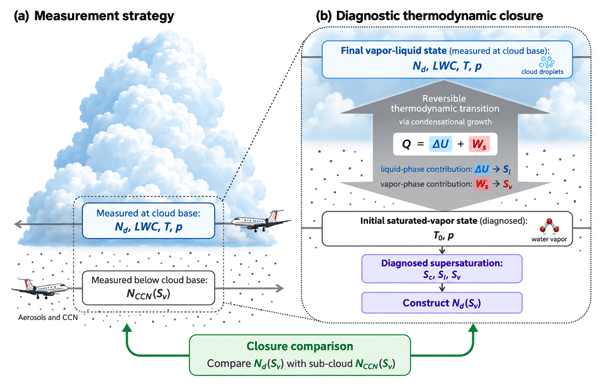
Abstract. We quantify water vapor supersaturation (Sv) at warm cloud base by describing the ascent of a saturated (cloudy) air parcel as a reversible cloud-adiabatic process. In this framework, the parcel’s isobaric enthalpy is conserved along the ascent. The latent heat release (Q) during condensational growth of cloud condensation nuclei (CCN) and droplets is internally redistributed according to the first law of thermodynamics, such that the energy balance is partitioned between the parcel’s internal energy (U) and the saturation work of water vapor (Ws). We find that the fraction of Q associated with ∆U and Ws corresponds to liquid-phase supersaturation (Sl) and Sv, respectively. Closure analyses of airborne measurements at cloud bases of growing cumuli over the Amazon Basin demonstrate that the droplet number concentration Nd scales with Sv and agrees within the uncertainty range with the CCN(Sv) activation spectra measured below cloud base. The new methodology allows the calculation of Nd(Sv) spectra from airborne measurements at cloud bases. Our results suggest that adiabatic models assuming full conversion of phase-change energy into condensational growth tend to overestimate the liquid water content. During the cloud parcel ascent, a finite fraction of this energy is expended as vapor expansion work, reducing the amount available for vapor-to-liquid conversion. Neglecting this energetic partition leads to an overestimation of the latent heat released during condensational growth of particles, cloud parcel buoyancy and vertical acceleration.
Competing interests: At least one of the (co-)authors is a member of the editorial board of Atmospheric Chemistry and Physics. The peer-review process was guided by an independent editor, and the authors also have no other competing interests to declare.
Publisher's note: Copernicus Publications remains neutral with regard to jurisdictional claims made in the text, published maps, institutional affiliations, or any other geographical representation in this paper. While Copernicus Publications makes every effort to include appropriate place names, the final responsibility lies with the authors. Views expressed in the text are those of the authors and do not necessarily reflect the views of the publisher.-
Notice on discussion status
The requested preprint has a corresponding peer-reviewed final revised paper. You are encouraged to refer to the final revised version.
-
Preprint
(1973 KB)
-
Supplement
(2913 KB)
-
The requested preprint has a corresponding peer-reviewed final revised paper. You are encouraged to refer to the final revised version.
- Preprint
(1973 KB) - Metadata XML
-
Supplement
(2913 KB) - BibTeX
- EndNote
- Final revised paper


Journal article(s) based on this preprint
Interactive discussion
Status: closed
-
RC1: 'Comment on egusphere-2026-795', Anonymous Referee #1, 08 Apr 2026
The comment was uploaded in the form of a supplement: https://egusphere.copernicus.org/preprints/2026/egusphere-2026-795/egusphere-2026-795-RC1-supplement.pdfCitation: https://doi.org/
10.5194/egusphere-2026-795-RC1 - AC1: 'Reply on RC1', Ramon Braga, 25 Apr 2026
-
RC2: 'Comment on egusphere-2026-795', Anonymous Referee #2, 29 Apr 2026
General comments:
The paper presents a new method that employs the energy budget analysis framework to estimate the amount of supersaturation at warm cloud base by assuming the saturated parcel ascent as reversible adiabatic process with conserved isobaric enthalpy. The authors partition the supersaturation of the cloud (Sc) into vapor-phase (Sv) and liquid-phase (Sl) supersaturations to derive magnitudes of Sc, Sv, and Sl in the context of the energy balance defined by the first law of thermodynamics. This method is complemented by a closure analysis conducted using airborne observations of warm cumulus clouds from the ACRIDICON-CHUVA campaign. The analysis demonstrates how droplet number concentration (Nd) scales with Sv and agrees within the uncertainty range of CCN(Sv) spectra measured below cloud base prior to cloud observations.
Overall, the manuscript is well written and easy to follow. However, some analyses require further clarification. It is recommended that the manuscript be reconsidered after a major revision.
Specific Comments:
- In section 3.1, please clarify the impact of background buoyant forcing on the estimated values of Sl and Sv using this framework regardless of aerosol regimes. In other words, how do uncertainty in Sl and Sv scales with increasing background buoyant forcing in any given environment?
- Cloud passes were considered using a threshold criterion of Nd greater than 20 cm–3 at initial stage of cloud formation (Lines 260-265). Since such in-cloud measurement thresholds are currently not standardized in our community, please perform sensitivity analysis on the resulting supersaturations with different threshold criteria defined using a combination of both minimum Nd and/or LWC. Additionally, please verify whether such definitions have any significant impact on the correlation coefficients discussed with power-law fits in Figure 4, S10, and S11. Include the analysis in the supporting information document.
- The derived correlation coefficients values exhibit inverse correlation with the sample size. Larger sample sizes are associated with lower correlation coefficients and vice versa. Given the extremely limited sample size for this analysis and considering the prior argument, justify whether Nd is well constrained by Sv (Lines 408-409).
- The reported uncertainties of 10% for N and LWC at lines 307-309 are applicable only to the ACRIDICON-CHUVA dataset. These uncertainties can be considered as the best-case scenario for measurement uncertainties, given that the Baumgardner et al., 2017 report the uncertainty range for scattering probes for sizing to be 10%-50% and for concentrations to be 10%-30%. Therefore, to extend the energy balance method to be applicable for other datasets from other field campaigns and to account for the worst-case scenario containing the maximum possible range of energy terms and supersaturations, please consider discussing the uncertainty to be defined as both the best-case and worst-case scenarios.
- Lines 473-474: Please provide the magnitude of overestimation to better highlight the importance of including the energetic cost of vapor expansion during the ascent of the saturated parcel.
Technical corrections:
- The spelling of ‘modeling’ in the manuscript is inconsistent. At Lines 33,36,237, it is spelled as ‘modeling’, whereas at lines 189, 226, 467 it is spelled as ‘modelling’.
- Figure 3 and 4: Include a description in the figure captions that indicates that the color choices correspond to different aerosol backgrounds in the Amazon region and list the colors with their corresponding regions.
Reference:
Baumgardner, D., and Coauthors, 2017: Cloud Ice Properties: In Situ Measurement Challenges. Meteor. Monogr., 58, 9.1–9.23, https://doi.org/10.1175/AMSMONOGRAPHS-D-16-0011.1
Citation: https://doi.org/10.5194/egusphere-2026-795-RC2 - AC2: 'Reply on RC2', Ramon Braga, 08 May 2026
Peer review completion


Interactive discussion
Status: closed
-
RC1: 'Comment on egusphere-2026-795', Anonymous Referee #1, 08 Apr 2026
The comment was uploaded in the form of a supplement: https://egusphere.copernicus.org/preprints/2026/egusphere-2026-795/egusphere-2026-795-RC1-supplement.pdf
- AC1: 'Reply on RC1', Ramon Braga, 25 Apr 2026
-
RC2: 'Comment on egusphere-2026-795', Anonymous Referee #2, 29 Apr 2026
General comments:
The paper presents a new method that employs the energy budget analysis framework to estimate the amount of supersaturation at warm cloud base by assuming the saturated parcel ascent as reversible adiabatic process with conserved isobaric enthalpy. The authors partition the supersaturation of the cloud (Sc) into vapor-phase (Sv) and liquid-phase (Sl) supersaturations to derive magnitudes of Sc, Sv, and Sl in the context of the energy balance defined by the first law of thermodynamics. This method is complemented by a closure analysis conducted using airborne observations of warm cumulus clouds from the ACRIDICON-CHUVA campaign. The analysis demonstrates how droplet number concentration (Nd) scales with Sv and agrees within the uncertainty range of CCN(Sv) spectra measured below cloud base prior to cloud observations.
Overall, the manuscript is well written and easy to follow. However, some analyses require further clarification. It is recommended that the manuscript be reconsidered after a major revision.
Specific Comments:
- In section 3.1, please clarify the impact of background buoyant forcing on the estimated values of Sl and Sv using this framework regardless of aerosol regimes. In other words, how do uncertainty in Sl and Sv scales with increasing background buoyant forcing in any given environment?
- Cloud passes were considered using a threshold criterion of Nd greater than 20 cm–3 at initial stage of cloud formation (Lines 260-265). Since such in-cloud measurement thresholds are currently not standardized in our community, please perform sensitivity analysis on the resulting supersaturations with different threshold criteria defined using a combination of both minimum Nd and/or LWC. Additionally, please verify whether such definitions have any significant impact on the correlation coefficients discussed with power-law fits in Figure 4, S10, and S11. Include the analysis in the supporting information document.
- The derived correlation coefficients values exhibit inverse correlation with the sample size. Larger sample sizes are associated with lower correlation coefficients and vice versa. Given the extremely limited sample size for this analysis and considering the prior argument, justify whether Nd is well constrained by Sv (Lines 408-409).
- The reported uncertainties of 10% for N and LWC at lines 307-309 are applicable only to the ACRIDICON-CHUVA dataset. These uncertainties can be considered as the best-case scenario for measurement uncertainties, given that the Baumgardner et al., 2017 report the uncertainty range for scattering probes for sizing to be 10%-50% and for concentrations to be 10%-30%. Therefore, to extend the energy balance method to be applicable for other datasets from other field campaigns and to account for the worst-case scenario containing the maximum possible range of energy terms and supersaturations, please consider discussing the uncertainty to be defined as both the best-case and worst-case scenarios.
- Lines 473-474: Please provide the magnitude of overestimation to better highlight the importance of including the energetic cost of vapor expansion during the ascent of the saturated parcel.
Technical corrections:
- The spelling of ‘modeling’ in the manuscript is inconsistent. At Lines 33,36,237, it is spelled as ‘modeling’, whereas at lines 189, 226, 467 it is spelled as ‘modelling’.
- Figure 3 and 4: Include a description in the figure captions that indicates that the color choices correspond to different aerosol backgrounds in the Amazon region and list the colors with their corresponding regions.
Reference:
Baumgardner, D., and Coauthors, 2017: Cloud Ice Properties: In Situ Measurement Challenges. Meteor. Monogr., 58, 9.1–9.23, https://doi.org/10.1175/AMSMONOGRAPHS-D-16-0011.1
Citation: https://doi.org/10.5194/egusphere-2026-795-RC2 - AC2: 'Reply on RC2', Ramon Braga, 08 May 2026
Peer review completion
Journal article(s) based on this preprint
Viewed
| HTML | XML | Total | Supplement | BibTeX | EndNote | |
|---|---|---|---|---|---|---|
| 1,047 | 491 | 115 | 1,653 | 209 | 112 | 176 |
- HTML: 1,047
- PDF: 491
- XML: 115
- Total: 1,653
- Supplement: 209
- BibTeX: 112
- EndNote: 176
Viewed (geographical distribution)
| Country | # | Views | % |
|---|
| Total: | 0 |
| HTML: | 0 |
| PDF: | 0 |
| XML: | 0 |
- 1
Ramon Campos Braga

Daniel Harrison
Manfred Wendisch
Rachel Albrecht
The requested preprint has a corresponding peer-reviewed final revised paper. You are encouraged to refer to the final revised version.
- Preprint
(1973 KB) - Metadata XML
-
Supplement
(2913 KB) - BibTeX
- EndNote
- Final revised paper