
the Creative Commons Attribution 4.0 License.
the Creative Commons Attribution 4.0 License.
 | 16 Mar 2026
Substantial accumulation rates on a glacier avalanche cone from time-lapse photogrammetry and field measurements
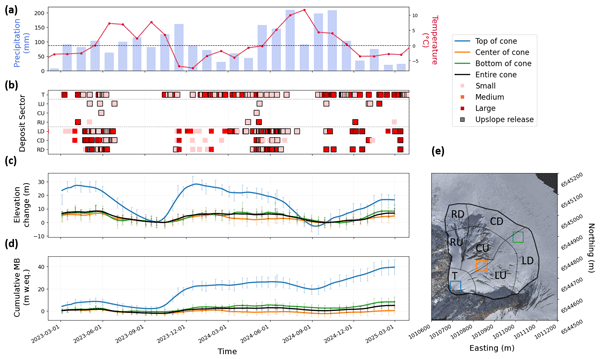
Abstract. Avalanches are critical contributors to the mass balance and spatial accumulation patterns of mountain glaciers. While gravitational snow redistribution models predict high localized accumulation, these predictions lack field validation due to the difficulty of monitoring highly dynamic avalanche cones. Here, we present two years of high-resolution monitoring of a large avalanche cone in the accumulation area of Argentière Glacier (French Alps). To capture these dynamics, we employed a multi-sensor approach: Uncrewed Aerial Vehicle (UAV) surveys and a time-lapse photogrammetry array consisting of 7 low-cost cameras deployed ~1 km away from the cone. Point clouds and Digital Elevations Models were produced at a two-week resolution using Structure-from-Motion photogrammetry. Methodological validation shows that while side-looking time-lapse photogrammetry captures the overall elevation changes, it tends to underestimate them compared to UAV data, with biases up to 1.8 m and precisions of 2–6 m. Despite these uncertainties, our results reveal extreme spatial variability in accumulation. The top of the cone is the most active zone, exhibiting elevation changes of ~30 m annually corresponding to a local annual mass balance reaching 23 +/- 4 m w.e. in 2023 and 16 +/- 4 m w.e. in 2024. We identify a topographical threshold for snow storage: the upper cone fills early in the season until reaching a critical slope of ~35°, after which subsequent avalanches bypass the cone’s apex to deposit mass at the cone’s base. From May onwards, mass redistribution is further modulated by the development of surface channels. Our findings demonstrate that time-lapse photogrammetry is a viable tool for monitoring dynamic glacier surfaces and provide rare empirical evidence of the dominant role avalanches play in the local glacier mass budget.
Competing interests: At least one of the (co-)authors is a member of the editorial board of The Cryosphere.
Publisher's note: Copernicus Publications remains neutral with regard to jurisdictional claims made in the text, published maps, institutional affiliations, or any other geographical representation in this paper. While Copernicus Publications makes every effort to include appropriate place names, the final responsibility lies with the authors. Views expressed in the text are those of the authors and do not necessarily reflect the views of the publisher.-
Notice on discussion status
The requested preprint has a corresponding peer-reviewed final revised paper. You are encouraged to refer to the final revised version.
-
Preprint
(2152 KB)
-
Supplement
(1121 KB)
-
The requested preprint has a corresponding peer-reviewed final revised paper. You are encouraged to refer to the final revised version.
- Preprint
(2152 KB) - Metadata XML
-
Supplement
(1121 KB) - BibTeX
- EndNote
- Final revised paper


Journal article(s) based on this preprint
Interactive discussion
Status: closed
-
RC1: 'Comment on egusphere-2026-786', Anonymous Referee #1, 25 Mar 2026
- AC1: 'Reply on RC1', Marin Kneib, 25 Jun 2026
-
RC2: 'Comment on egusphere-2026-786', Anonymous Referee #2, 12 Jun 2026
Review: Substantial accumulation rates on a glacier avalanche cone from time-lapse photogrammetry and field measurements
The manuscript presents an interesting and well‑documented analysis of extreme snow accumulation on an avalanche cone using time‑lapse and UAV photogrammetry. The overall concept — estimating intense avalanche‑driven accumulation — is highly valuable, and the transparent description of the SfM workflow is a clear strength. This is a valuable contribution, and the study has clear potential for publication after addressing several minor to major points outlined below.
Main comments:
- The study would benefit from placing the results in a broader mass‑balance context: The central limitation of the manuscript is that it does not quantify the relative contribution of avalanche‑derived accumulation to the glacier‑wide mass balance. Although the authors show exceptionally high local mass gain (up to +23 m w.e.) and briefly compare it to GLACIOCLIM reference stakes, the comparison remains qualitative. Because the area of the cone and the mean accumulation across the glacier’s accumulation zone are known, a simple scaling analysis could reveal whether the cone represents a negligible local anomaly or a meaningful component of the glacier’s annual mass budget. Without this quantification, the broader significance of the findings remains unclear. An alternative and complementary approach could be a process‑based glacier mass‑balance model that explicitly accounts for snow‑redistribution processes, which would help quantify how avalanche input modifies the glacier’s overall accumulation regime.
- A central strength of the manuscript is the transparent description of the time‑lapse SfM workflow and the careful comparison with UAV‑derived elevation changes. However, several methodological aspects related to reconstruction quality and uncertainty quantification would benefit from deeper analysis and clearer discussion. First, while the manuscript clearly demonstrates a systematic underestimation in the time‑lapse SfM (2–3.3 m), the potential causes of this bias are not yet adequately discussed. Factors such as the strongly off‑nadir viewing geometry, long camera–object distance, etc could plausibly contribute. A brief reflection on these aspects, supported by established SfM literature (e.g. James et al., 2019; Smith et al., 2020), would help contextualize the observed bias. Second, the treatment of uncertainties in the submergence velocity could be expanded. In particular, the temporal variability of near‑surface density, the assumption of constant Vsub, and the propagation of DEM uncertainties merit a more explicit discussion. Particularly, the manuscript assumes a temporally constant submergence velocity retrieved from summer Vsub. It may be worth considering whether this assumption holds throughout the year, given that processes such as snow loading, firn compaction, meltwater percolation, and seasonal changes in ice‑flow dynamics could influence vertical strain rates. A brief reflection on whether such seasonal effects might be relevant in this setting could help clarify the associated uncertainties. Third, the manuscript notes seasonal differences in SfM performance but does not explore them further. Given the two‑year dataset, even a concise assessment of seasonal influences—illumination, snow surface conditions, camera stability—using simple metrics (e.g. point density or reprojection error) would enhance methodological transparency.
Addressing these points would further clarify the limitations and strengths of the time‑lapse photogrammetry and the derived submergence‑velocity estimates.
Specific comments:
- Further studies should be mentioned when discussing snow depositions on glaciers such as Dadic et al., 2010: Dadic, R., Mott, R., Lehning, M., & Burlando, P. (2010). Wind influence on snow depth distribution and accumulation over glaciers. Journal of Geophysical Research: Earth Surface, 115, F01012 (8 pp.). https://doi.org/10.1029/2009JF001261.
- The SfM workflow is described transparently, but key references on off‑nadir photogrammetry and systematic SfM biases are missing. Given the ~1 km camera–object distance and strongly oblique viewing geometry are well‑known sources of negative elevation bias. A short discussion of these mechanisms would help explain the observed 2–3.3 m underestimation in the time‑lapse DEMs.
- The manuscript shows that the avalanche cone experiences exceptionally high mass gain, but the glacier‑wide significance remains unclear. A quantitative comparison between the cone’s annual mass balance (up to +23 m w.e.) and the glacier‑wide accumulation would greatly strengthen the interpretation. Because the authors know both the cone area and the mean accumulation across the glacier’s accumulation zone, a simple scaling analysis could reveal whether the cone contributes a negligible or substantial share of the total annual mass input.
For instance, even though the cone represents only a very small fraction of the total accumulation area, its annual mass gain is an order of magnitude higher than typical accumulation elsewhere on the glacier. This means that the cone could contribute a non‑negligible share of the glacier’s total annual accumulation, despite its limited spatial extent. Highlighting this contrast would help clarify whether the cone is merely a local anomaly or a meaningful component of the glacier’s overall mass budget. Integrating this perspective would strengthen the interpretation of the mass‑balance implications presented in the manuscript.
- The manuscript presents clear evidence that avalanches, wind redistribution, and storm characteristics exert a dominant control on the spatial pattern of accumulation at the cone. Against this background, it remains unclear why the study does not explore snow‑redistribution modelling, even at a simplified level. Given the pronounced influence of these processes, a process‑based or reduced‑complexity simulation — for example using established snow‑transport models or simple avalanche‑runout schemes — could have provided valuable context for interpreting the observed mass gain and its sensitivity to meteorological forcing and topographic controls.
Because the cone represents a highly constrained and well‑defined deposition environment, it would also serve as an interesting test case for such modelling approaches. Even if a full modelling framework lies beyond the intended scope of the study, a brief explanation of why no snow‑redistribution simulations were attempted would improve transparency and help readers understand the limits of the current interpretation.
- Several of the figures in the Results section are informative, but their interpretability could be improved. At present, many different panels require substantial effort from the reader to understand what is being shown and how the different datasets relate to each other. This is particularly relevant because the study relies heavily on spatial patterns and temporal changes, which depend on clear visual communication.
- Font types and sizes differ not only between figures but sometimes even within the same multi‑panel figure. This gives the visual presentation a fragmented appearance and makes it harder to read labels, legends, and axes consistently. Harmonising font style and size across all figures would significantly improve clarity.
Citation: https://doi.org/10.5194/egusphere-2026-786-RC2 - AC2: 'Reply on RC2', Marin Kneib, 25 Jun 2026
Peer review completion


Interactive discussion
Status: closed
-
RC1: 'Comment on egusphere-2026-786', Anonymous Referee #1, 25 Mar 2026
General comment:
This paper focuses on advancing methodological approaches to quantifying the contribution of avalanche to mass accumulation at an alpine glacier. It details a comprehensive field programme in challenging terrain, comparing elevation change (via Structure-from-Motion) derived from UAV survey with those derived from time-lapse photography. The authors find that the remote camera data underestimates elevation change on an avalanche cone when compared to UAV derived data. However, remote camera data provide a time-series of change not possible with mission-based UAV data.
The authors describe a robust approach to determining elevation change and convert that change to surface mass balance by accounting for submergence velocity (dynamics and compaction). Field data (e.g. snow density, ablation stakes) are utilised to improve the mass balance estimates, and checks were made between submergence velocity estimates and snow pit/density stratigraphy. The papers discussion is well organised progression logically from discussion of the methods and their limitations through to the process of avalanche accumulation – all sections are well cited.
This is an excellent contribution, providing a robust workflow to improving estimates of avalanche contribution to surface mass balance and at the same time adding to knowledge about how important this secondary accumulation source can be.
Specific/Technical Comments (minor):
In relation to Figure S5, the intra-day repeatability tests, which compare DEMs generated within 48-hr windows, the authors state they expect no change to have occurred. Can the authors confirm these dates are away from any precipitation events and/or radiative heating? As either of these meteorological conditions could stimulate sluffing/deposition onto the avalanche cone, especially during the Nov accumulation time period. It is somewhat difficult to assess the precipitation data shown in Figure 9 against that time-slices in S5.
Figure 5: On the pdf this appears to be missing a title horizontal axis title
Section 4.3.3: Order of content. The time chronology seems a little jumbled in this section making it difficult to follow. Can the authors present the data time sequentially, describing the total precipitation and number of avalanche events for the 2023-24 period and then the 2024-25 period so it is easier for the reader to assess the overall weather/snow conditions between the two field seasons?
Citation: https://doi.org/10.5194/egusphere-2026-786-RC1 - AC1: 'Reply on RC1', Marin Kneib, 25 Jun 2026
-
RC2: 'Comment on egusphere-2026-786', Anonymous Referee #2, 12 Jun 2026
Review: Substantial accumulation rates on a glacier avalanche cone from time-lapse photogrammetry and field measurements
The manuscript presents an interesting and well‑documented analysis of extreme snow accumulation on an avalanche cone using time‑lapse and UAV photogrammetry. The overall concept — estimating intense avalanche‑driven accumulation — is highly valuable, and the transparent description of the SfM workflow is a clear strength. This is a valuable contribution, and the study has clear potential for publication after addressing several minor to major points outlined below.
Main comments:
- The study would benefit from placing the results in a broader mass‑balance context: The central limitation of the manuscript is that it does not quantify the relative contribution of avalanche‑derived accumulation to the glacier‑wide mass balance. Although the authors show exceptionally high local mass gain (up to +23 m w.e.) and briefly compare it to GLACIOCLIM reference stakes, the comparison remains qualitative. Because the area of the cone and the mean accumulation across the glacier’s accumulation zone are known, a simple scaling analysis could reveal whether the cone represents a negligible local anomaly or a meaningful component of the glacier’s annual mass budget. Without this quantification, the broader significance of the findings remains unclear. An alternative and complementary approach could be a process‑based glacier mass‑balance model that explicitly accounts for snow‑redistribution processes, which would help quantify how avalanche input modifies the glacier’s overall accumulation regime.
- A central strength of the manuscript is the transparent description of the time‑lapse SfM workflow and the careful comparison with UAV‑derived elevation changes. However, several methodological aspects related to reconstruction quality and uncertainty quantification would benefit from deeper analysis and clearer discussion. First, while the manuscript clearly demonstrates a systematic underestimation in the time‑lapse SfM (2–3.3 m), the potential causes of this bias are not yet adequately discussed. Factors such as the strongly off‑nadir viewing geometry, long camera–object distance, etc could plausibly contribute. A brief reflection on these aspects, supported by established SfM literature (e.g. James et al., 2019; Smith et al., 2020), would help contextualize the observed bias. Second, the treatment of uncertainties in the submergence velocity could be expanded. In particular, the temporal variability of near‑surface density, the assumption of constant Vsub, and the propagation of DEM uncertainties merit a more explicit discussion. Particularly, the manuscript assumes a temporally constant submergence velocity retrieved from summer Vsub. It may be worth considering whether this assumption holds throughout the year, given that processes such as snow loading, firn compaction, meltwater percolation, and seasonal changes in ice‑flow dynamics could influence vertical strain rates. A brief reflection on whether such seasonal effects might be relevant in this setting could help clarify the associated uncertainties. Third, the manuscript notes seasonal differences in SfM performance but does not explore them further. Given the two‑year dataset, even a concise assessment of seasonal influences—illumination, snow surface conditions, camera stability—using simple metrics (e.g. point density or reprojection error) would enhance methodological transparency.
Addressing these points would further clarify the limitations and strengths of the time‑lapse photogrammetry and the derived submergence‑velocity estimates.
Specific comments:
- Further studies should be mentioned when discussing snow depositions on glaciers such as Dadic et al., 2010: Dadic, R., Mott, R., Lehning, M., & Burlando, P. (2010). Wind influence on snow depth distribution and accumulation over glaciers. Journal of Geophysical Research: Earth Surface, 115, F01012 (8 pp.). https://doi.org/10.1029/2009JF001261.
- The SfM workflow is described transparently, but key references on off‑nadir photogrammetry and systematic SfM biases are missing. Given the ~1 km camera–object distance and strongly oblique viewing geometry are well‑known sources of negative elevation bias. A short discussion of these mechanisms would help explain the observed 2–3.3 m underestimation in the time‑lapse DEMs.
- The manuscript shows that the avalanche cone experiences exceptionally high mass gain, but the glacier‑wide significance remains unclear. A quantitative comparison between the cone’s annual mass balance (up to +23 m w.e.) and the glacier‑wide accumulation would greatly strengthen the interpretation. Because the authors know both the cone area and the mean accumulation across the glacier’s accumulation zone, a simple scaling analysis could reveal whether the cone contributes a negligible or substantial share of the total annual mass input.
For instance, even though the cone represents only a very small fraction of the total accumulation area, its annual mass gain is an order of magnitude higher than typical accumulation elsewhere on the glacier. This means that the cone could contribute a non‑negligible share of the glacier’s total annual accumulation, despite its limited spatial extent. Highlighting this contrast would help clarify whether the cone is merely a local anomaly or a meaningful component of the glacier’s overall mass budget. Integrating this perspective would strengthen the interpretation of the mass‑balance implications presented in the manuscript.
- The manuscript presents clear evidence that avalanches, wind redistribution, and storm characteristics exert a dominant control on the spatial pattern of accumulation at the cone. Against this background, it remains unclear why the study does not explore snow‑redistribution modelling, even at a simplified level. Given the pronounced influence of these processes, a process‑based or reduced‑complexity simulation — for example using established snow‑transport models or simple avalanche‑runout schemes — could have provided valuable context for interpreting the observed mass gain and its sensitivity to meteorological forcing and topographic controls.
Because the cone represents a highly constrained and well‑defined deposition environment, it would also serve as an interesting test case for such modelling approaches. Even if a full modelling framework lies beyond the intended scope of the study, a brief explanation of why no snow‑redistribution simulations were attempted would improve transparency and help readers understand the limits of the current interpretation.
- Several of the figures in the Results section are informative, but their interpretability could be improved. At present, many different panels require substantial effort from the reader to understand what is being shown and how the different datasets relate to each other. This is particularly relevant because the study relies heavily on spatial patterns and temporal changes, which depend on clear visual communication.
- Font types and sizes differ not only between figures but sometimes even within the same multi‑panel figure. This gives the visual presentation a fragmented appearance and makes it harder to read labels, legends, and axes consistently. Harmonising font style and size across all figures would significantly improve clarity.
Citation: https://doi.org/10.5194/egusphere-2026-786-RC2 - AC2: 'Reply on RC2', Marin Kneib, 25 Jun 2026
Peer review completion
Journal article(s) based on this preprint
Viewed
| HTML | XML | Total | Supplement | BibTeX | EndNote | |
|---|---|---|---|---|---|---|
| 1,208 | 611 | 75 | 1,894 | 184 | 77 | 92 |
- HTML: 1,208
- PDF: 611
- XML: 75
- Total: 1,894
- Supplement: 184
- BibTeX: 77
- EndNote: 92
Viewed (geographical distribution)
| Country | # | Views | % |
|---|
| Total: | 0 |
| HTML: | 0 |
| PDF: | 0 |
| XML: | 0 |
- 1

Patrick Wagnon
Laurent Arnaud
Louise Balmas
Olivier Laarman
Bruno Jourdain
Amaury Dehecq
Emmanuel Lemeur
Fanny Brun
Andrea Kneib-Walter
Ilaria Santin
Laurane Charrier
Thierry Faug
Giulia Mazzotti
Antoine Rabatel
Delphine Six
Daniel Farinotti
The requested preprint has a corresponding peer-reviewed final revised paper. You are encouraged to refer to the final revised version.
- Preprint
(2152 KB) - Metadata XML
-
Supplement
(1121 KB) - BibTeX
- EndNote
- Final revised paper
General comment:
This paper focuses on advancing methodological approaches to quantifying the contribution of avalanche to mass accumulation at an alpine glacier. It details a comprehensive field programme in challenging terrain, comparing elevation change (via Structure-from-Motion) derived from UAV survey with those derived from time-lapse photography. The authors find that the remote camera data underestimates elevation change on an avalanche cone when compared to UAV derived data. However, remote camera data provide a time-series of change not possible with mission-based UAV data.
The authors describe a robust approach to determining elevation change and convert that change to surface mass balance by accounting for submergence velocity (dynamics and compaction). Field data (e.g. snow density, ablation stakes) are utilised to improve the mass balance estimates, and checks were made between submergence velocity estimates and snow pit/density stratigraphy. The papers discussion is well organised progression logically from discussion of the methods and their limitations through to the process of avalanche accumulation – all sections are well cited.
This is an excellent contribution, providing a robust workflow to improving estimates of avalanche contribution to surface mass balance and at the same time adding to knowledge about how important this secondary accumulation source can be.
Specific/Technical Comments (minor):
In relation to Figure S5, the intra-day repeatability tests, which compare DEMs generated within 48-hr windows, the authors state they expect no change to have occurred. Can the authors confirm these dates are away from any precipitation events and/or radiative heating? As either of these meteorological conditions could stimulate sluffing/deposition onto the avalanche cone, especially during the Nov accumulation time period. It is somewhat difficult to assess the precipitation data shown in Figure 9 against that time-slices in S5.
Figure 5: On the pdf this appears to be missing a title horizontal axis title
Section 4.3.3: Order of content. The time chronology seems a little jumbled in this section making it difficult to follow. Can the authors present the data time sequentially, describing the total precipitation and number of avalanche events for the 2023-24 period and then the 2024-25 period so it is easier for the reader to assess the overall weather/snow conditions between the two field seasons?