
the Creative Commons Attribution 4.0 License.
the Creative Commons Attribution 4.0 License.
 | 05 Mar 2026
GPR-derived ice thickness of the temperate Hintereisferner glacier (Austrian Alps): evaluation of thickness models
Abstract. Alpine glaciers are retreating rapidly and have a potential for near complete ice loss at the end of the 21st century thus accurate glacier evolution models are crucial for predicting the magnitude and rate of future glacier changes. Without reliable ice thickness assessments, such models lack credibility and cannot be validated, thus here we evaluate several ice thickness models and present new ground-penetrating radar (GPR) ice-thickness measurements of the Hintereisferner – a temperate glacier located in the Ötztal Alps, Austria, which despite of being one of the WGMS reference glaciers lacks up-to date measured ice thickness data.
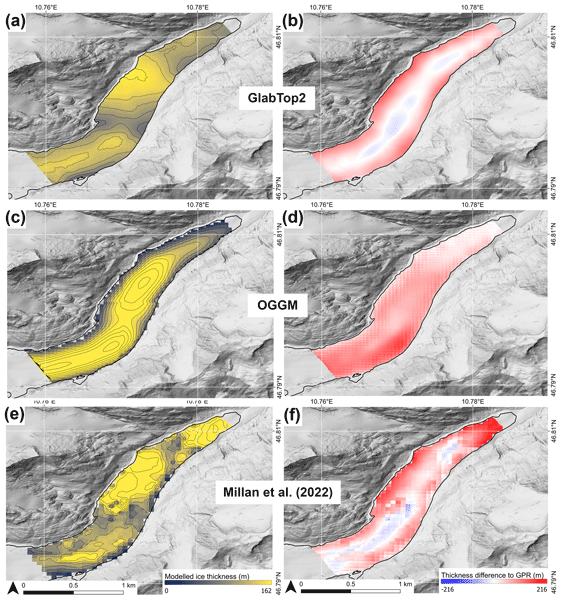
The GPR data is characterized by strong signal scattering, typical for temperate ice with high water content, however the glacier bed is detectable in most profiles. GPR measurements reveal a maximum ice thickness of ~160 m along the central flowline and a mean thickness of ~81 m across the surveyed area. We further select three widely used, open-source ice-thickness models, GlabTop2, OGGM, and Millan et al. (2022), and compare their output to the GPR-derived ice thickness. All models systematically overestimate ice thickness across the surveyed area, with mean positive biases of ~37–40 m for GlabTop2 and OGGM and ~59 m for the Millan model, while only minor and localized underestimation occurs along the central flowline. These results highlight the limitations of predominantly geometry-based and velocity-informed modelling approaches when applied to small, temperate valley glaciers, where ice rheology and basal conditions may have greater influence on the resulting thickness than these algorithms allow.
The GPR data presented here is made freely available in the section “Code and data availability” and provides an updated ice thickness benchmark for the Hintereisferner, to be used for future model calibration and improvement for Alpine glacier evolution projections.
-
Notice on discussion status
The requested preprint has a corresponding peer-reviewed final revised paper. You are encouraged to refer to the final revised version.
-
Preprint
(2024 KB)
-
The requested preprint has a corresponding peer-reviewed final revised paper. You are encouraged to refer to the final revised version.
- Preprint
(2024 KB) - Metadata XML
- BibTeX
- EndNote
- Final revised paper


Journal article(s) based on this preprint
Interactive discussion
Status: closed
-
RC1: 'Comment on egusphere-2026-783', Anonymous Referee #1, 10 Apr 2026
-
AC1: 'Reply on RC1', Lelde Švinka, 13 Apr 2026
Thank you for the careful reading of the manuscript and the constructive comments. We are pleased that you found our article valuable, and we will address each comment below.
- Line 90 - GPR campaign date and snow-cover conditions: the survey was conducted in August 2023 (stated in line 80), but you are correct to point out that additional information is needed. In revised manuscript we will add that the survey took place from 2nd to 7th of August, and all GPR profiles were recorded on a snow-free glacier surface (conditions visible in Fig.1b).
- Figure 5 - caption improvement: we agree that the caption should be more descriptive. In the revised manuscript the caption will state that panels (a), (c), and (e) show modelled ice thickness distributions for GlabTop2, OGGM, and Millan et al. (2022), respectively, and that panels (b), (d), and (f) show the corresponding thickness difference maps (modelled minus GPR-derived interpolated thickness).
- Line 255 - underestimation/overestimation: thank you for catching this error! Using a cold ice EM wave velocity (0.168 m ns⁻¹) that is higher than temperate ice velocity means the calculated thickness will be greater than the true thickness and lead to a slight overestimation, not underestimation. This is consistent with the discussion in Section 2.3, where we correctly describe this effect. Line 255 contains an unintentional contradiction, and we will correct it accordingly in the revised manuscript.
Citation: https://doi.org/10.5194/egusphere-2026-783-AC1
-
AC1: 'Reply on RC1', Lelde Švinka, 13 Apr 2026
-
RC2: 'Comment on egusphere-2026-783', Anonymous Referee #2, 13 Apr 2026
General Comments
The main focus of this paper is to compare existing ice thickness models, with a specific application to the Hintereisferner glacier in the Austrian Alps. While this topic has been addressed in previous studies, as mentioned in the introduction, the depth and scope of this analysis appear to push the boundaries further than what I’ve seen before. It certainly adds valuable insights to the field. It is particularly interesting to note the consistent overestimation of ice thickness across all models - a finding that warrants further discussion.
The methods of analysis are clearly explained. I especially appreciated the attention to detail regarding uncertainties linked to velocity and the decision to compare models only at GPR points (to avoid additional uncertainties from cubic interpolation).
However, I believe the manuscript could be slightly refined by placing more emphasis on the model comparison rather than the data acquisition. For example, the conclusion currently dedicates equal space to both topics, but the model comparison is where the paper truly shines. Additionally, I noticed a lack of cross-citations throughout the paper. While one reference is often provided, I would recommend citing at least three relevant studies when available. This would not only strengthen the validity of the points made but also better acknowledge the extensive work done in the past on these topics. Overall, previous work could be acknowledged more thoroughly.
That said, the paper is already of high quality, and after addressing these comments, I would strongly support its publication. I therefore encourage acceptance with minor revisions.
Specific Comments
Line 67: The previous use of GPR on glaciers could be discussed more broadly, especially if you keep emphasizing your data acquisition.
Line 83: I don’t question the data - it’s often challenging to obtain the most accurate measurements - but the time gap between the DSM acquisition (September 2022) and the GPR data (August 2023) seems significant. Unless I missed it, this isn’t addressed later in the paper. I could be wrong, though.
Figure 1 caption: Please include the exact date(s) of acquisition.
Line 90: Consider adding a link or reference to the full set of parameters (e.g., trace length, stacking number, sampling interval) for readers who may be interested.
Line 95: Why was this approach chosen? For example, is it based on proven methods, such as those discussed in Langhammer et al. (2017), which suggest a preferred orientation?
Section 2.1 (GPR surveys): Some points are based on very few surveys. Including more references would strengthen consistency. For instance, the velocity of 0.168 m/ns has been widely used and explained in previous studies.
Section 2.2 (Thickness data and modeling): One global observation : why is the interpolation used for ? You only compare the location of the GPR data (which is consistent as the 200m spacing introduce high level of uncertainties between the lines) and don’t really use the map to build ice volume I believe. Out of curiosity and on a personal note, I would be interested to know what’s the results oft he model comparison when it comes to ice volume as well.
Section 2.3 (Uncertainty and accuracy assessment): This section is excellent, but again, more citations would be beneficial. For example, the fact that EM velocity decreases with increasing liquid water content has been discussed in numerous papers and should be acknowledged more broadly.
Figure 4: Why does panel (a) not focus on the same area as the other three plots? Also, the figure is well done, but it might be helpful to add the locations of the GPR lines to panel (c) to better see (?). This would provide additional context for what’s happening between the lines - though it’s not crucial as again, I don’t think you use this interpolation.
Figure 5 (panels a, c, and e): Why do these panels not focus solely on the surveyed area? Additionally, I found it somewhat challenging to understand what each plot represents. Consider adding more detail to the captions (in addition to the legend) to improve clarity.
Table 1: I understand what "n" represents, but it’s only briefly introduced earlier. Renaming it to "number of data points" or something like this might make it clearer. Since "n" is only used twice, the abbreviation may not be necessary.
Line 249: In the introduction, you cite several studies that compare models with data, but in the discussion, only Lamsters et al. (2024) is referenced. While I understand you may be most familiar with this study, it would be valuable to include notes on the others to identify any consistent trends in model estimation.
Line 262: Could you provide examples of winter surveys as reference?
Line 269: More citations would be helpful here. Many helicopter/airborne surveys have been conducted, and their limitations (e.g., not always probing to the bottom) could be shortly introduced further.
Line 270: Drone-based GPR has probed depths of up to ~100 m (Klahold et al., 2026 - 10.1017/jog.2026.10145). It is shallower but is this still considered shallow?
Line 270: Ruols et al. (2023 and 2025) were not conducted on snow-covered glaciers.
Line 273: I am not sure to understand if the comparison between the data and the model is better or worse on the parallel to flow line than on the other lines. Again, I feel that the strenght of this paper is in this comparison between models and the comment on the reasons why reflections are varied is here rather shallow to my view – as some papers have entirely focused on that.
Conclusion: My overall impression is that the conclusion balances data acquisition and model comparison equally. Given that the model comparison is the paper’s strongest contribution, I’d suggest highlighting this aspect more prominently in the conclusion.
Technical corrections: None - great job!
Citation: https://doi.org/10.5194/egusphere-2026-783-RC2 -
AC2: 'Reply on RC2', Lelde Švinka, 16 Apr 2026
Thank you for your comments and recommendations that would improve our manuscript. We address your comments below.
General Comments
We agree that the model comparison is the paper's primary contribution and will put more emphasis on that in our revised manuscript. We also acknowledge that the paper would benefit from more references to other studies and will add them where applicable.
Specific Comments
Line 67: we usually describe our GPR methodology in a manner that allows the reader to fully understand how the data was gathered and processed which we consider important for transparency and scientific rigour.
Regarding a broader introduction to GPR applications in glaciology, we note that this topic has been thoroughly covered in dedicated resources, including the foundational work by Bogorodsky et al. (1985) on radioglaciology and the GPR chapter in Pellikka and Rees (2009). We will add references to these and other relevant recent studies in the revised manuscript, while keeping the introduction focused on aspects directly relevant to our study. We hope this represents a satisfactory compromise between accurate representation of previous studies and conciseness of the introduction.Line 83: yes, there is one-year gap, because of the issues with the laser scanner, thus only the data from the previous year was available. Thanks for mentioning this, we will add more information in Methods and Results regarding the difference. We measured the start and end points of GPR profiles roughly after 50 m with GNSS receiver using ppk service and closest base station to get precise coordinates and elevation. The median difference between the elevation of DSM and GNSS points is 2.8 m as the melting of the glacier surface close to the margin was high during that season, however it does not change the results significantly for the models and ice thickness comparison. We will provide details in the revised manuscript.
Figure 1: thank you for noting this issue, we will add the dates of acquisition for each panel – a) 02/08/2023, b) 03/08/2023, c) 05/08/2023.
Line 90: we will add the full acquisition parameters either in text or to our Zenodo repository where full metadata is available. The parameters are:
- Samples per trace: 2048
- Stacking: 2048
- No automatic data filters were used
- Time range: 2560 ns
- Range per sample: 1250 ps.
Line 95: there are two reasons why we usually orient profiles transverse to the longitudinal axis of a glacier. First, from a practical standpoint, walking perpendicular to the glacier's longitudinal axis avoids the need to continuously ascend and descend the glacier slope, which is both physically demanding and time-consuming. Second, and more importantly from a scientific perspective, englacial conduits are typically oriented parallel to the glacier's longitudinal axis. Recording profiles perpendicular to flow maximises the chance of crossing these features and produces the characteristic hyperbolic reflections that allow them to be identified and characterised. Profiles oriented parallel to flow would instead produce sub horizontal reflections from conduits that are much harder to distinguish, and there is a risk of missing conduits entirely if the profile does not pass directly overhead. Transverse profiles also better characterise the cross-sectional shape of the subglacial valley. These aspects represent standard GPR survey practice are described in numerous textbooks about GPR (for example Jol, 2008. Ground Penetrating Radar Theory and Applications), but we can add a brief explanatory sentence if you feel this would benefit the reader.
Section 2.1: we will add more references to revised manuscript.
Section 2.2: interpolation was used only for visualization purposes (we mention this in Sect.2.3), and all statistical comparisons are made at GPR measurement points only. However, in response to your interest, we can add volume estimates for the GPR-surveyed area as an additional metric. The volume for GPR-surveyed area is ~0.103 km3, while the modelled volume is ~0.159 km3 (RE 54.6%) for GlabTop2, ~0.178 km3 (RE 73.2%) for OGGM, and ~0.161 km3 (RE 56.5%) for the temporally adjusted Millan model. We must note that unlike all other reported statistics, which are compared directly to GPR point measurements, volume estimates are derived from interpolated rasters and therefore carry additional uncertainty that cannot be easily quantified.
Section 2.3: we will add more references to revised manuscript.
Figure 4: panel (a) (a) intentionally shows the full glaciated area rather than just the surveyed area, as the complete surface elevation map is referenced later in the Discussion when addressing the steeper upper glacier sections that were inaccessible during the survey. This context would be lost if panel (a) was cropped to the survey area only. We will also add the GPR profile lines to panel (c) to provide better spatial context for the interpolated thickness distribution in the revised manuscript.
Figure 5: panels (a), (c) and (e) show the full glaciated area because the thickness models were run for the entire glacier. Cropping the modelled thickness maps to the GPR-surveyed area could give the misleading impression that the models were run selectively and would also prevent the reader from seeing the full spatial distribution of modelled thickness. The difference maps in panels (b), (d), and (f) are naturally limited to the surveyed area where GPR data exist for comparison. Also, we will expand the caption for better readability, as also noted by the first reviewer.
Table 1: we will rename n to “number of data points”, as suggested.
Line 249: we will add references.
Line 262: thank you for noting this. We have not provided such references as it’s very challenging usually to survey Alpine glaciers in winter by ground-based GPR, but we will look specifically at the references where such surveys are done and will add them in the revised manuscript.
Line 269: yes, you are right, we will add more references and some sentences about the limitations of airborne surveys, as this was only briefly mentioned in the manuscript.
Line 270: Thanks for noting this issue as well, we will add reference to Klahold et al., 2026 and will check if there are even more studies available from 2026. We will change the sentence, I suppose for valley glaciers 100 m thickness could not be termed shallow nowadays, it is actually very impressive thickness for UAV-GPR, which is not usually reached by commercial systems.
Line 270: yes, thank you for noting this, Ruols et al. indeed did not survey snow-covered glaciers, we will improve this sentence. They reached 80 m, which for drone survey is not shallow as well, although its limits such surveys to the marginal parts of glaciers.
Line 273: We agree that this is not the main focus of the paper and will delete the paragraph from the revised manuscript.
Citation: https://doi.org/10.5194/egusphere-2026-783-AC2
-
AC2: 'Reply on RC2', Lelde Švinka, 16 Apr 2026
-
CC1: 'Comment on egusphere-2026-783', Christian Wild, 21 Apr 2026
Dear authors,
please find the feedback from the Ice and Climate Unit (University of Innsbruck, Austria) in the supplement. We hope you find it helpful and constructive.
Best,
Christian T. Wild- AC4: 'Reply on CC1', Lelde Švinka, 13 May 2026
-
RC3: 'Comment on egusphere-2026-783', Adriano Ribolini, 04 May 2026
I carefully read the paper by Švinka et al. "GPR-derived ice thickness of the temperate Hintereisferner glacier..." and found it interesting, with data worthy of consideration for publication.
I am aware of the difficulties of GPR surveys of glaciers (and especially rock glaciers), and therefore I believe this paper has the merit of producing data scarcely available in the literature.
However, I have some concerns that I believe deserve consideration to make the paper acceptable for publication.
- The paper is essentially based on Ground-Penetrating Radar, and how this type of data can validate or reject model-based glacier thickness assessments. For this reason, I believe more attention should be paid to describing the individual steps of GPR data processing, data interpretation, and data visualization. It is unclear to me why data migration was not applied once the radar wave propagation velocity was determined. The radar profiles do not appear to have been interpreted unambiguously; the areas indicated as characterized by strong scattering appear similar to others interpreted differently. Some signals are not interpreted, despite being frequent in the two images presented.
- The issue of propagation velocity is a delicate one, as is well known. However, interpreting radar images by emphasizing the existence of areas with different water content ("characterized by strong scattering signals") implies a non-constant propagation velocity of EM waves, whatever the value assumed. It could be useful to use a velocity model, even with values derived from the literature.
The (admitted) uncertainties in choosing a constant velocity value, the possible lateral/vertical velocity variations, and the (in my opinion) unclear interpretation of zones of the radar profiles could undermine the validation of glacier thickness based on modelling.
finally, I believe the GPR methodological part should be enhanced, and the interpretation improved, also in light of additional processing steps.
I hope the authors will take this into consideration because I believe their work is important and may fill relevant gaps in glacial modelling.
Some additional comments are added as annotations to the paper PDF file.
I hope this may help.
Best wishes
Adriano Ribolini
- AC3: 'Reply on RC3', Lelde Švinka, 13 May 2026
Peer review completion


Interactive discussion
Status: closed
-
RC1: 'Comment on egusphere-2026-783', Anonymous Referee #1, 10 Apr 2026
The paper presents a thorough comparison between ice‑thickness measurements obtained with ground‑penetrating radar (GPR) and three
numerical thickness models (GlabTop2, OGGM, and the model of Millan et al., 2022). I particularly appreciated the authors’ effort to place
the model results in context by discussing their strengths and limitations in the Discussion section. Providing a direct, data‑driven
benchmark is essential for assessing the reliability of glacier‑scale thickness models, and this manuscript makes a valuable contribution in
that regard.Line 90: The manuscript does not specify the date of the GPR campaign nor the snow‑cover conditions at that time. The reader is left to
assume that the glacier was snow‑free, which may not be correct.
Figure 5: The current caption should explain what the sub‑panels a)–f) represent, making the figure easier to interpret.Line 255 : It is written that "using a constant EM wave velocity representative of cold ice likely leads to a slight underestimation of
the true thickness in temperate ice". To my understanding, it should be "a slight overestimation of... ".For conclusion, the manuscript provides a valuable case study for validating glacier‑scale thickness models against GPR observations.
The points raised above are relatively minor and, once addressed, will improve the manuscript’s clarity and scientific rigour.
I recommend publication after minor revision.Citation: https://doi.org/10.5194/egusphere-2026-783-RC1 -
AC1: 'Reply on RC1', Lelde Švinka, 13 Apr 2026
Thank you for the careful reading of the manuscript and the constructive comments. We are pleased that you found our article valuable, and we will address each comment below.
- Line 90 - GPR campaign date and snow-cover conditions: the survey was conducted in August 2023 (stated in line 80), but you are correct to point out that additional information is needed. In revised manuscript we will add that the survey took place from 2nd to 7th of August, and all GPR profiles were recorded on a snow-free glacier surface (conditions visible in Fig.1b).
- Figure 5 - caption improvement: we agree that the caption should be more descriptive. In the revised manuscript the caption will state that panels (a), (c), and (e) show modelled ice thickness distributions for GlabTop2, OGGM, and Millan et al. (2022), respectively, and that panels (b), (d), and (f) show the corresponding thickness difference maps (modelled minus GPR-derived interpolated thickness).
- Line 255 - underestimation/overestimation: thank you for catching this error! Using a cold ice EM wave velocity (0.168 m ns⁻¹) that is higher than temperate ice velocity means the calculated thickness will be greater than the true thickness and lead to a slight overestimation, not underestimation. This is consistent with the discussion in Section 2.3, where we correctly describe this effect. Line 255 contains an unintentional contradiction, and we will correct it accordingly in the revised manuscript.
Citation: https://doi.org/10.5194/egusphere-2026-783-AC1
-
AC1: 'Reply on RC1', Lelde Švinka, 13 Apr 2026
-
RC2: 'Comment on egusphere-2026-783', Anonymous Referee #2, 13 Apr 2026
General Comments
The main focus of this paper is to compare existing ice thickness models, with a specific application to the Hintereisferner glacier in the Austrian Alps. While this topic has been addressed in previous studies, as mentioned in the introduction, the depth and scope of this analysis appear to push the boundaries further than what I’ve seen before. It certainly adds valuable insights to the field. It is particularly interesting to note the consistent overestimation of ice thickness across all models - a finding that warrants further discussion.
The methods of analysis are clearly explained. I especially appreciated the attention to detail regarding uncertainties linked to velocity and the decision to compare models only at GPR points (to avoid additional uncertainties from cubic interpolation).
However, I believe the manuscript could be slightly refined by placing more emphasis on the model comparison rather than the data acquisition. For example, the conclusion currently dedicates equal space to both topics, but the model comparison is where the paper truly shines. Additionally, I noticed a lack of cross-citations throughout the paper. While one reference is often provided, I would recommend citing at least three relevant studies when available. This would not only strengthen the validity of the points made but also better acknowledge the extensive work done in the past on these topics. Overall, previous work could be acknowledged more thoroughly.
That said, the paper is already of high quality, and after addressing these comments, I would strongly support its publication. I therefore encourage acceptance with minor revisions.
Specific Comments
Line 67: The previous use of GPR on glaciers could be discussed more broadly, especially if you keep emphasizing your data acquisition.
Line 83: I don’t question the data - it’s often challenging to obtain the most accurate measurements - but the time gap between the DSM acquisition (September 2022) and the GPR data (August 2023) seems significant. Unless I missed it, this isn’t addressed later in the paper. I could be wrong, though.
Figure 1 caption: Please include the exact date(s) of acquisition.
Line 90: Consider adding a link or reference to the full set of parameters (e.g., trace length, stacking number, sampling interval) for readers who may be interested.
Line 95: Why was this approach chosen? For example, is it based on proven methods, such as those discussed in Langhammer et al. (2017), which suggest a preferred orientation?
Section 2.1 (GPR surveys): Some points are based on very few surveys. Including more references would strengthen consistency. For instance, the velocity of 0.168 m/ns has been widely used and explained in previous studies.
Section 2.2 (Thickness data and modeling): One global observation : why is the interpolation used for ? You only compare the location of the GPR data (which is consistent as the 200m spacing introduce high level of uncertainties between the lines) and don’t really use the map to build ice volume I believe. Out of curiosity and on a personal note, I would be interested to know what’s the results oft he model comparison when it comes to ice volume as well.
Section 2.3 (Uncertainty and accuracy assessment): This section is excellent, but again, more citations would be beneficial. For example, the fact that EM velocity decreases with increasing liquid water content has been discussed in numerous papers and should be acknowledged more broadly.
Figure 4: Why does panel (a) not focus on the same area as the other three plots? Also, the figure is well done, but it might be helpful to add the locations of the GPR lines to panel (c) to better see (?). This would provide additional context for what’s happening between the lines - though it’s not crucial as again, I don’t think you use this interpolation.
Figure 5 (panels a, c, and e): Why do these panels not focus solely on the surveyed area? Additionally, I found it somewhat challenging to understand what each plot represents. Consider adding more detail to the captions (in addition to the legend) to improve clarity.
Table 1: I understand what "n" represents, but it’s only briefly introduced earlier. Renaming it to "number of data points" or something like this might make it clearer. Since "n" is only used twice, the abbreviation may not be necessary.
Line 249: In the introduction, you cite several studies that compare models with data, but in the discussion, only Lamsters et al. (2024) is referenced. While I understand you may be most familiar with this study, it would be valuable to include notes on the others to identify any consistent trends in model estimation.
Line 262: Could you provide examples of winter surveys as reference?
Line 269: More citations would be helpful here. Many helicopter/airborne surveys have been conducted, and their limitations (e.g., not always probing to the bottom) could be shortly introduced further.
Line 270: Drone-based GPR has probed depths of up to ~100 m (Klahold et al., 2026 - 10.1017/jog.2026.10145). It is shallower but is this still considered shallow?
Line 270: Ruols et al. (2023 and 2025) were not conducted on snow-covered glaciers.
Line 273: I am not sure to understand if the comparison between the data and the model is better or worse on the parallel to flow line than on the other lines. Again, I feel that the strenght of this paper is in this comparison between models and the comment on the reasons why reflections are varied is here rather shallow to my view – as some papers have entirely focused on that.
Conclusion: My overall impression is that the conclusion balances data acquisition and model comparison equally. Given that the model comparison is the paper’s strongest contribution, I’d suggest highlighting this aspect more prominently in the conclusion.
Technical corrections: None - great job!
Citation: https://doi.org/10.5194/egusphere-2026-783-RC2 -
AC2: 'Reply on RC2', Lelde Švinka, 16 Apr 2026
Thank you for your comments and recommendations that would improve our manuscript. We address your comments below.
General Comments
We agree that the model comparison is the paper's primary contribution and will put more emphasis on that in our revised manuscript. We also acknowledge that the paper would benefit from more references to other studies and will add them where applicable.
Specific Comments
Line 67: we usually describe our GPR methodology in a manner that allows the reader to fully understand how the data was gathered and processed which we consider important for transparency and scientific rigour.
Regarding a broader introduction to GPR applications in glaciology, we note that this topic has been thoroughly covered in dedicated resources, including the foundational work by Bogorodsky et al. (1985) on radioglaciology and the GPR chapter in Pellikka and Rees (2009). We will add references to these and other relevant recent studies in the revised manuscript, while keeping the introduction focused on aspects directly relevant to our study. We hope this represents a satisfactory compromise between accurate representation of previous studies and conciseness of the introduction.Line 83: yes, there is one-year gap, because of the issues with the laser scanner, thus only the data from the previous year was available. Thanks for mentioning this, we will add more information in Methods and Results regarding the difference. We measured the start and end points of GPR profiles roughly after 50 m with GNSS receiver using ppk service and closest base station to get precise coordinates and elevation. The median difference between the elevation of DSM and GNSS points is 2.8 m as the melting of the glacier surface close to the margin was high during that season, however it does not change the results significantly for the models and ice thickness comparison. We will provide details in the revised manuscript.
Figure 1: thank you for noting this issue, we will add the dates of acquisition for each panel – a) 02/08/2023, b) 03/08/2023, c) 05/08/2023.
Line 90: we will add the full acquisition parameters either in text or to our Zenodo repository where full metadata is available. The parameters are:
- Samples per trace: 2048
- Stacking: 2048
- No automatic data filters were used
- Time range: 2560 ns
- Range per sample: 1250 ps.
Line 95: there are two reasons why we usually orient profiles transverse to the longitudinal axis of a glacier. First, from a practical standpoint, walking perpendicular to the glacier's longitudinal axis avoids the need to continuously ascend and descend the glacier slope, which is both physically demanding and time-consuming. Second, and more importantly from a scientific perspective, englacial conduits are typically oriented parallel to the glacier's longitudinal axis. Recording profiles perpendicular to flow maximises the chance of crossing these features and produces the characteristic hyperbolic reflections that allow them to be identified and characterised. Profiles oriented parallel to flow would instead produce sub horizontal reflections from conduits that are much harder to distinguish, and there is a risk of missing conduits entirely if the profile does not pass directly overhead. Transverse profiles also better characterise the cross-sectional shape of the subglacial valley. These aspects represent standard GPR survey practice are described in numerous textbooks about GPR (for example Jol, 2008. Ground Penetrating Radar Theory and Applications), but we can add a brief explanatory sentence if you feel this would benefit the reader.
Section 2.1: we will add more references to revised manuscript.
Section 2.2: interpolation was used only for visualization purposes (we mention this in Sect.2.3), and all statistical comparisons are made at GPR measurement points only. However, in response to your interest, we can add volume estimates for the GPR-surveyed area as an additional metric. The volume for GPR-surveyed area is ~0.103 km3, while the modelled volume is ~0.159 km3 (RE 54.6%) for GlabTop2, ~0.178 km3 (RE 73.2%) for OGGM, and ~0.161 km3 (RE 56.5%) for the temporally adjusted Millan model. We must note that unlike all other reported statistics, which are compared directly to GPR point measurements, volume estimates are derived from interpolated rasters and therefore carry additional uncertainty that cannot be easily quantified.
Section 2.3: we will add more references to revised manuscript.
Figure 4: panel (a) (a) intentionally shows the full glaciated area rather than just the surveyed area, as the complete surface elevation map is referenced later in the Discussion when addressing the steeper upper glacier sections that were inaccessible during the survey. This context would be lost if panel (a) was cropped to the survey area only. We will also add the GPR profile lines to panel (c) to provide better spatial context for the interpolated thickness distribution in the revised manuscript.
Figure 5: panels (a), (c) and (e) show the full glaciated area because the thickness models were run for the entire glacier. Cropping the modelled thickness maps to the GPR-surveyed area could give the misleading impression that the models were run selectively and would also prevent the reader from seeing the full spatial distribution of modelled thickness. The difference maps in panels (b), (d), and (f) are naturally limited to the surveyed area where GPR data exist for comparison. Also, we will expand the caption for better readability, as also noted by the first reviewer.
Table 1: we will rename n to “number of data points”, as suggested.
Line 249: we will add references.
Line 262: thank you for noting this. We have not provided such references as it’s very challenging usually to survey Alpine glaciers in winter by ground-based GPR, but we will look specifically at the references where such surveys are done and will add them in the revised manuscript.
Line 269: yes, you are right, we will add more references and some sentences about the limitations of airborne surveys, as this was only briefly mentioned in the manuscript.
Line 270: Thanks for noting this issue as well, we will add reference to Klahold et al., 2026 and will check if there are even more studies available from 2026. We will change the sentence, I suppose for valley glaciers 100 m thickness could not be termed shallow nowadays, it is actually very impressive thickness for UAV-GPR, which is not usually reached by commercial systems.
Line 270: yes, thank you for noting this, Ruols et al. indeed did not survey snow-covered glaciers, we will improve this sentence. They reached 80 m, which for drone survey is not shallow as well, although its limits such surveys to the marginal parts of glaciers.
Line 273: We agree that this is not the main focus of the paper and will delete the paragraph from the revised manuscript.
Citation: https://doi.org/10.5194/egusphere-2026-783-AC2
-
AC2: 'Reply on RC2', Lelde Švinka, 16 Apr 2026
-
CC1: 'Comment on egusphere-2026-783', Christian Wild, 21 Apr 2026
Dear authors,
please find the feedback from the Ice and Climate Unit (University of Innsbruck, Austria) in the supplement. We hope you find it helpful and constructive.
Best,
Christian T. Wild- AC4: 'Reply on CC1', Lelde Švinka, 13 May 2026
-
RC3: 'Comment on egusphere-2026-783', Adriano Ribolini, 04 May 2026
I carefully read the paper by Švinka et al. "GPR-derived ice thickness of the temperate Hintereisferner glacier..." and found it interesting, with data worthy of consideration for publication.
I am aware of the difficulties of GPR surveys of glaciers (and especially rock glaciers), and therefore I believe this paper has the merit of producing data scarcely available in the literature.
However, I have some concerns that I believe deserve consideration to make the paper acceptable for publication.
- The paper is essentially based on Ground-Penetrating Radar, and how this type of data can validate or reject model-based glacier thickness assessments. For this reason, I believe more attention should be paid to describing the individual steps of GPR data processing, data interpretation, and data visualization. It is unclear to me why data migration was not applied once the radar wave propagation velocity was determined. The radar profiles do not appear to have been interpreted unambiguously; the areas indicated as characterized by strong scattering appear similar to others interpreted differently. Some signals are not interpreted, despite being frequent in the two images presented.
- The issue of propagation velocity is a delicate one, as is well known. However, interpreting radar images by emphasizing the existence of areas with different water content ("characterized by strong scattering signals") implies a non-constant propagation velocity of EM waves, whatever the value assumed. It could be useful to use a velocity model, even with values derived from the literature.
The (admitted) uncertainties in choosing a constant velocity value, the possible lateral/vertical velocity variations, and the (in my opinion) unclear interpretation of zones of the radar profiles could undermine the validation of glacier thickness based on modelling.
finally, I believe the GPR methodological part should be enhanced, and the interpretation improved, also in light of additional processing steps.
I hope the authors will take this into consideration because I believe their work is important and may fill relevant gaps in glacial modelling.
Some additional comments are added as annotations to the paper PDF file.
I hope this may help.
Best wishes
Adriano Ribolini
- AC3: 'Reply on RC3', Lelde Švinka, 13 May 2026
Peer review completion
Journal article(s) based on this preprint
Viewed
| HTML | XML | Total | BibTeX | EndNote | |
|---|---|---|---|---|---|
| 1,035 | 560 | 120 | 1,715 | 118 | 122 |
- HTML: 1,035
- PDF: 560
- XML: 120
- Total: 1,715
- BibTeX: 118
- EndNote: 122
Viewed (geographical distribution)
| Country | # | Views | % |
|---|
| Total: | 0 |
| HTML: | 0 |
| PDF: | 0 |
| XML: | 0 |
- 1

Kristaps Lamsters
Jānis Karušs
Pēteris Džeriņš
Jurijs Ješkins
The requested preprint has a corresponding peer-reviewed final revised paper. You are encouraged to refer to the final revised version.
- Preprint
(2024 KB) - Metadata XML
The paper presents a thorough comparison between ice‑thickness measurements obtained with ground‑penetrating radar (GPR) and three
numerical thickness models (GlabTop2, OGGM, and the model of Millan et al., 2022). I particularly appreciated the authors’ effort to place
the model results in context by discussing their strengths and limitations in the Discussion section. Providing a direct, data‑driven
benchmark is essential for assessing the reliability of glacier‑scale thickness models, and this manuscript makes a valuable contribution in
that regard.
Line 90: The manuscript does not specify the date of the GPR campaign nor the snow‑cover conditions at that time. The reader is left to
assume that the glacier was snow‑free, which may not be correct.
Figure 5: The current caption should explain what the sub‑panels a)–f) represent, making the figure easier to interpret.
Line 255 : It is written that "using a constant EM wave velocity representative of cold ice likely leads to a slight underestimation of
the true thickness in temperate ice". To my understanding, it should be "a slight overestimation of... ".
For conclusion, the manuscript provides a valuable case study for validating glacier‑scale thickness models against GPR observations.
The points raised above are relatively minor and, once addressed, will improve the manuscript’s clarity and scientific rigour.
I recommend publication after minor revision.