
the Creative Commons Attribution 4.0 License.
the Creative Commons Attribution 4.0 License.
 | 13 Feb 2026
Global Monsoon in ICON: The Scale-Dependent Response of Northern Hemisphere Monsoons
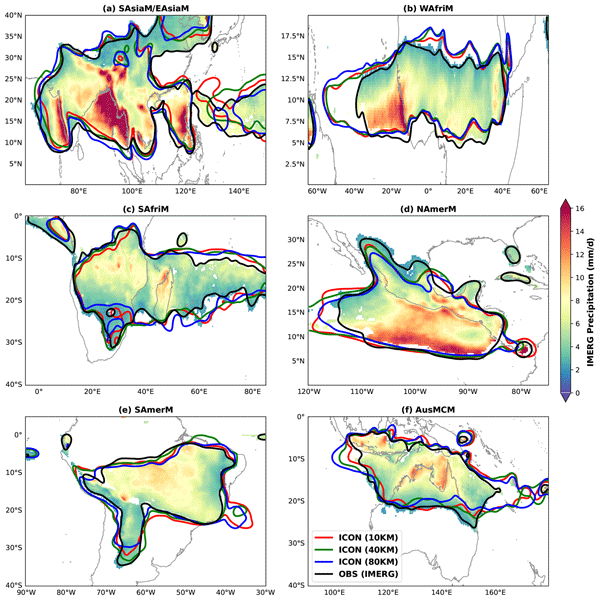
Abstract. The global monsoon system is a lifeline for two-thirds of the world’s population, as it is essential for tropical water security, food, and agriculture. However, its complex multiscale interactions challenge weather and climate models. This study investigates how horizontal grid spacing (80 km, 40 km and 10 km) in the ICOsahedral Non-hydrostatic (ICON) model affects both the mean state and the variability of Northern Hemisphere monsoons across diurnal, intraseasonal, and interannual timescales. The simulations were conducted with a refactored ICON model using a Python-based dynamical core optimized for Graphics Processing Units (GPUs). All ICON simulations show substantial skill in capturing the global monsoon system domain, its onset, and its mean precipitation with a pattern correlation of > 0.7 and RMSE < 3 mm/day. For the key Northern Hemisphere regional monsoons, South Asia (SAsiaM), West Africa (WAfriM) and North America (NAmerM), ICON achieves an accuracy > 80 % in capturing the observed monsoon domain. Crucially, the impact of grid spacing is strongly region-dependent and non-systematic. The finer grid spacing induces higher mean precipitation biases over continental SAsiaM, and WAfriM. Some of these biases are related to the intensity and location of moist monsoonal low-level jets, as well as their sensitivity to grid spacing. We further find that finer grid spacing overestimates monsoon precipitation variability at interannual and intraseasonal (high and low-frequency) scales, including intense precipitation frequency (> 10 mm/day), compared to observational references. Sensitivity tests confirm this variance amplification is a genuine model response, though it primarily reflects an overproduction of intense rainfall, while organized moderate variability may be underrepresented. This amplification stems primarily from enhanced intense grid-scale precipitation, while convective precipitation exhibits limited sensitivity to grid spacing. Process-oriented investigation show that the increased variance in the 10 km simulation over the core monsoon regions at high-frequency intraseasonal scales is linked to more intense low-pressure synoptic systems over SAsiaM and intense African easterly wave activity over WAfriM. Over NAmerM, biases are smaller and show minimal sensitivity to model grid spacing. All simulations have an excellent representation of the diurnal precipitation peak timing, with the 10 km simulation marginally performing better over continents. Our results demonstrate that increased grid spacing alone does not uniformly improve monsoon simulations. Instead, some features, such as the precipitation diurnal cycle, are improved while existing biases in mean precipitation and variability are enhanced. This underscores the role of region-dependent sensitivity of grid spacing governing monsoon dynamics.
-
Notice on discussion status
The requested preprint has a corresponding peer-reviewed final revised paper. You are encouraged to refer to the final revised version.
-
Preprint
(108044 KB)
-
The requested preprint has a corresponding peer-reviewed final revised paper. You are encouraged to refer to the final revised version.
- Preprint
(108044 KB) - Metadata XML
- BibTeX
- EndNote
- Final revised paper


Journal article(s) based on this preprint
Interactive discussion
Status: closed
-
RC1: 'Comment on egusphere-2026-782', Anonymous Referee #1, 03 Mar 2026
-
AC1: 'Reply on RC1', Praveen Kumar Pothapakula, 25 Apr 2026
The comment was uploaded in the form of a supplement: https://egusphere.copernicus.org/preprints/2026/egusphere-2026-782/egusphere-2026-782-AC1-supplement.pdf
-
AC1: 'Reply on RC1', Praveen Kumar Pothapakula, 25 Apr 2026
-
RC2: 'Comment on egusphere-2026-782', Anonymous Referee #2, 06 Mar 2026
This contribution by Pothapakula et al. is a comprehensive evaluation study of ICON in a new version. It focuses on important aspects of the global monsoon system and concludes, that grid-spacing still influences the climate modeling performance. It is an interesting and important contribution, which I find well worth publication after revisions.
Still, I have a few comments and questions as detailed below.
The abstract is quite long and it is difficult to identify the main findings. Is it a goal to evaluate the new ICON core (line 7, but not mentioned below) or just the grid-spacing dependence of global/regional monsoon representation? What is “organized moderate variability”? What is an “excellent representation”? Line 23: increased → decreased. Line 25: What “underscores” the region-dependent sensitivity?
Has the simple linear interpolation (line 120) of monthly SST data to daily data some impact on monsoon onset/offset? In the pre-monsoon phase this should slightly underestimate SST warming and this slightly increases the land-sea contrast. Perhaps this can explain a few days of monsoon onset/offset bias?
Significance: (line 330) “indicates that 40 km performs best”. This statement is based on a relativly small number of simulation years and the distributions shown in the violin plots (Fig. 4) are well overlapping. I assume here there is no conclusion about best grid-spacing possible.
Why do you exclude the southern hemispheric monsoons from the evaluation, but show them in the Figs.?
l632: I guess, here decreased not increased grid-spacing is meant? Does this worsening performance of precipitation simulation over ocean imply that the there is a tuning issues in the model? Later (l647) you state that the precipitation contribution by the convection parameterization independent of the chosen grid-spacing. The parameterization should contribute less at 10 km grid-spacing.
Minor issues:
l133: Tergen → Tegen
l165: “V” is horizontal (add) wind vector (and thus should be bold). Also here and in the following “kg/m-s” is uncommon. Correct would be kg/(ms) but we are used to kg/ms too. At line 441,2 you use inconsistently but correctly kg m-1 s-1.
l289: “skill scores” – usually a reference prediction/simulation (like a random, persistent ... simulation) is used in the definition of skill scores. In this sense you do not consider skill scores, just scores.
l325: “common bias” – references?
l389: dipole → dipole bias?
l656: “… variability …. show_s”
l837: incomplete reference
Citation: https://doi.org/10.5194/egusphere-2026-782-RC2 -
AC2: 'Reply on RC2', Praveen Kumar Pothapakula, 25 Apr 2026
The comment was uploaded in the form of a supplement: https://egusphere.copernicus.org/preprints/2026/egusphere-2026-782/egusphere-2026-782-AC2-supplement.pdf
-
AC2: 'Reply on RC2', Praveen Kumar Pothapakula, 25 Apr 2026


Interactive discussion
Status: closed
-
RC1: 'Comment on egusphere-2026-782', Anonymous Referee #1, 03 Mar 2026
-
AC1: 'Reply on RC1', Praveen Kumar Pothapakula, 25 Apr 2026
The comment was uploaded in the form of a supplement: https://egusphere.copernicus.org/preprints/2026/egusphere-2026-782/egusphere-2026-782-AC1-supplement.pdf
-
AC1: 'Reply on RC1', Praveen Kumar Pothapakula, 25 Apr 2026
-
RC2: 'Comment on egusphere-2026-782', Anonymous Referee #2, 06 Mar 2026
This contribution by Pothapakula et al. is a comprehensive evaluation study of ICON in a new version. It focuses on important aspects of the global monsoon system and concludes, that grid-spacing still influences the climate modeling performance. It is an interesting and important contribution, which I find well worth publication after revisions.
Still, I have a few comments and questions as detailed below.
The abstract is quite long and it is difficult to identify the main findings. Is it a goal to evaluate the new ICON core (line 7, but not mentioned below) or just the grid-spacing dependence of global/regional monsoon representation? What is “organized moderate variability”? What is an “excellent representation”? Line 23: increased → decreased. Line 25: What “underscores” the region-dependent sensitivity?
Has the simple linear interpolation (line 120) of monthly SST data to daily data some impact on monsoon onset/offset? In the pre-monsoon phase this should slightly underestimate SST warming and this slightly increases the land-sea contrast. Perhaps this can explain a few days of monsoon onset/offset bias?
Significance: (line 330) “indicates that 40 km performs best”. This statement is based on a relativly small number of simulation years and the distributions shown in the violin plots (Fig. 4) are well overlapping. I assume here there is no conclusion about best grid-spacing possible.
Why do you exclude the southern hemispheric monsoons from the evaluation, but show them in the Figs.?
l632: I guess, here decreased not increased grid-spacing is meant? Does this worsening performance of precipitation simulation over ocean imply that the there is a tuning issues in the model? Later (l647) you state that the precipitation contribution by the convection parameterization independent of the chosen grid-spacing. The parameterization should contribute less at 10 km grid-spacing.
Minor issues:
l133: Tergen → Tegen
l165: “V” is horizontal (add) wind vector (and thus should be bold). Also here and in the following “kg/m-s” is uncommon. Correct would be kg/(ms) but we are used to kg/ms too. At line 441,2 you use inconsistently but correctly kg m-1 s-1.
l289: “skill scores” – usually a reference prediction/simulation (like a random, persistent ... simulation) is used in the definition of skill scores. In this sense you do not consider skill scores, just scores.
l325: “common bias” – references?
l389: dipole → dipole bias?
l656: “… variability …. show_s”
l837: incomplete reference
Citation: https://doi.org/10.5194/egusphere-2026-782-RC2 -
AC2: 'Reply on RC2', Praveen Kumar Pothapakula, 25 Apr 2026
The comment was uploaded in the form of a supplement: https://egusphere.copernicus.org/preprints/2026/egusphere-2026-782/egusphere-2026-782-AC2-supplement.pdf
-
AC2: 'Reply on RC2', Praveen Kumar Pothapakula, 25 Apr 2026
Peer review completion


Journal article(s) based on this preprint
Viewed
| HTML | XML | Total | BibTeX | EndNote | |
|---|---|---|---|---|---|
| 1,160 | 551 | 100 | 1,811 | 165 | 252 |
- HTML: 1,160
- PDF: 551
- XML: 100
- Total: 1,811
- BibTeX: 165
- EndNote: 252
Viewed (geographical distribution)
| Country | # | Views | % |
|---|
| Total: | 0 |
| HTML: | 0 |
| PDF: | 0 |
| XML: | 0 |
- 1
Praveen Kumar Pothapakula
Andreas F. Prein
Anusha Sunkisala
Anurag Dipankar
The requested preprint has a corresponding peer-reviewed final revised paper. You are encouraged to refer to the final revised version.
- Preprint
(108044 KB) - Metadata XML
See attached