
the Creative Commons Attribution 4.0 License.
the Creative Commons Attribution 4.0 License.
 | 25 Mar 2026
Using high frequency observations of δ13C-CH4 and δ2H-CH4 and uncertain regional isotopic signatures to estimate sources of UK methane emissions
Abstract. Methane is emitted from a range of anthropogenic and natural sources, and identifying these sources is important for emissions monitoring and mitigation. Different sources emit methane with different isotopic signatures; however these signatures are often uncertain or vary spatially or temporally. Top-down inverse models can be used with measurement of methane mole fractions to estimate total emissions of methane from all sources. We present an inverse model for estimating regional fossil-fuel (FF) and non-fossil-fuel (non-FF) emissions concurrently, using isotope ratio observations and uncertain isotopic signatures. This method is highly adaptable and could be used to estimate emissions from any number of sources. Synthetic data tests with this method show that this model can accurately estimate FF and non-FF methane emissions across the UK, when isotopic source signatures are fixed at known values. However, emissions estimation becomes less accurate when source signature uncertainties rise above approximately 50 % of their likely ranges. In a real-world test of this method, we estimated south-east UK FF and non-FF emissions using high-frequency δ13C-CH4 and δ2H-CH4 observations from one UK site, with source signature uncertainties reflecting our current understanding of these values. Results show a limited impact on emissions uncertainty or magnitude, when compared with output from an inversion using only mole fraction observations. This suggests that both the ongoing expansion of isotope ratio observations and an improved understanding of isotopic signatures is required for this method to be used to estimate UK FF and non-FF methane emissions, with reduced uncertainty compared to traditional inverse methods.
-
Notice on discussion status
The requested preprint has a corresponding peer-reviewed final revised paper. You are encouraged to refer to the final revised version.
-
Preprint
(11609 KB)
-
The requested preprint has a corresponding peer-reviewed final revised paper. You are encouraged to refer to the final revised version.
- Preprint
(11609 KB) - Metadata XML
- BibTeX
- EndNote
- Final revised paper


Journal article(s) based on this preprint
Interactive discussion
Status: closed
- RC1: 'Comment on egusphere-2026-779', Anonymous Referee #1, 03 Apr 2026
-
RC2: 'Comment on egusphere-2026-779', Anonymous Referee #2, 07 Apr 2026
The comment was uploaded in the form of a supplement: https://egusphere.copernicus.org/preprints/2026/egusphere-2026-779/egusphere-2026-779-RC2-supplement.pdf
-
AC1: 'Comment on egusphere-2026-779', Alice Ramsden, 11 Jun 2026
Replies to Referee Comments on egusphere-2026-779
In the following response, referee comments are in bold, followed by our replies in standard font and changes to the manuscript in italics.
Responses to the annotated draft (which was provided as an attachment to RC1) are included as an attachment to this comment.
Reply to RC1
The paper by Ramsden et al. explores how methane isotope observations can refine estimates of methane emission sources in the UK. By providing additional constraints, these observations show strong potential to distinguish between emissions from different categories. However, further research across multiple scales is needed to better understand their impact on top-down estimates and to establish best practices for their application.
This study contributes to ongoing efforts to better leverage methane isotope data at different scales. Given the limited number of studies assessing the added value of isotope data at the national scale, this work represents an important contribution. The paper presents a new inversion system, coupled with the Lagrangian transport model NAME, that can assimilate δ13-CH₄ and δD-CH₄ observations while optimizing the associated isotopic signatures. Expanding the still limited number of systems capable of performing such inversions represents an important achievement.
Thank you for taking to the time to review the paper in such detail and for your valuable suggestions on how to improve the draft. We have responded to each of your comments below and have attached a copy of the annotated draft, with responses to your annotations.
General comments
The paper demonstrates a significant effort to clearly describe and thoroughly test the system, both in synthetic experiments and real-world applications. The methodology is sound and well structured. In its current form, the paper is suitable for publication (after addressing a significant number of minor comments) as it presents a robust system. However, the scientific contribution is somewhat limited, as it is already well established that accounting for uncertainties in source signatures can strongly influence posterior emission estimates and must be properly quantified to ensure robust results. Including a few additional tests could substantially enhance the impact of this work. Since the transport footprints have already been computed, the computational cost of such tests is likely to be relatively low.
For instance, I do not understand why δ¹³C alone and the combined δ¹³C + δD configuration were not tested separately in the real-world application, given that this distinction was explored in the synthetic experiments. Assessing these configurations would help clarify the added value of δD in this context. Additionally, you could try to extend the isotope observation network in the synthetic data case to estimate the maximum value of methane isotopes in the UK. The discussion also mentions the future use of spatial and temporal correlations, it would have been valuable to include at least one test incorporating spatial correlations. These are critical for both the synthetic experiments and the real-world application, and allowing all source signatures to be optimized independently may not be realistic. It is unclear why this aspect is deferred to future work rather than being addressed in the present study.
We have now included additional ‘real data’ tests: with δ¹³C alone: with both type of isotope ratio observation and with lower uncertainty on the isotope signatures. The case study tests now match the synthetic data tests more closely, which allows for clearer comparison between the two sets of tests, thank you for this suggestion.
However, we have chosen not to run the synthetic tests with an expanded network of isotope observations, as we feel like these tests are already presenting a some-what unrealistic idealised scenario (with no background concentrations, lower uncertainty and no gaps in the observation timeseries). Using only two sites keeps these tests more comparable to the real world, as we currently only have <5 years of isotope observations from one site in the UK, with a second site only very recently established.
Unfortunately, to include spatial and temporal correlations in the emissions and isotope signature uncertainties would require significant additional code in the model which, due to time constraints, is not possible. We aim to address this shortcoming in future projects which will build on these first tests of the method.
In addition, I believe the paper would benefit from an overall improvement in the presentation of the paper. The system should be presented more carefully. The different tests should be clearly named and properly introduced, ideally in a dedicated table that readers can refer to throughout the manuscript. Figure readability could also be improved: subplot titles and axis labels should be larger and more concise (use test names), and the overall font sizes appear too small. There are also several typos to correct and sentences to clarify/correct. More specific comments on this topic are included in the attached document.
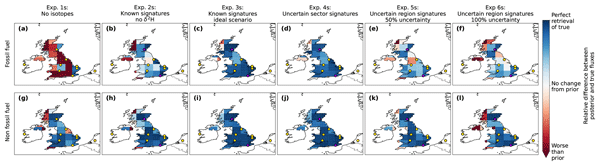
We have numbered each experiment in the text and summarised all experiments in two tables. These tables more clearly show how each experiment differs, and how the synthetic and real data experiments relate to each other.
Where possible, we have simplified axis and colour bar labels and increased font size in all the figures, to improve readability.
I would like to emphasize that, once the presentation is improved and the other minor comments (see the attached document) are addressed, I would be inclined to accept it for publication. However, I believe the manuscript could be significantly strengthened (without substantial additional effort if I am not mistaken) by including a few additional tests.
See the other comments in the attached document.
Thank you for your detailed comments in the annotated copy of the paper, and for considering the text so carefully. These comments were all very helpful in improving the draft, particularly your suggestions for additional or improved statistical analysis of the results. We have responded to each of your comments in the annotated draft.
Reply to RC2
Comments on “Using high frequency observations of δ13C-CH4 and δ2H-CH4 and uncertain regional isotopic signatures to estimate sources of UK methane emissions”
This study presents an inverse modelling framework that incorporates high-frequency observations of δ13C-CH4 and δ2H-CH4, together with uncertain regional isotopic signatures, to estimate fossil fuel (FF) and non-fossil fuel (non-FF) methane emissions over the UK. The authors evaluate the method using synthetic experiments and apply it to real observations, exploring the role of isotopic information in constraining sectoral emissions.
The topic is timely and relevant, particularly given the increasing interest in improving source attribution in methane emission inversions. The integration of dual-isotope observations into a Bayesian inversion framework is potentially valuable. However, the current manuscript lacks sufficient clarity in its motivation, methodological justification, and interpretation of results. In particular, the added value of isotope information is not convincingly demonstrated, and several methodological assumptions and limitations are not adequately discussed.
Therefore, the paper deserves further work before publication. Major revisions are required to make it a solid and valuable contribution to the literature. I request that the authors consider the following points as they revise this manuscript.
Thank you for taking the time to provide your review of the paper draft and for your overview of the updates required to improve the presentation of the methodological justification, results and conclusions. We have responded to each of your comments below and describe the changes we have made; these include revisions of how the method and experiments are presented, and clearer presentation of the study’s conclusions.
Major comments:
- The Introduction (Section 1) is difficult to follow and does not clearly establish why isotope observations are needed in methane inversion. The current structure mixes background information, previous studies, and methodological descriptions without a clear logical progression.
The manuscript does not clearly answer: What specific limitation in conventional (concentration-based) inversions is being addressed by isotope data?
We have added further information to the introduction, to answer this question. This includes more detail on why we are trying to use methane isotope observations to estimate sector-level emissions in a method independent from inventory and other ‘bottom-up’ sources of information. We also added more information on why source attribution using conventional (concentration-based) inversions is complicated by methane’s range of point and diffuse sources, some with overlapping isotopic source signatures.
The discussion of previous isotope-based studies lacks synthesis and does not clearly position this work relative to existing literature.
The end of section 1.3 (Methods using methane isotope ratio observations for source attribution) and section 1.4 (Paper overview) provide a summary of the discussed literature that uses methane isotope observations, followed by comments about how this method builds on those previous results.
The use of Section 1.1 is unnecessary given that no further subsections exist; this affects readability and structure.
We have added more subsections throughout the paper, to improve readability.
- A key conclusion of the manuscript is that incorporating isotope observations leads to only limited changes in emission magnitude and uncertainty compared to methane-only inversions. However, this important result is not critically discussed.
Does this imply that isotope information provides limited constraint under current observational conditions? Is the limited impact due to: insufficient observational coverage (e.g., single site), large uncertainties in isotopic signatures, or model structural limitations?
At present, the manuscript reports this result but does not provide a clear interpretation of its implications
We have updated section 4 (Discussion) to include a clearer summary of the main conclusions from both the synthetic data and real data case studies. This includes a comparison between the two sets of tests and discusses why the synthetic data tests were more successful that the real data study. We find that the limited impact of the isotope observations is likely caused by all three points you mention, and in the updated discussion we address each of these points.
We also present options for future developments of this method that would addresses the shortcomings of this version of the model.
Specific comments:
Line 5: The term “uncertain isotope signature” is unclear. Please clarify whether this refers to isotopic signatures with associated uncertainties, or a specific methodological treatment. A clear definition is needed.
We have updated this line for clarity, but a detailed description is not possible in the abstract, where word count is limited.
“… and uncertain isotope signature” changed to “and considering uncertainty in the isotopic signatures”
Line 10: The statement “limited impact on emissions uncertainty or magnitude” is ambiguous. Does this imply that isotope observations provide little additional constraint compared to methane-only inversions? Please clarify.
We are unable to add much more detail here due to the limited word count in the abstract, but the following line in the abstract provides some more detail:
This suggests that both the ongoing expansion of isotope ratio observations and an improved understanding of isotopic signatures is required for this method to be used to estimate UK FF and non-FF methane emissions, with reduced uncertainty compared to traditional inverse methods.
Line 20: For clarity, move (of approximately 10 years) immediately after “short tropospheric lifetime”.
We have updated this sentence to read:
“… because of its short tropospheric lifetime (approximately 10 years) compared to other greenhouse gases…”
Line 30: Please provide references to support the statement regarding current methane trends not aligning with low-emission SSP scenarios.
Reference added for this statement.
Line 35: The argument that accurate quantification is difficult due to multiple sources is not well developed. The authors should explicitly discuss: source heterogeneity, data limitations, and uncertainties in inventories and observations.
We have added additional information to explain this point, by adding to this paragraph and to the next section:
“Often different sources are co-located, for example waste and energy point sources are often located near populated areas and agriculture and natural sources are both distributed over wider areas away from populated regions. This therefore limits the use of only the spatial separation between sources as a method for informing the attribution of methane emissions to their source.”
“Sector-level emission estimation is required for detailed comparison between inventory and inversion emission estimates; secondary observations, which inform the inversion about the source of emission, can be used to estimate sector-level emissions whilst maintaining independence from any inventory or bottom-up models.”
Lines 70–75: Additional references are required to support the statements made in this section.
We have added more references to this paragraph.
Line 75: The causal relationship is unclear. The availability of low-frequency isotope observations does not directly explain their use in global-scale inversions. Please clarify the logic.
We have adjusted this sentence to clarify the use of long-term low-frequency measurements:
“Due to the availability of long term, low frequency (weekly or monthly) isotope ratios observations, these observations have most commonly been used in the top-down modelling of methane emissions on a global scale, to attribute long term trends in emissions to a source sector…”
Line 85: The term “new-resolution” is vague. Please specify whether this refers to temporal or spatial resolution, and quantify it.
The term “new-resolution” is not used in the text, only “new high-resolution”. We have updated this sentence to read “new high-frequency”, for clarity.
Line 90: Please clarify whether isotope-based inversions systematically produce higher emissions than inventories, or if this refers to specific studies.
This line refers to one study of emissions from London in the UK, which we believe is clearly expressed in the text. We have not stated any conclusions about isotope-based inversions systematically producing higher emissions than inventories, and this reference is used to show how isotope observations can be used to attribute mismatches between inversion and inventory estimates to their source.
Lines 95–110: The logical flow is unclear. The discussion shifts between source attribution and isotope applications without clearly linking them. Please reorganize for clarity.
We have reordered these paragraphs, to improve flow of the text.
Line 125: Please specify the atmospheric transport model used.
In this section we do not include any information about specific transport models, observations or priors, because we are introducing the method in general terms. Section 2.3 (Model inputs) introduces the transport model in more detail. We have added a line at the start of Section 2, clarifying this:
“The method is first introduced in general terms, then Section 2.3 covers the specific model inputs and settings used for the tests of this method presented in this paper.”
Line 235: The filtering strategy needs further justification. In particular, why are data points with strong local emission influence removed? These may contain useful source information.
We have updated the text to show that filtering is used to remove times when air is not well mixed, when we assume the transport model performs poorly:
“The four-hourly averaged methane observations were filtered to remove times when the air is not well mixed, when we assume that the transport model performs less accurately. Observations were removed if the planetary boundary layer height (as estimated by the Numerical Weather Predication model used to drive the transport model) was within 100 m of the observation height at the observation time. To remove observations with a strong influence from local sources, which can be a sign of poorly-mixed air, data points were also removed if over 15\% of the area-integrated sensitivity at the site was from the 25 grid cells surrounding the site (at the native resolution of the transport footprints).”
Line 245: The reported isotope uncertainties (e.g., 0.25‰ and 1.82‰) appear small. Please clarify whether these are realistic and how they are derived.
We have added a line here noting that the isotope uncertainties are calculated using the same method as the methane mole fraction uncertainties. These uncertainties are of a similar size (relative to the magnitude of the observations) to those for the methane mole fractions. The papers referenced for these observations give more detail on these uncertainties.
Line 250: Please define “pollution event” explicitly.
This definition is included on line 276 of the revised manuscript.
Tables: Table captions should be placed above the tables. Please revise accordingly.
Thank you for spotting this, we have corrected the placement of all table captions.
Figure 7: The colorbar should be differentiated between absolute emissions and emission differences for clarity.
Along with other updates to this figure, we have included separate colour schemes for each colour bar.
Line 585: The term “novel inverse modeling” is not sufficiently justified. Please clearly specify what is novel compared to existing inversion frameworks.
The sentences following this line explain how this method is novel compared to previous works:
The inversion uses the relationship between observations of its primary gas, in this case methane, to secondary isotope ratio observations, via regional isotopic signatures. By including both the uncertainties and spatial and temporal differences in isotopic source signatures, this work builds on previous isotope inversion methods with the aim of reducing the uncertainty in the posterior flux estimates of the FF and non-FF sectors.
Peer review completion


Interactive discussion
Status: closed
-
RC1: 'Comment on egusphere-2026-779', Anonymous Referee #1, 03 Apr 2026
The paper by Ramsden et al. explores how methane isotope observations can refine estimates of methane emission sources in the UK. By providing additional constraints, these observations show strong potential to distinguish between emissions from different categories. However, further research across multiple scales is needed to better understand their impact on top-down estimates and to establish best practices for their application.
This study contributes to ongoing efforts to better leverage methane isotope data at different scales. Given the limited number of studies assessing the added value of isotope data at the national scale, this work represents an important contribution. The paper presents a new inversion system, coupled with the Lagrangian transport model NAME, that can assimilate δ13-CH₄ and δD-CH₄ observations while optimizing the associated isotopic signatures. Expanding the still limited number of systems capable of performing such inversions represents an important achievement.
General comments
The paper demonstrates a significant effort to clearly describe and thoroughly test the system, both in synthetic experiments and real-world applications. The methodology is sound and well structured. In its current form, the paper is suitable for publication (after addressing a significant number of minor comments) as it presents a robust system. However, the scientific contribution is somewhat limited, as it is already well established that accounting for uncertainties in source signatures can strongly influence posterior emission estimates and must be properly quantified to ensure robust results. Including a few additional tests could substantially enhance the impact of this work. Since the transport footprints have already been computed, the computational cost of such tests is likely to be relatively low.
For instance, I do not understand why δ¹³C alone and the combined δ¹³C + δD configuration were not tested separately in the real-world application, given that this distinction was explored in the synthetic experiments. Assessing these configurations would help clarify the added value of δD in this context. Additionally, you could try to extend the isotope observation network in the synthetic data case to estimate the maximum value of methane isotopes in the UK. The discussion also mentions the future use of spatial and temporal correlations, it would have been valuable to include at least one test incorporating spatial correlations. These are critical for both the synthetic experiments and the real-world application, and allowing all source signatures to be optimized independently may not be realistic. It is unclear why this aspect is deferred to future work rather than being addressed in the present study.
In addition, I believe the paper would benefit from an overall improvement in the presentation of the paper. The system should be presented more carefully. The different tests should be clearly named and properly introduced, ideally in a dedicated table that readers can refer to throughout the manuscript. Figure readability could also be improved: subplot titles and axis labels should be larger and more concise (use test names), and the overall font sizes appear too small. There are also several typos to correct and sentences to clarify/correct. More specific comments on this topic are included in the attached document.
I would like to emphasize that, once the presentation is improved and the other minor comments (see the attached document) are addressed, I would be inclined to accept it for publication. However, I believe the manuscript could be significantly strengthened (without substantial additional effort if I am not mistaken) by including a few additional tests.
See the other comments in the attached document.
-
RC2: 'Comment on egusphere-2026-779', Anonymous Referee #2, 07 Apr 2026
The comment was uploaded in the form of a supplement: https://egusphere.copernicus.org/preprints/2026/egusphere-2026-779/egusphere-2026-779-RC2-supplement.pdf
-
AC1: 'Comment on egusphere-2026-779', Alice Ramsden, 11 Jun 2026
Replies to Referee Comments on egusphere-2026-779
In the following response, referee comments are in bold, followed by our replies in standard font and changes to the manuscript in italics.
Responses to the annotated draft (which was provided as an attachment to RC1) are included as an attachment to this comment.
Reply to RC1
The paper by Ramsden et al. explores how methane isotope observations can refine estimates of methane emission sources in the UK. By providing additional constraints, these observations show strong potential to distinguish between emissions from different categories. However, further research across multiple scales is needed to better understand their impact on top-down estimates and to establish best practices for their application.
This study contributes to ongoing efforts to better leverage methane isotope data at different scales. Given the limited number of studies assessing the added value of isotope data at the national scale, this work represents an important contribution. The paper presents a new inversion system, coupled with the Lagrangian transport model NAME, that can assimilate δ13-CH₄ and δD-CH₄ observations while optimizing the associated isotopic signatures. Expanding the still limited number of systems capable of performing such inversions represents an important achievement.
Thank you for taking to the time to review the paper in such detail and for your valuable suggestions on how to improve the draft. We have responded to each of your comments below and have attached a copy of the annotated draft, with responses to your annotations.
General comments
The paper demonstrates a significant effort to clearly describe and thoroughly test the system, both in synthetic experiments and real-world applications. The methodology is sound and well structured. In its current form, the paper is suitable for publication (after addressing a significant number of minor comments) as it presents a robust system. However, the scientific contribution is somewhat limited, as it is already well established that accounting for uncertainties in source signatures can strongly influence posterior emission estimates and must be properly quantified to ensure robust results. Including a few additional tests could substantially enhance the impact of this work. Since the transport footprints have already been computed, the computational cost of such tests is likely to be relatively low.
For instance, I do not understand why δ¹³C alone and the combined δ¹³C + δD configuration were not tested separately in the real-world application, given that this distinction was explored in the synthetic experiments. Assessing these configurations would help clarify the added value of δD in this context. Additionally, you could try to extend the isotope observation network in the synthetic data case to estimate the maximum value of methane isotopes in the UK. The discussion also mentions the future use of spatial and temporal correlations, it would have been valuable to include at least one test incorporating spatial correlations. These are critical for both the synthetic experiments and the real-world application, and allowing all source signatures to be optimized independently may not be realistic. It is unclear why this aspect is deferred to future work rather than being addressed in the present study.
We have now included additional ‘real data’ tests: with δ¹³C alone: with both type of isotope ratio observation and with lower uncertainty on the isotope signatures. The case study tests now match the synthetic data tests more closely, which allows for clearer comparison between the two sets of tests, thank you for this suggestion.
However, we have chosen not to run the synthetic tests with an expanded network of isotope observations, as we feel like these tests are already presenting a some-what unrealistic idealised scenario (with no background concentrations, lower uncertainty and no gaps in the observation timeseries). Using only two sites keeps these tests more comparable to the real world, as we currently only have <5 years of isotope observations from one site in the UK, with a second site only very recently established.
Unfortunately, to include spatial and temporal correlations in the emissions and isotope signature uncertainties would require significant additional code in the model which, due to time constraints, is not possible. We aim to address this shortcoming in future projects which will build on these first tests of the method.
In addition, I believe the paper would benefit from an overall improvement in the presentation of the paper. The system should be presented more carefully. The different tests should be clearly named and properly introduced, ideally in a dedicated table that readers can refer to throughout the manuscript. Figure readability could also be improved: subplot titles and axis labels should be larger and more concise (use test names), and the overall font sizes appear too small. There are also several typos to correct and sentences to clarify/correct. More specific comments on this topic are included in the attached document.
We have numbered each experiment in the text and summarised all experiments in two tables. These tables more clearly show how each experiment differs, and how the synthetic and real data experiments relate to each other.
Where possible, we have simplified axis and colour bar labels and increased font size in all the figures, to improve readability.
I would like to emphasize that, once the presentation is improved and the other minor comments (see the attached document) are addressed, I would be inclined to accept it for publication. However, I believe the manuscript could be significantly strengthened (without substantial additional effort if I am not mistaken) by including a few additional tests.
See the other comments in the attached document.
Thank you for your detailed comments in the annotated copy of the paper, and for considering the text so carefully. These comments were all very helpful in improving the draft, particularly your suggestions for additional or improved statistical analysis of the results. We have responded to each of your comments in the annotated draft.
Reply to RC2
Comments on “Using high frequency observations of δ13C-CH4 and δ2H-CH4 and uncertain regional isotopic signatures to estimate sources of UK methane emissions”
This study presents an inverse modelling framework that incorporates high-frequency observations of δ13C-CH4 and δ2H-CH4, together with uncertain regional isotopic signatures, to estimate fossil fuel (FF) and non-fossil fuel (non-FF) methane emissions over the UK. The authors evaluate the method using synthetic experiments and apply it to real observations, exploring the role of isotopic information in constraining sectoral emissions.
The topic is timely and relevant, particularly given the increasing interest in improving source attribution in methane emission inversions. The integration of dual-isotope observations into a Bayesian inversion framework is potentially valuable. However, the current manuscript lacks sufficient clarity in its motivation, methodological justification, and interpretation of results. In particular, the added value of isotope information is not convincingly demonstrated, and several methodological assumptions and limitations are not adequately discussed.
Therefore, the paper deserves further work before publication. Major revisions are required to make it a solid and valuable contribution to the literature. I request that the authors consider the following points as they revise this manuscript.
Thank you for taking the time to provide your review of the paper draft and for your overview of the updates required to improve the presentation of the methodological justification, results and conclusions. We have responded to each of your comments below and describe the changes we have made; these include revisions of how the method and experiments are presented, and clearer presentation of the study’s conclusions.
Major comments:
- The Introduction (Section 1) is difficult to follow and does not clearly establish why isotope observations are needed in methane inversion. The current structure mixes background information, previous studies, and methodological descriptions without a clear logical progression.
The manuscript does not clearly answer: What specific limitation in conventional (concentration-based) inversions is being addressed by isotope data?
We have added further information to the introduction, to answer this question. This includes more detail on why we are trying to use methane isotope observations to estimate sector-level emissions in a method independent from inventory and other ‘bottom-up’ sources of information. We also added more information on why source attribution using conventional (concentration-based) inversions is complicated by methane’s range of point and diffuse sources, some with overlapping isotopic source signatures.
The discussion of previous isotope-based studies lacks synthesis and does not clearly position this work relative to existing literature.
The end of section 1.3 (Methods using methane isotope ratio observations for source attribution) and section 1.4 (Paper overview) provide a summary of the discussed literature that uses methane isotope observations, followed by comments about how this method builds on those previous results.
The use of Section 1.1 is unnecessary given that no further subsections exist; this affects readability and structure.
We have added more subsections throughout the paper, to improve readability.
- A key conclusion of the manuscript is that incorporating isotope observations leads to only limited changes in emission magnitude and uncertainty compared to methane-only inversions. However, this important result is not critically discussed.
Does this imply that isotope information provides limited constraint under current observational conditions? Is the limited impact due to: insufficient observational coverage (e.g., single site), large uncertainties in isotopic signatures, or model structural limitations?
At present, the manuscript reports this result but does not provide a clear interpretation of its implications
We have updated section 4 (Discussion) to include a clearer summary of the main conclusions from both the synthetic data and real data case studies. This includes a comparison between the two sets of tests and discusses why the synthetic data tests were more successful that the real data study. We find that the limited impact of the isotope observations is likely caused by all three points you mention, and in the updated discussion we address each of these points.
We also present options for future developments of this method that would addresses the shortcomings of this version of the model.
Specific comments:
Line 5: The term “uncertain isotope signature” is unclear. Please clarify whether this refers to isotopic signatures with associated uncertainties, or a specific methodological treatment. A clear definition is needed.
We have updated this line for clarity, but a detailed description is not possible in the abstract, where word count is limited.
“… and uncertain isotope signature” changed to “and considering uncertainty in the isotopic signatures”
Line 10: The statement “limited impact on emissions uncertainty or magnitude” is ambiguous. Does this imply that isotope observations provide little additional constraint compared to methane-only inversions? Please clarify.
We are unable to add much more detail here due to the limited word count in the abstract, but the following line in the abstract provides some more detail:
This suggests that both the ongoing expansion of isotope ratio observations and an improved understanding of isotopic signatures is required for this method to be used to estimate UK FF and non-FF methane emissions, with reduced uncertainty compared to traditional inverse methods.
Line 20: For clarity, move (of approximately 10 years) immediately after “short tropospheric lifetime”.
We have updated this sentence to read:
“… because of its short tropospheric lifetime (approximately 10 years) compared to other greenhouse gases…”
Line 30: Please provide references to support the statement regarding current methane trends not aligning with low-emission SSP scenarios.
Reference added for this statement.
Line 35: The argument that accurate quantification is difficult due to multiple sources is not well developed. The authors should explicitly discuss: source heterogeneity, data limitations, and uncertainties in inventories and observations.
We have added additional information to explain this point, by adding to this paragraph and to the next section:
“Often different sources are co-located, for example waste and energy point sources are often located near populated areas and agriculture and natural sources are both distributed over wider areas away from populated regions. This therefore limits the use of only the spatial separation between sources as a method for informing the attribution of methane emissions to their source.”
“Sector-level emission estimation is required for detailed comparison between inventory and inversion emission estimates; secondary observations, which inform the inversion about the source of emission, can be used to estimate sector-level emissions whilst maintaining independence from any inventory or bottom-up models.”
Lines 70–75: Additional references are required to support the statements made in this section.
We have added more references to this paragraph.
Line 75: The causal relationship is unclear. The availability of low-frequency isotope observations does not directly explain their use in global-scale inversions. Please clarify the logic.
We have adjusted this sentence to clarify the use of long-term low-frequency measurements:
“Due to the availability of long term, low frequency (weekly or monthly) isotope ratios observations, these observations have most commonly been used in the top-down modelling of methane emissions on a global scale, to attribute long term trends in emissions to a source sector…”
Line 85: The term “new-resolution” is vague. Please specify whether this refers to temporal or spatial resolution, and quantify it.
The term “new-resolution” is not used in the text, only “new high-resolution”. We have updated this sentence to read “new high-frequency”, for clarity.
Line 90: Please clarify whether isotope-based inversions systematically produce higher emissions than inventories, or if this refers to specific studies.
This line refers to one study of emissions from London in the UK, which we believe is clearly expressed in the text. We have not stated any conclusions about isotope-based inversions systematically producing higher emissions than inventories, and this reference is used to show how isotope observations can be used to attribute mismatches between inversion and inventory estimates to their source.
Lines 95–110: The logical flow is unclear. The discussion shifts between source attribution and isotope applications without clearly linking them. Please reorganize for clarity.
We have reordered these paragraphs, to improve flow of the text.
Line 125: Please specify the atmospheric transport model used.
In this section we do not include any information about specific transport models, observations or priors, because we are introducing the method in general terms. Section 2.3 (Model inputs) introduces the transport model in more detail. We have added a line at the start of Section 2, clarifying this:
“The method is first introduced in general terms, then Section 2.3 covers the specific model inputs and settings used for the tests of this method presented in this paper.”
Line 235: The filtering strategy needs further justification. In particular, why are data points with strong local emission influence removed? These may contain useful source information.
We have updated the text to show that filtering is used to remove times when air is not well mixed, when we assume the transport model performs poorly:
“The four-hourly averaged methane observations were filtered to remove times when the air is not well mixed, when we assume that the transport model performs less accurately. Observations were removed if the planetary boundary layer height (as estimated by the Numerical Weather Predication model used to drive the transport model) was within 100 m of the observation height at the observation time. To remove observations with a strong influence from local sources, which can be a sign of poorly-mixed air, data points were also removed if over 15\% of the area-integrated sensitivity at the site was from the 25 grid cells surrounding the site (at the native resolution of the transport footprints).”
Line 245: The reported isotope uncertainties (e.g., 0.25‰ and 1.82‰) appear small. Please clarify whether these are realistic and how they are derived.
We have added a line here noting that the isotope uncertainties are calculated using the same method as the methane mole fraction uncertainties. These uncertainties are of a similar size (relative to the magnitude of the observations) to those for the methane mole fractions. The papers referenced for these observations give more detail on these uncertainties.
Line 250: Please define “pollution event” explicitly.
This definition is included on line 276 of the revised manuscript.
Tables: Table captions should be placed above the tables. Please revise accordingly.
Thank you for spotting this, we have corrected the placement of all table captions.
Figure 7: The colorbar should be differentiated between absolute emissions and emission differences for clarity.
Along with other updates to this figure, we have included separate colour schemes for each colour bar.
Line 585: The term “novel inverse modeling” is not sufficiently justified. Please clearly specify what is novel compared to existing inversion frameworks.
The sentences following this line explain how this method is novel compared to previous works:
The inversion uses the relationship between observations of its primary gas, in this case methane, to secondary isotope ratio observations, via regional isotopic signatures. By including both the uncertainties and spatial and temporal differences in isotopic source signatures, this work builds on previous isotope inversion methods with the aim of reducing the uncertainty in the posterior flux estimates of the FF and non-FF sectors.
Peer review completion
Journal article(s) based on this preprint
Data sets
Methane mole fraction data for Mace Head, Weybourne, Tacolneston, Bilsdale, Ridge Hill and Heathfield ICOS RI, F. Apadula et al. https://doi.org/10.18160/46ST-DEVK
Measurements of methane isotope ratio from HFD C. Rennick et al. https://hdl.handle.net/11676/MRHwmQFqm0O_Y39065JsIQLS
NOAA MHD flask measurements of δ13C-CH4 NOAA GML https://gml.noaa.gov/aftp/data/trace_gases/ch4c13/flask/surface/
Meteorological data used to drive the transport model from the UK Met Office operational Numerical Weather Prediction (NWP) Unified Model (UM) Met Office http://catalogue.ceda.ac.uk/uuid/78f23c539d304591b137cf986b69a525
EDGAR - Emissions Database for Global Atmospheric Research v8.0 M. Crippa et al. https://doi.org/10.2760/953322
Model code and software
multiple_gas_inverse_model v1.0 A. Ramsden https://doi.org/10.5281/zenodo.18496508
Viewed
| HTML | XML | Total | BibTeX | EndNote | |
|---|---|---|---|---|---|
| 795 | 406 | 77 | 1,278 | 80 | 109 |
- HTML: 795
- PDF: 406
- XML: 77
- Total: 1,278
- BibTeX: 80
- EndNote: 109
Viewed (geographical distribution)
| Country | # | Views | % |
|---|
| Total: | 0 |
| HTML: | 0 |
| PDF: | 0 |
| XML: | 0 |
- 1
Alice Emily Ramsden

Anita Ganesan
Matthew Rigby
Chris Rennick
Tim Arnold
Emmal Safi
Edward Chung
Dafina Kikaj
Cameron Yeo
Dave Lowry
Pete Levy
Simon O'Doherty
Kieran Stanley
Dickon Young
Damien Martin
Morgan Lopez
Michel Ramonet
Grant Forster
Arnoud Frumau
Alistair Manning
The requested preprint has a corresponding peer-reviewed final revised paper. You are encouraged to refer to the final revised version.
- Preprint
(11609 KB) - Metadata XML
The paper by Ramsden et al. explores how methane isotope observations can refine estimates of methane emission sources in the UK. By providing additional constraints, these observations show strong potential to distinguish between emissions from different categories. However, further research across multiple scales is needed to better understand their impact on top-down estimates and to establish best practices for their application.
This study contributes to ongoing efforts to better leverage methane isotope data at different scales. Given the limited number of studies assessing the added value of isotope data at the national scale, this work represents an important contribution. The paper presents a new inversion system, coupled with the Lagrangian transport model NAME, that can assimilate δ13-CH₄ and δD-CH₄ observations while optimizing the associated isotopic signatures. Expanding the still limited number of systems capable of performing such inversions represents an important achievement.
General comments
The paper demonstrates a significant effort to clearly describe and thoroughly test the system, both in synthetic experiments and real-world applications. The methodology is sound and well structured. In its current form, the paper is suitable for publication (after addressing a significant number of minor comments) as it presents a robust system. However, the scientific contribution is somewhat limited, as it is already well established that accounting for uncertainties in source signatures can strongly influence posterior emission estimates and must be properly quantified to ensure robust results. Including a few additional tests could substantially enhance the impact of this work. Since the transport footprints have already been computed, the computational cost of such tests is likely to be relatively low.
For instance, I do not understand why δ¹³C alone and the combined δ¹³C + δD configuration were not tested separately in the real-world application, given that this distinction was explored in the synthetic experiments. Assessing these configurations would help clarify the added value of δD in this context. Additionally, you could try to extend the isotope observation network in the synthetic data case to estimate the maximum value of methane isotopes in the UK. The discussion also mentions the future use of spatial and temporal correlations, it would have been valuable to include at least one test incorporating spatial correlations. These are critical for both the synthetic experiments and the real-world application, and allowing all source signatures to be optimized independently may not be realistic. It is unclear why this aspect is deferred to future work rather than being addressed in the present study.
In addition, I believe the paper would benefit from an overall improvement in the presentation of the paper. The system should be presented more carefully. The different tests should be clearly named and properly introduced, ideally in a dedicated table that readers can refer to throughout the manuscript. Figure readability could also be improved: subplot titles and axis labels should be larger and more concise (use test names), and the overall font sizes appear too small. There are also several typos to correct and sentences to clarify/correct. More specific comments on this topic are included in the attached document.
I would like to emphasize that, once the presentation is improved and the other minor comments (see the attached document) are addressed, I would be inclined to accept it for publication. However, I believe the manuscript could be significantly strengthened (without substantial additional effort if I am not mistaken) by including a few additional tests.
See the other comments in the attached document.