
the Creative Commons Attribution 4.0 License.
the Creative Commons Attribution 4.0 License.
 | 02 Mar 2026
Heterogeneity of tropical diversity and ecosystems: reefal meiofaunas in equatorial western and eastern African islands
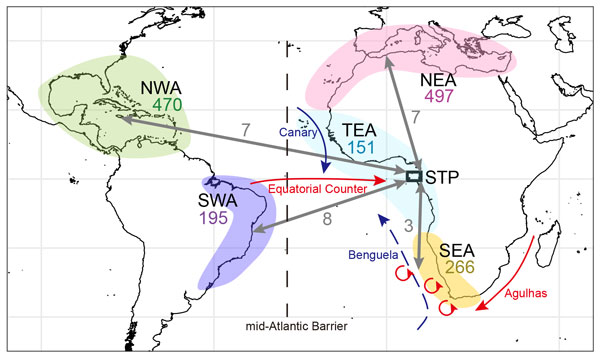
Abstract. From an ecological perspective, oceanic islands are unique marine environments that foster endemic species and also facilitate dispersal as steppingstones, yet they are often understudied and considered missing pieces in large-scale biological patterns. In this study, we focused on ostracods and foraminifera as two representative meiobenthic groups from the São Tomé-Príncipe (STP) Archipelago in tropical east Atlantic and the Zanzibar Archipelago in west Indian Ocean. We scrutinized the diversity distribution and faunal structure of these two island regions in similar climatic and oceanographic settings in different biogeographic provinces. We found that the STP is of much lower diversity compared with species-rich Zanzibar, which is likely explained by a combination of regional, historical, and habitat factors. Within each island region, the diversity and composition of benthic assemblages vary along a habitat topographic gradient, with a primary distinction between reefal and non-reefal habitats. Furthermore, across two regions with almost completely different faunas, the ecological composition of ostracod assemblages seems to follow strong and consistent controls of benthic community in terms of the relative cover of coral, algae, and bare sand bottoms. The STP ostracod fauna shows high level of endemism within and beyond tropical east Atlantic, indicating the mid-Atlantic Barrier and Benguela Current as effective biogeographic filters. Thus, our trans-regional investigation of the exotic oceanic islands contributes to important knowledge about the general patterns and determinants of such isolated, peripheral marine ecosystems.
-
Notice on discussion status
The requested preprint has a corresponding peer-reviewed final revised paper. You are encouraged to refer to the final revised version.
-
Preprint
(1771 KB)
-
Supplement
(772 KB)
-
The requested preprint has a corresponding peer-reviewed final revised paper. You are encouraged to refer to the final revised version.
- Preprint
(1771 KB) - Metadata XML
-
Supplement
(772 KB) - BibTeX
- EndNote
- Final revised paper


Journal article(s) based on this preprint
Interactive discussion
Status: closed
-
RC1: 'Comment on egusphere-2026-775', Olga Koukousioura, 06 Apr 2026
This manuscript presents a high-quality and methodologically rigorous comparative analysis of benthic meiofaunal diversity, specifically focusing on Ostracoda and Foraminifera across the São Tomé-Príncipe (STP) (eastern Atlantic) and Zanzibar archipelagos (western Indian Ocean). Using a combination of standardized sampling and advanced statistical modeling (Hill numbers and GAMMs), the authors investigate how regional biogeography and local environmental drivers (e.g., coral cover, algae, and substrate type) influence community structure. The study highlights a stark "diversity disparity," with Zanzibar exhibiting significantly higher richness and more complex environmental partitioning compared to the relatively depauperate and homogeneous fauna of STP.
As the first comprehensive island-scale survey of ostracods for STP, the study fills a critical void in our understanding of tropical East Atlantic biodiversity and provides a holistic view of the "meiofaunal bottleneck" by comparing metazoan and protist responses to dispersal filters. The use of Hill numbers (effective number of species) is excellent for comparing datasets with varying sample sizes. The integration of Generalized Additive Mixed-effect Models (GAMM) effectively disentangles the relative contributions of environmental variables.
Zanzibar’s alpha and gamma diversity are more than twice that of STP, reflecting the broader "species-rich" nature of the Indo-Pacific vs. the isolated Atlantic. In Zanzibar, habitat heterogeneity (reefal vs. non-reefal) is the primary driver of community assembly. In STP, the fauna is largely homogeneous across different benthic covers, suggesting that isolation and regional filters override local environmental selection.
The high endemism in STP ostracods suggests that the archipelago acts more as a biogeographic "cul-de-sac" rather than a stepping stone, due to the efficiency of the Mid-Atlantic Barrier. Could you elaborate on this?
Suggestions for improvements
While the diversity indices are robust, the manuscript could benefit from a more detailed discussion on the specific functional traits of the endemic species found in STP.
The reliance on visual benthic cover (algae/coral/sand) is useful, but the absence of physical-chemical data (e.g., precise salinity) limits the ability to explain some of the "unexplained variance" in foraminiferal distributions. Are those data available?
The results show that foraminiferal evenness in Zanzibar follows a "more obscure pattern" than ostracods. The authors should hypothesize whether this is due to different dispersal capabilities or a higher sensitivity to micro-scale environmental fluctuations not captured in the current model.
While the GAMM plots are informative, a simplified schematic showing the "Environmental Filtering Model" vs. the "Biogeographic Isolation Model" would help summarize the key findings for a broader audience.
Are the species names in the appendices cross-referenced with updated WoRMS (World Register of Marine Species) databases, particularly for the endemic STP taxa.
This manuscript is a high-quality contribution to tropical marine biology and biogeography. The data is sound, and the conclusions are supported by robust statistical evidence. I recommend minor revisions to address the depth of the ecological discussion regarding foraminiferal patterns and further contextualization of the Atlantic results.
Citation: https://doi.org/10.5194/egusphere-2026-775-RC1 - AC1: 'Reply on RC1', Skye Yunshu Tian, 17 Jun 2026
-
RC2: 'Comment on egusphere-2026-775', Marie-Béatrice Forel, 08 Jun 2026
Dear editors, dear colleagues,
I have been requested to review the manuscript entitledHeterogeneity of tropical diversity and ecosystems: reefal meiofaunas in equatorial western and eastern African islands submitted for publication to EGUsphere (manuscript: egusphere-2026-775).
The manuscript analyses the diversity and distribution of two meiofaunal groups (ostracods and foraminifera) from the Sao Tomé-Principe archipelago in the Tropical East Atlantic and the Zanzibar archipelago in the western Indian Ocean. The manuscript is clear as to its methods and discussions, and its conclusions are of importance. I however see a few modifications that need to be made prior to publication, which may correspond to minor-moderate revisions. Among them, the most important regards references throughout the text, that are often problematic as they actually correspond to inadequate publications when compared to the topic specifically discussed. Throughout the text, it is surprising to see that the references cited are focused on recent ones, though ostracodologist got interested in these questions much earlier than 2017. In such a discussion, pioneer works by Witte or Jellinek should be cited within the main-text and not only relegated to the supplementary data. A second point is the use of abbreviations for studied stations in the two areas, the meaning of which is not explained anywhere (and appears to only be available in the supplementary data). This makes the results and discussion quite hard to follow.
I am adding a number of comments below, as well as corrections in the attached pdf.
Figure 1: this figure is quite important to follow the text and it would be important to add somewhere the correspondence between the different sites studied in each of the two areas and the abbreviations used in all other figures/tables and throughout the text. The correspondence between the abbreviations and the stations is in the supplementary files but the remaining discussion is literally not understandable if this is not explained somewhere as we read a succession of abbreviations without understanding what they correspond to.
Lines 109-111: “Last but not least, these meiofaunas leave extremely rich fossil records, which make them the ideal proxy to reconstruct historical changes and assess human impacts on biosphere over decades to hundreds of years (Yasuhara et al., 2017)”.
“and references therein” should be added: this reference is a review, while there are tens and tens of works that have been published before and since, and could be cited here.
Lines 141-143: “In terms of substratum, a large proportion of the coastal area is covered by dark-colored volcanic sands in contrast to stable quartz sands and calcareous bioclastic sands.”
In this presentation, it is not clear where “stable quartz sands and calcareous bioclastic sands” are found, are they like restricted to a specific area?
Lines 145-159: in this paragraph, a number of references are inadequate. Narayan et al. (2022) is used as a reference for the position of the Zanzibar archipelago and its climatic characterization: this reference deals with the link between foraminifera and an appropriate reference should be found for the climate of the area. Similarly, Tian et al. (2024a) is used for the circulation system in the area, which should be replaced by an appropriate reference for this aspect.
General comment on the chapter “2.2 Sample processing and data integration”
A quite important number of published works have been used for the present analysis. I do understand that the space may be limited but the supplementary files should at least be mentioned here, indicating that all references and taxa are available there. It is currently available only in the legend of Table 2 but should be clearly written in the text as well.
Lines 169-171: “Subfossil ostracods were picked from the > 150 μm size fraction and a single valve or a carapace was treated as one individual, which is the standard method in ostracod research (Tian et al., 2024a)”.
This sentence raises two problems on my side. First, the reference Tian et al. (2024a), with regard to this specific matter, does not propose any specific discussion on how to count ostracods in a meaningful way, but rather refers to Yasuhara et al. (2017). Upon checking Yasuhara et al. (2017), there is also no reference to how ostracod specimens should be counted, or I may have totally missed it. On that question, the ostracodological literature provides more adapted references, for instance Boomer et al. (2003).
This first remark leads me to my second issue with this sentence lines 169 to 171. Let’s say that we have 3 left valves, 3 right valves and 4 carapaces of species X from the exact same sample. If I understand well, then the counting would lead to 10 specimens in total for this example. But, the 3 right valves and the 3 left valves could well belong to only 3 individual that may have dissociated: counting them as 6 would lead to a bias in abundance evaluation.
Lines 180-188: it would be important to write “black on white” that biogeographic analysis is only performed for Sao-Tome area and why it is not performed for Zanzibar.
Figures 3, 4, 5: indicate in the legend what 0D, 1D, 2D, 1E, 2E mean.
Lines 308, 309: “Foraminifera diversity is generally high on fringing reefs, with one exception that the sand flat at ST2 is particularly diverse”.
This sentence is unclear and should be rephrased.
Beginning from line 309, abbreviations of stations are increasingly used. What they correspond to has not been detailed anywhere and the reader constantly needs to search through the figures to understand what is discussed exactly.
Table 3: a number of things should be clarified in the legend, as (Intercept), s(Island), t value, Pr(>|t|), *, **.
Line 354 and following: the impact of human is evaluated but how was it evaluated? What does a “medium human impact” mean? Similarly in this paragraph, the mention to “intermediate water depths” is unclear, what does this mean? The same applies to “shallow samples”, “deep reefs”, “intermediate and deep waters”, “true reefs”? All in all, we need clarifications.
Lines 472-474: “The transitions from mature to marginal reefs and eventually to non-reefs across a large environmental gradient correspond to fundamental shifts in the well-adapted ostracod composition”. This sentence is really hard to get. Could you rephrase and perhaps bring a bit more details? By “well-adapted ostracod composition”, do you mean well-adapted ostracod taxa? Should references be added?
Figure 8: there is a discrepancy between the text and the ecological categories mentioned for this figure.
Table 4: a number of things should be clarified in the legend, as SumOfSqs, F value, dist2land, Pr(>F), **, ***.
Lines 601-603: “Ostracods have low dispersal capacity because they do not have a planktic larvae stage, unlike foraminifera and many other benthic groups (Yasuhara et al., 2017)”.
The reference is not adapted and should be replaced by one that really fits with the discussed aspect.
A number of similar comments are added directly in the pdf.
I stay available to the authors if needed.
Marie-Béatrice FOREL
MNHN, Paris
- AC2: 'Reply on RC2', Skye Yunshu Tian, 17 Jun 2026
Peer review completion


Interactive discussion
Status: closed
-
RC1: 'Comment on egusphere-2026-775', Olga Koukousioura, 06 Apr 2026
This manuscript presents a high-quality and methodologically rigorous comparative analysis of benthic meiofaunal diversity, specifically focusing on Ostracoda and Foraminifera across the São Tomé-Príncipe (STP) (eastern Atlantic) and Zanzibar archipelagos (western Indian Ocean). Using a combination of standardized sampling and advanced statistical modeling (Hill numbers and GAMMs), the authors investigate how regional biogeography and local environmental drivers (e.g., coral cover, algae, and substrate type) influence community structure. The study highlights a stark "diversity disparity," with Zanzibar exhibiting significantly higher richness and more complex environmental partitioning compared to the relatively depauperate and homogeneous fauna of STP.
As the first comprehensive island-scale survey of ostracods for STP, the study fills a critical void in our understanding of tropical East Atlantic biodiversity and provides a holistic view of the "meiofaunal bottleneck" by comparing metazoan and protist responses to dispersal filters. The use of Hill numbers (effective number of species) is excellent for comparing datasets with varying sample sizes. The integration of Generalized Additive Mixed-effect Models (GAMM) effectively disentangles the relative contributions of environmental variables.
Zanzibar’s alpha and gamma diversity are more than twice that of STP, reflecting the broader "species-rich" nature of the Indo-Pacific vs. the isolated Atlantic. In Zanzibar, habitat heterogeneity (reefal vs. non-reefal) is the primary driver of community assembly. In STP, the fauna is largely homogeneous across different benthic covers, suggesting that isolation and regional filters override local environmental selection.
The high endemism in STP ostracods suggests that the archipelago acts more as a biogeographic "cul-de-sac" rather than a stepping stone, due to the efficiency of the Mid-Atlantic Barrier. Could you elaborate on this?
Suggestions for improvements
While the diversity indices are robust, the manuscript could benefit from a more detailed discussion on the specific functional traits of the endemic species found in STP.
The reliance on visual benthic cover (algae/coral/sand) is useful, but the absence of physical-chemical data (e.g., precise salinity) limits the ability to explain some of the "unexplained variance" in foraminiferal distributions. Are those data available?
The results show that foraminiferal evenness in Zanzibar follows a "more obscure pattern" than ostracods. The authors should hypothesize whether this is due to different dispersal capabilities or a higher sensitivity to micro-scale environmental fluctuations not captured in the current model.
While the GAMM plots are informative, a simplified schematic showing the "Environmental Filtering Model" vs. the "Biogeographic Isolation Model" would help summarize the key findings for a broader audience.
Are the species names in the appendices cross-referenced with updated WoRMS (World Register of Marine Species) databases, particularly for the endemic STP taxa.
This manuscript is a high-quality contribution to tropical marine biology and biogeography. The data is sound, and the conclusions are supported by robust statistical evidence. I recommend minor revisions to address the depth of the ecological discussion regarding foraminiferal patterns and further contextualization of the Atlantic results.
Citation: https://doi.org/10.5194/egusphere-2026-775-RC1 - AC1: 'Reply on RC1', Skye Yunshu Tian, 17 Jun 2026
-
RC2: 'Comment on egusphere-2026-775', Marie-Béatrice Forel, 08 Jun 2026
Dear editors, dear colleagues,
I have been requested to review the manuscript entitledHeterogeneity of tropical diversity and ecosystems: reefal meiofaunas in equatorial western and eastern African islands submitted for publication to EGUsphere (manuscript: egusphere-2026-775).
The manuscript analyses the diversity and distribution of two meiofaunal groups (ostracods and foraminifera) from the Sao Tomé-Principe archipelago in the Tropical East Atlantic and the Zanzibar archipelago in the western Indian Ocean. The manuscript is clear as to its methods and discussions, and its conclusions are of importance. I however see a few modifications that need to be made prior to publication, which may correspond to minor-moderate revisions. Among them, the most important regards references throughout the text, that are often problematic as they actually correspond to inadequate publications when compared to the topic specifically discussed. Throughout the text, it is surprising to see that the references cited are focused on recent ones, though ostracodologist got interested in these questions much earlier than 2017. In such a discussion, pioneer works by Witte or Jellinek should be cited within the main-text and not only relegated to the supplementary data. A second point is the use of abbreviations for studied stations in the two areas, the meaning of which is not explained anywhere (and appears to only be available in the supplementary data). This makes the results and discussion quite hard to follow.
I am adding a number of comments below, as well as corrections in the attached pdf.
Figure 1: this figure is quite important to follow the text and it would be important to add somewhere the correspondence between the different sites studied in each of the two areas and the abbreviations used in all other figures/tables and throughout the text. The correspondence between the abbreviations and the stations is in the supplementary files but the remaining discussion is literally not understandable if this is not explained somewhere as we read a succession of abbreviations without understanding what they correspond to.
Lines 109-111: “Last but not least, these meiofaunas leave extremely rich fossil records, which make them the ideal proxy to reconstruct historical changes and assess human impacts on biosphere over decades to hundreds of years (Yasuhara et al., 2017)”.
“and references therein” should be added: this reference is a review, while there are tens and tens of works that have been published before and since, and could be cited here.
Lines 141-143: “In terms of substratum, a large proportion of the coastal area is covered by dark-colored volcanic sands in contrast to stable quartz sands and calcareous bioclastic sands.”
In this presentation, it is not clear where “stable quartz sands and calcareous bioclastic sands” are found, are they like restricted to a specific area?
Lines 145-159: in this paragraph, a number of references are inadequate. Narayan et al. (2022) is used as a reference for the position of the Zanzibar archipelago and its climatic characterization: this reference deals with the link between foraminifera and an appropriate reference should be found for the climate of the area. Similarly, Tian et al. (2024a) is used for the circulation system in the area, which should be replaced by an appropriate reference for this aspect.
General comment on the chapter “2.2 Sample processing and data integration”
A quite important number of published works have been used for the present analysis. I do understand that the space may be limited but the supplementary files should at least be mentioned here, indicating that all references and taxa are available there. It is currently available only in the legend of Table 2 but should be clearly written in the text as well.
Lines 169-171: “Subfossil ostracods were picked from the > 150 μm size fraction and a single valve or a carapace was treated as one individual, which is the standard method in ostracod research (Tian et al., 2024a)”.
This sentence raises two problems on my side. First, the reference Tian et al. (2024a), with regard to this specific matter, does not propose any specific discussion on how to count ostracods in a meaningful way, but rather refers to Yasuhara et al. (2017). Upon checking Yasuhara et al. (2017), there is also no reference to how ostracod specimens should be counted, or I may have totally missed it. On that question, the ostracodological literature provides more adapted references, for instance Boomer et al. (2003).
This first remark leads me to my second issue with this sentence lines 169 to 171. Let’s say that we have 3 left valves, 3 right valves and 4 carapaces of species X from the exact same sample. If I understand well, then the counting would lead to 10 specimens in total for this example. But, the 3 right valves and the 3 left valves could well belong to only 3 individual that may have dissociated: counting them as 6 would lead to a bias in abundance evaluation.
Lines 180-188: it would be important to write “black on white” that biogeographic analysis is only performed for Sao-Tome area and why it is not performed for Zanzibar.
Figures 3, 4, 5: indicate in the legend what 0D, 1D, 2D, 1E, 2E mean.
Lines 308, 309: “Foraminifera diversity is generally high on fringing reefs, with one exception that the sand flat at ST2 is particularly diverse”.
This sentence is unclear and should be rephrased.
Beginning from line 309, abbreviations of stations are increasingly used. What they correspond to has not been detailed anywhere and the reader constantly needs to search through the figures to understand what is discussed exactly.
Table 3: a number of things should be clarified in the legend, as (Intercept), s(Island), t value, Pr(>|t|), *, **.
Line 354 and following: the impact of human is evaluated but how was it evaluated? What does a “medium human impact” mean? Similarly in this paragraph, the mention to “intermediate water depths” is unclear, what does this mean? The same applies to “shallow samples”, “deep reefs”, “intermediate and deep waters”, “true reefs”? All in all, we need clarifications.
Lines 472-474: “The transitions from mature to marginal reefs and eventually to non-reefs across a large environmental gradient correspond to fundamental shifts in the well-adapted ostracod composition”. This sentence is really hard to get. Could you rephrase and perhaps bring a bit more details? By “well-adapted ostracod composition”, do you mean well-adapted ostracod taxa? Should references be added?
Figure 8: there is a discrepancy between the text and the ecological categories mentioned for this figure.
Table 4: a number of things should be clarified in the legend, as SumOfSqs, F value, dist2land, Pr(>F), **, ***.
Lines 601-603: “Ostracods have low dispersal capacity because they do not have a planktic larvae stage, unlike foraminifera and many other benthic groups (Yasuhara et al., 2017)”.
The reference is not adapted and should be replaced by one that really fits with the discussed aspect.
A number of similar comments are added directly in the pdf.
I stay available to the authors if needed.
Marie-Béatrice FOREL
MNHN, Paris
- AC2: 'Reply on RC2', Skye Yunshu Tian, 17 Jun 2026
Peer review completion
Journal article(s) based on this preprint
Viewed
| HTML | XML | Total | Supplement | BibTeX | EndNote | |
|---|---|---|---|---|---|---|
| 645 | 815 | 79 | 1,539 | 142 | 85 | 107 |
- HTML: 645
- PDF: 815
- XML: 79
- Total: 1,539
- Supplement: 142
- BibTeX: 85
- EndNote: 107
Viewed (geographical distribution)
| Country | # | Views | % |
|---|
| Total: | 0 |
| HTML: | 0 |
| PDF: | 0 |
| XML: | 0 |
- 1

Martin Langer
Chih-Lin Wei
Moriaki Yasuhara
The requested preprint has a corresponding peer-reviewed final revised paper. You are encouraged to refer to the final revised version.
- Preprint
(1771 KB) - Metadata XML
-
Supplement
(772 KB) - BibTeX
- EndNote
- Final revised paper