
the Creative Commons Attribution 4.0 License.
the Creative Commons Attribution 4.0 License.
 | 11 Mar 2026
Raman lidar-derived aerosol optical properties and classification during the FENNEC experiment – Coherence with CAMS data
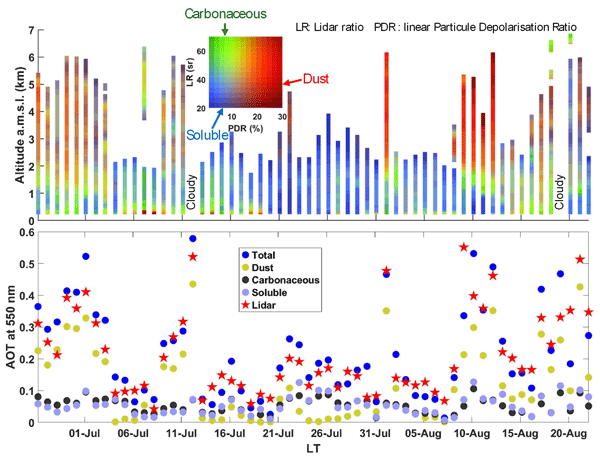
Abstract. As part of the FENNEC programme, a field campaign was conducted on the Mediterranean coast of southern Spain, close to Gibraltar, from June to August 2011. Using a relatively straightforward ground-based N2–Raman lidar, several aerosol optical properties were retrieved at 355 nm, including the linear particle depolarisation ratio (PDR), the lidar ratio (LR), and the aerosol backscatter and extinction coefficients. Of the 58 sampled nights, several periods were identified in which aerosol events exhibited optical thicknesses greater than 0.5. The primary causative agents of these events are the influx of Saharan dust mixed with local polluted and marine air masses. Pairing PDR and LR has been shown to be significant in identifying three distinct bulk aerosol classes: dust, carbonaceous and soluble (predominantly marine) aerosols. After processing the night-time data to ensure sufficient lidar range, the study demonstrates the efficiency of lidar profiles in evaluating the reliability of the Copernicus Atmosphere Monitoring Service (CAMS) reanalyses of atmospheric aerosols up to approximately 7 km above mean sea level (a.m.s.l.). The two datasets show excellent consistency in terms of the optical thickness and vertical profile of the aerosol extinction coefficient in the Saharan dust aerosol layers. CAMS reproduces the temporal evolution well, with a correlation coefficient (COR) greater than 0.8. However, this is less true for the layer below 2 km a.m.s.l. (COR = 0.56), where there is a tendency for CAMS to underestimate compared to ground-based lidar.
-
Notice on discussion status
The requested preprint has a corresponding peer-reviewed final revised paper. You are encouraged to refer to the final revised version.
-
Preprint
(1833 KB)
-
The requested preprint has a corresponding peer-reviewed final revised paper. You are encouraged to refer to the final revised version.
- Preprint
(1833 KB) - Metadata XML
- BibTeX
- EndNote
- Final revised paper


Journal article(s) based on this preprint
Interactive discussion
Status: closed
-
RC1: 'Comment on egusphere-2026-765', Anonymous Referee #1, 24 Mar 2026
- AC1: 'Reply on RC1', Patrick Chazette, 07 Apr 2026
-
RC2: 'Comment on egusphere-2026-765', Anonymous Referee #2, 02 Apr 2026
General comments
This manuscript presents Raman lidar observations of aerosol optical properties collected during the FENNEC campaign in southern Spain and compares them with CAMS reanalysis products. The study is based on a valuable dataset and addresses an important topic, namely the evaluation of modelled aerosol vertical distributions using ground-based active remote sensing.
The manuscript demonstrates a generally good agreement between lidar-derived and CAMS aerosol optical properties, particularly in the free troposphere, and highlights known limitations of model performance in the planetary boundary layer. The use of combined lidar ratio (LR) and particle depolarisation ratio (PDR) for aerosol typing is appropriate and consistent with the literature.
However, I believe that several methodological and interpretative aspects still require clarification or strengthening, particularly regarding uncertainty quantification, aerosol classification robustness, and the interpretation of model–observation discrepancies.
The comments below are intended to further improve the scientific rigor and clarity of the manuscript. Most of them can be addressed without major additional analysis but would significantly strengthen the paper.
Major comments
Robustness and uncertainty of aerosol classification
The aerosol classification is based on the joint use of LR and PDR (Section 4.2, Table 3). While this approach is well established, it relies on predefined ranges of LR and PDR for different aerosol types.
However:
- The ranges assigned to different aerosol classes (e.g. dust vs pollution) partly overlap.
- The classification is applied deterministically without providing any estimate of uncertainty or confidence.
Given the frequent occurrence of mixed aerosol layers (as acknowledged in the manuscript), this may lead to ambiguous classification.
Suggestion:
Provide a discussion on the uncertainty and potential misclassification of aerosol types.
If possible, include a probabilistic interpretation or at least comment on the sensitivity of the classification to the assumed LR/PDR ranges.
Lack of uncertainty propagation
Although uncertainties are provided for individual retrieved quantities (AEC, LR, PDR), there is no propagation of these uncertainties into: aerosol classification, comparison with CAMS, or the final conclusions. Given that the study draws quantitative conclusions based on correlation, bias, and RMSE, this is an important limitation.
Suggestion:
Include a discussion on how measurement uncertainties may impact: classification results, and the evaluation of CAMS performance. A full propagation may not be necessary, but a quantitative or semi-quantitative assessment would be valuable.
Vertical representativeness mismatch between lidar and CAMS
The comparison between lidar profiles and CAMS data (Section 5.2) does not explicitly account for differences in vertical resolution and representativeness, as Lidar profiles have high vertical resolution (~100 m), while CAMS profiles are much coarser and model-based.
The observed discrepancies, particularly in the boundary layer (low correlation and positive bias), are attributed mainly to model deficiencies. However, part of these differences may arise from scale mismatch and representativeness errors, especially in a coastal environment.
Suggestion:
- Discuss the impact of vertical resolution mismatch.
- If possible, consider smoothing lidar profiles to the CAMS vertical grid, or explicitly acknowledge this limitation.
Interpretation of CAMS performance
The manuscript concludes that CAMS shows “excellent agreement” with lidar observations. While this is valid for the free troposphere, the results clearly show significantly lower correlation in the boundary layer (~0.5) and systematic bias near the surface. Therefore, the conclusions appear somewhat over-generalized.
Suggestion:
Refine the conclusions to clearly distinguish between:
- good performance in the free troposphere,
- and more limited performance in the boundary layer.
Assumptions in CAMS extinction reconstruction
The method used to reconstruct extinction profiles from CAMS mixing ratios (Section 3.2) assumes constant specific cross-sections for each aerosol type. This simplification neglects hygroscopic growth (especially relevant near the surface), variability in aerosol composition within each class, and size distribution changes. These factors may contribute significantly to the discrepancies observed in the lower troposphere.
Suggestion:
- Expand the discussion of these assumptions and their impact.
- If possible, comment on the sensitivity of the results to these choices.
Temporal averaging strategy
The lidar profiles are averaged over relatively long nighttime periods. While this is necessary for signal-to-noise reasons, it may smooth out short-term variability, and potentially improve apparent agreement with model data.
Suggestion:
- Include a discussion of the implications of this temporal averaging.
- Optionally, illustrate one case with higher temporal resolution.
Novelty and relevance of the dataset
The dataset dates from 2011, and the manuscript does not sufficiently justify its relevance in the context of more recent observations and advances in instrumentation and modelling.
This point was also raised by Referee #1.
Suggestion:
- Clearly state the added value of this dataset
Link to radiative implications
The introduction emphasizes aerosol radiative effects and climate relevance, but the study does not directly quantify radiative forcing.
Suggestion:
- Either briefly discuss the radiative implications of the observed aerosol properties or moderate the claims in the introduction
Minor comments
- Figure 1- the map is blurry; please improve the quality in the final uploaded file
- Figure 4 and 5- consider improving readability (the graphs are blurry).
- Terminology such as “optical apportionment” should be clearly defined when first introduced.
- Ensure consistency in terminology for statistical metrics (RMSE vs RMSD), in line with Referee #1.
- page 12 Lines 11 and 12 “may lead to LRs of the order of 8%”; LR is measured in sr, not %. Please clarify in here what 8% (and 2-3% on the next line) mean
- page 16 Line 10: “Qualitatively, The altitude and time locations…”; “The” should be lowercase.
- page 18 Line 2 and 3 “rectangle” Should be corrected with “ triangle”
General language issues
The manuscript would benefit from a careful language revision, as it contains a number of minor grammatical errors, typographical issues, and occasional imprecise phrasing. While these do not affect the scientific content, improving readability would significantly enhance the clarity of the paper.
Some long sentences could be split for clarity.
Conclusion
I believe that the manuscript presents valuable results and is suitable for publication after minor to moderate revisions addressing the points above.
Citation: https://doi.org/10.5194/egusphere-2026-765-RC2 - AC2: 'Reply on RC2', Patrick Chazette, 09 Apr 2026
Peer review completion


Interactive discussion
Status: closed
-
RC1: 'Comment on egusphere-2026-765', Anonymous Referee #1, 24 Mar 2026
This article describes a new dataset of aerosol optical properties taken in southern Spain during the Fennec campaign in June-August 2011 using a relatively simple ground-based lidar system. The author presents a novel method for classifying aerosols into three types based on a combination of depolarization and lidar ratio. The new dataset and classification is used to evaluate the aerosol vertical profiles and speciation in the CAMS aerosol reanalysis. The author finds that the reanalysis performs better in the free troposphere, with lower correlations in the boundary layer.
This article presents an interesting method for identifying aerosol types. Evaluation of the CAMS reanalysis is important both for users of the reanalysis and for identifying where improvements are required. However, the writing requires significant improvements as detailed below. Moreover, the calculation of aerosol extinction for the reanalysis seems overly simplistic.
General Comments
- I found the article quite difficult to read, with numerous errors (some but not all highlighted below). I found the introduction in particular lacked coherence, and this needs a significant rewrite to ensure that the context and novelty of the research is clearer to the reader. The author should go through the full article to improve readability.
- The calculation of vertical profiles of aerosol extinction for the reanalysis may be overly simplistic and the author only verifies that the calculation reproduces the model AOT. In particular, using a single value for the specific cross section for each aerosol type neglects any dependence on humidity or the aerosol species within the type that is included in the reanalysis. Indeed neglecting the impact of increasing humidity near the surface could explain the underestimate of the extinction. More recent versions of the model used for the reanalysis do output aerosol extinction, so I would suggest checking that the method works well for extinction at the same location for a more recent period when the extinction is available.
- The “RMSE” used in this article is more typically called the centred root mean square error (e.g. Taylor, 2001) I appreciate that the terminology used in this article is used by some authors, but I think RMSE is more widely understood to mean the error including the bias (i.e. what is called RMSD in this article). I think it would be better to adopt the more widely used terminology, which is less likely to cause confusion. In addition, while the appendix was useful for highlighting that a non-standard definition of the RMSE is used, I think it is unnecessary if the more widely used terminology is used.
- I appreciate that there may be non-scientific reasons, but am puzzled by the long delay between collection of the data and the submission of this paper. I expect other readers will be too. It would be good to highlight how this older dataset remains relevant and important given the availability of more recent observations and more sophisticated instruments.
Specific Comments
P1, L10: Expand FENNEC acronym.
P2, L32: This should be after the Mediterannean dust experiment?
P5, L20: This is incorrect. Aeronet observations are not assimilated into the model
P13, L9: During the day…
P16, L10: No need for upper case The.
Fig. 9: Can you add ticks to the axis with the same orientation as the lines that show constant values for that aerosol to make it clear which lines correspond to which aerosol?
P19 L 23: expends should be extent?
Citation: https://doi.org/10.5194/egusphere-2026-765-RC1 - AC1: 'Reply on RC1', Patrick Chazette, 07 Apr 2026
-
RC2: 'Comment on egusphere-2026-765', Anonymous Referee #2, 02 Apr 2026
General comments
This manuscript presents Raman lidar observations of aerosol optical properties collected during the FENNEC campaign in southern Spain and compares them with CAMS reanalysis products. The study is based on a valuable dataset and addresses an important topic, namely the evaluation of modelled aerosol vertical distributions using ground-based active remote sensing.
The manuscript demonstrates a generally good agreement between lidar-derived and CAMS aerosol optical properties, particularly in the free troposphere, and highlights known limitations of model performance in the planetary boundary layer. The use of combined lidar ratio (LR) and particle depolarisation ratio (PDR) for aerosol typing is appropriate and consistent with the literature.
However, I believe that several methodological and interpretative aspects still require clarification or strengthening, particularly regarding uncertainty quantification, aerosol classification robustness, and the interpretation of model–observation discrepancies.
The comments below are intended to further improve the scientific rigor and clarity of the manuscript. Most of them can be addressed without major additional analysis but would significantly strengthen the paper.
Major comments
Robustness and uncertainty of aerosol classification
The aerosol classification is based on the joint use of LR and PDR (Section 4.2, Table 3). While this approach is well established, it relies on predefined ranges of LR and PDR for different aerosol types.
However:
- The ranges assigned to different aerosol classes (e.g. dust vs pollution) partly overlap.
- The classification is applied deterministically without providing any estimate of uncertainty or confidence.
Given the frequent occurrence of mixed aerosol layers (as acknowledged in the manuscript), this may lead to ambiguous classification.
Suggestion:
Provide a discussion on the uncertainty and potential misclassification of aerosol types.
If possible, include a probabilistic interpretation or at least comment on the sensitivity of the classification to the assumed LR/PDR ranges.
Lack of uncertainty propagation
Although uncertainties are provided for individual retrieved quantities (AEC, LR, PDR), there is no propagation of these uncertainties into: aerosol classification, comparison with CAMS, or the final conclusions. Given that the study draws quantitative conclusions based on correlation, bias, and RMSE, this is an important limitation.
Suggestion:
Include a discussion on how measurement uncertainties may impact: classification results, and the evaluation of CAMS performance. A full propagation may not be necessary, but a quantitative or semi-quantitative assessment would be valuable.
Vertical representativeness mismatch between lidar and CAMS
The comparison between lidar profiles and CAMS data (Section 5.2) does not explicitly account for differences in vertical resolution and representativeness, as Lidar profiles have high vertical resolution (~100 m), while CAMS profiles are much coarser and model-based.
The observed discrepancies, particularly in the boundary layer (low correlation and positive bias), are attributed mainly to model deficiencies. However, part of these differences may arise from scale mismatch and representativeness errors, especially in a coastal environment.
Suggestion:
- Discuss the impact of vertical resolution mismatch.
- If possible, consider smoothing lidar profiles to the CAMS vertical grid, or explicitly acknowledge this limitation.
Interpretation of CAMS performance
The manuscript concludes that CAMS shows “excellent agreement” with lidar observations. While this is valid for the free troposphere, the results clearly show significantly lower correlation in the boundary layer (~0.5) and systematic bias near the surface. Therefore, the conclusions appear somewhat over-generalized.
Suggestion:
Refine the conclusions to clearly distinguish between:
- good performance in the free troposphere,
- and more limited performance in the boundary layer.
Assumptions in CAMS extinction reconstruction
The method used to reconstruct extinction profiles from CAMS mixing ratios (Section 3.2) assumes constant specific cross-sections for each aerosol type. This simplification neglects hygroscopic growth (especially relevant near the surface), variability in aerosol composition within each class, and size distribution changes. These factors may contribute significantly to the discrepancies observed in the lower troposphere.
Suggestion:
- Expand the discussion of these assumptions and their impact.
- If possible, comment on the sensitivity of the results to these choices.
Temporal averaging strategy
The lidar profiles are averaged over relatively long nighttime periods. While this is necessary for signal-to-noise reasons, it may smooth out short-term variability, and potentially improve apparent agreement with model data.
Suggestion:
- Include a discussion of the implications of this temporal averaging.
- Optionally, illustrate one case with higher temporal resolution.
Novelty and relevance of the dataset
The dataset dates from 2011, and the manuscript does not sufficiently justify its relevance in the context of more recent observations and advances in instrumentation and modelling.
This point was also raised by Referee #1.
Suggestion:
- Clearly state the added value of this dataset
Link to radiative implications
The introduction emphasizes aerosol radiative effects and climate relevance, but the study does not directly quantify radiative forcing.
Suggestion:
- Either briefly discuss the radiative implications of the observed aerosol properties or moderate the claims in the introduction
Minor comments
- Figure 1- the map is blurry; please improve the quality in the final uploaded file
- Figure 4 and 5- consider improving readability (the graphs are blurry).
- Terminology such as “optical apportionment” should be clearly defined when first introduced.
- Ensure consistency in terminology for statistical metrics (RMSE vs RMSD), in line with Referee #1.
- page 12 Lines 11 and 12 “may lead to LRs of the order of 8%”; LR is measured in sr, not %. Please clarify in here what 8% (and 2-3% on the next line) mean
- page 16 Line 10: “Qualitatively, The altitude and time locations…”; “The” should be lowercase.
- page 18 Line 2 and 3 “rectangle” Should be corrected with “ triangle”
General language issues
The manuscript would benefit from a careful language revision, as it contains a number of minor grammatical errors, typographical issues, and occasional imprecise phrasing. While these do not affect the scientific content, improving readability would significantly enhance the clarity of the paper.
Some long sentences could be split for clarity.
Conclusion
I believe that the manuscript presents valuable results and is suitable for publication after minor to moderate revisions addressing the points above.
Citation: https://doi.org/10.5194/egusphere-2026-765-RC2 - AC2: 'Reply on RC2', Patrick Chazette, 09 Apr 2026
Peer review completion
Journal article(s) based on this preprint
Viewed
| HTML | XML | Total | BibTeX | EndNote | |
|---|---|---|---|---|---|
| 695 | 268 | 91 | 1,054 | 67 | 94 |
- HTML: 695
- PDF: 268
- XML: 91
- Total: 1,054
- BibTeX: 67
- EndNote: 94
Viewed (geographical distribution)
| Country | # | Views | % |
|---|
| Total: | 0 |
| HTML: | 0 |
| PDF: | 0 |
| XML: | 0 |
- 1
Patrick Chazette
The requested preprint has a corresponding peer-reviewed final revised paper. You are encouraged to refer to the final revised version.
- Preprint
(1833 KB) - Metadata XML
This article describes a new dataset of aerosol optical properties taken in southern Spain during the Fennec campaign in June-August 2011 using a relatively simple ground-based lidar system. The author presents a novel method for classifying aerosols into three types based on a combination of depolarization and lidar ratio. The new dataset and classification is used to evaluate the aerosol vertical profiles and speciation in the CAMS aerosol reanalysis. The author finds that the reanalysis performs better in the free troposphere, with lower correlations in the boundary layer.
This article presents an interesting method for identifying aerosol types. Evaluation of the CAMS reanalysis is important both for users of the reanalysis and for identifying where improvements are required. However, the writing requires significant improvements as detailed below. Moreover, the calculation of aerosol extinction for the reanalysis seems overly simplistic.
General Comments
Specific Comments
P1, L10: Expand FENNEC acronym.
P2, L32: This should be after the Mediterannean dust experiment?
P5, L20: This is incorrect. Aeronet observations are not assimilated into the model
P13, L9: During the day…
P16, L10: No need for upper case The.
Fig. 9: Can you add ticks to the axis with the same orientation as the lines that show constant values for that aerosol to make it clear which lines correspond to which aerosol?
P19 L 23: expends should be extent?