
the Creative Commons Attribution 4.0 License.
the Creative Commons Attribution 4.0 License.
 | 16 Feb 2026
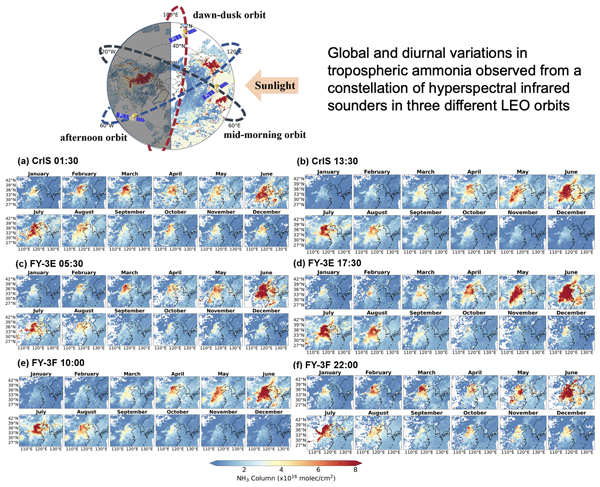
Global and diurnal variations in tropospheric ammonia observed from a constellation of hyperspectral infrared sounders in three different LEO orbits
Abstract. As a reactive nitrogen compound, atmospheric ammonia (NH3) plays a key role in the global nitrogen cycle. Tracking the spatiotemporal dynamics of NH3 is crucial to quantify its emissions and depositions, as well as offering insights to inform the regulation of anthropogenic emission sources. Currently, the diurnal cycle of NH3 remains under-constrained, particularly in regions lacking geostationary satellite observations, which poses a challenge to accurate emission quantification. To address this gap, we construct an integrated constellation to achieve quasi-geostationary-like global monitoring coverage, comprising China’s FengYun-3 (FY-3) series satellites and the Cross-track Infrared Sounder (CrIS). FY-3E operates in a dawn-dusk orbit with equatorial overpassing time at 05:30 am/pm, while FY-3F operates in a mid-morning orbit with overpassing time at 10:00 am/pm. Both are equipped with the second-generation High Spectral Infrared Atmospheric Sounder (HIRAS-II). CrIS, operating with overpassing time at 01:30 am/pm, provides supplementary observations in an afternoon orbit. In this study, hyperspectral infrared observations from the constellation are utilized to retrieve global NH3 columns based on the optimal estimation method. Six maps of global NH3 for every 4-hour in each day are retrieved. The retrieval results in four weeks of different seasons in 2024, as a demonstration, show elevated columns in global major source regions, including Western Europe, North America, North China Plain and North India. In addition, the diurnal and seasonal cycles of NH3 over these regions using all observations in 2024 are also investigated. The constellation reasonably captures the diurnal (every 4-hour) and seasonal cycles of NH3 columns, effectively mitigating the constraints in regions without geostationary observations. Consistency of the retrievals among different satellites is demonstrated by comparing with geostationary observations from the Geostationary Interferometric Infrared Sounder (GIIRS). The sensitivity of NH3 detection in the lower atmosphere as quantified by the column averaging kernel (AVK) from the retrieval shows diurnal variations that dependent on thermal contrast, defined as the temperature difference between the surface and the lower atmospheric layer. This study demonstrates the capability of the integrated constellation, comprising FY-3E/HIRAS-II (dawn-dusk), FY-3F/HIRAS-II (mid-morning), and CrIS (afternoon), to monitor global and diurnal NH3 variations at unprecedentedly six distinct times of a day, and has the potential to enhance the global climate-monitoring capacity of polar-orbiting meteorological satellites.
Competing interests: At least one of the (co-)authors is a member of the editorial board of Atmospheric Measurement Techniques.
Publisher's note: Copernicus Publications remains neutral with regard to jurisdictional claims made in the text, published maps, institutional affiliations, or any other geographical representation in this paper. While Copernicus Publications makes every effort to include appropriate place names, the final responsibility lies with the authors. Views expressed in the text are those of the authors and do not necessarily reflect the views of the publisher.-
Notice on discussion status
The requested preprint has a corresponding peer-reviewed final revised paper. You are encouraged to refer to the final revised version.
-
Preprint
(10714 KB)
-
The requested preprint has a corresponding peer-reviewed final revised paper. You are encouraged to refer to the final revised version.
- Preprint
(10714 KB) - Metadata XML
- BibTeX
- EndNote
- Final revised paper


Journal article(s) based on this preprint
Interactive discussion
Status: closed
-
RC1: 'Comment on egusphere-2026-746', Anonymous Referee #1, 19 Mar 2026
The manuscript 'Global and diurnal variations in tropospheric ammonia observed from a constellation of hyperspectral infrared sounders in three different LEO orbits' by Hua et al. presents an evaluation of the global spatial and diurnal variability of NH3 based on observations from the HIRAS-II instruments aboard the Chinese FY-3E and FY-3F satellites along with observations from CrIS on JPSS-1.
The authors utilize a harmonized retrieval approach and the differing overpasses of these three satellites to provide unique insights into the diurnal variability of NH3 which remains broadly uncertain and was previously challenging to capture globally from the existing polar-orbiting instruments. The NH3 observations from these three satellites are combined to yield a quasi-geostationary dataset with observations made roughly every 4 hours throughout the day. Furthermore, a comparison is performed of each polar-orbiting dataset against true geostationary NH3 observations from GIIRS, which serves to provide a consistent intercomparison point. The authors demonstrate that their quasi-geostationary constellation is capable of resolving the seasonal and diurnal variability globally and in several high-emission regions of interest.
Overall, the manuscript is well written and the results are presented in a clear manner. I believe that the manuscript fits well within the scope of AMT. There are some sections of the manuscript that can be improved both in terms of clarity and level of detail, but after these revisions are made, I recommend it for publication.
Major comments:
- Section 2.2 (Optimal estimation methods) the authors describe some deviations in their retrieval methods from the previous studies of Zeng et al. (2023) including using a single-value column scaling retrieval as opposed to a full OEM profile retrieval. However more details are needed here and I have some concerns on the impacts of such choices.
For example, on L127 - L128, the authors state "A profile scaling approach is used to retrieve a single scale factor applied to a fixed a priori NH3 profile." and later that "A fixed a priori profile instead of a variable one is adopted, so that any spatiotemporal changes in retrieved
NH3 column concentrations reflect only information from satellite observations, rather than variations in the prior". However the authors do not describe how the initial prior profile was selected. Additionally, using the same fixed profile shape for both daytime and nighttime retrievals would likely bias the retrieved ammonia total column high or low.Since this study being considered for AMT and is also partly a presentation of these harmonized retrievals and with a modified approach from previous studies, I think more details should be provided on, for example, the choice of a priori profile shape and how much that impacts the resulting total columns (and potentially also the diurnal cycles). This could be included in the appendix, but this is important to support the robustness of the remainder of the results presented in the manuscript.
Furthermore, a comparison of the retrievals with a ground-based dataset like an FTIR such as the one at Hefei (https://doi.org/10.1016/j.atmosenv.2022.119256) could strengthen the case for the satellite retrievals even more. This could be included as part of Section 3.3 and leads me to my next comment.
- Section 3.3 (Comparisons with geostationary NH3 observations from GIIRS) is light on details and could be expanded to better match the scope of the remainder of the manuscript.
The paper places a significant focus on seasonal variability, but the comparisons presented between FY-3E, FY-3F and CrIS versus FY-4B/GIIRS are only shown on the yearly scale. It would be valuable to also show the comparisons monthly and/or seasonally to help identify whether there are any seasonal biases or inconsistencies across the satellite products, as these may be covered up or averaged out when looking at the correlations at the yearly scale.
Additionally, there is a pretty consistent slope on the order of 0.86-0.89 in almost all of the comparisons of FY-3E, FY-3F and CrIS with GIIRS but this is not discussed. Can the authors provide some potential explanations? Is this due to some systematic bias in the GIIRS product and/or the products retrieved in this study?
- In Section 3.1 the authors describe a rigorous filtering approach for the data including filters based on surface temperature, thermal contrast, emissivity and the averaging kernel values. However, the impact of the filtering is not described. On average how many observations are removed/excluded based on the filters?
Providing more information on the impact of the filters is important, particularly since the paper presents night-time retrievals which typically are far more challenging due to poorer observational conditions, and these filters likely impact the data density. Additionally, it seems a different filtering criterion is applied in Section 3.2, but it is not immediately clear to me why a different criterion is necessitated and also if it is applied on top of the earlier criterion or not.
- L151-152: Why were periods of only one week used for the seasonal variability investigation? Why not use the full seasons? The reasoning behind only choosing one week periods is not provided and by including longer periods, it would give a more robust picture of the true seasonal variability.
By limiting it to single weeks, the results are more subject to things such as transient events (e.g., biomass burning, manure application etc) that could skew or bias the seasonal results. This is already apparent in the results, for example the large wildifire over North America in July. I suggest revising the seasonal analysis to include averages over more months. Later on in Section 3.2 full months are seemingly used, so this would make it more consistent with that Section and the results there as well.
Minor comments:
- L41: Dammers et al., 2017 is cited here for the general background on NH3, but the references therein are likely more appropriate for citation here as the focus of that paper is on satellite validation.
- L47-48: "A number of in situ monitoring sites equipped with Fourier transform infrared (FTIR) spectrometers have been established...", there are also ground/surface measurement stations that make in-situ measurements that are not FTIRS e.g., via DOAS measurements or passive samplers. It is not also 100% correct to call an FTIR site an "in situ" site, since they technically measure on a very long slant-path through the atmosphere. In situ methods for NH3 are typically made at the point via an inlet based or some other measurement method.
- L63-65: "However, the lack of geostationary orbit observations across most global regions especially in the Southern Hemisphere prevents multiple daily observations from being achieved." the wording of this sentence is a bit strange. "Multiple daily observations" can technically be achieved with 1 to 2 polar orbiting satellites no?
- General comment on Section 1: was there a reason to exclude IASI from the main analysis? Was it just that its overpass time was too close to FY-3F and thus did not provide more info? Or something else? IASI is utilized at some points in the analysis as a comparison point (e.g., in Figure 4), but it isn't really mentioned on why its excluded from the main analysis.
- L82: "It detects upwelling infrared radiative signals across the short-wave.." the phrasing and word choice is a bit strange here. I would probably rephrase it as "It measures upwelling infrared radiation across the short-wave...".
- L84-87: very minor comment, but this sentence describing the overpasses of the instruments is slightly repetitive with the second last paragraph of Section 1. In my opinion, the description of the overpass times definitely fits better here in the Methodology section, but if the authors feel it is important to also keep it in Section 1 then it is fine as well.
- L93: Why was the 930 cm-1 NH3 band not utilized in the retrievals? Was the performance less consistent across the instruments for this band? Or was there a different reason?
- L117-119: the authors do not describe what the actual cloud-filtering criteria/threshold was that they applied here. Was it also the same exact criterion of <0.4 that was used in Wells et al. (2020)? Even if so, it should be mentioned here in the text. Additionally, I am curious how the cloud flagging applied here compares to, for example, that from the CrIS CFPR product. Is it consistent?
- L158-L159: What is the approximate height above the surface of the lowest atmospheric layer here? This is an important clarification for understanding how rigid of a thermal contrast filter 3 kelvin is. For example, if the first layer is at a height of 500m above the surface, then 3K is a relatively loose filter, if its 50m then its a strict filter.
- L173-L174: "In particular, large-scale wildfires prevalent in summer North America..." -> "... during the summer in North America..."
- L175-L177: I think another good citation to include here would be Lutsch et al. (2019; https://doi.org/10.1029/2019JD030419) as they discuss the long-range transport of NH3 in wildfire plumes.
- L196-L197: its unclear what is meant here by "valid data defined as having more than 10 effective observation points to ensure statistical robustness". Do the authors mean a valid overpass must have more than 10 effective observations? Or the monthly averages themselves must consist of 10 points or more?
- L197-L198: I think it would be useful to (in a single sentence) explain why higher TC = better retrieval accuracy/better retrievals. It is also unclear whether the TC criterion is based on the absolute value of TC (thus allowing more strongly negative TC's), or if only positive TC values > 3K are allowed.
- L203: What version of the IASI retrievals was used here? It is never mentioned nor in the data availability section. I assume ANNI V4.0, but it should be noted in the text.
- L205: "a pattern that consists with Clarisse et al.’s (2021) findings from GIIRS observations and aligns with broader research on NH3 dynamics" -> "a pattern that is consistent with the findings of Clarisse et al. (2021) from GIIRS..."
- Figure 4: A more differentiated line color could be chosen for the NH3 and BLH lines to make it more colorblind friendly.
- Figure 5 and Figure 6: The aspect ratio of the individual subpanels looks stretched in the vertical.
- Figure 7: Overlay outlines of the country borders and the US state and Canadian province borders to make it easier to interpret the geographical area depicted in the figures.
- General comment on Section 3.3 and Figure 8: The co-location criterion is only described in the Figure 8 caption, but not in the main text. Please add this to the text. I am also curious how this co-location criterion was selected initially? The choice is not motivated or explained.
- L286-287: specify in the text the fitting method used for the linear regressions. Was it ordinary least squares or something more robust like reduced major axis?
- Figure 8: It would be good to include information on the total number of observations, the fit intercepts, and also possibly the mean biases for each case somewhere on the figure subpanels or in the text.
- L315: Not 100% true that it follows a pure inverse relationship. For example, Boynard et al. 2014 (https://agupubs.onlinelibrary.wiley.com/doi/epdf/10.1002/2013GL058333) show that as thermal contrast goes largely negative (e.g., during winter), you regain sensitivity since your absorption features become emission features. So it is not fully correct to claim it is a pure inverse relationship with TC. Even here in Fig. 9 it is not always strictly the case.
- Figure 9: in my opinion, more information is needed either on the panels or in the text on the total number of observations used to generate the diurnal plot here. Are there comparable number of observations used for January versus June? Or is it quite different?
- L334: What is meant by "performance across different observational periods" here? The comparison with GIIRS was not separated into different periods/months seasons, so it is difficult to judge whether the performance is consistent across the sensors in the different periods. We can only really say that they compare across the full year.
- L336-L337: "anthropogenic activities (e.g., agricultural practices) govern diurnal and seasonal cycles, while regional variations reflect
differences in emission intensity and atmospheric chemistry." but anthropogenic activities and differences in emission intensity are quite directly linked here for NH3 in most cases no? - Data availability: It seems the CrIS NH3 retrieval dataset is missing, it should also be included here same as the FY-3E and FY-3F datasets.
Citation: https://doi.org/10.5194/egusphere-2026-746-RC1 - AC1: 'Reply on RC1', Zhao-Cheng Zeng, 20 May 2026
-
RC2: 'Comment on egusphere-2026-746', Anonymous Referee #2, 07 May 2026
This manuscript presents a potentially valuable study on global and diurnal tropospheric NH3 monitoring using a constellation of polar-orbiting hyperspectral infrared sounders: FY-3E/HIRAS-II, FY-3F/HIRAS-II, and CrIS. The idea of combining complementary local overpass times to achieve quasi-geostationary-like global sampling is interesting and important, especially for NH3, whose short lifetime and strong diurnal variability make sparse temporal sampling a major limitation.
The manuscript shows promising results, including global seasonal maps, regional diurnal cycles over major source regions, and comparison with FY-4B/GIIRS. But I still have some suggestions for the authors to consider.
Major Comments:
1) The manuscript states that the retrieval is based on the FY-LeoAIR optimal estimation framework and that a profile scaling approach is used, but the actual NH3, retrieval setup is not sufficiently documented in this paper. Here are some of the contents that are suggested to include into the manuscript: the exact state vector elements retrieved jointly with NH3, whether surface temperature and emissivity are simultaneously fitted or fixed, whether the three sensors are spectrally harmonized before inversion, any sensor-specific bias correction or radiometric adjustment. Since this paper’s novelty rests on a multi-sensor integrated retrieval, the retrieval description must be more self-contained. Referring readers to previous papers is not enough.
2) The main consistency check is a comparison with FY-4B/GIIRS over the Indo-Gangetic Plain and North China Plain. This is useful, but I think it is not sufficient to support the broader conclusion that the constellation can robustly monitor global and diurnal NH3 variability.
3) Another major concern is that retrieval sensitivity is explicitly controlled by thermal contrast (TC), and the authors apply thresholds such as TC > 3 K globally and TC > 5 K in hotspot analyses. Since TC itself has a diurnal cycle, the filtering preferentially retains daytime observations and may distort the apparent amplitude and phase of the NH3 diurnal cycle.
Minor Comments:
1) Section 3 is titled “Results and Discussions,” while Section 4 is said to be “the discussions” in the introduction, but there is no standalone Section 4 in the provided text.
2) The title and text alternate between “tropospheric ammonia,” “NH3 column,” and “total column.” Since the retrieval is limited to 11 layers from the surface to 200 hPa, please define precisely what column is being reported and use consistent terminology.
3) A 2.5°×2.5° box is fairly large, especially in regions with heterogeneous sources. Please explain why this spatial extent was selected and how sensitive results are to box size.
4)The manuscript states that the emissivity database is “Monthly Global 0.05° V003” and then says it provides data “at a 0.5° spatial resolution.” This should be checked.
5)Section 3.3 title says “Comparisons with geostationary NH3 observations,” but the text uses “validate.” I suggest replacing “validate” with “evaluate consistency” or “cross-compare.”
6)The collocation uses <0.5° in latitude/longitude and <0.5 h in time. Given the gradients and diurnal variability of NH3, please justify these thresholds and discuss representativeness mismatch.
7) The manuscript uses both “PBL” and “BLH.” Please make it consistent.
Citation: https://doi.org/10.5194/egusphere-2026-746-RC2 - AC2: 'Reply on RC2', Zhao-Cheng Zeng, 20 May 2026


Interactive discussion
Status: closed
-
RC1: 'Comment on egusphere-2026-746', Anonymous Referee #1, 19 Mar 2026
The manuscript 'Global and diurnal variations in tropospheric ammonia observed from a constellation of hyperspectral infrared sounders in three different LEO orbits' by Hua et al. presents an evaluation of the global spatial and diurnal variability of NH3 based on observations from the HIRAS-II instruments aboard the Chinese FY-3E and FY-3F satellites along with observations from CrIS on JPSS-1.
The authors utilize a harmonized retrieval approach and the differing overpasses of these three satellites to provide unique insights into the diurnal variability of NH3 which remains broadly uncertain and was previously challenging to capture globally from the existing polar-orbiting instruments. The NH3 observations from these three satellites are combined to yield a quasi-geostationary dataset with observations made roughly every 4 hours throughout the day. Furthermore, a comparison is performed of each polar-orbiting dataset against true geostationary NH3 observations from GIIRS, which serves to provide a consistent intercomparison point. The authors demonstrate that their quasi-geostationary constellation is capable of resolving the seasonal and diurnal variability globally and in several high-emission regions of interest.
Overall, the manuscript is well written and the results are presented in a clear manner. I believe that the manuscript fits well within the scope of AMT. There are some sections of the manuscript that can be improved both in terms of clarity and level of detail, but after these revisions are made, I recommend it for publication.
Major comments:
- Section 2.2 (Optimal estimation methods) the authors describe some deviations in their retrieval methods from the previous studies of Zeng et al. (2023) including using a single-value column scaling retrieval as opposed to a full OEM profile retrieval. However more details are needed here and I have some concerns on the impacts of such choices.
For example, on L127 - L128, the authors state "A profile scaling approach is used to retrieve a single scale factor applied to a fixed a priori NH3 profile." and later that "A fixed a priori profile instead of a variable one is adopted, so that any spatiotemporal changes in retrieved
NH3 column concentrations reflect only information from satellite observations, rather than variations in the prior". However the authors do not describe how the initial prior profile was selected. Additionally, using the same fixed profile shape for both daytime and nighttime retrievals would likely bias the retrieved ammonia total column high or low.Since this study being considered for AMT and is also partly a presentation of these harmonized retrievals and with a modified approach from previous studies, I think more details should be provided on, for example, the choice of a priori profile shape and how much that impacts the resulting total columns (and potentially also the diurnal cycles). This could be included in the appendix, but this is important to support the robustness of the remainder of the results presented in the manuscript.
Furthermore, a comparison of the retrievals with a ground-based dataset like an FTIR such as the one at Hefei (https://doi.org/10.1016/j.atmosenv.2022.119256) could strengthen the case for the satellite retrievals even more. This could be included as part of Section 3.3 and leads me to my next comment.
- Section 3.3 (Comparisons with geostationary NH3 observations from GIIRS) is light on details and could be expanded to better match the scope of the remainder of the manuscript.
The paper places a significant focus on seasonal variability, but the comparisons presented between FY-3E, FY-3F and CrIS versus FY-4B/GIIRS are only shown on the yearly scale. It would be valuable to also show the comparisons monthly and/or seasonally to help identify whether there are any seasonal biases or inconsistencies across the satellite products, as these may be covered up or averaged out when looking at the correlations at the yearly scale.
Additionally, there is a pretty consistent slope on the order of 0.86-0.89 in almost all of the comparisons of FY-3E, FY-3F and CrIS with GIIRS but this is not discussed. Can the authors provide some potential explanations? Is this due to some systematic bias in the GIIRS product and/or the products retrieved in this study?
- In Section 3.1 the authors describe a rigorous filtering approach for the data including filters based on surface temperature, thermal contrast, emissivity and the averaging kernel values. However, the impact of the filtering is not described. On average how many observations are removed/excluded based on the filters?
Providing more information on the impact of the filters is important, particularly since the paper presents night-time retrievals which typically are far more challenging due to poorer observational conditions, and these filters likely impact the data density. Additionally, it seems a different filtering criterion is applied in Section 3.2, but it is not immediately clear to me why a different criterion is necessitated and also if it is applied on top of the earlier criterion or not.
- L151-152: Why were periods of only one week used for the seasonal variability investigation? Why not use the full seasons? The reasoning behind only choosing one week periods is not provided and by including longer periods, it would give a more robust picture of the true seasonal variability.
By limiting it to single weeks, the results are more subject to things such as transient events (e.g., biomass burning, manure application etc) that could skew or bias the seasonal results. This is already apparent in the results, for example the large wildifire over North America in July. I suggest revising the seasonal analysis to include averages over more months. Later on in Section 3.2 full months are seemingly used, so this would make it more consistent with that Section and the results there as well.
Minor comments:
- L41: Dammers et al., 2017 is cited here for the general background on NH3, but the references therein are likely more appropriate for citation here as the focus of that paper is on satellite validation.
- L47-48: "A number of in situ monitoring sites equipped with Fourier transform infrared (FTIR) spectrometers have been established...", there are also ground/surface measurement stations that make in-situ measurements that are not FTIRS e.g., via DOAS measurements or passive samplers. It is not also 100% correct to call an FTIR site an "in situ" site, since they technically measure on a very long slant-path through the atmosphere. In situ methods for NH3 are typically made at the point via an inlet based or some other measurement method.
- L63-65: "However, the lack of geostationary orbit observations across most global regions especially in the Southern Hemisphere prevents multiple daily observations from being achieved." the wording of this sentence is a bit strange. "Multiple daily observations" can technically be achieved with 1 to 2 polar orbiting satellites no?
- General comment on Section 1: was there a reason to exclude IASI from the main analysis? Was it just that its overpass time was too close to FY-3F and thus did not provide more info? Or something else? IASI is utilized at some points in the analysis as a comparison point (e.g., in Figure 4), but it isn't really mentioned on why its excluded from the main analysis.
- L82: "It detects upwelling infrared radiative signals across the short-wave.." the phrasing and word choice is a bit strange here. I would probably rephrase it as "It measures upwelling infrared radiation across the short-wave...".
- L84-87: very minor comment, but this sentence describing the overpasses of the instruments is slightly repetitive with the second last paragraph of Section 1. In my opinion, the description of the overpass times definitely fits better here in the Methodology section, but if the authors feel it is important to also keep it in Section 1 then it is fine as well.
- L93: Why was the 930 cm-1 NH3 band not utilized in the retrievals? Was the performance less consistent across the instruments for this band? Or was there a different reason?
- L117-119: the authors do not describe what the actual cloud-filtering criteria/threshold was that they applied here. Was it also the same exact criterion of <0.4 that was used in Wells et al. (2020)? Even if so, it should be mentioned here in the text. Additionally, I am curious how the cloud flagging applied here compares to, for example, that from the CrIS CFPR product. Is it consistent?
- L158-L159: What is the approximate height above the surface of the lowest atmospheric layer here? This is an important clarification for understanding how rigid of a thermal contrast filter 3 kelvin is. For example, if the first layer is at a height of 500m above the surface, then 3K is a relatively loose filter, if its 50m then its a strict filter.
- L173-L174: "In particular, large-scale wildfires prevalent in summer North America..." -> "... during the summer in North America..."
- L175-L177: I think another good citation to include here would be Lutsch et al. (2019; https://doi.org/10.1029/2019JD030419) as they discuss the long-range transport of NH3 in wildfire plumes.
- L196-L197: its unclear what is meant here by "valid data defined as having more than 10 effective observation points to ensure statistical robustness". Do the authors mean a valid overpass must have more than 10 effective observations? Or the monthly averages themselves must consist of 10 points or more?
- L197-L198: I think it would be useful to (in a single sentence) explain why higher TC = better retrieval accuracy/better retrievals. It is also unclear whether the TC criterion is based on the absolute value of TC (thus allowing more strongly negative TC's), or if only positive TC values > 3K are allowed.
- L203: What version of the IASI retrievals was used here? It is never mentioned nor in the data availability section. I assume ANNI V4.0, but it should be noted in the text.
- L205: "a pattern that consists with Clarisse et al.’s (2021) findings from GIIRS observations and aligns with broader research on NH3 dynamics" -> "a pattern that is consistent with the findings of Clarisse et al. (2021) from GIIRS..."
- Figure 4: A more differentiated line color could be chosen for the NH3 and BLH lines to make it more colorblind friendly.
- Figure 5 and Figure 6: The aspect ratio of the individual subpanels looks stretched in the vertical.
- Figure 7: Overlay outlines of the country borders and the US state and Canadian province borders to make it easier to interpret the geographical area depicted in the figures.
- General comment on Section 3.3 and Figure 8: The co-location criterion is only described in the Figure 8 caption, but not in the main text. Please add this to the text. I am also curious how this co-location criterion was selected initially? The choice is not motivated or explained.
- L286-287: specify in the text the fitting method used for the linear regressions. Was it ordinary least squares or something more robust like reduced major axis?
- Figure 8: It would be good to include information on the total number of observations, the fit intercepts, and also possibly the mean biases for each case somewhere on the figure subpanels or in the text.
- L315: Not 100% true that it follows a pure inverse relationship. For example, Boynard et al. 2014 (https://agupubs.onlinelibrary.wiley.com/doi/epdf/10.1002/2013GL058333) show that as thermal contrast goes largely negative (e.g., during winter), you regain sensitivity since your absorption features become emission features. So it is not fully correct to claim it is a pure inverse relationship with TC. Even here in Fig. 9 it is not always strictly the case.
- Figure 9: in my opinion, more information is needed either on the panels or in the text on the total number of observations used to generate the diurnal plot here. Are there comparable number of observations used for January versus June? Or is it quite different?
- L334: What is meant by "performance across different observational periods" here? The comparison with GIIRS was not separated into different periods/months seasons, so it is difficult to judge whether the performance is consistent across the sensors in the different periods. We can only really say that they compare across the full year.
- L336-L337: "anthropogenic activities (e.g., agricultural practices) govern diurnal and seasonal cycles, while regional variations reflect
differences in emission intensity and atmospheric chemistry." but anthropogenic activities and differences in emission intensity are quite directly linked here for NH3 in most cases no? - Data availability: It seems the CrIS NH3 retrieval dataset is missing, it should also be included here same as the FY-3E and FY-3F datasets.
Citation: https://doi.org/10.5194/egusphere-2026-746-RC1 - AC1: 'Reply on RC1', Zhao-Cheng Zeng, 20 May 2026
-
RC2: 'Comment on egusphere-2026-746', Anonymous Referee #2, 07 May 2026
This manuscript presents a potentially valuable study on global and diurnal tropospheric NH3 monitoring using a constellation of polar-orbiting hyperspectral infrared sounders: FY-3E/HIRAS-II, FY-3F/HIRAS-II, and CrIS. The idea of combining complementary local overpass times to achieve quasi-geostationary-like global sampling is interesting and important, especially for NH3, whose short lifetime and strong diurnal variability make sparse temporal sampling a major limitation.
The manuscript shows promising results, including global seasonal maps, regional diurnal cycles over major source regions, and comparison with FY-4B/GIIRS. But I still have some suggestions for the authors to consider.
Major Comments:
1) The manuscript states that the retrieval is based on the FY-LeoAIR optimal estimation framework and that a profile scaling approach is used, but the actual NH3, retrieval setup is not sufficiently documented in this paper. Here are some of the contents that are suggested to include into the manuscript: the exact state vector elements retrieved jointly with NH3, whether surface temperature and emissivity are simultaneously fitted or fixed, whether the three sensors are spectrally harmonized before inversion, any sensor-specific bias correction or radiometric adjustment. Since this paper’s novelty rests on a multi-sensor integrated retrieval, the retrieval description must be more self-contained. Referring readers to previous papers is not enough.
2) The main consistency check is a comparison with FY-4B/GIIRS over the Indo-Gangetic Plain and North China Plain. This is useful, but I think it is not sufficient to support the broader conclusion that the constellation can robustly monitor global and diurnal NH3 variability.
3) Another major concern is that retrieval sensitivity is explicitly controlled by thermal contrast (TC), and the authors apply thresholds such as TC > 3 K globally and TC > 5 K in hotspot analyses. Since TC itself has a diurnal cycle, the filtering preferentially retains daytime observations and may distort the apparent amplitude and phase of the NH3 diurnal cycle.
Minor Comments:
1) Section 3 is titled “Results and Discussions,” while Section 4 is said to be “the discussions” in the introduction, but there is no standalone Section 4 in the provided text.
2) The title and text alternate between “tropospheric ammonia,” “NH3 column,” and “total column.” Since the retrieval is limited to 11 layers from the surface to 200 hPa, please define precisely what column is being reported and use consistent terminology.
3) A 2.5°×2.5° box is fairly large, especially in regions with heterogeneous sources. Please explain why this spatial extent was selected and how sensitive results are to box size.
4)The manuscript states that the emissivity database is “Monthly Global 0.05° V003” and then says it provides data “at a 0.5° spatial resolution.” This should be checked.
5)Section 3.3 title says “Comparisons with geostationary NH3 observations,” but the text uses “validate.” I suggest replacing “validate” with “evaluate consistency” or “cross-compare.”
6)The collocation uses <0.5° in latitude/longitude and <0.5 h in time. Given the gradients and diurnal variability of NH3, please justify these thresholds and discuss representativeness mismatch.
7) The manuscript uses both “PBL” and “BLH.” Please make it consistent.
Citation: https://doi.org/10.5194/egusphere-2026-746-RC2 - AC2: 'Reply on RC2', Zhao-Cheng Zeng, 20 May 2026
Peer review completion
Journal article(s) based on this preprint
Data sets
FengYun-3F/HIRAS-II FYLeoAIR NH3 retrievals in 2024 Zhao-Cheng Zeng and Jiancong Hua https://doi.org/10.5281/zenodo.18366114
FengYun-3E/HIRAS-II FYLeoAIR NH3 retrievals from January 2023 to December 2024 Zhao-Cheng Zeng and Jiancong Hua https://doi.org/10.5281/zenodo.18359451
Viewed
| HTML | XML | Total | BibTeX | EndNote | |
|---|---|---|---|---|---|
| 938 | 492 | 83 | 1,513 | 59 | 150 |
- HTML: 938
- PDF: 492
- XML: 83
- Total: 1,513
- BibTeX: 59
- EndNote: 150
Viewed (geographical distribution)
| Country | # | Views | % |
|---|
| Total: | 0 |
| HTML: | 0 |
| PDF: | 0 |
| XML: | 0 |
- 1
Cited


Jiancong Hua
Runyi Zhou
Mengya Sheng
The requested preprint has a corresponding peer-reviewed final revised paper. You are encouraged to refer to the final revised version.
- Preprint
(10714 KB) - Metadata XML