
the Creative Commons Attribution 4.0 License.
the Creative Commons Attribution 4.0 License.
 | 25 Feb 2026
Parameterization of the snow fracture energy to model the onset of crack propagation in snowpack models
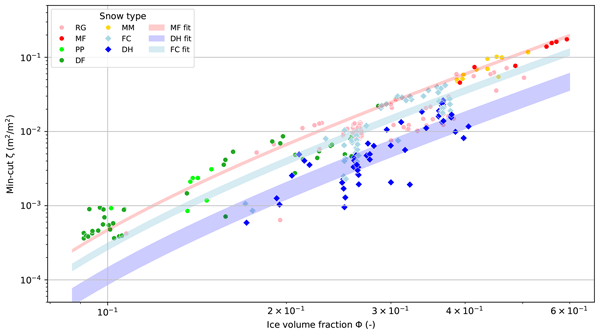
Abstract. Snowpack models are widely used to complement field observations in avalanche risk forecasting. They help estimate key indicators related to dry-snow slab avalanche triggering processes, such as failure initiation and crack propagation. In recent decades, several models have been developed to predict crack propagation propensity, typically characterized by the critical crack length (the cut length beyond which an initial crack self-propagates), measurable in the field using the Propagation Saw Test (PST). However, these models often depend on poorly constrained parameters, particularly, the weak layer fracture energy wf. In this work, we relate the fracture energy to snow properties that can be measured directly or simulated by detailed snowpack models. To this end, we first exploit microstructural knowledge and data by computing the min-cut on about 300 three-dimensional snow microstructure images. The min-cut represents the smallest ice interface that would need to be fractured to separate two opposing sides of the structure, thus providing a quantitative proxy of fracture energy at the microscale. We fitted a relation between the min-cut and snow properties that can be measured or simulated, namely density and grain morphology. The min-cut is then linearly related to the fracture energy wf using measurements from Richter et al. (2019), which track weak layers across multiple seasons and sites using PST and observed profiles. We retrieved wf by inverting the state-of-the-art slab model WEAC (Weißgraeber and Rosendahl, 2023), based on manual measurements and snowpack simulations from the Crocus model. After calibration, wf is evaluated in two slab models of different complexity for their ability to reproduce observed critical crack lengths, using both observed data and Crocus outputs. Although the correlation between min-cut and wf remains moderate (i.e. R of 0.5 at most), likely due to measurement and modeling uncertainties, the parameterization demonstrate a clear added-value over the use of a constant wf in reproducing realistic critical crack lengths (i.e. R = 0.59 and RMSE of 12.5 cm against R = 0.39 and RMSE = 14.5 cm). Moreover, the proposed parameterization performs well for identifying and monitoring weak layers over the course of the season. Its consistent performance across slab models and strong results using Crocus outputs highlight its potential for operational dry-snow slab avalanche hazard monitoring.
-
Notice on discussion status
The requested preprint has a corresponding peer-reviewed final revised paper. You are encouraged to refer to the final revised version.
-
Preprint
(1176 KB)
-
The requested preprint has a corresponding peer-reviewed final revised paper. You are encouraged to refer to the final revised version.
- Preprint
(1176 KB) - Metadata XML
- BibTeX
- EndNote
- Final revised paper


Journal article(s) based on this preprint
Interactive discussion
Status: closed
-
CC1: 'Comment on egusphere-2026-733', Valentin Adam, 25 Mar 2026
- AC3: 'Reply on CC1', Diego Monteiro, 17 Jun 2026
-
RC1: 'Comment on egusphere-2026-733', Philipp Rosendahl, 14 Apr 2026
This manuscript addresses an important and operationally relevant problem: how to parameterize weak-layer fracture energy for snowpack models from variables that are actually available in Crocus-like systems. I find the overall idea promising. The strongest aspect of the study is the multi-scale workflow: the authors start from min-cut calculations on 271 µCT snow images, derive a density–morphology parameterization, map this to weak-layer fracture energy through WEAC inversions of PST data, and then test the resulting formulation in both WEAC and a simplified Heierli-type model. This is a sensible and practically useful direction. The reported improvement over a constant wf is real, especially for observed profiles, and the manuscript benefits from explicit reproducibility efforts through shared data/code.I also view the use of WEAC as methodologically appropriate. Weißgraeber and Rosendahl (2023) present WEAC as a closed-form layered-slab mechanics framework that delivers slab deformations, weak-layer stresses, and energy release rates in real time, while explicitly not making it itself a crack-growth criterion. In that sense, using WEAC here as an inversion/forward mechanics engine is sound.My main concerns are how strongly the manuscript interprets the resulting parameterization as a physically established fracture law, and how it interprets PST-derived critical cut lengths in light of the recent fracture-mechanics literature.Please consider the following general, overarching remarks.1. Critical cut length should be treated more carefully as a system response, not as a material property.Recent work makes this point very clearly. Adam et al. (2024) state that the critical cut length ac marks the onset of unstable crack growth, but it must not be misinterpreted as a material property because it depends on cutting direction, slope angle, slab layering, and load. Bergfeld et al. (2025) further show that PST geometry alone can change measured critical cut lengths substantially, with slope-normal ends yielding up to 50% shorter values than vertical ends. Recent ISSW guidance by Rosendahl et. al (2024) makes the same point even more directly: the measured critical cut length alone does not allow comparison across different experimental conditions and should be used to derive fracture toughness (not vice versa) if comparability is desired. Against that background, I encourage the authors to consistently frame ac as a configuration-dependent system quantity. Within one standardized setup it is a legitimate model target, but it is not itself the weak-layer fracture resistance.2. The manuscript should more clearly separate onset of propagation from sustained propagation, crack arrest, and avalanche release.The title is appropriately limited to the onset of crack propagation, and that focus is scientifically defensible. However, several passages broaden the interpretation toward general “crack propagation propensity” and operational hazard monitoring. Literature shows that these are not the same problem. Bergfeld et al. (2023) distinguish onset from the subsequent dynamic propagation phase and separately quantify dynamic fracture and compaction. Rosendahl et al. (2025) then show that slab touchdown can reduce the energy release rate after onset and contribute to crack arrest, so onset and sustained self-propagation are mechanically distinct stages. In my view, the paper would be stronger if the claims were narrowed accordingly: this is a promising parameterization for onset models, but not yet a complete description of crack propagation or release probability.3. The recent mixed-mode literature raises an important limitation of the scalar wf formulation used here.The manuscript states that WEAC accounts for mixed-mode conditions, but in practice the inversion setup uses upslope PST cuts, no touchdown, and a fixed weak-layer height of 3 cm. Adam et al. (2024) provide a first mixed-mode anticrack interaction law and show that fracture toughness is significantly larger in shear than in collapse. They also note that the historical PST literature contains almost no mode-II-rich data. Conference work by Walet et al. (2024) and Rheinschmidt et al. (2024) points in the same direction: accurate fracture-toughness estimates require better elastic-property retrieval, and fracture resistance is mode-dependent, potentially including mode III for cross-slope propagation. I therefore think the authors should explicitly discuss what their scalar wf represents. As currently formulated, it looks more like an effective PST-based fracture parameter for a limited loading regime than a general weak-layer fracture-energy law. At minimum, the authors should report the mode mixity of their inverted cases and explain why a scalar wf is acceptable for this dataset.4. The min-cut idea is physically attractive, but the paper does not yet establish a strong physical law linking min-cut to macroscopic fracture energy.Here I see both a strength and a limitation. The strength is that the authors do not rely on density alone, and recent work by Schöttner and co-authors strongly supports the general idea that weak-layer mechanics are shaped by microstructure in addition to density. The limitation is that the actual evidence presented here for the specific min-cut → wf link remains moderate: the reported correlations between min-cut and inverted wf are only R ≈ 0.31 .. 0.36 for observed profiles and R = 0.47 for Crocus profiles. Recent mechanical studies also suggest that the relevant microstructural controls are richer than sphericity and SSA alone. In Schöttner et al. (2026), stiffness is linked primarily to anisotropy and tortuosity, while strength is more sensitive to local interface geometry; distinct grain-type regimes are also reported. That does not invalidate the present parameterization, but it does suggest that it should be presented as a pragmatic empirical proxy rather than a physically established constitutive law for fracture energy. Moreover, since µCT scans are available, I encourage the authors to consider the recent findings on links between microscructural and macroscopic properties and look further than min–cut.5. The validation strategy needs to be strengthened, and stronger baselines are necessary.As I understand the workflow, the Richter PST dataset is used to invert pseudo-observed wf, then to fit the min-cut–wf relation, and then again to evaluate predicted ac. This is not an independent validation. A leave-one-weak-layer-out, leave-one-season-out, or leave-one-site-out cross-validation would materially strengthen the paper. This matters especially because the performance gains are uneven: for observed profiles the improvement over constant wf is substantial, but for the Crocus case that is closest to the intended operational application, the gain is modest (R = 0.76 versus 0.73; RMSE 10.1 versus 11.1 cm). In addition, given the recent literature showing that density is the dominant first-order predictor of weak-layer mechanical behavior, I think the key missing baseline is a density-only wf model. Without that comparison, it is difficult to quantify the actual value added by the morphology term. A second useful baseline would be density plus discrete grain type. The present comparison against a constant wf is necessary, but not sufficient.6. The inversion is likely sensitive to elastic and geometric assumptions, and this deserves a more systematic uncertainty analysis.The manuscript fixes several quantities that recent work suggests are influential: weak-layer height is set to 3 cm, weak-layer modulus is taken from a density-only Gerling relation, the WEAC setup assumes upslope cuts, and the Heierli implementation uses an equivalent modulus derived from the WEAC mode-I formulation. Bergfeld et al. (2023) showed that slab layering materially affects inferred stiffness, weak-layer modulus, and fracture-energy partitioning; Adam et al. (2024) and Walet et al. (2024) likewise emphasize the importance of retrieving elastic properties more directly from experiments. I therefore encourage the authors to add a sensitivity analysis for weak-layer thickness, modulus parameterization, and touchdown assumptions, or at least to propagate those uncertainties into the inferred wf. At present, the uncertainty bands for observed profiles mainly reflect the assigned Table A1 ranges of sphericity and SSA, which are themselves taken from 5th–95th percentile ranges in long-term Crocus reanalysis rather than from co-located microstructural measurements.7. The applicability across weak-layer types should be stated more cautiously.The validation data are dominated by faceted crystals and depth hoar, and the single surface-hoar layer in the Richter dataset was not reproduced by Crocus. At the same time, Adam et al. (2024) derived their mixed-mode interaction law on surface-hoar weak layers, while Schöttner et al. (2026) report distinct scaling behavior across FC&DH, DF&RG, and SH categories. I therefore do not think the present manuscript yet supports a broad statement about “snow fracture energy” in general. What it supports best, in my reading, is an effective parameterization for PST-like onset calculations in persistent FC/DH-type weak layers under the specific modeling assumptions used here. The conclusions should be narrowed accordingly.Please also consider the following specific remarks.
- When referring to the PST measurement, I suggest to consistently use critical cut length rather than critical crack length, except where the latter is explicitly defined as a modeled fracture-mechanics quantity.
- Please report the mode-I / mode-II share of the energy release rate for the inverted WEAC cases, not only the final scalar wf. This would greatly help readers position the results relative to Adam et al. (2024), even if dominated by mode I.
- Please add density-only and density-plus-grain-type baselines, and perform held-out validation by weak layer or season. That comparison is central to the paper’s main claim that morphology materially improves prediction.
- Title: The title currently promises a general parameterization of snow fracture energy (fracture toughness), which suggests applicability across mixed-mode fracture, compression, tension, shear, and related cases. The manuscript does not support such a broad scope. As presented, the study is limited to compression fracture toughness of weak layers. I therefore recommend a shorter title that reflects this narrower scope more accurately (see comment 2 above).
- l5: The critical crack length measured in PSTs is specific to the PST configuration, i.e. the cut length beyond which a crack self-propagates in that particular setup. It should not be interpreted as directly transferable to skier-triggered anticracks in an effectively infinite domain. The energy release rates in these configurations differ substantially; this can be demonstrated, for example, with the Heierli model or WEAC. Because the free boundaries in PSTs increase the energy release rate, enclosed anticracks in the same weak layer would generally require much longer critical lengths for propagation. This is a central methodological issue in the manuscript. Critical lengths are configuration- and geometry-dependent and therefore have limited predictive value on their own. For modeling and forecasting, they are better used to infer material properties such as fracture toughness, not treated as transferable physical properties themselves. By contrast, fracture toughness is a material property and is, in principle, transferable across geometries, slope inclinations, and slab configurations. This distinction should be stated clearly and introduced much more carefully.
- l13: The meaning of "inverting" becomes clearer later in the manuscript, but in the abstract the term is too vague. I suggest stating more explicitly what is being inverted and for what purpose.
- l46: This statement is not correct, and the clarification given in l50 points in the opposite direction. Critical crack length depends on geometric, elastic, and bulk properties of the system and is not, by itself, a reliable predictor of crack propagation. For example, a flat slope and a 60 degree slope with the same weak layer and slab can yield very different cut lengths because the slab deformation is fundamentally different. A short cut length measured at 60 degrees does not imply easy propagation on flat terrain. I recommend revising this passage carefully and making these limitations explicit. This comment is closely related to my remark on l5.
- l52: The energy release rate is a system property, reflecting the change in total energy, and should not be attributed to the slab alone. I agree that beam theory can provide a useful modeling framework here, but the wording should be more precise.
- l55: I find this statement too strong in its current form. Whether slab compliance or weak-layer compliance dominates depends strongly on their respective elastic properties. Please qualify the statement more carefully.
- l63-l65: This section requires much more careful framing. In its current form, the method appears insufficiently justified. For instance, how sensitive are the results to changes in SMP diameter, layer thickness, or tip shape? Would a doubled diameter, doubled layer thickness, or a much sharper tip yield the same inferred fracture toughness? I am not sure. These concerns should be addressed.
- l68: The method of Richter et al. (2019) relies on highly simplified weak-layer stress representations and a long chain of assumptions that now appear dated. I suggest acknowledging these limitations more explicitly when citing this work.
- l77: I see a conceptual tension between "physics-based" and "parameterization" in the way these terms are used here. A physics-based model aims to represent causal physical mechanisms, even if approximately. A parameterization, by contrast, is generally phenomenological and correlation-based. I recommend clarifying this distinction.
- l89-l90: This statement is an oversimplification. Crack propagation also depends on weak-layer elastic properties, geometry, slope angle, and related system characteristics. Please revise accordingly.
- l110: The equation appears to lack physical dimensions or units. In particular, considering E but not weak-layer thickness t directly affects the modeled wf, since wf = sig^2 / k where sig is stress and k = E / t weak-layer stiffness. This should be discussed explicitly.
- l169: Does the Richter dataset include weak-layer thickness? If so, I strongly recommend using it. If not, please provide an error-propagation analysis to quantify the effect of assumed versus measured weak-layer thickness.
- l193: The opening sentence of the Results section is unclear. Please rephrase for clarity.
- Figure 3: This figure appears redundant. In my view, Figure 4 already conveys the necessary information, so Figure 3 could be omitted.
- Figure 4: Please consider using a more accessible color palette.
- Figure 6: Does this figure not suggest that a single parameter is insufficient to model wf? Have you considered additional parameters? Since µCT data are available, I encourage you to examine recent work by Schöttner et al. on informative microstructural descriptors and to test parameterizations based on those variables. I understand the motivation to develop a practically usable model with easily measurable inputs. However, even if the eventual goal is a reduced operational model, it is still important first to identify the best-performing physically meaningful model rather than starting from assumptions that may already be too restrictive.
- l274: I cannot follow the equation in its current form. Please define the variables explicitly.
- Figure 7: Adding row labels such as "observed" and "simulated" would improve readability.
- l301: With constant t, the Heierli and WEAC models will naturally give very similar results. Variability in layer thickness would likely provide a stronger basis for discriminating between the models.
- Figure 8: I would appreciate uncertainty estimates for both the data points and the model curves.
- l348–l349: This is presented as an advantage, whereas I would view it more as a limitation in terms of physical representation. I suggest rephrasing accordingly.
- l360: This assumption appears insufficiently supported by fracture-mechanics reasoning, especially for highly porous media, and your own results seem to contradict it. I therefore recommend rewording this point more cautiously.
- l366: Given that µCT data are available, I encourage the authors to go beyond noting the "lack of complexity in the proposed parameterization" and to provide a more advanced analysis.
- l427: The Heierli model does not focus on physical processes at the crack tip. Rather, it only describes slab deformation in regions not supported by the weak layer. This should be stated more accurately.
Overall, I view the manuscript as promising and potentially useful, particularly for operational snowpack modeling. However, I think substantial revision is needed before publication. The key changes are conceptual rather than cosmetic: the paper should more carefully distinguish system-level PST observables from material properties, onset from sustained propagation, and empirical operational parameterization from physically established fracture law. With those revisions, plus stronger baselines and more defensible validation, the study could become a valuable contribution.Citation: https://doi.org/10.5194/egusphere-2026-733-RC1 - AC1: 'Reply on RC1', Diego Monteiro, 17 Jun 2026
-
RC2: 'Comment on egusphere-2026-733', Johan Gaume, 07 May 2026
Dear authors,
I found this manuscript generally well written, timely, and of important potential interest for avalanche forecasting. The central objective is relevant: to relate weak-layer fracture energy in dry-snow slab avalanche models to snow properties that can be measured or simulated by detailed snowpack models, in particular Crocus to model the onset of crack propagation. The proposed workflow, linking microstructural information from 3D images to a min-cut proxy and then to PST-derived effective fracture energies, is interesting and useful.
Although the underlying mechanical representation remains deliberately simplified, the model reproduces field critical crack lengths and their temporal evolution reasonably well. From that perspective, the present approach already appears to be a meaningful and promising step for operational avalanche forecasting: it does not solve the full avalanche-release forecasting problem, but it provides a practical and mechanically interpretable indicator for the onset of crack propagation in modeled snow profiles. More complex and complete models are certainly possible, and may be needed to address mode mixity, finite softening, crack arrest, slab fracture, or skier triggering more completely. However, for the scale and application considered here, the model appears to capture the dominant mechanics controlling the evolution of the critical length while remaining simple enough for operational use.
I nevertheless have several comments and suggestions that I believe could strengthen the manuscript.
First, I agree with previous comments that the fracture energy obtained here should be framed more explicitly as an effective PST-based failure/fracture parameter, rather than as a fully established intrinsic fracture law valid for all geometries and loading modes. This is already partly implicit in the manuscript, since wf is obtained by inversion of PST critical crack lengths using a slab–weak-layer model, and the authors themselves report only moderate correlations between min-cut and inferred wf. I suggest making this point more explicit throughout the paper.
Second, a critical crack length model should, in principle, involve the weak-layer strength, its pre-peak compliance, and, if the weak-layer behavior is not perfectly brittle, a softening distance or fracture energy. In the present framework, the role of strength is somewhat hidden inside the effective energy-based formulation. It would therefore be interesting to compare the present approach not only with the Heierli model, but also with the stress-strength model previously implemented in SNOWPACK by Richter et al. Although that model is also simplified, notably because it assumes perfectly brittle behavior and does not explicitly include a softening length or fracture energy, it provides a useful reference point, and I suspect that very similar results may be obtained. Such a comparison could be placed in an appendix, or at least discussed qualitatively if the authors prefer not to expand the main analysis. In fact, the Richter model somewhat hides fracture-energy or softening information, which may partly explain the empirical correction factor proposed by Richter et al., whereas the Heierli-type formulation hides strength and weak-layer elasticity information inside an effective wf. More generally, explicitly including strength would help avoid potentially inconsistent interpretations, for example when a stress-based stability indicator such as MEPRA predicts natural release while the present propagation model still returns a finite positive critical crack length.
Going one step further, one could introduce both pre-peak compliance and finite softening in a simplified manner (see preprint link at the end of the review). This may help constrain either fracture energy or softening length more robustly, and may also improve the agreement with measured critical crack lengths. Alternatively, the full coupled criterion of Weißgraeber and co-workers could be considered, although constraining both mode-I and mode-II fracture properties from the present dataset may be difficult without dedicated fracture experiments or simulations. The model proposed in the preprint linked at the end of this review could also provide a simplified route, with the merit of clearly distinguishing the brittle contribution associated with the elastic mismatch between weak layer and slab from the finite-softening contribution within a compact mechanical formulation. Distinguishing strength and fracture energy may also help improve the link with the min-cut density.
For instance, the data compiled by Jamieson and Johnston show that snow strength is strongly related to density, but also to grain type. Their 2001 work (https://doi.org/10.3189/172756401781819472) proposed separate density-based parameterizations for persistent and non-persistent grain types, which is broadly consistent with the trends observed here for the min-cut. This raises the question of whether the min-cut may, at least partly, correlate more directly with weak-layer strength than with fracture energy alone. If this dominant strength contribution could be separated, the remaining contribution associated with softening distance or fracture energy might be easier to evaluate. One possible first test would be to use a model combining a brittle contribution ac0 and a softening (or fracture energy contribution), as suggested in the preprint linked below, with a brittle contribution similar in spirit to the Richter/Gaume formulation, possibly using the Jamieson and Johnston (2001) shear-strength parameterization already used in SNOWPACK. A correction term would then account for finite softening or fracture-energy effects. Such a formulation would provide a simple way to include both pre-peak weak-layer compliance and finite softening, while keeping the model compatible with operational snowpack-model inputs. It could also help determine whether the min-cut primarily reflects strength, fracture energy, or a combination of both. I am not requesting to try this in this paper but I think it could be interesting in the future. As a first and simpler step, I suggest testing the Richter/Gaume model with a grain-type-dependent strength parameterization.
The low predicted critical crack lengths close to the surface deserve additional discussion. From the point of view of the slab–weak-layer system and the equations used, such low values are understandable. However, near-surface snow is often poorly bonded and may not form a sufficiently cohesive slab. In practice, crack propagation may then be prevented by slab fracture or crack arrest, even if the computed weak-layer critical crack length is small. The manuscript already mentions this point, but I think it should be emphasized more in the context of future work as a simple tensile-slab criterion could be a useful addition. For example, one could compute a tensile failure length (including bending and pure tension e.g. as in Gaume et al. (2015, TC)) and compare it with the system critical crack length. If the tensile fracture length is smaller than the critical length, sustained propagation in the weak layer would not be mechanically possible because the slab would fracture first.
While the critical crack length is a meaningful metric for the onset of crack propagation in an idealized slab–weak-layer system, it is not sufficient by itself for skier-triggering assessment. A useful next step would be to develop an index in the spirit of Gaume and Reuter, and more recently Méloche et al., comparing the critical crack length to a skier-induced crack or damage length. This would naturally connect the present work to operational triggering likelihood rather than only to propagation onset. This aspect could be discussed as an outlook.
Public discussion
I would also like to comment on part of the public discussion, because I think some conceptual clarifications are important. The following remarks are therefore intended primarily as a response to some of the public comments and their framing; they should not be interpreted as criticisms of the manuscript itself.
Several comments emphasize that the critical crack length should not be treated as a material property. I fully agree with this statement. However, I do not think this is a controversial point, nor do I think the manuscript assumes otherwise. The manuscript explicitly states that the critical crack length depends both on slab deformation and on weak-layer fracture energy. In other words, ac is clearly a system-level quantity of the slab–weak-layer–geometry configuration, not an intrinsic property of the weak layer alone. This distinction is important, but it should not be presented as if the snow-avalanche community, or the present authors, were unaware of it. Such an implication would be misleading, because it turns a well-established distinction into an apparent conceptual controversy.
More importantly, I disagree with the statement that the critical crack length is merely a “geometric measure” and therefore not useful. ac is not an intrinsic material property, but neither is it purely geometrical. It is precisely because ac depends on geometry, slope angle, elastic properties, slab thickness, weak-layer strength and fracture energy that it is useful as a system metric. In avalanche mechanics, like in other fields, we often need configuration-dependent quantities. For example, two avalanches with the same flowing snow may exert different impact pressures on an obstacle because of different flow velocities, obstacle sizes, or obstacle shapes; this does not make impact pressure meaningless. Similarly, the fact that two slab–weak-layer configurations with the same weak layer can produce different critical crack lengths is not a weakness of the concept. It is the purpose of the concept: to describe the onset of propagation for a given mechanical configuration.
Along these lines, the formulation that ac “reinforces a historically misinterpreted quantity in the snow science community” seems unnecessarily broad and risks caricaturing several decades of avalanche-mechanics work. The relevant distinction is not between a single supposedly definitive fracture-mechanics formalism and a “misinterpreted snow-science view”, but between treating ac incorrectly either as a material property or as a purely “geometrical measure”, and using it correctly as the critical response of a given slab–weak-layer configuration. In my view, the latter interpretation has long been well understood in the avalanche community, not only by researchers but also by practitioners in the field: ac is interpreted as a configuration-dependent indicator of propagation onset. Presenting this established distinction as a historical misunderstanding is therefore misleading and, in my view, inappropriate. It does not help move the field forward; on the contrary, it creates unnecessary conceptual confusion around a point that is already well understood.
I also think one should avoid implying that a coupled stress-and-energy criterion is the only mechanically legitimate route to a critical crack length. Coupled criteria, such as those inspired by Leguillon and implemented elegantly in later snow-fracture models, are powerful and valuable. However, they are not the only possible framework. In particular, suggesting that “everyone with a mechanical background” should interpret the critical crack length exclusively through this coupled formalism is an overly narrow view of mechanics and does not reflect the diversity of accepted approaches to failure and fracture. Critical lengths can also emerge from cohesive-zone models, continuum damage models, regularized elastoplastic softening models, phase-field approaches, or simplified analytical or numerical models based on stress, displacement, and finite softening, such as the ones in the preprint linked below. In such formulations, the critical length naturally depends on weak-layer strength, elasticity, and a characteristic softening displacement, which can be related to fracture energy. Thus, fracture mechanics provides an elegant framework to the problem, but it is not the only mechanically consistent one.
This point is important because the manuscript should not be judged only against one particular fracture-mechanics formalism. The relevant question is whether the simplified model captures the dominant mechanics at the scale and for the application considered. In the present case, the model appears to reproduce the order of magnitude, variability, and seasonal evolution of critical crack lengths reasonably well using variables available from Crocus. For operational applications, model parsimony is not necessarily a weakness. The objective should not necessarily be to include all possible fracture processes in a single operational indicator, but to identify which level of mechanical complexity is sufficient for the intended forecasting use. Additional work is clearly needed to obtain a complete picture of the avalanche-triggering problem, but this paper provides a useful first step in that direction.
Finally, I would phrase the suggested “more appropriate framework” with some care. Saying that one should simply compare “the available energy release to the intrinsic fracture toughness of that layer” is not, by itself, sufficient. In a fracture-mechanics framework, one compares a crack-driving quantity, such as an energy release rate or stress-intensity factor, to a corresponding resistance, such as fracture energy or fracture toughness, respectively. However, this comparison still requires a crack size or defect size, unless the additional skier load is explicitly included, as in Part II of the Weißgraeber framework. In practical snowpack stability assessment, this leads back to the same central question: what crack or damage length can be created by a skier, and is it larger than the critical length required for self-propagation? Comparing a skier-induced crack length to the critical crack length is therefore not an inferior alternative; it is essentially the applied form of the same mechanical problem.
Recommendation
Overall, I find the manuscript promising and worth publication after revisions. The main improvements I would recommend are to clearly frame wf as an effective PST-based failure/fracture parameter, clarify the role of strength and softening (or fracture energy), possibly compare the present results with previously published stress-based approaches, and extend the discussion on how this approach could be developed in the future to address current limitations. With these revisions, the study would make a valuable contribution by bridging microstructural snow physics, simplified but mechanically interpretable release-process indicators, and operational snowpack modeling.
Finally, I am grateful for the opportunity to review this paper and to take part in this open discussion. The manuscript and associated comments, together with the recent renewed interest in shear-based theories in the context of supershear crack propagation, motivated me to revisit some old notes and complete a derivation that I had left aside when the field was shifting strongly toward anticrack mechanics. This resulted in the preprint linked below, which focuses primarily on shear failure while also exploring anticrack propagation, and which I hope may provide a useful complementary perspective on the role of weak-layer strength, elasticity, and finite softening in critical crack length models.
Kind regards,
Johan Gaume
Gaume, J., Meloche, F., & Reiweger, I. (2026). Growth of shear failure in snow slab avalanche release: Analytical solution for a compliant weak layer with finite softening. arXiv. https://doi.org/10.48550/arXiv.2605.05061
Citation: https://doi.org/10.5194/egusphere-2026-733-RC2 - AC2: 'Reply on RC2', Diego Monteiro, 17 Jun 2026
-
CC2: 'Comment on egusphere-2026-733', Ron Simenhois, 11 May 2026
Community Comment
As an operational avalanche forecaster and part-time researcher with some experience in snowpack modeling, avalanche release research, and avalanche hazard assessment, I offer the following perspective on this manuscript and the associated public discussion.
Overall assessment
This paper addresses a genuine and longstanding gap: the weak-layer fracture energy wf has remained a poorly constrained free parameter in crack-propagation models, typically back-calculated from PST data rather than independently estimated from snowpack state variables. The proposed parameterization, linking wf to density, grain sphericity, and SSA through a min-cut proxy derived from X-ray microtomography, is a meaningful step toward making crack propagation indicators fully prognostic from snowpack model outputs. From a practitioner's standpoint, programs already running Crocus or SNOWPACK operationally can implement this with modest effort and obtain more physically consistent crack-propagation estimates than a constant wf provides. That is a real and useful contribution. Beyond its immediate application to crack-propagation onset, the continuously applicable wf parameterization developed here serves as a foundational input for future work on dynamic crack propagation and fracture arrest at the slope scale. Coupling spatially varying wf fields derived from distributed snowpack simulations to dynamic propagation frameworks would be a natural and productive next step, crucial to operational avalanche programs, and this paper removes a key obstacle to that work.
On the nature of ac
The public discussion has generated considerable debate over whether the critical crack length ac is a valid indicator of crack-propagation propensity. We want to be precise here. Calling ac a "geometrical measure" understates its physical content; it integrates slab density, elastic modulus, height, weak layer fracture energy, slope angle, and cutting direction through a mechanical model. It is more accurately described as a system property: a configuration-dependent indicator of the onset of propagation for a given slab-weak layer configuration. I agree with the second reviewer's framing, and the impact pressure analogy is apt. Recent work by Adam et al. (2024) and Bergfeld et al. (2025) makes explicit that PST-derived critical cut lengths are not transferable across experimental configurations and that they are most appropriately used to infer material properties, such as fracture toughness, rather than treated as portable physical properties themselves. The paper should reflect this framing consistently.
That said, the configuration-dependence of ac does raise a legitimate methodological concern that the paper should address more explicitly. Comparing ac values across different snowpack configurations without adequately controlling for the dominant non-wf drivers, primarily slab density and height, makes it difficult to isolate the contribution of the wf parameterization. The slab stiffness gradient with depth dominates the profile-wide ac signal in Figure 9, and the cross-sectional comparison in Figure 7 conflates variance from slab properties with variance from wf. The more controlled and compelling validation is actually the temporal evolution analysis in Figure 8, where the same weak layer is tracked through a season with consistently modeled slab evolution. This result deserves greater prominence: it is both scientifically cleaner and directly relevant to operational use, where practitioners need to track weak-layer stabilization over a season.
On the completeness of the physical framework
The first public comment implies that the absence of a coupled stress-energy initiation criterion represents a fundamental conceptual gap. I disagree with this framing. Avalanche release is a chain of distinct necessary conditions: failure initiation, onset of crack propagation, dynamic crack propagation across the slope, crown fracture, and slab sliding. This paper addresses one link in that chain. No single contribution is expected to resolve the full sequence, and evaluating this paper against that standard is not appropriate. The relevant avalanche mechanics literature, including Reuter and Schweizer (2018), has explicitly separated failure initiation from crack propagation propensity precisely because these are distinct problems requiring distinct treatments.
It is equally important to distinguish the onset of crack propagation, which this paper models, from sustained dynamic propagation and fracture arrest, which are mechanically distinct subsequent stages. Bergfeld et al. (2023) separately quantify dynamic fracture and compaction following onset, while Rosendahl et al. (2025) show that slab touchdown can reduce the energy release rate after onset and contribute to crack arrest. The paper's title appropriately limits scope to the onset, but several passages broaden the interpretation toward general crack-propagation propensity and operational hazard monitoring. The claims should be narrowed accordingly: this is a promising parameterization for onset models, not yet a complete description of crack propagation or release probability.
The practical implication is not that the paper's output is invalid; rather, it is that ac should be interpreted in combination with failure initiation indicators, which is already standard practice in operational programs that use multiple stability indices. A weak layer with low ac but low failure initiation likelihood is not operationally dangerous, and practitioners understand this. The paper acknowledges this briefly but could be more explicit about it as an operational caveat.
Scientific concerns worth addressing
Setting aside the conceptual debate, several methodological concerns merit attention.
The most significant is the potential circularity between calibration and evaluation. The Richter et al. (2019) PST dataset is used both to establish the linear wf-to-min-cut relationship and to evaluate how well the resulting parameterization predicts ac. The demonstrated improvement over a constant wf is at least partially guaranteed by construction. A leave-one-weak-layer-out, leave-one-season-out, or leave-one-site-out cross-validation would materially strengthen the validation. This matters especially because the performance gain in the operationally relevant Crocus case, the configuration closest to actual forecasting use, is modest: R = 0.76 versus 0.73 and RMSE 10.1 versus 11.1 cm compared to constant wf. The larger gains appear in the observed-profile case, which is less operationally relevant. The paper should be transparent about this asymmetry rather than leading with the more favorable numbers.
The question of whether the min-cut is doing genuinely independent work beyond density deserves a direct test. The paper itself acknowledges that density is the primary driver of min-cut, and density also enters the WEAC model through the Gerling elastic modulus formulation at a steep power law (ρ^5.13). Without a density-only baseline, and ideally a density-plus-discrete-grain-type baseline, it is impossible to quantify the contribution of the morphology term, as measured by sphericity and SSA. The current comparison with only a constant wf is necessary but insufficient to support the paper's main claim.
A related concern is mode mixity. The manuscript states that WEAC accounts for mixed-mode conditions, but the inversion setup uses upslope PST cuts, no touchdown, and a fixed weak layer height of 3 cm. Adam et al. (2024) show that fracture toughness is substantially larger in shear than in collapse, and that the historical PST literature contains almost no mode-II-rich data. As currently formulated, wf looks more like an effective PST-based fracture parameter for a mode-I-dominated loading regime than a general weak-layer fracture energy law. The authors should report the mode-I/mode-II share of the energy release rate for the inverted WEAC cases and explain explicitly why a scalar wf is acceptable for this dataset and its intended application.
A more technical concern relates to the fitted percolation threshold ϕt = 0.04, corresponding to a density of approximately 37 kg/m³. The dataset does not include samples with ϕ < approximately 0.08 (~75 kg/m³ for precipitation particles), so this parameter is extrapolated below the calibration data range. The physical interpretation of a percolation threshold for ice bond network connectivity in very low-density fresh snow is not straightforward, and to my knowledge, the appropriate literature, modern snow micro-tomography work on structural connectivity, does not clearly support a value this low. The sensitivity of the parameterization to this fitted threshold should be reported, and its physical basis discussed more carefully.
The finding that modeled Crocus profiles outperform directly observed profiles is operationally encouraging but deserves careful interpretation alongside the known density bias in Crocus (systematic underestimation of slab density, RMSE 58.8 kg/m³). The authors suggest this reflects measurement noise in density cutters, which is plausible. However, it also reflects that the parameterization was calibrated within Crocus's representational space, where density, SSA, and sphericity evolve with internal consistency. The possibility that the parameterization is better tuned to the model world than to physical reality should be acknowledged explicitly.
From a practitioner and operational perspective
Both Crocus and SNOWPACK have known limitations in representing actual snowpack states, density biases, sensitivity of weak layer formation to temperature-gradient parameterization, and layering resolution constraints. These challenges are larger in many operational contexts than the specific gap this paper addresses. But that context favors this paper's contribution: it removes one source of indeterminacy in the crack-propagation modeling chain without requiring new field measurements or model restructuring.
The validation dataset being drawn entirely from two instrumented research sites 3 km apart above Davos, dominated by DH and FC grain types in an Alpine climate regime, limits statements about portability. The single surface hoar layer in the dataset was not reproduced by Crocus, and Adam et al. (2024) derived their mixed-mode interaction law specifically on surface hoar weak layers, while Schöttner et al. (2026) report distinct scaling behavior across FC/DH, DF/RG, and surface hoar categories. What the paper supports most defensibly is an effective parameterization for PST-onset calculations in persistent FC/DH-type weak layers under the specific modeling assumptions used. The conclusions should reflect this scope rather than claiming generality across snow fracture energy broadly. Maritime snowpacks and thin continental snowpacks are unrepresented, and portability to other climate regimes is an important open question that should be stated explicitly as a priority for future work.
A subtler but equally important limitation is that neither of these study sites, nor most sites where operational snowpack models are routinely validated, are located in actual avalanche start zones. Snowpack models are typically run at weather station sites on flat or low-angle terrain, and their outputs are extrapolated to release zone terrain. The snowpack in a 35-40° start zone differs from a research plot in its wind redistribution history, slope-parallel settlement, radiation geometry, and spatial variability. Whether the parameterization behaves consistently when applied to start zone terrain, where the slab-weak layer system properties are what actually matter for avalanche release, has not been investigated. This is a recognized gap across the broader snowpack modeling literature, not specific to this paper, but it deserves explicit acknowledgment in the context of operational claims.
Conclusion
This paper makes a genuine and implementable contribution to operational avalanche forecasting. It narrows a specific gap, the wf free parameter problem, that has limited the utility of crack propagation indicators in operational snowpack modeling. The scope is best understood as an effective parameterization for PST-based onset calculations in persistent FC/DH weak layers, rather than a general snow fracture energy law, and the conclusions and title should reflect this more carefully. The public debate around the paper has, in places, conflated legitimate methodological concerns with broader disciplinary arguments about fracture mechanics frameworks that do not directly bear on the paper's contribution. The second reviewer's careful response to these comments is well-reasoned, and I support its framing.
With revisions addressing the calibration circularity, the density-alone and density-plus-grain-type baselines, the mode mixity characterization, the percolation threshold extrapolation, the modest performance gain in the operationally relevant Crocus case, and clearer framing of wf as an effective PST-based parameter rather than an intrinsic material property, this paper would represent a meaningful and operationally relevant advance.
Thank you,
Ron Simenhois
Citation: https://doi.org/10.5194/egusphere-2026-733-CC2 - AC4: 'Reply on CC2', Diego Monteiro, 17 Jun 2026
-
CC3: 'Comment on egusphere-2026-733', Valentin Adam, 12 May 2026
Dear authors, reviewers, and members of the discussion,
After reading the subsequent reviews and community comments, I would like to add a short follow-up reflection regarding my earlier community comment.
First, I would like to apologize for the tone of some parts of my original comment. I am very engaged in this topic and probably approached the discussion too narrowly from within my own research perspective. In doing so, I expressed some points more harshly than intended. This was never meant as a personal criticism of the authors or to diminish the value and ambition of the paper itself, which addresses an important and timely problem for avalanche forecasting and snowpack modeling.
I especially appreciated reading the later reviews and discussion contributions. In particular, Johan Gaume’s review helped broaden my perspective regarding the interpretation and role of critical crack length approaches and the diversity of mechanically consistent frameworks that can be used to describe propagation onset. I realize that I framed some aspects too strongly around one specific fracture-mechanics interpretation, while the operational and systems-level perspective emphasized by Johan is equally important and valuable in this context. Ron Simenhois also raised several very good points regarding the practical and operational relevance of configuration-dependent indicators such as (a_c), as well as the importance of distinguishing between methodological limitations and the actual usefulness of simplified operational models.
I still believe that some of the conceptual clarifications discussed throughout the review process, particularly regarding the interpretation of (a_c), the scope of the parameterized (w_f), and the distinction between onset and sustained propagation, are important and will strengthen the manuscript. However, I also recognize that my original wording at times overstated the level of controversy around these topics and did not sufficiently acknowledge the broader context and history of avalanche mechanics research.
Overall, I very much enjoyed reading the different reviews and the discussion taking place around this manuscript. The discussion itself highlights how relevant and active this research direction currently is, and in my opinion it clearly underscores the need for such approaches and continued development in this field.
I believe the manuscript is promising and worth publication after revision, although of course I am only a community commenter and not in the position to make editorial judgments.
I thank the authors, reviewers, and community contributors for the thoughtful discussion. I will also take this as a reminder to check my tone a bit more carefully before posting future comments. My intention was always to contribute constructively to the discussion, even if my enthusiasm for the topic came across more strongly than intended.
Best regards,
Valentin Adam
Citation: https://doi.org/10.5194/egusphere-2026-733-CC3
Peer review completion


Interactive discussion
Status: closed
-
CC1: 'Comment on egusphere-2026-733', Valentin Adam, 25 Mar 2026
Dear authors,
The topic is highly relevant for avalanche forecasting and aims to bridge microstructural physics with operational snowpack models. In particular, the analysis of the CT dataset is valuable and extensive, contributing to an improved understanding of how microstructural properties relate to macroscopic properties.
However, the manuscript currently suffers from conceptual inconsistencies, unclear physical interpretation, and methodological gaps that limit the strength of its conclusions.
1. Critical energy release rate vs. critical crack length
From a fracture mechanics perspective, it remains unclear what is meant by the term “critical crack length.” One could interpret it as the finite crack size required for the onset of crack propagation within a coupled criterion framework (Leguillon, https://doi.org/10.1016/S0997-7538(01)01184-6), but this is not the case here. Renaming this quantity to “critical cut length” would help avoid this ambiguity.
Furthermore, the manuscript neglects the second condition required for fracture initiation, namely that the stress must exceed the strength of the weak layer (Leguillon). The context of coupled criteria is therefore missing.
“The stability of a snowpack and the critical length above which a crack spontaneously propagates depend on both the fracture energy of the weak layer w_f and on the mechanical behavior of the overlying slab”. What critical length is ment here, the finite length of a coupled criterion which needs to be exceeded (like everyone with a mechanical background reads) or the “critical crack length” of a PST (like snow practitioners reads it) ?
“The fracture energy itself is known to be a function of the snow layer density and microstructure”. This has never been stated in the mentioned reference Adam et al., https://doi.org/10.1038/s41467-024-51491-7
The magnitude of the “critical crack length” derived from a PST does not provide direct information about crack propagation propensity. It is a geometric measure rather than a material property. For the same weak layer, different critical cut lengths can be obtained depending on slope inclination, slab stratification, and cutting direction (see Adam et al., https://doi.org/10.1038/s41467-024-51491-7).
"A small a_c means that the weak layer below the slab is prone to crack propagation.” This statement is incorrect. A small “critical crack length” is not a direct indicator that the weak layer is prone to crack propagation, but a configuration-dependent system response of the slab–weak layer–geometry setup as you partly mention: “The critical crack length ac thus depends on both how the slab deforms when it loses support from the weak layer, and the specific fracture energy of the weak layer “. Same applies for “Finally, we examine the potential of predicted critical crack lengths to discriminate between weak layers and more stable layers within a profile.”
The “critical crack length" has so many geometric and material dependencies which scale differently that its nearly impossible to interpret it. E.g. a longer “crack length” can be related to a stiffer slab due to a crust and even though the weak layer might be potentially dangerous. Vice versa how should be the small “crack length” at lower slab height be interpreted in Figure 9 without knowledge? Those interactions makes the interpretation highly complex, particularly for operational applications or practitioners.
The profiles in Figure 9 mainly reflect the effect of slab stiffness, which causes the “critical crack length” to increase more or less linearly with depth. The observed discontinuities are introduced by the min-cut parameterization associated with different grain types. If the min-cut parameterization were plotted with the corresponding calculated critical energy release rates, this would contain essentially the same information but would be easier to interpret. In this context, the level of “critical cut length” is unnecessary. These values are absolute and configuration-dependent, and therefore not intrinsic material properties. As such, they are not suitable quantities to describe or predict fracture initiation or propagation.
The terminology “crack propagation propensity” is vague. The critical energy release rate describes fracture initiation (or “onset,” as stated in the title). If crack propagation itself is to be addressed, a steady-state framework (e.g., Rosendahl et al., https://doi.org/10.5194/nhess-25-1975-2025) or dynamic fracture processes (e.g., Bergfeld et al., https://doi.org/10.5194/nhess-23-293-2023) must be considered. From a fracture mechanics standpoint, the PST-derived “critical crack length” is not a valid indicator of crack propagation and has historically been misinterpreted in the snow science community.
Since PST measurements are partly conducted on inclined slopes, the relative contributions of mode I and mode II should also be clarified. A brief statement quantifying that the loading is predominantly mode I (e.g., ~95%) and that the analysis is therefore restricted to mode I-driven initiation would improve clarity.
2. Missing physical justification of the min-cut → fracture energy link
No direct experimental validation is provided to support a correlation between min-cut and critical energy release rate.
The argumentation of the parameterization follows an indirect route via the “critical crack length.” The comparison with a constant energy release rate primarily shows that, within the PST dataset, the inferred energy release rate is not constant but varies, likely with density. Since density is also a primary input to the min-cut formulation, the resulting improvement in modelled “critical crack length” does not constitute a robust justification for a physically meaningful parameterization between min-cut and fracture energy.
Rather, this highlights the need for a controlled experimental campaign combining fracture mechanical field tests with direct CT measurements across different grain types.
The correlation on which the parameterization is based remains only moderate.
It is unclear whether the PST dataset alone is suitable to validate such a relationship across different grain types. It should first be demonstrated that grain types can be statistically correlated with fracture energy derived from the PST dataset itself. If this is not possible, the dataset may not be appropriate for validating the proposed parameterization.
In addition, it is unclear whether the PST dataset contains a sufficient diversity of grain types to support such validation.
The assumption of a fixed weak-layer thickness in the PST analysis is not explained, as this information is available in the original dataset. Similarly, the weak-layer elasticity is parameterized via density relationships derived for general snow types rather than specifically for weak layers. It is not stated which parametrisation is chosen (AC, CT, SMP) from Gerling 2017. This would improve clarity. Furthermore, density-based parameterizations reflect an apparent stiffness rather than the theoretical Young’s modulus. Consequently, the experimental method used to derive such parameterizations should be consistent with the actual loading conditions, particularly with respect to strain rate and time-dependent behavior. For example, formulations such as Gerling (2017) may yield Young’s modulus values several times higher than the effective modulus relevant for PST-type configurations (see Schöttner et al., 2025, Fig. 13a). In addition, more appropriate parameterizations exist for specific weak layer grain types (e.g., Schöttner et al., 2025). A clear separation between the derivation of weak layer and slab elastic moduli is necessary.
Since the weak-layer Young’s modulus strongly influences the calculated energy release rate (see sensitivity study Adam et al., https://doi.org/10.1038/s41467-024-51491-7), it is important to assess whether the observed correlation between min-cut and fracture energy isn’t in fact primarily a density correlation. Given the multiple sources of uncertainty in deriving fracture energy from PSTs, this should be explicitly tested. For example, a direct comparison between weak-layer density and min-cut may already yield similar or even stronger correlations.
The manuscript itself acknowledges that density is the main variable controlling min-cut and that measured densities exhibit strong scatter: ” Since the density of the weak layer is the main variable used to estimate the min-cut in the parameterization Eq. 5,” and “we assume that the min-cut can be related to a macroscopic quantity, in particular the snow density.” A sensitivity analysis quantifying this effect would therefore be highly valuable.
While the min-cut may indeed be a promising proxy for fracture energy, the current approach does not convincingly demonstrate this. It would be more straightforward to directly test correlations between fracture energy and other available microstructural descriptors (e.g., from CROCUS or grain-type parameterizations) rather than introducing an additional layer of assumptions via min-cut.
3. Further comments
- The inclusion of the Heierli model does not add clear value to the manuscript. The WEAC model is state-of-the-art and computationally efficient, and the comparison does not contribute significantly to the overall argument.
- Figure 1 is misleading, as the slab is not represented as a true Timoshenko beam; the boundary conditions do not allow for rotational freedom at the slab end.
- The nomenclature should be used consistently (e.g., a_c vs. AC in figures). Indexing of Units should also be checked carefully m^2 “squared” instead of just m2.
- Introduced variables should appear consistently in figure labels (e.g., min-cut with ζ).
- Figure 5 contains redundant labeling (headers and x-axis labels).
- Figures 3 and 4 appear redundant; one should be removed. Additionally, labeling inconsistencies (“min min-cut” vs. “min-cut”) should be corrected.
- Avoid using red and green with identical marker shapes due to accessibility concerns.
- Use consistent terminology throughout (e.g., “min-cut” vs. “mincut”).
- A schematic overview of the full methodology (similar to Mayer et al., 2023, Fig. 1 https://doi.org/10.5194/nhess-23-3445-2023) would greatly improve readability.
- The treatment of sphericity and SSA is difficult to follow. It is only briefly mentioned in a figure caption (Fig. 6) and appendix. A1 clearer methodological description of how different grain types are handled is needed.
- Key contextual explanations currently presented in the first section of the discussion should be moved to the methods, this would help to better follow the conceptual idea.
- Figure 2 would benefit from additional labelling of the weak layer of interest
- 3.2.2 (Fig. 6Y) ?
- Figure 7: Indicate clearer within the plots that a) b) are observed and c) d) are simulated. This can only be know with reading the caption.
- Figure 6 c) to f) x axis label is missing or can not be required to be transferred by the reader from g) because its another scale and plot.
- Figure 6: what are the units for time ?
- The inconsistency in error use and their origin is confusing think about adding errors in the whole model chain as well.
- Figure 7 a) where does the different errors measured for a_c come from? They are rather relativ nor absolute.
The general approach of estimating the resistance of each snow layer against crack propagation using snowpack models such as Crocus, which resolve microstructural properties, is very promising.
However:
a) The methodological justification of the min-cut parameterization for fracture energy is currently insufficient.
b) The use of the geometrical measure “critical crack length” introduces conceptual ambiguity and reinforces a historically misinterpreted quantity in the snow science community.A more appropriate framework would directly assess, for each layer, how the available energy release compares to the intrinsic fracture toughness of that layer. This ultimately calls for a physically consistent approach in which fracture toughness is determined through controlled fracture experiments across different grain types combined with direct CT measurements.
Citation: https://doi.org/10.5194/egusphere-2026-733-CC1 - AC3: 'Reply on CC1', Diego Monteiro, 17 Jun 2026
-
RC1: 'Comment on egusphere-2026-733', Philipp Rosendahl, 14 Apr 2026
This manuscript addresses an important and operationally relevant problem: how to parameterize weak-layer fracture energy for snowpack models from variables that are actually available in Crocus-like systems. I find the overall idea promising. The strongest aspect of the study is the multi-scale workflow: the authors start from min-cut calculations on 271 µCT snow images, derive a density–morphology parameterization, map this to weak-layer fracture energy through WEAC inversions of PST data, and then test the resulting formulation in both WEAC and a simplified Heierli-type model. This is a sensible and practically useful direction. The reported improvement over a constant wf is real, especially for observed profiles, and the manuscript benefits from explicit reproducibility efforts through shared data/code.I also view the use of WEAC as methodologically appropriate. Weißgraeber and Rosendahl (2023) present WEAC as a closed-form layered-slab mechanics framework that delivers slab deformations, weak-layer stresses, and energy release rates in real time, while explicitly not making it itself a crack-growth criterion. In that sense, using WEAC here as an inversion/forward mechanics engine is sound.My main concerns are how strongly the manuscript interprets the resulting parameterization as a physically established fracture law, and how it interprets PST-derived critical cut lengths in light of the recent fracture-mechanics literature.Please consider the following general, overarching remarks.1. Critical cut length should be treated more carefully as a system response, not as a material property.Recent work makes this point very clearly. Adam et al. (2024) state that the critical cut length ac marks the onset of unstable crack growth, but it must not be misinterpreted as a material property because it depends on cutting direction, slope angle, slab layering, and load. Bergfeld et al. (2025) further show that PST geometry alone can change measured critical cut lengths substantially, with slope-normal ends yielding up to 50% shorter values than vertical ends. Recent ISSW guidance by Rosendahl et. al (2024) makes the same point even more directly: the measured critical cut length alone does not allow comparison across different experimental conditions and should be used to derive fracture toughness (not vice versa) if comparability is desired. Against that background, I encourage the authors to consistently frame ac as a configuration-dependent system quantity. Within one standardized setup it is a legitimate model target, but it is not itself the weak-layer fracture resistance.2. The manuscript should more clearly separate onset of propagation from sustained propagation, crack arrest, and avalanche release.The title is appropriately limited to the onset of crack propagation, and that focus is scientifically defensible. However, several passages broaden the interpretation toward general “crack propagation propensity” and operational hazard monitoring. Literature shows that these are not the same problem. Bergfeld et al. (2023) distinguish onset from the subsequent dynamic propagation phase and separately quantify dynamic fracture and compaction. Rosendahl et al. (2025) then show that slab touchdown can reduce the energy release rate after onset and contribute to crack arrest, so onset and sustained self-propagation are mechanically distinct stages. In my view, the paper would be stronger if the claims were narrowed accordingly: this is a promising parameterization for onset models, but not yet a complete description of crack propagation or release probability.3. The recent mixed-mode literature raises an important limitation of the scalar wf formulation used here.The manuscript states that WEAC accounts for mixed-mode conditions, but in practice the inversion setup uses upslope PST cuts, no touchdown, and a fixed weak-layer height of 3 cm. Adam et al. (2024) provide a first mixed-mode anticrack interaction law and show that fracture toughness is significantly larger in shear than in collapse. They also note that the historical PST literature contains almost no mode-II-rich data. Conference work by Walet et al. (2024) and Rheinschmidt et al. (2024) points in the same direction: accurate fracture-toughness estimates require better elastic-property retrieval, and fracture resistance is mode-dependent, potentially including mode III for cross-slope propagation. I therefore think the authors should explicitly discuss what their scalar wf represents. As currently formulated, it looks more like an effective PST-based fracture parameter for a limited loading regime than a general weak-layer fracture-energy law. At minimum, the authors should report the mode mixity of their inverted cases and explain why a scalar wf is acceptable for this dataset.4. The min-cut idea is physically attractive, but the paper does not yet establish a strong physical law linking min-cut to macroscopic fracture energy.Here I see both a strength and a limitation. The strength is that the authors do not rely on density alone, and recent work by Schöttner and co-authors strongly supports the general idea that weak-layer mechanics are shaped by microstructure in addition to density. The limitation is that the actual evidence presented here for the specific min-cut → wf link remains moderate: the reported correlations between min-cut and inverted wf are only R ≈ 0.31 .. 0.36 for observed profiles and R = 0.47 for Crocus profiles. Recent mechanical studies also suggest that the relevant microstructural controls are richer than sphericity and SSA alone. In Schöttner et al. (2026), stiffness is linked primarily to anisotropy and tortuosity, while strength is more sensitive to local interface geometry; distinct grain-type regimes are also reported. That does not invalidate the present parameterization, but it does suggest that it should be presented as a pragmatic empirical proxy rather than a physically established constitutive law for fracture energy. Moreover, since µCT scans are available, I encourage the authors to consider the recent findings on links between microscructural and macroscopic properties and look further than min–cut.5. The validation strategy needs to be strengthened, and stronger baselines are necessary.As I understand the workflow, the Richter PST dataset is used to invert pseudo-observed wf, then to fit the min-cut–wf relation, and then again to evaluate predicted ac. This is not an independent validation. A leave-one-weak-layer-out, leave-one-season-out, or leave-one-site-out cross-validation would materially strengthen the paper. This matters especially because the performance gains are uneven: for observed profiles the improvement over constant wf is substantial, but for the Crocus case that is closest to the intended operational application, the gain is modest (R = 0.76 versus 0.73; RMSE 10.1 versus 11.1 cm). In addition, given the recent literature showing that density is the dominant first-order predictor of weak-layer mechanical behavior, I think the key missing baseline is a density-only wf model. Without that comparison, it is difficult to quantify the actual value added by the morphology term. A second useful baseline would be density plus discrete grain type. The present comparison against a constant wf is necessary, but not sufficient.6. The inversion is likely sensitive to elastic and geometric assumptions, and this deserves a more systematic uncertainty analysis.The manuscript fixes several quantities that recent work suggests are influential: weak-layer height is set to 3 cm, weak-layer modulus is taken from a density-only Gerling relation, the WEAC setup assumes upslope cuts, and the Heierli implementation uses an equivalent modulus derived from the WEAC mode-I formulation. Bergfeld et al. (2023) showed that slab layering materially affects inferred stiffness, weak-layer modulus, and fracture-energy partitioning; Adam et al. (2024) and Walet et al. (2024) likewise emphasize the importance of retrieving elastic properties more directly from experiments. I therefore encourage the authors to add a sensitivity analysis for weak-layer thickness, modulus parameterization, and touchdown assumptions, or at least to propagate those uncertainties into the inferred wf. At present, the uncertainty bands for observed profiles mainly reflect the assigned Table A1 ranges of sphericity and SSA, which are themselves taken from 5th–95th percentile ranges in long-term Crocus reanalysis rather than from co-located microstructural measurements.7. The applicability across weak-layer types should be stated more cautiously.The validation data are dominated by faceted crystals and depth hoar, and the single surface-hoar layer in the Richter dataset was not reproduced by Crocus. At the same time, Adam et al. (2024) derived their mixed-mode interaction law on surface-hoar weak layers, while Schöttner et al. (2026) report distinct scaling behavior across FC&DH, DF&RG, and SH categories. I therefore do not think the present manuscript yet supports a broad statement about “snow fracture energy” in general. What it supports best, in my reading, is an effective parameterization for PST-like onset calculations in persistent FC/DH-type weak layers under the specific modeling assumptions used here. The conclusions should be narrowed accordingly.Please also consider the following specific remarks.
- When referring to the PST measurement, I suggest to consistently use critical cut length rather than critical crack length, except where the latter is explicitly defined as a modeled fracture-mechanics quantity.
- Please report the mode-I / mode-II share of the energy release rate for the inverted WEAC cases, not only the final scalar wf. This would greatly help readers position the results relative to Adam et al. (2024), even if dominated by mode I.
- Please add density-only and density-plus-grain-type baselines, and perform held-out validation by weak layer or season. That comparison is central to the paper’s main claim that morphology materially improves prediction.
- Title: The title currently promises a general parameterization of snow fracture energy (fracture toughness), which suggests applicability across mixed-mode fracture, compression, tension, shear, and related cases. The manuscript does not support such a broad scope. As presented, the study is limited to compression fracture toughness of weak layers. I therefore recommend a shorter title that reflects this narrower scope more accurately (see comment 2 above).
- l5: The critical crack length measured in PSTs is specific to the PST configuration, i.e. the cut length beyond which a crack self-propagates in that particular setup. It should not be interpreted as directly transferable to skier-triggered anticracks in an effectively infinite domain. The energy release rates in these configurations differ substantially; this can be demonstrated, for example, with the Heierli model or WEAC. Because the free boundaries in PSTs increase the energy release rate, enclosed anticracks in the same weak layer would generally require much longer critical lengths for propagation. This is a central methodological issue in the manuscript. Critical lengths are configuration- and geometry-dependent and therefore have limited predictive value on their own. For modeling and forecasting, they are better used to infer material properties such as fracture toughness, not treated as transferable physical properties themselves. By contrast, fracture toughness is a material property and is, in principle, transferable across geometries, slope inclinations, and slab configurations. This distinction should be stated clearly and introduced much more carefully.
- l13: The meaning of "inverting" becomes clearer later in the manuscript, but in the abstract the term is too vague. I suggest stating more explicitly what is being inverted and for what purpose.
- l46: This statement is not correct, and the clarification given in l50 points in the opposite direction. Critical crack length depends on geometric, elastic, and bulk properties of the system and is not, by itself, a reliable predictor of crack propagation. For example, a flat slope and a 60 degree slope with the same weak layer and slab can yield very different cut lengths because the slab deformation is fundamentally different. A short cut length measured at 60 degrees does not imply easy propagation on flat terrain. I recommend revising this passage carefully and making these limitations explicit. This comment is closely related to my remark on l5.
- l52: The energy release rate is a system property, reflecting the change in total energy, and should not be attributed to the slab alone. I agree that beam theory can provide a useful modeling framework here, but the wording should be more precise.
- l55: I find this statement too strong in its current form. Whether slab compliance or weak-layer compliance dominates depends strongly on their respective elastic properties. Please qualify the statement more carefully.
- l63-l65: This section requires much more careful framing. In its current form, the method appears insufficiently justified. For instance, how sensitive are the results to changes in SMP diameter, layer thickness, or tip shape? Would a doubled diameter, doubled layer thickness, or a much sharper tip yield the same inferred fracture toughness? I am not sure. These concerns should be addressed.
- l68: The method of Richter et al. (2019) relies on highly simplified weak-layer stress representations and a long chain of assumptions that now appear dated. I suggest acknowledging these limitations more explicitly when citing this work.
- l77: I see a conceptual tension between "physics-based" and "parameterization" in the way these terms are used here. A physics-based model aims to represent causal physical mechanisms, even if approximately. A parameterization, by contrast, is generally phenomenological and correlation-based. I recommend clarifying this distinction.
- l89-l90: This statement is an oversimplification. Crack propagation also depends on weak-layer elastic properties, geometry, slope angle, and related system characteristics. Please revise accordingly.
- l110: The equation appears to lack physical dimensions or units. In particular, considering E but not weak-layer thickness t directly affects the modeled wf, since wf = sig^2 / k where sig is stress and k = E / t weak-layer stiffness. This should be discussed explicitly.
- l169: Does the Richter dataset include weak-layer thickness? If so, I strongly recommend using it. If not, please provide an error-propagation analysis to quantify the effect of assumed versus measured weak-layer thickness.
- l193: The opening sentence of the Results section is unclear. Please rephrase for clarity.
- Figure 3: This figure appears redundant. In my view, Figure 4 already conveys the necessary information, so Figure 3 could be omitted.
- Figure 4: Please consider using a more accessible color palette.
- Figure 6: Does this figure not suggest that a single parameter is insufficient to model wf? Have you considered additional parameters? Since µCT data are available, I encourage you to examine recent work by Schöttner et al. on informative microstructural descriptors and to test parameterizations based on those variables. I understand the motivation to develop a practically usable model with easily measurable inputs. However, even if the eventual goal is a reduced operational model, it is still important first to identify the best-performing physically meaningful model rather than starting from assumptions that may already be too restrictive.
- l274: I cannot follow the equation in its current form. Please define the variables explicitly.
- Figure 7: Adding row labels such as "observed" and "simulated" would improve readability.
- l301: With constant t, the Heierli and WEAC models will naturally give very similar results. Variability in layer thickness would likely provide a stronger basis for discriminating between the models.
- Figure 8: I would appreciate uncertainty estimates for both the data points and the model curves.
- l348–l349: This is presented as an advantage, whereas I would view it more as a limitation in terms of physical representation. I suggest rephrasing accordingly.
- l360: This assumption appears insufficiently supported by fracture-mechanics reasoning, especially for highly porous media, and your own results seem to contradict it. I therefore recommend rewording this point more cautiously.
- l366: Given that µCT data are available, I encourage the authors to go beyond noting the "lack of complexity in the proposed parameterization" and to provide a more advanced analysis.
- l427: The Heierli model does not focus on physical processes at the crack tip. Rather, it only describes slab deformation in regions not supported by the weak layer. This should be stated more accurately.
Overall, I view the manuscript as promising and potentially useful, particularly for operational snowpack modeling. However, I think substantial revision is needed before publication. The key changes are conceptual rather than cosmetic: the paper should more carefully distinguish system-level PST observables from material properties, onset from sustained propagation, and empirical operational parameterization from physically established fracture law. With those revisions, plus stronger baselines and more defensible validation, the study could become a valuable contribution.Citation: https://doi.org/10.5194/egusphere-2026-733-RC1 - AC1: 'Reply on RC1', Diego Monteiro, 17 Jun 2026
-
RC2: 'Comment on egusphere-2026-733', Johan Gaume, 07 May 2026
Dear authors,
I found this manuscript generally well written, timely, and of important potential interest for avalanche forecasting. The central objective is relevant: to relate weak-layer fracture energy in dry-snow slab avalanche models to snow properties that can be measured or simulated by detailed snowpack models, in particular Crocus to model the onset of crack propagation. The proposed workflow, linking microstructural information from 3D images to a min-cut proxy and then to PST-derived effective fracture energies, is interesting and useful.
Although the underlying mechanical representation remains deliberately simplified, the model reproduces field critical crack lengths and their temporal evolution reasonably well. From that perspective, the present approach already appears to be a meaningful and promising step for operational avalanche forecasting: it does not solve the full avalanche-release forecasting problem, but it provides a practical and mechanically interpretable indicator for the onset of crack propagation in modeled snow profiles. More complex and complete models are certainly possible, and may be needed to address mode mixity, finite softening, crack arrest, slab fracture, or skier triggering more completely. However, for the scale and application considered here, the model appears to capture the dominant mechanics controlling the evolution of the critical length while remaining simple enough for operational use.
I nevertheless have several comments and suggestions that I believe could strengthen the manuscript.
First, I agree with previous comments that the fracture energy obtained here should be framed more explicitly as an effective PST-based failure/fracture parameter, rather than as a fully established intrinsic fracture law valid for all geometries and loading modes. This is already partly implicit in the manuscript, since wf is obtained by inversion of PST critical crack lengths using a slab–weak-layer model, and the authors themselves report only moderate correlations between min-cut and inferred wf. I suggest making this point more explicit throughout the paper.
Second, a critical crack length model should, in principle, involve the weak-layer strength, its pre-peak compliance, and, if the weak-layer behavior is not perfectly brittle, a softening distance or fracture energy. In the present framework, the role of strength is somewhat hidden inside the effective energy-based formulation. It would therefore be interesting to compare the present approach not only with the Heierli model, but also with the stress-strength model previously implemented in SNOWPACK by Richter et al. Although that model is also simplified, notably because it assumes perfectly brittle behavior and does not explicitly include a softening length or fracture energy, it provides a useful reference point, and I suspect that very similar results may be obtained. Such a comparison could be placed in an appendix, or at least discussed qualitatively if the authors prefer not to expand the main analysis. In fact, the Richter model somewhat hides fracture-energy or softening information, which may partly explain the empirical correction factor proposed by Richter et al., whereas the Heierli-type formulation hides strength and weak-layer elasticity information inside an effective wf. More generally, explicitly including strength would help avoid potentially inconsistent interpretations, for example when a stress-based stability indicator such as MEPRA predicts natural release while the present propagation model still returns a finite positive critical crack length.
Going one step further, one could introduce both pre-peak compliance and finite softening in a simplified manner (see preprint link at the end of the review). This may help constrain either fracture energy or softening length more robustly, and may also improve the agreement with measured critical crack lengths. Alternatively, the full coupled criterion of Weißgraeber and co-workers could be considered, although constraining both mode-I and mode-II fracture properties from the present dataset may be difficult without dedicated fracture experiments or simulations. The model proposed in the preprint linked at the end of this review could also provide a simplified route, with the merit of clearly distinguishing the brittle contribution associated with the elastic mismatch between weak layer and slab from the finite-softening contribution within a compact mechanical formulation. Distinguishing strength and fracture energy may also help improve the link with the min-cut density.
For instance, the data compiled by Jamieson and Johnston show that snow strength is strongly related to density, but also to grain type. Their 2001 work (https://doi.org/10.3189/172756401781819472) proposed separate density-based parameterizations for persistent and non-persistent grain types, which is broadly consistent with the trends observed here for the min-cut. This raises the question of whether the min-cut may, at least partly, correlate more directly with weak-layer strength than with fracture energy alone. If this dominant strength contribution could be separated, the remaining contribution associated with softening distance or fracture energy might be easier to evaluate. One possible first test would be to use a model combining a brittle contribution ac0 and a softening (or fracture energy contribution), as suggested in the preprint linked below, with a brittle contribution similar in spirit to the Richter/Gaume formulation, possibly using the Jamieson and Johnston (2001) shear-strength parameterization already used in SNOWPACK. A correction term would then account for finite softening or fracture-energy effects. Such a formulation would provide a simple way to include both pre-peak weak-layer compliance and finite softening, while keeping the model compatible with operational snowpack-model inputs. It could also help determine whether the min-cut primarily reflects strength, fracture energy, or a combination of both. I am not requesting to try this in this paper but I think it could be interesting in the future. As a first and simpler step, I suggest testing the Richter/Gaume model with a grain-type-dependent strength parameterization.
The low predicted critical crack lengths close to the surface deserve additional discussion. From the point of view of the slab–weak-layer system and the equations used, such low values are understandable. However, near-surface snow is often poorly bonded and may not form a sufficiently cohesive slab. In practice, crack propagation may then be prevented by slab fracture or crack arrest, even if the computed weak-layer critical crack length is small. The manuscript already mentions this point, but I think it should be emphasized more in the context of future work as a simple tensile-slab criterion could be a useful addition. For example, one could compute a tensile failure length (including bending and pure tension e.g. as in Gaume et al. (2015, TC)) and compare it with the system critical crack length. If the tensile fracture length is smaller than the critical length, sustained propagation in the weak layer would not be mechanically possible because the slab would fracture first.
While the critical crack length is a meaningful metric for the onset of crack propagation in an idealized slab–weak-layer system, it is not sufficient by itself for skier-triggering assessment. A useful next step would be to develop an index in the spirit of Gaume and Reuter, and more recently Méloche et al., comparing the critical crack length to a skier-induced crack or damage length. This would naturally connect the present work to operational triggering likelihood rather than only to propagation onset. This aspect could be discussed as an outlook.
Public discussion
I would also like to comment on part of the public discussion, because I think some conceptual clarifications are important. The following remarks are therefore intended primarily as a response to some of the public comments and their framing; they should not be interpreted as criticisms of the manuscript itself.
Several comments emphasize that the critical crack length should not be treated as a material property. I fully agree with this statement. However, I do not think this is a controversial point, nor do I think the manuscript assumes otherwise. The manuscript explicitly states that the critical crack length depends both on slab deformation and on weak-layer fracture energy. In other words, ac is clearly a system-level quantity of the slab–weak-layer–geometry configuration, not an intrinsic property of the weak layer alone. This distinction is important, but it should not be presented as if the snow-avalanche community, or the present authors, were unaware of it. Such an implication would be misleading, because it turns a well-established distinction into an apparent conceptual controversy.
More importantly, I disagree with the statement that the critical crack length is merely a “geometric measure” and therefore not useful. ac is not an intrinsic material property, but neither is it purely geometrical. It is precisely because ac depends on geometry, slope angle, elastic properties, slab thickness, weak-layer strength and fracture energy that it is useful as a system metric. In avalanche mechanics, like in other fields, we often need configuration-dependent quantities. For example, two avalanches with the same flowing snow may exert different impact pressures on an obstacle because of different flow velocities, obstacle sizes, or obstacle shapes; this does not make impact pressure meaningless. Similarly, the fact that two slab–weak-layer configurations with the same weak layer can produce different critical crack lengths is not a weakness of the concept. It is the purpose of the concept: to describe the onset of propagation for a given mechanical configuration.
Along these lines, the formulation that ac “reinforces a historically misinterpreted quantity in the snow science community” seems unnecessarily broad and risks caricaturing several decades of avalanche-mechanics work. The relevant distinction is not between a single supposedly definitive fracture-mechanics formalism and a “misinterpreted snow-science view”, but between treating ac incorrectly either as a material property or as a purely “geometrical measure”, and using it correctly as the critical response of a given slab–weak-layer configuration. In my view, the latter interpretation has long been well understood in the avalanche community, not only by researchers but also by practitioners in the field: ac is interpreted as a configuration-dependent indicator of propagation onset. Presenting this established distinction as a historical misunderstanding is therefore misleading and, in my view, inappropriate. It does not help move the field forward; on the contrary, it creates unnecessary conceptual confusion around a point that is already well understood.
I also think one should avoid implying that a coupled stress-and-energy criterion is the only mechanically legitimate route to a critical crack length. Coupled criteria, such as those inspired by Leguillon and implemented elegantly in later snow-fracture models, are powerful and valuable. However, they are not the only possible framework. In particular, suggesting that “everyone with a mechanical background” should interpret the critical crack length exclusively through this coupled formalism is an overly narrow view of mechanics and does not reflect the diversity of accepted approaches to failure and fracture. Critical lengths can also emerge from cohesive-zone models, continuum damage models, regularized elastoplastic softening models, phase-field approaches, or simplified analytical or numerical models based on stress, displacement, and finite softening, such as the ones in the preprint linked below. In such formulations, the critical length naturally depends on weak-layer strength, elasticity, and a characteristic softening displacement, which can be related to fracture energy. Thus, fracture mechanics provides an elegant framework to the problem, but it is not the only mechanically consistent one.
This point is important because the manuscript should not be judged only against one particular fracture-mechanics formalism. The relevant question is whether the simplified model captures the dominant mechanics at the scale and for the application considered. In the present case, the model appears to reproduce the order of magnitude, variability, and seasonal evolution of critical crack lengths reasonably well using variables available from Crocus. For operational applications, model parsimony is not necessarily a weakness. The objective should not necessarily be to include all possible fracture processes in a single operational indicator, but to identify which level of mechanical complexity is sufficient for the intended forecasting use. Additional work is clearly needed to obtain a complete picture of the avalanche-triggering problem, but this paper provides a useful first step in that direction.
Finally, I would phrase the suggested “more appropriate framework” with some care. Saying that one should simply compare “the available energy release to the intrinsic fracture toughness of that layer” is not, by itself, sufficient. In a fracture-mechanics framework, one compares a crack-driving quantity, such as an energy release rate or stress-intensity factor, to a corresponding resistance, such as fracture energy or fracture toughness, respectively. However, this comparison still requires a crack size or defect size, unless the additional skier load is explicitly included, as in Part II of the Weißgraeber framework. In practical snowpack stability assessment, this leads back to the same central question: what crack or damage length can be created by a skier, and is it larger than the critical length required for self-propagation? Comparing a skier-induced crack length to the critical crack length is therefore not an inferior alternative; it is essentially the applied form of the same mechanical problem.
Recommendation
Overall, I find the manuscript promising and worth publication after revisions. The main improvements I would recommend are to clearly frame wf as an effective PST-based failure/fracture parameter, clarify the role of strength and softening (or fracture energy), possibly compare the present results with previously published stress-based approaches, and extend the discussion on how this approach could be developed in the future to address current limitations. With these revisions, the study would make a valuable contribution by bridging microstructural snow physics, simplified but mechanically interpretable release-process indicators, and operational snowpack modeling.
Finally, I am grateful for the opportunity to review this paper and to take part in this open discussion. The manuscript and associated comments, together with the recent renewed interest in shear-based theories in the context of supershear crack propagation, motivated me to revisit some old notes and complete a derivation that I had left aside when the field was shifting strongly toward anticrack mechanics. This resulted in the preprint linked below, which focuses primarily on shear failure while also exploring anticrack propagation, and which I hope may provide a useful complementary perspective on the role of weak-layer strength, elasticity, and finite softening in critical crack length models.
Kind regards,
Johan Gaume
Gaume, J., Meloche, F., & Reiweger, I. (2026). Growth of shear failure in snow slab avalanche release: Analytical solution for a compliant weak layer with finite softening. arXiv. https://doi.org/10.48550/arXiv.2605.05061
Citation: https://doi.org/10.5194/egusphere-2026-733-RC2 - AC2: 'Reply on RC2', Diego Monteiro, 17 Jun 2026
-
CC2: 'Comment on egusphere-2026-733', Ron Simenhois, 11 May 2026
Community Comment
As an operational avalanche forecaster and part-time researcher with some experience in snowpack modeling, avalanche release research, and avalanche hazard assessment, I offer the following perspective on this manuscript and the associated public discussion.
Overall assessment
This paper addresses a genuine and longstanding gap: the weak-layer fracture energy wf has remained a poorly constrained free parameter in crack-propagation models, typically back-calculated from PST data rather than independently estimated from snowpack state variables. The proposed parameterization, linking wf to density, grain sphericity, and SSA through a min-cut proxy derived from X-ray microtomography, is a meaningful step toward making crack propagation indicators fully prognostic from snowpack model outputs. From a practitioner's standpoint, programs already running Crocus or SNOWPACK operationally can implement this with modest effort and obtain more physically consistent crack-propagation estimates than a constant wf provides. That is a real and useful contribution. Beyond its immediate application to crack-propagation onset, the continuously applicable wf parameterization developed here serves as a foundational input for future work on dynamic crack propagation and fracture arrest at the slope scale. Coupling spatially varying wf fields derived from distributed snowpack simulations to dynamic propagation frameworks would be a natural and productive next step, crucial to operational avalanche programs, and this paper removes a key obstacle to that work.
On the nature of ac
The public discussion has generated considerable debate over whether the critical crack length ac is a valid indicator of crack-propagation propensity. We want to be precise here. Calling ac a "geometrical measure" understates its physical content; it integrates slab density, elastic modulus, height, weak layer fracture energy, slope angle, and cutting direction through a mechanical model. It is more accurately described as a system property: a configuration-dependent indicator of the onset of propagation for a given slab-weak layer configuration. I agree with the second reviewer's framing, and the impact pressure analogy is apt. Recent work by Adam et al. (2024) and Bergfeld et al. (2025) makes explicit that PST-derived critical cut lengths are not transferable across experimental configurations and that they are most appropriately used to infer material properties, such as fracture toughness, rather than treated as portable physical properties themselves. The paper should reflect this framing consistently.
That said, the configuration-dependence of ac does raise a legitimate methodological concern that the paper should address more explicitly. Comparing ac values across different snowpack configurations without adequately controlling for the dominant non-wf drivers, primarily slab density and height, makes it difficult to isolate the contribution of the wf parameterization. The slab stiffness gradient with depth dominates the profile-wide ac signal in Figure 9, and the cross-sectional comparison in Figure 7 conflates variance from slab properties with variance from wf. The more controlled and compelling validation is actually the temporal evolution analysis in Figure 8, where the same weak layer is tracked through a season with consistently modeled slab evolution. This result deserves greater prominence: it is both scientifically cleaner and directly relevant to operational use, where practitioners need to track weak-layer stabilization over a season.
On the completeness of the physical framework
The first public comment implies that the absence of a coupled stress-energy initiation criterion represents a fundamental conceptual gap. I disagree with this framing. Avalanche release is a chain of distinct necessary conditions: failure initiation, onset of crack propagation, dynamic crack propagation across the slope, crown fracture, and slab sliding. This paper addresses one link in that chain. No single contribution is expected to resolve the full sequence, and evaluating this paper against that standard is not appropriate. The relevant avalanche mechanics literature, including Reuter and Schweizer (2018), has explicitly separated failure initiation from crack propagation propensity precisely because these are distinct problems requiring distinct treatments.
It is equally important to distinguish the onset of crack propagation, which this paper models, from sustained dynamic propagation and fracture arrest, which are mechanically distinct subsequent stages. Bergfeld et al. (2023) separately quantify dynamic fracture and compaction following onset, while Rosendahl et al. (2025) show that slab touchdown can reduce the energy release rate after onset and contribute to crack arrest. The paper's title appropriately limits scope to the onset, but several passages broaden the interpretation toward general crack-propagation propensity and operational hazard monitoring. The claims should be narrowed accordingly: this is a promising parameterization for onset models, not yet a complete description of crack propagation or release probability.
The practical implication is not that the paper's output is invalid; rather, it is that ac should be interpreted in combination with failure initiation indicators, which is already standard practice in operational programs that use multiple stability indices. A weak layer with low ac but low failure initiation likelihood is not operationally dangerous, and practitioners understand this. The paper acknowledges this briefly but could be more explicit about it as an operational caveat.
Scientific concerns worth addressing
Setting aside the conceptual debate, several methodological concerns merit attention.
The most significant is the potential circularity between calibration and evaluation. The Richter et al. (2019) PST dataset is used both to establish the linear wf-to-min-cut relationship and to evaluate how well the resulting parameterization predicts ac. The demonstrated improvement over a constant wf is at least partially guaranteed by construction. A leave-one-weak-layer-out, leave-one-season-out, or leave-one-site-out cross-validation would materially strengthen the validation. This matters especially because the performance gain in the operationally relevant Crocus case, the configuration closest to actual forecasting use, is modest: R = 0.76 versus 0.73 and RMSE 10.1 versus 11.1 cm compared to constant wf. The larger gains appear in the observed-profile case, which is less operationally relevant. The paper should be transparent about this asymmetry rather than leading with the more favorable numbers.
The question of whether the min-cut is doing genuinely independent work beyond density deserves a direct test. The paper itself acknowledges that density is the primary driver of min-cut, and density also enters the WEAC model through the Gerling elastic modulus formulation at a steep power law (ρ^5.13). Without a density-only baseline, and ideally a density-plus-discrete-grain-type baseline, it is impossible to quantify the contribution of the morphology term, as measured by sphericity and SSA. The current comparison with only a constant wf is necessary but insufficient to support the paper's main claim.
A related concern is mode mixity. The manuscript states that WEAC accounts for mixed-mode conditions, but the inversion setup uses upslope PST cuts, no touchdown, and a fixed weak layer height of 3 cm. Adam et al. (2024) show that fracture toughness is substantially larger in shear than in collapse, and that the historical PST literature contains almost no mode-II-rich data. As currently formulated, wf looks more like an effective PST-based fracture parameter for a mode-I-dominated loading regime than a general weak-layer fracture energy law. The authors should report the mode-I/mode-II share of the energy release rate for the inverted WEAC cases and explain explicitly why a scalar wf is acceptable for this dataset and its intended application.
A more technical concern relates to the fitted percolation threshold ϕt = 0.04, corresponding to a density of approximately 37 kg/m³. The dataset does not include samples with ϕ < approximately 0.08 (~75 kg/m³ for precipitation particles), so this parameter is extrapolated below the calibration data range. The physical interpretation of a percolation threshold for ice bond network connectivity in very low-density fresh snow is not straightforward, and to my knowledge, the appropriate literature, modern snow micro-tomography work on structural connectivity, does not clearly support a value this low. The sensitivity of the parameterization to this fitted threshold should be reported, and its physical basis discussed more carefully.
The finding that modeled Crocus profiles outperform directly observed profiles is operationally encouraging but deserves careful interpretation alongside the known density bias in Crocus (systematic underestimation of slab density, RMSE 58.8 kg/m³). The authors suggest this reflects measurement noise in density cutters, which is plausible. However, it also reflects that the parameterization was calibrated within Crocus's representational space, where density, SSA, and sphericity evolve with internal consistency. The possibility that the parameterization is better tuned to the model world than to physical reality should be acknowledged explicitly.
From a practitioner and operational perspective
Both Crocus and SNOWPACK have known limitations in representing actual snowpack states, density biases, sensitivity of weak layer formation to temperature-gradient parameterization, and layering resolution constraints. These challenges are larger in many operational contexts than the specific gap this paper addresses. But that context favors this paper's contribution: it removes one source of indeterminacy in the crack-propagation modeling chain without requiring new field measurements or model restructuring.
The validation dataset being drawn entirely from two instrumented research sites 3 km apart above Davos, dominated by DH and FC grain types in an Alpine climate regime, limits statements about portability. The single surface hoar layer in the dataset was not reproduced by Crocus, and Adam et al. (2024) derived their mixed-mode interaction law specifically on surface hoar weak layers, while Schöttner et al. (2026) report distinct scaling behavior across FC/DH, DF/RG, and surface hoar categories. What the paper supports most defensibly is an effective parameterization for PST-onset calculations in persistent FC/DH-type weak layers under the specific modeling assumptions used. The conclusions should reflect this scope rather than claiming generality across snow fracture energy broadly. Maritime snowpacks and thin continental snowpacks are unrepresented, and portability to other climate regimes is an important open question that should be stated explicitly as a priority for future work.
A subtler but equally important limitation is that neither of these study sites, nor most sites where operational snowpack models are routinely validated, are located in actual avalanche start zones. Snowpack models are typically run at weather station sites on flat or low-angle terrain, and their outputs are extrapolated to release zone terrain. The snowpack in a 35-40° start zone differs from a research plot in its wind redistribution history, slope-parallel settlement, radiation geometry, and spatial variability. Whether the parameterization behaves consistently when applied to start zone terrain, where the slab-weak layer system properties are what actually matter for avalanche release, has not been investigated. This is a recognized gap across the broader snowpack modeling literature, not specific to this paper, but it deserves explicit acknowledgment in the context of operational claims.
Conclusion
This paper makes a genuine and implementable contribution to operational avalanche forecasting. It narrows a specific gap, the wf free parameter problem, that has limited the utility of crack propagation indicators in operational snowpack modeling. The scope is best understood as an effective parameterization for PST-based onset calculations in persistent FC/DH weak layers, rather than a general snow fracture energy law, and the conclusions and title should reflect this more carefully. The public debate around the paper has, in places, conflated legitimate methodological concerns with broader disciplinary arguments about fracture mechanics frameworks that do not directly bear on the paper's contribution. The second reviewer's careful response to these comments is well-reasoned, and I support its framing.
With revisions addressing the calibration circularity, the density-alone and density-plus-grain-type baselines, the mode mixity characterization, the percolation threshold extrapolation, the modest performance gain in the operationally relevant Crocus case, and clearer framing of wf as an effective PST-based parameter rather than an intrinsic material property, this paper would represent a meaningful and operationally relevant advance.
Thank you,
Ron Simenhois
Citation: https://doi.org/10.5194/egusphere-2026-733-CC2 - AC4: 'Reply on CC2', Diego Monteiro, 17 Jun 2026
-
CC3: 'Comment on egusphere-2026-733', Valentin Adam, 12 May 2026
Dear authors, reviewers, and members of the discussion,
After reading the subsequent reviews and community comments, I would like to add a short follow-up reflection regarding my earlier community comment.
First, I would like to apologize for the tone of some parts of my original comment. I am very engaged in this topic and probably approached the discussion too narrowly from within my own research perspective. In doing so, I expressed some points more harshly than intended. This was never meant as a personal criticism of the authors or to diminish the value and ambition of the paper itself, which addresses an important and timely problem for avalanche forecasting and snowpack modeling.
I especially appreciated reading the later reviews and discussion contributions. In particular, Johan Gaume’s review helped broaden my perspective regarding the interpretation and role of critical crack length approaches and the diversity of mechanically consistent frameworks that can be used to describe propagation onset. I realize that I framed some aspects too strongly around one specific fracture-mechanics interpretation, while the operational and systems-level perspective emphasized by Johan is equally important and valuable in this context. Ron Simenhois also raised several very good points regarding the practical and operational relevance of configuration-dependent indicators such as (a_c), as well as the importance of distinguishing between methodological limitations and the actual usefulness of simplified operational models.
I still believe that some of the conceptual clarifications discussed throughout the review process, particularly regarding the interpretation of (a_c), the scope of the parameterized (w_f), and the distinction between onset and sustained propagation, are important and will strengthen the manuscript. However, I also recognize that my original wording at times overstated the level of controversy around these topics and did not sufficiently acknowledge the broader context and history of avalanche mechanics research.
Overall, I very much enjoyed reading the different reviews and the discussion taking place around this manuscript. The discussion itself highlights how relevant and active this research direction currently is, and in my opinion it clearly underscores the need for such approaches and continued development in this field.
I believe the manuscript is promising and worth publication after revision, although of course I am only a community commenter and not in the position to make editorial judgments.
I thank the authors, reviewers, and community contributors for the thoughtful discussion. I will also take this as a reminder to check my tone a bit more carefully before posting future comments. My intention was always to contribute constructively to the discussion, even if my enthusiasm for the topic came across more strongly than intended.
Best regards,
Valentin Adam
Citation: https://doi.org/10.5194/egusphere-2026-733-CC3
Peer review completion
Journal article(s) based on this preprint
Viewed
| HTML | XML | Total | BibTeX | EndNote | |
|---|---|---|---|---|---|
| 952 | 316 | 94 | 1,362 | 95 | 153 |
- HTML: 952
- PDF: 316
- XML: 94
- Total: 1,362
- BibTeX: 95
- EndNote: 153
Viewed (geographical distribution)
| Country | # | Views | % |
|---|
| Total: | 0 |
| HTML: | 0 |
| PDF: | 0 |
| XML: | 0 |
- 1

Léo Viallon-Galinier
Kévin Fourteau
Oscar Dick
Pascal Hagenmuller
The requested preprint has a corresponding peer-reviewed final revised paper. You are encouraged to refer to the final revised version.
- Preprint
(1176 KB) - Metadata XML
Dear authors,
The topic is highly relevant for avalanche forecasting and aims to bridge microstructural physics with operational snowpack models. In particular, the analysis of the CT dataset is valuable and extensive, contributing to an improved understanding of how microstructural properties relate to macroscopic properties.
However, the manuscript currently suffers from conceptual inconsistencies, unclear physical interpretation, and methodological gaps that limit the strength of its conclusions.
1. Critical energy release rate vs. critical crack length
From a fracture mechanics perspective, it remains unclear what is meant by the term “critical crack length.” One could interpret it as the finite crack size required for the onset of crack propagation within a coupled criterion framework (Leguillon, https://doi.org/10.1016/S0997-7538(01)01184-6), but this is not the case here. Renaming this quantity to “critical cut length” would help avoid this ambiguity.
Furthermore, the manuscript neglects the second condition required for fracture initiation, namely that the stress must exceed the strength of the weak layer (Leguillon). The context of coupled criteria is therefore missing.
“The stability of a snowpack and the critical length above which a crack spontaneously propagates depend on both the fracture energy of the weak layer w_f and on the mechanical behavior of the overlying slab”. What critical length is ment here, the finite length of a coupled criterion which needs to be exceeded (like everyone with a mechanical background reads) or the “critical crack length” of a PST (like snow practitioners reads it) ?
“The fracture energy itself is known to be a function of the snow layer density and microstructure”. This has never been stated in the mentioned reference Adam et al., https://doi.org/10.1038/s41467-024-51491-7
The magnitude of the “critical crack length” derived from a PST does not provide direct information about crack propagation propensity. It is a geometric measure rather than a material property. For the same weak layer, different critical cut lengths can be obtained depending on slope inclination, slab stratification, and cutting direction (see Adam et al., https://doi.org/10.1038/s41467-024-51491-7).
"A small a_c means that the weak layer below the slab is prone to crack propagation.” This statement is incorrect. A small “critical crack length” is not a direct indicator that the weak layer is prone to crack propagation, but a configuration-dependent system response of the slab–weak layer–geometry setup as you partly mention: “The critical crack length ac thus depends on both how the slab deforms when it loses support from the weak layer, and the specific fracture energy of the weak layer “. Same applies for “Finally, we examine the potential of predicted critical crack lengths to discriminate between weak layers and more stable layers within a profile.”
The “critical crack length" has so many geometric and material dependencies which scale differently that its nearly impossible to interpret it. E.g. a longer “crack length” can be related to a stiffer slab due to a crust and even though the weak layer might be potentially dangerous. Vice versa how should be the small “crack length” at lower slab height be interpreted in Figure 9 without knowledge? Those interactions makes the interpretation highly complex, particularly for operational applications or practitioners.
The profiles in Figure 9 mainly reflect the effect of slab stiffness, which causes the “critical crack length” to increase more or less linearly with depth. The observed discontinuities are introduced by the min-cut parameterization associated with different grain types. If the min-cut parameterization were plotted with the corresponding calculated critical energy release rates, this would contain essentially the same information but would be easier to interpret. In this context, the level of “critical cut length” is unnecessary. These values are absolute and configuration-dependent, and therefore not intrinsic material properties. As such, they are not suitable quantities to describe or predict fracture initiation or propagation.
The terminology “crack propagation propensity” is vague. The critical energy release rate describes fracture initiation (or “onset,” as stated in the title). If crack propagation itself is to be addressed, a steady-state framework (e.g., Rosendahl et al., https://doi.org/10.5194/nhess-25-1975-2025) or dynamic fracture processes (e.g., Bergfeld et al., https://doi.org/10.5194/nhess-23-293-2023) must be considered. From a fracture mechanics standpoint, the PST-derived “critical crack length” is not a valid indicator of crack propagation and has historically been misinterpreted in the snow science community.
Since PST measurements are partly conducted on inclined slopes, the relative contributions of mode I and mode II should also be clarified. A brief statement quantifying that the loading is predominantly mode I (e.g., ~95%) and that the analysis is therefore restricted to mode I-driven initiation would improve clarity.
2. Missing physical justification of the min-cut → fracture energy link
No direct experimental validation is provided to support a correlation between min-cut and critical energy release rate.
The argumentation of the parameterization follows an indirect route via the “critical crack length.” The comparison with a constant energy release rate primarily shows that, within the PST dataset, the inferred energy release rate is not constant but varies, likely with density. Since density is also a primary input to the min-cut formulation, the resulting improvement in modelled “critical crack length” does not constitute a robust justification for a physically meaningful parameterization between min-cut and fracture energy.
Rather, this highlights the need for a controlled experimental campaign combining fracture mechanical field tests with direct CT measurements across different grain types.
The correlation on which the parameterization is based remains only moderate.
It is unclear whether the PST dataset alone is suitable to validate such a relationship across different grain types. It should first be demonstrated that grain types can be statistically correlated with fracture energy derived from the PST dataset itself. If this is not possible, the dataset may not be appropriate for validating the proposed parameterization.
In addition, it is unclear whether the PST dataset contains a sufficient diversity of grain types to support such validation.
The assumption of a fixed weak-layer thickness in the PST analysis is not explained, as this information is available in the original dataset. Similarly, the weak-layer elasticity is parameterized via density relationships derived for general snow types rather than specifically for weak layers. It is not stated which parametrisation is chosen (AC, CT, SMP) from Gerling 2017. This would improve clarity. Furthermore, density-based parameterizations reflect an apparent stiffness rather than the theoretical Young’s modulus. Consequently, the experimental method used to derive such parameterizations should be consistent with the actual loading conditions, particularly with respect to strain rate and time-dependent behavior. For example, formulations such as Gerling (2017) may yield Young’s modulus values several times higher than the effective modulus relevant for PST-type configurations (see Schöttner et al., 2025, Fig. 13a). In addition, more appropriate parameterizations exist for specific weak layer grain types (e.g., Schöttner et al., 2025). A clear separation between the derivation of weak layer and slab elastic moduli is necessary.
Since the weak-layer Young’s modulus strongly influences the calculated energy release rate (see sensitivity study Adam et al., https://doi.org/10.1038/s41467-024-51491-7), it is important to assess whether the observed correlation between min-cut and fracture energy isn’t in fact primarily a density correlation. Given the multiple sources of uncertainty in deriving fracture energy from PSTs, this should be explicitly tested. For example, a direct comparison between weak-layer density and min-cut may already yield similar or even stronger correlations.
The manuscript itself acknowledges that density is the main variable controlling min-cut and that measured densities exhibit strong scatter: ” Since the density of the weak layer is the main variable used to estimate the min-cut in the parameterization Eq. 5,” and “we assume that the min-cut can be related to a macroscopic quantity, in particular the snow density.” A sensitivity analysis quantifying this effect would therefore be highly valuable.
While the min-cut may indeed be a promising proxy for fracture energy, the current approach does not convincingly demonstrate this. It would be more straightforward to directly test correlations between fracture energy and other available microstructural descriptors (e.g., from CROCUS or grain-type parameterizations) rather than introducing an additional layer of assumptions via min-cut.
3. Further comments
The general approach of estimating the resistance of each snow layer against crack propagation using snowpack models such as Crocus, which resolve microstructural properties, is very promising.
However:
a) The methodological justification of the min-cut parameterization for fracture energy is currently insufficient.
b) The use of the geometrical measure “critical crack length” introduces conceptual ambiguity and reinforces a historically misinterpreted quantity in the snow science community.
A more appropriate framework would directly assess, for each layer, how the available energy release compares to the intrinsic fracture toughness of that layer. This ultimately calls for a physically consistent approach in which fracture toughness is determined through controlled fracture experiments across different grain types combined with direct CT measurements.