
the Creative Commons Attribution 4.0 License.
the Creative Commons Attribution 4.0 License.
 | 03 Mar 2026
Mass changes of the Antarctic Peninsula ice sheet and peripheral glaciers, 2007–2021
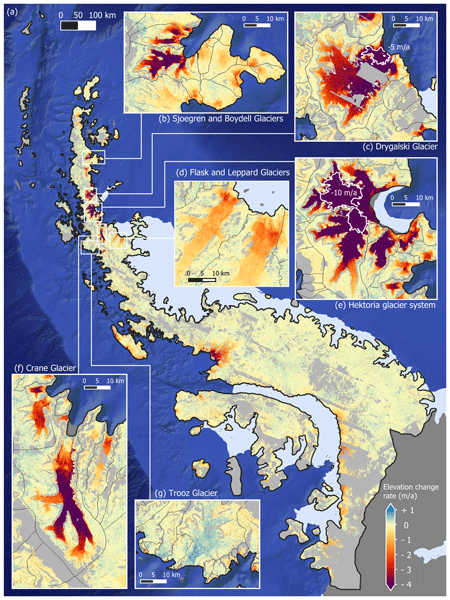
Abstract. The Antarctic Peninsula (AP), encompassing the ice sheet and its peripheral glaciers, is a highly dynamic component of the cryosphere that disproportionately contributes to sea level rise relative to its size. However, a large spread remains between the mass changes estimated using gravimetry, altimetry and the mass budget method. Among these techniques, the satellite (radar or laser) altimetry method has a resolution of, at best, 1 km, which is coarse to resolve the mountainous landscape of the Peninsula. Therefore, we use digital elevation models (DEMs; 30 x 30 m) to provide an estimate of mass changes across the AP between 2007 and 2021. We combine 476 DEMs derived from SPOT5-HRS satellite images (2006–2008) and 2 525 DEMs of the Reference Elevation Model of Antarctica (2020–2022) to map elevation changes for the entire Peninsula. We vertically adjusted each DEM using near-coincident ICESat/-2 laser altimetry measurements. Our observations cover 70 % of the AP Ice Sheet and 60 % of its peripheral glaciers, including regions of the Peninsula poorly studied to date, and reveal a spatially complex pattern of elevation changes. After correction with different models of firn air content and solid-earth response, we find that between 2007 and 2021, the AP Ice Sheet lost -27 ± 9 Gt/a while its peripheral glaciers lost -14 ± 2 Gt/a. For the AP Ice Sheet, our new estimate is four to five times more negative than the one obtained in IMBIE using altimetry data (-5.2 ± 2.3 Gt/a from 2007 to 2019) and in better agreement with gravimetry and the mass budget method. Our study highlights the importance of resolving fine scale elevation changes of glaciers and ice sheets in complex, dynamic coastal areas.
Competing interests: At least one of the (co-)authors is a member of the editorial board of The Cryosphere.
Publisher's note: Copernicus Publications remains neutral with regard to jurisdictional claims made in the text, published maps, institutional affiliations, or any other geographical representation in this paper. While Copernicus Publications makes every effort to include appropriate place names, the final responsibility lies with the authors. Views expressed in the text are those of the authors and do not necessarily reflect the views of the publisher.-
Notice on discussion status
The requested preprint has a corresponding peer-reviewed final revised paper. You are encouraged to refer to the final revised version.
-
Preprint
(42641 KB)
-
The requested preprint has a corresponding peer-reviewed final revised paper. You are encouraged to refer to the final revised version.
- Preprint
(42641 KB) - Metadata XML
- BibTeX
- EndNote
- Final revised paper


Journal article(s) based on this preprint
Interactive discussion
Status: closed
-
RC1: 'Comment on egusphere-2026-729', Anonymous Referee #1, 07 Apr 2026
-
AC1: 'Reply on RC1', Maud Bernat, 24 Apr 2026
We thank the reviewer for taking the time to read the manuscript and for providing constructive feedbacks to improve the manuscript. We have addressed their comments in the attached PDF with reviewers and community comments in black and our answers in blue.
-
AC1: 'Reply on RC1', Maud Bernat, 24 Apr 2026
-
RC2: 'Comment on egusphere-2026-729', Anonymous Referee #2, 10 Apr 2026
The paper describes elevation and mass change observations on the Antarctic Peninsula and surrounding islands (AP). The region is a difficult setup for mass change assessment, since all measuring methods show limitations so far. Radar altimetry has a rather coarse footprint or the swath mode data is limited by the steep topography, specifically on the northern part of the AP. Laser altimetry is limited by clouds and the sparse tracks. DEM differencing from optical imagery was limited by frequent clouds and oversaturation while bi-static radar interferometry by the short observation times, challenges for phase unwrapping and co-registration on sparse stable ground. Direct measurements from gravimetry are limited due to the narrow mountain range and a cross orbit track setting. The input-output method is subject to uncertain ice thickness estimations and measurements as previous papers revealed and what forms the base for the current SCAR RINGS AP initiative. Hence, this new data sets based on DEMs from the SPOT5-HRS and REMA is of high relevance, since it overcomes some of the deficiencies mentioned above for optical DEM differencing, specifically the difficulties with over-saturation in bright areas. Besides the DEM differencing, the paper includes an analysis on firn compaction models and GIA and elastic rebound. The paper is very well written and advances our understanding of mass changes for this region. The methods are very extensively described which is very much appreciated. I strongly recommend acceptance of the paper after some minor corrections.
Specific comments:
L12: I agree that your estimate is 4-5 times more negative as IMBIE, however, this value range is not completely new. A previous DEM change analysis by Seehaus et al. (2023) also referred to later in this paper reported comparable values (24 +- 2.8 Gt) although for a shorter time period (2013-2017). Hence, at least an indication, that such a previous study exist should be mentioned also in the abstract.
L21: “… responding dramatically” is a kind of not clearly defined expression. The authors might consider choosing a different wording.
L23: I suggest to refer to the original literature that discovered this reaction to ice shelf collapse and not to one of the many subsequent studies. Specifically, as this reaction has not been discovered by altimetry.
L68: If I understand this sentence correctly, the ICESat-1/2 elevations are used not necessarily from the same year, but from the same season. Maybe, this could be expressed more clearly since the subsequent description in the method sections reads like only data from the same year/season had been considered (e.g. L206, L244).
L416: The values in the text and Fig.7 for Trooz Glacier are different. Please clarify if this is caused the elevation interval restriction to 0-800m.
Fig. 7: it would be interesting to read more including an explanation for the very heterogeneous dh/dt values on Anvers Island, e.g Iliad Glacier and surroundings. It is shown in the map, but I could not fins a corresponding section in the main text (L579 and following). Fig.4 shows a quite limited coverage whereas Fig.7 provides values for each glacier catchment. Do those heterogeneous values partially come from the interpolation?
L599: This paragraph mainly contains information from previous work without a real own contribution. Could perhaps be shortened and other parts extended as mentioned before e.g. on Anvers Island glaciers. It is understood, that this is mainly an observational paper, however, an attempt for a glaciological/climatological explanation of those close by differences in advance/retreat would be of interest. This does not come out from the quite general and known statements on DCW influence (L612f). Same for Jason Peninsula.
L704: The doi and location of the elevation and mass change product should be published with the paper.References:
Seehaus, T., Sommer, C., Dethinne, T., and Malz, P.: Mass changes of the northern Antarctic Peninsula Ice Sheet derived from repeat bi-static synthetic aperture radar acquisitions for the period 2013–2017, The Cryosphere, 17, 4629–4644, https://doi.org/10.5194/tc-17-4629-2023, 2023.Citation: https://doi.org/10.5194/egusphere-2026-729-RC2 -
AC2: 'Reply on RC2', Maud Bernat, 24 Apr 2026
We thank the reviewer for taking the time to read the manuscript and for providing constructive feedbacks to improve the manuscript. We have addressed their comments in the attached PDF with reviewers and community comments in black and our answers in blue.
-
AC2: 'Reply on RC2', Maud Bernat, 24 Apr 2026
-
CC1: 'Comment on egusphere-2026-729', Matt King, 15 Apr 2026
A brief comment on the adopted GIA models on what looks like a really nice paper. The millennial-scale GIA models are well known to be inaccurate in the Peninsula. I provide the references below. I think this is a secondary issue, but it does possibly need some quantification of the effect of this mismodelling, given that it is a systematic error.
Nield et al. 2014 https://www.sciencedirect.com/science/article/pii/S0012821X14002519 (see Figure 4 where uplift rates are compared to ICE5G and IJ05R2). ICE6G would have similarly low agreement with the GPS uplifts.
Samrat et al. 2020 https://academic.oup.com/gji/article/222/2/1013/5835685?login=true
I look forward to seeing the finalised paper and data!
Citation: https://doi.org/10.5194/egusphere-2026-729-CC1 - AC3: 'Reply on CC1', Maud Bernat, 24 Apr 2026
Peer review completion


Post-review adjustments


Interactive discussion
Status: closed
-
RC1: 'Comment on egusphere-2026-729', Anonymous Referee #1, 07 Apr 2026
This is a well-executed study that makes a genuine contribution to our understanding of Antarctic Peninsula (AP) mass changes. The authors combine SPOT5-HRS DEMs with REMA, vertically adjusted using ICESat and ICESat-2 laser altimetry, to produce high-resolution (30 m) elevation change maps over a 14-year period. The approach is methodologically sound, the uncertainty quantification is thorough, and the spatial detail revealed is a clear advance over previous altimetry-based estimates. I recommend acceptance after minor revisions.
Major comments:
- The authors report an AP Ice Sheet mass change of -26.5 ± 5.3 Gt/a, which is 4–5 times more negative than the IMBIE altimetry estimate of -5.2 ± 2.3 Gt/a. While the authors correctly attribute this discrepancy to the resolution limitations of satellite altimetry in mountainous terrain, the discussion would benefit from a more explicit spatial breakdown of where this difference originates.
- The FAC correction is identified as the largest source of uncertainty, yet the discussion of inter-model divergence remains brief. Since the authors already computed mass change outputs for all four FDMs individually, a short dedicated discussion of why these models diverge would be a valuable addition. In particular, are certain models known to perform better over the Peninsula, given its strong west–east climate gradient?
Minor comments
- The abstract states the AP Ice Sheet lost -27 ± 9 Gt/a, while Table 1 reports -28.2 ± 5.9 Gt/a for the SIL20 (APIS) outline. Please clarify this apparent inconsistency.
- Figure 1: "Prince Gustav chanel" should read "Prince Gustav Channel."
- Line 416: Trooz Glacier is cited with a thickening signal of +0.32 ± 0.26 m/a in the text, yet Figure 7 reports +0.06 ± 0.08 m/a. Please clarify whether these values refer to different spatial extents or time periods.
- Line 547: "Eembayment" should read "Embayment."
- Line 569: "in a many areas" should read "in many areas."
- Line 711: "personnal communication" should read "personal communication."
Citation: https://doi.org/10.5194/egusphere-2026-729-RC1 -
AC1: 'Reply on RC1', Maud Bernat, 24 Apr 2026
We thank the reviewer for taking the time to read the manuscript and for providing constructive feedbacks to improve the manuscript. We have addressed their comments in the attached PDF with reviewers and community comments in black and our answers in blue.
-
RC2: 'Comment on egusphere-2026-729', Anonymous Referee #2, 10 Apr 2026
The paper describes elevation and mass change observations on the Antarctic Peninsula and surrounding islands (AP). The region is a difficult setup for mass change assessment, since all measuring methods show limitations so far. Radar altimetry has a rather coarse footprint or the swath mode data is limited by the steep topography, specifically on the northern part of the AP. Laser altimetry is limited by clouds and the sparse tracks. DEM differencing from optical imagery was limited by frequent clouds and oversaturation while bi-static radar interferometry by the short observation times, challenges for phase unwrapping and co-registration on sparse stable ground. Direct measurements from gravimetry are limited due to the narrow mountain range and a cross orbit track setting. The input-output method is subject to uncertain ice thickness estimations and measurements as previous papers revealed and what forms the base for the current SCAR RINGS AP initiative. Hence, this new data sets based on DEMs from the SPOT5-HRS and REMA is of high relevance, since it overcomes some of the deficiencies mentioned above for optical DEM differencing, specifically the difficulties with over-saturation in bright areas. Besides the DEM differencing, the paper includes an analysis on firn compaction models and GIA and elastic rebound. The paper is very well written and advances our understanding of mass changes for this region. The methods are very extensively described which is very much appreciated. I strongly recommend acceptance of the paper after some minor corrections.
Specific comments:
L12: I agree that your estimate is 4-5 times more negative as IMBIE, however, this value range is not completely new. A previous DEM change analysis by Seehaus et al. (2023) also referred to later in this paper reported comparable values (24 +- 2.8 Gt) although for a shorter time period (2013-2017). Hence, at least an indication, that such a previous study exist should be mentioned also in the abstract.
L21: “… responding dramatically” is a kind of not clearly defined expression. The authors might consider choosing a different wording.
L23: I suggest to refer to the original literature that discovered this reaction to ice shelf collapse and not to one of the many subsequent studies. Specifically, as this reaction has not been discovered by altimetry.
L68: If I understand this sentence correctly, the ICESat-1/2 elevations are used not necessarily from the same year, but from the same season. Maybe, this could be expressed more clearly since the subsequent description in the method sections reads like only data from the same year/season had been considered (e.g. L206, L244).
L416: The values in the text and Fig.7 for Trooz Glacier are different. Please clarify if this is caused the elevation interval restriction to 0-800m.
Fig. 7: it would be interesting to read more including an explanation for the very heterogeneous dh/dt values on Anvers Island, e.g Iliad Glacier and surroundings. It is shown in the map, but I could not fins a corresponding section in the main text (L579 and following). Fig.4 shows a quite limited coverage whereas Fig.7 provides values for each glacier catchment. Do those heterogeneous values partially come from the interpolation?
L599: This paragraph mainly contains information from previous work without a real own contribution. Could perhaps be shortened and other parts extended as mentioned before e.g. on Anvers Island glaciers. It is understood, that this is mainly an observational paper, however, an attempt for a glaciological/climatological explanation of those close by differences in advance/retreat would be of interest. This does not come out from the quite general and known statements on DCW influence (L612f). Same for Jason Peninsula.
L704: The doi and location of the elevation and mass change product should be published with the paper.References:
Seehaus, T., Sommer, C., Dethinne, T., and Malz, P.: Mass changes of the northern Antarctic Peninsula Ice Sheet derived from repeat bi-static synthetic aperture radar acquisitions for the period 2013–2017, The Cryosphere, 17, 4629–4644, https://doi.org/10.5194/tc-17-4629-2023, 2023.Citation: https://doi.org/10.5194/egusphere-2026-729-RC2 -
AC2: 'Reply on RC2', Maud Bernat, 24 Apr 2026
We thank the reviewer for taking the time to read the manuscript and for providing constructive feedbacks to improve the manuscript. We have addressed their comments in the attached PDF with reviewers and community comments in black and our answers in blue.
-
AC2: 'Reply on RC2', Maud Bernat, 24 Apr 2026
-
CC1: 'Comment on egusphere-2026-729', Matt King, 15 Apr 2026
A brief comment on the adopted GIA models on what looks like a really nice paper. The millennial-scale GIA models are well known to be inaccurate in the Peninsula. I provide the references below. I think this is a secondary issue, but it does possibly need some quantification of the effect of this mismodelling, given that it is a systematic error.
Nield et al. 2014 https://www.sciencedirect.com/science/article/pii/S0012821X14002519 (see Figure 4 where uplift rates are compared to ICE5G and IJ05R2). ICE6G would have similarly low agreement with the GPS uplifts.
Samrat et al. 2020 https://academic.oup.com/gji/article/222/2/1013/5835685?login=true
I look forward to seeing the finalised paper and data!
Citation: https://doi.org/10.5194/egusphere-2026-729-CC1 - AC3: 'Reply on CC1', Maud Bernat, 24 Apr 2026
Peer review completion
Post-review adjustments
Journal article(s) based on this preprint
Viewed
| HTML | XML | Total | BibTeX | EndNote | |
|---|---|---|---|---|---|
| 1,234 | 788 | 101 | 2,123 | 148 | 162 |
- HTML: 1,234
- PDF: 788
- XML: 101
- Total: 2,123
- BibTeX: 148
- EndNote: 162
Viewed (geographical distribution)
| Country | # | Views | % |
|---|
| Total: | 0 |
| HTML: | 0 |
| PDF: | 0 |
| XML: | 0 |
- 1

Etienne Berthier
Amaury Dehecq
Romain Hugonnet
Joaquin M. C. Belart
Naomi Ochwat
Peter Kuipers Munneke
Elizabeth Case
Ted Scambos
Louis-Marie Gauer
David Youssefi
The requested preprint has a corresponding peer-reviewed final revised paper. You are encouraged to refer to the final revised version.
- Preprint
(42641 KB) - Metadata XML
This is a well-executed study that makes a genuine contribution to our understanding of Antarctic Peninsula (AP) mass changes. The authors combine SPOT5-HRS DEMs with REMA, vertically adjusted using ICESat and ICESat-2 laser altimetry, to produce high-resolution (30 m) elevation change maps over a 14-year period. The approach is methodologically sound, the uncertainty quantification is thorough, and the spatial detail revealed is a clear advance over previous altimetry-based estimates. I recommend acceptance after minor revisions.
Major comments:
Minor comments