
the Creative Commons Attribution 4.0 License.
the Creative Commons Attribution 4.0 License.
 | 12 Feb 2026
Errors in satellite-based global horizontal irradiance retrievals due to three-dimensional cloud-radiation interactions
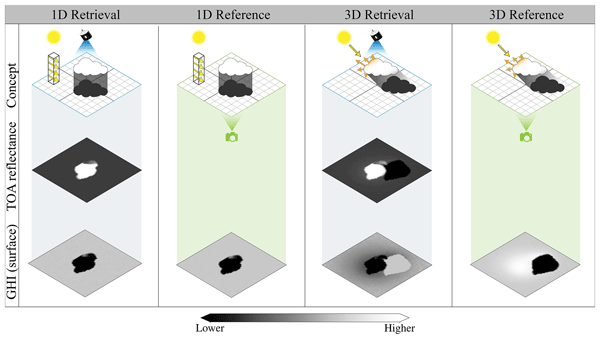
Abstract. Observations of sunlight reaching the Earth's surface are crucial for a range of applications, including accurate monitoring and nowcasting of solar energy. Satellite retrieval algorithms for global horizontal irradiance (GHI) are generally one-dimensional (1D), assuming horizontally independent and homogeneous pixels, called the independent pixel approximation (IPA) and plane-parallel approximation (PPA), respectively. In reality, clouds scatter radiation in three dimensions, introducing retrieval errors which – without prior knowledge of three-dimensional (3D) cloud structures – remain unknown. This study assesses the PPA and IPA validity in GHI retrievals for two highly variable cumulus cloud fields at spatial resolutions ranging from 0.05 to 12.4 km. Using accurate 3D Monte Carlo radiative transfer (RT) simulations, synthetic top-of-atmosphere reflectances are generated, from which GHI is retrieved. GHI calculated directly from the input using 1D and 3D RT serves as a reference. We explain how horizontal photon transport leads to GHI underestimations in clear-sky regions, while in cloud shadows GHI is overestimated. Furthermore, towards coarser spatial resolutions, the PPA introduces retrieval biases due to mixing of cloudy and clear-sky reflectances. Generally, domain-averaged biases are minimal at a resolution of 1 to 3 km. In terms of root mean square error, the largest disagreements are observed at the finest spatial scales, with IPA-related errors dominating for resolutions finer than about 2 to 6 km. The current generation of geostationary satellites already resolves these finer spatial scales. Therefore, this work emphasises the need to develop 3D RT parameterizations and corrections for GHI retrievals.
-
Notice on discussion status
The requested preprint has a corresponding peer-reviewed final revised paper. You are encouraged to refer to the final revised version.
-
Preprint
(9747 KB)
-
The requested preprint has a corresponding peer-reviewed final revised paper. You are encouraged to refer to the final revised version.
- Preprint
(9747 KB) - Metadata XML
- BibTeX
- EndNote
- Final revised paper


Journal article(s) based on this preprint
Interactive discussion
Status: closed
-
RC1: 'Comment on egusphere-2026-723', Anonymous Referee #1, 05 Mar 2026
The comment was uploaded in the form of a supplement: https://egusphere.copernicus.org/preprints/2026/egusphere-2026-723/egusphere-2026-723-RC1-supplement.pdfCitation: https://doi.org/
10.5194/egusphere-2026-723-RC1 -
AC1: 'Reply on RC1', Job Wiltink, 15 Apr 2026
We thank the reviewer for the constructive and thorough feedback on our manuscript. We have carefully addressed the comments, which should further improve and clarify the study.Please see the attached supplement for details on how the comments were handled.
-
AC1: 'Reply on RC1', Job Wiltink, 15 Apr 2026
-
RC2: 'Comment on egusphere-2026-723', Anonymous Referee #2, 11 Mar 2026
The comment was uploaded in the form of a supplement: https://egusphere.copernicus.org/preprints/2026/egusphere-2026-723/egusphere-2026-723-RC2-supplement.pdf
-
AC2: 'Reply on RC2', Job Wiltink, 15 Apr 2026
We thank the reviewer for the constructive and thorough feedback on our manuscript. We have carefully addressed the comments, which should further improve and clarify the study.
Please see the attached supplement for details on how the comments were handled.
-
AC2: 'Reply on RC2', Job Wiltink, 15 Apr 2026
Peer review completion


Interactive discussion
Status: closed
-
RC1: 'Comment on egusphere-2026-723', Anonymous Referee #1, 05 Mar 2026
The comment was uploaded in the form of a supplement: https://egusphere.copernicus.org/preprints/2026/egusphere-2026-723/egusphere-2026-723-RC1-supplement.pdf
-
AC1: 'Reply on RC1', Job Wiltink, 15 Apr 2026
We thank the reviewer for the constructive and thorough feedback on our manuscript. We have carefully addressed the comments, which should further improve and clarify the study.Please see the attached supplement for details on how the comments were handled.
-
AC1: 'Reply on RC1', Job Wiltink, 15 Apr 2026
-
RC2: 'Comment on egusphere-2026-723', Anonymous Referee #2, 11 Mar 2026
The comment was uploaded in the form of a supplement: https://egusphere.copernicus.org/preprints/2026/egusphere-2026-723/egusphere-2026-723-RC2-supplement.pdf
-
AC2: 'Reply on RC2', Job Wiltink, 15 Apr 2026
We thank the reviewer for the constructive and thorough feedback on our manuscript. We have carefully addressed the comments, which should further improve and clarify the study.
Please see the attached supplement for details on how the comments were handled.
-
AC2: 'Reply on RC2', Job Wiltink, 15 Apr 2026
Peer review completion
Journal article(s) based on this preprint
Data sets
Code and data used for Errors in satellite-based global horizontal irradiance retrievals due to three-dimensional cloud-radiation interactions Job I. Wiltink https://doi.org/10.5281/zenodo.17987194
Viewed
| HTML | XML | Total | BibTeX | EndNote | |
|---|---|---|---|---|---|
| 1,423 | 711 | 106 | 2,240 | 217 | 208 |
- HTML: 1,423
- PDF: 711
- XML: 106
- Total: 2,240
- BibTeX: 217
- EndNote: 208
Viewed (geographical distribution)
| Country | # | Views | % |
|---|
| Total: | 0 |
| HTML: | 0 |
| PDF: | 0 |
| XML: | 0 |
- 1

Victor J. H. Trees
Chiel C. van Heerwaarden
Jan Fokke Meirink
The requested preprint has a corresponding peer-reviewed final revised paper. You are encouraged to refer to the final revised version.
- Preprint
(9747 KB) - Metadata XML