
the Creative Commons Attribution 4.0 License.
the Creative Commons Attribution 4.0 License.
 | 24 Mar 2026
TRAILS – A novel framework for time-height-resolved attribution of long-range transported wildfire smoke
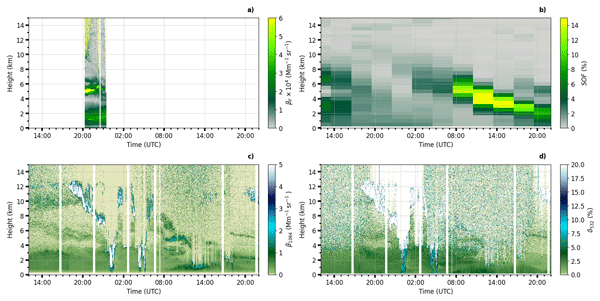
Abstract. Accurately attributing long-range transported wildfire smoke to specific sources remains challenging, especially for elevated plumes. This study presents the TRAILS tool (Trajectory-based Identification of Lofted Smoke), which extends the automated air mass source attribution tool of Radenz et al. (2021) to provide time- and height-resolved identification of wildfire smoke. By integrating 10-day backward trajectories from FLEXPART with a multi-sensor satellite detection algorithm, we calculate a vertically resolved Smoke Occurrence Fraction (SOF), quantifying the likelihood of smoke influence based on air parcel residence time within smoke-affected regions. TRAILS identifies where and at what altitudes smoke is present, but does not automatically attributes these layers to specific fire sources. A key innovation is a new, statistically significant linear relationship between Ozone Mapping and Profiler Suite (OMPS) Ultraviolet Aerosol Index (UVAI) values and smoke plume height for fresh tropospheric smoke, derived from collocated OMPS and CALIOP observations. TRAILS was evaluated against ground-based fluorescence lidar measurements (MARTHA and PollyXT in Leipzig during the 2023 Canadian wildfire season. Results show that TRAILS effectively reproduces the vertical distribution and temporal evolution of long-range smoke layers, with a 76 % detection rate for fluorescent aerosol layers. Systematic underestimation of layer heights by 0.4 km, most pronounced in the UTLS, is consistent with unaccounted diabatic self-lofting in FLEXPART. While TRAILS performs well for the Northern Hemisphere smoke events studied here, its application to other wildfire regimes (e.g., Southern Hemisphere, different fuel types) may require recalibration of thresholds and carries additional uncertainties related to dust contamination. TRAILS provides a valuable, observationally constrained method for time-height-resolved smoke attribution, particularly where advanced fluorescence lidars are unavailable.
-
Notice on discussion status
The requested preprint has a corresponding peer-reviewed final revised paper. You are encouraged to refer to the final revised version.
-
Preprint
(3029 KB)
-
The requested preprint has a corresponding peer-reviewed final revised paper. You are encouraged to refer to the final revised version.
- Preprint
(3029 KB) - Metadata XML
- BibTeX
- EndNote
- Final revised paper


Journal article(s) based on this preprint
Interactive discussion
Status: closed
-
RC1: 'Comment on egusphere-2026-718', Anonymous Referee #1, 15 Apr 2026
The comment was uploaded in the form of a supplement: https://egusphere.copernicus.org/preprints/2026/egusphere-2026-718/egusphere-2026-718-RC1-supplement.pdfCitation: https://doi.org/
10.5194/egusphere-2026-718-RC1 -
AC1: 'Reply on RC1', Johanna Roschke, 22 Jul 2026
Dear Reviewer,
Thank you for carefully reading the manuscript and pointing out several issues where the description needs to be improved for understanding. The requested clarifications and references to ambiguities contribute to the improvement of the manuscript.
Sincerely, on behalf of all authors
Johanna Roschke
-
AC1: 'Reply on RC1', Johanna Roschke, 22 Jul 2026
-
RC2: 'Comment on egusphere-2026-718', Anonymous Referee #2, 04 Jun 2026
Review of “TRAILS – A novel framework or time-height-resolved attribution of long-range transported wildfire smoke”
This paper builds on the tool developed by Radenz et al. (2021) and offers a synergistic approach to attributing wildfire smoke. The new tool, called TRAILS, overcomes the main limitation of Radenz et al. (2021), which is the fixed reception height. The reception height is now dynamically defined based on extending the work of Guan et al. (2010). The algorithm incorporates UVAI observations and active fire data to derive profiles of the metric smoke occurrence fractions. The algorithm, its configuration, and related ramifications are thoroughly explained. The paper is clearly written with clear structure which makes it mostly easy to follow but I do have a few comments that should be addressed before publication that I have outlined below. Also, I provide a few technical corrections. I would suggest reviewing parentheses and acronyms throughout the manuscript.
General comments
Page2Line55: I happen to come across of the Huang et al. (2026; https://doi.org/10.1029/2025GL120904), who in fact observed it.
Page3Lines85-86: It is not clear to me, not at least at this point, but do active fire data are part of Radenz et al. (2021)? If this is the case, this sentence could be omitted.
Page5Line115: Tackett et al. (2023) introduced the improved stratospheric typing algorithm; therefore I would suggest including also Kim et al. (2018; https://doi.org/10.5194/amt-11-6107-2018).
Page6Lines123-125: Why is it needed? How does it serve TRAILS? Is it valid only for the cases presented here, and can it be used to improve the classification in general?
Page6Line128: Which denoising and filtering techniques?
Page6Line131: What do you mean by cluster? Is it a binary array: say 0 for cloud and 1 for aerosol? So, if I get it right, a cluster is a “pixel” and multiple clusters correspond to a layer.
Page6Lines138-139: This statement refers to the visual inspection of the smoke layer boundaries and whether the method enclosed correctly the plume, as in figures 1e and 1f. The thresholds of Table 2, where do they come from?
Page8§2.3: Is it really needed? Isn’t it part of Radenz et al. (2021)?
Page12§3.1: Figure 5 is not introduced at all. Please do so. Also, the choice for the default UVAI_fresh value is only given in the Appendix (lines 684-686), it would be worthwhile also to mention it as well in this section.
Page13Figure5: The UVAI_dust default threshold does not appear in the caption.
Page14Line320: Please define z_tropo.
Page17Line404: Maybe discussion on the choice.
Page24Lines520-521: Would the presence of pyrocb activity explain the high depolarization ratio values?
Technical comments
Page1Line10: Close parenthesis or remove.
Page1Line23: It should be “short for”.
Page3Line69: It should be “EPIC’s”.
Page3Line79: Correct to “outperforms”.
Page3Line 81: Change “studies” to “study”.
Page6Lines118-119: Review “prohibiting an ambiguous classification”. Prohibiting and ambiguous are contradictory.
Page6Line130: Remove “via” and double parentheses.
Page8Line175: I would probably remove “Observations conducted by”.
Page8Line186: Remove double parentheses.
Page8Line188: Consider changing “based on” with “with.”
Page11Line261: Fix parentheses.
Page11Line269: Something is wrong “Fig. 5 is explained”.
Page12Line277: Change “5” to “4”.
Page12Line279 and Line292: Keep consistent nomenclature.
Page13Figure 5: Remove comma after “observed” and change “been” into “be”.
Page14Line300: Close the references in parentheses.
Page14Line318: Correct “parcle”.
Page16Line380-381. Correct the sentence
Page17Line393: “posit”?
Page20Figure8: Review parentheses
Page25Figure11: Change “d)” to “c)”. Add “the” after “of which”.
Page26Line597: Add “of” after “lacking”.
Page28Line631: Fix parentheses
Citation: https://doi.org/10.5194/egusphere-2026-718-RC2 -
AC2: 'Reply on RC2', Johanna Roschke, 22 Jul 2026
Dear Reviewer,
Thank you for carefully reading the manuscript and pointing out several issues where the description needs to be improved for understanding. The requested clarifications and references to ambiguities contribute to the improvement of the manuscript.
Sincerely, on behalf of all authors
Johanna Roschke
-
AC2: 'Reply on RC2', Johanna Roschke, 22 Jul 2026
Peer review completion


Interactive discussion
Status: closed
-
RC1: 'Comment on egusphere-2026-718', Anonymous Referee #1, 15 Apr 2026
The comment was uploaded in the form of a supplement: https://egusphere.copernicus.org/preprints/2026/egusphere-2026-718/egusphere-2026-718-RC1-supplement.pdf
-
AC1: 'Reply on RC1', Johanna Roschke, 22 Jul 2026
Dear Reviewer,
Thank you for carefully reading the manuscript and pointing out several issues where the description needs to be improved for understanding. The requested clarifications and references to ambiguities contribute to the improvement of the manuscript.
Sincerely, on behalf of all authors
Johanna Roschke
-
AC1: 'Reply on RC1', Johanna Roschke, 22 Jul 2026
-
RC2: 'Comment on egusphere-2026-718', Anonymous Referee #2, 04 Jun 2026
Review of “TRAILS – A novel framework or time-height-resolved attribution of long-range transported wildfire smoke”
This paper builds on the tool developed by Radenz et al. (2021) and offers a synergistic approach to attributing wildfire smoke. The new tool, called TRAILS, overcomes the main limitation of Radenz et al. (2021), which is the fixed reception height. The reception height is now dynamically defined based on extending the work of Guan et al. (2010). The algorithm incorporates UVAI observations and active fire data to derive profiles of the metric smoke occurrence fractions. The algorithm, its configuration, and related ramifications are thoroughly explained. The paper is clearly written with clear structure which makes it mostly easy to follow but I do have a few comments that should be addressed before publication that I have outlined below. Also, I provide a few technical corrections. I would suggest reviewing parentheses and acronyms throughout the manuscript.
General comments
Page2Line55: I happen to come across of the Huang et al. (2026; https://doi.org/10.1029/2025GL120904), who in fact observed it.
Page3Lines85-86: It is not clear to me, not at least at this point, but do active fire data are part of Radenz et al. (2021)? If this is the case, this sentence could be omitted.
Page5Line115: Tackett et al. (2023) introduced the improved stratospheric typing algorithm; therefore I would suggest including also Kim et al. (2018; https://doi.org/10.5194/amt-11-6107-2018).
Page6Lines123-125: Why is it needed? How does it serve TRAILS? Is it valid only for the cases presented here, and can it be used to improve the classification in general?
Page6Line128: Which denoising and filtering techniques?
Page6Line131: What do you mean by cluster? Is it a binary array: say 0 for cloud and 1 for aerosol? So, if I get it right, a cluster is a “pixel” and multiple clusters correspond to a layer.
Page6Lines138-139: This statement refers to the visual inspection of the smoke layer boundaries and whether the method enclosed correctly the plume, as in figures 1e and 1f. The thresholds of Table 2, where do they come from?
Page8§2.3: Is it really needed? Isn’t it part of Radenz et al. (2021)?
Page12§3.1: Figure 5 is not introduced at all. Please do so. Also, the choice for the default UVAI_fresh value is only given in the Appendix (lines 684-686), it would be worthwhile also to mention it as well in this section.
Page13Figure5: The UVAI_dust default threshold does not appear in the caption.
Page14Line320: Please define z_tropo.
Page17Line404: Maybe discussion on the choice.
Page24Lines520-521: Would the presence of pyrocb activity explain the high depolarization ratio values?
Technical comments
Page1Line10: Close parenthesis or remove.
Page1Line23: It should be “short for”.
Page3Line69: It should be “EPIC’s”.
Page3Line79: Correct to “outperforms”.
Page3Line 81: Change “studies” to “study”.
Page6Lines118-119: Review “prohibiting an ambiguous classification”. Prohibiting and ambiguous are contradictory.
Page6Line130: Remove “via” and double parentheses.
Page8Line175: I would probably remove “Observations conducted by”.
Page8Line186: Remove double parentheses.
Page8Line188: Consider changing “based on” with “with.”
Page11Line261: Fix parentheses.
Page11Line269: Something is wrong “Fig. 5 is explained”.
Page12Line277: Change “5” to “4”.
Page12Line279 and Line292: Keep consistent nomenclature.
Page13Figure 5: Remove comma after “observed” and change “been” into “be”.
Page14Line300: Close the references in parentheses.
Page14Line318: Correct “parcle”.
Page16Line380-381. Correct the sentence
Page17Line393: “posit”?
Page20Figure8: Review parentheses
Page25Figure11: Change “d)” to “c)”. Add “the” after “of which”.
Page26Line597: Add “of” after “lacking”.
Page28Line631: Fix parentheses
Citation: https://doi.org/10.5194/egusphere-2026-718-RC2 -
AC2: 'Reply on RC2', Johanna Roschke, 22 Jul 2026
Dear Reviewer,
Thank you for carefully reading the manuscript and pointing out several issues where the description needs to be improved for understanding. The requested clarifications and references to ambiguities contribute to the improvement of the manuscript.
Sincerely, on behalf of all authors
Johanna Roschke
-
AC2: 'Reply on RC2', Johanna Roschke, 22 Jul 2026
Peer review completion
Journal article(s) based on this preprint
Viewed
| HTML | XML | Total | BibTeX | EndNote | |
|---|---|---|---|---|---|
| 716 | 486 | 89 | 1,291 | 65 | 87 |
- HTML: 716
- PDF: 486
- XML: 89
- Total: 1,291
- BibTeX: 65
- EndNote: 87
Viewed (geographical distribution)
| Country | # | Views | % |
|---|
| Total: | 0 |
| HTML: | 0 |
| PDF: | 0 |
| XML: | 0 |
- 1
Johanna Roschke

Benedikt Gast
Martin Radenz
Albert Ansmann
Patric Seifert
George McCosh
Heike Kalesse-Los
The requested preprint has a corresponding peer-reviewed final revised paper. You are encouraged to refer to the final revised version.
- Preprint
(3029 KB) - Metadata XML