
the Creative Commons Attribution 4.0 License.
the Creative Commons Attribution 4.0 License.
 | 23 Feb 2026
Direct-sun versus Sky-Scan Pandora Formaldehyde Retrievals: Implications for OMI Validation in Tropical Southeast Asia
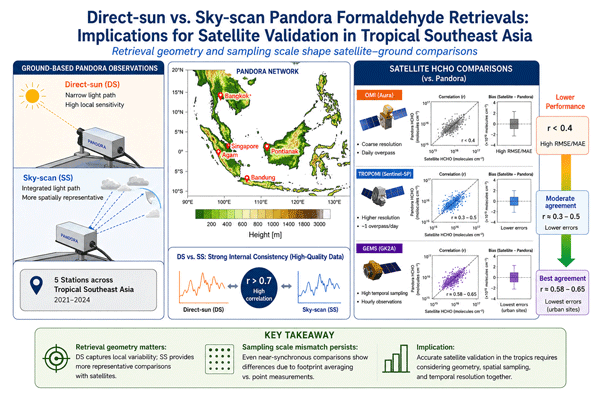
Abstract. Ground-based Pandora spectrometers are widely used for validating satellite formaldehyde (HCHO) retrievals; however, the influence of scanning geometry and spatiotemporal representativeness remains insufficiently quantified in tropical environments. This study evaluates Pandora Level-2 HCHO total vertical columns from five Southeast Asian stations (Bangkok, Bandung, Agam, Pontianak, and Singapore-NUS) over 2021–2025, comparing Direct-sun and Sky-scan retrievals and assessing their consistency with OMI Aura observations. HCHO distributions exhibit strong inter-site variability and pronounced skewness, with Direct-sun retrievals showing higher medians and substantially larger variance than Sky-scan observations. Mean Direct-sun HCHO columns are strongly influenced by episodic enhancements at biomass-burning-affected sites, particularly Agam, whereas Sky-scan retrievals display lower central values and reduced variability, consistent with broader atmospheric sampling and diminished sensitivity to localized plumes. Satellite–ground comparisons are conducted using nine spatiotemporal averaging configurations that vary OMI spatial footprints (nearest grid, 3 × 3, and 5 × 5) and Pandora temporal averaging. Direct-sun comparisons generally yield weak or unstable correlations (R ≈ −0.1 to 0.3) and large errors (RMSE ≈ 8–14 × 1015 molecules cm-2). In contrast, Sky-scan retrievals show systematically improved agreement, with optimized configurations achieving RMSE values of ~5 × 10¹⁵ molecules cm⁻², MAE of ~4–7 × 10¹⁵ molecules cm⁻², and moderate positive correlations (R ≈ 0.4–0.6) at several sites. Solar zenith angle–dependent analysis reveals persistent positive biases in Direct-sun retrievals (~10–20 × 1015 molecules cm-2), while Sky-scan retrievals exhibit near-zero bias at low to moderate SZAs and substantially reduced extremes. Overall, the results demonstrate that scanning geometry exerts a first-order control on Pandora–OMI consistency in the tropics, with Sky-scan observations providing a more spatially representative reference for satellite validation, although optimal configurations remain site dependent.
-
Notice on discussion status
The requested preprint has a corresponding peer-reviewed final revised paper. You are encouraged to refer to the final revised version.
-
Preprint
(2617 KB)
-
The requested preprint has a corresponding peer-reviewed final revised paper. You are encouraged to refer to the final revised version.
- Preprint
(2617 KB) - Metadata XML
- BibTeX
- EndNote
- Final revised paper


Journal article(s) based on this preprint
Interactive discussion
Status: closed
-
RC1: 'Comment on egusphere-2026-716', Anonymous Referee #1, 12 Mar 2026
The comment was uploaded in the form of a supplement: https://egusphere.copernicus.org/preprints/2026/egusphere-2026-716/egusphere-2026-716-RC1-supplement.pdfCitation: https://doi.org/
10.5194/egusphere-2026-716-RC1 - AC1: 'Reply on RC1', Jackson Hian-Wui Chang, 09 Apr 2026
-
RC2: 'Comment on egusphere-2026-716', Anonymous Referee #2, 16 Mar 2026
The authors present a comparison of ground based HCHO retrievals from 5 Pandora sites with retrievals from OMI. The authors compare both direct sun and sky scan retrievals from Pandora to OMI and use those comparisons to suggest the use of sky scans would be preferable for satellite validation in the tropics. This work presents interesting data from an understudied part of the world. Unfortunately, the manuscripts conclusions rely on an incomplete analysis and questionable experimental design. Substantial revisions are needed before this work can be published.Major issues:This paper doesn't work without a more robust intercomparison of the two ground-based datasets to support the conclusions. Comparing both to OMI and discussing the differences between each and OMI is not sufficient. The authors point out that SZA dependent uncertainties exist in OMI products, so why are the authors conducting their analysis assuming OMI is the more trustworthy observation? We use ground-based measurements to evaluate satellite-based retrievals, not the other way around. How do the retrieved columns compare to each other? What are the conditions where they diverge from each other. What are the conditions when the direct sun and sky scan agree and disagree? Are there potential explanations that might impact the utility of each for satellite validation?Sky scan retrievals are not sensitive to the whole column, one would expect that the direct sun retrieval would typically be higher since it is sensitive to the whole column. Sky scans that use a temporally local zenith reference are typically only sensitive to the lowest 2 km of the atmosphere. This doesn't necessarily imply mean direct sun retrievals are "highly sensitive to episodic enhancements" as a general rule, but they are more likely to pick up lofted plumes than a sky scan observation where the plume would impact the reference spectrum and not impact the measured slant columns in the same way as a direct sun observation.The chosen experiments for comparison don't all have utility for satellite evaluation, so it is unclear why these 9 scenarios were chosen.
- Given that formaldehyde columns generally have a strong temperature and sunlight dependence and thus vary throughout the day, I'm unclear what the utility of daily averaging is in a satellite evaluation context, where the overpass time is known. Most studies just consider the average around the overpass time .
- The daytime averaging period is given as 07-09 local, is this a typo or should the label be changed from daytime to early morning? Assuming a typo, for measurements that require sunlight, what is the utility of separate daytime and daily averages? Aren't they pretty much the same aside from some less reliable measurements in low light conditions that would typically be discarded anyway?
- Similarly, given Rayleigh scattering limits the effective horizontal pathlength of the Pandora measurements to ~20 km under clear sky conditions in this fit window, it makes little sense to average over 2 adjacent OMI pixels (5x5) for comparison as the Pandora may not even be sampling adjacent pixels let alone two over.
There doesn't appear to be sufficient data quality checks done on the Pandora data. While there is a case to be made for not relying solely on Pandora L2 QC flags (e.g. Rawat et al 2025), one should still check fit quality (RMS) and do cloud screening before comparing to satellite based measurements. For example, the statistics presented for your retrievals at Agam show unrealistically large columns with no explanation. Are these actual events or retrieval artifacts?It looks like the Pandora data are filtered when making the Figures 4 and 5, but not when calculating the statistics in Table 3. You need consistent treatment throughout the analysis.Minor PointsFigures 2 and 3: I think your analysis would be better served by correlation plots of these data rather than frequency distributions. If the authors want to present frequency distributions, all three retrievals should be present on the same axis for each site, so the reader can more easily compare the distributions.Line 241: Elevated has an ambiguous meaning when discussing atmospheric measurements, do you mean aloft or enhanced relative to background.OMI while providing a long timeseries is not really the most widely used HCHO product used these days, the community would likely find more benefit from comparisons with TROPOMI and GEMS. Spatial averaging can be utilized to deal with the Pandora path crossing multiple pixels.References:Dimitropoulou, E., Hendrick, F., Friedrich, M. M., Tack, F., Pinardi, G., Merlaud, A., et al. (2022). Horizontal distribution of tropospheric NO2 and aerosols derived by dual-scan multi-wavelength multi-axis differential optical absorption spectroscopy (MAX-DOAS) measurements in Uccle, Belgium. Atmospheric Measurement Techniques, 15(15), 4503–4529. https://doi.org/10.5194/amt-15-4503-2022Rawat, P., Crawford, J. H., Travis, K. R., Judd, L. M., Demetillo, M. A. G., Valin, L. C., et al. (2025). Maximizing the scientific application of Pandora column observations of HCHO and NO2. Atmospheric Measurement Techniques, 18(13), 2899–2917. https://doi.org/10.5194/amt-18-2899-2025Citation: https://doi.org/10.5194/egusphere-2026-716-RC2 - AC3: 'Reply on RC2', Jackson Hian-Wui Chang, 09 Apr 2026
-
RC3: 'Comment on egusphere-2026-716', Anonymous Referee #3, 18 Mar 2026
This manuscript presents a much-needed investigation of Pandora HCHO products, including both direct-sun and sky-scan retrievals. Given there are limited studies evaluating these data products, particularly in Southeast Asia, the work addresses an important need. The authors analyze observations from five Pandora instruments across this region over several years, comparing variability between direct-sun and sky-scan measurements, as well as against satellite observations from OMI. While the study has the potential to make a valuable contribution, substantial revisions are necessary to address concerns related to the methodology and the interpretation of the results.
line 24-26: Sky-scan does not report total vertical columns. Only the tropospheric columns.line 81-87: I'm not sure this is true that previous studies don't differentiate between sky-scan and Direct sun modes for HCHO. I'd say it is more that there have been very few studies that look into DS HCHO at all because of known issues. Please reword this section. Same thing on line 121.
line 113: Weird that you mention TEMPO and Sentinel-4 but not GEMS for a southeast Asia study?
Table 1: State Altitude above sea level?
line 142: sky-scan does not report the same product as DS. Sky-scan reports 'Tropospheric' column (usually 3-4 km) while DS reports total column.
line 155: I suggest you reword this sentence because Pandora data quality flags are already confusing. All pandoras belong to the official pandora global network, but this does nothing to guarantee the quality of the data.
line173-175: You don't need to include the file versions in the results. The methods is sufficient.
Table 2: move to section 2.1
Table 2: While explaining the data quality is necessary for Pandora discussions, I think there is more relevant information that would explain the Pandoras better. Because basically all data is unassured it doesn't do us much good to focus on that. Instead, I would rather see the 'high' 'medium' and 'low' flags that are also included in the L2 files.
The DS HCHO is all unassured because the PGN does not have an official method of assuring that product (I'm not sure what is going on with Singapore, but if you have not I suggest reaching out to the operator to make sure the assured values are real).
Once the backlog of manually assuring the data is complete, much of the Sky-scan data should be fine, however this table does not show that. I am surprised that there is no assured data at all for any of these sites.Are these data only for the OMI overpass time?
Line 188: Reword
Line 189-197: No need to type out everything that is already in Table 2.
Line 190: I think you should rethink your exclusion criteria. There is no official recommendation for excluding bad quality data, however several studies suggest removing data based on uncertainty (Rawat et al 2024).
Table3: Don't need version numbers in description.
Figure 2: What are the colors of the bars? If nothing, make the bars the same color.
Figures 2 and 3: I suggest changing these to a normalized distribution plot. Because some Pandoras have more data than others we would be able to see the differences better.
If the message is to compare DS to Sky-scan I also suggest including both results on the same subplot. For example a histogram of the one monitor's DS values in one color and the Sky-scan values in another color on top of that histogram. As it is now, it is hard to compare.
Figure 4: In this figure description you change your filtering methods to also remove data above 50e15. This needs to be consistent throughout the entire results and stated in methodology. What is the reasoning behind this number? Instead I suggest filtering based on uncertainty and that would most likely give a similar result.
You reuse letters in labeling the panels in this figure (and Figs 2-3). Each panel needs a unique letter. I also suggest combining the hourly and daily figures together so we can easily see the differences.
Table 4: Under "remarks" are the distances needed? I don't understand what that is referring to other than the OMI spatial averaging column.
Why noontime if the OMI overpass is closer to 1pm? What are the time windows for "daytime". Pandora does not report data at nighttime.
Figure 5: x tick times need to be more clear. State month.
Reword the description. The different experiments E1-E9 are referring to OMI not the Pandoras, right?
I think you are being a little hasty in determining which experiment is performing best. This needs more discussion in the text. In Table 5 there does not seem to be a clear winner, rather each Pandora monitor works best with a different comparison method.Figure 6: No need for different colors in this figure.
Line 315-319: This figure needs to be discussed in greater detail. I think this could be an important figure to show the comparison between OMI and Pandora HCHO distributions.
Figures 7and 8: combine into one showing E1 in one color, and E2/E8 in another for easier comparison. Are these the daily comparisons? Noontime?
lines 320-325: More discussion on this figure as well. This seems to be the main point of the paper yet only a few sentences.
Section 4.1: This discussion and figure 9 should still be under results. You are presenting new information.
Figure 10: I don't think a and b are necessary.
the colors and markers on this figure are difficult to read
Instead of SZA versus HCHO column, try SZA versus uncertainty.General/Conclusions:
Why not include GEMS in this analysis? The time range should be perfect and there are several figures showing the hourly Pandora columns.Further development into understanding the data quality (and the data products) is necessary. For example, it is not made clear in the manuscript that DS is total column, while sky-scan is only the lower portion of the troposphere. The Pandoras are also pointing in different directions throughout the day in the DS mode.
Several figures could be removed/combined.
This paper is presented as a comparison between Pandora and OMI, however the methods used for the comparison require further justification.
Citation: https://doi.org/10.5194/egusphere-2026-716-RC3 - AC2: 'Reply on RC3', Jackson Hian-Wui Chang, 09 Apr 2026
Peer review completion


Interactive discussion
Status: closed
-
RC1: 'Comment on egusphere-2026-716', Anonymous Referee #1, 12 Mar 2026
The comment was uploaded in the form of a supplement: https://egusphere.copernicus.org/preprints/2026/egusphere-2026-716/egusphere-2026-716-RC1-supplement.pdf
- AC1: 'Reply on RC1', Jackson Hian-Wui Chang, 09 Apr 2026
-
RC2: 'Comment on egusphere-2026-716', Anonymous Referee #2, 16 Mar 2026
The authors present a comparison of ground based HCHO retrievals from 5 Pandora sites with retrievals from OMI. The authors compare both direct sun and sky scan retrievals from Pandora to OMI and use those comparisons to suggest the use of sky scans would be preferable for satellite validation in the tropics. This work presents interesting data from an understudied part of the world. Unfortunately, the manuscripts conclusions rely on an incomplete analysis and questionable experimental design. Substantial revisions are needed before this work can be published.Major issues:This paper doesn't work without a more robust intercomparison of the two ground-based datasets to support the conclusions. Comparing both to OMI and discussing the differences between each and OMI is not sufficient. The authors point out that SZA dependent uncertainties exist in OMI products, so why are the authors conducting their analysis assuming OMI is the more trustworthy observation? We use ground-based measurements to evaluate satellite-based retrievals, not the other way around. How do the retrieved columns compare to each other? What are the conditions where they diverge from each other. What are the conditions when the direct sun and sky scan agree and disagree? Are there potential explanations that might impact the utility of each for satellite validation?Sky scan retrievals are not sensitive to the whole column, one would expect that the direct sun retrieval would typically be higher since it is sensitive to the whole column. Sky scans that use a temporally local zenith reference are typically only sensitive to the lowest 2 km of the atmosphere. This doesn't necessarily imply mean direct sun retrievals are "highly sensitive to episodic enhancements" as a general rule, but they are more likely to pick up lofted plumes than a sky scan observation where the plume would impact the reference spectrum and not impact the measured slant columns in the same way as a direct sun observation.The chosen experiments for comparison don't all have utility for satellite evaluation, so it is unclear why these 9 scenarios were chosen.
- Given that formaldehyde columns generally have a strong temperature and sunlight dependence and thus vary throughout the day, I'm unclear what the utility of daily averaging is in a satellite evaluation context, where the overpass time is known. Most studies just consider the average around the overpass time .
- The daytime averaging period is given as 07-09 local, is this a typo or should the label be changed from daytime to early morning? Assuming a typo, for measurements that require sunlight, what is the utility of separate daytime and daily averages? Aren't they pretty much the same aside from some less reliable measurements in low light conditions that would typically be discarded anyway?
- Similarly, given Rayleigh scattering limits the effective horizontal pathlength of the Pandora measurements to ~20 km under clear sky conditions in this fit window, it makes little sense to average over 2 adjacent OMI pixels (5x5) for comparison as the Pandora may not even be sampling adjacent pixels let alone two over.
There doesn't appear to be sufficient data quality checks done on the Pandora data. While there is a case to be made for not relying solely on Pandora L2 QC flags (e.g. Rawat et al 2025), one should still check fit quality (RMS) and do cloud screening before comparing to satellite based measurements. For example, the statistics presented for your retrievals at Agam show unrealistically large columns with no explanation. Are these actual events or retrieval artifacts?It looks like the Pandora data are filtered when making the Figures 4 and 5, but not when calculating the statistics in Table 3. You need consistent treatment throughout the analysis.Minor PointsFigures 2 and 3: I think your analysis would be better served by correlation plots of these data rather than frequency distributions. If the authors want to present frequency distributions, all three retrievals should be present on the same axis for each site, so the reader can more easily compare the distributions.Line 241: Elevated has an ambiguous meaning when discussing atmospheric measurements, do you mean aloft or enhanced relative to background.OMI while providing a long timeseries is not really the most widely used HCHO product used these days, the community would likely find more benefit from comparisons with TROPOMI and GEMS. Spatial averaging can be utilized to deal with the Pandora path crossing multiple pixels.References:Dimitropoulou, E., Hendrick, F., Friedrich, M. M., Tack, F., Pinardi, G., Merlaud, A., et al. (2022). Horizontal distribution of tropospheric NO2 and aerosols derived by dual-scan multi-wavelength multi-axis differential optical absorption spectroscopy (MAX-DOAS) measurements in Uccle, Belgium. Atmospheric Measurement Techniques, 15(15), 4503–4529. https://doi.org/10.5194/amt-15-4503-2022Rawat, P., Crawford, J. H., Travis, K. R., Judd, L. M., Demetillo, M. A. G., Valin, L. C., et al. (2025). Maximizing the scientific application of Pandora column observations of HCHO and NO2. Atmospheric Measurement Techniques, 18(13), 2899–2917. https://doi.org/10.5194/amt-18-2899-2025Citation: https://doi.org/10.5194/egusphere-2026-716-RC2 - AC3: 'Reply on RC2', Jackson Hian-Wui Chang, 09 Apr 2026
-
RC3: 'Comment on egusphere-2026-716', Anonymous Referee #3, 18 Mar 2026
This manuscript presents a much-needed investigation of Pandora HCHO products, including both direct-sun and sky-scan retrievals. Given there are limited studies evaluating these data products, particularly in Southeast Asia, the work addresses an important need. The authors analyze observations from five Pandora instruments across this region over several years, comparing variability between direct-sun and sky-scan measurements, as well as against satellite observations from OMI. While the study has the potential to make a valuable contribution, substantial revisions are necessary to address concerns related to the methodology and the interpretation of the results.
line 24-26: Sky-scan does not report total vertical columns. Only the tropospheric columns.line 81-87: I'm not sure this is true that previous studies don't differentiate between sky-scan and Direct sun modes for HCHO. I'd say it is more that there have been very few studies that look into DS HCHO at all because of known issues. Please reword this section. Same thing on line 121.
line 113: Weird that you mention TEMPO and Sentinel-4 but not GEMS for a southeast Asia study?
Table 1: State Altitude above sea level?
line 142: sky-scan does not report the same product as DS. Sky-scan reports 'Tropospheric' column (usually 3-4 km) while DS reports total column.
line 155: I suggest you reword this sentence because Pandora data quality flags are already confusing. All pandoras belong to the official pandora global network, but this does nothing to guarantee the quality of the data.
line173-175: You don't need to include the file versions in the results. The methods is sufficient.
Table 2: move to section 2.1
Table 2: While explaining the data quality is necessary for Pandora discussions, I think there is more relevant information that would explain the Pandoras better. Because basically all data is unassured it doesn't do us much good to focus on that. Instead, I would rather see the 'high' 'medium' and 'low' flags that are also included in the L2 files.
The DS HCHO is all unassured because the PGN does not have an official method of assuring that product (I'm not sure what is going on with Singapore, but if you have not I suggest reaching out to the operator to make sure the assured values are real).
Once the backlog of manually assuring the data is complete, much of the Sky-scan data should be fine, however this table does not show that. I am surprised that there is no assured data at all for any of these sites.Are these data only for the OMI overpass time?
Line 188: Reword
Line 189-197: No need to type out everything that is already in Table 2.
Line 190: I think you should rethink your exclusion criteria. There is no official recommendation for excluding bad quality data, however several studies suggest removing data based on uncertainty (Rawat et al 2024).
Table3: Don't need version numbers in description.
Figure 2: What are the colors of the bars? If nothing, make the bars the same color.
Figures 2 and 3: I suggest changing these to a normalized distribution plot. Because some Pandoras have more data than others we would be able to see the differences better.
If the message is to compare DS to Sky-scan I also suggest including both results on the same subplot. For example a histogram of the one monitor's DS values in one color and the Sky-scan values in another color on top of that histogram. As it is now, it is hard to compare.
Figure 4: In this figure description you change your filtering methods to also remove data above 50e15. This needs to be consistent throughout the entire results and stated in methodology. What is the reasoning behind this number? Instead I suggest filtering based on uncertainty and that would most likely give a similar result.
You reuse letters in labeling the panels in this figure (and Figs 2-3). Each panel needs a unique letter. I also suggest combining the hourly and daily figures together so we can easily see the differences.
Table 4: Under "remarks" are the distances needed? I don't understand what that is referring to other than the OMI spatial averaging column.
Why noontime if the OMI overpass is closer to 1pm? What are the time windows for "daytime". Pandora does not report data at nighttime.
Figure 5: x tick times need to be more clear. State month.
Reword the description. The different experiments E1-E9 are referring to OMI not the Pandoras, right?
I think you are being a little hasty in determining which experiment is performing best. This needs more discussion in the text. In Table 5 there does not seem to be a clear winner, rather each Pandora monitor works best with a different comparison method.Figure 6: No need for different colors in this figure.
Line 315-319: This figure needs to be discussed in greater detail. I think this could be an important figure to show the comparison between OMI and Pandora HCHO distributions.
Figures 7and 8: combine into one showing E1 in one color, and E2/E8 in another for easier comparison. Are these the daily comparisons? Noontime?
lines 320-325: More discussion on this figure as well. This seems to be the main point of the paper yet only a few sentences.
Section 4.1: This discussion and figure 9 should still be under results. You are presenting new information.
Figure 10: I don't think a and b are necessary.
the colors and markers on this figure are difficult to read
Instead of SZA versus HCHO column, try SZA versus uncertainty.General/Conclusions:
Why not include GEMS in this analysis? The time range should be perfect and there are several figures showing the hourly Pandora columns.Further development into understanding the data quality (and the data products) is necessary. For example, it is not made clear in the manuscript that DS is total column, while sky-scan is only the lower portion of the troposphere. The Pandoras are also pointing in different directions throughout the day in the DS mode.
Several figures could be removed/combined.
This paper is presented as a comparison between Pandora and OMI, however the methods used for the comparison require further justification.
Citation: https://doi.org/10.5194/egusphere-2026-716-RC3 - AC2: 'Reply on RC3', Jackson Hian-Wui Chang, 09 Apr 2026
Peer review completion
Journal article(s) based on this preprint
Viewed
| HTML | XML | Total | BibTeX | EndNote | |
|---|---|---|---|---|---|
| 1,179 | 401 | 119 | 1,699 | 96 | 149 |
- HTML: 1,179
- PDF: 401
- XML: 119
- Total: 1,699
- BibTeX: 96
- EndNote: 149
Viewed (geographical distribution)
| Country | # | Views | % |
|---|
| Total: | 0 |
| HTML: | 0 |
| PDF: | 0 |
| XML: | 0 |
- 1
Santanasawry A. L. David Arul
Jackson Hian-Wui Chang

Yong Jie Wong
Maggie Chel-Gee Ooi
Juneng Liew
Fuei Pien Chee
Jedol Dayou
Justin Sentian
Putu Aryastana
Neng-Huei Lin
The requested preprint has a corresponding peer-reviewed final revised paper. You are encouraged to refer to the final revised version.
- Preprint
(2617 KB) - Metadata XML