
the Creative Commons Attribution 4.0 License.
the Creative Commons Attribution 4.0 License.
 | 16 Feb 2026
The integrated benthic silicate flux in the Baltic Sea suggests a major land-derived reactive silicon source
Abstract. Coastal marine environments are hot spots in the global marine silicon (Si) cycle. Dissolved silicate (DSi) is an essential macronutrient for diatoms, which often dominate primary productivity in temporal coastal seas and constitute a key food source for grazers. Even though benthic release of DSi influences the ecology of coastal marine areas, direct rate measurements of DSi mobilisation remain scarce. The Baltic Sea is no exception, and the spatial coverage of benthic DSi flux data is low and limited largely only to regional reports. We report data from 305 individual measurements (mostly in situ) of benthic DSi fluxes conducted in different basins and sediment types of the Baltic Sea during 2001–2021. Using the benthic DSi flux data in combination with literature values, representative average fluxes for various sediment types in the major basins of the Baltic Sea were determined. An areal extrapolation using Geographical Information System (GIS) tools suggests an integrated annual benthic release of 8520 metric kilotonnes (kt) of DSi for the entire Baltic Sea. This benthic release of DSi is about ten times higher than the reported riverine transport of DSi to the Baltic Sea. Furthermore, this benthic load, together with the reported annual burial rate, is more than three times higher than the autochthonous export production of biogenic silica out of the photic zone. The integrated benthic DSi release being substantially larger than that cycled by diatoms may explain the trend of the increasing DSi standing stock in most of the Baltic Sea basins which has been observed since the 1990s. Overall, other major sources of reactive Si (estimated to be 6390 kt yr-1) to the sediment are suggested to exist, such as deposition of river and groundwater derived reactive (dissolvable) particulate amorphous and/or lithogenic Si. Our results strongly suggest that the biogeochemical Baltic Si cycle is more heavily influenced by reactive Si of terrestrial origin than previously known.
-
Notice on discussion status
The requested preprint has a corresponding peer-reviewed final revised paper. You are encouraged to refer to the final revised version.
-
Preprint
(3404 KB)
-
Supplement
(25 KB)
-
The requested preprint has a corresponding peer-reviewed final revised paper. You are encouraged to refer to the final revised version.
- Preprint
(3404 KB) - Metadata XML
-
Supplement
(25 KB) - BibTeX
- EndNote
- Final revised paper


Journal article(s) based on this preprint
Interactive discussion
Status: closed
-
RC1: 'Comment on egusphere-2026-707', Anonymous Referee #1, 08 Mar 2026
-
AC1: 'Reply on RC1', Per Hall, 25 Apr 2026
Response to review #1 of Ekeroth et al., Egusphere-2026-707
Our responses are in blue text and the reviewer comments in black text.
RC1: 'Comment on egusphere-2026-707', Anonymous Referee #1, 08 Mar 2026
For marine biogeochemists the Baltic Sea is a world ocean fascinating part. Indeed, this semi-enclosed sea is not easily renewed by North Sea episodical inputs, and thus is submitted to perturbations generated from the land which indirectly impacts the evolution of the dioxygen content of the deep reservoir and of the nutrient cycles of the Baltic ecosystem as a whole.
In this study the authors implemented an ambitious program to estimate of the benthic silicic acid flux at the sediment-water interface for the different types of sediments that composed the Baltic Sea bottom (sand, mud-muddy sand, rock and boulder, mixed types). Using data acquired from benthic landers in the many sub-basins of the Baltic Sea and from ex situ measurements, thanks to GIS tools the authors spatially extrapolate from local to Baltic scale. They report silicic acid benthic fluxes ranging between 0.3 to 9.0 mol-Si m-2 d-1
Please note: 0.3 to 9.0 mmol Si m-2 d-1 (not mol).
with a mean of 3.7 mmol-Si m-2 d-1, which is consistent with analogous systems over the world. Then, extrapolating to annual scale the authors calculated a total flux of 8520 kt-Si yr-1 (304.3 Gmol-Si yr-1). This part of the article is without problems (however see comments below).
We thank the reviewer for this assessment.
Difficulties rise when the authors try to built an equilibrated budget of Si at Baltic Sea scale, integrating different fluxes and processus that are presently not well known, and/or not constrained.
The reviewer may have misunderstood our aim with this manuscript. Our aim was not to “build an equilibrated budget of Si at Baltic Sea scale”. We aimed to show, by GIS upscaling on the Baltic Sea scale of a very large number of benthic dSi flux measurements, carried out during two decades, that the autochthonous export production from the photic zone was far from enough to match the sum of the integrated benthic dSi flux and the reported bSi burial rate. Therefore we suggested that other sources of rSi must exist, such as rSi of terrestrial origin. Our results should provide an incentive as well as facilitate upcoming investigations to construct a revised and more complete Baltic Si budget, as we wrote at the end of Conclusions: “Results of this study should facilitate and stimulate the construction of a revised and more complete Si budget for the Baltic Sea. Future studies should in this regard include new estimates of burial of rSi (not only limited to BSi), of export of DSi and rSi to the Kattegat, of delivery of DSi and rSi via both rivers and groundwater, and continued observations of changes of the water column DSi standing stock.”
1-Playing the authors’game, assuming steady state, to get a balanced budget of Si for the Baltic Sea, I build the below figure, inspired from Tréguer et al. (2021).
Figure 1 : A possible scenario for a steady state Si cycle in the Baltic sea
This budget is built assuming that the benthic flux is generated by the amount of biogenic silica deposited in sediments that escapes long term accumulation (21.8 Gmol-Si yr-1).
21.8 Gmol-Si yr-1 equals about 612 kt Si yr-1. If “the benthic flux is generated by the amount of biogenic silica deposited in sediments”, and originating from the autochthonous export production from the photic zone, “that escapes long-term accumulation”, this number should be, based on the numbers we have presented in the manuscript, 2740 – 610 = 2130 kt Si yr-1. Not 612 kt Si yr-1. Hence, this benthic flux estimate by the reviewer does not agree with our upscaled direct measurements.
For an annual benthic flux of 76.1 Gmol-Si y-1,
This would be the benthic dSi flux if it was generated only by dissolution of the bSi originating from the Baltic Sea photic zone that is not buried.
the mean daily benthic flux is 0.56 mmol-Si m-2 d-1, which actually is in the range of the authors’measured fluxes (0.3-9.3 mmol m-2 d-1) but more than six times below the mean calculated by the authors.
This is one of the main points of our paper. Our results strongly suggest that the integrated annual benthic dSi flux is not only generated from the autochthonous export production from the photic zone, but that other sources of rSi must exist, such as deposition of riverine rSi and groundwater-derived rSi.
Assuming spatial extrapolation through GIS is correct, could the authors’ annual benthic flux be over estimated due extrapolation of fluxes measured during a short period of time?
If the reviewer means short chamber incubation times at the sea-floor, the answer is no. We optimized chamber incubation times to match the reactivity of the sediment. Still some incubations became too long and in those cases the increase rate of dSi concentration in chambers slowed down at the end of incubations (see examples in our Figure S1).
If the reviewer means a short period of time of the annual cycle (for example mostly under the productive season), the answer is most likely no. Our flux measurements were carried out during 10 months of the year (January-November; but during many different years). The only months without measurements were March and December (Table 1).
If not, could the export of biogenic silica to depth be underestimated?
We assumed no dissolution of bSi during sinking through the water column from the bottom of the photic zone to the seafloor. Since the average depth of the Baltic Sea is relatively shallow, and the sinking rate of diatom debris is quite fast, this should only cause a minor underestimation.
Could the gross production biogenic silica in the surface layer be underestimated ?
We have used the most reliable estimate of primary production in the Baltic Sea that, to our knowledge, exists. Based on that and on well-known literature, we calculated the biogenic silica production in the surface layer. So our answer is that it is possible, but not likely.
2-It is clear that more data dealing with the biogenic matter fluxes and/or of the silicic acid fluxes (Si release from particulate matter transported by rivers, direct dissolution of lithogenic silica of sediments,…) are needed to build a realistic budget of Si for the Baltic sea.
We wrote that in the manuscript. So we do agree.
The authors’ speculative Figure 6, a conceptual mass balance in the Baltic Sea, is not helpful given the uncertainties as regards the rSi sources which, according to the authors totalize 326 Gmol-Si.
Our aim in including Figure 6 was to illustrate the numbers we arrived at in the manuscript. Since this and the second reviewer seem to have misunderstood our intention with this Figure, we will remove it from the manuscript.
3-My recommendation would be that the authors try to built a « realistic » Si budget analogous to the above figure 1, expliciting their hypothesis regarding presently unknown fluxes.
It was never our intention to build a «realistic» Si budget. Please see our responses above.
Minor points :
-dSi and not DSi (which is ambiguous for a chemist).
Agree. We will change to dSi.
-bSi and not BSi (idem)
Agree. We will change to bSi.
-aSi and not ASi (idem)
Agree. We will change to aSi.
-
AC1: 'Reply on RC1', Per Hall, 25 Apr 2026
-
RC2: 'Comment on egusphere-2026-707', Anonymous Referee #2, 17 Mar 2026
Ekeroth et al complied 305 individual benthic DSi measurements in the Baltic Sea over the past two decades. This is a very much appreciated effort to refine today’s Baltic Si budget. Given this dataset, it is clear that benthic BSi and LSi dissolution is properly the most important process supplying DSi to the Baltic Sea. However, it is a pity that the authors work hard to address the missing Si pool derived from land that they cannot provide any direct data/evidence from this study in terms of the mass balance (such as Fig 6), while there are some potential findings that requires more attention get lost in the discussion. Below are major suggestions.
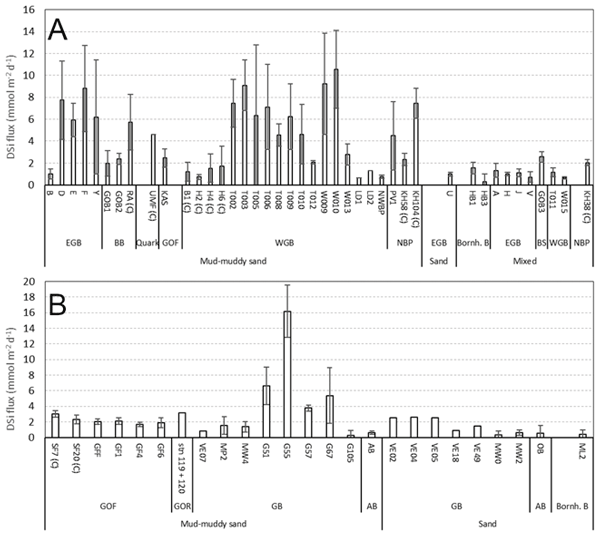
- It is great to see so many in situ DSi flux measurements across the Baltic. Meanwhile, these measurements also show large spatial heterogeneity that cannot be simply explained by seabed types. E.g., in Figure 2a, for the mud-muddy sand seabed, the DSi flux varies between 1-10 mmol/m2/day. Is this a natural variability or this is something to do with in situ technique from different years or the sampling locations (river mouth vs fjords vs shallow open sediments vs deep basins etc.) or with temporal periods (the peak of eutrophication to the post-eutrophication period). Anyway, I think there is a large potential to dig from this dataset, which is worthy more efforts and in turn improve the certainty of benthic DSi estimates.
- I see the point that the total calculated benthic Dsi flux is much larger than BSi export from water column, but another uncertainty here is the accumulative effects of sedimentary BSi due to eutrophication. There was a clear increasing trend of BSi contents in the Baltic sediments before, so this older Bsi pool could continue dissolving as part of this benthic flux. This adds more uncertainty to estimates of LSi dissolution in this study.
- There is no doubt LSi in seafloor is an important player, but some factors should be considered. (1) the rate of LSi dissolution and authigenic clay formation, usually these are much slower than BSi process. if the in situ measurements are running from hours to days, how much LSi dissolution signal it is really captured is a question. (2) Si consumption by authigenic clay formation may can also be considered in the overal Si sink.
- Overall, both the introduction (almost one page) and discussion sections (4.1) start with the important role of riverine inputs, giving a feeling of a study about Si delivery by rivers, but the methods and results exclusively leans on benthic flux. I think it would be much better to focus more on discussing benthic flux variability that this study has solid evidence, and speculate to a lesser extent regarding the mass balance of Si in the Baltic, in which riverine and groundwater inputs and LSi dissolution, two major sources, are largely unconstrained.
Citation: https://doi.org/10.5194/egusphere-2026-707-RC2 -
AC2: 'Reply on RC2', Per Hall, 25 Apr 2026
Response to review #2 of Ekeroth et al., Egusphere-2026-707
Our responses are in blue text and the reviewer comments in black text.
RC2: 'Comment on egusphere-2026-707', Anonymous Referee #2, 17 Mar 2026
Ekeroth et al complied 305 individual benthic DSi measurements in the Baltic Sea over the past two decades. This is a very much appreciated effort to refine today’s Baltic Si budget. Given this dataset, it is clear that benthic BSi and LSi dissolution is properly the most important process supplying DSi to the Baltic Sea.
We thank the reviewer for this assessment.
However, it is a pity that the authors work hard to address the missing Si pool derived from land
This is one of the main messages of the manuscript: The autochthonous export production from the photic zone does not match the sum of the integrated benthic dSi flux and the reported bSi burial rate. So, a main finding of this manuscript is that rSi of terrestrial and groundwater origin (“the missing Si pool”) makes an important contribution.
that they cannot provide any direct data/evidence from this study in terms of the mass balance (such as Fig 6),
We have presented strong indirect evidence that Si of terrestrial and groundwater origin makes an important contribution to the integrated benthic dSi flux and that this Si is reactive (dissolvable). Our aim in including Figure 6 was to illustrate the numbers we arrived at in the manuscript. Since this and the first reviewer seem to have misunderstood our intention with this Figure, we will remove it from the manuscript.
while there are some potential findings that requires more attention get lost in the discussion. Below are major suggestions.
- It is great to see so many in situ DSi flux measurements across the Baltic. Meanwhile, these measurements also show large spatial heterogeneity that cannot be simply explained by seabed types. E.g., in Figure 2a, for the mud-muddy sand seabed, the DSi flux varies between 1-10 mmol/m2/day. Is this a natural variability or this is something to do with in situ technique from different years or the sampling locations (river mouth vs fjords vs shallow open sediments vs deep basins etc.) or with temporal periods (the peak of eutrophication to the post-eutrophication period). Anyway, I think there is a large potential to dig from this dataset, which is worthy more efforts and in turn improve the certainty of benthic DSi estimates.
Mud-muddy sand spans over large areas including transport bottoms, deep accumulation bottoms and this sediment type contains various degrees of sand and carbon content. It also covers the seafloor in all of the major Baltic Sea basins with various water depths, trophic states (mesotrophic to highly eutrophic) and hence a large range of vertical particle fluxes. So this sediment type encompasses the large natural spatial variability of the Baltic Sea. The in situ technique we used was the same during all years and it is described in Kononets et al. (2021; cited in the manuscript). As far as seasonal variability is concerned, as mentioned in the response to reviewer 1, we performed our flux measurements during all months of the year except December and March (Table 1), so not only during the productive part of the annual cycle. We carried out our measurements between 2001 and 2021 (during two decades), so all degrees of eutrophication encountered in the Baltic Sea during this period are included.
- I see the point that the total calculated benthic Dsi flux is much larger than BSi export from water column, but another uncertainty here is the accumulative effects of sedimentary BSi due to eutrophication. There was a clear increasing trend of BSi contents in the Baltic sediments before, so this older Bsi pool could continue dissolving as part of this benthic flux. This adds more uncertainty to estimates of LSi dissolution in this study.
Yes, we agree that older (legacy) bSi can contribute. We will add this possibility to the text. If dissolution of this old legacy bSi pool is important, the need for rSi from land, including groundwater, will be less to match the sum of the integrated benthic dSi flux and the reported bSi burial rate. However, we are not aware of any observations of a legacy bSi pool in Baltic sediments, nor the quantity of it or any change of this quantity. This is due to the fact that published data on solid phase bSi in Baltic sediments are scarce, and on other forms of particulate rSi are largely absent. For this reason, we assume that the contribution to the integrated benthic dSi flux from any legacy bSi pool is quantitatively of less importance.
- There is no doubt LSi in seafloor is an important player, but some factors should be considered. (1) the rate of LSi dissolution and authigenic clay formation, usually these are much slower than BSi process. if the in situ measurements are running from hours to days, how much LSi dissolution signal it is really captured is a question.
Yes, the in situ measurements lasted from less than a day to about three days depending on the reactivity of the seafloor sediment. The porewater dSi is released as a benthic flux to the overlying bottom water due to the concentration gradient across the sediment-water interface. The porewater dSi is produced from the dissolution of all the different forms of particulate Si that exist in the sediment and is dissolvable (reactive). So how much dSi (contributing to the benthic flux) that originates from dissolution of one form of particulate Si (e.g. lsi) or another (e.g. bSi) is a function of the relative abundance of each of the reactive forms of particulate Si in the sediment and their respective dissolution rates. However, this cannot be resolved with the benthic flux measurements we performed. Determinations of the Si isotopic composition of the dSi in the benthic chambers may have helped to disentangle the origin of the dSi in the benthic flux, but this study did not include isotopic determinations.
(2) Si consumption by authigenic clay formation may can also be considered in the overal Si sink.
Correct, and we have never denied that. This process is removing some dSi from the porewater forming authigenic clays, which would make the benthic dSi flux lower. The influence of this process on the benthic dSi flux is included in the measurements we performed (since the fluxes we measure are net fluxes), and thus so also in the integrated annual dSi flux we have presented. However, it is not the aim of this study to specifically quantify this process or to show evidence of its importance in the Baltic Sea.
- Overall, both the introduction (almost one page) and discussion sections (4.1) start with the important role of riverine inputs, giving a feeling of a study about Si delivery by rivers, but the methods and results exclusively leans on benthic flux. I think it would be much better to focus more on discussing benthic flux variability that this study has solid evidence, and speculate to a lesser extent regarding the mass balance of Si in the Baltic, in which riverine and groundwater inputs and LSi dissolution, two major sources, are largely unconstrained.
We have strong indirect evidence that riverine and groundwater inputs of particulate reactive (dissolvable) lSi and aSi (including for example phytoliths and bSi from freshwater diatoms) to sediments of the Baltic Sea have a major influence on the magnitude of the integrated benthic dSi flux. These lines of evidence are already clearly presented in the manuscript. We agree that our strongest empirical evidence concerns benthic fluxes. Riverine and groundwater inputs are therefore discussed primarily as probable contributors rather than quantified sources. We have now also added the possibility that any legacy bSi pool in sediments may contribute to the integrated benthic dSi flux, albeit presumably to a lesser extent.
Peer review completion


Post-review adjustments


Interactive discussion
Status: closed
-
RC1: 'Comment on egusphere-2026-707', Anonymous Referee #1, 08 Mar 2026
For marine biogeochemists the Baltic Sea is a world ocean fascinating part. Indeed, this semi-enclosed sea is not easily renewed by North Sea episodical inputs, and thus is submitted to perturbations generated from the land which indirectly impacts the evolution of the dioxygen content of the deep reservoir and of the nutrient cycles of the Baltic ecosystem as a whole.
In this study the authors implemented an ambitious program to estimate of the benthic silicic acid flux at the sediment-water interface for the different types of sediments that composed the Baltic Sea bottom (sand, mud-muddy sand, rock and boulder, mixed types). Using data acquired from benthic landers in the many sub-basins of the Baltic Sea and from ex situ measurements, thanks to GIS tools the authors spatially extrapolate from local to Baltic scale. They report silicic acid benthic fluxes ranging between 0.3 to 9.0 mol-Si m-2 d-1 with a mean of 3.7 mmol-Si m-2 d-1, which is consistent with analogous systems over the world. Then, extrapolating to annual scale the authors calculated a total flux of 8520 kt-Si yr-1 (304.3 Gmol-Si yr-1). This part of the article is without problems (however see comments below).
Difficulties rise when the authors try to built an equilibrated budget of Si at Baltic Sea scale, integrating different fluxes and processus that are presently not well known, and/or not constrained.
1-Playing the authors’game, assuming steady state, to get a balanced budget of Si for the Baltic Sea, I build the below figure, inspired from Tréguer et al. (2021).
Figure 1 : A possible scenario for a steady state Si cycle in the Baltic sea
This budget is built assuming that the benthic flux is generated by the amount of biogenic silica deposited in sediments that escapes long term accumulation (21.8 Gmol-Si yr-1).
For an annual benthic flux of 76.1 Gmol-Si y-1, the mean daily benthic flux is 0.56 mmol-Si m-2 d-1, which actually is in the range of the authors’measured fluxes (0.3-9.3 mmol m-2 d-1) but more than six times below the mean calculated by the authors. Assuming spatial extrapolation through GIS is correct, could the authors’ annual benthic flux be over estimated due extrapolation of fluxes measured during a short period of time?
If not, could the export of biogenic silica to depth be underestimated ? Could the gross production biogenic silica in the surface layer be underestimated ?
2-It is clear that more data dealing with the biogenic matter fluxes and/or of the silicic acid fluxes (Si release from particulate matter transported by rivers, direct dissolution of lithogenic silica of sediments,…) are needed to build a realistic budget of Si for the Baltic sea. The authors’ speculative Figure 6, a conceptual mass balance in the Baltic Sea, is not helpful given the uncertainties as regards the rSi sources which, according to the authors totalize 326 Gmol-Si.
3-My recommendation would be that the authors try to built a « realistic » Si budget analogous to the above figure 1, expliciting their hypothesis regarding presently unknown fluxes.
Minor points :
-dSi and not DSi (which is ambiguous for a chemist)
-bSi and not BSi (idem)
-aSi and not ASi (idem)
-
AC1: 'Reply on RC1', Per Hall, 25 Apr 2026
Response to review #1 of Ekeroth et al., Egusphere-2026-707
Our responses are in blue text and the reviewer comments in black text.
RC1: 'Comment on egusphere-2026-707', Anonymous Referee #1, 08 Mar 2026
For marine biogeochemists the Baltic Sea is a world ocean fascinating part. Indeed, this semi-enclosed sea is not easily renewed by North Sea episodical inputs, and thus is submitted to perturbations generated from the land which indirectly impacts the evolution of the dioxygen content of the deep reservoir and of the nutrient cycles of the Baltic ecosystem as a whole.
In this study the authors implemented an ambitious program to estimate of the benthic silicic acid flux at the sediment-water interface for the different types of sediments that composed the Baltic Sea bottom (sand, mud-muddy sand, rock and boulder, mixed types). Using data acquired from benthic landers in the many sub-basins of the Baltic Sea and from ex situ measurements, thanks to GIS tools the authors spatially extrapolate from local to Baltic scale. They report silicic acid benthic fluxes ranging between 0.3 to 9.0 mol-Si m-2 d-1
Please note: 0.3 to 9.0 mmol Si m-2 d-1 (not mol).
with a mean of 3.7 mmol-Si m-2 d-1, which is consistent with analogous systems over the world. Then, extrapolating to annual scale the authors calculated a total flux of 8520 kt-Si yr-1 (304.3 Gmol-Si yr-1). This part of the article is without problems (however see comments below).
We thank the reviewer for this assessment.
Difficulties rise when the authors try to built an equilibrated budget of Si at Baltic Sea scale, integrating different fluxes and processus that are presently not well known, and/or not constrained.
The reviewer may have misunderstood our aim with this manuscript. Our aim was not to “build an equilibrated budget of Si at Baltic Sea scale”. We aimed to show, by GIS upscaling on the Baltic Sea scale of a very large number of benthic dSi flux measurements, carried out during two decades, that the autochthonous export production from the photic zone was far from enough to match the sum of the integrated benthic dSi flux and the reported bSi burial rate. Therefore we suggested that other sources of rSi must exist, such as rSi of terrestrial origin. Our results should provide an incentive as well as facilitate upcoming investigations to construct a revised and more complete Baltic Si budget, as we wrote at the end of Conclusions: “Results of this study should facilitate and stimulate the construction of a revised and more complete Si budget for the Baltic Sea. Future studies should in this regard include new estimates of burial of rSi (not only limited to BSi), of export of DSi and rSi to the Kattegat, of delivery of DSi and rSi via both rivers and groundwater, and continued observations of changes of the water column DSi standing stock.”
1-Playing the authors’game, assuming steady state, to get a balanced budget of Si for the Baltic Sea, I build the below figure, inspired from Tréguer et al. (2021).
Figure 1 : A possible scenario for a steady state Si cycle in the Baltic sea
This budget is built assuming that the benthic flux is generated by the amount of biogenic silica deposited in sediments that escapes long term accumulation (21.8 Gmol-Si yr-1).
21.8 Gmol-Si yr-1 equals about 612 kt Si yr-1. If “the benthic flux is generated by the amount of biogenic silica deposited in sediments”, and originating from the autochthonous export production from the photic zone, “that escapes long-term accumulation”, this number should be, based on the numbers we have presented in the manuscript, 2740 – 610 = 2130 kt Si yr-1. Not 612 kt Si yr-1. Hence, this benthic flux estimate by the reviewer does not agree with our upscaled direct measurements.
For an annual benthic flux of 76.1 Gmol-Si y-1,
This would be the benthic dSi flux if it was generated only by dissolution of the bSi originating from the Baltic Sea photic zone that is not buried.
the mean daily benthic flux is 0.56 mmol-Si m-2 d-1, which actually is in the range of the authors’measured fluxes (0.3-9.3 mmol m-2 d-1) but more than six times below the mean calculated by the authors.
This is one of the main points of our paper. Our results strongly suggest that the integrated annual benthic dSi flux is not only generated from the autochthonous export production from the photic zone, but that other sources of rSi must exist, such as deposition of riverine rSi and groundwater-derived rSi.
Assuming spatial extrapolation through GIS is correct, could the authors’ annual benthic flux be over estimated due extrapolation of fluxes measured during a short period of time?
If the reviewer means short chamber incubation times at the sea-floor, the answer is no. We optimized chamber incubation times to match the reactivity of the sediment. Still some incubations became too long and in those cases the increase rate of dSi concentration in chambers slowed down at the end of incubations (see examples in our Figure S1).
If the reviewer means a short period of time of the annual cycle (for example mostly under the productive season), the answer is most likely no. Our flux measurements were carried out during 10 months of the year (January-November; but during many different years). The only months without measurements were March and December (Table 1).
If not, could the export of biogenic silica to depth be underestimated?
We assumed no dissolution of bSi during sinking through the water column from the bottom of the photic zone to the seafloor. Since the average depth of the Baltic Sea is relatively shallow, and the sinking rate of diatom debris is quite fast, this should only cause a minor underestimation.
Could the gross production biogenic silica in the surface layer be underestimated ?
We have used the most reliable estimate of primary production in the Baltic Sea that, to our knowledge, exists. Based on that and on well-known literature, we calculated the biogenic silica production in the surface layer. So our answer is that it is possible, but not likely.
2-It is clear that more data dealing with the biogenic matter fluxes and/or of the silicic acid fluxes (Si release from particulate matter transported by rivers, direct dissolution of lithogenic silica of sediments,…) are needed to build a realistic budget of Si for the Baltic sea.
We wrote that in the manuscript. So we do agree.
The authors’ speculative Figure 6, a conceptual mass balance in the Baltic Sea, is not helpful given the uncertainties as regards the rSi sources which, according to the authors totalize 326 Gmol-Si.
Our aim in including Figure 6 was to illustrate the numbers we arrived at in the manuscript. Since this and the second reviewer seem to have misunderstood our intention with this Figure, we will remove it from the manuscript.
3-My recommendation would be that the authors try to built a « realistic » Si budget analogous to the above figure 1, expliciting their hypothesis regarding presently unknown fluxes.
It was never our intention to build a «realistic» Si budget. Please see our responses above.
Minor points :
-dSi and not DSi (which is ambiguous for a chemist).
Agree. We will change to dSi.
-bSi and not BSi (idem)
Agree. We will change to bSi.
-aSi and not ASi (idem)
Agree. We will change to aSi.
-
AC1: 'Reply on RC1', Per Hall, 25 Apr 2026
-
RC2: 'Comment on egusphere-2026-707', Anonymous Referee #2, 17 Mar 2026
Ekeroth et al complied 305 individual benthic DSi measurements in the Baltic Sea over the past two decades. This is a very much appreciated effort to refine today’s Baltic Si budget. Given this dataset, it is clear that benthic BSi and LSi dissolution is properly the most important process supplying DSi to the Baltic Sea. However, it is a pity that the authors work hard to address the missing Si pool derived from land that they cannot provide any direct data/evidence from this study in terms of the mass balance (such as Fig 6), while there are some potential findings that requires more attention get lost in the discussion. Below are major suggestions.
- It is great to see so many in situ DSi flux measurements across the Baltic. Meanwhile, these measurements also show large spatial heterogeneity that cannot be simply explained by seabed types. E.g., in Figure 2a, for the mud-muddy sand seabed, the DSi flux varies between 1-10 mmol/m2/day. Is this a natural variability or this is something to do with in situ technique from different years or the sampling locations (river mouth vs fjords vs shallow open sediments vs deep basins etc.) or with temporal periods (the peak of eutrophication to the post-eutrophication period). Anyway, I think there is a large potential to dig from this dataset, which is worthy more efforts and in turn improve the certainty of benthic DSi estimates.
- I see the point that the total calculated benthic Dsi flux is much larger than BSi export from water column, but another uncertainty here is the accumulative effects of sedimentary BSi due to eutrophication. There was a clear increasing trend of BSi contents in the Baltic sediments before, so this older Bsi pool could continue dissolving as part of this benthic flux. This adds more uncertainty to estimates of LSi dissolution in this study.
- There is no doubt LSi in seafloor is an important player, but some factors should be considered. (1) the rate of LSi dissolution and authigenic clay formation, usually these are much slower than BSi process. if the in situ measurements are running from hours to days, how much LSi dissolution signal it is really captured is a question. (2) Si consumption by authigenic clay formation may can also be considered in the overal Si sink.
- Overall, both the introduction (almost one page) and discussion sections (4.1) start with the important role of riverine inputs, giving a feeling of a study about Si delivery by rivers, but the methods and results exclusively leans on benthic flux. I think it would be much better to focus more on discussing benthic flux variability that this study has solid evidence, and speculate to a lesser extent regarding the mass balance of Si in the Baltic, in which riverine and groundwater inputs and LSi dissolution, two major sources, are largely unconstrained.
Citation: https://doi.org/10.5194/egusphere-2026-707-RC2 -
AC2: 'Reply on RC2', Per Hall, 25 Apr 2026
Response to review #2 of Ekeroth et al., Egusphere-2026-707
Our responses are in blue text and the reviewer comments in black text.
RC2: 'Comment on egusphere-2026-707', Anonymous Referee #2, 17 Mar 2026
Ekeroth et al complied 305 individual benthic DSi measurements in the Baltic Sea over the past two decades. This is a very much appreciated effort to refine today’s Baltic Si budget. Given this dataset, it is clear that benthic BSi and LSi dissolution is properly the most important process supplying DSi to the Baltic Sea.
We thank the reviewer for this assessment.
However, it is a pity that the authors work hard to address the missing Si pool derived from land
This is one of the main messages of the manuscript: The autochthonous export production from the photic zone does not match the sum of the integrated benthic dSi flux and the reported bSi burial rate. So, a main finding of this manuscript is that rSi of terrestrial and groundwater origin (“the missing Si pool”) makes an important contribution.
that they cannot provide any direct data/evidence from this study in terms of the mass balance (such as Fig 6),
We have presented strong indirect evidence that Si of terrestrial and groundwater origin makes an important contribution to the integrated benthic dSi flux and that this Si is reactive (dissolvable). Our aim in including Figure 6 was to illustrate the numbers we arrived at in the manuscript. Since this and the first reviewer seem to have misunderstood our intention with this Figure, we will remove it from the manuscript.
while there are some potential findings that requires more attention get lost in the discussion. Below are major suggestions.
- It is great to see so many in situ DSi flux measurements across the Baltic. Meanwhile, these measurements also show large spatial heterogeneity that cannot be simply explained by seabed types. E.g., in Figure 2a, for the mud-muddy sand seabed, the DSi flux varies between 1-10 mmol/m2/day. Is this a natural variability or this is something to do with in situ technique from different years or the sampling locations (river mouth vs fjords vs shallow open sediments vs deep basins etc.) or with temporal periods (the peak of eutrophication to the post-eutrophication period). Anyway, I think there is a large potential to dig from this dataset, which is worthy more efforts and in turn improve the certainty of benthic DSi estimates.
Mud-muddy sand spans over large areas including transport bottoms, deep accumulation bottoms and this sediment type contains various degrees of sand and carbon content. It also covers the seafloor in all of the major Baltic Sea basins with various water depths, trophic states (mesotrophic to highly eutrophic) and hence a large range of vertical particle fluxes. So this sediment type encompasses the large natural spatial variability of the Baltic Sea. The in situ technique we used was the same during all years and it is described in Kononets et al. (2021; cited in the manuscript). As far as seasonal variability is concerned, as mentioned in the response to reviewer 1, we performed our flux measurements during all months of the year except December and March (Table 1), so not only during the productive part of the annual cycle. We carried out our measurements between 2001 and 2021 (during two decades), so all degrees of eutrophication encountered in the Baltic Sea during this period are included.
- I see the point that the total calculated benthic Dsi flux is much larger than BSi export from water column, but another uncertainty here is the accumulative effects of sedimentary BSi due to eutrophication. There was a clear increasing trend of BSi contents in the Baltic sediments before, so this older Bsi pool could continue dissolving as part of this benthic flux. This adds more uncertainty to estimates of LSi dissolution in this study.
Yes, we agree that older (legacy) bSi can contribute. We will add this possibility to the text. If dissolution of this old legacy bSi pool is important, the need for rSi from land, including groundwater, will be less to match the sum of the integrated benthic dSi flux and the reported bSi burial rate. However, we are not aware of any observations of a legacy bSi pool in Baltic sediments, nor the quantity of it or any change of this quantity. This is due to the fact that published data on solid phase bSi in Baltic sediments are scarce, and on other forms of particulate rSi are largely absent. For this reason, we assume that the contribution to the integrated benthic dSi flux from any legacy bSi pool is quantitatively of less importance.
- There is no doubt LSi in seafloor is an important player, but some factors should be considered. (1) the rate of LSi dissolution and authigenic clay formation, usually these are much slower than BSi process. if the in situ measurements are running from hours to days, how much LSi dissolution signal it is really captured is a question.
Yes, the in situ measurements lasted from less than a day to about three days depending on the reactivity of the seafloor sediment. The porewater dSi is released as a benthic flux to the overlying bottom water due to the concentration gradient across the sediment-water interface. The porewater dSi is produced from the dissolution of all the different forms of particulate Si that exist in the sediment and is dissolvable (reactive). So how much dSi (contributing to the benthic flux) that originates from dissolution of one form of particulate Si (e.g. lsi) or another (e.g. bSi) is a function of the relative abundance of each of the reactive forms of particulate Si in the sediment and their respective dissolution rates. However, this cannot be resolved with the benthic flux measurements we performed. Determinations of the Si isotopic composition of the dSi in the benthic chambers may have helped to disentangle the origin of the dSi in the benthic flux, but this study did not include isotopic determinations.
(2) Si consumption by authigenic clay formation may can also be considered in the overal Si sink.
Correct, and we have never denied that. This process is removing some dSi from the porewater forming authigenic clays, which would make the benthic dSi flux lower. The influence of this process on the benthic dSi flux is included in the measurements we performed (since the fluxes we measure are net fluxes), and thus so also in the integrated annual dSi flux we have presented. However, it is not the aim of this study to specifically quantify this process or to show evidence of its importance in the Baltic Sea.
- Overall, both the introduction (almost one page) and discussion sections (4.1) start with the important role of riverine inputs, giving a feeling of a study about Si delivery by rivers, but the methods and results exclusively leans on benthic flux. I think it would be much better to focus more on discussing benthic flux variability that this study has solid evidence, and speculate to a lesser extent regarding the mass balance of Si in the Baltic, in which riverine and groundwater inputs and LSi dissolution, two major sources, are largely unconstrained.
We have strong indirect evidence that riverine and groundwater inputs of particulate reactive (dissolvable) lSi and aSi (including for example phytoliths and bSi from freshwater diatoms) to sediments of the Baltic Sea have a major influence on the magnitude of the integrated benthic dSi flux. These lines of evidence are already clearly presented in the manuscript. We agree that our strongest empirical evidence concerns benthic fluxes. Riverine and groundwater inputs are therefore discussed primarily as probable contributors rather than quantified sources. We have now also added the possibility that any legacy bSi pool in sediments may contribute to the integrated benthic dSi flux, albeit presumably to a lesser extent.
Peer review completion
Post-review adjustments
Journal article(s) based on this preprint
Data sets
The integrated benthic silicate flux in the Baltic Sea suggests a major land-derived reactive silicon source, Zenodo [data set] N. Ekeroth et al. https://doi.org/10.5281/zenodo.18484732
Viewed
| HTML | XML | Total | Supplement | BibTeX | EndNote | |
|---|---|---|---|---|---|---|
| 1,011 | 574 | 143 | 1,728 | 192 | 117 | 159 |
- HTML: 1,011
- PDF: 574
- XML: 143
- Total: 1,728
- Supplement: 192
- BibTeX: 117
- EndNote: 159
Viewed (geographical distribution)
| Country | # | Views | % |
|---|
| Total: | 0 |
| HTML: | 0 |
| PDF: | 0 |
| XML: | 0 |
- 1
Nils Ekeroth
Mikhail Kononets
Stefano Bonaglia
Volker Brüchert
Elizabeth K. Robertson
Anders Tengberg

The requested preprint has a corresponding peer-reviewed final revised paper. You are encouraged to refer to the final revised version.
- Preprint
(3404 KB) - Metadata XML
-
Supplement
(25 KB) - BibTeX
- EndNote
- Final revised paper
For marine biogeochemists the Baltic Sea is a world ocean fascinating part. Indeed, this semi-enclosed sea is not easily renewed by North Sea episodical inputs, and thus is submitted to perturbations generated from the land which indirectly impacts the evolution of the dioxygen content of the deep reservoir and of the nutrient cycles of the Baltic ecosystem as a whole.
In this study the authors implemented an ambitious program to estimate of the benthic silicic acid flux at the sediment-water interface for the different types of sediments that composed the Baltic Sea bottom (sand, mud-muddy sand, rock and boulder, mixed types). Using data acquired from benthic landers in the many sub-basins of the Baltic Sea and from ex situ measurements, thanks to GIS tools the authors spatially extrapolate from local to Baltic scale. They report silicic acid benthic fluxes ranging between 0.3 to 9.0 mol-Si m-2 d-1 with a mean of 3.7 mmol-Si m-2 d-1, which is consistent with analogous systems over the world. Then, extrapolating to annual scale the authors calculated a total flux of 8520 kt-Si yr-1 (304.3 Gmol-Si yr-1). This part of the article is without problems (however see comments below).
Difficulties rise when the authors try to built an equilibrated budget of Si at Baltic Sea scale, integrating different fluxes and processus that are presently not well known, and/or not constrained.
1-Playing the authors’game, assuming steady state, to get a balanced budget of Si for the Baltic Sea, I build the below figure, inspired from Tréguer et al. (2021).
Figure 1 : A possible scenario for a steady state Si cycle in the Baltic sea
This budget is built assuming that the benthic flux is generated by the amount of biogenic silica deposited in sediments that escapes long term accumulation (21.8 Gmol-Si yr-1).
For an annual benthic flux of 76.1 Gmol-Si y-1, the mean daily benthic flux is 0.56 mmol-Si m-2 d-1, which actually is in the range of the authors’measured fluxes (0.3-9.3 mmol m-2 d-1) but more than six times below the mean calculated by the authors. Assuming spatial extrapolation through GIS is correct, could the authors’ annual benthic flux be over estimated due extrapolation of fluxes measured during a short period of time?
If not, could the export of biogenic silica to depth be underestimated ? Could the gross production biogenic silica in the surface layer be underestimated ?
2-It is clear that more data dealing with the biogenic matter fluxes and/or of the silicic acid fluxes (Si release from particulate matter transported by rivers, direct dissolution of lithogenic silica of sediments,…) are needed to build a realistic budget of Si for the Baltic sea. The authors’ speculative Figure 6, a conceptual mass balance in the Baltic Sea, is not helpful given the uncertainties as regards the rSi sources which, according to the authors totalize 326 Gmol-Si.
3-My recommendation would be that the authors try to built a « realistic » Si budget analogous to the above figure 1, expliciting their hypothesis regarding presently unknown fluxes.
Minor points :
-dSi and not DSi (which is ambiguous for a chemist)
-bSi and not BSi (idem)
-aSi and not ASi (idem)