
the Creative Commons Attribution 4.0 License.
the Creative Commons Attribution 4.0 License.
 | 06 Mar 2026
On spatial scales of local aerosol production in boreal ecosystems
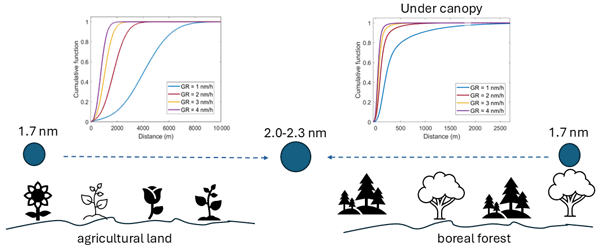
Abstract. Quantification of the climate impact of land use is important for the development of effective climate change mitigation and adaptation practices. Ecosystems emit compounds that participate in the formation and growth of aerosol particles. Particles of few nm size can be produced locally as compared to regional aerosol growth processes at larger sizes, and in boreal environment, higher concentrations of small particles were observed over agricultural lands than over forests. The aim of this study is to provide estimates of spatial scales of an ecosystem needed to produce small particles predominantly from own emissions. Here, we consider forest and agricultural ecosystems, and distinguish situations in which aerosol production is relatively slow and vertically distributed within the well-mixed boundary layer and when it can occur quickly close to the surface. For the latter, we introduce source contribution function of local aerosol production, which is based on the concentration footprint function modified to account for aerosol growth. We quantify the contributing area for neutral stratification and a typical wind speed. For below-canopy forest, the relevant distance is at 100–500 m, whereas it is at 0.9–5.5 km in agricultural fields, depending on the growth rate and the initial size distribution. For the distribution close to measurements, the contribution of the nearby 100–500 m is approximately 30 % in agricultural fields. To improve estimates, more research is needed on the dynamics of small aerosol, including contributions of chemical compounds to aerosol growth and the impact of meteorological conditions.
-
Notice on discussion status
The requested preprint has a corresponding peer-reviewed final revised paper. You are encouraged to refer to the final revised version.
-
Preprint
(1989 KB)
-
The requested preprint has a corresponding peer-reviewed final revised paper. You are encouraged to refer to the final revised version.
- Preprint
(1989 KB) - Metadata XML
- BibTeX
- EndNote
- Final revised paper


Journal article(s) based on this preprint
Interactive discussion
Status: closed
-
RC1: 'Comment on egusphere-2026-704', David Fitzjarrald, 17 Apr 2026
- AC1: 'Reply on RC1', Ekaterina Ezhova, 10 Jun 2026
-
RC2: 'Comment on egusphere-2026-704', Anonymous Referee #2, 30 Apr 2026
## General comments
The manuscript introduces a method to assess the spatial scales of local aerosol production in boreal forest and agricultural ecosystem. Following the footprint estimation via Lagrangian dispersion modelling to assess flux footprints they develop a source contribution function for aerosol particles in the size range of 2-2.3 nm which can be related to the local sources of needed precursor gases and the favorite atmosperic conditions.
The manuscript has some aspects that may need a bit deeper explanations. As example, the prerequisite of a neutral stratification and the limit to this conditions is mentioned but it remains unclear why that limitation was chosen.
## Specific comments
page 1, line 5: "to produce small particles predominantly from own emissions." It is not immediatly clear what these "own emissions" are. You speak about "an ecosystem" therefore I assume the "own" relates to this ecosystem, in that case I would at least write "its own emissions".
page 1, line 10: What do you mean with "below-canopy forest"? Is that the understory layer? Is it a supressed canopy layer?
page 1, line 11: "For the distribution close to measurements, the contribution of the nearby 100-500 m is approximately 30% in agricultural fields." What distribution do you refer to? It leaves me thinking what if that distribution is not near to measurements? Why the 100-500 m, that are a feature of the forest (in the sentence before), are now some fraction of the agricultural field?
page 6, line 178ff: You emphasize that the footprint function is itself not time depended? Where do you get this statement from? I ask because later in the manuscript (page 8, line 240) you tell that your Lagrangian dispersion model calculates according the travel time of air parcels. Furthermore you tell in Appendix B that the model used Gaussian distributions of velocity fluctuations. Velocities usually have a unit of m/s, so an explicit relation to time.
page 6, line 184ff: The two subsequent sentences "Our concept of the source contribution function of local aerosol production is related to the concentration footprint for non-inert trace gases as we consider also the time scales of aerosol dynamics.Our concept of the source contribution function of local aerosol production is related to the concentration footprint for organic vapours (inert scalar) but considers also the time scales of aerosol dynamics." seem to tell the same thing. Maybe that remained accidentially while revising or, as AI helpers become more popular, these tend to repeat text with slightly different wording over and over. Maybe decide which version to retain.
page 10, line 310 and page 11, line 327: Figure number reference not resolved in the text.
page 11, line 349: "the concept of the footprint of the turbulent transport," I am not sure if I understand that statement. Turbulent transport "determines" the footprint (the field of view of the sensor). Why the "concept"?
page 12, line 358: "Above the canopy, the behaviour seems..." I would add like so " Above the canopy, the behaviour of forests seems..."
page 14, line 438: You tell that you are using the forward trajectory method. Can you explain why that choice was taken? Backward method is reported (e.g., Vesala 2008) to allow efficient application in case of inhomogenous terrain which is more apparent than homogenous terrain.
Citation: https://doi.org/10.5194/egusphere-2026-704-RC2 - AC2: 'Reply on RC2', Ekaterina Ezhova, 10 Jun 2026
-
AC3: 'Reply on RC2', Ekaterina Ezhova, 10 Jun 2026
Publisher’s note: this comment is a copy of AC2 and its content was therefore removed on 12 June 2026
Citation: https://doi.org/10.5194/egusphere-2026-704-AC3
Peer review completion


Interactive discussion
Status: closed
-
RC1: 'Comment on egusphere-2026-704', David Fitzjarrald, 17 Apr 2026
Please see the attached supplement for my review comments.
- AC1: 'Reply on RC1', Ekaterina Ezhova, 10 Jun 2026
-
RC2: 'Comment on egusphere-2026-704', Anonymous Referee #2, 30 Apr 2026
## General comments
The manuscript introduces a method to assess the spatial scales of local aerosol production in boreal forest and agricultural ecosystem. Following the footprint estimation via Lagrangian dispersion modelling to assess flux footprints they develop a source contribution function for aerosol particles in the size range of 2-2.3 nm which can be related to the local sources of needed precursor gases and the favorite atmosperic conditions.
The manuscript has some aspects that may need a bit deeper explanations. As example, the prerequisite of a neutral stratification and the limit to this conditions is mentioned but it remains unclear why that limitation was chosen.
## Specific comments
page 1, line 5: "to produce small particles predominantly from own emissions." It is not immediatly clear what these "own emissions" are. You speak about "an ecosystem" therefore I assume the "own" relates to this ecosystem, in that case I would at least write "its own emissions".
page 1, line 10: What do you mean with "below-canopy forest"? Is that the understory layer? Is it a supressed canopy layer?
page 1, line 11: "For the distribution close to measurements, the contribution of the nearby 100-500 m is approximately 30% in agricultural fields." What distribution do you refer to? It leaves me thinking what if that distribution is not near to measurements? Why the 100-500 m, that are a feature of the forest (in the sentence before), are now some fraction of the agricultural field?
page 6, line 178ff: You emphasize that the footprint function is itself not time depended? Where do you get this statement from? I ask because later in the manuscript (page 8, line 240) you tell that your Lagrangian dispersion model calculates according the travel time of air parcels. Furthermore you tell in Appendix B that the model used Gaussian distributions of velocity fluctuations. Velocities usually have a unit of m/s, so an explicit relation to time.
page 6, line 184ff: The two subsequent sentences "Our concept of the source contribution function of local aerosol production is related to the concentration footprint for non-inert trace gases as we consider also the time scales of aerosol dynamics.Our concept of the source contribution function of local aerosol production is related to the concentration footprint for organic vapours (inert scalar) but considers also the time scales of aerosol dynamics." seem to tell the same thing. Maybe that remained accidentially while revising or, as AI helpers become more popular, these tend to repeat text with slightly different wording over and over. Maybe decide which version to retain.
page 10, line 310 and page 11, line 327: Figure number reference not resolved in the text.
page 11, line 349: "the concept of the footprint of the turbulent transport," I am not sure if I understand that statement. Turbulent transport "determines" the footprint (the field of view of the sensor). Why the "concept"?
page 12, line 358: "Above the canopy, the behaviour seems..." I would add like so " Above the canopy, the behaviour of forests seems..."
page 14, line 438: You tell that you are using the forward trajectory method. Can you explain why that choice was taken? Backward method is reported (e.g., Vesala 2008) to allow efficient application in case of inhomogenous terrain which is more apparent than homogenous terrain.
Citation: https://doi.org/10.5194/egusphere-2026-704-RC2 - AC2: 'Reply on RC2', Ekaterina Ezhova, 10 Jun 2026
-
AC3: 'Reply on RC2', Ekaterina Ezhova, 10 Jun 2026
Publisher’s note: this comment is a copy of AC2 and its content was therefore removed on 12 June 2026
Citation: https://doi.org/10.5194/egusphere-2026-704-AC3
Peer review completion
Journal article(s) based on this preprint
Viewed
| HTML | XML | Total | BibTeX | EndNote | |
|---|---|---|---|---|---|
| 828 | 442 | 122 | 1,392 | 126 | 149 |
- HTML: 828
- PDF: 442
- XML: 122
- Total: 1,392
- BibTeX: 126
- EndNote: 149
Viewed (geographical distribution)
| Country | # | Views | % |
|---|
| Total: | 0 |
| HTML: | 0 |
| PDF: | 0 |
| XML: | 0 |
- 1
Cited


1 citations as recorded by crossref.
Ekaterina Ezhova

Üllar Rannik
Santeri Tuovinen
Olga Garmash
Otso Peräkylä
Piaopiao Ke
Topi Laanti
Anna Lintunen
Veli-Matti Kerminen
Janne Rinne
Timo Vesala
Markku Kulmala
The requested preprint has a corresponding peer-reviewed final revised paper. You are encouraged to refer to the final revised version.
- Preprint
(1989 KB) - Metadata XML
Please see the attached supplement for my review comments.