
the Creative Commons Attribution 4.0 License.
the Creative Commons Attribution 4.0 License.
 | 23 Feb 2026
Elevational Dependence of Global Forest Fires and Associated Aerosol Optical Depth: Drivers and Decoupling
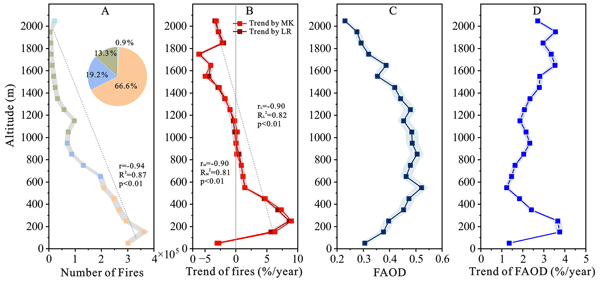
Abstract. Forest fires have become an escalating environmental and ecological issue worldwide over the past decades. However, a knowledge gap persists in globally assessing how topography modulates wildfire behavior. Here we quantify global spatiotemporal patterns of forest fire activity and associated aerosol optical depth (AOD), together with elevation-dependent controls, using satellite observations from 2012 to 2024. The analysis reveals a slight yet significant increase in fire occurrence, accompanied by a strong positive association with fine-mode AOD (FAOD). In contrast, coarse-mode AOD (CAOD) shows little response, implying that wildfire emissions mainly contribute to the fine aerosol fraction. Forest fire occurrence declines systematically with elevation, with most fires concentrated below 600 m. In contrast, FAOD exhibits elevated mean values and increasing trends at mid-elevations (600–1400 m), revealing a decoupling between fire frequency and aerosol loading. This divergence is consistent with shifts in forest-type composition and topographically modulated smoke transport, including aerosol self-lifting driven by radiative absorption and atmospheric convection. Elevation-stratified multiple linear regression analyses incorporating the Fire Weather Index, leaf area index, temperature, wind speed, and precipitation indicate that fire activity is primarily governed by fuel availability and aridity. Precipitation exerts a consistent suppressive effect across elevations, while wind speed enhances fuel drying and fire spread at mid-elevations. Overall, these results identify elevation as a key organizing factor linking forest fires, aerosol emissions, and their underlying drivers, providing new constraints for wildfire risk assessment and fire–aerosol interactions under a changing climate.
-
Notice on discussion status
The requested preprint has a corresponding peer-reviewed final revised paper. You are encouraged to refer to the final revised version.
-
Preprint
(3176 KB)
-
The requested preprint has a corresponding peer-reviewed final revised paper. You are encouraged to refer to the final revised version.
- Preprint
(3176 KB) - Metadata XML
- BibTeX
- EndNote
- Final revised paper


Journal article(s) based on this preprint
Interactive discussion
Status: closed
- RC1: 'Comment on egusphere-2026-689', Anonymous Referee #1, 09 Mar 2026
-
RC2: 'Comment on egusphere-2026-689', Anonymous Referee #2, 15 Mar 2026
The manuscript investigates the global spatiotemporal characteristics of forest fire activity and associated aerosol optical depth (AOD) from 2012 to 2024, with a focus on elevation-dependent patterns and controlling factors. By integrating satellite observations with environmental variables, this study highlights a potential decoupling between fire occurrence and fine-mode aerosol loading across different elevation bands. The topic is relevant to the scope of Atmospheric Chemistry and Physics, and the results are potentially interesting. However, some important methodological details are missing and several issues require clarification or revision. If the following comments are adequately addressed, the manuscript could be considered for publication.
Specific comments
- In Section 2.3, the study uses AOD data derived from the SIDN algorithm. The authors could clarify why this dataset was selected and what advantages it offers compared with other commonly used AOD products (e.g., MODIS AOD).
- The spatial resolution of the AOD data (0.5°) is much coarser than that of the forest fire data (0.1°). The manuscript states that a nearest-neighbor approach was used to match the datasets, but the rationale for choosing this method is not explained. The authors should justify this choice and discuss the potential uncertainties introduced by the spatial mismatch.
- The manuscript compares the spatiotemporal trends in FAOD and CAOD with the trends in active fire counts. However, FAOD and CAOD may also be affected by other aerosol sources unrelated to wildfire emissions. The authors should discuss whether such comparisons are appropriate and clarify how other sources may influence the interpretation of the results.
- Lines 322–323 indicate that only 0.9% of fires occur above 2000 m, and the analysis therefore focuses mainly on low- and mid-elevation regions. However, previous studies (e.g., Xu et al., 2022; https://nsojournals.onlinelibrary.wiley.com/doi/full/10.1111/ecog.06527) reported increasing burned areas in global high-mountain regions (>3000 m). The authors are encouraged to discuss their findings in the context of this study.
- In Lines 385–386, the manuscript refers to “low elevation (200–300 m and 600–700 m)”. However, in the abstract and other parts of the manuscript (e.g., Line 345), elevations above 600 m are defined as mid-elevation. This inconsistency needs to be clarified.
- In Figure 6, the low-elevation band (200–300 m) shows relatively strong positive regression coefficients between LAI and fire activity. The authors mainly emphasize the relationship at mid-elevations, and it would be helpful to explain why the low-elevation relationship is not discussed in similar detail.
- In Figures 2 and 4, abbreviations for forest types are used in these figures. The full names of these forest types could be provided in the figure captions for clarity.
Citation: https://doi.org/10.5194/egusphere-2026-689-RC2 -
AC1: 'Comment on egusphere-2026-689', Chuanfeng Zhao, 08 Apr 2026
Response to Reviewer #1
We highly appreciate the insightful comments and suggestions provided by the reviewer, which have helped us enhance the quality of our manuscript. We have carefully considered each comment and implemented the suggested revisions or provided detailed clarifications where appropriate. Note that our responses are represented in blue.Wildfires have become an escalating environmental and ecological concern worldwide over recent decades. This study uses satellite observations to investigate the influence of elevation on global forest fire activity and the associated aerosol optical depth (AOD). The results reveal a decoupling between fire frequency and aerosol loading, characterized by a decline in forest fire occurrence with elevation, while FAOD exhibits elevated mean values and increasing trends at mid-elevations. This divergence is attributed to variations in forest-type composition and topographically modulated smoke transport. In addition, elevation-stratified multiple linear regression analyses suggest that fuel availability and aridity are the primary factors controlling forest fire activity at mid-elevations. Overall, the manuscript is well organized and clearly presented, and the observational analyses and interpretations are generally convincing. The topic is relevant to understanding fire–aerosol interactions and their dependence on topographic factors. The paper could be considered for publication after the following issues are addressed.
We appreciate the reviewer’s positive evaluations regarding our study, along with the thoughtful and helpful comments on our manuscript. We have revised our manuscript taking all these comments into account.
1. In this study, AOD is decomposed into FAOD and CAOD to analyze their relationships with forest fire activity. However, the manuscript does not sufficiently explain the scientific rationale and significance of this separation. The authors should clearly clarify the motivation and importance of distinguishing FAOD and CAOD in the context of wildfire–aerosol interactions. A brief explanation in the methodology or introduction or discussion would help readers better understand why this decomposition is necessary.
Thank you for your insightful suggestion. We agree that the scientific motivation for separating AOD into FAOD and CAOD should be more clearly explained. To address this, we have added a brief explanation in the Discussion (Lines 289–294). The added text reads as follows:
“Aerosols influence the atmospheric radiation balance through the scattering and absorption of radiation (Andreae et al., 2004; Blanchard-Wrigglesworth et al., 2025). Owing to their distinct optical properties, different aerosol types exert varying climatic effects (Lin et al., 2021), particularly between fine-mode and coarse-mode particles (Li et al., 2025). To better investigate aerosol responses to forest fire activity, aerosol loading is therefore characterized using FAOD and CAOD.”
2. The manuscript reports no significant correlation between CAOD and forest fire pixel counts. However, several previous studies have suggested that wildfire activity can be associated with increases in dust aerosols, which contribute to coarse-mode optical depth. Therefore, the authors should discuss this issue in more detail. In particular, it would be helpful to explain why such relationships are not detected in the present analysis.
The reviewer proposed a very good question. In response to your comment, we have incorporated a clarification in Lines 325–331 to explain why a significant correlation between CAOD and forest fire pixel counts is not evident in our analysis. Specifically, our analysis focuses on large-scale averages over forest fire regions, whereas coarse-mode aerosol enhancements related to wildfires are often associated with episodic events such as pyroCb emissions or post-fire dust outbreaks. The added text reads as follows:
“In contrast to the large aerosol particles associated with large fire events, such as pyroCb emissions (Li et al., 2025) or coarse dust produced by post-fire dust outbreaks caused by reduced vegetation cover and soil moisture (Yu and Ginoux, 2022), the results presented here mainly represent the global mean response within forest fire regions. Although large fire events may generate unusually high aerosol loading or coarse-mode dust, such episodic events are not fully captured in the large-scale averages analyzed in this study.”
3. FWI is widely used as a representative indicator of meteorological conditions favorable for wildfire occurrences. However, the elevation-dependent regression analysis in this study indicates a relatively weak independent relationship between FWI and forest fire activity. This result is somewhat unexpected and deserves further discussion. The authors should provide additional explanation for this finding.
Thank you for this helpful suggestion. We agree that the relatively weak independent relationship between FWI and forest fire activity warrants further explanation. We have incorporated additional discussion in Lines 407–414. The analysis suggests that FWI mainly represents short-term surface meteorological conditions, whereas wildfire development can also be strongly influenced by atmospheric instability and lightning activity, which are not explicitly included in the FWI formulation. Moreover, complex regional topography may further modulate atmospheric instability and fire behavior. The added text reads as follows:
“FWI primarily represents short-term surface meteorological conditions conducive to wildfire occurrence, but it does not explicitly account for atmospheric instability, which can play an important role in the development of large fires (Pinto et al., 2020). In addition, our analysis focuses on the influence of topographic effects. The complex regional topography may strongly modulate atmospheric instability (Santos et al., 2023), which is closely associated with lightning activity and has been shown to be an important factor in fire growth at the local scale (Haines, 1988).”
4. In Line 357, the manuscript states that “fewer than 50 grid cells above 1500 m exhibiting statistically significant trends may compromise the representativeness and accuracy of the computed global FAOD trend.” Later in the manuscript, it is mentioned that “the limited number of grid cells (<10) between 1300 and 2100 m reduces statistical robustness.” The criteria used here appear inconsistent. The authors should clarify why different thresholds (50 vs. 10 grid cells) are used in these two contexts and explain the reasoning behind these choices.
Thank you for the insightful comment. We agree that the use of different grid-cell thresholds requires clarification. The two thresholds are associated with analyses conducted at different spatial resolutions and therefore different sample sizes. In response, we have added a clarification in Lines 488–495 of the revised manuscript to explain the rationale for using different thresholds. The added text reads as follows:
“This threshold differs from that used in the FAOD trend analysis because the two analyses are conducted at different spatial resolutions. Specifically, the FAOD trend analysis is based on a 0.1° grid with a large number of global grid cells, for which a threshold of 50 grid cells is applied to ensure statistical representativeness. In contrast, the elevation-dependent regression analysis is performed on a coarser 1° grid, where the number of available grid cells is substantially smaller; therefore, a lower threshold of 10 grid cells is adopted to maintain sufficient statistical robustness.”
5. In Section 2.5 (Correlation and multivariate regression analysis), the manuscript indicates that linear regressions are applied to individual 2° × 2° grid cells, while the elevation-based analysis uses variables resampled to 1° × 1° grids. The use of different spatial resolutions in related analyses may introduce inconsistencies. The authors should clarify the rationale for using two resolutions and discuss whether the results are sensitive to this choice. If possible, using a consistent spatial resolution across analyses would improve methodological clarity.
We highly appreciate the reviewer’s detailed comments and suggestions. We agree that using different spatial resolutions in related analyses may introduce potential inconsistencies and reduce methodological clarity. Following the reviewer’s suggestion, we have revised the analysis to use a consistent spatial resolution of 1° × 1° for both the grid-based regression analysis and the elevation-dependent analysis. All relevant variables have been resampled to the 1° × 1° grid before performing the regression calculations.
Accordingly, the regression analysis described in Section 2.5 has been updated, and Figure 4 has been regenerated based on the 1° × 1° dataset. The revised analysis produces results that are consistent with the original findings, indicating that the main conclusions are not sensitive to the spatial resolution used in the previous version. The corresponding description in Section 2.5 has been revised to clarify the spatial resolution used in the analysis.
6. Several minor formatting issues should be corrected. For example: Line 217: “two-tailed t test” should be formatted as “two-tailed *t* test” (with the “t” in italics). Line 453: “+2.89 % yr⁻¹” should be formatted as “+2.89% yr⁻¹”.
Thank you for identifying these formatting issues. We carefully checked the manuscript and corrected the formatting.
Response to Reviewer #2
We highly appreciate the insightful comments and suggestions provided by the reviewer, which have helped us enhance the quality of our manuscript. We have carefully considered each comment and implemented the suggested revisions or provided detailed clarifications where appropriate. Note that our responses are represented in blue.
The manuscript investigates the global spatiotemporal characteristics of forest fire activity and associated aerosol optical depth (AOD) from 2012 to 2024, with a focus on elevation-dependent patterns and controlling factors. By integrating satellite observations with environmental variables, this study highlights a potential decoupling between fire occurrence and fine-mode aerosol loading across different elevation bands. The topic is relevant to the scope of Atmospheric Chemistry and Physics, and the results are potentially interesting. However, some important methodological details are missing and several issues require clarification or revision. If the following comments are adequately addressed, the manuscript could be considered for publication.
Thank you for your insightful and valuable feedback on our manuscript. We have carefully addressed all your comments and revised the manuscript accordingly.
Specific comments
1. In Section 2.3, the study uses AOD data derived from the SIDN algorithm. The authors could clarify why this dataset was selected and what advantages it offers compared with other commonly used AOD products (e.g., MODIS AOD).
Thank you for the valuable comment and we highly appreciate it. SIDN was chosen because it simultaneously retrieves FAOD and CAOD, which allows a more direct investigation of aerosol particle-size responses to wildfire activity. The SIDN retrievals are trained against high-quality AERONET observations and have been shown to outperform conventional satellite aerosol products in terms of accuracy and spatial completeness.
To clarify this point, we have added a brief explanation in Section 2.3 of the revised manuscript describing the advantages of the SIDN dataset compared with commonly used satellite AOD products in Lines 185–188: “In addition, the deep-learning framework trained with AERONET observations substantially improves retrieval accuracy and stability across different aerosol regimes, making the dataset particularly suitable for investigating wildfire–aerosol interactions on a global scale.”
2. The spatial resolution of the AOD data (0.5°) is much coarser than that of the forest fire data (0.1°). The manuscript states that a nearest-neighbor approach was used to match the datasets, but the rationale for choosing this method is not explained. The authors should justify this choice and discuss the potential uncertainties introduced by the spatial mismatch.
Thank you for your insightful feedback. We agree that the spatial resolution mismatch between the AOD data (0.5°) and the forest fire data (0.1°) requires clarification. In this study, the nearest-neighbor approach was adopted to match the two datasets in order to preserve the original AOD values without introducing artificial smoothing or interpolation errors. The nearest-neighbor method allows each forest fire grid cell to be assigned the corresponding AOD value from the closest AOD grid cell while maintaining the integrity of the original dataset. We acknowledge that the difference in spatial resolution may introduce some uncertainties which is worthy for investigation. However, the analysis is conducted at regional and global scales, where the influence of this mismatch is expected to be limited.
To clarify this issue, we have added an explanation in the Section 2.3 of the revised manuscript in Lines 186–192: “Because the spatial resolution of the AOD data is coarser than that of the forest fire dataset, a nearest-neighbor approach was used to match the datasets. This method preserves the original aerosol observations without introducing artificial smoothing or interpolation effects and has been widely applied in satellite data matching studies. Although the spatial resolution mismatch may introduce some uncertainties, its impact is expected to be limited for the large-scale analyses conducted in this study.”
3. The manuscript compares the spatiotemporal trends in FAOD and CAOD with the trends in active fire counts. However, FAOD and CAOD may also be affected by other aerosol sources unrelated to wildfire emissions. The authors should discuss whether such comparisons are appropriate and clarify how other sources may influence the interpretation of the results.
Thank you for this insightful comment. We agree that FAOD and CAOD can be influenced by aerosol sources other than wildfire emissions. In this study, the comparison between fire activity and FAOD/CAOD trends should be treated as a first-order diagnostic rather than a definitive attribution of aerosol sources. To better evaluate the wildfire–aerosol relationship, we further performed a regression analysis between FAOD and fire pixel counts at the regional scale. The results show a consistent positive association between FAOD and fire activity across global forest regions from 2012 to 2024.
We acknowledge that other aerosol sources may also contribute to the observed aerosol variability. To clarify this limitation, we have included a discussion in the revised manuscript in Lines 297–300: “It should be noted that FAOD and CAOD may also be influenced by aerosol sources unrelated to wildfire emissions; therefore, the comparison with fire activity should be treated as a first-order diagnostic of their potential linkage rather than a strict attribution of aerosol sources.”
4. Lines 322–323 indicate that only 0.9% of fires occur above 2000 m, and the analysis therefore focuses mainly on low- and mid-elevation regions. However, previous studies (e.g., Xu et al., 2022; https://nsojournals.onlinelibrary.wiley.com/doi/full/10.1111/ecog.06527) reported increasing burned areas in global high-mountain regions (>3000 m). The authors are encouraged to discuss their findings in the context of this study.
We highly appreciate this valuable comment and thank the reviewer for bringing this study to our attention. The findings of Xu and You (2022) indicate increasing burned areas in global high-mountain regions above 3000 m. The difference between their results and ours likely arises from the different study focuses. Specifically, our study examines wildfire activity within global forest regions, where the majority of fires occur at low and mid elevations. In contrast, Xu and You (2022) focused specifically on high-mountain ecosystems (>3000 m), which include alpine and non-forest environments where fire regimes and vegetation characteristics differ substantially from those in forested regions. Therefore, while high-elevation fire activity may be increasing in some mountain environments, the global forest-fire distribution analyzed in this study remains dominated by lower-elevation regions.
We have included a brief discussion in the revised manuscript to clarify this difference in study scope in Lines 354–360 “However, Xu and You (2022) reported increasing burned areas in global high-mountain regions above 3000 m, primarily focusing on high-mountain ecosystems that include alpine and other non-forest environments. In contrast, the present study examines wildfire activity within global forest regions, where most fires occur at low and mid elevations. Differences in vegetation type, fuel availability, and fire regimes between forested landscapes and alpine environments may partly explain these contrasting patterns.”
5. In Lines 385–386, the manuscript refers to “low elevation (200–300 m and 600–700 m)”. However, in the abstract and other parts of the manuscript (e.g., Line 345), elevations above 600 m are defined as mid-elevation. This inconsistency needs to be clarified.
Thank you for helping point it out. We apologize for the inconsistency in the elevation classification. We have carefully reviewed the manuscript and corrected the description to ensure that elevations above 600 m are consistently defined as mid-elevation throughout the text.
6. In Figure 6, the low-elevation band (200–300 m) shows relatively strong positive regression coefficients between LAI and fire activity. The authors mainly emphasize the relationship at mid-elevations, and it would be helpful to explain why the low-elevation relationship is not discussed in similar detail.
Thank you for your feedback and suggestions. Although relatively strong regression coefficients between LAI and fire activity appear in the low-elevation band (200–300 m), the corresponding coefficient of determination (R²) values are relatively low, indicating that LAI explains only a limited fraction of the variability in fire activity in these regions. In contrast, the mid-elevation bands exhibit both stronger regression coefficients and higher R² values, suggesting a more robust relationship between vegetation conditions and fire activity. Therefore, the discussion in the manuscript focuses primarily on mid-elevation regions where the statistical relationship is more reliable.
We have incorporated a clarification in the revised manuscript to explain this choice in Lines 424–428: “While relatively strong regression coefficients are observed in the low-elevation band (200–300 m), the corresponding R2 values are comparatively low, indicating that LAI explains only a limited fraction of the variability in fire occurrence at these elevations. Consequently, the relationship between vegetation and fire activity is more robust at mid-elevations.”
7. In Figures 2 and 4, abbreviations for forest types are used in these figures. The full names of these forest types could be provided in the figure captions for clarity.
Thank you for this helpful suggestion. We agree that providing the full names improves clarity. The full names of the forest types have now been added to the captions of Figures 2 and 4 in the revised manuscript.Citation: https://doi.org/10.5194/egusphere-2026-689-AC1
Peer review completion


Interactive discussion
Status: closed
-
RC1: 'Comment on egusphere-2026-689', Anonymous Referee #1, 09 Mar 2026
Wildfires have become an escalating environmental and ecological concern worldwide over recent decades. This study uses satellite observations to investigate the influence of elevation on global forest fire activity and the associated aerosol optical depth (AOD). The results reveal a decoupling between fire frequency and aerosol loading, characterized by a decline in forest fire occurrence with elevation, while FAOD exhibits elevated mean values and increasing trends at mid-elevations. This divergence is attributed to variations in forest-type composition and topographically modulated smoke transport. In addition, elevation-stratified multiple linear regression analyses suggest that fuel availability and aridity are the primary factors controlling forest fire activity at mid-elevations. Overall, the manuscript is well organized and clearly presented, and the observational analyses and interpretations are generally convincing. The topic is relevant to understanding fire–aerosol interactions and their dependence on topographic factors. The paper could be considered for publication after the following issues are addressed.
1. In this study, AOD is decomposed into FAOD) and CAOD to analyze their relationships with forest fire activity. However, the manuscript does not sufficiently explain the scientific rationale and significance of this separation. The authors should clearly clarify the motivation and importance of distinguishing FAOD and CAOD in the context of wildfire–aerosol interactions. A brief explanation in the methodology or introduction or discussion would help readers better understand why this decomposition is necessary.
2. The manuscript reports no significant correlation between CAOD and forest fire pixel counts. However, several previous studies have suggested that wildfire activity can be associated with increases in dust aerosols, which contribute to coarse-mode optical depth. Therefore, the authors should discuss this issue in more detail. In particular, it would be helpful to explain why such relationships are not detected in the present analysis.
3. FWI is widely used as a representative indicator of meteorological conditions favorable for wildfire occurrences. However, the elevation-dependent regression analysis in this study indicates a relatively weak independent relationship between FWI and forest fire activity. This result is somewhat unexpected and deserves further discussion. The authors should provide additional explanation for this finding.
4. In Line 357, the manuscript states that “fewer than 50 grid cells above 1500 m exhibiting statistically significant trends may compromise the representativeness and accuracy of the computed global FAOD trend.” Later in the manuscript, it is mentioned that “the limited number of grid cells (<10) between 1300 and 2100 m reduces statistical robustness.” The criteria used here appear inconsistent. The authors should clarify why different thresholds (50 vs. 10 grid cells) are used in these two contexts and explain the reasoning behind these choices.
5. In Section 2.5 (Correlation and multivariate regression analysis), the manuscript indicates that linear regressions are applied to individual 2° × 2° grid cells, while the elevation-based analysis uses variables resampled to 1° × 1° grids. The use of different spatial resolutions in related analyses may introduce inconsistencies. The authors should clarify the rationale for using two resolutions and discuss whether the results are sensitive to this choice. If possible, using a consistent spatial resolution across analyses would improve methodological clarity.
6. Several minor formatting issues should be corrected. For example: Line 217: “two-tailed t test”should be formatted as “two-tailed *t* test” (with the “t” in italics). Line 453: “+2.89 % yr⁻¹”should be formatted as “+2.89% yr⁻¹”.
Citation: https://doi.org/10.5194/egusphere-2026-689-RC1 -
RC2: 'Comment on egusphere-2026-689', Anonymous Referee #2, 15 Mar 2026
The manuscript investigates the global spatiotemporal characteristics of forest fire activity and associated aerosol optical depth (AOD) from 2012 to 2024, with a focus on elevation-dependent patterns and controlling factors. By integrating satellite observations with environmental variables, this study highlights a potential decoupling between fire occurrence and fine-mode aerosol loading across different elevation bands. The topic is relevant to the scope of Atmospheric Chemistry and Physics, and the results are potentially interesting. However, some important methodological details are missing and several issues require clarification or revision. If the following comments are adequately addressed, the manuscript could be considered for publication.
Specific comments
- In Section 2.3, the study uses AOD data derived from the SIDN algorithm. The authors could clarify why this dataset was selected and what advantages it offers compared with other commonly used AOD products (e.g., MODIS AOD).
- The spatial resolution of the AOD data (0.5°) is much coarser than that of the forest fire data (0.1°). The manuscript states that a nearest-neighbor approach was used to match the datasets, but the rationale for choosing this method is not explained. The authors should justify this choice and discuss the potential uncertainties introduced by the spatial mismatch.
- The manuscript compares the spatiotemporal trends in FAOD and CAOD with the trends in active fire counts. However, FAOD and CAOD may also be affected by other aerosol sources unrelated to wildfire emissions. The authors should discuss whether such comparisons are appropriate and clarify how other sources may influence the interpretation of the results.
- Lines 322–323 indicate that only 0.9% of fires occur above 2000 m, and the analysis therefore focuses mainly on low- and mid-elevation regions. However, previous studies (e.g., Xu et al., 2022; https://nsojournals.onlinelibrary.wiley.com/doi/full/10.1111/ecog.06527) reported increasing burned areas in global high-mountain regions (>3000 m). The authors are encouraged to discuss their findings in the context of this study.
- In Lines 385–386, the manuscript refers to “low elevation (200–300 m and 600–700 m)”. However, in the abstract and other parts of the manuscript (e.g., Line 345), elevations above 600 m are defined as mid-elevation. This inconsistency needs to be clarified.
- In Figure 6, the low-elevation band (200–300 m) shows relatively strong positive regression coefficients between LAI and fire activity. The authors mainly emphasize the relationship at mid-elevations, and it would be helpful to explain why the low-elevation relationship is not discussed in similar detail.
- In Figures 2 and 4, abbreviations for forest types are used in these figures. The full names of these forest types could be provided in the figure captions for clarity.
Citation: https://doi.org/10.5194/egusphere-2026-689-RC2 -
AC1: 'Comment on egusphere-2026-689', Chuanfeng Zhao, 08 Apr 2026
Response to Reviewer #1
We highly appreciate the insightful comments and suggestions provided by the reviewer, which have helped us enhance the quality of our manuscript. We have carefully considered each comment and implemented the suggested revisions or provided detailed clarifications where appropriate. Note that our responses are represented in blue.Wildfires have become an escalating environmental and ecological concern worldwide over recent decades. This study uses satellite observations to investigate the influence of elevation on global forest fire activity and the associated aerosol optical depth (AOD). The results reveal a decoupling between fire frequency and aerosol loading, characterized by a decline in forest fire occurrence with elevation, while FAOD exhibits elevated mean values and increasing trends at mid-elevations. This divergence is attributed to variations in forest-type composition and topographically modulated smoke transport. In addition, elevation-stratified multiple linear regression analyses suggest that fuel availability and aridity are the primary factors controlling forest fire activity at mid-elevations. Overall, the manuscript is well organized and clearly presented, and the observational analyses and interpretations are generally convincing. The topic is relevant to understanding fire–aerosol interactions and their dependence on topographic factors. The paper could be considered for publication after the following issues are addressed.
We appreciate the reviewer’s positive evaluations regarding our study, along with the thoughtful and helpful comments on our manuscript. We have revised our manuscript taking all these comments into account.
1. In this study, AOD is decomposed into FAOD and CAOD to analyze their relationships with forest fire activity. However, the manuscript does not sufficiently explain the scientific rationale and significance of this separation. The authors should clearly clarify the motivation and importance of distinguishing FAOD and CAOD in the context of wildfire–aerosol interactions. A brief explanation in the methodology or introduction or discussion would help readers better understand why this decomposition is necessary.
Thank you for your insightful suggestion. We agree that the scientific motivation for separating AOD into FAOD and CAOD should be more clearly explained. To address this, we have added a brief explanation in the Discussion (Lines 289–294). The added text reads as follows:
“Aerosols influence the atmospheric radiation balance through the scattering and absorption of radiation (Andreae et al., 2004; Blanchard-Wrigglesworth et al., 2025). Owing to their distinct optical properties, different aerosol types exert varying climatic effects (Lin et al., 2021), particularly between fine-mode and coarse-mode particles (Li et al., 2025). To better investigate aerosol responses to forest fire activity, aerosol loading is therefore characterized using FAOD and CAOD.”
2. The manuscript reports no significant correlation between CAOD and forest fire pixel counts. However, several previous studies have suggested that wildfire activity can be associated with increases in dust aerosols, which contribute to coarse-mode optical depth. Therefore, the authors should discuss this issue in more detail. In particular, it would be helpful to explain why such relationships are not detected in the present analysis.
The reviewer proposed a very good question. In response to your comment, we have incorporated a clarification in Lines 325–331 to explain why a significant correlation between CAOD and forest fire pixel counts is not evident in our analysis. Specifically, our analysis focuses on large-scale averages over forest fire regions, whereas coarse-mode aerosol enhancements related to wildfires are often associated with episodic events such as pyroCb emissions or post-fire dust outbreaks. The added text reads as follows:
“In contrast to the large aerosol particles associated with large fire events, such as pyroCb emissions (Li et al., 2025) or coarse dust produced by post-fire dust outbreaks caused by reduced vegetation cover and soil moisture (Yu and Ginoux, 2022), the results presented here mainly represent the global mean response within forest fire regions. Although large fire events may generate unusually high aerosol loading or coarse-mode dust, such episodic events are not fully captured in the large-scale averages analyzed in this study.”
3. FWI is widely used as a representative indicator of meteorological conditions favorable for wildfire occurrences. However, the elevation-dependent regression analysis in this study indicates a relatively weak independent relationship between FWI and forest fire activity. This result is somewhat unexpected and deserves further discussion. The authors should provide additional explanation for this finding.
Thank you for this helpful suggestion. We agree that the relatively weak independent relationship between FWI and forest fire activity warrants further explanation. We have incorporated additional discussion in Lines 407–414. The analysis suggests that FWI mainly represents short-term surface meteorological conditions, whereas wildfire development can also be strongly influenced by atmospheric instability and lightning activity, which are not explicitly included in the FWI formulation. Moreover, complex regional topography may further modulate atmospheric instability and fire behavior. The added text reads as follows:
“FWI primarily represents short-term surface meteorological conditions conducive to wildfire occurrence, but it does not explicitly account for atmospheric instability, which can play an important role in the development of large fires (Pinto et al., 2020). In addition, our analysis focuses on the influence of topographic effects. The complex regional topography may strongly modulate atmospheric instability (Santos et al., 2023), which is closely associated with lightning activity and has been shown to be an important factor in fire growth at the local scale (Haines, 1988).”
4. In Line 357, the manuscript states that “fewer than 50 grid cells above 1500 m exhibiting statistically significant trends may compromise the representativeness and accuracy of the computed global FAOD trend.” Later in the manuscript, it is mentioned that “the limited number of grid cells (<10) between 1300 and 2100 m reduces statistical robustness.” The criteria used here appear inconsistent. The authors should clarify why different thresholds (50 vs. 10 grid cells) are used in these two contexts and explain the reasoning behind these choices.
Thank you for the insightful comment. We agree that the use of different grid-cell thresholds requires clarification. The two thresholds are associated with analyses conducted at different spatial resolutions and therefore different sample sizes. In response, we have added a clarification in Lines 488–495 of the revised manuscript to explain the rationale for using different thresholds. The added text reads as follows:
“This threshold differs from that used in the FAOD trend analysis because the two analyses are conducted at different spatial resolutions. Specifically, the FAOD trend analysis is based on a 0.1° grid with a large number of global grid cells, for which a threshold of 50 grid cells is applied to ensure statistical representativeness. In contrast, the elevation-dependent regression analysis is performed on a coarser 1° grid, where the number of available grid cells is substantially smaller; therefore, a lower threshold of 10 grid cells is adopted to maintain sufficient statistical robustness.”
5. In Section 2.5 (Correlation and multivariate regression analysis), the manuscript indicates that linear regressions are applied to individual 2° × 2° grid cells, while the elevation-based analysis uses variables resampled to 1° × 1° grids. The use of different spatial resolutions in related analyses may introduce inconsistencies. The authors should clarify the rationale for using two resolutions and discuss whether the results are sensitive to this choice. If possible, using a consistent spatial resolution across analyses would improve methodological clarity.
We highly appreciate the reviewer’s detailed comments and suggestions. We agree that using different spatial resolutions in related analyses may introduce potential inconsistencies and reduce methodological clarity. Following the reviewer’s suggestion, we have revised the analysis to use a consistent spatial resolution of 1° × 1° for both the grid-based regression analysis and the elevation-dependent analysis. All relevant variables have been resampled to the 1° × 1° grid before performing the regression calculations.
Accordingly, the regression analysis described in Section 2.5 has been updated, and Figure 4 has been regenerated based on the 1° × 1° dataset. The revised analysis produces results that are consistent with the original findings, indicating that the main conclusions are not sensitive to the spatial resolution used in the previous version. The corresponding description in Section 2.5 has been revised to clarify the spatial resolution used in the analysis.
6. Several minor formatting issues should be corrected. For example: Line 217: “two-tailed t test” should be formatted as “two-tailed *t* test” (with the “t” in italics). Line 453: “+2.89 % yr⁻¹” should be formatted as “+2.89% yr⁻¹”.
Thank you for identifying these formatting issues. We carefully checked the manuscript and corrected the formatting.
Response to Reviewer #2
We highly appreciate the insightful comments and suggestions provided by the reviewer, which have helped us enhance the quality of our manuscript. We have carefully considered each comment and implemented the suggested revisions or provided detailed clarifications where appropriate. Note that our responses are represented in blue.
The manuscript investigates the global spatiotemporal characteristics of forest fire activity and associated aerosol optical depth (AOD) from 2012 to 2024, with a focus on elevation-dependent patterns and controlling factors. By integrating satellite observations with environmental variables, this study highlights a potential decoupling between fire occurrence and fine-mode aerosol loading across different elevation bands. The topic is relevant to the scope of Atmospheric Chemistry and Physics, and the results are potentially interesting. However, some important methodological details are missing and several issues require clarification or revision. If the following comments are adequately addressed, the manuscript could be considered for publication.
Thank you for your insightful and valuable feedback on our manuscript. We have carefully addressed all your comments and revised the manuscript accordingly.
Specific comments
1. In Section 2.3, the study uses AOD data derived from the SIDN algorithm. The authors could clarify why this dataset was selected and what advantages it offers compared with other commonly used AOD products (e.g., MODIS AOD).
Thank you for the valuable comment and we highly appreciate it. SIDN was chosen because it simultaneously retrieves FAOD and CAOD, which allows a more direct investigation of aerosol particle-size responses to wildfire activity. The SIDN retrievals are trained against high-quality AERONET observations and have been shown to outperform conventional satellite aerosol products in terms of accuracy and spatial completeness.
To clarify this point, we have added a brief explanation in Section 2.3 of the revised manuscript describing the advantages of the SIDN dataset compared with commonly used satellite AOD products in Lines 185–188: “In addition, the deep-learning framework trained with AERONET observations substantially improves retrieval accuracy and stability across different aerosol regimes, making the dataset particularly suitable for investigating wildfire–aerosol interactions on a global scale.”
2. The spatial resolution of the AOD data (0.5°) is much coarser than that of the forest fire data (0.1°). The manuscript states that a nearest-neighbor approach was used to match the datasets, but the rationale for choosing this method is not explained. The authors should justify this choice and discuss the potential uncertainties introduced by the spatial mismatch.
Thank you for your insightful feedback. We agree that the spatial resolution mismatch between the AOD data (0.5°) and the forest fire data (0.1°) requires clarification. In this study, the nearest-neighbor approach was adopted to match the two datasets in order to preserve the original AOD values without introducing artificial smoothing or interpolation errors. The nearest-neighbor method allows each forest fire grid cell to be assigned the corresponding AOD value from the closest AOD grid cell while maintaining the integrity of the original dataset. We acknowledge that the difference in spatial resolution may introduce some uncertainties which is worthy for investigation. However, the analysis is conducted at regional and global scales, where the influence of this mismatch is expected to be limited.
To clarify this issue, we have added an explanation in the Section 2.3 of the revised manuscript in Lines 186–192: “Because the spatial resolution of the AOD data is coarser than that of the forest fire dataset, a nearest-neighbor approach was used to match the datasets. This method preserves the original aerosol observations without introducing artificial smoothing or interpolation effects and has been widely applied in satellite data matching studies. Although the spatial resolution mismatch may introduce some uncertainties, its impact is expected to be limited for the large-scale analyses conducted in this study.”
3. The manuscript compares the spatiotemporal trends in FAOD and CAOD with the trends in active fire counts. However, FAOD and CAOD may also be affected by other aerosol sources unrelated to wildfire emissions. The authors should discuss whether such comparisons are appropriate and clarify how other sources may influence the interpretation of the results.
Thank you for this insightful comment. We agree that FAOD and CAOD can be influenced by aerosol sources other than wildfire emissions. In this study, the comparison between fire activity and FAOD/CAOD trends should be treated as a first-order diagnostic rather than a definitive attribution of aerosol sources. To better evaluate the wildfire–aerosol relationship, we further performed a regression analysis between FAOD and fire pixel counts at the regional scale. The results show a consistent positive association between FAOD and fire activity across global forest regions from 2012 to 2024.
We acknowledge that other aerosol sources may also contribute to the observed aerosol variability. To clarify this limitation, we have included a discussion in the revised manuscript in Lines 297–300: “It should be noted that FAOD and CAOD may also be influenced by aerosol sources unrelated to wildfire emissions; therefore, the comparison with fire activity should be treated as a first-order diagnostic of their potential linkage rather than a strict attribution of aerosol sources.”
4. Lines 322–323 indicate that only 0.9% of fires occur above 2000 m, and the analysis therefore focuses mainly on low- and mid-elevation regions. However, previous studies (e.g., Xu et al., 2022; https://nsojournals.onlinelibrary.wiley.com/doi/full/10.1111/ecog.06527) reported increasing burned areas in global high-mountain regions (>3000 m). The authors are encouraged to discuss their findings in the context of this study.
We highly appreciate this valuable comment and thank the reviewer for bringing this study to our attention. The findings of Xu and You (2022) indicate increasing burned areas in global high-mountain regions above 3000 m. The difference between their results and ours likely arises from the different study focuses. Specifically, our study examines wildfire activity within global forest regions, where the majority of fires occur at low and mid elevations. In contrast, Xu and You (2022) focused specifically on high-mountain ecosystems (>3000 m), which include alpine and non-forest environments where fire regimes and vegetation characteristics differ substantially from those in forested regions. Therefore, while high-elevation fire activity may be increasing in some mountain environments, the global forest-fire distribution analyzed in this study remains dominated by lower-elevation regions.
We have included a brief discussion in the revised manuscript to clarify this difference in study scope in Lines 354–360 “However, Xu and You (2022) reported increasing burned areas in global high-mountain regions above 3000 m, primarily focusing on high-mountain ecosystems that include alpine and other non-forest environments. In contrast, the present study examines wildfire activity within global forest regions, where most fires occur at low and mid elevations. Differences in vegetation type, fuel availability, and fire regimes between forested landscapes and alpine environments may partly explain these contrasting patterns.”
5. In Lines 385–386, the manuscript refers to “low elevation (200–300 m and 600–700 m)”. However, in the abstract and other parts of the manuscript (e.g., Line 345), elevations above 600 m are defined as mid-elevation. This inconsistency needs to be clarified.
Thank you for helping point it out. We apologize for the inconsistency in the elevation classification. We have carefully reviewed the manuscript and corrected the description to ensure that elevations above 600 m are consistently defined as mid-elevation throughout the text.
6. In Figure 6, the low-elevation band (200–300 m) shows relatively strong positive regression coefficients between LAI and fire activity. The authors mainly emphasize the relationship at mid-elevations, and it would be helpful to explain why the low-elevation relationship is not discussed in similar detail.
Thank you for your feedback and suggestions. Although relatively strong regression coefficients between LAI and fire activity appear in the low-elevation band (200–300 m), the corresponding coefficient of determination (R²) values are relatively low, indicating that LAI explains only a limited fraction of the variability in fire activity in these regions. In contrast, the mid-elevation bands exhibit both stronger regression coefficients and higher R² values, suggesting a more robust relationship between vegetation conditions and fire activity. Therefore, the discussion in the manuscript focuses primarily on mid-elevation regions where the statistical relationship is more reliable.
We have incorporated a clarification in the revised manuscript to explain this choice in Lines 424–428: “While relatively strong regression coefficients are observed in the low-elevation band (200–300 m), the corresponding R2 values are comparatively low, indicating that LAI explains only a limited fraction of the variability in fire occurrence at these elevations. Consequently, the relationship between vegetation and fire activity is more robust at mid-elevations.”
7. In Figures 2 and 4, abbreviations for forest types are used in these figures. The full names of these forest types could be provided in the figure captions for clarity.
Thank you for this helpful suggestion. We agree that providing the full names improves clarity. The full names of the forest types have now been added to the captions of Figures 2 and 4 in the revised manuscript.Citation: https://doi.org/10.5194/egusphere-2026-689-AC1
Peer review completion
Journal article(s) based on this preprint
Viewed
| HTML | XML | Total | BibTeX | EndNote | |
|---|---|---|---|---|---|
| 600 | 292 | 65 | 957 | 41 | 54 |
- HTML: 600
- PDF: 292
- XML: 65
- Total: 957
- BibTeX: 41
- EndNote: 54
Viewed (geographical distribution)
| Country | # | Views | % |
|---|
| Total: | 0 |
| HTML: | 0 |
| PDF: | 0 |
| XML: | 0 |
- 1
Qiaomin Pei

Xingchuan Yang
Annan Chen
The requested preprint has a corresponding peer-reviewed final revised paper. You are encouraged to refer to the final revised version.
- Preprint
(3176 KB) - Metadata XML
Wildfires have become an escalating environmental and ecological concern worldwide over recent decades. This study uses satellite observations to investigate the influence of elevation on global forest fire activity and the associated aerosol optical depth (AOD). The results reveal a decoupling between fire frequency and aerosol loading, characterized by a decline in forest fire occurrence with elevation, while FAOD exhibits elevated mean values and increasing trends at mid-elevations. This divergence is attributed to variations in forest-type composition and topographically modulated smoke transport. In addition, elevation-stratified multiple linear regression analyses suggest that fuel availability and aridity are the primary factors controlling forest fire activity at mid-elevations. Overall, the manuscript is well organized and clearly presented, and the observational analyses and interpretations are generally convincing. The topic is relevant to understanding fire–aerosol interactions and their dependence on topographic factors. The paper could be considered for publication after the following issues are addressed.
1. In this study, AOD is decomposed into FAOD) and CAOD to analyze their relationships with forest fire activity. However, the manuscript does not sufficiently explain the scientific rationale and significance of this separation. The authors should clearly clarify the motivation and importance of distinguishing FAOD and CAOD in the context of wildfire–aerosol interactions. A brief explanation in the methodology or introduction or discussion would help readers better understand why this decomposition is necessary.
2. The manuscript reports no significant correlation between CAOD and forest fire pixel counts. However, several previous studies have suggested that wildfire activity can be associated with increases in dust aerosols, which contribute to coarse-mode optical depth. Therefore, the authors should discuss this issue in more detail. In particular, it would be helpful to explain why such relationships are not detected in the present analysis.
3. FWI is widely used as a representative indicator of meteorological conditions favorable for wildfire occurrences. However, the elevation-dependent regression analysis in this study indicates a relatively weak independent relationship between FWI and forest fire activity. This result is somewhat unexpected and deserves further discussion. The authors should provide additional explanation for this finding.
4. In Line 357, the manuscript states that “fewer than 50 grid cells above 1500 m exhibiting statistically significant trends may compromise the representativeness and accuracy of the computed global FAOD trend.” Later in the manuscript, it is mentioned that “the limited number of grid cells (<10) between 1300 and 2100 m reduces statistical robustness.” The criteria used here appear inconsistent. The authors should clarify why different thresholds (50 vs. 10 grid cells) are used in these two contexts and explain the reasoning behind these choices.
5. In Section 2.5 (Correlation and multivariate regression analysis), the manuscript indicates that linear regressions are applied to individual 2° × 2° grid cells, while the elevation-based analysis uses variables resampled to 1° × 1° grids. The use of different spatial resolutions in related analyses may introduce inconsistencies. The authors should clarify the rationale for using two resolutions and discuss whether the results are sensitive to this choice. If possible, using a consistent spatial resolution across analyses would improve methodological clarity.
6. Several minor formatting issues should be corrected. For example: Line 217: “two-tailed t test”should be formatted as “two-tailed *t* test” (with the “t” in italics). Line 453: “+2.89 % yr⁻¹”should be formatted as “+2.89% yr⁻¹”.