
the Creative Commons Attribution 4.0 License.
the Creative Commons Attribution 4.0 License.
 | 12 Feb 2026
Macroseismic Constraints on Deep Crustal Structures in the Bohemian Massif
Abstract. We analysed two moderate earthquakes that occurred near Mirotice in southern Bohemian Massif (Czechia) in March 2024 (ML 3.5) and April 2025 (ML 3.1), integrating seismological analyses with crowdsourced macroseismic observations. Both events originated at unusually large focal depths for the region (23–24 km) and were widely felt across southern and central Bohemia, attracting significant public and scientific attention. Macroseismic effects were documented through extensive citizen participation, with over 1,500 questionnaires for each event collected by the Institute of Geophysics of Czech Academy of Sciences. Maximum macroseismic intensities reached IV–V; however, the spatial distribution of observations was distinctly non–circular, forming a pattern controlled by major tectonic structures. Areas underlain by granitoids of the Central Bohemian Pluton exhibited dense and far reaching macroseismic responses, consistent with low seismic energy attenuation of the Moldanubian, whereas regions dominated by early Palaeozoic sedimentary rocks of the Teplá–Barrandian showed sparse observations, indicating higher attenuation. Focal mechanisms indicated normal faulting on a NW–SE striking fault plane, consistent with regional stress field. The unusually large focal depths may be attributed to low geothermal gradient in the area suggesting deep seated structural controls on earthquake nucleation. The results delineate two subvertical structures within the Bohemian Massif and demonstrate that crowdsourced macroseismic data provide valuable constraints on earthquake effects and deep geological controls on seismic wave propagation, even in regions with low seismicity, and effectively complement instrumental observations.
-
Notice on discussion status
The requested preprint has a corresponding peer-reviewed final revised paper. You are encouraged to refer to the final revised version.
-
Preprint
(1388 KB)
-
Supplement
(285 KB)
-
The requested preprint has a corresponding peer-reviewed final revised paper. You are encouraged to refer to the final revised version.
- Preprint
(1388 KB) - Metadata XML
-
Supplement
(285 KB) - BibTeX
- EndNote
- Final revised paper


Journal article(s) based on this preprint
Interactive discussion
Status: closed
-
RC1: 'Comment on egusphere-2026-686', Anonymous Referee #1, 07 Apr 2026
-
AC1: 'Reply on RC1', Pavla Hrubcová, 17 May 2026
The comment was uploaded in the form of a supplement: https://egusphere.copernicus.org/preprints/2026/egusphere-2026-686/egusphere-2026-686-AC1-supplement.pdf
-
AC1: 'Reply on RC1', Pavla Hrubcová, 17 May 2026
-
RC2: 'Comment on egusphere-2026-686', Anonymous Referee #2, 13 Apr 2026
The paper by Hrubcova and coauthors aims to constrain source characteristics, and deep propagation properties by using online macroseismic questionnaires collected after two recent earthquakes.
Despite the efforts are appreciable, there are many questionable points in the actual release, for which I suggest a major revision, or resubmission. They are listed below.
Major points:
1) About the Tectonic and structural context (lines 56-68, 171-202), text and figures are poorly informative of the actual expected tectonic seismicity: I suggest shrinking the description of the large scale-long time evolution of the orogenic belt in favour of a more detailed qualification of the present seismicity (actually lines 70-76): fig 1 is not sufficiently readable, consider to combine the geological panel with a physical map showing main events from CZEQ catalogue, station locations (e.g. moving the inset of Fig.2) showing for example the country's border, as common reference line.
2) About the selected earthquakes (lines 95-128), no reference is given for the solutions proposed, no details are provided about the location method, accuracy of the solutions and depth control with such a limited station coverage in the surroundings of the epicenter. Searching on ISC bullettins, the solutions provided in the manuscript nearly coincides with the ones given by national agency IPEC The Institute of Physics of the Earth; quite a lot of mining events are listed by ISC, close in space (epicenters) and time to the two mentioned tectonic events: if true, they deserve to be mentioned; a table of the identified aftershock is more informative than the actual Tab 1 (that anyway has to be mentioned in the block of focal mechanism description -lines 122-128). Consider to add a cross-correlation graph/ waveform comparison of the two events at the same station in the inset of Fig 2, to support they are co-located and with the same source mechanism. Some considerations concerning the theoretical radiation pattern of S-waves have to be added too.
3) last but the most important: I find critical and not properly presented the criteria used to assign the macroseismic degree from the questionnaires (basically described only at line 148-154). The literature in Europe on this subject is wide, but basically not quoted. Considering the formulation of questions provided in English in the Annex questionnaire, I believe the indicators of the "strength" of the shakings are still vague (for example the "observer's feelings and reactions" do not include the doubt/surprise, no fear or reaction that is usually associated with degrees II-III), and the final assignment of degrees III, IV and IV-V may overestimates the intensity. A better representation of the population density and description of the engagement of population for the compilation of questionnaires is welcome.
Minor points:
a) magnitude 3.1-3.5 cannot be defined as moderate earthquakes (usually 4.0-5.5), but light ones
b) line 54, Cifelli et al not in reference list
c) line 73 and 389 CZEQ catalogue reference lacks the date
d) references starting at lines 331, 365, 386 and 393 are not cited in the text
e) mistype at lines 407-409
f) wrong date? at reference starting at line 422, in the text quoted without a,b
Citation: https://doi.org/10.5194/egusphere-2026-686-RC2 -
AC2: 'Reply on RC2', Pavla Hrubcová, 17 May 2026
The comment was uploaded in the form of a supplement: https://egusphere.copernicus.org/preprints/2026/egusphere-2026-686/egusphere-2026-686-AC2-supplement.pdf
-
AC2: 'Reply on RC2', Pavla Hrubcová, 17 May 2026
Peer review completion


Post-review adjustments


Interactive discussion
Status: closed
-
RC1: 'Comment on egusphere-2026-686', Anonymous Referee #1, 07 Apr 2026
General Comments
The paper aims to investigate deep crustal structures in the Bohemian Massif by integrating seismological data with crowdsourced macroseismic observations. While the manuscript is well-written and provides a thorough geological background of the study area, there is a significant disconnect between the stated objectives and the actual data analysis presented.
The authors claim that the study demonstrates how citizen-reported data can reveal geological controls on earthquake effects. However, the manuscript lacks the analytical support necessary to justify such conclusions. Furthermore, there is a notable absence of macroseismic literature or citations linking macroseismic intensity to geological structures, despite the extensive geological references. In its current form, the paper describes the dataset and the geological setting but falls short of providing the seismological and macroseismic analysis promised in the abstract. Major revisions are required to substantiate the interpretations with quantitative evidence.
Specific Comments
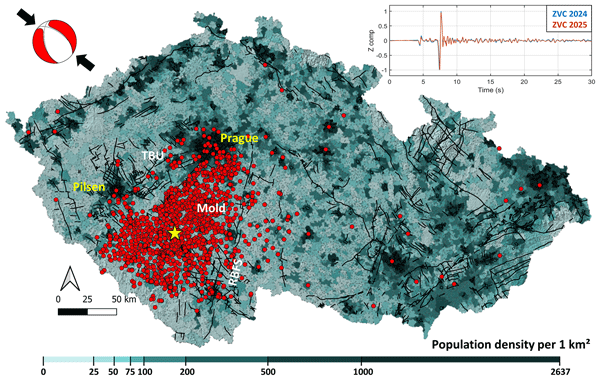
- Although the abstract mentions the integration of seismological and macroseismic analyses, no actual seismological analysis is presented; the authors only provide a figure showing waveforms from some stations.
- The authors state that individual responses were converted to macroseismic intensities but do not explain the methodology. It is unclear how intensities were calculated, what weights were given to specific answers, or whether intensity was assigned to individual questionnaires or geographic localities.
- For low intensities (2–5) such as those discussed here, "not felt" reports are critical. The authors should clarify if they have access to these data and how they were utilized.
- Figures 3a and 3c show the locations of observations but fail to display the actual intensity values. Additionally, while Figure 3d shows an area of intensity 2, there is no explanation of how this specific intensity was assigned.
- In the Discussion the authors interpret the low density of observations in specific sectors (e.g., NW of the epicenter and near the RBFS structure to the east) as evidence of geological control or seismic energy attenuation. However, a low density of data points may simply reflect low population density or a lack of participation, which provides no objective evidence regarding the actual intensity value. Moreover, in Figure 4 the lack of observations NW of the epicenter appears to coincide with low-density areas. To support these claims, the authors should show the density of observations relative to the population and provide attenuation plots of the intensity values for those specific sectors.
- At line 143, it is claimed that a booming sound often preceded the shaking. However, the attached questionnaire does not include a question regarding the timing of the sound; the authors must explain the source of this information. It would also be beneficial to provide a map showing the spatial distribution of these acoustic reports.
- At line 247, the macroseismic fields are compared to a field with quadrupolar symmetry, but no bibliographic references are provided to support the existence of such a field.
- The manuscript does not specify how the population was invited to complete the questionnaires, which is a vital part of assessing crowdsourced data quality.
Technical Corrections
- The citation "Cifelli et al., 1999" (line 54) is missing from the References section.
- The Appendix, which defines magnitude and macroseismic intensity, is unnecessary for a specialized scientific journal like Solid Earth and should be removed.
- The authors should provide access to the dataset in a dedicated "Data Availability" section.
Citation: https://doi.org/10.5194/egusphere-2026-686-RC1 -
AC1: 'Reply on RC1', Pavla Hrubcová, 17 May 2026
The comment was uploaded in the form of a supplement: https://egusphere.copernicus.org/preprints/2026/egusphere-2026-686/egusphere-2026-686-AC1-supplement.pdf
-
RC2: 'Comment on egusphere-2026-686', Anonymous Referee #2, 13 Apr 2026
The paper by Hrubcova and coauthors aims to constrain source characteristics, and deep propagation properties by using online macroseismic questionnaires collected after two recent earthquakes.
Despite the efforts are appreciable, there are many questionable points in the actual release, for which I suggest a major revision, or resubmission. They are listed below.
Major points:
1) About the Tectonic and structural context (lines 56-68, 171-202), text and figures are poorly informative of the actual expected tectonic seismicity: I suggest shrinking the description of the large scale-long time evolution of the orogenic belt in favour of a more detailed qualification of the present seismicity (actually lines 70-76): fig 1 is not sufficiently readable, consider to combine the geological panel with a physical map showing main events from CZEQ catalogue, station locations (e.g. moving the inset of Fig.2) showing for example the country's border, as common reference line.
2) About the selected earthquakes (lines 95-128), no reference is given for the solutions proposed, no details are provided about the location method, accuracy of the solutions and depth control with such a limited station coverage in the surroundings of the epicenter. Searching on ISC bullettins, the solutions provided in the manuscript nearly coincides with the ones given by national agency IPEC The Institute of Physics of the Earth; quite a lot of mining events are listed by ISC, close in space (epicenters) and time to the two mentioned tectonic events: if true, they deserve to be mentioned; a table of the identified aftershock is more informative than the actual Tab 1 (that anyway has to be mentioned in the block of focal mechanism description -lines 122-128). Consider to add a cross-correlation graph/ waveform comparison of the two events at the same station in the inset of Fig 2, to support they are co-located and with the same source mechanism. Some considerations concerning the theoretical radiation pattern of S-waves have to be added too.
3) last but the most important: I find critical and not properly presented the criteria used to assign the macroseismic degree from the questionnaires (basically described only at line 148-154). The literature in Europe on this subject is wide, but basically not quoted. Considering the formulation of questions provided in English in the Annex questionnaire, I believe the indicators of the "strength" of the shakings are still vague (for example the "observer's feelings and reactions" do not include the doubt/surprise, no fear or reaction that is usually associated with degrees II-III), and the final assignment of degrees III, IV and IV-V may overestimates the intensity. A better representation of the population density and description of the engagement of population for the compilation of questionnaires is welcome.
Minor points:
a) magnitude 3.1-3.5 cannot be defined as moderate earthquakes (usually 4.0-5.5), but light ones
b) line 54, Cifelli et al not in reference list
c) line 73 and 389 CZEQ catalogue reference lacks the date
d) references starting at lines 331, 365, 386 and 393 are not cited in the text
e) mistype at lines 407-409
f) wrong date? at reference starting at line 422, in the text quoted without a,b
Citation: https://doi.org/10.5194/egusphere-2026-686-RC2 -
AC2: 'Reply on RC2', Pavla Hrubcová, 17 May 2026
The comment was uploaded in the form of a supplement: https://egusphere.copernicus.org/preprints/2026/egusphere-2026-686/egusphere-2026-686-AC2-supplement.pdf
-
AC2: 'Reply on RC2', Pavla Hrubcová, 17 May 2026
Peer review completion
Post-review adjustments
Journal article(s) based on this preprint
Viewed
| HTML | XML | Total | Supplement | BibTeX | EndNote | |
|---|---|---|---|---|---|---|
| 949 | 387 | 100 | 1,436 | 191 | 177 | 176 |
- HTML: 949
- PDF: 387
- XML: 100
- Total: 1,436
- Supplement: 191
- BibTeX: 177
- EndNote: 176
Viewed (geographical distribution)
| Country | # | Views | % |
|---|
| Total: | 0 |
| HTML: | 0 |
| PDF: | 0 |
| XML: | 0 |
- 1

Matěj Machek
Jiří Vackář
Anna Pohořalá
Hana Kampfová Exnerová
Petr Špaček
Jan Zedník
The requested preprint has a corresponding peer-reviewed final revised paper. You are encouraged to refer to the final revised version.
- Preprint
(1388 KB) - Metadata XML
-
Supplement
(285 KB) - BibTeX
- EndNote
- Final revised paper
General Comments
The paper aims to investigate deep crustal structures in the Bohemian Massif by integrating seismological data with crowdsourced macroseismic observations. While the manuscript is well-written and provides a thorough geological background of the study area, there is a significant disconnect between the stated objectives and the actual data analysis presented.
The authors claim that the study demonstrates how citizen-reported data can reveal geological controls on earthquake effects. However, the manuscript lacks the analytical support necessary to justify such conclusions. Furthermore, there is a notable absence of macroseismic literature or citations linking macroseismic intensity to geological structures, despite the extensive geological references. In its current form, the paper describes the dataset and the geological setting but falls short of providing the seismological and macroseismic analysis promised in the abstract. Major revisions are required to substantiate the interpretations with quantitative evidence.
Specific Comments
Technical Corrections