
the Creative Commons Attribution 4.0 License.
the Creative Commons Attribution 4.0 License.
 | 27 Jan 2026
In Situ Real-Time Determination of SO2 Photochemical Oxidation in Nanoscale Sea Salt Aerosols based on Dark-Field Microscopy
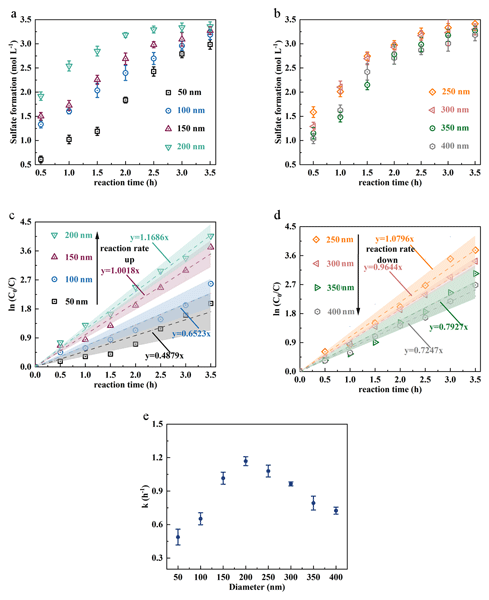
Abstract. Heterogeneous reaction processes of aerosols play an important role in air quality and climate change. However, the lack of in-situ measurements of single-nanoparticle reactions results in large uncertainties in modeling the nanoparticle reaction kinetics. The study introduces a method to quantify reaction rates of single-nanoparticles using hygroscopic growth factors (GFs) and the Zdanovskii-Stokes-Robinson (ZSR) rule. Planar waveguide dark-field microscopy was employed to monitor sodium chloride (NaCl) aerosol GFs under ultraviolet (UV) irradiation and SO2 exposure in real time. The results revealed a first-order reaction rate constant of 0.6523 h⁻¹ for 100 nm NaCl aerosols. Moreover, the reaction rate constant exhibits a non-monotonic size dependence on particle diameter-increasing in the 50–200 nm range and decreasing for particle sizes larger than 200 nm. This reflects a competitive interplay between the surface curvature effect at small particle sizes and specific surface area effect at larger sizes, which is further validated by a combined analysis based on transition state theory and the double-film mass transfer approach. Subsequently, sodium octyl sulfate (SOS) was introduced to form binary NaCl-based nanoaerosols, where the organic coating content was systematically varied under constant surface curvature to modulate the specific surface area. An increase in organic volume fraction reduces the effective specific surface area and suppresses heterogeneous reaction rates, accompanied by a pronounced nonlinear transition from partial to complete coating. This further confirms the experimentally observed size-dependent nonlinearity in reaction rates and offers new insights into nanoscale sulfate formation, improving atmospheric chemical models and pollution-climate assessments.
-
Notice on discussion status
The requested preprint has a corresponding peer-reviewed final revised paper. You are encouraged to refer to the final revised version.
-
Preprint
(2369 KB)
-
Supplement
(4578 KB)
-
The requested preprint has a corresponding peer-reviewed final revised paper. You are encouraged to refer to the final revised version.
- Preprint
(2369 KB) - Metadata XML
-
Supplement
(4578 KB) - BibTeX
- EndNote
- Final revised paper


Journal article(s) based on this preprint
Interactive discussion
Status: closed
-
RC1: 'Comment on egusphere-2026-68', Anonymous Referee #1, 13 Feb 2026
The comment was uploaded in the form of a supplement: https://egusphere.copernicus.org/preprints/2026/egusphere-2026-68/egusphere-2026-68-RC1-supplement.pdfCitation: https://doi.org/
10.5194/egusphere-2026-68-RC1 -
AC1: 'Reply on RC1', Zhibo Xie, 10 Mar 2026
We thank the anonymous referees for their valuable and constructive comments/suggestions on our manuscript. We will revise the manuscript accordingly and please find our point-to-point responses below.
Comments by Anonymous Referee #1:
General Comments:
This study proposes an in situ real-time measurement method based on dark-field microscopy to investigate the photochemical oxidation of SO₂ in nanoscale sea-salt aerosols. By combining the hygroscopic GF with the ZSR mixing rule, the authors successfully retrieve single-particle reaction kinetics and reveal a non-monotonic dependence of the reaction rate on particle size. The method is innovative, and the research falls within the scope of ACP. However, the scientific significance and the completeness of the experimental design require further clarification and strengthening. Acceptance is recommended after addressing the following points.
Response: We thank the reviewer for the constructive comments and valuable suggestions. Following the reviewer’s recommendations, we will revise the manuscript to clarify the scientific significance of this study and strengthen the description of the experimental design. Point-to-point responses to the reviewer’s comments are provided below, and the corresponding revisions will be incorporated into the manuscript.
Major comments:
1)While this study achieves in situ observation of reaction kinetics for individual nano-aerosol particles—a notable methodological advance—what specific atmospheric chemistry problem does it aim to solve? For instance, does it target the mechanism of rapid sulfate formation during haze episodes? How do the findings directly improve existing atmospheric chemistry models or pollution assessments?
Response: We thank the reviewer for this important question. The primary objective of this study is to investigate the size-dependent kinetics of heterogeneous SO₂ oxidation in nanoscale sea salt aerosols. Rapid sulfate formation in atmospheric particles—such as that observed during haze episodes—has been widely reported, yet the controlling mechanisms and kinetic parameters remain uncertain, particularly at the nanoscale. Most previous studies derive heterogeneous reaction rates from bulk solutions or micrometer-sized droplets, while atmospheric aerosols frequently exist in the submicron and nanoscale range.
In this size regime, geometric factors such as surface-to-volume ratio and surface curvature may influence gas uptake and interfacial mass transfer, but experimental constraints on these effects remain limited. By combining dark-field microscopy with hygroscopic growth analysis, this work provides in situ kinetic measurements for individual NaCl particles in the 50–400 nm size range. The observed non-monotonic size dependence of sulfate formation rates suggests that nanoscale geometric effects can influence heterogeneous SO₂ oxidation. These findings provide experimental constraints on size-dependent sulfate formation processes and may help improve the representation of heterogeneous sulfur oxidation in atmospheric chemistry models.
2)In this study, the hygroscopic G) of particles is derived from grayscale intensity using dark-field microscopy, and reaction kinetics are inferred based on the ZSR rule. To verify the reliability of the optical method, please provide the measured hygroscopic GF results for pure NaCl particles under the same experimental conditions (e.g., RH range 25%–85%) and compare them with theoretical models (e.g., E-AIM) or classical HTDMA data. If direct measurements were not performed, please specify whether GF parameters for NaCl from validated literature were adopted and discuss their applicability within your optical measurement system.
Response: We thank the reviewer for this helpful suggestion. In response, we will add a comparison between the hygroscopic GF of monodisperse 100 nm NaCl particles measured using our dark-field microscopy method and the predictions from the thermodynamic model E-AIM under the same RH conditions.3)In Section 2.2 and Figure 3b, you state that IC measurements provided independent validation of the GF-based kinetic analysis, showing a "consistent linear trend" when plotting ln(C₀/C) versus time. However, the manuscript does not provide a clear, step-by-step explanation of how the IC data (presumably aqueous concentrations of anions like sulfate or chloride from filter extracts) were converted into the dimensionless ln(C₀/C) values used in Figure 3b
Response: We thank the reviewer for pointing out this lack of clarity. In response to this comment, wewill add a detailed description of the data processing procedure in the revised manuscript, including the step-by-step derivation showing how the ion chromatography (IC) measurements were converted into the dimensionless ln(C₀/C) values used in Figure 3b.
4)The SO₂ concentration used in the experiments (200 ppm) is much higher than typical atmospheric background levels (usually ppb). The authors explain this is necessary to obtain sufficient signal within the experimental timeframe. However, could this affect the representativeness of the reaction mechanism (e.g., surface adsorption, oxidation pathways)? Were validation experiments conducted at lower, more atmospherically relevant concentrations to confirm the applicability of the derived kinetic parameters?
Response: In this study, experiments were conducted at 85 % RH to ensure that NaCl particles were fully deliquesced and maintained a stable aqueous phase during UV irradiation. Under such conditions, gas–particle mass transfer and aqueous-phase chemistry can proceed without the additional complexity introduced by solid–liquid phase transitions. The selected RH therefore provides a controlled framework to examine size-dependent kinetic effects under well-defined aqueous conditions.An RH of ~85 % is atmospherically relevant, particularly in marine boundary layers, coastal regions, and humid polluted environments, where sea salt aerosols frequently exist in a deliquesced state. Such high-RH conditions are also representative of pre-cloud or near-cloud environments, where heterogeneous sulfur oxidation can contribute significantly to sulfate formation.We agree that reaction kinetics may differ at lower RH, where partial deliquescence, increased ionic strength, or viscosity effects could modify gas uptake and aqueous-phase reactivity. However, the curvature-related mass transfer considerations discussed in this work are fundamentally geometric and therefore expected to remain relevant across RH conditions, although their quantitative contribution may vary. Investigating RH-dependent transitions in kinetic regimes is an important direction for future work.Citation: https://doi.org/10.5194/egusphere-2026-68-AC1
-
AC1: 'Reply on RC1', Zhibo Xie, 10 Mar 2026
-
CC1: 'Comment on egusphere-2026-68', Pai Liu, 21 Apr 2026
Report on the manuscript titled “In Situ Real-Time Determination of SO2 Photochemical Oxidation in Nanoscale Sea Salt Aerosols Based on Dark-Field Microscopy”
Recommendation: Major revision
Xiong et al. measured photochemical SO2 conversion in submicrometer droplets. I believe the analytical method is novel and potentially very valuable to the atmospheric chemistry community, as it enables in situ measurement of heterogeneous reaction kinetics on a single-particle basis in the nanoscale size range. Despite this methodological advancement, I have significant concerns regarding the proposed chemical mechanism, the experimental design, and the kinetic analysis presented in the current study. The clarity of the manuscript should also be improved substantially.
At its current stage, the manuscript does not yet meet the standard required for publication.
Detailed comments are provided below.
Major comments
- The authors need to clarify which photochemical mechanism is being investigated in this work. The manuscript uses terms such as “UV-catalyzed SO2 oxidation,” which are too vague. Is the SO2 conversion driven by photoactivation of chloride, such as that reported by Cao et al. (JACS 2024, 146, 1467–1475)? If so, I suggest that the authors explicitly state the targeted reaction mechanism in the Introduction or at the beginning of the Results section. The relevant chemical equations and the corresponding kinetic expression derived from the proposed mechanism should also be clearly presented.
- Does O2 exist in the gas phase of the multiphase reaction system? Based on the Methods section, I infer that the gas phase consists of SO2, N2, and water vapor. The authors should explain why O2 (or air) was excluded from the system. This exclusion does not reflect realistic atmospheric conditions. In addition, O2 may play an important role in chloride-mediated SO2 photooxidation. As shown by Cao et al. (2024), Cl radicals are generated through photoactivation of [Cl-…H3O+…O2] adducts rather than by direct activation of Cl- ions.
- How do the authors rule out the influence of the substrate? Both SiO2 and TiO2 can act as effective photocatalytic materials under UV irradiation. It is therefore possible that the substrate contributes to the conversion of S(IV). Moreover, if the reaction occurs partly or predominantly at the liquid–solid interface, for example in the contact region between the droplet and the substrate, the observed reaction rate could also increase with droplet size simply because larger droplets have a greater contact area with the substrate.
- The SO2 concentration used in the experiments (200 ppm) is extremely high. This is approximately three to four orders of magnitude higher than concentrations encountered even during severe air pollution episodes. The authors should consider repeating the experiments over a range of SO2 concentrations and examining how the kinetics scale with SO2 concentration. Without such parameterization, it is difficult to assess whether the measured kinetics can be meaningfully extrapolated to atmospherically relevant conditions.
- I am very confused by the derivation of first-order kinetics from the presented data. As stated in the manuscript, first-order kinetics should be reflected by an exponential decay in NaCl concentration. However, Figure 3d appears to show an exponential increase in C, rather than a decay. In addition, at the initial condition (t = 0), why is ln(C/C0) equal to zero rather than one? Furthermore, the sulfate concentration shown in Figure 3a increases approximately linearly with time, rather than following the type of exponential behavior expected for first-order kinetics. These observations seem inconsistent with the authors’ kinetic interpretation and should be clarified carefully.
Minor comments
Line 43: Do the authors mean oxidation of SO2 by H2O2?
Lines 47–48: The authors may wish to reconsider their interpretation of the work by Angle et al. In that study, the kinetics were derived from Raman measurements of changes in reactant or product concentrations, rather than from the evolution of ionic strength.
Figure 1: Please check the spelling of “diffusion dryer.”
Citation: https://doi.org/10.5194/egusphere-2026-68-CC1 -
AC3: 'Reply on CC1', Zhibo Xie, 21 May 2026
Manuscript No.: ACP-2026-68
Title: In Situ Real-Time Determination of SO2 Photochemical Oxidation in Nanoscale Sea Salt Aerosols Based on Dark-Field MicroscopyWe thank the commenter for the valuable and constructive comments on our manuscript. We will revise the manuscript accordingly. Please find our point-to-point responses below.
Major comments:
1)The authors need to clarify which photochemical mechanism is being investigated in this work. The manuscript uses terms such as “UV-catalyzed SO2 oxidation,” which are too vague. Is the SO2 conversion driven by photoactivation of chloride, such as that reported by Cao et al. (JACS 2024, 146, 1467–1475)? If so, I suggest that the authors explicitly state the targeted reaction mechanism in the Introduction or at the beginning of the Results section. The relevant chemical equations and the corresponding kinetic expression derived from the proposed mechanism should also be clearly presented.
Response: We thank the reviewer for this important comment. We agree that the description “UV-catalyzed SO2 oxidation” in the original manuscript was not sufficiently specific. In the revised manuscript, we have clarified that the reaction is interpreted as a chloride-mediated photochemical oxidation process occurring in the aqueous phase of NaCl droplets under UV irradiation.
We have added a more explicit description of the proposed reaction pathways in the Introduction and at the beginning of the Results section, including representative reactions involving reactive chlorine species based on relevant literature (e.g., Cao et al., 2024).
Corresponding kinetic expressions have also been included to better support the interpretation of the observed kinetics. We note that the mechanism is inferred based on consistency with previous studies, rather than directly resolved in this work.
2)Does O2 exist in the gas phase of the multiphase reaction system? Based on the Methods section, I infer that the gas phase consists of SO2, N2, and water vapor. The authors should explain why O2 (or air) was excluded from the system. This exclusion does not reflect realistic atmospheric conditions. In addition, O2 may play an important role in chloride-mediated SO2 photooxidation. As shown by Cao et al. (2024), Cl radicals are generated through photoactivation of [Cl-…H3O+…O2] adducts rather than by direct activation of Cl- ions.
Response: We thank the reviewer for this insightful comment. We acknowledge that O2 can play an important role in chloride-mediated photochemical oxidation pathways, particularly in facilitating radical formation and propagation, as suggested in previous studies (e.g., Cao et al., 2024).
In the present study, the carrier gas consists of SO2, N2, and water vapor, and O2 was not intentionally introduced. This design was adopted to control experimental variables and to better highlight geometric effects, particularly those related to particle size and curvature.
We have clarified this point in the revised manuscript and emphasized that the present results should be interpreted as reflecting a simplified system, where geometric and interfacial effects can be examined more clearly. The influence of O2 on the reaction mechanism and kinetics will be an important direction for future work.
3)How do the authors rule out the influence of the substrate? Both SiO2 and TiO2 can act as effective photocatalytic materials under UV irradiation. It is therefore possible that the substrate contributes to the conversion of S(IV). Moreover, if the reaction occurs partly or predominantly at the liquid–solid interface, for example in the contact region between the droplet and the substrate, the observed reaction rate could also increase with droplet size simply because larger droplets have a greater contact area with the substrate.
Response: We thank the reviewer for raising this important point. To minimize potential substrate-induced effects, the SiO2 substrate used in this study is coated with a thin inert gold layer, which effectively suppresses direct photocatalytic activity from the underlying material.
This surface treatment reduces the likelihood that the observed reaction is driven by substrate photocatalysis. In addition, the observed size-dependent trends are more consistent with aerosol geometric factors (e.g., surface-to-volume ratio and curvature effects) rather than scaling with the droplet–substrate contact area.
Similar surface treatment strategies have been employed in our previous work. This aspect was not explicitly emphasized in the original manuscript, and we will add a discussion of this point in the revised version.4)The SO2 concentration used in the experiments (200 ppm) is extremely high. This is approximately three to four orders of magnitude higher than concentrations encountered even during severe air pollution episodes. The authors should consider repeating the experiments over a range of SO2 concentrations and examining how the kinetics scale with SO2 concentration. Without such parameterization, it is difficult to assess whether the measured kinetics can be meaningfully extrapolated to atmospherically relevant conditions.
Response: We thank the reviewer for this important comment. We acknowledge that the SO2 concentration used in this study (200 ppm) is significantly higher than typical atmospheric levels. This concentration was selected to ensure sufficient signal-to-noise ratio.
We agree that reaction kinetics may depend on SO2 concentration, and therefore the absolute rate constants reported here should not be directly extrapolated to ambient conditions. Instead, the primary focus of this study is on relative trends, particularly the dependence of reaction kinetics on particle size and surface properties.
We will include additional control experiments conducted at lower SO2 concentrations to evaluate whether the reaction kinetics exhibit significant dependence on SO2 levels and to assess the robustness of the observed trends under more atmospherically relevant conditions. We will clarify this in the revised supproting information.5)I am very confused by the derivation of first-order kinetics from the presented data. As stated in the manuscript, first-order kinetics should be reflected by an exponential decay in NaCl concentration. However, Figure 3d appears to show an exponential increase in C, rather than a decay. In addition, at the initial condition (t = 0), why is ln(C/C0) equal to zero rather than one? Furthermore, the sulfate concentration shown in Figure 3a increases approximately linearly with time, rather than following the type of exponential behavior expected for first-order kinetics. These observations seem inconsistent with the authors’ kinetic interpretation and should be clarified carefully.
Response: We thank the reviewer for this careful reading and for pointing out the confusion regarding the kinetic analysis. We have clarified this point in the revised manuscript.
In Figure 3d, the plotted quantity represents sulfate concentration, which is a reaction product. Therefore, its increase with time reflects product formation and can exhibit an exponential growth behavior, rather than decay.
For the logarithmic analysis, ln(C0/C) is used to describe the decay of the reactant (NaCl). At the initial condition (t = 0), C = C0, and thus ln(C0/C) = ln(1) = 0, which is consistent with the definition.
The approximately linear increase in sulfate concentration shown in Figure 3a corresponds to the early stage of the reaction, during which the reactant concentration does not decrease significantly. Under such conditions, the reaction rate is effectively independent of reactant depletion, and the product formation appears quasi-linear over time.
We have revised the text and figure descriptions to clearly distinguish between reactant decay and product formation, and to improve the consistency of the kinetic interpretation.Minor Comments:
1)Line 43: Do the authors mean oxidation of SO2 by H2O2?
2)Lines 47–48: The authors may wish to reconsider their interpretation of the work by Angle et al. In that study, the kinetics were derived from Raman measurements of changes in reactant or product concentrations, rather than from the evolution of ionic strength.
3)Figure 1: Please check the spelling of “diffusion dryer.”
Response: We thank the reviewer for the careful reading and for these helpful minor comments. We will revise the manuscript accordingly, as detailed below:
Line 43: The text will be revised to clarify that this refers to the oxidation of SO2 by H2O2.
Lines 47–48: We thank the reviewer for this suggestion. The description of the work by Angle et al. will be revised to more accurately reflect that the reaction kinetics were derived from Raman measurements of changes in reactant and/or product concentrations, rather than from the evolution of ionic strength.
Figure 1: The spelling of “diffusion dryer” will be checked and corrected in the figure.
-
RC2: 'Comment on egusphere-2026-68', Anonymous Referee #2, 14 May 2026
The comment was uploaded in the form of a supplement: https://egusphere.copernicus.org/preprints/2026/egusphere-2026-68/egusphere-2026-68-RC2-supplement.pdf
-
AC2: 'Reply on RC2', Zhibo Xie, 21 May 2026
Manuscript No.: ACP-2026-68
Title: In Situ Real-Time Determination of SO2 Photochemical Oxidation in Nanoscale Sea Salt Aerosols based on Dark-Field Microscopy
We thank the anonymous referees for their valuable and constructive comments/suggestions on our manuscript. We will revise the manuscript accordingly and please find our point-to-point responses below.
Comments by Anonymous Referee #2:General Comments:
This manuscript details a method using dark-field microscopy for in situ real-time measurement of photochemical oxidation of SO2 in individual nanoscale aerosol particles. Hygroscopic growth factors and the Zdanovskii-Stokes-Robinson rule are employed to determine first-order kinetics for sodium chloride aerosols ranging in size from 50-400 nm, revealing a non-monotonic dependence of the reaction rate constant on particle size. Additionally, the study investigates the effect of organic coatings on oxidation reaction rates. The method is certainly novel and an appropriate topic for ACP, however I have several questions and points of confusion that should be addressed prior to acceptance.
Response: We thank the reviewer for the constructive comments and for recognizing the novelty and relevance of this work. We also appreciate the reviewer’s careful reading and for pointing out several questions and areas that require clarification. Following these comments, we will revise the manuscript to improve the clarity of the data analysis, better explain the experimental design and underlying assumptions, and strengthen the presentation of the results and their interpretation. Point-by-point responses to the reviewer’s comments are provided below, and all corresponding revisions will be incorporated into the manuscript.
Major comments:
- I found it difficult to follow the method for calculating the rate constant as detailed in the experimental section, and then subsequently challenging to connect the presentation of kinetic data in the results with the described calculations. There were several mislabeled variables (see Minor Comments for examples) or new variables introduced in the discussion that were not defined in the method (specifically ln(C0/C). Most of my confusion re: calculations will be alleviated by correcting equation/variable labels and clarifying how plotted variables in Figures 3-5 were determined, but as it currently is presented, the method for data analysis is unclear and needs to be addressed.
Response: We thank the reviewer for this careful reading and for pointing out the lack of clarity in the presentation of the data analysis procedure. In response, we will revise the relevant sections of the manuscript to improve the transparency and consistency of the kinetic analysis.
Specifically, the calculation procedure for deriving the rate constant will be reorganized and described in a clearer, step-by-step manner. All variables used in the analysis (including ln(C0/C)) will be explicitly defined upon first introduction, and their physical meanings will be clarified. In addition, we will carefully check and correct mislabeled variables and ensure consistency between the Methods section and the presentation of results in Figures 3–5.
Furthermore, we will expand the description of how the plotted quantities were obtained from the experimental measurements, including the derivation from hygroscopic GF data to the kinetic parameters. These revisions are intended to eliminate ambiguity and ensure that the data processing workflow is transparent and reproducible.
- The primary conclusions regarding the non-monotonic dependence of the SO2reaction rate constant on particle size rely on a comparison of the experimental GFs of NaCl particles with E-AIM calculated GFs of NaCl and NaHSO4 Comparison to experimental GFs for NaCl and NaHSO4 particles or literature GFs under similar environmental parameters would lend greater validity and confidence to the results presented in this work.
Response: We thank the reviewer for this valuable suggestion. To strengthen the validity of the GF-based analysis, we will supplement the manuscript with experimentally measured hygroscopic GFs for both NaCl and NaHSO4 particles under comparable environmental conditions. The experimental results will be included and compared with the corresponding E-AIM model predictions.
- How might this method be applied to cover a scope of more atmospherically relevant conditions, such as lower SO2concentrations or lower RH?
Response: We thank the reviewer for this important question regarding the broader applicability of the method. We acknowledge that atmospheric conditions often involve lower SO2 concentrations and a wider range of RH. In principle, the methodology developed here can be extended to such conditions.
The present study focuses on the retrieval of reaction kinetics and the investigation of curvature effects. To better resolve these effects and enhance the observability of the reaction behavior, relatively elevated SO2 concentrations and high RH conditions were employed.
Future work will extend this approach to the investigation of more atmospherically relevant particles under realistic environmental conditions. We will clarify these points in the revised manuscript and identify this as an important direction for future work.
Minor Comments:
- Figure 1: Misspelling of ‘diffusion dryer’ in graphic labels.
- Line 100: The text refers to Figure 2.1 – should it be Figure 1?
- Line 115: Please define the acronym ‘OVF’.
- Line 150: Should the section title read ‘2.4 Calculation of Reaction Rate’?
- Line 178: Should the defined variables be C0, Ct? I do not see CT in either equation (7) or (8).
- Figure 2/Line 210: The text refers to a red curve representing fresh NaCl particles in Figure 2, but the curve in reference is actually blue?
- Lines 240-250: The text refers to ln(C/C0) but the corresponding Figure 3 (and later discussion) refers to ln(C0/C).
- Line 350: The text referring to Figure 5 discusses ln(C0/C) values, but they are not represented in the figure?
- Figure 5: The figure caption refers to a shaded area denote 95% confidence intervals, but there does not appear to be a shaded area in the figure.
Response: We thank the reviewer for the careful reading of the manuscript and for pointing out these minor errors and inconsistencies. We have carefully revised the manuscript to correct all typographical errors, inconsistencies in figure labeling, and unclear definitions. Specific revisions are detailed below:
- The spelling of “diffusion dryer” in Figure 1 will be corrected.
- The figure reference in Line 100 will be corrected to the appropriate figure.
- The acronym “OVF” (organic volume fraction) will be defined upon first use in the revised manuscript.
- The section title will be corrected to “4 Calculation of Reaction Rate.”
- The variable notation will be corrected for consistency, and the definitions of C0 and Ct are now clearly stated in both the text and equations.
- The color description of the curve in Figure 2 will be corrected to match the actual figure.
- The notation for the logarithmic expression will be corrected to ensure consistency between the text and figures (ln(C0/C)).
- The description of Figure 5 will be revised to accurately reflect the data presented, and the corresponding variables are now clearly indicated.
- The figure caption will berevised to clarify that the shaded regions representing the 95% confidence intervals correspond specifically to Figures 5c and 5d.
-
AC2: 'Reply on RC2', Zhibo Xie, 21 May 2026
Peer review completion


Interactive discussion
Status: closed
-
RC1: 'Comment on egusphere-2026-68', Anonymous Referee #1, 13 Feb 2026
The comment was uploaded in the form of a supplement: https://egusphere.copernicus.org/preprints/2026/egusphere-2026-68/egusphere-2026-68-RC1-supplement.pdf
-
AC1: 'Reply on RC1', Zhibo Xie, 10 Mar 2026
We thank the anonymous referees for their valuable and constructive comments/suggestions on our manuscript. We will revise the manuscript accordingly and please find our point-to-point responses below.
Comments by Anonymous Referee #1:
General Comments:
This study proposes an in situ real-time measurement method based on dark-field microscopy to investigate the photochemical oxidation of SO₂ in nanoscale sea-salt aerosols. By combining the hygroscopic GF with the ZSR mixing rule, the authors successfully retrieve single-particle reaction kinetics and reveal a non-monotonic dependence of the reaction rate on particle size. The method is innovative, and the research falls within the scope of ACP. However, the scientific significance and the completeness of the experimental design require further clarification and strengthening. Acceptance is recommended after addressing the following points.
Response: We thank the reviewer for the constructive comments and valuable suggestions. Following the reviewer’s recommendations, we will revise the manuscript to clarify the scientific significance of this study and strengthen the description of the experimental design. Point-to-point responses to the reviewer’s comments are provided below, and the corresponding revisions will be incorporated into the manuscript.
Major comments:
1)While this study achieves in situ observation of reaction kinetics for individual nano-aerosol particles—a notable methodological advance—what specific atmospheric chemistry problem does it aim to solve? For instance, does it target the mechanism of rapid sulfate formation during haze episodes? How do the findings directly improve existing atmospheric chemistry models or pollution assessments?
Response: We thank the reviewer for this important question. The primary objective of this study is to investigate the size-dependent kinetics of heterogeneous SO₂ oxidation in nanoscale sea salt aerosols. Rapid sulfate formation in atmospheric particles—such as that observed during haze episodes—has been widely reported, yet the controlling mechanisms and kinetic parameters remain uncertain, particularly at the nanoscale. Most previous studies derive heterogeneous reaction rates from bulk solutions or micrometer-sized droplets, while atmospheric aerosols frequently exist in the submicron and nanoscale range.
In this size regime, geometric factors such as surface-to-volume ratio and surface curvature may influence gas uptake and interfacial mass transfer, but experimental constraints on these effects remain limited. By combining dark-field microscopy with hygroscopic growth analysis, this work provides in situ kinetic measurements for individual NaCl particles in the 50–400 nm size range. The observed non-monotonic size dependence of sulfate formation rates suggests that nanoscale geometric effects can influence heterogeneous SO₂ oxidation. These findings provide experimental constraints on size-dependent sulfate formation processes and may help improve the representation of heterogeneous sulfur oxidation in atmospheric chemistry models.
2)In this study, the hygroscopic G) of particles is derived from grayscale intensity using dark-field microscopy, and reaction kinetics are inferred based on the ZSR rule. To verify the reliability of the optical method, please provide the measured hygroscopic GF results for pure NaCl particles under the same experimental conditions (e.g., RH range 25%–85%) and compare them with theoretical models (e.g., E-AIM) or classical HTDMA data. If direct measurements were not performed, please specify whether GF parameters for NaCl from validated literature were adopted and discuss their applicability within your optical measurement system.
Response: We thank the reviewer for this helpful suggestion. In response, we will add a comparison between the hygroscopic GF of monodisperse 100 nm NaCl particles measured using our dark-field microscopy method and the predictions from the thermodynamic model E-AIM under the same RH conditions.3)In Section 2.2 and Figure 3b, you state that IC measurements provided independent validation of the GF-based kinetic analysis, showing a "consistent linear trend" when plotting ln(C₀/C) versus time. However, the manuscript does not provide a clear, step-by-step explanation of how the IC data (presumably aqueous concentrations of anions like sulfate or chloride from filter extracts) were converted into the dimensionless ln(C₀/C) values used in Figure 3b
Response: We thank the reviewer for pointing out this lack of clarity. In response to this comment, wewill add a detailed description of the data processing procedure in the revised manuscript, including the step-by-step derivation showing how the ion chromatography (IC) measurements were converted into the dimensionless ln(C₀/C) values used in Figure 3b.
4)The SO₂ concentration used in the experiments (200 ppm) is much higher than typical atmospheric background levels (usually ppb). The authors explain this is necessary to obtain sufficient signal within the experimental timeframe. However, could this affect the representativeness of the reaction mechanism (e.g., surface adsorption, oxidation pathways)? Were validation experiments conducted at lower, more atmospherically relevant concentrations to confirm the applicability of the derived kinetic parameters?
Response: In this study, experiments were conducted at 85 % RH to ensure that NaCl particles were fully deliquesced and maintained a stable aqueous phase during UV irradiation. Under such conditions, gas–particle mass transfer and aqueous-phase chemistry can proceed without the additional complexity introduced by solid–liquid phase transitions. The selected RH therefore provides a controlled framework to examine size-dependent kinetic effects under well-defined aqueous conditions.An RH of ~85 % is atmospherically relevant, particularly in marine boundary layers, coastal regions, and humid polluted environments, where sea salt aerosols frequently exist in a deliquesced state. Such high-RH conditions are also representative of pre-cloud or near-cloud environments, where heterogeneous sulfur oxidation can contribute significantly to sulfate formation.We agree that reaction kinetics may differ at lower RH, where partial deliquescence, increased ionic strength, or viscosity effects could modify gas uptake and aqueous-phase reactivity. However, the curvature-related mass transfer considerations discussed in this work are fundamentally geometric and therefore expected to remain relevant across RH conditions, although their quantitative contribution may vary. Investigating RH-dependent transitions in kinetic regimes is an important direction for future work.Citation: https://doi.org/10.5194/egusphere-2026-68-AC1
-
AC1: 'Reply on RC1', Zhibo Xie, 10 Mar 2026
-
CC1: 'Comment on egusphere-2026-68', Pai Liu, 21 Apr 2026
Report on the manuscript titled “In Situ Real-Time Determination of SO2 Photochemical Oxidation in Nanoscale Sea Salt Aerosols Based on Dark-Field Microscopy”
Recommendation: Major revision
Xiong et al. measured photochemical SO2 conversion in submicrometer droplets. I believe the analytical method is novel and potentially very valuable to the atmospheric chemistry community, as it enables in situ measurement of heterogeneous reaction kinetics on a single-particle basis in the nanoscale size range. Despite this methodological advancement, I have significant concerns regarding the proposed chemical mechanism, the experimental design, and the kinetic analysis presented in the current study. The clarity of the manuscript should also be improved substantially.
At its current stage, the manuscript does not yet meet the standard required for publication.
Detailed comments are provided below.
Major comments
- The authors need to clarify which photochemical mechanism is being investigated in this work. The manuscript uses terms such as “UV-catalyzed SO2 oxidation,” which are too vague. Is the SO2 conversion driven by photoactivation of chloride, such as that reported by Cao et al. (JACS 2024, 146, 1467–1475)? If so, I suggest that the authors explicitly state the targeted reaction mechanism in the Introduction or at the beginning of the Results section. The relevant chemical equations and the corresponding kinetic expression derived from the proposed mechanism should also be clearly presented.
- Does O2 exist in the gas phase of the multiphase reaction system? Based on the Methods section, I infer that the gas phase consists of SO2, N2, and water vapor. The authors should explain why O2 (or air) was excluded from the system. This exclusion does not reflect realistic atmospheric conditions. In addition, O2 may play an important role in chloride-mediated SO2 photooxidation. As shown by Cao et al. (2024), Cl radicals are generated through photoactivation of [Cl-…H3O+…O2] adducts rather than by direct activation of Cl- ions.
- How do the authors rule out the influence of the substrate? Both SiO2 and TiO2 can act as effective photocatalytic materials under UV irradiation. It is therefore possible that the substrate contributes to the conversion of S(IV). Moreover, if the reaction occurs partly or predominantly at the liquid–solid interface, for example in the contact region between the droplet and the substrate, the observed reaction rate could also increase with droplet size simply because larger droplets have a greater contact area with the substrate.
- The SO2 concentration used in the experiments (200 ppm) is extremely high. This is approximately three to four orders of magnitude higher than concentrations encountered even during severe air pollution episodes. The authors should consider repeating the experiments over a range of SO2 concentrations and examining how the kinetics scale with SO2 concentration. Without such parameterization, it is difficult to assess whether the measured kinetics can be meaningfully extrapolated to atmospherically relevant conditions.
- I am very confused by the derivation of first-order kinetics from the presented data. As stated in the manuscript, first-order kinetics should be reflected by an exponential decay in NaCl concentration. However, Figure 3d appears to show an exponential increase in C, rather than a decay. In addition, at the initial condition (t = 0), why is ln(C/C0) equal to zero rather than one? Furthermore, the sulfate concentration shown in Figure 3a increases approximately linearly with time, rather than following the type of exponential behavior expected for first-order kinetics. These observations seem inconsistent with the authors’ kinetic interpretation and should be clarified carefully.
Minor comments
Line 43: Do the authors mean oxidation of SO2 by H2O2?
Lines 47–48: The authors may wish to reconsider their interpretation of the work by Angle et al. In that study, the kinetics were derived from Raman measurements of changes in reactant or product concentrations, rather than from the evolution of ionic strength.
Figure 1: Please check the spelling of “diffusion dryer.”
Citation: https://doi.org/10.5194/egusphere-2026-68-CC1 -
AC3: 'Reply on CC1', Zhibo Xie, 21 May 2026
Manuscript No.: ACP-2026-68
Title: In Situ Real-Time Determination of SO2 Photochemical Oxidation in Nanoscale Sea Salt Aerosols Based on Dark-Field MicroscopyWe thank the commenter for the valuable and constructive comments on our manuscript. We will revise the manuscript accordingly. Please find our point-to-point responses below.
Major comments:
1)The authors need to clarify which photochemical mechanism is being investigated in this work. The manuscript uses terms such as “UV-catalyzed SO2 oxidation,” which are too vague. Is the SO2 conversion driven by photoactivation of chloride, such as that reported by Cao et al. (JACS 2024, 146, 1467–1475)? If so, I suggest that the authors explicitly state the targeted reaction mechanism in the Introduction or at the beginning of the Results section. The relevant chemical equations and the corresponding kinetic expression derived from the proposed mechanism should also be clearly presented.
Response: We thank the reviewer for this important comment. We agree that the description “UV-catalyzed SO2 oxidation” in the original manuscript was not sufficiently specific. In the revised manuscript, we have clarified that the reaction is interpreted as a chloride-mediated photochemical oxidation process occurring in the aqueous phase of NaCl droplets under UV irradiation.
We have added a more explicit description of the proposed reaction pathways in the Introduction and at the beginning of the Results section, including representative reactions involving reactive chlorine species based on relevant literature (e.g., Cao et al., 2024).
Corresponding kinetic expressions have also been included to better support the interpretation of the observed kinetics. We note that the mechanism is inferred based on consistency with previous studies, rather than directly resolved in this work.
2)Does O2 exist in the gas phase of the multiphase reaction system? Based on the Methods section, I infer that the gas phase consists of SO2, N2, and water vapor. The authors should explain why O2 (or air) was excluded from the system. This exclusion does not reflect realistic atmospheric conditions. In addition, O2 may play an important role in chloride-mediated SO2 photooxidation. As shown by Cao et al. (2024), Cl radicals are generated through photoactivation of [Cl-…H3O+…O2] adducts rather than by direct activation of Cl- ions.
Response: We thank the reviewer for this insightful comment. We acknowledge that O2 can play an important role in chloride-mediated photochemical oxidation pathways, particularly in facilitating radical formation and propagation, as suggested in previous studies (e.g., Cao et al., 2024).
In the present study, the carrier gas consists of SO2, N2, and water vapor, and O2 was not intentionally introduced. This design was adopted to control experimental variables and to better highlight geometric effects, particularly those related to particle size and curvature.
We have clarified this point in the revised manuscript and emphasized that the present results should be interpreted as reflecting a simplified system, where geometric and interfacial effects can be examined more clearly. The influence of O2 on the reaction mechanism and kinetics will be an important direction for future work.
3)How do the authors rule out the influence of the substrate? Both SiO2 and TiO2 can act as effective photocatalytic materials under UV irradiation. It is therefore possible that the substrate contributes to the conversion of S(IV). Moreover, if the reaction occurs partly or predominantly at the liquid–solid interface, for example in the contact region between the droplet and the substrate, the observed reaction rate could also increase with droplet size simply because larger droplets have a greater contact area with the substrate.
Response: We thank the reviewer for raising this important point. To minimize potential substrate-induced effects, the SiO2 substrate used in this study is coated with a thin inert gold layer, which effectively suppresses direct photocatalytic activity from the underlying material.
This surface treatment reduces the likelihood that the observed reaction is driven by substrate photocatalysis. In addition, the observed size-dependent trends are more consistent with aerosol geometric factors (e.g., surface-to-volume ratio and curvature effects) rather than scaling with the droplet–substrate contact area.
Similar surface treatment strategies have been employed in our previous work. This aspect was not explicitly emphasized in the original manuscript, and we will add a discussion of this point in the revised version.4)The SO2 concentration used in the experiments (200 ppm) is extremely high. This is approximately three to four orders of magnitude higher than concentrations encountered even during severe air pollution episodes. The authors should consider repeating the experiments over a range of SO2 concentrations and examining how the kinetics scale with SO2 concentration. Without such parameterization, it is difficult to assess whether the measured kinetics can be meaningfully extrapolated to atmospherically relevant conditions.
Response: We thank the reviewer for this important comment. We acknowledge that the SO2 concentration used in this study (200 ppm) is significantly higher than typical atmospheric levels. This concentration was selected to ensure sufficient signal-to-noise ratio.
We agree that reaction kinetics may depend on SO2 concentration, and therefore the absolute rate constants reported here should not be directly extrapolated to ambient conditions. Instead, the primary focus of this study is on relative trends, particularly the dependence of reaction kinetics on particle size and surface properties.
We will include additional control experiments conducted at lower SO2 concentrations to evaluate whether the reaction kinetics exhibit significant dependence on SO2 levels and to assess the robustness of the observed trends under more atmospherically relevant conditions. We will clarify this in the revised supproting information.5)I am very confused by the derivation of first-order kinetics from the presented data. As stated in the manuscript, first-order kinetics should be reflected by an exponential decay in NaCl concentration. However, Figure 3d appears to show an exponential increase in C, rather than a decay. In addition, at the initial condition (t = 0), why is ln(C/C0) equal to zero rather than one? Furthermore, the sulfate concentration shown in Figure 3a increases approximately linearly with time, rather than following the type of exponential behavior expected for first-order kinetics. These observations seem inconsistent with the authors’ kinetic interpretation and should be clarified carefully.
Response: We thank the reviewer for this careful reading and for pointing out the confusion regarding the kinetic analysis. We have clarified this point in the revised manuscript.
In Figure 3d, the plotted quantity represents sulfate concentration, which is a reaction product. Therefore, its increase with time reflects product formation and can exhibit an exponential growth behavior, rather than decay.
For the logarithmic analysis, ln(C0/C) is used to describe the decay of the reactant (NaCl). At the initial condition (t = 0), C = C0, and thus ln(C0/C) = ln(1) = 0, which is consistent with the definition.
The approximately linear increase in sulfate concentration shown in Figure 3a corresponds to the early stage of the reaction, during which the reactant concentration does not decrease significantly. Under such conditions, the reaction rate is effectively independent of reactant depletion, and the product formation appears quasi-linear over time.
We have revised the text and figure descriptions to clearly distinguish between reactant decay and product formation, and to improve the consistency of the kinetic interpretation.Minor Comments:
1)Line 43: Do the authors mean oxidation of SO2 by H2O2?
2)Lines 47–48: The authors may wish to reconsider their interpretation of the work by Angle et al. In that study, the kinetics were derived from Raman measurements of changes in reactant or product concentrations, rather than from the evolution of ionic strength.
3)Figure 1: Please check the spelling of “diffusion dryer.”
Response: We thank the reviewer for the careful reading and for these helpful minor comments. We will revise the manuscript accordingly, as detailed below:
Line 43: The text will be revised to clarify that this refers to the oxidation of SO2 by H2O2.
Lines 47–48: We thank the reviewer for this suggestion. The description of the work by Angle et al. will be revised to more accurately reflect that the reaction kinetics were derived from Raman measurements of changes in reactant and/or product concentrations, rather than from the evolution of ionic strength.
Figure 1: The spelling of “diffusion dryer” will be checked and corrected in the figure.
-
RC2: 'Comment on egusphere-2026-68', Anonymous Referee #2, 14 May 2026
The comment was uploaded in the form of a supplement: https://egusphere.copernicus.org/preprints/2026/egusphere-2026-68/egusphere-2026-68-RC2-supplement.pdf
-
AC2: 'Reply on RC2', Zhibo Xie, 21 May 2026
Manuscript No.: ACP-2026-68
Title: In Situ Real-Time Determination of SO2 Photochemical Oxidation in Nanoscale Sea Salt Aerosols based on Dark-Field Microscopy
We thank the anonymous referees for their valuable and constructive comments/suggestions on our manuscript. We will revise the manuscript accordingly and please find our point-to-point responses below.
Comments by Anonymous Referee #2:General Comments:
This manuscript details a method using dark-field microscopy for in situ real-time measurement of photochemical oxidation of SO2 in individual nanoscale aerosol particles. Hygroscopic growth factors and the Zdanovskii-Stokes-Robinson rule are employed to determine first-order kinetics for sodium chloride aerosols ranging in size from 50-400 nm, revealing a non-monotonic dependence of the reaction rate constant on particle size. Additionally, the study investigates the effect of organic coatings on oxidation reaction rates. The method is certainly novel and an appropriate topic for ACP, however I have several questions and points of confusion that should be addressed prior to acceptance.
Response: We thank the reviewer for the constructive comments and for recognizing the novelty and relevance of this work. We also appreciate the reviewer’s careful reading and for pointing out several questions and areas that require clarification. Following these comments, we will revise the manuscript to improve the clarity of the data analysis, better explain the experimental design and underlying assumptions, and strengthen the presentation of the results and their interpretation. Point-by-point responses to the reviewer’s comments are provided below, and all corresponding revisions will be incorporated into the manuscript.
Major comments:
- I found it difficult to follow the method for calculating the rate constant as detailed in the experimental section, and then subsequently challenging to connect the presentation of kinetic data in the results with the described calculations. There were several mislabeled variables (see Minor Comments for examples) or new variables introduced in the discussion that were not defined in the method (specifically ln(C0/C). Most of my confusion re: calculations will be alleviated by correcting equation/variable labels and clarifying how plotted variables in Figures 3-5 were determined, but as it currently is presented, the method for data analysis is unclear and needs to be addressed.
Response: We thank the reviewer for this careful reading and for pointing out the lack of clarity in the presentation of the data analysis procedure. In response, we will revise the relevant sections of the manuscript to improve the transparency and consistency of the kinetic analysis.
Specifically, the calculation procedure for deriving the rate constant will be reorganized and described in a clearer, step-by-step manner. All variables used in the analysis (including ln(C0/C)) will be explicitly defined upon first introduction, and their physical meanings will be clarified. In addition, we will carefully check and correct mislabeled variables and ensure consistency between the Methods section and the presentation of results in Figures 3–5.
Furthermore, we will expand the description of how the plotted quantities were obtained from the experimental measurements, including the derivation from hygroscopic GF data to the kinetic parameters. These revisions are intended to eliminate ambiguity and ensure that the data processing workflow is transparent and reproducible.
- The primary conclusions regarding the non-monotonic dependence of the SO2reaction rate constant on particle size rely on a comparison of the experimental GFs of NaCl particles with E-AIM calculated GFs of NaCl and NaHSO4 Comparison to experimental GFs for NaCl and NaHSO4 particles or literature GFs under similar environmental parameters would lend greater validity and confidence to the results presented in this work.
Response: We thank the reviewer for this valuable suggestion. To strengthen the validity of the GF-based analysis, we will supplement the manuscript with experimentally measured hygroscopic GFs for both NaCl and NaHSO4 particles under comparable environmental conditions. The experimental results will be included and compared with the corresponding E-AIM model predictions.
- How might this method be applied to cover a scope of more atmospherically relevant conditions, such as lower SO2concentrations or lower RH?
Response: We thank the reviewer for this important question regarding the broader applicability of the method. We acknowledge that atmospheric conditions often involve lower SO2 concentrations and a wider range of RH. In principle, the methodology developed here can be extended to such conditions.
The present study focuses on the retrieval of reaction kinetics and the investigation of curvature effects. To better resolve these effects and enhance the observability of the reaction behavior, relatively elevated SO2 concentrations and high RH conditions were employed.
Future work will extend this approach to the investigation of more atmospherically relevant particles under realistic environmental conditions. We will clarify these points in the revised manuscript and identify this as an important direction for future work.
Minor Comments:
- Figure 1: Misspelling of ‘diffusion dryer’ in graphic labels.
- Line 100: The text refers to Figure 2.1 – should it be Figure 1?
- Line 115: Please define the acronym ‘OVF’.
- Line 150: Should the section title read ‘2.4 Calculation of Reaction Rate’?
- Line 178: Should the defined variables be C0, Ct? I do not see CT in either equation (7) or (8).
- Figure 2/Line 210: The text refers to a red curve representing fresh NaCl particles in Figure 2, but the curve in reference is actually blue?
- Lines 240-250: The text refers to ln(C/C0) but the corresponding Figure 3 (and later discussion) refers to ln(C0/C).
- Line 350: The text referring to Figure 5 discusses ln(C0/C) values, but they are not represented in the figure?
- Figure 5: The figure caption refers to a shaded area denote 95% confidence intervals, but there does not appear to be a shaded area in the figure.
Response: We thank the reviewer for the careful reading of the manuscript and for pointing out these minor errors and inconsistencies. We have carefully revised the manuscript to correct all typographical errors, inconsistencies in figure labeling, and unclear definitions. Specific revisions are detailed below:
- The spelling of “diffusion dryer” in Figure 1 will be corrected.
- The figure reference in Line 100 will be corrected to the appropriate figure.
- The acronym “OVF” (organic volume fraction) will be defined upon first use in the revised manuscript.
- The section title will be corrected to “4 Calculation of Reaction Rate.”
- The variable notation will be corrected for consistency, and the definitions of C0 and Ct are now clearly stated in both the text and equations.
- The color description of the curve in Figure 2 will be corrected to match the actual figure.
- The notation for the logarithmic expression will be corrected to ensure consistency between the text and figures (ln(C0/C)).
- The description of Figure 5 will be revised to accurately reflect the data presented, and the corresponding variables are now clearly indicated.
- The figure caption will berevised to clarify that the shaded regions representing the 95% confidence intervals correspond specifically to Figures 5c and 5d.
-
AC2: 'Reply on RC2', Zhibo Xie, 21 May 2026
Peer review completion
Journal article(s) based on this preprint
Viewed
| HTML | XML | Total | Supplement | BibTeX | EndNote | |
|---|---|---|---|---|---|---|
| 1,033 | 492 | 188 | 1,713 | 285 | 133 | 232 |
- HTML: 1,033
- PDF: 492
- XML: 188
- Total: 1,713
- Supplement: 285
- BibTeX: 133
- EndNote: 232
Viewed (geographical distribution)
| Country | # | Views | % |
|---|
| Total: | 0 |
| HTML: | 0 |
| PDF: | 0 |
| XML: | 0 |
- 1
Xijie Xiong
Zhibo Xie

XiuLi Wei
Douguo Zhang
Jianguo Liu
Huaqiao Gui
The requested preprint has a corresponding peer-reviewed final revised paper. You are encouraged to refer to the final revised version.
- Preprint
(2369 KB) - Metadata XML
-
Supplement
(4578 KB) - BibTeX
- EndNote
- Final revised paper