
the Creative Commons Attribution 4.0 License.
the Creative Commons Attribution 4.0 License.
 | 13 Feb 2026
Analysis of 3GM High Accuracy Accelerometer data collected during JUICE Lunar Earth Gravity Assist
Abstract. The JUpiter ICy moons Explorer (JUICE) mission, launched in April 2023 by the European Space Agency (ESA), is designed to investigate Jupiter and its largest icy moons, Ganymede, Callisto, and Europa, with a focus on assessing their potential habitability and investigating subsurface oceans. During its eight-year interplanetary cruise to the Jovian system, JUICE will perform several flybys, including the first-ever combined Lunar-Earth Gravity Assist (LEGA), which occurred in August 2024. The spacecraft is equipped with a High Accuracy Accelerometer (HAA) that is part of the Gravity and Geophysics of Jupiter and the Galilean Moons (3GM) radio science instrument. During LEGA operations, HAA collected two hours of scientific data centered across the Moon’s closest approach. We present here a detailed analysis of the HAA calibrated measurements that show a strong agreement with predicted non-gravitational accelerations, including those related to spacecraft deformation caused by the Moon’s gravity gradient and thermoelastic displacements of the solar arrays during penumbra transitions. Additionally, unexpected dynamic responses were observed, including structural vibrations excited by the movement of the steerable telescope of the Submillimeter Wave Instrument (SWI) and a distinct outgassing event detected shortly after crossing the lunar terminator. The outgassing, likely involving sublimated water ice on the spacecraft, resulted in a measurable velocity change of 0.7 ± 0.1 mm/s along the -Z spacecraft axis and a consequent mass loss of a few grams. This direction coincides with the normal direction of the spacecraft’s most exposed surface to the Moon illuminated surface. The JUICE orbital reconstruction derived from radio tracking data collected by the Deep Space Transponder (DST) confirmed a consistent velocity variation, supporting HAA findings. These in-flight observations are essential for instrument calibration, characterization of the spacecraft’s dynamic environment, and refining operational strategies.
-
Notice on discussion status
The requested preprint has a corresponding peer-reviewed final revised paper. You are encouraged to refer to the final revised version.
-
Preprint
(3135 KB)
-
The requested preprint has a corresponding peer-reviewed final revised paper. You are encouraged to refer to the final revised version.
- Preprint
(3135 KB) - Metadata XML
- BibTeX
- EndNote
- Final revised paper


Journal article(s) based on this preprint
Interactive discussion
Status: closed
-
RC1: 'Comment on egusphere-2026-673', Anonymous Referee #1, 10 Apr 2026
-
AC1: 'Reply on RC1', Umberto De Filippis, 05 Jun 2026
The paper presents original results obtained from the HAA accelerometer on board the Juice mission during the flyby of the Earth’s Moon. The paper is well written and the authors have conducted a careful analysis of the accelerometer data. In the following there are a few comments, questions and suggestions to the authors aimed at improving its scientific impact.
We thank the reviewer for the careful reading of our manuscript and appreciated the constructive comments and suggestions. The reviews helped us to improve the clarity and effectiveness of the paper. Here below we addressed all the raised issues.
On p. 4 Table 1 – the unit of the intrinsic noise floor is corrupted in the pdf file where the Square Root symbol has disappeared.
We corrected it accordingly.
On various pages there are numbers inside parentheses at the beginning of each sentence that have no obvious significance: are these the numbers of references? Please indicate them as Ref [xx] if that is the case.
We corrected it accordingly.
The legends inside the figures are often too small to be read. Please add the legends of also in the figure captions for clarity.
We corrected it accordingly.
More importantly, the analysis carried out of ripples and oscillations in the acceleration data is detailed and it does show the proper functioning of the accelerometer and rather indirectly its calibration. However, there is no explanation in the paper of the scientific impact: How does this analysis relate to the scientific goals of the 3GM experiment? Is the accuracy of these acceleration measurements enough to meet the goals of the experiment? Taking as an example the specific case of the DV of 0.7 mm/s due to outgassing, what will be the scientific impact of similar events and the associated perturbations to the spacecraft motion during the 3GM experiment?
We agree with the reviewer that the primary purpose of HAA is to support the 3GM radio science experiment and contribute to the achievement of its scientific objectives. Although HAA has already collected valuable data, the instrument is still undergoing checkout activities aimed at reaching its expected performance and accuracy. In the example, the active thermal control system has not yet been fully optimized, making it premature to assess the instrument’s ultimate performance.
Nevertheless, the capability to directly measure unexpected accelerations, such as those observed during the JUICE lunar flyby, represents a significant asset for the 3GM experiment. Detecting and characterizing such perturbations can improve orbit determination and help mitigate their impact on the scientific results.
The paper will have a much stronger impact if these connections to the scientific goals were discussed in the paper.
This aspect has been added in the manuscript within the Conclusion section:
“Moreover, HAA’s proven ability to detect such accelerations is particularly important in the context of the 3GM radio science experiment. Indeed, these unexpected accelerations, which are challenging to model accurately, may compromise the quality of the scientific results if they are not adequately taken into account during orbit determination.”
Citation: https://doi.org/10.5194/egusphere-2026-673-AC1
-
AC1: 'Reply on RC1', Umberto De Filippis, 05 Jun 2026
-
RC2: 'Comment on egusphere-2026-673', Anonymous Referee #1, 10 Apr 2026
Equation (1) on p. 6 of the paper is missing a 3 to multiply the scalar product of the unit vectors R0
Citation: https://doi.org/10.5194/egusphere-2026-673-RC2 -
AC2: 'Reply on RC2', Umberto De Filippis, 05 Jun 2026
Equation (1) on p. 6 of the paper is missing a 3 to multiply the scalar product of the unit vectors R0
We corrected it accordingly.
Citation: https://doi.org/10.5194/egusphere-2026-673-AC2
-
AC2: 'Reply on RC2', Umberto De Filippis, 05 Jun 2026
-
RC3: 'Comment on egusphere-2026-673', Anonymous Referee #2, 02 Jun 2026
General comments:
The manuscript presents a valuable analysis of High Accuracy Accelerometer measurements acquired during the JUICE lunar flyby. The various signals, whether expected or unexpected, are carefully examined, and the authors provide well-supported explanations for them. However, the estimation of the sublimated water mass should be strengthened, and better justified. Below, I provide several comments and suggestions aimed at improving the clarity, consistency and overall quality of the manuscript.
Specific comments:
The Earth flyby immediately following the lunar flyby is not discussed in the manuscript. Did the HAA remain off, or was the closest approach too far for a relevant HAA analysis?
Page 6, line 296: Please provide a few details about the calibration of HAA data, or at least a reference.
Page 13, lines 361-362: The authors should clarify whether HAA data was used to fit the radiometric data. Was the thermal snap modeled as discussed in section 4.2.2?
Page 13, lines 375-376. This sentence should also clarify what is meant by being “consistent with [...] null ΔVi.
Page 13, line 383-384. The authors mention that the data collected by Acc1 and Acc2 are noisier than Acc0. Nevertheless, is it possible to provide an upper bound to ΔVx and ΔVy? Lines 405-406 indicate that they are significantly smaller. Providing bounds would help the reader.
Page 13-14, lines 385-403: The approach followed by the authors to estimate the mass of the sublimated water appears similar to that adopted by Sandford et al. (2020) for the Osiris-REx Sample Return Capsule,. This should be stated explicitly. Sandford et al. (2020) report a typical value for Vlim = 1000 m/s (the same given by the authors), associated with a range of modelled capsule temperatures. The authors of this manuscript should clarify why they chose T=300K. Given the probable location of the outgassing event, is there a more reliable estimate or measurement of the local surface temperature? In addition, the authors should provide a reference for Eq. (7). With T=300K and R=461.5J/kg/K, I obtain Vlim = 1056 m/s, rather than 1000m/s. The authors should also clarify why the choice Vsub = Vlim / 2 (line 398). Sandford et al. (2020) state that the velocity of H20 outgassing can be up to half the theoretical Vlim. Therefore, the inferred sublimated mass should be given as a range. This is currently only addressed indirectly. Please revise this section accordingly. The conclusion on line 424 should also be revised, since “around 8g” is an upper bound.
Conclusion: The potential interference cause by resonance modes of different spacecraft substructure should be mentioned in the conclusion. The authors should also state that the impact of this effect on the science results deserves further investigation, possibly in future work.
Technical corrections:
Please check the consistency of the vector notation in figures, equations, and text.
Page 1, lines 17-18: “JUICE will perform several flybys,including the first-ever combined Lunar-Earth Gravity Assist (LEGA), which occurred in August 2024.”. The sentence mixes future and past: “will perform” suggests that all flybys are still upcoming, whereas the LEGA already occurred in August 2024.
Page 1, line 21: “Submilimeter” -> “Submilimetre”.
Page 2, line 56: Since it is not clear whether “This phase” refers specifically to the orbital phase around Ganymede, the statement “unprecedented insights into the moons' geology” may be ambiguous. Do the authors mean Ganymede specifically, or the three outer Galilean moons more generally? Please clarify.
Page 2, line 77: “deals about” → “deals with”.
Page 4, Table 1: There is a typo in the unit of the intrinsic noise floor.
Page 4, line 160: “till” → “until”.
Page 7, Fig 4: Please add to the caption that the modelled gravity gradient is superimposed on the HAA calibrated data, so that the caption is self-contained.
Page 8, line 235: These displacements are inversely proportional to the thickness h.
Page 8, Equation (5): Please define Φ1 AU and DS.
Page 9, line 263: “Here, Cp,f and Cp,f are” → “Here, Cp,f and Cp,b are”
Page 9, Table 2: Unit notations “J/kgK” and “W/mk” are ambiguous. Following the current style of the paper (e.g., Table 1), I recommend “J/kg/K” and “W/m/k”.
Page 9, line 289: “deg” → “°”.
Page 9, line 294: Please refer to the red area in Fig. 4 for clarity.
Page 10, Fig. 9: Please add to the caption that the vertical dashed lines indicate the proper modes of the different components. The MAGboom #1 and #2 should also be indicated more clearly.
Page 10, line 304: “a HAA” → “an HAA”.
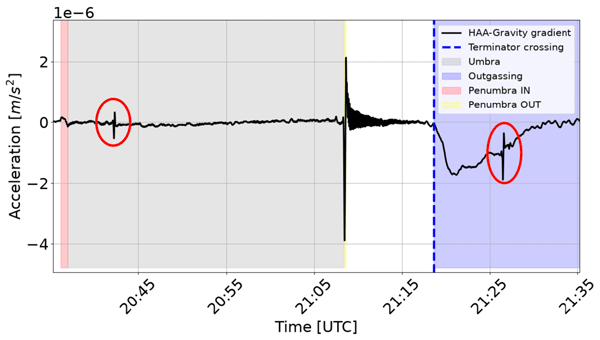
Page 11, Fig. 10: Is the blue area intended to highlight the time interval during which outgassing is suspected? The figure would benefit from clarifying that, e.g., in the caption. The caption should also indicate that the red circles correspond to SWI operations.
Page 11, line 317: “Fig. above” → “Fig. 10”.
Page 11, line 318: “Submilimeter” → “Submilimetre”
Page 11, line 324: “mode” → “modes”. Additionally, the resonance modes should be formatted as “(0.44, 0.46, and 2.6 Hz)” and “(0.13, 0.21, and 0.89 Hz)”.
Page 12, Fig. 12: Please define RW in the caption: “reaction wheels (RW)”.
Page 13, line 370-371. Please specify which version of GODOT was used.
Page 13, line 373: “radio metric” → radiometric”.
Page 13, line 374. “too high covariance matrix” is imprecise. The authors should refer to specific quantities, e.g., large covariances.
Page 13, line 378: Please introduce FD as Flight Dynamics earlier in the paragraph.
Page 13, lines 381, 397. Why is DV used instead of ΔV, especially since ΔVi and ΔVy are used elsewhere?
Page 14, line 395. Please specify the value of the specific gas constant R.
Page 14, line 412: “sensible masses” → “proof masses”.
Citation: https://doi.org/10.5194/egusphere-2026-673-RC3 - AC3: 'Reply on RC3', Umberto De Filippis, 16 Jun 2026
-
RC4: 'Comment on egusphere-2026-673', Anonymous Referee #3, 17 Jun 2026
The manuscript presents an analysis of the 3GM High Accuracy Accelerometer data collected during the JUICE Lunar–Earth Gravity Assist. The paper is generally well written, clearly structured, and provides valuable insights into the in-flight performance of the HAA instrument. Given the importance of non-gravitational force measurements for the JUICE mission and future scientific analyses, I believe the manuscript represents a useful contribution to the community. I have only a few comments and questions that may help improve the clarity and completeness of the paper.
- In Table 1, the measurement accuracy is reported as 10-8 m/s2. It would be helpful if the authors could clarify whether this accuracy includes the effect of accelerometer bias at low frequencies, or if it refers solely to the high-frequency noise performance of the instrument. In my opinion, Table 1 could be further improved by including information on the expected and/or measured accelerometer bias and scale factor.
- In Table 1, the unit reported for the intrinsic noise floor appears to contain a typo.
- In Section 3, it is stated that “to reduce the down-conversion of out-of-band high-frequency signals, the HAA is equipped with an out-of-band mechanical noise rejection algorithm.” Additional clarification on this point would be appreciated. Does this mechanism only suppress high-frequency disturbances outside the measurement bandwidth, or can it also suppress noise components within or below the instrument bandwidth? Furthermore, a brief description of the working principle of this mechanism, together with an indication of the expected residual error level after the noise rejection, would help readers better understand its effectiveness and limitations.
- Lines 284 and 285 state that “Fig. 8 shows the comparison between HAA Acc0 calibrated data after the removal of the Moon’s gravity gradient signal and the expected thermal snap acceleration”. This sentence might need to be revised as both Figure 8 and its caption indicate that the computed thermal snap acceleration is explicitly shown (in red) in the figure.
- In several figures, the caption text appears rather small and is difficult to read.
- I would be interested to know whether the HAA measurements acquired during the Lunar–Earth Gravity Assist could be used to estimate the accelerometer bias. In particular, during the umbra passage, when radiation pressure effects are significantly reduced and gravity-gradient contributions are relatively small, it may be possible to identify constant or linear discrepancies between the measured and modeled accelerations. Such conditions could potentially provide an opportunity to characterize or constrain the instrument bias. A brief discussion of this possibility would be valuable.
Citation: https://doi.org/10.5194/egusphere-2026-673-RC4 - AC4: 'Reply on RC4', Umberto De Filippis, 30 Jun 2026
Peer review completion


Interactive discussion
Status: closed
-
RC1: 'Comment on egusphere-2026-673', Anonymous Referee #1, 10 Apr 2026
The paper presents original results obtained from the HAA accelerometer on board the Juice mission during the flyby of the Earth’s Moon. The paper is well written and the authors have conducted a careful analysis of the accelerometer data. In the following there are a few comments, questions and suggestions to the authors aimed at improving its scientific impact.
On p. 4 Table 1 – the unit of the intrinsic noise floor is corrupted in the pdf file where the Square Root symbol has disappeared.
On various pages there are numbers inside parentheses at the beginning of each sentence that have no obvious significance: are these the numbers of references? Please indicate them as Ref [xx] if that is the case.
The legends inside the figures are often too small to be read. Please add the legends of also in the figure captions for clarity.
More importantly, the analysis carried out of ripples and oscillations in the acceleration data is detailed and it does show the proper functioning of the accelerometer and rather indirectly its calibration. However, there is no explanation in the paper of the scientific impact: How does this analysis relate to the scientific goals of the 3GM experiment? Is the accuracy of these acceleration measurements enough to meet the goals of the experiment? Taking as an example the specific case of the DV of 0.7 mm/s due to outgassing, what will be the scientific impact of similar events and the associated perturbations to the spacecraft motion during the 3GM experiment?
The paper will have a much stronger impact if these connections to the scientific goals were discussed in the paper.
Citation: https://doi.org/10.5194/egusphere-2026-673-RC1 -
AC1: 'Reply on RC1', Umberto De Filippis, 05 Jun 2026
The paper presents original results obtained from the HAA accelerometer on board the Juice mission during the flyby of the Earth’s Moon. The paper is well written and the authors have conducted a careful analysis of the accelerometer data. In the following there are a few comments, questions and suggestions to the authors aimed at improving its scientific impact.
We thank the reviewer for the careful reading of our manuscript and appreciated the constructive comments and suggestions. The reviews helped us to improve the clarity and effectiveness of the paper. Here below we addressed all the raised issues.
On p. 4 Table 1 – the unit of the intrinsic noise floor is corrupted in the pdf file where the Square Root symbol has disappeared.
We corrected it accordingly.
On various pages there are numbers inside parentheses at the beginning of each sentence that have no obvious significance: are these the numbers of references? Please indicate them as Ref [xx] if that is the case.
We corrected it accordingly.
The legends inside the figures are often too small to be read. Please add the legends of also in the figure captions for clarity.
We corrected it accordingly.
More importantly, the analysis carried out of ripples and oscillations in the acceleration data is detailed and it does show the proper functioning of the accelerometer and rather indirectly its calibration. However, there is no explanation in the paper of the scientific impact: How does this analysis relate to the scientific goals of the 3GM experiment? Is the accuracy of these acceleration measurements enough to meet the goals of the experiment? Taking as an example the specific case of the DV of 0.7 mm/s due to outgassing, what will be the scientific impact of similar events and the associated perturbations to the spacecraft motion during the 3GM experiment?
We agree with the reviewer that the primary purpose of HAA is to support the 3GM radio science experiment and contribute to the achievement of its scientific objectives. Although HAA has already collected valuable data, the instrument is still undergoing checkout activities aimed at reaching its expected performance and accuracy. In the example, the active thermal control system has not yet been fully optimized, making it premature to assess the instrument’s ultimate performance.
Nevertheless, the capability to directly measure unexpected accelerations, such as those observed during the JUICE lunar flyby, represents a significant asset for the 3GM experiment. Detecting and characterizing such perturbations can improve orbit determination and help mitigate their impact on the scientific results.
The paper will have a much stronger impact if these connections to the scientific goals were discussed in the paper.
This aspect has been added in the manuscript within the Conclusion section:
“Moreover, HAA’s proven ability to detect such accelerations is particularly important in the context of the 3GM radio science experiment. Indeed, these unexpected accelerations, which are challenging to model accurately, may compromise the quality of the scientific results if they are not adequately taken into account during orbit determination.”
Citation: https://doi.org/10.5194/egusphere-2026-673-AC1
-
AC1: 'Reply on RC1', Umberto De Filippis, 05 Jun 2026
-
RC2: 'Comment on egusphere-2026-673', Anonymous Referee #1, 10 Apr 2026
Equation (1) on p. 6 of the paper is missing a 3 to multiply the scalar product of the unit vectors R0
Citation: https://doi.org/10.5194/egusphere-2026-673-RC2 -
AC2: 'Reply on RC2', Umberto De Filippis, 05 Jun 2026
Equation (1) on p. 6 of the paper is missing a 3 to multiply the scalar product of the unit vectors R0
We corrected it accordingly.
Citation: https://doi.org/10.5194/egusphere-2026-673-AC2
-
AC2: 'Reply on RC2', Umberto De Filippis, 05 Jun 2026
-
RC3: 'Comment on egusphere-2026-673', Anonymous Referee #2, 02 Jun 2026
General comments:
The manuscript presents a valuable analysis of High Accuracy Accelerometer measurements acquired during the JUICE lunar flyby. The various signals, whether expected or unexpected, are carefully examined, and the authors provide well-supported explanations for them. However, the estimation of the sublimated water mass should be strengthened, and better justified. Below, I provide several comments and suggestions aimed at improving the clarity, consistency and overall quality of the manuscript.
Specific comments:
The Earth flyby immediately following the lunar flyby is not discussed in the manuscript. Did the HAA remain off, or was the closest approach too far for a relevant HAA analysis?
Page 6, line 296: Please provide a few details about the calibration of HAA data, or at least a reference.
Page 13, lines 361-362: The authors should clarify whether HAA data was used to fit the radiometric data. Was the thermal snap modeled as discussed in section 4.2.2?
Page 13, lines 375-376. This sentence should also clarify what is meant by being “consistent with [...] null ΔVi.
Page 13, line 383-384. The authors mention that the data collected by Acc1 and Acc2 are noisier than Acc0. Nevertheless, is it possible to provide an upper bound to ΔVx and ΔVy? Lines 405-406 indicate that they are significantly smaller. Providing bounds would help the reader.
Page 13-14, lines 385-403: The approach followed by the authors to estimate the mass of the sublimated water appears similar to that adopted by Sandford et al. (2020) for the Osiris-REx Sample Return Capsule,. This should be stated explicitly. Sandford et al. (2020) report a typical value for Vlim = 1000 m/s (the same given by the authors), associated with a range of modelled capsule temperatures. The authors of this manuscript should clarify why they chose T=300K. Given the probable location of the outgassing event, is there a more reliable estimate or measurement of the local surface temperature? In addition, the authors should provide a reference for Eq. (7). With T=300K and R=461.5J/kg/K, I obtain Vlim = 1056 m/s, rather than 1000m/s. The authors should also clarify why the choice Vsub = Vlim / 2 (line 398). Sandford et al. (2020) state that the velocity of H20 outgassing can be up to half the theoretical Vlim. Therefore, the inferred sublimated mass should be given as a range. This is currently only addressed indirectly. Please revise this section accordingly. The conclusion on line 424 should also be revised, since “around 8g” is an upper bound.
Conclusion: The potential interference cause by resonance modes of different spacecraft substructure should be mentioned in the conclusion. The authors should also state that the impact of this effect on the science results deserves further investigation, possibly in future work.
Technical corrections:
Please check the consistency of the vector notation in figures, equations, and text.
Page 1, lines 17-18: “JUICE will perform several flybys,including the first-ever combined Lunar-Earth Gravity Assist (LEGA), which occurred in August 2024.”. The sentence mixes future and past: “will perform” suggests that all flybys are still upcoming, whereas the LEGA already occurred in August 2024.
Page 1, line 21: “Submilimeter” -> “Submilimetre”.
Page 2, line 56: Since it is not clear whether “This phase” refers specifically to the orbital phase around Ganymede, the statement “unprecedented insights into the moons' geology” may be ambiguous. Do the authors mean Ganymede specifically, or the three outer Galilean moons more generally? Please clarify.
Page 2, line 77: “deals about” → “deals with”.
Page 4, Table 1: There is a typo in the unit of the intrinsic noise floor.
Page 4, line 160: “till” → “until”.
Page 7, Fig 4: Please add to the caption that the modelled gravity gradient is superimposed on the HAA calibrated data, so that the caption is self-contained.
Page 8, line 235: These displacements are inversely proportional to the thickness h.
Page 8, Equation (5): Please define Φ1 AU and DS.
Page 9, line 263: “Here, Cp,f and Cp,f are” → “Here, Cp,f and Cp,b are”
Page 9, Table 2: Unit notations “J/kgK” and “W/mk” are ambiguous. Following the current style of the paper (e.g., Table 1), I recommend “J/kg/K” and “W/m/k”.
Page 9, line 289: “deg” → “°”.
Page 9, line 294: Please refer to the red area in Fig. 4 for clarity.
Page 10, Fig. 9: Please add to the caption that the vertical dashed lines indicate the proper modes of the different components. The MAGboom #1 and #2 should also be indicated more clearly.
Page 10, line 304: “a HAA” → “an HAA”.
Page 11, Fig. 10: Is the blue area intended to highlight the time interval during which outgassing is suspected? The figure would benefit from clarifying that, e.g., in the caption. The caption should also indicate that the red circles correspond to SWI operations.
Page 11, line 317: “Fig. above” → “Fig. 10”.
Page 11, line 318: “Submilimeter” → “Submilimetre”
Page 11, line 324: “mode” → “modes”. Additionally, the resonance modes should be formatted as “(0.44, 0.46, and 2.6 Hz)” and “(0.13, 0.21, and 0.89 Hz)”.
Page 12, Fig. 12: Please define RW in the caption: “reaction wheels (RW)”.
Page 13, line 370-371. Please specify which version of GODOT was used.
Page 13, line 373: “radio metric” → radiometric”.
Page 13, line 374. “too high covariance matrix” is imprecise. The authors should refer to specific quantities, e.g., large covariances.
Page 13, line 378: Please introduce FD as Flight Dynamics earlier in the paragraph.
Page 13, lines 381, 397. Why is DV used instead of ΔV, especially since ΔVi and ΔVy are used elsewhere?
Page 14, line 395. Please specify the value of the specific gas constant R.
Page 14, line 412: “sensible masses” → “proof masses”.
Citation: https://doi.org/10.5194/egusphere-2026-673-RC3 - AC3: 'Reply on RC3', Umberto De Filippis, 16 Jun 2026
-
RC4: 'Comment on egusphere-2026-673', Anonymous Referee #3, 17 Jun 2026
The manuscript presents an analysis of the 3GM High Accuracy Accelerometer data collected during the JUICE Lunar–Earth Gravity Assist. The paper is generally well written, clearly structured, and provides valuable insights into the in-flight performance of the HAA instrument. Given the importance of non-gravitational force measurements for the JUICE mission and future scientific analyses, I believe the manuscript represents a useful contribution to the community. I have only a few comments and questions that may help improve the clarity and completeness of the paper.
- In Table 1, the measurement accuracy is reported as 10-8 m/s2. It would be helpful if the authors could clarify whether this accuracy includes the effect of accelerometer bias at low frequencies, or if it refers solely to the high-frequency noise performance of the instrument. In my opinion, Table 1 could be further improved by including information on the expected and/or measured accelerometer bias and scale factor.
- In Table 1, the unit reported for the intrinsic noise floor appears to contain a typo.
- In Section 3, it is stated that “to reduce the down-conversion of out-of-band high-frequency signals, the HAA is equipped with an out-of-band mechanical noise rejection algorithm.” Additional clarification on this point would be appreciated. Does this mechanism only suppress high-frequency disturbances outside the measurement bandwidth, or can it also suppress noise components within or below the instrument bandwidth? Furthermore, a brief description of the working principle of this mechanism, together with an indication of the expected residual error level after the noise rejection, would help readers better understand its effectiveness and limitations.
- Lines 284 and 285 state that “Fig. 8 shows the comparison between HAA Acc0 calibrated data after the removal of the Moon’s gravity gradient signal and the expected thermal snap acceleration”. This sentence might need to be revised as both Figure 8 and its caption indicate that the computed thermal snap acceleration is explicitly shown (in red) in the figure.
- In several figures, the caption text appears rather small and is difficult to read.
- I would be interested to know whether the HAA measurements acquired during the Lunar–Earth Gravity Assist could be used to estimate the accelerometer bias. In particular, during the umbra passage, when radiation pressure effects are significantly reduced and gravity-gradient contributions are relatively small, it may be possible to identify constant or linear discrepancies between the measured and modeled accelerations. Such conditions could potentially provide an opportunity to characterize or constrain the instrument bias. A brief discussion of this possibility would be valuable.
Citation: https://doi.org/10.5194/egusphere-2026-673-RC4 - AC4: 'Reply on RC4', Umberto De Filippis, 30 Jun 2026
Peer review completion
Journal article(s) based on this preprint
Viewed
| HTML | XML | Total | BibTeX | EndNote | |
|---|---|---|---|---|---|
| 1,049 | 509 | 102 | 1,660 | 170 | 211 |
- HTML: 1,049
- PDF: 509
- XML: 102
- Total: 1,660
- BibTeX: 170
- EndNote: 211
Viewed (geographical distribution)
| Country | # | Views | % |
|---|
| Total: | 0 |
| HTML: | 0 |
| PDF: | 0 |
| XML: | 0 |
- 1
Umberto De Filippis

Paolo Cappuccio
Mauro Di Benedetto
Ivan di Stefano
Daniele Durante
Luciano Iess
The requested preprint has a corresponding peer-reviewed final revised paper. You are encouraged to refer to the final revised version.
- Preprint
(3135 KB) - Metadata XML
The paper presents original results obtained from the HAA accelerometer on board the Juice mission during the flyby of the Earth’s Moon. The paper is well written and the authors have conducted a careful analysis of the accelerometer data. In the following there are a few comments, questions and suggestions to the authors aimed at improving its scientific impact.
On p. 4 Table 1 – the unit of the intrinsic noise floor is corrupted in the pdf file where the Square Root symbol has disappeared.
On various pages there are numbers inside parentheses at the beginning of each sentence that have no obvious significance: are these the numbers of references? Please indicate them as Ref [xx] if that is the case.
The legends inside the figures are often too small to be read. Please add the legends of also in the figure captions for clarity.
More importantly, the analysis carried out of ripples and oscillations in the acceleration data is detailed and it does show the proper functioning of the accelerometer and rather indirectly its calibration. However, there is no explanation in the paper of the scientific impact: How does this analysis relate to the scientific goals of the 3GM experiment? Is the accuracy of these acceleration measurements enough to meet the goals of the experiment? Taking as an example the specific case of the DV of 0.7 mm/s due to outgassing, what will be the scientific impact of similar events and the associated perturbations to the spacecraft motion during the 3GM experiment?
The paper will have a much stronger impact if these connections to the scientific goals were discussed in the paper.