
the Creative Commons Attribution 4.0 License.
the Creative Commons Attribution 4.0 License.
 | 05 Mar 2026
Quantification of inmixing of Asian Monsoon air by multi-species classification in a match flight experiment
Abstract. Mixing of air masses between different compartments of the atmosphere is one of the processes ruling atmospheric composition. The mixing process is commonly studied by using tracer-tracer correlations. Here, we generalize this approach by statistical classification methods based on a larger number of tracers to quantify mixing. From the 3-D resolution of our trace gas observations we are able to spatially resolve the observed mixing processes. This paper presents a matching flight-experiment of a filament of Asian monsoon air in the Upper Troposphere/ Lower Stratosphere (UTLS) off the North-American west coast by two flights of the High Altitude and Long Range research aircraft (HALO) conducted during the "Probing High Latitude Export of air from the Asian Summer Monsoon (PHILEAS)" campaign. In both flights the 3-D structure of the filament was revealed by tomographic observations by the Gimballed Limb Observer for Radiance Imaging of the Atmosphere (GLORIA) of five trace species (H2O, PAN, CFC – 12, O3, HNO3). The observed tracer mixing ratios show evidence for a tropopause folding in connection to a Rossby wave breaking event. We show that the strongly perturbed atmospheric situation can not be decisively described by simple tracer-tracer correlations. By using a Bayesian Gaussian mixture model to cluster our observations by similarity we identify five classes of air masses: tropospheric air (both continental and maritime), Asian Summer Monsoon outflow (ASMO), mixed air and stratospheric air. Trajectory calculations are carried out to identify air masses which are observed in both flights. A measure of the mixing strengths of the mixing between both flights follows naturally from this classification. The unique 3-D observations allow us to reveal the spatial structure of the mixing processes in high detail. In particular, the mixing of ASMO air directly with stratospheric air and into the UTLS are shown. Comparing the classification to simulated artificial surface-origin tracers in the Chemical Lagrangian Model of the Stratosphere (CLaMS), we find strong evidence for distinctly correlated air masses to originate within different source regions within the Asian monsoon region.
-
Notice on discussion status
The requested preprint has a corresponding peer-reviewed final revised paper. You are encouraged to refer to the final revised version.
-
Preprint
(14988 KB)
-
The requested preprint has a corresponding peer-reviewed final revised paper. You are encouraged to refer to the final revised version.
- Preprint
(14988 KB) - Metadata XML
- BibTeX
- EndNote
- Final revised paper


Journal article(s) based on this preprint
Interactive discussion
Status: closed
-
CC1: 'Comment on egusphere-2026-650', Peter Preusse, 19 Mar 2026
Publisher’s note: the content of this comment was removed on 20 March 2026 since the comment was posted by mistake.
Citation: https://doi.org/10.5194/egusphere-2026-650-CC1 -
CC2: 'Reply on CC1', Peter Preusse, 19 Mar 2026
Publisher’s note: the content of this comment was removed on 20 March 2026 since the comment was posted by mistake.
Citation: https://doi.org/10.5194/egusphere-2026-650-CC2
-
CC2: 'Reply on CC1', Peter Preusse, 19 Mar 2026
-
RC1: 'Comment on egusphere-2026-650', Anonymous Referee #1, 04 Apr 2026
Review of "Quantification of inmixing of Asian Monsoon air by multi-species classification in a match flight experiment" by Kaumanns et al.
Summary:
In this study, Kaumanns et al. present a comprehensive analysis on the inmixing of Asian Monsoon Air sampled during the PHILEAS field campaign. The experiment design is well designed and executed. The dataset provided by the GLORIA retrievals is unique. But before I recommend for the publication, I have some specific questions and comments for the authors.
Major comments:
1. Some important details of the datasets in this study are left out. For example, what is the horizontal and vertical resolution of the GLORIA retrievals? There should also be at least a short section to describe CLaMS model output and ECMWRF ERA5 data. In Figure 3, do you initialize your trajectories from the same vertical level (e.g., flight level, one or multiple levels of the GLORIA retrievals) inside the first hexagon?
2. I cannot fully evaluate the result because some key details of the datasets are missing. Even if the result is robust at all, I would like the authors to reconsider to bring your findings to a bigger picture. The authors analyzed a case study only. And certainly the GLORIA is not widely used yet. So how could your findings benefit to those who study Asian monsoon?
3. I am not familiar with the Gaussian Mixture Model that you propose in this study. You spent several pages to explain your whole data pipeline. But if you want to convince readers to use your method, you have to clearly show the limitation of the (simpler) traditional method first. For example, first plot concentration of some species and compute correlation using the traditional method. Then state its disadvantages. Overall, for your section 2.4, it will be much easier to provide some numbers/examples for readers to understand your method. For example, in your PCA subsection, does M represent the three datasets and does N represent the total number of observation made in each dataset?
4. In Figure 5, what's your value for the dynamical tropopause? If it is not the usual 2 pvu that I see in the literature, please state your value and probably explain it a little bit, instead of referring to Kunz et al. (2015). You refer to it as tropopause folding so I am curious what I can see using normal lapse rate or cold point tropopause.
5. Generally, all 3D plots (e.g., Figures 7, 10, and 12) do not offer much more information than multiple 2D plots. Consider to re-plot them.
6. Could you provide any uncertainty statistics for the results fromm the Gaussian Mixture Model?
7. There are some lightning events shown from GOES-18. But are they enough to quantitatively explain the HNO3 concentration difference?
8. Lastly, there are lots of minor mistakes. See my minor comments for part of the mistakes below. The frequent occurrences disrupt the flow to read the manuscript a lot. Please proofread your manuscript carefully.
Minor comments:
L23: upper tropospheric -> upper-tropospheric
L26: northwards -> to the north
L35: There should be parentheses enclosing the citations. There are similar citation style issues, e.g., L85 and L86. Please fix these.
L49: I don't understand this sentence. The ASM contributes to the ATAL?
L60: for example during -> during, for example,
L63: what time in UTC?
L93: Please revise the sentence.
L104: I think there should be a full stop after "technique".
L104: an -> a
L122: For the Curtis-Godson approximation, you should also cite the Godson 1953 QJRMS paper.
L131: A-priori -> A priori
Figure 2: You should state the time before UTC.
L183-185. Consider to rewrite this sentence. There are two which clauses.
L199: a choosable parameter -> an input parameter.
L270: 250 km vertical resolution seems not reasonable.
L281-282: The two which clauses are confusing. Consider to revise your sentence.
L283: 3-PV. Do you mean 3-PVU?
L304: were -> was
L352: B3. Are you referring to Figure B2?
L588: founding -> funding
L534: Technical data -> Technical details
L535-548: There are three A1 subsections.
Figure A1: Should F13 and F14 be PH13 and PH14 as stated in L63?Citation: https://doi.org/10.5194/egusphere-2026-650-RC1 -
AC1: 'Reply on RC1', Jan Kaumanns, 11 May 2026
Response to the review by RC1:
First and foremost we would thank both reviewers for the constructive criticism. We have carefully reviewed the comments and would include the following changes to the original manuscript:
Regarding the major comments (1 - 7):- Reviewer: Some important details of the datasets in this study are left out. For example, what is the horizontal and vertical resolution of the GLORIA retrievals? There should also be at least a short section to describe CLaMS model output and ECMWRF ERA5 data. In Figure 3, do you initialize your trajectories from the same vertical level (e.g., flight level, one or multiple levels of the GLORIA retrievals) inside the first hexagon?
Authors: We have added estimates for the horizontal and vertical resolutions of GLORIA. We say estimates, since the retrieval grid is irregular and thus no unified resolutions can be given. It should agree with the spirit of the comment. We have specified the resolution of the ECMWF data and added a section explaining the CLaMS model in more detail. We have clarified that the trajectories in Fig. 3 are initialized at the positions of retrieval grid, and thus at different levels.
Relevant text: 134-138
(+)The resolution of these 3-D tomographic retrievals generally depends on the retrieval process itself. The retrieval grid used in this study is irregular and chosen such that as many tangent points of the observations as feasible are contained. The vertical resolution of either retrieval is 250\,m, the horizontal resolution lies between 28.6\,km zonally, 22.24\,km meridionally or 38.28\,km for the nearest diagonal point.
Relevant text: 140-158(+)2.2 Lagrangian simulations and surface-origin tracer
CLaMS (e.g. McKenna et al., 2002; McKenna et al., 2002) is a chemistry transport model that includes irreversible mixing
and can resolve fine-scale tracer structures and gradients, particularly at the tropopause or in the vicinity of the ASMA (e.g.
Ploeger et al., 2017b; Vogel et al., 2025). While originally designed to simulate the stratosphere, CLaMS was later extended to
the troposphere (Konopka et al. (2010a); Konopka and Pan (2012); Pommrich et al. (2014a)and references therein).
Results of a CLaMS simulation driven by ECMWF forecasts are used as a priori values for the GLORIA retrieval, whereas
surface-origin tracers from a global CLaMS simulation driven by ECMWF ERA5 reanalysis (Hersbach et al., 2020) are used
to diagnose the origin of air masses measured by the GLORIA instrument. Here, ERA5 is used in a downscaled version with a
horizontal resolution of 1° × 1° and a 6-hourly temporal resolution (similar to Ploeger et al. (2021); Vogel et al. (2024)).
This simulation was started on 1 May 2023 and run over the course of the 2023 ASM season (for more details, see Vogel
et al. (2025)). Surface-origin tracers are initialized every day in the model boundary layer (≈ 2–3 km above Earth’s surface,
considering orography) and are subsequently transported into the free atmosphere over the course of the simulation. The
percentage of a surface-origin tracer in an arbitrary air parcel indicates the extent to which the considered air parcel originates
from the respective region.
The following surface-origin tracers in the ASM region (Fig. 1) are considered in our study: “Northern Indian Subcontinent”
(NIN), “Indian Subcontinent” (IND), “Tibetan Plateau” (TIB), “Eastern China” (ECH), “South East Asia” (SEA), “North-West
Pacific” (NWP), and “Tropical Western Pacific” (TWP).
Furthermore, the sum of the following surface-origin tracers, referred to as the “South Asia” tracer, is used as a proxy for air
contributing to the ASMA: “ECH” + “TIB” + “NIN” + “IND” + “BoB” + “NIO” (for more details, see Vogel et al. (2025)).
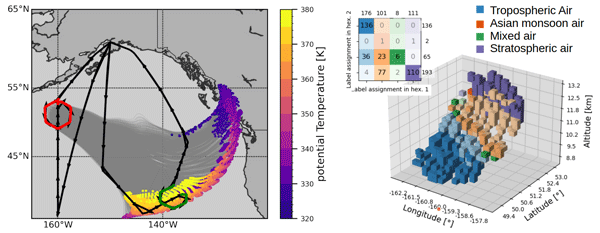
(-) Lines 151-160Relevant text: Figure 3 (Caption)
Figure 3. Self matching experiment during flights PH13 and PH14. The first hexagon is marked in red, the second hexagon is marked in
green. Flight paths are shown in black lines, flight orientation is indicated by the arrows. CLaMS forward trajectories are shown as gray lines.
They begin inside the first hexagon at 01:35 UTC and end at 01:50 UTC on the following day. The trajectories were started at every point
on the retrieval grid and were driven by ERA5 (1°x1°) reanalysis. Potential temperature of end points are shown in color-code. Trajectories
were calculated for every point of the retrieval grid - Reviewer: I cannot fully evaluate the result because some key details of the datasets are missing. Even if the result is robust at all, I would like the authors to reconsider to bring your findings to a bigger picture. The authors analyzed a case study only. And certainly the GLORIA is not widely used yet. So how could your findings benefit to those who study Asian monsoon?
Authors: Regarding the robustness of the result: We have included a section in the appendix investigating the robustness of the classification by evaluating the variability of parameters over multiple initializations. This should outline the robustness of the method. Regarding a "bigger picture": The double-flight experiment was conducted to demonstrate the capabilities of the (at the time) proposed Earth Explorer 11 candidate CAIRT, which at the time of the submission was not selected for the mission. However, the similar instrument STRIVE was approved and will be available in a few years. The methodology presented here therefore outlines how similar measurements will be possible in the near future with observations by STRIVE. Any other measurement of multiple trace gas species would be equally suited for the classfication approach, but it is mostly limited to measurements since simulated data likely would not have to rely on it. These statements have been included in the manuscript.
Relevant text: 621-632
(+) B5 Robustness of BGMM parameters
An instance of a trained (converged) BGMM generally converges towards the same state. Small variability may be introduced
by different initializations or ambiguity of the clusters contained with the data. To illustrate the robustness of the BGMM shown
here an ensemble of 100 instances was trained and the variability of the BGMM parameters such as means (cluster centers)
and covariances (cluster shapes) were determined. Fig. B7 summarizes the results. The means of each cluster are indeed rather625
robust, with the largest variability found for H2O and the continental tropospheric class (blue) in general. Since water vapor
has the largest intrinsic variability this result is partially expected. The mixing weights (panel b) vary little, indicating indeed
well defined clusters with sufficient local point density and global variability. The covariances also are subject to very little
variability, with the most uncertainty found for the correlation between H2O and HNO3 in the blended class and the variance in
H2O in the maritime tropospheric class such that the cluster shape along these axes (and subsequently along the contributions630
of those axes to the principal components) may vary. The covariances shown here were calculated from the untransformed
clusters (in 5-D) based on clusters found in the reduced 3-D space.
Relevant text: 547-552
(+) This self-matching experiment was conducted to demonstrate the measurement capabilities of the Earth
Explorer 11 candidate CAIRT ESA (2023, 2025), which at the time of writing of this study was not selected for the mission.
The wide range of trace gas species observable by CAIRT and its capability to perform 3-D resolved measurements would
have been ideally suited to study mixing processes. A conceptionally similar instrument STRIVE is in development and will be550
deployed no earlier than 2030 NASA (2026). It will be capable of performing similar experiments and will be able to provide
additional insights into the mixing processes in the UTLS region and the ASM. - Reviewer: I am not familiar with the Gaussian Mixture Model that you propose in this study. You spent several pages to explain your whole data pipeline. But if you want to convince readers to use your method, you have to clearly show the limitation of the (simpler) traditional method first. For example, first plot concentration of some species and compute correlation using the traditional method. Then state its disadvantages. Overall, for your section 2.4, it will be much easier to provide some numbers/examples for readers to understand your method. For example, in your PCA subsection, does M represent the three datasets and does N represent the total number of observation made in each dataset?
Authors: We have added a short classification using the traditional approach using water vapor and ozone to the appendix. This should illustrate the shortcomings of the conventonal approach. We had already included the specific numbers for our use case in brackets. We have revised all symbols used in the sections in question to make sure they are consistent. In the (old) notation M denotes the number of observations (here: 4117 for hexagon 1) and N the number of features (here: 5 trace gas species).
Relevant text: 602-620
(+) B4 Comparison to conventional classification
The comparison between the BGMM classification and conventional methods is illustrated in Fig. B6. The tracers H2O and
O3 have been chosen since most conventional methods use them. Any other combination of tracers will yield a more chaotic
correlation. The BGMM classification is shown in Fig. B6a in color-code. The first conventional method used the tropopause605
similarly to Ungermann et al. (2016) to determine the tropospheric and stratospheric regimes. For either regime a linear
regression if performed to determine the air types. Air parcels are included into either tropospheric/stratospheric regime if
the regression suggests at least 66% prediction confidence. The classification fails to provide complete classification for either
tropospheric/stratospheric air, indicated by the green regimes above the stratospheric band and to the sides of the tropospheric
band. Mixed air (in the form of mixing lines between the tropospheric/stratospheric band) is underrepresented compared to the610
other classifications. This classification would allow a total of four regimes to be defined (in either quadrant of the bands), but
the section corresponding to the ASM air in Fig. B6a is generally not considered in this approach. The second conventional
approach uses percentile thresholds similarly to Cohen et al. (2023) to identify tropospheric/stratospheric air. Linear regressions
through either regime are performed and the air parcels classified accordingly. This classification is most similar to the BGMM
classification, but only yields three significant regions. The third conventional approach uses commonly used fixed thresholds615
similarly to Ma et al. (2022). We use a threshold of 20 ppmV H2O for the tropospheric regime and a threshold of 0.2 ppmV O3
and perform linear regressions. This classification yields a stratosphere most similar to Fig. B6a, and a reasonable definition of
the troposphere. However, it is only capable of identifying three distinct regimes. Neither conventional method can reasonably
perform a classification into more than three classes. Even between different conventional approaches significant differences
persist. - Reviewer: In Figure 5, what's your value for the dynamical tropopause? If it is not the usual 2 pvu that I see in the literature, please state your value and probably explain it a little bit, instead of referring to Kunz et al. (2015). You refer to it as tropopause folding so I am curious what I can see using normal lapse rate or cold point tropopause.
Authors: As stated in the paper the dynamical tropopause is calculated based on the combination of potential temperature and PV based on the climatologies by Kunz et. al. 2015. We have added such an explanation for a better understanding. Regarding normal lapse rate/cold point tropopause: as shown in Fig. B2 the lapse rate tropopause lies mostly outside of the retrieval volume and does not reflect the tracer fields well at all.
Relevant text: Figure 5, caption:
(+-) . The dynamical tropopause adapted from Kunz et al. (2015), which determines the PV-value depending on the potential temperature based on climatological data, is indicated as black line in all panels. - Reviewer: Generally, all 3D plots (e.g., Figures 7, 10, and 12) do not offer much more information than multiple 2D plots. Consider to re-plot them.
Authors: We have evaluated alternative illustrations and find that none are more beneficial than the currently used ones. We see this as a technical limitation of visualizing 3-D structures in 2-D. We have therefore created interactive 3-D plots in html-format which we provide as supplements for better visualization. We have attached these 3-D plots as a supplement and will provide a suitable host for them for the final publication.
Relevant text: None - Reviewer: Could you provide any uncertainty statistics for the results fromm the Gaussian Mixture Model?
Authors: As per request we have performed a small robustness analysis for every parameter of the GMM, which we included in the appendix (see comment above).
Relevant text: 621-632 - Reviewer: There are some lightning events shown from GOES-18. But are they enough to quantitatively explain the HNO3 concentration difference?
Authors: The amount by which lightning events can increase HNO3 mixing ratios varies in the literature, but we find a value of around 300 pptv in Tie et. al. 2001, which lies in the correct order of magnitude. We included this statement in the manuscript.
Relevant text: 492-495
(+) . Tie et al. (2001) state that lightning events can lead to increases of up to 300 pptV in HNO3 compared to the background, which lies in
the order of magnitude of observed increase. - The comment states that there are multiple minor mistakes with the script, of which many were also noted by RC2. We have addressed these points. Typos have been corrected, including hypthens. Incorrect citation commands (resulting in missing brackets) have been corrected.
Regarding some more specific (minor) comments:
Reviewer: I don't understand this sentence. The ASM contributes to the ATAL?
Authors: We have reviewed the sentence and added sources indicating the significance of the ASM for the ATAL.
Relevant text: 51-53
Reviewer: L122: For the Curtis-Godson approximation, you should also cite the Godson 1953 QJRMS paper.
Authors: We have included the reference at the relevant place.
Relevant text: 121
Reviewer: Figure 2: You should state the time before UTC.
Authors: The measurement flights take between 8 and 10 hours, the hexagons themselves take up around 2 hours. We would abstain from including an hour, as we fear it would lead to confusion, but recognize the critique. We did include the start and end times of the outflow trajectories, which subsequently indicates the retrieval time for either hexagon.
Relevant text: Figure 3 (Caption) - Reviewer: Some important details of the datasets in this study are left out. For example, what is the horizontal and vertical resolution of the GLORIA retrievals? There should also be at least a short section to describe CLaMS model output and ECMWRF ERA5 data. In Figure 3, do you initialize your trajectories from the same vertical level (e.g., flight level, one or multiple levels of the GLORIA retrievals) inside the first hexagon?
-
AC1: 'Reply on RC1', Jan Kaumanns, 11 May 2026
-
RC2: 'Comment on egusphere-2026-650', Anonymous Referee #2, 03 May 2026
The authors have used a combination of observational measurements during a flight campaign, atmospheric transport modelling, weather/climate models and statistical methods to quantify the mixing of Asian Monsoon outflow air during a flight of the PHILEAS campaign.
I am highly positive about the paper. I believe it very appropriately uses all these methods to study the mixing of parcels of air between two GLORIA retrievals and is a very well designed study. Most of my comments are mostly about small details and clarifications. Overall I believe the paper is fit for acceptance to the journal with minor changes.
Below are my comments in the order in which they appear in the manuscript
1. Abstract line 3 - ".. classification methods based on a larger number of tracers .." Larger than what?
2. Introduction very clearly lays out the problem and the relevant literature
3. Lines 85, 86 - Brackets missing to enclose the references
4. Section 2.2 -- It would be good to describe Clams model in more detail. Further, the Clams model is focused on stratospheric transport modelling - How good is the model fidelity while considering tropospheric air parcels and transport below the tropopause where many processes can play different roles?
5. What is a "filament of air" exactly? Could you be more precise when you first introduce this? The discussion jumps directly into "filaments of ASM air" without explaining them
6. Line 154 - The first sentence should appear later. It is a reference to Fig 3 sandwiched between two detailed discussions on Fig 2.
7. Fig 3 caption says "trajectories were calculated using ERA5". Which Lagrangian particle trajectory was used? Please clarify (probably Clams)
8. Line 170 "discussed in the following. " Following what? Last word of the sentence missing
9. Line 270 - 250 km vertical resolution. That's quite a poor resolution :)
10. Figure 6 caption should mention that the values are averaged over longitude within the hexagon (I am guessing that is the case)
11. Line 348 onwards - This is a very important paragraph. I think it should be emphasised more and the arguments should be strengthened why this particular class is clearly associated with ASMO air. I was not entirely convinced.
12. The rest of the discussion follows very cleanly and clearly.
13. Line 419 - "Elements with very few elements" - typo
14. Figure 11 - I do not like images and captions which are not self-contained. The caption can mention what T, A, B, and S are
15. The discussion on the transition and mixing was quite clear and easy to follow.
Overall I believe the strongest point of this paper is the method adopted to tackle a rather difficult problem. There are definitely uncertainties regarding the exact single origin of different air-masses, but the study has used an excellent combination of GLORIA retrievals, atmospheric transport modelling and the PCA/Mixture model to shed insight into some very interesting and hard to uncover processes.
Citation: https://doi.org/10.5194/egusphere-2026-650-RC2 -
AC2: 'Reply on RC2', Jan Kaumanns, 11 May 2026
First and foremost we would thank both reviewers for the constructive criticism. We have carefully reviewed the comments and would include the following changes to the original manuscript:
RC2 does not differentiate between minor and mahor comments, but implied that their comments are of minor nature. We will address them here as such:
- Reviewer: Abstract line 3 - ".. classification methods based on a larger number of tracers .." Larger than what?
Authors: Changed to „many tracers“ as clearer language
Relevant text: 3 - Reviewer: Lines 85, 86 - Brackets missing to enclose the references
Authors: Included the missing brackets.
Relevant text: 85-86 - Reviewer: Section 2.2 -- It would be good to describe Clams model in more detail. Further, the Clams model is focused on stratospheric transport modelling - How good is the model fidelity while considering tropospheric air parcels and transport below the tropopause where many processes can play different roles?
Authors: We have included a dedicated section for the CLaMS simulations. We have included sources which investigate the fidelity of CLaMS as well.
Relevant text: 140-157
(+) 2.2 Lagrangian simulations and surface-origin tracer
CLaMS (e.g. McKenna et al., 2002; McKenna et al., 2002) is a chemistry transport model that includes irreversible mixing
and can resolve fine-scale tracer structures and gradients, particularly at the tropopause or in the vicinity of the ASMA (e.g.
Ploeger et al., 2017b; Vogel et al., 2025). While originally designed to simulate the stratosphere, CLaMS was later extended to
the troposphere (Konopka et al. (2010a); Konopka and Pan (2012); Pommrich et al. (2014a)and references therein).
Results of a CLaMS simulation driven by ECMWF forecasts are used as a priori values for the GLORIA retrieval, whereas
surface-origin tracers from a global CLaMS simulation driven by ECMWF ERA5 reanalysis (Hersbach et al., 2020) are used
to diagnose the origin of air masses measured by the GLORIA instrument. Here, ERA5 is used in a downscaled version with a
horizontal resolution of 1° × 1° and a 6-hourly temporal resolution (similar to Ploeger et al. (2021); Vogel et al. (2024)).
This simulation was started on 1 May 2023 and run over the course of the 2023 ASM season (for more details, see Vogel
et al. (2025)). Surface-origin tracers are initialized every day in the model boundary layer (≈ 2–3 km above Earth’s surface,
considering orography) and are subsequently transported into the free atmosphere over the course of the simulation. The
percentage of a surface-origin tracer in an arbitrary air parcel indicates the extent to which the considered air parcel originates
from the respective region.
The following surface-origin tracers in the ASM region (Fig. 1) are considered in our study: “Northern Indian Subcontinent”
(NIN), “Indian Subcontinent” (IND), “Tibetan Plateau” (TIB), “Eastern China” (ECH), “South East Asia” (SEA), “North-West
Pacific” (NWP), and “Tropical Western Pacific” (TWP).
Furthermore, the sum of the following surface-origin tracers, referred to as the “South Asia” tracer, is used as a proxy for air
contributing to the ASMA: “ECH” + “TIB” + “NIN” + “IND” + “BoB” + “NIO” (for more details, see Vogel et al. (2025)) - Reviewer: What is a "filament of air" exactly? Could you be more precise when you first introduce this? The discussion jumps directly into "filaments of ASM air" without explaining them
Authors: We have included a brief introduction to the wording. It should now be much clearer.
Relevant text: 66-67
(+) ... the edge of a coherent, elongated structure of air with enhanced content originating in the ASM region
relative to its surroundings – in the following referred to as a filament of ASM air – associated... - Reviewer: Line 154 - The first sentence should appear later. It is a reference to Fig 3 sandwiched between two detailed discussions on Fig 2.
Authors: We have switched the sentence around to improve the structure.
Relevant text: (-) 168-169, (+) 177 - Reviewer: 7. Fig 3 caption says "trajectories were calculated using ERA5". Which Lagrangian particle trajectory was used? Please clarify (probably Clams)
Authors: We have clarified that the trajectory is indeed by ClaMS.
Relevant text: Figure 3 (Caption) - Reviewer: 8. Line 170 "discussed in the following. " Following what? Last word of the sentence missing
Authors: We have added the missing word.
Relevant text: 186 - Reviewer: 9. Line 270 - 250 km vertical resolution. That's quite a poor resolution :)
Authors: We have provided the correct unit to the resolution :)
Relevant text: 286 - Reviewer: 10. Figure 6 caption should mention that the values are averaged over longitude within the hexagon (I am guessing that is the case)
Authors: We have clarified that these values are not averaged over longitude, but rather are interpolated along a constant longitude of 160°W. They correspond to the green cross-section in Fig.10
Relevant text: Figure 6 (caption) - Reviewer: 11. Line 348 onwards - This is a very important paragraph. I think it should be emphasised more and the arguments should be strengthened why this particular class is clearly associated with ASMO air. I was not entirely convinced.
Authors: We have rewritten the paragraph to better underline that this air type corresponds to the ASM with the available arguments. We hope this version is more convincing. We also included a source of a different paper investigating the different origins.
Relevant text: 363-372
(+-) Asian Summer monsoon outflow class: the air associated with the orange label shows moderately low values in both
tropospheric and stratospheric tracers. Its composition is clear distinct from either tropospheric or stratospheric air and
therefore cannot be either. To preempt the succeeding analysis this class is localized precisely in those section of the365
hexagon where the filament was predicted during flight planning. The regions most aligned with this air type are the
East China (ECH) region and the Tropical West Pacific (TWP) region, further suggesting a link to the ASM outflow.
Additionally, comparing the surface-origin tracers to the localization of this class (see. Fig. B4) it shows that this class
contains the highest mixing ratios of relevant surface-origin tracers. The strong signatures of both ECH and TWP indicate
a mixing of these air masses even before the formation of the filament. The CLaMS simulations do indeed show this370
mixing of TWP air with the outer regions of the ASMA ((see Vogel et al., 2025)). The chemical composition is consistent
with such an interpretation. We refer to this type of air as ASMO air (A). - Reviewer: 13. Line 419 - "Elements with very few elements" – typo
Authors: We have fixed the typo.
Relevant text: 419
Other changes include additional spelling corrections and minor changes in phrasing. Since Reviewer 1 requested better visualization of the 3-D plots we will provide interactive 3-D plots for better visualization as a supplement in the final version. We have attached these in this reply if you wish to inspect them.
- Reviewer: Abstract line 3 - ".. classification methods based on a larger number of tracers .." Larger than what?
-
AC2: 'Reply on RC2', Jan Kaumanns, 11 May 2026
Peer review completion


Post-review adjustments


Interactive discussion
Status: closed
-
CC1: 'Comment on egusphere-2026-650', Peter Preusse, 19 Mar 2026
Publisher’s note: the content of this comment was removed on 20 March 2026 since the comment was posted by mistake.
Citation: https://doi.org/10.5194/egusphere-2026-650-CC1 -
CC2: 'Reply on CC1', Peter Preusse, 19 Mar 2026
Publisher’s note: the content of this comment was removed on 20 March 2026 since the comment was posted by mistake.
Citation: https://doi.org/10.5194/egusphere-2026-650-CC2
-
CC2: 'Reply on CC1', Peter Preusse, 19 Mar 2026
-
RC1: 'Comment on egusphere-2026-650', Anonymous Referee #1, 04 Apr 2026
Review of "Quantification of inmixing of Asian Monsoon air by multi-species classification in a match flight experiment" by Kaumanns et al.
Summary:
In this study, Kaumanns et al. present a comprehensive analysis on the inmixing of Asian Monsoon Air sampled during the PHILEAS field campaign. The experiment design is well designed and executed. The dataset provided by the GLORIA retrievals is unique. But before I recommend for the publication, I have some specific questions and comments for the authors.
Major comments:
1. Some important details of the datasets in this study are left out. For example, what is the horizontal and vertical resolution of the GLORIA retrievals? There should also be at least a short section to describe CLaMS model output and ECMWRF ERA5 data. In Figure 3, do you initialize your trajectories from the same vertical level (e.g., flight level, one or multiple levels of the GLORIA retrievals) inside the first hexagon?
2. I cannot fully evaluate the result because some key details of the datasets are missing. Even if the result is robust at all, I would like the authors to reconsider to bring your findings to a bigger picture. The authors analyzed a case study only. And certainly the GLORIA is not widely used yet. So how could your findings benefit to those who study Asian monsoon?
3. I am not familiar with the Gaussian Mixture Model that you propose in this study. You spent several pages to explain your whole data pipeline. But if you want to convince readers to use your method, you have to clearly show the limitation of the (simpler) traditional method first. For example, first plot concentration of some species and compute correlation using the traditional method. Then state its disadvantages. Overall, for your section 2.4, it will be much easier to provide some numbers/examples for readers to understand your method. For example, in your PCA subsection, does M represent the three datasets and does N represent the total number of observation made in each dataset?
4. In Figure 5, what's your value for the dynamical tropopause? If it is not the usual 2 pvu that I see in the literature, please state your value and probably explain it a little bit, instead of referring to Kunz et al. (2015). You refer to it as tropopause folding so I am curious what I can see using normal lapse rate or cold point tropopause.
5. Generally, all 3D plots (e.g., Figures 7, 10, and 12) do not offer much more information than multiple 2D plots. Consider to re-plot them.
6. Could you provide any uncertainty statistics for the results fromm the Gaussian Mixture Model?
7. There are some lightning events shown from GOES-18. But are they enough to quantitatively explain the HNO3 concentration difference?
8. Lastly, there are lots of minor mistakes. See my minor comments for part of the mistakes below. The frequent occurrences disrupt the flow to read the manuscript a lot. Please proofread your manuscript carefully.
Minor comments:
L23: upper tropospheric -> upper-tropospheric
L26: northwards -> to the north
L35: There should be parentheses enclosing the citations. There are similar citation style issues, e.g., L85 and L86. Please fix these.
L49: I don't understand this sentence. The ASM contributes to the ATAL?
L60: for example during -> during, for example,
L63: what time in UTC?
L93: Please revise the sentence.
L104: I think there should be a full stop after "technique".
L104: an -> a
L122: For the Curtis-Godson approximation, you should also cite the Godson 1953 QJRMS paper.
L131: A-priori -> A priori
Figure 2: You should state the time before UTC.
L183-185. Consider to rewrite this sentence. There are two which clauses.
L199: a choosable parameter -> an input parameter.
L270: 250 km vertical resolution seems not reasonable.
L281-282: The two which clauses are confusing. Consider to revise your sentence.
L283: 3-PV. Do you mean 3-PVU?
L304: were -> was
L352: B3. Are you referring to Figure B2?
L588: founding -> funding
L534: Technical data -> Technical details
L535-548: There are three A1 subsections.
Figure A1: Should F13 and F14 be PH13 and PH14 as stated in L63?Citation: https://doi.org/10.5194/egusphere-2026-650-RC1 -
AC1: 'Reply on RC1', Jan Kaumanns, 11 May 2026
Response to the review by RC1:
First and foremost we would thank both reviewers for the constructive criticism. We have carefully reviewed the comments and would include the following changes to the original manuscript:
Regarding the major comments (1 - 7):- Reviewer: Some important details of the datasets in this study are left out. For example, what is the horizontal and vertical resolution of the GLORIA retrievals? There should also be at least a short section to describe CLaMS model output and ECMWRF ERA5 data. In Figure 3, do you initialize your trajectories from the same vertical level (e.g., flight level, one or multiple levels of the GLORIA retrievals) inside the first hexagon?
Authors: We have added estimates for the horizontal and vertical resolutions of GLORIA. We say estimates, since the retrieval grid is irregular and thus no unified resolutions can be given. It should agree with the spirit of the comment. We have specified the resolution of the ECMWF data and added a section explaining the CLaMS model in more detail. We have clarified that the trajectories in Fig. 3 are initialized at the positions of retrieval grid, and thus at different levels.
Relevant text: 134-138
(+)The resolution of these 3-D tomographic retrievals generally depends on the retrieval process itself. The retrieval grid used in this study is irregular and chosen such that as many tangent points of the observations as feasible are contained. The vertical resolution of either retrieval is 250\,m, the horizontal resolution lies between 28.6\,km zonally, 22.24\,km meridionally or 38.28\,km for the nearest diagonal point.
Relevant text: 140-158(+)2.2 Lagrangian simulations and surface-origin tracer
CLaMS (e.g. McKenna et al., 2002; McKenna et al., 2002) is a chemistry transport model that includes irreversible mixing
and can resolve fine-scale tracer structures and gradients, particularly at the tropopause or in the vicinity of the ASMA (e.g.
Ploeger et al., 2017b; Vogel et al., 2025). While originally designed to simulate the stratosphere, CLaMS was later extended to
the troposphere (Konopka et al. (2010a); Konopka and Pan (2012); Pommrich et al. (2014a)and references therein).
Results of a CLaMS simulation driven by ECMWF forecasts are used as a priori values for the GLORIA retrieval, whereas
surface-origin tracers from a global CLaMS simulation driven by ECMWF ERA5 reanalysis (Hersbach et al., 2020) are used
to diagnose the origin of air masses measured by the GLORIA instrument. Here, ERA5 is used in a downscaled version with a
horizontal resolution of 1° × 1° and a 6-hourly temporal resolution (similar to Ploeger et al. (2021); Vogel et al. (2024)).
This simulation was started on 1 May 2023 and run over the course of the 2023 ASM season (for more details, see Vogel
et al. (2025)). Surface-origin tracers are initialized every day in the model boundary layer (≈ 2–3 km above Earth’s surface,
considering orography) and are subsequently transported into the free atmosphere over the course of the simulation. The
percentage of a surface-origin tracer in an arbitrary air parcel indicates the extent to which the considered air parcel originates
from the respective region.
The following surface-origin tracers in the ASM region (Fig. 1) are considered in our study: “Northern Indian Subcontinent”
(NIN), “Indian Subcontinent” (IND), “Tibetan Plateau” (TIB), “Eastern China” (ECH), “South East Asia” (SEA), “North-West
Pacific” (NWP), and “Tropical Western Pacific” (TWP).
Furthermore, the sum of the following surface-origin tracers, referred to as the “South Asia” tracer, is used as a proxy for air
contributing to the ASMA: “ECH” + “TIB” + “NIN” + “IND” + “BoB” + “NIO” (for more details, see Vogel et al. (2025)).
(-) Lines 151-160Relevant text: Figure 3 (Caption)
Figure 3. Self matching experiment during flights PH13 and PH14. The first hexagon is marked in red, the second hexagon is marked in
green. Flight paths are shown in black lines, flight orientation is indicated by the arrows. CLaMS forward trajectories are shown as gray lines.
They begin inside the first hexagon at 01:35 UTC and end at 01:50 UTC on the following day. The trajectories were started at every point
on the retrieval grid and were driven by ERA5 (1°x1°) reanalysis. Potential temperature of end points are shown in color-code. Trajectories
were calculated for every point of the retrieval grid - Reviewer: I cannot fully evaluate the result because some key details of the datasets are missing. Even if the result is robust at all, I would like the authors to reconsider to bring your findings to a bigger picture. The authors analyzed a case study only. And certainly the GLORIA is not widely used yet. So how could your findings benefit to those who study Asian monsoon?
Authors: Regarding the robustness of the result: We have included a section in the appendix investigating the robustness of the classification by evaluating the variability of parameters over multiple initializations. This should outline the robustness of the method. Regarding a "bigger picture": The double-flight experiment was conducted to demonstrate the capabilities of the (at the time) proposed Earth Explorer 11 candidate CAIRT, which at the time of the submission was not selected for the mission. However, the similar instrument STRIVE was approved and will be available in a few years. The methodology presented here therefore outlines how similar measurements will be possible in the near future with observations by STRIVE. Any other measurement of multiple trace gas species would be equally suited for the classfication approach, but it is mostly limited to measurements since simulated data likely would not have to rely on it. These statements have been included in the manuscript.
Relevant text: 621-632
(+) B5 Robustness of BGMM parameters
An instance of a trained (converged) BGMM generally converges towards the same state. Small variability may be introduced
by different initializations or ambiguity of the clusters contained with the data. To illustrate the robustness of the BGMM shown
here an ensemble of 100 instances was trained and the variability of the BGMM parameters such as means (cluster centers)
and covariances (cluster shapes) were determined. Fig. B7 summarizes the results. The means of each cluster are indeed rather625
robust, with the largest variability found for H2O and the continental tropospheric class (blue) in general. Since water vapor
has the largest intrinsic variability this result is partially expected. The mixing weights (panel b) vary little, indicating indeed
well defined clusters with sufficient local point density and global variability. The covariances also are subject to very little
variability, with the most uncertainty found for the correlation between H2O and HNO3 in the blended class and the variance in
H2O in the maritime tropospheric class such that the cluster shape along these axes (and subsequently along the contributions630
of those axes to the principal components) may vary. The covariances shown here were calculated from the untransformed
clusters (in 5-D) based on clusters found in the reduced 3-D space.
Relevant text: 547-552
(+) This self-matching experiment was conducted to demonstrate the measurement capabilities of the Earth
Explorer 11 candidate CAIRT ESA (2023, 2025), which at the time of writing of this study was not selected for the mission.
The wide range of trace gas species observable by CAIRT and its capability to perform 3-D resolved measurements would
have been ideally suited to study mixing processes. A conceptionally similar instrument STRIVE is in development and will be550
deployed no earlier than 2030 NASA (2026). It will be capable of performing similar experiments and will be able to provide
additional insights into the mixing processes in the UTLS region and the ASM. - Reviewer: I am not familiar with the Gaussian Mixture Model that you propose in this study. You spent several pages to explain your whole data pipeline. But if you want to convince readers to use your method, you have to clearly show the limitation of the (simpler) traditional method first. For example, first plot concentration of some species and compute correlation using the traditional method. Then state its disadvantages. Overall, for your section 2.4, it will be much easier to provide some numbers/examples for readers to understand your method. For example, in your PCA subsection, does M represent the three datasets and does N represent the total number of observation made in each dataset?
Authors: We have added a short classification using the traditional approach using water vapor and ozone to the appendix. This should illustrate the shortcomings of the conventonal approach. We had already included the specific numbers for our use case in brackets. We have revised all symbols used in the sections in question to make sure they are consistent. In the (old) notation M denotes the number of observations (here: 4117 for hexagon 1) and N the number of features (here: 5 trace gas species).
Relevant text: 602-620
(+) B4 Comparison to conventional classification
The comparison between the BGMM classification and conventional methods is illustrated in Fig. B6. The tracers H2O and
O3 have been chosen since most conventional methods use them. Any other combination of tracers will yield a more chaotic
correlation. The BGMM classification is shown in Fig. B6a in color-code. The first conventional method used the tropopause605
similarly to Ungermann et al. (2016) to determine the tropospheric and stratospheric regimes. For either regime a linear
regression if performed to determine the air types. Air parcels are included into either tropospheric/stratospheric regime if
the regression suggests at least 66% prediction confidence. The classification fails to provide complete classification for either
tropospheric/stratospheric air, indicated by the green regimes above the stratospheric band and to the sides of the tropospheric
band. Mixed air (in the form of mixing lines between the tropospheric/stratospheric band) is underrepresented compared to the610
other classifications. This classification would allow a total of four regimes to be defined (in either quadrant of the bands), but
the section corresponding to the ASM air in Fig. B6a is generally not considered in this approach. The second conventional
approach uses percentile thresholds similarly to Cohen et al. (2023) to identify tropospheric/stratospheric air. Linear regressions
through either regime are performed and the air parcels classified accordingly. This classification is most similar to the BGMM
classification, but only yields three significant regions. The third conventional approach uses commonly used fixed thresholds615
similarly to Ma et al. (2022). We use a threshold of 20 ppmV H2O for the tropospheric regime and a threshold of 0.2 ppmV O3
and perform linear regressions. This classification yields a stratosphere most similar to Fig. B6a, and a reasonable definition of
the troposphere. However, it is only capable of identifying three distinct regimes. Neither conventional method can reasonably
perform a classification into more than three classes. Even between different conventional approaches significant differences
persist. - Reviewer: In Figure 5, what's your value for the dynamical tropopause? If it is not the usual 2 pvu that I see in the literature, please state your value and probably explain it a little bit, instead of referring to Kunz et al. (2015). You refer to it as tropopause folding so I am curious what I can see using normal lapse rate or cold point tropopause.
Authors: As stated in the paper the dynamical tropopause is calculated based on the combination of potential temperature and PV based on the climatologies by Kunz et. al. 2015. We have added such an explanation for a better understanding. Regarding normal lapse rate/cold point tropopause: as shown in Fig. B2 the lapse rate tropopause lies mostly outside of the retrieval volume and does not reflect the tracer fields well at all.
Relevant text: Figure 5, caption:
(+-) . The dynamical tropopause adapted from Kunz et al. (2015), which determines the PV-value depending on the potential temperature based on climatological data, is indicated as black line in all panels. - Reviewer: Generally, all 3D plots (e.g., Figures 7, 10, and 12) do not offer much more information than multiple 2D plots. Consider to re-plot them.
Authors: We have evaluated alternative illustrations and find that none are more beneficial than the currently used ones. We see this as a technical limitation of visualizing 3-D structures in 2-D. We have therefore created interactive 3-D plots in html-format which we provide as supplements for better visualization. We have attached these 3-D plots as a supplement and will provide a suitable host for them for the final publication.
Relevant text: None - Reviewer: Could you provide any uncertainty statistics for the results fromm the Gaussian Mixture Model?
Authors: As per request we have performed a small robustness analysis for every parameter of the GMM, which we included in the appendix (see comment above).
Relevant text: 621-632 - Reviewer: There are some lightning events shown from GOES-18. But are they enough to quantitatively explain the HNO3 concentration difference?
Authors: The amount by which lightning events can increase HNO3 mixing ratios varies in the literature, but we find a value of around 300 pptv in Tie et. al. 2001, which lies in the correct order of magnitude. We included this statement in the manuscript.
Relevant text: 492-495
(+) . Tie et al. (2001) state that lightning events can lead to increases of up to 300 pptV in HNO3 compared to the background, which lies in
the order of magnitude of observed increase. - The comment states that there are multiple minor mistakes with the script, of which many were also noted by RC2. We have addressed these points. Typos have been corrected, including hypthens. Incorrect citation commands (resulting in missing brackets) have been corrected.
Regarding some more specific (minor) comments:
Reviewer: I don't understand this sentence. The ASM contributes to the ATAL?
Authors: We have reviewed the sentence and added sources indicating the significance of the ASM for the ATAL.
Relevant text: 51-53
Reviewer: L122: For the Curtis-Godson approximation, you should also cite the Godson 1953 QJRMS paper.
Authors: We have included the reference at the relevant place.
Relevant text: 121
Reviewer: Figure 2: You should state the time before UTC.
Authors: The measurement flights take between 8 and 10 hours, the hexagons themselves take up around 2 hours. We would abstain from including an hour, as we fear it would lead to confusion, but recognize the critique. We did include the start and end times of the outflow trajectories, which subsequently indicates the retrieval time for either hexagon.
Relevant text: Figure 3 (Caption) - Reviewer: Some important details of the datasets in this study are left out. For example, what is the horizontal and vertical resolution of the GLORIA retrievals? There should also be at least a short section to describe CLaMS model output and ECMWRF ERA5 data. In Figure 3, do you initialize your trajectories from the same vertical level (e.g., flight level, one or multiple levels of the GLORIA retrievals) inside the first hexagon?
-
AC1: 'Reply on RC1', Jan Kaumanns, 11 May 2026
-
RC2: 'Comment on egusphere-2026-650', Anonymous Referee #2, 03 May 2026
The authors have used a combination of observational measurements during a flight campaign, atmospheric transport modelling, weather/climate models and statistical methods to quantify the mixing of Asian Monsoon outflow air during a flight of the PHILEAS campaign.
I am highly positive about the paper. I believe it very appropriately uses all these methods to study the mixing of parcels of air between two GLORIA retrievals and is a very well designed study. Most of my comments are mostly about small details and clarifications. Overall I believe the paper is fit for acceptance to the journal with minor changes.
Below are my comments in the order in which they appear in the manuscript
1. Abstract line 3 - ".. classification methods based on a larger number of tracers .." Larger than what?
2. Introduction very clearly lays out the problem and the relevant literature
3. Lines 85, 86 - Brackets missing to enclose the references
4. Section 2.2 -- It would be good to describe Clams model in more detail. Further, the Clams model is focused on stratospheric transport modelling - How good is the model fidelity while considering tropospheric air parcels and transport below the tropopause where many processes can play different roles?
5. What is a "filament of air" exactly? Could you be more precise when you first introduce this? The discussion jumps directly into "filaments of ASM air" without explaining them
6. Line 154 - The first sentence should appear later. It is a reference to Fig 3 sandwiched between two detailed discussions on Fig 2.
7. Fig 3 caption says "trajectories were calculated using ERA5". Which Lagrangian particle trajectory was used? Please clarify (probably Clams)
8. Line 170 "discussed in the following. " Following what? Last word of the sentence missing
9. Line 270 - 250 km vertical resolution. That's quite a poor resolution :)
10. Figure 6 caption should mention that the values are averaged over longitude within the hexagon (I am guessing that is the case)
11. Line 348 onwards - This is a very important paragraph. I think it should be emphasised more and the arguments should be strengthened why this particular class is clearly associated with ASMO air. I was not entirely convinced.
12. The rest of the discussion follows very cleanly and clearly.
13. Line 419 - "Elements with very few elements" - typo
14. Figure 11 - I do not like images and captions which are not self-contained. The caption can mention what T, A, B, and S are
15. The discussion on the transition and mixing was quite clear and easy to follow.
Overall I believe the strongest point of this paper is the method adopted to tackle a rather difficult problem. There are definitely uncertainties regarding the exact single origin of different air-masses, but the study has used an excellent combination of GLORIA retrievals, atmospheric transport modelling and the PCA/Mixture model to shed insight into some very interesting and hard to uncover processes.
Citation: https://doi.org/10.5194/egusphere-2026-650-RC2 -
AC2: 'Reply on RC2', Jan Kaumanns, 11 May 2026
First and foremost we would thank both reviewers for the constructive criticism. We have carefully reviewed the comments and would include the following changes to the original manuscript:
RC2 does not differentiate between minor and mahor comments, but implied that their comments are of minor nature. We will address them here as such:
- Reviewer: Abstract line 3 - ".. classification methods based on a larger number of tracers .." Larger than what?
Authors: Changed to „many tracers“ as clearer language
Relevant text: 3 - Reviewer: Lines 85, 86 - Brackets missing to enclose the references
Authors: Included the missing brackets.
Relevant text: 85-86 - Reviewer: Section 2.2 -- It would be good to describe Clams model in more detail. Further, the Clams model is focused on stratospheric transport modelling - How good is the model fidelity while considering tropospheric air parcels and transport below the tropopause where many processes can play different roles?
Authors: We have included a dedicated section for the CLaMS simulations. We have included sources which investigate the fidelity of CLaMS as well.
Relevant text: 140-157
(+) 2.2 Lagrangian simulations and surface-origin tracer
CLaMS (e.g. McKenna et al., 2002; McKenna et al., 2002) is a chemistry transport model that includes irreversible mixing
and can resolve fine-scale tracer structures and gradients, particularly at the tropopause or in the vicinity of the ASMA (e.g.
Ploeger et al., 2017b; Vogel et al., 2025). While originally designed to simulate the stratosphere, CLaMS was later extended to
the troposphere (Konopka et al. (2010a); Konopka and Pan (2012); Pommrich et al. (2014a)and references therein).
Results of a CLaMS simulation driven by ECMWF forecasts are used as a priori values for the GLORIA retrieval, whereas
surface-origin tracers from a global CLaMS simulation driven by ECMWF ERA5 reanalysis (Hersbach et al., 2020) are used
to diagnose the origin of air masses measured by the GLORIA instrument. Here, ERA5 is used in a downscaled version with a
horizontal resolution of 1° × 1° and a 6-hourly temporal resolution (similar to Ploeger et al. (2021); Vogel et al. (2024)).
This simulation was started on 1 May 2023 and run over the course of the 2023 ASM season (for more details, see Vogel
et al. (2025)). Surface-origin tracers are initialized every day in the model boundary layer (≈ 2–3 km above Earth’s surface,
considering orography) and are subsequently transported into the free atmosphere over the course of the simulation. The
percentage of a surface-origin tracer in an arbitrary air parcel indicates the extent to which the considered air parcel originates
from the respective region.
The following surface-origin tracers in the ASM region (Fig. 1) are considered in our study: “Northern Indian Subcontinent”
(NIN), “Indian Subcontinent” (IND), “Tibetan Plateau” (TIB), “Eastern China” (ECH), “South East Asia” (SEA), “North-West
Pacific” (NWP), and “Tropical Western Pacific” (TWP).
Furthermore, the sum of the following surface-origin tracers, referred to as the “South Asia” tracer, is used as a proxy for air
contributing to the ASMA: “ECH” + “TIB” + “NIN” + “IND” + “BoB” + “NIO” (for more details, see Vogel et al. (2025)) - Reviewer: What is a "filament of air" exactly? Could you be more precise when you first introduce this? The discussion jumps directly into "filaments of ASM air" without explaining them
Authors: We have included a brief introduction to the wording. It should now be much clearer.
Relevant text: 66-67
(+) ... the edge of a coherent, elongated structure of air with enhanced content originating in the ASM region
relative to its surroundings – in the following referred to as a filament of ASM air – associated... - Reviewer: Line 154 - The first sentence should appear later. It is a reference to Fig 3 sandwiched between two detailed discussions on Fig 2.
Authors: We have switched the sentence around to improve the structure.
Relevant text: (-) 168-169, (+) 177 - Reviewer: 7. Fig 3 caption says "trajectories were calculated using ERA5". Which Lagrangian particle trajectory was used? Please clarify (probably Clams)
Authors: We have clarified that the trajectory is indeed by ClaMS.
Relevant text: Figure 3 (Caption) - Reviewer: 8. Line 170 "discussed in the following. " Following what? Last word of the sentence missing
Authors: We have added the missing word.
Relevant text: 186 - Reviewer: 9. Line 270 - 250 km vertical resolution. That's quite a poor resolution :)
Authors: We have provided the correct unit to the resolution :)
Relevant text: 286 - Reviewer: 10. Figure 6 caption should mention that the values are averaged over longitude within the hexagon (I am guessing that is the case)
Authors: We have clarified that these values are not averaged over longitude, but rather are interpolated along a constant longitude of 160°W. They correspond to the green cross-section in Fig.10
Relevant text: Figure 6 (caption) - Reviewer: 11. Line 348 onwards - This is a very important paragraph. I think it should be emphasised more and the arguments should be strengthened why this particular class is clearly associated with ASMO air. I was not entirely convinced.
Authors: We have rewritten the paragraph to better underline that this air type corresponds to the ASM with the available arguments. We hope this version is more convincing. We also included a source of a different paper investigating the different origins.
Relevant text: 363-372
(+-) Asian Summer monsoon outflow class: the air associated with the orange label shows moderately low values in both
tropospheric and stratospheric tracers. Its composition is clear distinct from either tropospheric or stratospheric air and
therefore cannot be either. To preempt the succeeding analysis this class is localized precisely in those section of the365
hexagon where the filament was predicted during flight planning. The regions most aligned with this air type are the
East China (ECH) region and the Tropical West Pacific (TWP) region, further suggesting a link to the ASM outflow.
Additionally, comparing the surface-origin tracers to the localization of this class (see. Fig. B4) it shows that this class
contains the highest mixing ratios of relevant surface-origin tracers. The strong signatures of both ECH and TWP indicate
a mixing of these air masses even before the formation of the filament. The CLaMS simulations do indeed show this370
mixing of TWP air with the outer regions of the ASMA ((see Vogel et al., 2025)). The chemical composition is consistent
with such an interpretation. We refer to this type of air as ASMO air (A). - Reviewer: 13. Line 419 - "Elements with very few elements" – typo
Authors: We have fixed the typo.
Relevant text: 419
Other changes include additional spelling corrections and minor changes in phrasing. Since Reviewer 1 requested better visualization of the 3-D plots we will provide interactive 3-D plots for better visualization as a supplement in the final version. We have attached these in this reply if you wish to inspect them.
- Reviewer: Abstract line 3 - ".. classification methods based on a larger number of tracers .." Larger than what?
-
AC2: 'Reply on RC2', Jan Kaumanns, 11 May 2026
Peer review completion
Post-review adjustments
Journal article(s) based on this preprint
Viewed
| HTML | XML | Total | BibTeX | EndNote | |
|---|---|---|---|---|---|
| 971 | 486 | 110 | 1,567 | 94 | 105 |
- HTML: 971
- PDF: 486
- XML: 110
- Total: 1,567
- BibTeX: 94
- EndNote: 105
Viewed (geographical distribution)
| Country | # | Views | % |
|---|
| Total: | 0 |
| HTML: | 0 |
| PDF: | 0 |
| XML: | 0 |
- 1
Jan Kaumanns

Jörn Ungermann
Bärbel Vogel
Sören Johansson
Erik Kretschmer
Felix Plöger
Peter Preuße
Wolfgang Woiwode
Martin Riese
The requested preprint has a corresponding peer-reviewed final revised paper. You are encouraged to refer to the final revised version.
- Preprint
(14988 KB) - Metadata XML