
the Creative Commons Attribution 4.0 License.
the Creative Commons Attribution 4.0 License.
 | 13 Feb 2026
Climatology and annual cycle of global ocean dissolved oxygen represented by multiple observational gridded products
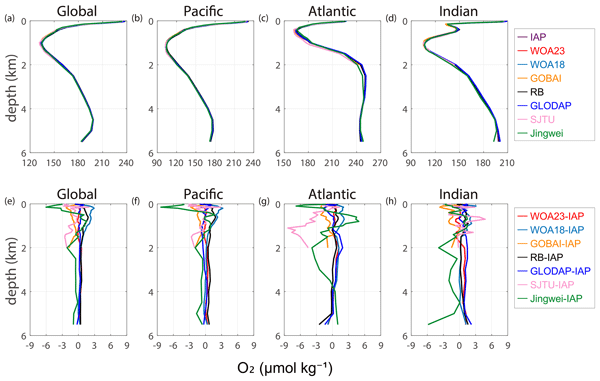
Abstract. Ocean dissolved oxygen (O2) is an essential climate variable crucial for sustaining the marine life; thus, changes of O2 at various spatiotemporal scales should be quantified and understood. Here, we study the climatology and annual cycle of O2 at regional to global scales using eight available gridded observational products. These datasets are generated by different groups using different primary data selection, quality control, bias correction and interpolation methods including statistical and machine-learning based mapping methods. A common set of metrics was collaboratively developed by the community of Gridded Observational Dataset Intercomparison Project-Dissolved Oxygen (GODIP-DO) to facilitate the inter-comparison, which allows assessing the robustness of the uncertainties through the spread of the products. Global mean O2 profiles are consistent among all products (±3 µmol kg-1), with the well-established decrease from high surface values to a minimum ~1000 meters, and subsequent increase to higher O2 at depth, although local differences could reach ±25 µmol kg-1 (0–1000 m). The hemispheric O2 annual cycle correlates strongly with ocean temperature changes, suggesting the key driver of temperature for the O2 annual cycle. However, there is substantial variation in the global mean 0–100 m O2 annual cycle, the magnitude ranges from -1 to 0.8 μmol kg-1, with a standard deviation of the datasets of ~0.3 μmol kg-1. Average oxygen minimum zones (OMZ) volume among the products is 80.92 × 10⁶ km3 (±1.95 %) for a 60 µmol kg-1 threshold and 152.00 × 10⁶ km3 (±1.72 %) for a 90 µmol kg-1 threshold. Our results serve as a starting point for resolving the uncertainty budget of the ocean O2 changes.
-
Notice on discussion status
The requested preprint has a corresponding peer-reviewed final revised paper. You are encouraged to refer to the final revised version.
-
Preprint
(3640 KB)
-
Supplement
(2863 KB)
-
The requested preprint has a corresponding peer-reviewed final revised paper. You are encouraged to refer to the final revised version.
- Preprint
(3640 KB) - Metadata XML
-
Supplement
(2863 KB) - BibTeX
- EndNote
- Final revised paper


Journal article(s) based on this preprint
Interactive discussion
Status: closed
-
RC1: 'Comment on egusphere-2026-641', Anonymous Referee #1, 26 Mar 2026
- AC1: 'Reply on RC1', Juan Du, 09 Apr 2026
-
RC2: 'Comment on egusphere-2026-641', Malek Belgacem, 31 Mar 2026
The paper by Du al. compares eight gridded dissolved oxygen products to assess global dissolved oxygen climatology, annual cycle and oxygen minimum zone (OMZ) representation.
This is timely and useful contribution for the oxygen community. A multi-product comparison of this kind is much needed and valuable.
The focus on both climatology and annual cycle is worthwhile, and the effort to define common comparison metrics through GODIP-DO is a strong point. In my view, the manuscript is strongest as a descriptive intercomparison. It is less convincing when it moves toward explaining why products differ, or when it comes close to treating product spread as formal uncertainty estimate.
The main findings are clear: the global mean vertical oxygen structure is broadly similar across products, while local upper-ocean differences can be much larger.
My main concern is that the manuscript sometimes over-interprets what this study design can support. The products differ in their source observations, quality check, bias correction, mapping approaches, resolution , mask and climatological periods. The study is therefore well suited to attributing those differences to a specific cause.
The manuscript acknowledges this point, but not consistently enough throughout.
Main issues
- The abstract states that the intercomparison “allows assessing the robustness of uncertainties through the spread of products”, and in the conclusion presents the results as a starting point for resolving the uncertainty budget. That is reasonable at a broad level, but the wording needs to be more careful. What the paper really quantifies is inter-products spread or product disagreement, not total uncertainty in a formal sense.
Some comments
- The annual cycle section seems weaker than the climatology section, and could be dicussed more in the text.
- There is also a coverage mismatch across products. Some extend only to 2000 m, while others reach deeper; some provide annual climatology only, whereas others include monthly fields. The authors do point this out, but the implications for comparability should be discussed more explicitly, especially for the OMZ analysis.
- The handling uncertainty remains descriptive. I would encourage the authors to be more precise in how they frame product disagreement. As noted above, the paper measures inter-products spread, not uncertainty in a formal sense.
- At times, especially in the conclusion, the manuscript moves too quickly from descriptive comparison to causal explanation. For example, the statement that discrepancies “...could give an insight into regions where the accuracy of gridded data reconstruction is relatively more sensitive to the mapping method and observation data distribution...” is stronger than the analysis allows. This comparison does not isolate the effect of mapping method or observation data distribution, since products differs in several ways at once. I would suggest softening this kind of language. More generally, the final paragraph is trying to look ahead, but it becomes somewhat generic. I think the paper would end more strongly by saying that it establishes a baseline descriptive benchmark, while controlled intercomparisons are still needed to partition the causes of spread, especially in regions with strong gradients and sparse observations.
Overall, the main revision need is not the dataset comparison itself, which is useful, but a tighter framing of what the study can and cannot infer.
Some wording comments:
- Line 509:” by its depth-mean spatial distribution” is awkward and should be rephrased.
- Lines 527-528: “serve as a regular practice” would read better as “serve as a regular intercomparison exercise”.
Citation: https://doi.org/10.5194/egusphere-2026-641-RC2 - AC2: 'Reply on RC2', Juan Du, 09 Apr 2026


Interactive discussion
Status: closed
-
RC1: 'Comment on egusphere-2026-641', Anonymous Referee #1, 26 Mar 2026
Du et al. presents a worthwhile comparison of nine different oceanic dissolved oxygen datasets from differing methods. As a key biogeochemical property to understand current climate, including deoxygenation, patterns, this analysis is extremely worthwhile and valuable to the community. Despite some significant regionality, I am thoroughly impressed with how well these datasets align and only have minor questions for the authors.
Major comments:
- I would like to see more information on how much of the data was from Winkler’s vs. how much from sensors. That would be useful to understand some of the spatiotemporal biases.
Minor comments:
Line 65: Please define IPCC.
Lines 66-68: Please keep numerical range formatting consistent.
Lines 75-77: Should be commas not semi colons.
Line 77: I would add “Since the late 19th century, oceanographers have measured ocean O2 using many instruments with varying sampling resolutions.”
Lines 78-85: Similar to my comment from above, I would expand on this by noting that Winklers are labour intensive, leading to lower sampling resolution, whereas sensor-based measurements have better spatiotemporal resolution, and the proliferation of the BGC-Argo program has dramatically increased observations.
Lines 118-122: Personally, I don’t think this type of paper outline is necessary, but that is up to you.
Lines 188-190: Have you trimmed both GOBAI and IAP so that the exact years match up (i.e., 2004-2022)? That should correct for any bias specifically due to the dataset age.
Line 307: Gradients, plural.
Lines 338-349: I appreciate the discussion of biological and physical controls on the annual cycle, but this feels like the first time underlying mechanistic drivers are being discussed. Can you similarly discuss biological and physical controls on spatial patterns or zonal structures?
Citation: https://doi.org/10.5194/egusphere-2026-641-RC1 - AC1: 'Reply on RC1', Juan Du, 09 Apr 2026
-
RC2: 'Comment on egusphere-2026-641', Malek Belgacem, 31 Mar 2026
The paper by Du al. compares eight gridded dissolved oxygen products to assess global dissolved oxygen climatology, annual cycle and oxygen minimum zone (OMZ) representation.
This is timely and useful contribution for the oxygen community. A multi-product comparison of this kind is much needed and valuable.
The focus on both climatology and annual cycle is worthwhile, and the effort to define common comparison metrics through GODIP-DO is a strong point. In my view, the manuscript is strongest as a descriptive intercomparison. It is less convincing when it moves toward explaining why products differ, or when it comes close to treating product spread as formal uncertainty estimate.
The main findings are clear: the global mean vertical oxygen structure is broadly similar across products, while local upper-ocean differences can be much larger.
My main concern is that the manuscript sometimes over-interprets what this study design can support. The products differ in their source observations, quality check, bias correction, mapping approaches, resolution , mask and climatological periods. The study is therefore well suited to attributing those differences to a specific cause.
The manuscript acknowledges this point, but not consistently enough throughout.
Main issues
- The abstract states that the intercomparison “allows assessing the robustness of uncertainties through the spread of products”, and in the conclusion presents the results as a starting point for resolving the uncertainty budget. That is reasonable at a broad level, but the wording needs to be more careful. What the paper really quantifies is inter-products spread or product disagreement, not total uncertainty in a formal sense.
Some comments
- The annual cycle section seems weaker than the climatology section, and could be dicussed more in the text.
- There is also a coverage mismatch across products. Some extend only to 2000 m, while others reach deeper; some provide annual climatology only, whereas others include monthly fields. The authors do point this out, but the implications for comparability should be discussed more explicitly, especially for the OMZ analysis.
- The handling uncertainty remains descriptive. I would encourage the authors to be more precise in how they frame product disagreement. As noted above, the paper measures inter-products spread, not uncertainty in a formal sense.
- At times, especially in the conclusion, the manuscript moves too quickly from descriptive comparison to causal explanation. For example, the statement that discrepancies “...could give an insight into regions where the accuracy of gridded data reconstruction is relatively more sensitive to the mapping method and observation data distribution...” is stronger than the analysis allows. This comparison does not isolate the effect of mapping method or observation data distribution, since products differs in several ways at once. I would suggest softening this kind of language. More generally, the final paragraph is trying to look ahead, but it becomes somewhat generic. I think the paper would end more strongly by saying that it establishes a baseline descriptive benchmark, while controlled intercomparisons are still needed to partition the causes of spread, especially in regions with strong gradients and sparse observations.
Overall, the main revision need is not the dataset comparison itself, which is useful, but a tighter framing of what the study can and cannot infer.
Some wording comments:
- Line 509:” by its depth-mean spatial distribution” is awkward and should be rephrased.
- Lines 527-528: “serve as a regular practice” would read better as “serve as a regular intercomparison exercise”.
Citation: https://doi.org/10.5194/egusphere-2026-641-RC2 - AC2: 'Reply on RC2', Juan Du, 09 Apr 2026
Peer review completion


Journal article(s) based on this preprint
Data sets
Global Dissolved Oxygen Gridded Climatological Datasets GODIP-DO Group https://doi.org/10.5281/zenodo.16664650
Viewed
| HTML | XML | Total | Supplement | BibTeX | EndNote | |
|---|---|---|---|---|---|---|
| 919 | 479 | 79 | 1,477 | 189 | 137 | 147 |
- HTML: 919
- PDF: 479
- XML: 79
- Total: 1,477
- Supplement: 189
- BibTeX: 137
- EndNote: 147
Viewed (geographical distribution)
| Country | # | Views | % |
|---|
| Total: | 0 |
| HTML: | 0 |
| PDF: | 0 |
| XML: | 0 |
- 1
Lijing Cheng
Takamitsu Ito
Hernan E. Garcia
Zhankun Wang
Jonathan D. Sharp
Christopher J. Roach
Shoshiro Minobe
Yuntao Zhou
Gian G. Navarra
Seth M. Bushinsky
The requested preprint has a corresponding peer-reviewed final revised paper. You are encouraged to refer to the final revised version.
- Preprint
(3640 KB) - Metadata XML
-
Supplement
(2863 KB) - BibTeX
- EndNote
- Final revised paper
Du et al. presents a worthwhile comparison of nine different oceanic dissolved oxygen datasets from differing methods. As a key biogeochemical property to understand current climate, including deoxygenation, patterns, this analysis is extremely worthwhile and valuable to the community. Despite some significant regionality, I am thoroughly impressed with how well these datasets align and only have minor questions for the authors.
Major comments:
Minor comments:
Line 65: Please define IPCC.
Lines 66-68: Please keep numerical range formatting consistent.
Lines 75-77: Should be commas not semi colons.
Line 77: I would add “Since the late 19th century, oceanographers have measured ocean O2 using many instruments with varying sampling resolutions.”
Lines 78-85: Similar to my comment from above, I would expand on this by noting that Winklers are labour intensive, leading to lower sampling resolution, whereas sensor-based measurements have better spatiotemporal resolution, and the proliferation of the BGC-Argo program has dramatically increased observations.
Lines 118-122: Personally, I don’t think this type of paper outline is necessary, but that is up to you.
Lines 188-190: Have you trimmed both GOBAI and IAP so that the exact years match up (i.e., 2004-2022)? That should correct for any bias specifically due to the dataset age.
Line 307: Gradients, plural.
Lines 338-349: I appreciate the discussion of biological and physical controls on the annual cycle, but this feels like the first time underlying mechanistic drivers are being discussed. Can you similarly discuss biological and physical controls on spatial patterns or zonal structures?