
the Creative Commons Attribution 4.0 License.
the Creative Commons Attribution 4.0 License.
 | 26 Feb 2026
Root turnover and soil indicators capture belowground recovery following saltmarsh restoration
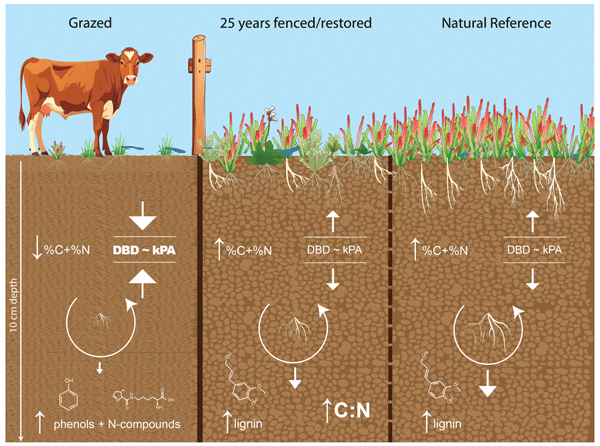
Abstract. Coastal wetlands, including saltmarsh, are highly productive ecosystems, with carbon- and nutrient-rich soils supporting biodiversity. Beyond carbon stocks and sequestration, the responses to restoration of these nutrient-rich and structurally complex soils remain poorly defined for coastal wetlands, especially in saltmarsh ecosystems restored by exclusion fencing. This study used a space-for-time approach to evaluate belowground responses in Salicornia quinqueflora-dominated saltmarsh 25 years after ungulate exclusion in Swan Bay, Victoria, Australia. We monitored surficial soil physicochemical characteristics, root and standardised litter decomposition, and root molecular composition across Grazed, Restored, and Natural Reference sites. Restored and Reference sites had ≥20 % higher vegetation cover and 2–3-fold higher percent soil carbon and nitrogen content, with 2.5-fold lower shear vane soil strength compared to Grazed sites. However, carbon and nitrogen stocks in the top 10 cm were not significantly different across sites (means ranging 30–36 Mg C ha-1) due to elevated bulk density at Grazed sites caused by compaction from ungulates. Salicornia quinqueflora root litter decomposition was slowest in Natural Reference sites, with molecular composition showing preservation of recalcitrant lignin in the Reference and Restored sites, indicating greater soil carbon preservation capacity. In contrast, roots decomposing in Grazed sites showed increased nitrogen and phenolic compounds indicating greater microbial-driven turnover. This study demonstrates that exclusion fencing can restore saltmarsh soil function and promote long-term resilience, particularly through improved preservation of recalcitrant organic matter material decades after intervention. By highlighting shifts in surface soil structure and organic matter preservation, this study shows why soil quality metrics beyond carbon stocks are essential for accurately evaluating restoration outcomes.
-
Notice on discussion status
The requested preprint has a corresponding peer-reviewed final revised paper. You are encouraged to refer to the final revised version.
-
Preprint
(1573 KB)
-
Supplement
(707 KB)
-
The requested preprint has a corresponding peer-reviewed final revised paper. You are encouraged to refer to the final revised version.
- Preprint
(1573 KB) - Metadata XML
-
Supplement
(707 KB) - BibTeX
- EndNote
- Final revised paper


Journal article(s) based on this preprint
Interactive discussion
Status: closed
-
RC1: 'Comment on egusphere-2026-635', Anonymous Referee #1, 01 Apr 2026
-
AC1: 'Reply on RC1', Sabrina Olsson, 24 Apr 2026
Response to reviewer comments for “Root turnover and soil indicators capture belowground recovery following saltmarsh restoration”
General comments
The study by Olsson et al. uses a space-for-time approach to evaluate the impact of restoration, through ungulate exclusion, on soil properties and carbon sequestration in saltmarsh ecosystems. The authors show that soils in areas subjected to exclusion fencing resemble natural reference conditions after 25 years, suggesting that this is an effective measure for improving physical, chemical, and biological soil properties. While studies assessing restoration outcomes in saltmarsh ecosystems often focus on only a limited number of indicators of belowground ecological function, this study examines a wide range of soil quality metrics. In particular, the authors highlight soil strength as a potentially useful indicator of belowground recovery. Restored and natural reference sites exhibited greater preservation of surficial recalcitrant carbon stocks, whereas enhanced microbial turnover likely occurred in disturbed soils in grazed saltmarshes. Overall, the study demonstrates the potential of exclusion fencing as a restoration strategy to enhance organic carbon stabilization in saltmarsh ecosystems.
The manuscript is clearly written and will likely be of interest to researchers and stakeholders working on saltmarsh restoration, as well as to a broader audience concerned with blue carbon sequestration.
Response: Thank you for this feedback. We have improved our manuscript based on your suggestions, particularly the motivation for testing the top 10 cm of soil and the condition under which the use of exclusion fencing is most relevant. Line numbers are included for new or edited text from the tracked changes version.
Specific comments
1. The authors could better justify why only the top 10 cm of the soil profile was sampled and analyzed, given that greater depths are typically included in standard blue carbon stock assessments, as noted in the manuscript. Expanding the discussion on how well surface soil patterns reflect deeper soil conditions and total carbon stocks would strengthen the interpretation of the results and provide useful context for readers.
Response: We have included the following paragraph in the discussion and included a relevant reference, supporting this statement.
L577-581: “Analyses of saltmarsh and mudflat sediments indicate that organic matter degradation is largely confined to the upper 5-10 cm, showing minimal change below this depth (Benjamin et al. 2026). Therefore, we focused on the top 10 cm in this study to quantifying the organic matter cycling.
Benjamin, A., Benedicte, D., Chaumillon, E., Rumpel, C., Dignac, M. F., Felbacq, A., Schmidt, S., Destampes, M., Arnaud, M., Metzger, E., Lacoue-Labarthe, T., & Dupuy, C. (2026). Organic carbon composition and preservation in macrotidal coastal wetland sediment: insights from biomarkers and isotopic signatures. Sci Total Environ, 1020, 181542. https://doi.org/10.1016/j.scitotenv.2026.181542
2. There is a general lack of consistency between figure/table references and the corresponding content. Please ensure that all references correctly match the figures and tables cited.
Examples of mismatches include:
Line 258: A reference to Table S2 and Table S3 but the text does not match with the information in these tables.
Figure S4 is mentioned before S3.
Line 330 and 333: Table S4 should be Table S2.
Line 364 and 377: Table S5 should be Table S3.
Line 386 and 391: Figure 7 should be Figure 6.
Response: We apologise for this inconvenience; an old version of the supplementary material had been uploaded by mistake. Figure S4 and S3 have been reordered. The tables and figures listed in the manuscript now match the table and figure labels in the supplementary material.
3. The authors state that ungulate exclusion through fencing is an attractive restoration approach due to its low cost and minimal intervention, and that large-scale wetland restoration is increasingly needed. However, these landscapes are also used for livestock grazing. The authors could potentially strengthen the discussion by briefly addressing under which conditions exclusion fencing is most appropriate or efficient.
Response: This sentence has been added:
L60-63: “Exclusion fencing as a coastal wetland restoration method is especially relevant in an Australia context, as there is a disproportionate impact of introduced ungulates on marginal lands (Rowland and Lovelock, 2024)”
Technical corrections
Line 53 – 54: The sentence starting with “There is an increasing…” appears out of context and disrupts the flow. Consider rephrasing. Also, motivate why there is an increasing demand for large-scale wetland restoration.
Response: Done. The sentence and motivation have been included earlier in the paragraph. The sentence now reads:
L48-51“Such coastal wetland degradation can compromise key ecosystem functions, including food chain supply, biodiversity conservation, resilience to sea level rise, water filtration, and carbon accumulation and storage (Prahalad, 2014). Therefore, there is an increasing demand for large-scale wetland restoration and protection (Macreadie et al., 2021).”
Line 487: Remove “the” after “preservation”.
Response: Done
Line 526 – 529: This sentence is difficult to follow and should be simplified for clarity.
Response: Done. The sentence now reads:
L542-545: “Disturbing coastal soils releases reactive organic matter. This changes the microbial community and causes microbes to start breaking down complex organic compounds that normally stay stable, which in turn releases CO2 emissions (Ward et al., 2019; Macreadie et al., 2025).”
Line 525: Please clarify the mechanism by which low nutrient availability would stimulate root turnover.
Response: The use of “low nutrients” here was misleading as we are discussing organic matter as a whole and not just inorganic nutrients. The sentence has been changed:
L536-539: “In contrast, the highly compacted, historically grazed soils in this study have higher saltmarsh root turnover, potentially due to a combination of low availability of organic matter, less frequent inundation and higher temperatures (Figure 8).”
Figure 7: Variable names overlap in the figure, which reduces readability.
Response: Figure has been adjusted. See attached document for the updated version.
Figure 8: It is not clearly visible in the figure that root decomposition is lower in the restored and natural reference sites. This could potentially be made clearer. Additionally, the figure appears to suggest higher aboveground biodiversity in the natural reference site, which differs from the description in the text.
Response: Figure has been adjusted. See attached document for the updated version.
Supplementary Materials: The title does not match with the title of the manuscript and should be corrected.
Response: This has been corrected.
-
AC1: 'Reply on RC1', Sabrina Olsson, 24 Apr 2026
-
RC2: 'Comment on egusphere-2026-635', Anonymous Referee #2, 09 May 2026
This manuscript presents a valuable assessment of belowground responses to ungulate exclusion in Salicornia quinqueflora-dominated saltmarshes in Swan Bay, Australia, using a well-structured space-for-time approach. The Introduction is clear and effective in outlining the broader context, research gap, study aims, and hypotheses. The Methods are detailed and transparent, while the Results are clearly presented and supported by a robust and interesting Discussion. Overall, I believe this study will be of considerable interest to researchers and practitioners working on saltmarsh restoration, nature-based solutions, and ecosystem services assessment, particularly because of its insightful discussion on soil condition dynamics and related indicators. I have only a few minor comments.
First, when discussing “ungulate exclusion” as a restoration approach, it would be helpful to clarify whether this refers primarily to livestock exclusion or also includes wild ungulates, as the current wording may create some ambiguity. This distinction is important because livestock grazing is a widespread management practice in saltmarshes globally, not only in Australia, and wild ungulates could potentially also exert pressure on natural marshes.
Second, in the Methods section, please clarify whether the two selected natural reference sites are the only natural marsh remaining in the bay; if not, explain the rationale for selecting the two sites.
Finally, in the Results section (line 339), please briefly define “alpha diversity” for non-specialist readers.
Citation: https://doi.org/10.5194/egusphere-2026-635-RC2 -
AC2: 'Reply on RC2', Sabrina Olsson, 11 May 2026
Response to reviewer 2 comments for “Root turnover and soil indicators capture belowground recovery following saltmarsh restoration”
This manuscript presents a valuable assessment of belowground responses to ungulate exclusion in Salicornia quinqueflora-dominated saltmarshes in Swan Bay, Australia, using a well-structured space-for-time approach. The Introduction is clear and effective in outlining the broader context, research gap, study aims, and hypotheses. The Methods are detailed and transparent, while the Results are clearly presented and supported by a robust and interesting Discussion. Overall, I believe this study will be of considerable interest to researchers and practitioners working on saltmarsh restoration, nature-based solutions, and ecosystem services assessment, particularly because of its insightful discussion on soil condition dynamics and related indicators. I have only a few minor comments.
First, when discussing “ungulate exclusion” as a restoration approach, it would be helpful to clarify whether this refers primarily to livestock exclusion or also includes wild ungulates, as the current wording may create some ambiguity. This distinction is important because livestock grazing is a widespread management practice in saltmarshes globally, not only in Australia, and wild ungulates could potentially also exert pressure on natural marshes.
REPLY: Thank you for this feedback. We have now specified in the text that ungulate exclusion in practice is both for livestock and wild ungulates, and that this study is referring specifically to livestock exclusion. Specific sentences that have been changed are outlined below.
L22-24: This study used a space-for-time approach to evaluate belowground responses in Salicornia quinqueflora-dominated saltmarsh 25 years after livestock exclusion in Swan Bay, Victoria, Australia.
L61-64: Exclusion fencing as a coastal wetland restoration method, is especially relevant in an Australian context, as there is a disproportionate impact of introduced livestock and wild ungulates on marginal lands (Rowland and Lovelock, 2024).
L484-485: A strong positive correlation between DBD and soil strength showed significant reductions after livestock exclusion, likely improving erosion and root development (Cahoon et al., 2021; Daniel et al., 2002).
L553-554: Thus, the present study attests to the capacity of restoration practices, such as exclusion fencing of livestock, for the stabilisation of organic carbon.
Second, in the Methods section, please clarify whether the two selected natural reference sites are the only natural marsh remaining in the bay; if not, explain the rationale for selecting the two sites.
REPLY: The following sentence has been added
L132-133: We were limited to using the only two Natural Reference sites in Swan Bay. The third was not accessible due to lack of permissions.
Finally, in the Results section (line 339), please briefly define “alpha diversity” for non-specialist readers.
REPLY: The sentence has been changed to the following
L348-350: The Natural Reference sites had the highest S. quinqueflora cover (≥90%) leading to the lowest alpha diversity (i.e. species richness and abundance) of the three rehabilitation categories (Figure 3, Figure S4).
-
AC2: 'Reply on RC2', Sabrina Olsson, 11 May 2026
Peer review completion


Interactive discussion
Status: closed
-
RC1: 'Comment on egusphere-2026-635', Anonymous Referee #1, 01 Apr 2026
General comments
The study by Olsson et al. uses a space-for-time approach to evaluate the impact of restoration, through ungulate exclusion, on soil properties and carbon sequestration in saltmarsh ecosystems. The authors show that soils in areas subjected to exclusion fencing resemble natural reference conditions after 25 years, suggesting that this is an effective measure for improving physical, chemical, and biological soil properties. While studies assessing restoration outcomes in saltmarsh ecosystems often focus on only a limited number of indicators of belowground ecological function, this study examines a wide range of soil quality metrics. In particular, the authors highlight soil strength as a potentially useful indicator of belowground recovery. Restored and natural reference sites exhibited greater preservation of surficial recalcitrant carbon stocks, whereas enhanced microbial turnover likely occurred in disturbed soils in grazed saltmarshes. Overall, the study demonstrates the potential of exclusion fencing as a restoration strategy to enhance organic carbon stabilization in saltmarsh ecosystems.
The manuscript is clearly written and will likely be of interest to researchers and stakeholders working on saltmarsh restoration, as well as to a broader audience concerned with blue carbon sequestration.
Specific comments
1. The authors could better justify why only the top 10 cm of the soil profile was sampled and analyzed, given that greater depths are typically included in standard blue carbon stock assessments, as noted in the manuscript. Expanding the discussion on how well surface soil patterns reflect deeper soil conditions and total carbon stocks would strengthen the interpretation of the results and provide useful context for readers.
2. There is a general lack of consistency between figure/table references and the corresponding content. Please ensure that all references correctly match the figures and tables cited.
Examples of mismatches include:
- Line 258: A reference to Table S2 and Table S3 but the text does not match with the information in these tables.
- Figure S4 is mentioned before S3.
- Line 330 and 333: Table S4 should be Table S2.
- Line 364 and 377: Table S5 should be Table S3.
- Line 386 and 391: Figure 7 should be Figure 6.
3. The authors state that ungulate exclusion through fencing is an attractive restoration approach due to its low cost and minimal intervention, and that large-scale wetland restoration is increasingly needed. However, these landscapes are also used for livestock grazing. The authors could potentially strengthen the discussion by briefly addressing under which conditions exclusion fencing is most appropriate or efficient.
Technical corrections
Line 53 – 54: The sentence starting with “There is an increasing…” appears out of context and disrupts the flow. Consider rephrasing. Also, motivate why there is an increasing demand for larges-cale wetland restoration.
Line 487: Remove “the” after “preservation”.
Line 526 – 529: This sentence is difficult to follow and should be simplified for clarity.
Line 525: Please clarify the mechanism by which low nutrient availability would stimulate root turnover.
Figure 7: Variable names overlap in the figure, which reduces readability.
Figure 8: It is not clearly visible in the figure that root decomposition is lower in the restored and natural reference sites. This could potentially be made clearer. Additionally, the figure appears to suggest higher aboveground biodiversity in the natural reference site, which differs from the description in the text.
Supplementary Materials: The title does not match with the title of the manuscript and should be corrected.
Citation: https://doi.org/10.5194/egusphere-2026-635-RC1 -
AC1: 'Reply on RC1', Sabrina Olsson, 24 Apr 2026
Response to reviewer comments for “Root turnover and soil indicators capture belowground recovery following saltmarsh restoration”
General comments
The study by Olsson et al. uses a space-for-time approach to evaluate the impact of restoration, through ungulate exclusion, on soil properties and carbon sequestration in saltmarsh ecosystems. The authors show that soils in areas subjected to exclusion fencing resemble natural reference conditions after 25 years, suggesting that this is an effective measure for improving physical, chemical, and biological soil properties. While studies assessing restoration outcomes in saltmarsh ecosystems often focus on only a limited number of indicators of belowground ecological function, this study examines a wide range of soil quality metrics. In particular, the authors highlight soil strength as a potentially useful indicator of belowground recovery. Restored and natural reference sites exhibited greater preservation of surficial recalcitrant carbon stocks, whereas enhanced microbial turnover likely occurred in disturbed soils in grazed saltmarshes. Overall, the study demonstrates the potential of exclusion fencing as a restoration strategy to enhance organic carbon stabilization in saltmarsh ecosystems.
The manuscript is clearly written and will likely be of interest to researchers and stakeholders working on saltmarsh restoration, as well as to a broader audience concerned with blue carbon sequestration.
Response: Thank you for this feedback. We have improved our manuscript based on your suggestions, particularly the motivation for testing the top 10 cm of soil and the condition under which the use of exclusion fencing is most relevant. Line numbers are included for new or edited text from the tracked changes version.
Specific comments
1. The authors could better justify why only the top 10 cm of the soil profile was sampled and analyzed, given that greater depths are typically included in standard blue carbon stock assessments, as noted in the manuscript. Expanding the discussion on how well surface soil patterns reflect deeper soil conditions and total carbon stocks would strengthen the interpretation of the results and provide useful context for readers.
Response: We have included the following paragraph in the discussion and included a relevant reference, supporting this statement.
L577-581: “Analyses of saltmarsh and mudflat sediments indicate that organic matter degradation is largely confined to the upper 5-10 cm, showing minimal change below this depth (Benjamin et al. 2026). Therefore, we focused on the top 10 cm in this study to quantifying the organic matter cycling.
Benjamin, A., Benedicte, D., Chaumillon, E., Rumpel, C., Dignac, M. F., Felbacq, A., Schmidt, S., Destampes, M., Arnaud, M., Metzger, E., Lacoue-Labarthe, T., & Dupuy, C. (2026). Organic carbon composition and preservation in macrotidal coastal wetland sediment: insights from biomarkers and isotopic signatures. Sci Total Environ, 1020, 181542. https://doi.org/10.1016/j.scitotenv.2026.181542
2. There is a general lack of consistency between figure/table references and the corresponding content. Please ensure that all references correctly match the figures and tables cited.
Examples of mismatches include:
Line 258: A reference to Table S2 and Table S3 but the text does not match with the information in these tables.
Figure S4 is mentioned before S3.
Line 330 and 333: Table S4 should be Table S2.
Line 364 and 377: Table S5 should be Table S3.
Line 386 and 391: Figure 7 should be Figure 6.
Response: We apologise for this inconvenience; an old version of the supplementary material had been uploaded by mistake. Figure S4 and S3 have been reordered. The tables and figures listed in the manuscript now match the table and figure labels in the supplementary material.
3. The authors state that ungulate exclusion through fencing is an attractive restoration approach due to its low cost and minimal intervention, and that large-scale wetland restoration is increasingly needed. However, these landscapes are also used for livestock grazing. The authors could potentially strengthen the discussion by briefly addressing under which conditions exclusion fencing is most appropriate or efficient.
Response: This sentence has been added:
L60-63: “Exclusion fencing as a coastal wetland restoration method is especially relevant in an Australia context, as there is a disproportionate impact of introduced ungulates on marginal lands (Rowland and Lovelock, 2024)”
Technical corrections
Line 53 – 54: The sentence starting with “There is an increasing…” appears out of context and disrupts the flow. Consider rephrasing. Also, motivate why there is an increasing demand for large-scale wetland restoration.
Response: Done. The sentence and motivation have been included earlier in the paragraph. The sentence now reads:
L48-51“Such coastal wetland degradation can compromise key ecosystem functions, including food chain supply, biodiversity conservation, resilience to sea level rise, water filtration, and carbon accumulation and storage (Prahalad, 2014). Therefore, there is an increasing demand for large-scale wetland restoration and protection (Macreadie et al., 2021).”
Line 487: Remove “the” after “preservation”.
Response: Done
Line 526 – 529: This sentence is difficult to follow and should be simplified for clarity.
Response: Done. The sentence now reads:
L542-545: “Disturbing coastal soils releases reactive organic matter. This changes the microbial community and causes microbes to start breaking down complex organic compounds that normally stay stable, which in turn releases CO2 emissions (Ward et al., 2019; Macreadie et al., 2025).”
Line 525: Please clarify the mechanism by which low nutrient availability would stimulate root turnover.
Response: The use of “low nutrients” here was misleading as we are discussing organic matter as a whole and not just inorganic nutrients. The sentence has been changed:
L536-539: “In contrast, the highly compacted, historically grazed soils in this study have higher saltmarsh root turnover, potentially due to a combination of low availability of organic matter, less frequent inundation and higher temperatures (Figure 8).”
Figure 7: Variable names overlap in the figure, which reduces readability.
Response: Figure has been adjusted. See attached document for the updated version.
Figure 8: It is not clearly visible in the figure that root decomposition is lower in the restored and natural reference sites. This could potentially be made clearer. Additionally, the figure appears to suggest higher aboveground biodiversity in the natural reference site, which differs from the description in the text.
Response: Figure has been adjusted. See attached document for the updated version.
Supplementary Materials: The title does not match with the title of the manuscript and should be corrected.
Response: This has been corrected.
-
RC2: 'Comment on egusphere-2026-635', Anonymous Referee #2, 09 May 2026
This manuscript presents a valuable assessment of belowground responses to ungulate exclusion in Salicornia quinqueflora-dominated saltmarshes in Swan Bay, Australia, using a well-structured space-for-time approach. The Introduction is clear and effective in outlining the broader context, research gap, study aims, and hypotheses. The Methods are detailed and transparent, while the Results are clearly presented and supported by a robust and interesting Discussion. Overall, I believe this study will be of considerable interest to researchers and practitioners working on saltmarsh restoration, nature-based solutions, and ecosystem services assessment, particularly because of its insightful discussion on soil condition dynamics and related indicators. I have only a few minor comments.
First, when discussing “ungulate exclusion” as a restoration approach, it would be helpful to clarify whether this refers primarily to livestock exclusion or also includes wild ungulates, as the current wording may create some ambiguity. This distinction is important because livestock grazing is a widespread management practice in saltmarshes globally, not only in Australia, and wild ungulates could potentially also exert pressure on natural marshes.
Second, in the Methods section, please clarify whether the two selected natural reference sites are the only natural marsh remaining in the bay; if not, explain the rationale for selecting the two sites.
Finally, in the Results section (line 339), please briefly define “alpha diversity” for non-specialist readers.
Citation: https://doi.org/10.5194/egusphere-2026-635-RC2 -
AC2: 'Reply on RC2', Sabrina Olsson, 11 May 2026
Response to reviewer 2 comments for “Root turnover and soil indicators capture belowground recovery following saltmarsh restoration”
This manuscript presents a valuable assessment of belowground responses to ungulate exclusion in Salicornia quinqueflora-dominated saltmarshes in Swan Bay, Australia, using a well-structured space-for-time approach. The Introduction is clear and effective in outlining the broader context, research gap, study aims, and hypotheses. The Methods are detailed and transparent, while the Results are clearly presented and supported by a robust and interesting Discussion. Overall, I believe this study will be of considerable interest to researchers and practitioners working on saltmarsh restoration, nature-based solutions, and ecosystem services assessment, particularly because of its insightful discussion on soil condition dynamics and related indicators. I have only a few minor comments.
First, when discussing “ungulate exclusion” as a restoration approach, it would be helpful to clarify whether this refers primarily to livestock exclusion or also includes wild ungulates, as the current wording may create some ambiguity. This distinction is important because livestock grazing is a widespread management practice in saltmarshes globally, not only in Australia, and wild ungulates could potentially also exert pressure on natural marshes.
REPLY: Thank you for this feedback. We have now specified in the text that ungulate exclusion in practice is both for livestock and wild ungulates, and that this study is referring specifically to livestock exclusion. Specific sentences that have been changed are outlined below.
L22-24: This study used a space-for-time approach to evaluate belowground responses in Salicornia quinqueflora-dominated saltmarsh 25 years after livestock exclusion in Swan Bay, Victoria, Australia.
L61-64: Exclusion fencing as a coastal wetland restoration method, is especially relevant in an Australian context, as there is a disproportionate impact of introduced livestock and wild ungulates on marginal lands (Rowland and Lovelock, 2024).
L484-485: A strong positive correlation between DBD and soil strength showed significant reductions after livestock exclusion, likely improving erosion and root development (Cahoon et al., 2021; Daniel et al., 2002).
L553-554: Thus, the present study attests to the capacity of restoration practices, such as exclusion fencing of livestock, for the stabilisation of organic carbon.
Second, in the Methods section, please clarify whether the two selected natural reference sites are the only natural marsh remaining in the bay; if not, explain the rationale for selecting the two sites.
REPLY: The following sentence has been added
L132-133: We were limited to using the only two Natural Reference sites in Swan Bay. The third was not accessible due to lack of permissions.
Finally, in the Results section (line 339), please briefly define “alpha diversity” for non-specialist readers.
REPLY: The sentence has been changed to the following
L348-350: The Natural Reference sites had the highest S. quinqueflora cover (≥90%) leading to the lowest alpha diversity (i.e. species richness and abundance) of the three rehabilitation categories (Figure 3, Figure S4).
-
AC2: 'Reply on RC2', Sabrina Olsson, 11 May 2026
Peer review completion
Journal article(s) based on this preprint
Viewed
| HTML | XML | Total | Supplement | BibTeX | EndNote | |
|---|---|---|---|---|---|---|
| 822 | 433 | 98 | 1,353 | 191 | 76 | 132 |
- HTML: 822
- PDF: 433
- XML: 98
- Total: 1,353
- Supplement: 191
- BibTeX: 76
- EndNote: 132
Viewed (geographical distribution)
| Country | # | Views | % |
|---|
| Total: | 0 |
| HTML: | 0 |
| PDF: | 0 |
| XML: | 0 |
- 1
Sabrina K. B. Olsson

Anirban Akhand
Peter I. Macreadie
Joeri Kaal
Siegmund Nuyts
Paul E. Carnell
Stacey M. Trevathan-Tackett
The requested preprint has a corresponding peer-reviewed final revised paper. You are encouraged to refer to the final revised version.
- Preprint
(1573 KB) - Metadata XML
-
Supplement
(707 KB) - BibTeX
- EndNote
- Final revised paper
General comments
The study by Olsson et al. uses a space-for-time approach to evaluate the impact of restoration, through ungulate exclusion, on soil properties and carbon sequestration in saltmarsh ecosystems. The authors show that soils in areas subjected to exclusion fencing resemble natural reference conditions after 25 years, suggesting that this is an effective measure for improving physical, chemical, and biological soil properties. While studies assessing restoration outcomes in saltmarsh ecosystems often focus on only a limited number of indicators of belowground ecological function, this study examines a wide range of soil quality metrics. In particular, the authors highlight soil strength as a potentially useful indicator of belowground recovery. Restored and natural reference sites exhibited greater preservation of surficial recalcitrant carbon stocks, whereas enhanced microbial turnover likely occurred in disturbed soils in grazed saltmarshes. Overall, the study demonstrates the potential of exclusion fencing as a restoration strategy to enhance organic carbon stabilization in saltmarsh ecosystems.
The manuscript is clearly written and will likely be of interest to researchers and stakeholders working on saltmarsh restoration, as well as to a broader audience concerned with blue carbon sequestration.
Specific comments
1. The authors could better justify why only the top 10 cm of the soil profile was sampled and analyzed, given that greater depths are typically included in standard blue carbon stock assessments, as noted in the manuscript. Expanding the discussion on how well surface soil patterns reflect deeper soil conditions and total carbon stocks would strengthen the interpretation of the results and provide useful context for readers.
2. There is a general lack of consistency between figure/table references and the corresponding content. Please ensure that all references correctly match the figures and tables cited.
Examples of mismatches include:
3. The authors state that ungulate exclusion through fencing is an attractive restoration approach due to its low cost and minimal intervention, and that large-scale wetland restoration is increasingly needed. However, these landscapes are also used for livestock grazing. The authors could potentially strengthen the discussion by briefly addressing under which conditions exclusion fencing is most appropriate or efficient.
Technical corrections
Line 53 – 54: The sentence starting with “There is an increasing…” appears out of context and disrupts the flow. Consider rephrasing. Also, motivate why there is an increasing demand for larges-cale wetland restoration.
Line 487: Remove “the” after “preservation”.
Line 526 – 529: This sentence is difficult to follow and should be simplified for clarity.
Line 525: Please clarify the mechanism by which low nutrient availability would stimulate root turnover.
Figure 7: Variable names overlap in the figure, which reduces readability.
Figure 8: It is not clearly visible in the figure that root decomposition is lower in the restored and natural reference sites. This could potentially be made clearer. Additionally, the figure appears to suggest higher aboveground biodiversity in the natural reference site, which differs from the description in the text.
Supplementary Materials: The title does not match with the title of the manuscript and should be corrected.