
the Creative Commons Attribution 4.0 License.
the Creative Commons Attribution 4.0 License.
 | 11 Mar 2026
Ice albedo and its relationship with light-absorbing impurities and weathering crust at Potanin Glacier, Mongolia
Abstract. The glacier ablation areas in the mid-latitude mountains have a dark surface due to abundant light-absorbing impurities (LAIs) (mineral dust, organic matter of microbial origin, black carbon). Conversely, the development of weathering crust on the bare ice surface increases the surface albedo. During the summers of 2022 to 2024, field observations were conducted on the Potanin Glacier in Mongolia. In this study, we defined the low-density surface layer within the weathering crust as the weathering granular ice layer. Here, we clarify the relationship between broad-band albedo (BB albedo), the thickness of surface granular ice, and LAI content within the granular ice layer. In situ measurements of the BB albedo showed a significant positive correlation with the thickness of the granular ice layer, but a relatively strong negative correlation with organic matter. It was also revealed that higher concentrations of LAIs inhibited the thickening of the weathering crust layer. Furthermore, the observed variability in correlation strength across different impurity concentrations, together with evidence from previous studies, suggests that mineral particles, whether exposed within the glacier or deposited onto the glacier surface from the atmosphere, support the growth of microorganisms living on the ice. The subsequent proliferation of these microorganisms and the production of humic-like substances are considered to increase surface adhesiveness, thereby facilitating the adsorption of black carbon.
-
Notice on discussion status
The requested preprint has a corresponding peer-reviewed final revised paper. You are encouraged to refer to the final revised version.
-
Preprint
(1388 KB)
-
Supplement
(596 KB)
-
The requested preprint has a corresponding peer-reviewed final revised paper. You are encouraged to refer to the final revised version.
- Preprint
(1388 KB) - Metadata XML
-
Supplement
(596 KB) - BibTeX
- EndNote
- Final revised paper


Journal article(s) based on this preprint
Interactive discussion
Status: closed
-
RC1: 'Comment on egusphere-2026-631', Anonymous Referee #1, 24 Apr 2026
- AC1: 'Reply on RC1', Akiko Sakai, 29 Jun 2026
-
RC2: 'Comment on egusphere-2026-631', Anonymous Referee #2, 01 Jun 2026
The authors conducted field observations during 2022-2024 summer over the Potanin Glacier in Mongolia to quantify the relationship between broad-band albedo (BB albedo), the thickness of surface granular ice, and LAI content within the granular ice layer. They found a significant positive correlation of BB albedo with the thickness of the granular ice layer, but a relatively strong negative correlation with organic matter. They also found that higher concentrations of LAIs inhibited the thickening of the weathering crust layer. The key mechanism they propose is that mineral particles support the growth of microorganisms living on the ice, which support production of humic-like substances that increase surface adhesiveness, thereby facilitating the adsorption of black carbon. Overall, this topic is relatively less studied and this study would contribute to the scientific knowledge of glacier weathering crust impacts on ice albedo. I have a few comments and suggestions for the authors to address.
Specific comments:
- Abstract: The current abstract is too qualitative. I suggest including some quantitative descriptions of the key results.
- Page 2, Line 49: There are many other key factors (e.g., snow grain shape, snowpack thickness, snow microstructure, and snowpack density) that can affect snow albedo, which are not included here. I would suggest replacing the “are” in “Important factors … are the size of …” with “include” or mention the other factors as well.
- Page 2, Line 60: “bioalbedo is more effective” This part is not clear. How is the effectiveness defined? Did the authors mean causing larger albedo changes per unit mass of particles? Please be accurate.
- Page 2, Line 71: “… LAI are important factors increasing albedo …” This is a bit confusing to me. I thought LAI decreases snow and ice albedo rather than increasing it.
- Figure 1: What do different colors represent? Please clarify them in the figure caption.
- Section 2.2.2: (1) What is the measurement accuracy/uncertainty for BB albedo? What times of each day were those BB measurements conducted? Were they around local noon? Albedo measurements under high solar zenith angle may introduce large uncertainties. (2) What is the measurement accuracy/uncertainty for those LAI species?
- Section 2.2.3: What is the accuracy/uncertainty for ablation rate measurements?
- Section 2.2.4: What is the accuracy/uncertainty for spectral albedo measurements?
- Section 2.2.5: What is the accuracy/uncertainty for humic substance measurements?
- I would suggest the authors include one photo for the weathering crust and its structure as an additional panel in Figure 1.
- Figure 3: How did the authors determine the bottom depth of weathering crust layer based on the ice density profiles? The current bottom interface seems to have same (or similar) ice density as the layer below.
- Page 15, Line 422: Should it be “lambda < 850nm”?
- Section 3.4: Could the authors provide some insights on how these different types of humic acids were formed?
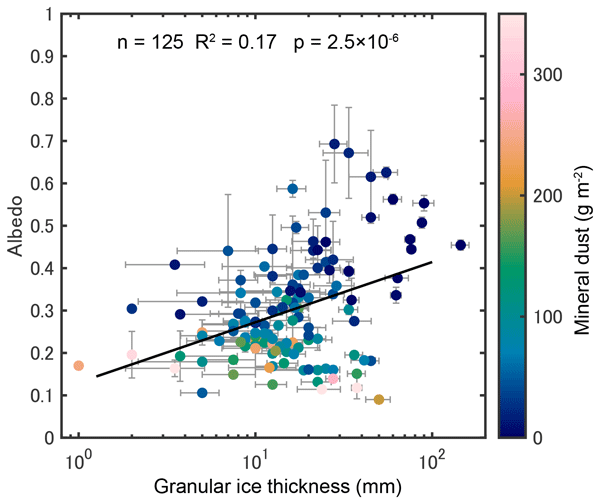
- Figure 8: It is interesting to see both the relationship between albedo and granular ice thickness as well as the dilution effect of dust concentration. Is the albedo increase more contributed by the dilution of dust concentration or the enhanced scattering from thicker granular ice?
- Equation (1): Why did the authors use logarithm form for all predictors, which does not work for zero concentration cases?
- Lines 611-623: The strong OM-BC correlation may also reflect the common emission source of BC and OM, which lead to correlated BC and OM deposition onto snow/ice surfaces.
Citation: https://doi.org/10.5194/egusphere-2026-631-RC2 - AC2: 'Reply on RC2', Akiko Sakai, 29 Jun 2026
Peer review completion


Interactive discussion
Status: closed
-
RC1: 'Comment on egusphere-2026-631', Anonymous Referee #1, 24 Apr 2026
The surface albedo determines the amount of absorbed solar energy, which is a key factor in driving surface snow and ice melting. This study presents one of very few studies of ice albedo, a major gap of knowledge limiting our understanding of the glacier’s reactions to a warming world. In this study, the authors investigated the relationships between albedo and glacier surface conditions based on extensive field observations, including three major light-absorbing impurities (mineral dust, organic matter of microbial origin, black carbon) and granular ice thickness of the weathering crust on the bare ice surface. In particular, the relationship between the granular ice thickness of weathered crust and surface albedo as well as light-absorbing impurities may be the most noteworthy aspect of this study. Basically, results are based on measurements, and the interpretation is sound. Major and specific comments are as below.
This study primarily focuses on Ice albedo and its relationship with light-absorbing impurities and weathering crust. However, only Section 3.5 is closely aligned with the research theme, which appears somewhat insufficient. In contrast, Section 3.1 presents the characteristics of ice temperature and ice density of the glacial surface weathering crust. Although interesting, this content is only weakly related to the main theme of the study—unless it serves as a basis for determining the thickness of the weathering crust. If not, it is recommended to move this section to the Appendix. Furthermore, Section 3.6 discusses a large amount of content regarding the relationship between LAIs and GIT, which is also weakly connected to the main focus of the study and should be condensed. Alternatively, the title of this study could be revised to "Characteristics of the Glacier Surface Weathering Crust and Its Impact on Glacier Albedo."
In Figure 1, I suggest that authors add essential geographic information, including contour lines and latitude/longitude coordinates.
Line 155-160: When measuring broadband albedo, what is the observation height of the pyranometer, and approximately what ground area does it cover?
Line 421-422: “In both dark and clean surfaces, the albedo at the granular ice surface was lower than at the ice surface below the granular ice layer at λ> 850 nm.” This statement is inconsistent with Figure 6. Should it be λ < 850?
Line 485-486: “Table 1 summarizes the correlation coefficient between BB albedo and each LAI and WC thickness”, should it be Table 2? Similarly, Line 510-511: “Multiple regression analysis results with BB albedo as the objective variable and impurity and GIT as the explanatory variables are summarized in Table 2”, should it be Table 3?
Line 527: “BB albedo was obtained using equation (10), and RMSE was 0.08.” should it be equation (1)?
Line 515-516: the t-value is positive for MD in 2022 and the whole year from 2022 to 2024, please explain the possible reasons.Citation: https://doi.org/10.5194/egusphere-2026-631-RC1 - AC1: 'Reply on RC1', Akiko Sakai, 29 Jun 2026
-
RC2: 'Comment on egusphere-2026-631', Anonymous Referee #2, 01 Jun 2026
The authors conducted field observations during 2022-2024 summer over the Potanin Glacier in Mongolia to quantify the relationship between broad-band albedo (BB albedo), the thickness of surface granular ice, and LAI content within the granular ice layer. They found a significant positive correlation of BB albedo with the thickness of the granular ice layer, but a relatively strong negative correlation with organic matter. They also found that higher concentrations of LAIs inhibited the thickening of the weathering crust layer. The key mechanism they propose is that mineral particles support the growth of microorganisms living on the ice, which support production of humic-like substances that increase surface adhesiveness, thereby facilitating the adsorption of black carbon. Overall, this topic is relatively less studied and this study would contribute to the scientific knowledge of glacier weathering crust impacts on ice albedo. I have a few comments and suggestions for the authors to address.
Specific comments:
- Abstract: The current abstract is too qualitative. I suggest including some quantitative descriptions of the key results.
- Page 2, Line 49: There are many other key factors (e.g., snow grain shape, snowpack thickness, snow microstructure, and snowpack density) that can affect snow albedo, which are not included here. I would suggest replacing the “are” in “Important factors … are the size of …” with “include” or mention the other factors as well.
- Page 2, Line 60: “bioalbedo is more effective” This part is not clear. How is the effectiveness defined? Did the authors mean causing larger albedo changes per unit mass of particles? Please be accurate.
- Page 2, Line 71: “… LAI are important factors increasing albedo …” This is a bit confusing to me. I thought LAI decreases snow and ice albedo rather than increasing it.
- Figure 1: What do different colors represent? Please clarify them in the figure caption.
- Section 2.2.2: (1) What is the measurement accuracy/uncertainty for BB albedo? What times of each day were those BB measurements conducted? Were they around local noon? Albedo measurements under high solar zenith angle may introduce large uncertainties. (2) What is the measurement accuracy/uncertainty for those LAI species?
- Section 2.2.3: What is the accuracy/uncertainty for ablation rate measurements?
- Section 2.2.4: What is the accuracy/uncertainty for spectral albedo measurements?
- Section 2.2.5: What is the accuracy/uncertainty for humic substance measurements?
- I would suggest the authors include one photo for the weathering crust and its structure as an additional panel in Figure 1.
- Figure 3: How did the authors determine the bottom depth of weathering crust layer based on the ice density profiles? The current bottom interface seems to have same (or similar) ice density as the layer below.
- Page 15, Line 422: Should it be “lambda < 850nm”?
- Section 3.4: Could the authors provide some insights on how these different types of humic acids were formed?
- Figure 8: It is interesting to see both the relationship between albedo and granular ice thickness as well as the dilution effect of dust concentration. Is the albedo increase more contributed by the dilution of dust concentration or the enhanced scattering from thicker granular ice?
- Equation (1): Why did the authors use logarithm form for all predictors, which does not work for zero concentration cases?
- Lines 611-623: The strong OM-BC correlation may also reflect the common emission source of BC and OM, which lead to correlated BC and OM deposition onto snow/ice surfaces.
Citation: https://doi.org/10.5194/egusphere-2026-631-RC2 - AC2: 'Reply on RC2', Akiko Sakai, 29 Jun 2026
Peer review completion
Journal article(s) based on this preprint
Viewed
| HTML | XML | Total | Supplement | BibTeX | EndNote | |
|---|---|---|---|---|---|---|
| 1,015 | 464 | 97 | 1,576 | 193 | 116 | 102 |
- HTML: 1,015
- PDF: 464
- XML: 97
- Total: 1,576
- Supplement: 193
- BibTeX: 116
- EndNote: 102
Viewed (geographical distribution)
| Country | # | Views | % |
|---|
| Total: | 0 |
| HTML: | 0 |
| PDF: | 0 |
| XML: | 0 |
- 1

Kino Kobayashi
Masato Ono
Sayako Ueda
Sho Ohata
Akira Watanabe
Osada Kazuo
Nozomu Takeuchi
Khalzan Prevdagva
Sumito Matoba
Tomonori Tanikawa
Teruo Aoki
The requested preprint has a corresponding peer-reviewed final revised paper. You are encouraged to refer to the final revised version.
- Preprint
(1388 KB) - Metadata XML
-
Supplement
(596 KB) - BibTeX
- EndNote
- Final revised paper
The surface albedo determines the amount of absorbed solar energy, which is a key factor in driving surface snow and ice melting. This study presents one of very few studies of ice albedo, a major gap of knowledge limiting our understanding of the glacier’s reactions to a warming world. In this study, the authors investigated the relationships between albedo and glacier surface conditions based on extensive field observations, including three major light-absorbing impurities (mineral dust, organic matter of microbial origin, black carbon) and granular ice thickness of the weathering crust on the bare ice surface. In particular, the relationship between the granular ice thickness of weathered crust and surface albedo as well as light-absorbing impurities may be the most noteworthy aspect of this study. Basically, results are based on measurements, and the interpretation is sound. Major and specific comments are as below.
This study primarily focuses on Ice albedo and its relationship with light-absorbing impurities and weathering crust. However, only Section 3.5 is closely aligned with the research theme, which appears somewhat insufficient. In contrast, Section 3.1 presents the characteristics of ice temperature and ice density of the glacial surface weathering crust. Although interesting, this content is only weakly related to the main theme of the study—unless it serves as a basis for determining the thickness of the weathering crust. If not, it is recommended to move this section to the Appendix. Furthermore, Section 3.6 discusses a large amount of content regarding the relationship between LAIs and GIT, which is also weakly connected to the main focus of the study and should be condensed. Alternatively, the title of this study could be revised to "Characteristics of the Glacier Surface Weathering Crust and Its Impact on Glacier Albedo."
In Figure 1, I suggest that authors add essential geographic information, including contour lines and latitude/longitude coordinates.
Line 155-160: When measuring broadband albedo, what is the observation height of the pyranometer, and approximately what ground area does it cover?
Line 421-422: “In both dark and clean surfaces, the albedo at the granular ice surface was lower than at the ice surface below the granular ice layer at λ> 850 nm.” This statement is inconsistent with Figure 6. Should it be λ < 850?
Line 485-486: “Table 1 summarizes the correlation coefficient between BB albedo and each LAI and WC thickness”, should it be Table 2? Similarly, Line 510-511: “Multiple regression analysis results with BB albedo as the objective variable and impurity and GIT as the explanatory variables are summarized in Table 2”, should it be Table 3?
Line 527: “BB albedo was obtained using equation (10), and RMSE was 0.08.” should it be equation (1)?
Line 515-516: the t-value is positive for MD in 2022 and the whole year from 2022 to 2024, please explain the possible reasons.