
the Creative Commons Attribution 4.0 License.
the Creative Commons Attribution 4.0 License.
 | 24 Feb 2026
Causal and uncertainty-aware digital-twin framework for ultra–low-noise geoscientific inertial sensors
Abstract. Ultra–low-noise inertial sensors are a cornerstone of modern geoscientific instrumentation, enabling high-resolution observations across seismology, geodesy, gravimetry, and vibration isolation. Achieving and reliably predicting their performance requires a rigorous treatment of physical causality, noise propagation, and uncertainty, particularly in force-feedback architectures operating near fundamental limits. In this study, we introduce a causal and uncertainty-aware digital-twin framework for the design and metrological assessment of ultra–low-noise geoscientific inertial sensors. The proposed framework integrates mechanical dynamics, force-feedback control, transduction, and digital acquisition within a physically realisable model that explicitly enforces causality and stability constraints. Starting from a minimal equation-of-motion description, the digital twin is formulated in the frequency domain to construct causal transfer functions and a comprehensive noise-budget model. The framework enables the systematic separation of fundamental thermal noise limits from implementation-dependent noise sources, including readout, actuation, and digital acquisition effects. We introduce quantitative performance metrics based on self-noise spectra, dominant noise regimes, crossover frequencies, and near-plateau bandwidths, allowing complex spectral behaviour to be condensed into actionable design indicators. Parameter uncertainties are propagated through the digital twin to provide uncertainty-aware performance estimates and robustness diagnostics. Through a series of illustrative analyses, we demonstrate how the proposed digital twin supports informed design trade-offs, identifies performance bottlenecks, and prevents non-physical or overly optimistic sensitivity estimates arising from non-causal modelling assumptions. While focused on inertial sensors, the methodology is general and transferable to other classes of geoscientific instruments. The framework provides a transparent and extensible foundation for next-generation sensor design, virtual experimentation, and metrologically consistent performance prediction.
-
Notice on discussion status
The requested preprint has a corresponding peer-reviewed final revised paper. You are encouraged to refer to the final revised version.
-
Preprint
(2415 KB)
-
The requested preprint has a corresponding peer-reviewed final revised paper. You are encouraged to refer to the final revised version.
- Preprint
(2415 KB) - Metadata XML
- BibTeX
- EndNote
- Final revised paper


Journal article(s) based on this preprint
Interactive discussion
Status: closed
-
RC1: 'Comment on egusphere-2026-628', Anonymous Referee #1, 27 Mar 2026
-
AC1: 'Reply on RC1', Antonino D'Alessandro, 27 Apr 2026
The comment was uploaded in the form of a supplement: https://egusphere.copernicus.org/preprints/2026/egusphere-2026-628/egusphere-2026-628-AC1-supplement.pdf
-
AC1: 'Reply on RC1', Antonino D'Alessandro, 27 Apr 2026
-
RC2: 'Comment on egusphere-2026-628', Anonymous Referee #2, 13 Apr 2026
The manuscript “Causal and uncertainty-aware digital-twin framework for ultra–low-noise geoscientific inertial sensors” by Antonino D’Alessandro is well written and easy to follow. The digital twin framework developed in the manuscript appears sound and useful to me. The assumptions and potential shortcomings in the numerical models are clearly stated, e.g., no nonlinear effects or noise correlations are included.
I am not an expert on inertial sensors and cannot therefore comment adequately on the novelty of the approach presented here but trust the other reviewers to judge this aspect. I have no objections to the manuscript being accepted for publication once a few details are fixed.
Moderate issue:
Line 154: Isn’t this a reference to figure 1 rather than figure 2? And speaking of figure 2, this figure showcasing open loop / closed loop performance isn’t discussed in the text.
Minor issues
Line 154: Isn’t this a reference to figure 1 rather than figure 2? And speaking of figure 2, this figure showcasing open loop / closed loop performance isn’t discussed in the text.
Line 185: Would it be possible to add a reference to the “analytical treatments that neglect realisability constraints”?
Line 209, equation 1, a_g(t) is ground acceleration to be measured. In figure 1, this quantity is denoted by u-double-dot. Is there a reason for this choice (shift?) of notation?
Line 243: spaces are missing after mathematical notation.
Section 8 and 9. There is a lot of similarity between the discussion and the conclusion. It might be preferred to shorten one of these sections. If space is made available in the discussion section, it could be interesting and worthwhile to add an example or two with design considerations where the results from figure 4-7 come into play.
Figure 6 and 7. In both these figures, panel (a) is missing the x-label “Frequency [Hz]”.
The abbreviation ENOB is used several times in the manuscript, but it is never defined.
Citation: https://doi.org/10.5194/egusphere-2026-628-RC2 -
AC2: 'Reply on RC2', Antonino D'Alessandro, 27 Apr 2026
The comment was uploaded in the form of a supplement: https://egusphere.copernicus.org/preprints/2026/egusphere-2026-628/egusphere-2026-628-AC2-supplement.pdf
-
AC2: 'Reply on RC2', Antonino D'Alessandro, 27 Apr 2026
Peer review completion


Interactive discussion
Status: closed
-
RC1: 'Comment on egusphere-2026-628', Anonymous Referee #1, 27 Mar 2026
This paper focuses on the core challenges in the design and metrological assessment of ultra-low-noise inertial sensors for geoscientific applications, proposing a causal and uncertainty-aware digital twin framework.However, there is room for optimization in experimental validation, parameter sensitivity analysis, and the expression of certain technical details. It can meet the publication requirements after targeted revisions.
1.The mechanical subsystem in the paper is modeled as a single-degree-of-freedom inertial plant, which can capture the dominant dynamics but fails to clearly state the applicable frequency range and boundary conditions of this simplified model.
2.The paper only verifies the framework's effectiveness through simulation analysis, lacking experimental data support from actual sensor prototypes. It is suggested to supplement experimental validation based on real inertial sensors.
3.The references lack sufficient citations of relevant research in the past 2 years (2024-2025), especially the latest applications of digital twins in the field of inertial sensors and advances in ultra-low-noise readout technology. It is suggested to supplement high-impact literature from the past 2 years to reflect the cutting-edge and timeliness of the research.
4.Excessive steps are omitted in the derivation of some formulas. For example, the conversion steps from the equation of motion (1) to the frequency-domain expression (2) and the derivation logic of the self-noise power spectral density formula (3) are not elaborated. It is suggested to supplement the core derivation steps of key formulas, or cite relevant literature to illustrate the derivation basis, enhancing the rigor of the theoretical part.
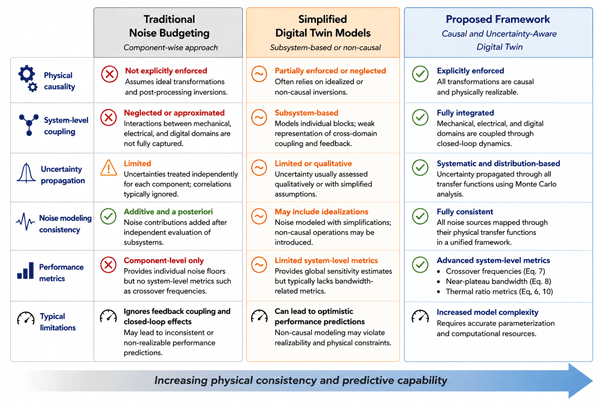
5.The performance comparison section only compares with theoretical limits and lacks quantitative comparison with existing similar sensor design methods (such as traditional noise budgeting and simplified digital twin models).
Citation: https://doi.org/10.5194/egusphere-2026-628-RC1 -
AC1: 'Reply on RC1', Antonino D'Alessandro, 27 Apr 2026
The comment was uploaded in the form of a supplement: https://egusphere.copernicus.org/preprints/2026/egusphere-2026-628/egusphere-2026-628-AC1-supplement.pdf
-
AC1: 'Reply on RC1', Antonino D'Alessandro, 27 Apr 2026
-
RC2: 'Comment on egusphere-2026-628', Anonymous Referee #2, 13 Apr 2026
The manuscript “Causal and uncertainty-aware digital-twin framework for ultra–low-noise geoscientific inertial sensors” by Antonino D’Alessandro is well written and easy to follow. The digital twin framework developed in the manuscript appears sound and useful to me. The assumptions and potential shortcomings in the numerical models are clearly stated, e.g., no nonlinear effects or noise correlations are included.
I am not an expert on inertial sensors and cannot therefore comment adequately on the novelty of the approach presented here but trust the other reviewers to judge this aspect. I have no objections to the manuscript being accepted for publication once a few details are fixed.
Moderate issue:
Line 154: Isn’t this a reference to figure 1 rather than figure 2? And speaking of figure 2, this figure showcasing open loop / closed loop performance isn’t discussed in the text.
Minor issues
Line 154: Isn’t this a reference to figure 1 rather than figure 2? And speaking of figure 2, this figure showcasing open loop / closed loop performance isn’t discussed in the text.
Line 185: Would it be possible to add a reference to the “analytical treatments that neglect realisability constraints”?
Line 209, equation 1, a_g(t) is ground acceleration to be measured. In figure 1, this quantity is denoted by u-double-dot. Is there a reason for this choice (shift?) of notation?
Line 243: spaces are missing after mathematical notation.
Section 8 and 9. There is a lot of similarity between the discussion and the conclusion. It might be preferred to shorten one of these sections. If space is made available in the discussion section, it could be interesting and worthwhile to add an example or two with design considerations where the results from figure 4-7 come into play.
Figure 6 and 7. In both these figures, panel (a) is missing the x-label “Frequency [Hz]”.
The abbreviation ENOB is used several times in the manuscript, but it is never defined.
Citation: https://doi.org/10.5194/egusphere-2026-628-RC2 -
AC2: 'Reply on RC2', Antonino D'Alessandro, 27 Apr 2026
The comment was uploaded in the form of a supplement: https://egusphere.copernicus.org/preprints/2026/egusphere-2026-628/egusphere-2026-628-AC2-supplement.pdf
-
AC2: 'Reply on RC2', Antonino D'Alessandro, 27 Apr 2026
Peer review completion
Journal article(s) based on this preprint
Viewed
| HTML | XML | Total | BibTeX | EndNote | |
|---|---|---|---|---|---|
| 738 | 392 | 119 | 1,249 | 103 | 185 |
- HTML: 738
- PDF: 392
- XML: 119
- Total: 1,249
- BibTeX: 103
- EndNote: 185
Viewed (geographical distribution)
| Country | # | Views | % |
|---|
| Total: | 0 |
| HTML: | 0 |
| PDF: | 0 |
| XML: | 0 |
- 1
Antonino D'Alessandro

The requested preprint has a corresponding peer-reviewed final revised paper. You are encouraged to refer to the final revised version.
- Preprint
(2415 KB) - Metadata XML
This paper focuses on the core challenges in the design and metrological assessment of ultra-low-noise inertial sensors for geoscientific applications, proposing a causal and uncertainty-aware digital twin framework.However, there is room for optimization in experimental validation, parameter sensitivity analysis, and the expression of certain technical details. It can meet the publication requirements after targeted revisions.
1.The mechanical subsystem in the paper is modeled as a single-degree-of-freedom inertial plant, which can capture the dominant dynamics but fails to clearly state the applicable frequency range and boundary conditions of this simplified model.
2.The paper only verifies the framework's effectiveness through simulation analysis, lacking experimental data support from actual sensor prototypes. It is suggested to supplement experimental validation based on real inertial sensors.
3.The references lack sufficient citations of relevant research in the past 2 years (2024-2025), especially the latest applications of digital twins in the field of inertial sensors and advances in ultra-low-noise readout technology. It is suggested to supplement high-impact literature from the past 2 years to reflect the cutting-edge and timeliness of the research.
4.Excessive steps are omitted in the derivation of some formulas. For example, the conversion steps from the equation of motion (1) to the frequency-domain expression (2) and the derivation logic of the self-noise power spectral density formula (3) are not elaborated. It is suggested to supplement the core derivation steps of key formulas, or cite relevant literature to illustrate the derivation basis, enhancing the rigor of the theoretical part.
5.The performance comparison section only compares with theoretical limits and lacks quantitative comparison with existing similar sensor design methods (such as traditional noise budgeting and simplified digital twin models).